Secure Your Empire State Investment: Loans for Rental Properties in NY

Summary
Unlock rental property financing New York. Explore loan types, qualification, and strategies for your Empire State investment. Partner with BrightBridge.
Why New York Real Estate Financing Demands a Strategic Approach

Rental property financing New York is a high-stakes game where speed, knowledge, and access to the right loan products determine whether you capture a lucrative investment or watch it slip away. The Empire State's rental market is a study in contrasts, from the hyper-competitive, high-density landscape of New York City to the steady, cash-flowing markets of Upstate cities like Buffalo, Rochester, and Albany. This diversity offers immense opportunity for investors who can secure capital quickly and on favorable terms, but it also presents unique challenges.
The market is fueled by relentless demand, a chronic housing supply shortage, and some of the nation's highest average rents, particularly in the five boroughs. However, investors must also navigate a complex regulatory environment, including the Housing Stability and Tenant Protection Act of 2019 (HSTPA), which significantly altered the rules for rent increases, lease renewals, and security deposits. This landscape means that a successful investment hinges not just on finding a property, but on structuring a financing deal that can withstand market fluctuations and regulatory pressures.
Here's a deeper look at what you need to know about financing a rental property in New York:
Conventional Loans: These are the bedrock of financing for many investors, especially those just starting. However, the requirements are stringent. Lenders typically demand a 20-30% down payment to avoid Private Mortgage Insurance (PMI) and to demonstrate your commitment. Your credit score is paramount; while a 620 might get you in the door, a score of 700, and ideally 740+, is necessary to unlock the most competitive interest rates. Furthermore, your debt-to-income (DTI) ratio, which compares your monthly debt payments to your gross income, must generally fall between 36% and 45%. This can be a major hurdle in a high-cost state like New York.
DSCR Loans: Debt Service Coverage Ratio (DSCR) loans are a powerful tool for experienced investors. Instead of scrutinizing your personal W-2s and tax returns, these loans let you qualify based almost entirely on the property's cash flow. The lender assesses if the projected rental income will be sufficient to cover the mortgage payment and other expenses. This is ideal for self-employed individuals, investors with complex income streams, or those looking to scale their portfolio without their personal DTI becoming a limiting factor.
Private & Hard Money Lending: In New York's fast-paced market, where all-cash offers often win, speed is a competitive advantage. Private and hard money lenders offer rapid funding, often closing in 10-30 days, compared to the 45-60 days typical for conventional banks. This speed comes with higher interest rates and fees, but it's invaluable for strategies like fix-and-flip or the BRRRR (Buy, Rehab, Rent, Refinance, Repeat) method, where you need to acquire and stabilize a property quickly before refinancing into a long-term loan.
Down Payment Assistance Programs: While primarily aimed at owner-occupants, these programs can be an entry point for new investors. For example, eligible first-time buyers purchasing a 1-4 unit property in NYC can leverage programs to help with the substantial down payment. The key is that you must live in one of the units, but you can rent out the others, a strategy known as "house hacking" that can launch a real estate investment career.
Interest Rates and Terms: The financing landscape is not one-size-fits-all. The interest rate and terms you receive will vary widely based on the loan type (conventional, DSCR, private), your credit profile, the property type (single-family, multi-family, co-op), and the leverage you seek. Loan-to-Value (LTV) ratios typically cap out at 80% for most investment loans, meaning you need at least 20% down.
The approval timeline can range from a few days with agile private lenders to several weeks or even months with traditional banks. Documentation requirements are extensive and include tax returns, bank statements, credit reports, and a solid business plan that clearly demonstrates the property's income potential. New York's competitive landscape means investors need more than just capital—they need a lender who understands the market's nuances, from co-op board requirements in Manhattan to cap rate expectations in Buffalo. Whether you're acquiring a multi-family building in Brooklyn or a single-family rental upstate, the right financing structure can mean the difference between a break-even property and one that generates strong, positive cash flow for years to come.
I'm Daniel Lopez, a loan officer at BrightBridge Realty Capital, where I've helped dozens of investors steer rental property financing New York challenges—from structuring complex DSCR loans for portfolio expansion to arranging fast bridge financing for time-sensitive acquisitions. My approach centers on transparency and creative problem-solving, ensuring you understand every option and secure terms that align with your long-term investment strategy.
Rental property financing New York definitions:
Types of Rental Property Loans in New York
Navigating rental property financing New York is a complex but critical task for any real estate investor. The type of loan you choose will profoundly impact your cash flow, return on investment, and ability to scale your portfolio. At BrightBridge Realty Capital, we specialize in offering and arranging a diverse suite of solutions that cater to the unique demands of this market, ensuring you get the funding you need, when you need it.
Conventional Investment Property Loans
Conventional loans, which conform to the guidelines set by Fannie Mae and Freddie Mac, are a primary option for investors purchasing stable, income-generating assets in New York. They are widely available for 1-4 unit residential properties. For larger multifamily buildings (5+ units), investors typically need to seek out commercial loans, which have different underwriting criteria and terms.
Key Characteristics:
- Down Payment: Expect to put down a minimum of 20% for a single-unit investment property. For 2-4 unit properties, the requirement often increases to 25-30%.
- LTV/CLTV: The maximum Loan-to-Value (LTV) is typically 80% for a purchase. For a cash-out refinance, it's often lower, around 70-75%.
- Credit Score: While a 620 score is the technical minimum for some programs, most lenders require a score of 680+, with the best rates reserved for borrowers with scores of 740 or higher.
- DTI Ratio: Your Debt-to-Income ratio must generally be 45% or lower. Lenders will use your existing debts plus the proposed new mortgage payment (PITI) for the investment property. To help you qualify, they will typically allow you to use up to 75% of the property's projected rental income (as determined by an appraiser) to offset the new mortgage payment in this calculation.
- Number of Financed Properties: Fannie Mae and Freddie Mac have limits on the number of properties an investor can finance, typically capping at 10. The requirements become significantly stricter after the fourth financed property.
Local Down Payment Assistance Programs (Overview)
While our primary focus is on investor financing, it's important to be aware of programs that can serve as a launchpad. In New York City, the HomeFirst Down Payment Assistance Program is a notable example. It can provide qualified first-time homebuyers with a forgivable loan of up to $100,000 for a down payment or closing costs on a 1-4 family home, condo, or co-op within the five boroughs. These programs have strict requirements, including income limits based on household size and a mandate that the buyer must occupy the property as their primary residence for a set period (e.g., 10-15 years). This "house hacking" strategy is an excellent way for new investors to enter the market with less capital upfront.
Private Lending & Hard Money Solutions
For investors who prioritize speed, flexibility, and certainty, private lending is a game-changer in rental property financing New York. This is where BrightBridge Realty Capital shines. As direct, asset-based lenders, we cut out the slow-moving intermediaries of traditional banking to provide fast funding and competitive rates. These loans are ideal for time-sensitive acquisitions, fix-and-flip projects, or the BRRRR strategy.
Key Characteristics:
- Speed: We can provide approvals in as little as 24 hours and fund a loan in 10-15 days, a crucial advantage in competitive bidding situations.
- Underwriting: Qualification is based on the property's value (After Repair Value for rehab projects) rather than your personal income. Our light documentation process often requires no tax returns or W-2s.
- Use Cases: These loans are perfect for acquiring a property that won't qualify for conventional financing in its current state, or for bridge financing to secure a property quickly while you arrange long-term debt.
- Terms: We offer term rental loans for 1-9 family properties with rates as low as 6% and leverage up to 80% LTV, with options for 30-year amortization, ARM, or interest-only payments to maximize cash flow.
DSCR Loans: Flexible Investor Financing
DSCR (Debt Service Coverage Ratio) loans have become one of the most popular financing options for real estate investors looking to scale their portfolios. These loans qualify you based on the property's income-generating ability, not your personal finances. This is a massive advantage, as it removes your personal DTI from the equation and simplifies the application process, as no personal income verification or tax returns are needed.
How it Works:A DSCR loan compares the property's projected gross rental income to its total debt obligation (Principal, Interest, Taxes, and Insurance - PITI). A ratio above 1.0 indicates the property generates enough income to cover its debt service. Most lenders look for a DSCR of 1.20x or higher. However, some lenders, including our partners, offer programs for properties with a DSCR below 1.0, providing greater flexibility for properties in high-appreciation areas with lower initial cash flow.
Key Characteristics:
- Property Types: DSCR loans are available for a wide range of properties, from single-family residences to small multifamily buildings.
- Loan Amounts: Loan amounts can go up to $3 million or more, with LTVs up to 80% on purchases and 75% on cash-out refinances.
- Loan Products: Investors can choose from various loan structures, including 30-year fixed rates, 5/6 and 7/6 ARMs, and interest-only options to further customize their financing and optimize cash flow.
At BrightBridge Realty Capital, we are experts in DSCR loans and can help you leverage your property's earning potential to expand your rental portfolio across New York State.
| Loan Type | Down Payment (Typical) | Credit Score (Ideal) | Income Verification | Qualification Basis | Speed |
|---|---|---|---|---|---|
| Conventional | 20-30% | 700+ | Required | Borrower & Property Income | Weeks to Months |
| Private Lending | 20-30% | Flexible | Light/Not Required | Property Value & Potential | Days to Weeks |
| DSCR Loans | 20-30% | 680+ | Not Required | Property Cash Flow (DSCR) | Weeks to Months (can be faster with specialized lenders) |
Qualifying for Rental Property Financing New York
Securing rental property financing New York is a dual-track evaluation. Lenders must be confident in both you, the investor, and the property's ability to perform as a profitable asset. The underwriting process for investment properties is inherently more conservative and detailed than for a primary residence because the lender's risk is higher. We're here to help you prepare for this comprehensive evaluation and present your application in the strongest possible light.
Your Financial Profile: Credit, Income, and Reserves
Lenders will put your personal financial health under a microscope. A strong personal financial foundation is non-negotiable, even for asset-based loans like DSCR, where it can influence your interest rate.

- Credit Score Requirements: A strong credit score is your ticket to better financing terms. While some programs accept scores as low as 620, lenders reserve their best interest rates and highest LTVs for borrowers with scores of 740 and above. A higher score signals to the lender that you are a responsible borrower, reducing their perceived risk.
- Debt-to-Income (DTI) Ratio: For conventional loans, your DTI is a critical metric. It's calculated by dividing your total monthly debt payments (including your primary residence mortgage, car loans, student loans, credit card payments, and the proposed new investment property mortgage) by your gross monthly income. Most lenders cap this at 45%. For example, if your gross monthly income is $10,000, your total monthly debts cannot exceed $4,500. For New York rental investors, the ability to use up to 75% of the property's expected rental income to offset the new mortgage payment can be a significant advantage in this calculation, dramatically improving your borrowing power.
- Income Verification: For conventional loans, you must provide extensive proof of stable, reliable income. This typically includes your last two years of federal tax returns (both personal and business, if applicable), your two most recent W-2s, and your last 30 days of pay stubs. For self-employed borrowers, a year-to-date profit and loss statement is also required. This is where DSCR loans offer a major advantage, as personal income verification is often waived entirely, focusing instead on the property's cash-generating ability.
- Cash Reserves: Lenders need to see that you have a financial safety net. After closing, you'll be required to show liquid reserves sufficient to cover a certain number of months of the full mortgage payment (PITI) for the new investment property. The standard requirement is 6 months of reserves. If you own other financed properties, you may need to show reserves for them as well. These funds must be in liquid accounts like checking, savings, or a brokerage account; retirement funds like a 401(k) may only be partially counted.
Down Payment Requirements for rental property financing New York
Down payments for investment properties in New York are significantly higher than for primary residences, typically ranging from 20% to 30%. For a single-family rental, 20% is often the minimum. For a 2-4 unit multifamily property, lenders will almost always require at least 25% down. This higher equity stake serves two purposes: it reduces the lender's risk and allows you to avoid Private Mortgage Insurance (PMI), an additional monthly cost designed to protect the lender, not you.
Down payment funds must be sourced and seasoned, meaning they have been in your account for at least two months. They can come from savings, the sale of an asset, or gift funds (which require a formal gift letter stating the funds are not a loan). You can also use a Home Equity Line of Credit (HELOC) on your primary residence or another investment property, a common strategy for seasoned investors.
The Property's Viability: Appraisals and DSCR
The property itself is the collateral for the loan and must prove its worth through a rigorous evaluation of its market value and income potential.
- Property Appraisal: An independent appraisal is required to determine the property's fair market value. This is essential for the lender to calculate the Loan-to-Value (LTV) ratio. For an investment property, the appraiser performs not only a sales comparison approach (comparing it to similar sold properties) but also an income approach. This involves a detailed rental analysis using a Single-Family Comparable Rent Schedule (Form 1007) to establish a credible market rent for the property. This appraised rental income figure is what lenders use to calculate DTI offset and DSCR.
- Calculating DSCR: For any investment property loan, but especially for DSCR loans, the Debt Service Coverage Ratio is the key metric of profitability. It is calculated by dividing the property's Net Operating Income (NOI) by its total debt service (the annual mortgage payments). A DSCR greater than 1.0 indicates positive cash flow. For example:
- Gross Annual Rent: $30,000
- Operating Expenses (taxes, insurance, 5% vacancy, 5% maintenance): $9,000
- Net Operating Income (NOI): $21,000
- Annual Debt Service (Mortgage): $16,000
- DSCR = $21,000 / $16,000 = 1.31x
A compelling business plan that projects a favorable DSCR is vital for convincing lenders of your investment's viability.
The Application Process & Advanced Financing Strategies
Securing rental property financing New York involves a structured, multi-step process and opens the door to advanced strategies that can accelerate your portfolio growth. At BrightBridge Realty Capital, we partner with you to navigate this landscape efficiently, leveraging our direct lending solutions to give you a competitive edge.
Step-by-Step Loan Application Guide
Understanding the loan application journey from start to finish demystifies the process and helps you prepare for a smooth and successful closing, even with our accelerated private lending solutions.

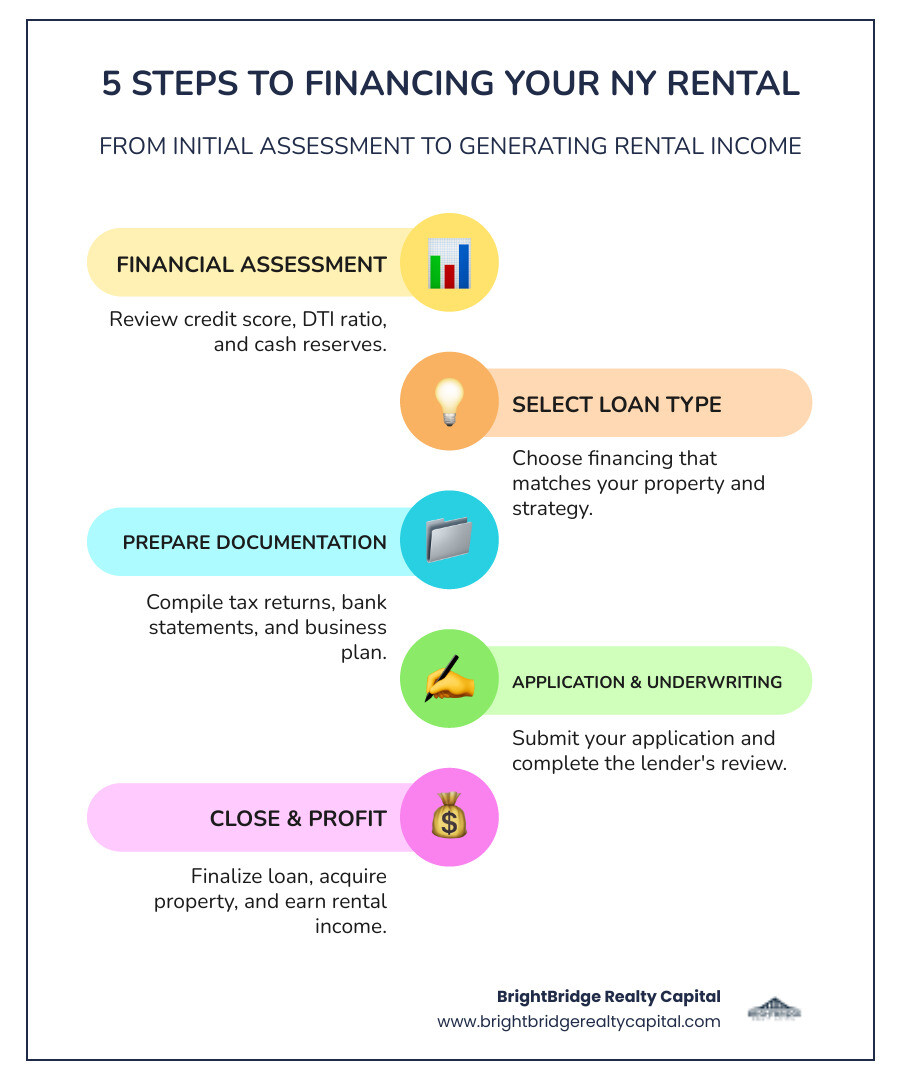
- Loan Inquiry & Pre-Approval: The journey begins with a conversation to discuss your investment goals, target property type, and financial profile. Based on this, we can issue a pre-approval letter. In New York's competitive market, a pre-approval from a reputable lender shows sellers you are a serious, qualified buyer. With our private lending capabilities, we can often provide a strong pre-approval within 24 hours.
- Formal Application & Documentation: Once you have an accepted offer on a property, you'll submit a formal loan application. This involves providing a comprehensive package of documents, including personal financial records (tax returns, bank statements for sourcing funds), authorization for a credit report, a detailed investment plan or business plan, and property-specific details like the purchase agreement and any existing leases.
- Appraisal and Title Search: The lender will order a third-party appraisal to verify the property's value and a rental schedule to confirm its income potential. Simultaneously, a title company will conduct a title search to ensure there are no liens or claims against the property and will prepare for the closing.
- Underwriting: This is the lender's formal risk assessment phase. An underwriter meticulously reviews all your financial documents and the property details to ensure they meet the loan program's guidelines. This can take weeks for conventional loans due to strict regulations, but our direct lending approach often shortens this timeline to a matter of days.
- Approval & Closing: Once the underwriter issues a clear-to-close, you'll receive a final loan commitment. The closing is scheduled, where you'll sign the final loan documents and mortgage. Funds are then disbursed to the seller, and you officially become the owner of your new investment property.
Leveraging Equity: Cash-Out Refinancing and HELOCs
As you build equity in your existing properties, you can leverage it to expand your New York real estate portfolio. This is a cornerstone strategy for many successful investors.
- Cash-Out Refinance: This strategy involves replacing your current mortgage with a new, larger loan and taking the difference in cash. For example, if your property is worth $800,000 and you owe $300,000, a lender might allow you to refinance up to 75% LTV ($600,000). You would pay off the old $300,000 loan and receive $300,000 in cash (less closing costs). This tax-free lump sum can be used as a substantial down payment for new acquisitions or to fund major renovations.
- Home Equity Line of Credit (HELOC): A HELOC functions more like a credit card, secured by your property's equity. It's a revolving line of credit that you can draw from and pay back as needed during a set "draw period" (usually 10 years). This provides incredible flexibility for smaller renovations, opportunistic acquisitions, or as a ready source of capital for unexpected expenses. HELOCs typically have variable interest rates and lower upfront costs than a cash-out refinance.
Creative & Advanced Financing Approaches
In a dynamic market like New York, thinking outside the box can provide a significant advantage. While we focus on direct lending, we can guide you on how these solutions can integrate with our financing.
- The BRRRR Method with Hard Money: The Buy, Rehab, Rent, Refinance, Repeat (BRRRR) strategy is perfectly suited for hard money loans. You use a short-term, high-leverage hard money loan to purchase and renovate a distressed property. Once the property is stabilized and rented out, its value has increased. You then refinance with a long-term, lower-rate loan (like a DSCR loan), paying off the hard money lender and potentially pulling out your initial investment to "repeat" the process.
- Real Estate Partnerships: Pooling capital and expertise with other investors can allow you to acquire larger, more profitable properties sooner. Forming an LLC is the most common structure, providing liability protection. A detailed operating agreement is crucial to outline responsibilities, profit splits, and exit strategies.
- Seller Financing: In certain situations, a seller may be willing to act as the lender, offering financing directly to you. This can be beneficial if you don't qualify for a traditional loan or if you need more flexible terms. The deal is structured with a promissory note and a mortgage recorded against the property, just like a traditional loan.
- 1031 Exchange: This powerful tax code provision allows you to defer capital gains taxes when you sell an investment property by reinvesting the proceeds into a new "like-kind" property. This allows you to roll your entire equity into a new, larger, or better-performing asset, significantly accelerating portfolio growth.
Beyond the Loan: Maximizing ROI and Mitigating Risk
Securing rental property financing New York is a monumental step, but the real work begins after closing. Long-term profitability hinges on your ability to effectively manage the property, strategically enhance its value, and proactively mitigate the inherent risks of being a landlord in a complex market.
Smart Property Management and Tenant Retention
Effective property management is the engine of a successful rental business. It's not just about collecting rent; it's about creating a stable, valuable asset that attracts and retains high-quality tenants.
- Tenant Screening and Attraction: Your tenant is your primary customer. Attract the best applicants with high-quality photos, detailed listings, and competitive pricing based on thorough market research. Your screening process must be rigorous and compliant with Fair Housing laws. It should include a credit check, criminal background check, eviction history, and verification of income and employment.
- Navigating New York's Regulatory Landscape: Being a landlord in New York means complying with a web of regulations, most notably the Housing Stability and Tenant Protection Act of 2019 (HSTPA). This law introduced sweeping changes, including limits on security deposits (capped at one month's rent), restrictions on late fees, and new rules for lease renewals and eviction proceedings. Staying informed and compliant is essential to avoid costly legal battles.
- Self-Management vs. Professional Management: Many new investors self-manage to save money, but this can be a time-consuming and stressful job. A professional property management company handles everything from marketing and tenant screening to maintenance and rent collection. They typically charge 8-12% of the monthly gross rent, but their expertise in local laws and market conditions can save you money and headaches in the long run, making it a worthwhile investment for many.
Strategic Renovations to Boost Value and Income
Strategic renovations are a powerful tool for forcing appreciation, justifying higher rents, and increasing your property's Net Operating Income (NOI).
- Focus on High-ROI Renovations: Not all renovations are created equal. Prioritize updates that offer the highest return on investment. In most rental properties, these are kitchen and bathroom remodels. Even minor updates like new countertops, modern fixtures, and a fresh coat of paint can have a significant impact. Enhancing curb appeal with landscaping or a new front door also provides a strong first impression.
- Energy-Efficient Upgrades and NY Incentives: In New York, reducing operating costs is just as important as increasing rent. Energy-efficient upgrades like new windows, improved insulation, or high-efficiency HVAC systems can significantly lower utility bills (if you pay them) and increase your NOI. New York offers powerful incentives for these upgrades. The NYSERDA Residential Financing program offers low-interest loans for energy-saving renovations. Additionally, in NYC, the J-51 tax incentive program provides a property tax exemption and abatement for certain residential rehabilitations and major capital improvements, which can dramatically improve your bottom line.
Protecting Your Asset: Legal Structures, Insurance, and Contingency Planning
Proactive risk management is vital for safeguarding your New York rental property investment against financial and legal threats.
- Legal Structures for Asset Protection: Do not hold investment property in your personal name. Forming a Limited Liability Company (LLC) is a critical step to protect your personal assets (like your primary home and savings) from lawsuits related to your rental property. An LLC creates a legal shield, so if a tenant sues, they are suing the LLC, not you personally. This is an essential component of asset protection for any serious investor.
- Comprehensive Landlord Insurance: Standard homeowner's insurance is not sufficient for a rental property. You need a specialized landlord insurance policy. This should include property damage coverage (for fire, storms, etc.), liability coverage (to protect you if a tenant is injured on the property), and loss of income coverage (which replaces lost rent if the property becomes uninhabitable due to a covered event). Consider an umbrella policy for additional liability protection, especially as your portfolio grows.
- Building a Contingency Fund: The New York rental market can be volatile, and unexpected expenses are a certainty. A critical part of risk management is building and maintaining a robust cash reserve. This fund should be separate from your personal savings and contain enough capital to cover several months (3-6 is a good rule of thumb) of mortgage payments, taxes, insurance, and a budget for major repairs (like a new roof or boiler). This financial buffer ensures you can weather vacancies or unexpected costs without financial distress.
Frequently Asked Questions about NY Rental Property Loans
Can I use projected rental income to qualify for a loan?
Absolutely. Using a property's projected rental income is a standard and essential part of qualifying for an investment property loan. For conventional loans, lenders typically take 75% of the gross monthly rent (as determined by an appraiser on a Form 1007) and use it to offset your Debt-to-Income (DTI) ratio. For DSCR loans, this concept is the very foundation of the loan; the property's ability to generate enough income to cover the mortgage payment (with a buffer) is the primary qualification factor, making your personal income secondary.
How does the loan approval process for rental properties differ from a primary residence?
The approval process for rental properties is significantly more rigorous. Lenders view investment properties as higher risk, so they apply stricter underwriting standards. Key differences include:
- Higher Down Payments: Expect to put down 20-30%, versus as little as 3-5% for a primary home.
- Higher Credit Score Requirements: The best terms are reserved for scores of 740+, whereas primary home loans can be more lenient.
- Larger Cash Reserves: Lenders require you to have 3-6 months of PITI (principal, interest, taxes, insurance) in liquid reserves after closing, a requirement not always present for primary homes.
- Focus on Property Performance: The appraisal includes a detailed rental analysis, and the property's projected cash flow is heavily scrutinized.
- Interest Rates: Rates for investment properties are typically 0.50% to 1.00% higher than for primary residences to compensate for the increased risk.
What strategies exist to get a loan with less than a 20% down payment?
For a pure investment property (non-owner-occupied), securing a loan with less than 20% down is very difficult and often not advisable due to poor terms and mandatory PMI. The most effective strategy is "house hacking": purchasing a 2-4 unit property with a low-down-payment FHA (3.5% down) or conventional owner-occupied loan (5% down), living in one unit, and renting out the others. For investors not looking to owner-occupy, other strategies involve partnerships to pool funds for the down payment or using seller financing where a seller might agree to a lower down payment.
What are the specific challenges of financing a co-op or condo for investment in NYC?
Financing co-ops and condos, especially in NYC, presents unique hurdles:
- Co-op Boards: Co-ops are notoriously difficult. The co-op board must approve you as a buyer and a shareholder. Many boards have strict financial requirements (e.g., high liquidity, low DTI) that can exceed the bank's. They also often have restrictive sublet policies, limiting or even prohibiting renting out the unit, making them poor investment vehicles.
- Condo Questionnaires: For a condo, lenders will send a detailed questionnaire to the condo association. They are assessing the building's financial health, owner-occupancy ratio (many lenders want to see over 50% owner-occupied), and whether any single entity owns more than 10% of the units. A negative review can kill the financing.
- Flip Taxes & Fees: Both co-ops and condos often have "flip taxes" (a fee paid upon sale) and other fees that can eat into your returns.
Can I get a rental property loan in New York as a foreign national?
Yes, it is possible for foreign nationals to obtain rental property financing in New York, but the options are more limited. Most conventional lenders will not lend to non-resident aliens without a U.S. credit history. The primary solution is through specialized portfolio lenders and private banks that offer DSCR loan programs specifically for foreign nationals. These programs typically require:
- A larger down payment (30-40% is common).
- Proof of funds in a U.S. bank account.
- A U.S. business entity (like an LLC) to hold the title.
- Higher interest rates and fees than domestic loans.
What is a bridge loan and when should I use one in New York?
A bridge loan is a short-term loan (typically 6-12 months) used to "bridge" a gap in financing. In New York's competitive real estate market, a bridge loan is a powerful tool. A common use case is when you need to close on a new investment property quickly before you have sold your existing one. It allows you to pull equity from your current property to fund the new purchase, making your offer more like cash. It can also be used to purchase a property in an auction or to acquire a property that needs light renovations before it can qualify for long-term financing.
Conclusion: Partnering for Success in the NY Market
Successfully navigating rental property financing New York is a complex but achievable goal that requires a deep understanding of the diverse loan types, a firm grasp of the stringent qualification criteria, and a forward-thinking approach to managing your investment. From the foundational security of conventional mortgages to the flexibility of DSCR loans and the speed of private capital, the right financing is the key that unlocks the door to the state's lucrative and dynamic rental market.
As this guide has shown, the path to financing is laden with details—from calculating DTI and DSCR to understanding the nuances of co-op financing and leveraging equity through advanced strategies like the BRRRR method. In a market where timing and certainty are paramount, working with a direct private lender who understands these complexities can provide a significant competitive advantage. BrightBridge Realty Capital specializes in providing fast, transparent, and customized financing solutions. We are dedicated to helping you cut through the red tape of traditional banking, secure your next investment property with confidence, and build a profitable real estate portfolio in New York.