The Second Act: Bridging Loans for Properties with Existing Finance


Summary
Need funds fast? Discover 2nd charge bridging loans. Unlock your property's equity while keeping your existing mortgage.
Why Second Charge Bridging Loans Matter for Property Investors

2nd charge bridging loans are short-term financing solutions secured against a property that already has an existing mortgage. They allow property owners to access additional equity without refinancing their current first charge loan, providing fast capital for time-sensitive opportunities.
Key Facts About 2nd Charge Bridging Loans:
- What they are: Short-term loans (typically 1-24 months) secured as a second charge against a property.
- How much you can borrow: Usually up to 75% combined loan-to-value (LTV), including your existing mortgage.
- Typical loan amounts: From $25,000 to over $10,000,000.
- Interest rates: Generally 0.5% to 1.5% per month.
- Speed to funds: Often 2-4 weeks, with some cases completing in as little as 5 days.
- Who can apply: Individuals, limited companies, and investors—even with some adverse credit history.
If you have a mortgage on an investment property but need funds for renovations, another acquisition, or business purposes, a second charge bridging loan lets you access locked-in equity without triggering early repayment charges on your existing loan. The "second charge" means the lender's claim ranks behind your primary mortgage holder if the property is sold to satisfy debts.
This tool is valuable for investors who have favorable rates on their first mortgages and need capital faster than a traditional refinance allows. As a loan officer at BrightBridge Realty Capital, I've helped many investors use 2nd charge bridging loans to seize opportunities. This guide explains how these loans work, when to use them, and what they cost.
2nd charge bridging loans terms to know:
- bridge financing meaning
- how does a bridge loan work
- short term property finance
Understanding the Mechanics of 2nd Charge Bridging Loans
At BrightBridge Realty Capital, we make real estate finance straightforward. A 2nd charge bridging loan is a clever way to open up the potential in your property without disturbing your primary mortgage.
How does a second charge bridging loan work?
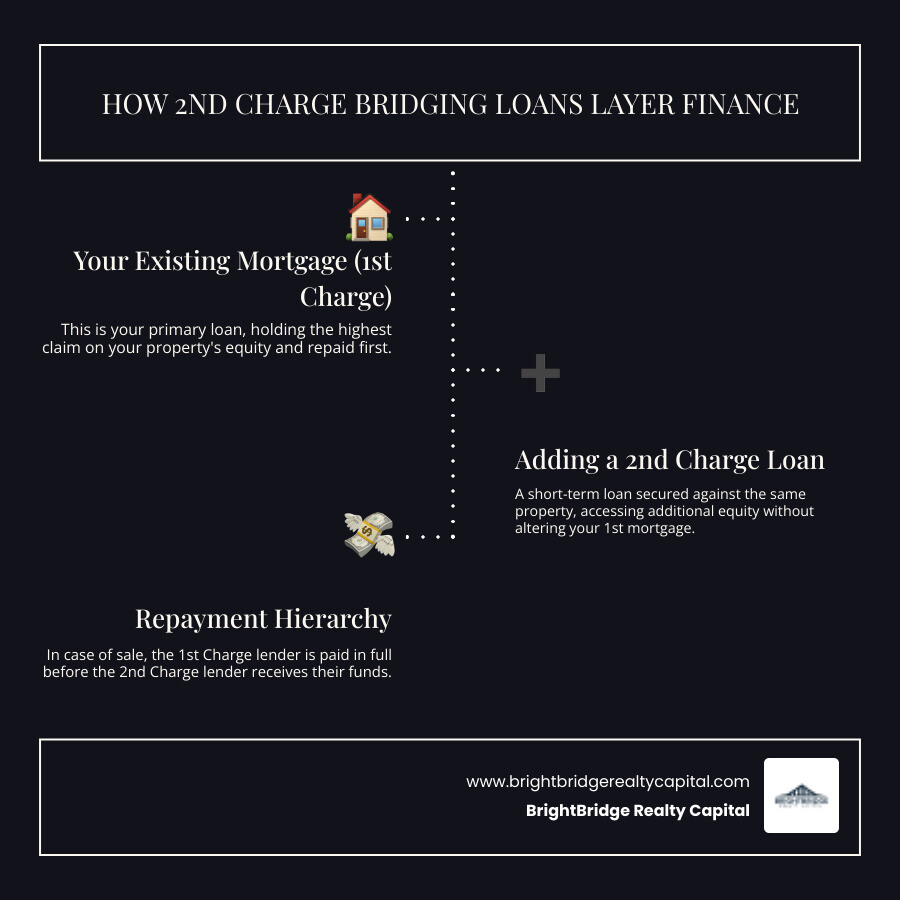
A 2nd charge bridging loan allows you to leverage the equity you've built up in a property that already has a mortgage, without refinancing the original loan.
- Leveraging Equity: You borrow against the available equity in your property—the difference between its current market value and your outstanding first mortgage.
- Subordinate Debt: The "second charge" means this loan is subordinate to your first mortgage. In the event of a default and property sale, the first mortgage lender is paid back in full before the second charge lender receives anything. This priority order is why interest rates can be higher, as the lender's risk is greater.
- Lender Assessment: Our team assesses your financial situation, creditworthiness, and the property's value. We look for a clear repayment path and a solid investment strategy.
- Property Valuation: A professional valuation is crucial to determine your property's market value and the available equity. For eligible applications, we can use Automated Valuation Models (AVMs) to speed up this process.
- Clear Exit Plan: As these are short-term loans (typically 1-24 months), a viable "exit strategy" is essential. This is your plan to repay the loan, such as selling the property, refinancing, or using proceeds from another venture.
The key benefit is providing quick funds for a specific, time-sensitive purpose, allowing you to seize opportunities without disrupting your long-term financial arrangements.
How long does it take to secure a loan?
2nd charge bridging loans are built for speed. While traditional loans can take months, we aim to get you funds fast.
A typical timeline includes:
- Initial Inquiry & Application: We quickly gather basic information about your needs.
- Documentation: You provide details of your existing mortgage, property, and exit strategy.
- Valuation: A professional valuation is conducted, which can be expedited using AVMs for qualifying properties.
- Underwriting & Loan Offer: Our underwriters review your application and issue a loan offer, often within hours of receiving all information.
- Legal Process: Our legal teams work to finalize documentation and register the second charge.
- Funds Release: Once legal requirements are met, funds are released. We pride ourselves on fast closings, often within a week, and sometimes in as little as 5 days.
What are the eligibility criteria for 2nd charge bridging loans?
While we aim to be accessible, we have criteria to ensure a secure process:
- Property Ownership: You must own the property you're using as security.
- Sufficient Equity: You need enough equity beyond your first mortgage to secure the loan. We typically lend up to 70-75% of the property's value, including the existing mortgage.
- Viable Exit Strategy: A clear, credible plan to repay the loan within its term is non-negotiable.
- Credit History: While a good credit history is beneficial, we are more flexible than traditional lenders and can consider applications with some adverse credit if the property and exit strategy are strong.
- Borrower Type: We lend to both individuals and limited companies.
- Property Location: The property must be located in a region we serve, such as New York, NY.
When to Use a Second Charge Bridge Loan: Scenarios & Advantages
2nd charge bridging loans shine when speed and flexibility are crucial, acting as a financial springboard for time-sensitive opportunities.

Common Use Cases for Individuals and Businesses
Our clients at BrightBridge Realty Capital use 2nd charge bridging loans for a variety of strategic purposes:
- Property Renovations and Redevelopment: Fund major renovations, like a loft conversion or extension, to increase a property's value. A 2nd charge bridge loan provides the capital without disturbing a favorable primary mortgage.
- Business Investment and Expansion: Provide a quick cash flow injection for entrepreneurs to purchase stock, fund marketing, or expand operations by leveraging a property they own.
- Urgent Property Purchases: Secure an investment property at auction or avoid property chain delays by acting as a cash buyer.
- Breaking Property Chains: Bridge the financial gap between selling one property and buying another, eliminating the stress of a stalled chain.
- Debt Consolidation: Consolidate existing debts or pay off arrears to improve financial stability, often in preparation for a sale or refinance.
- Covering Unexpected Costs: A rapid solution for urgent financial needs like unexpected tax bills or probate costs.

These examples highlight the tactical advantage of 2nd charge bridging loans—they enable smart, timely financial moves.
What are the advantages of a second charge bridging loan?
The benefits of a 2nd charge bridging loan are compelling:
- Fast Access to Funds: Access capital much faster than with traditional loans, often within a week, which is crucial for time-sensitive opportunities.
- Flexibility in Use: Use the funds for a wide array of needs, from property development and business expansion to urgent purchases.
- Retain Existing Mortgage: Tap into your equity without losing the favorable terms of your primary mortgage.
- Avoid Early Repayment Charges: Bypass the hefty penalties often associated with refinancing your first mortgage.
- Access Locked-In Equity: Open up capital tied up in your assets without selling the property.
- Cash Buyer Status: Present yourself as a cash buyer for new properties, giving you a strong negotiating position.
The Financials: Costs, Risks, and Key Loan Parameters
Understanding the financial landscape of 2nd charge bridging loans is crucial. While they offer incredible advantages, it's important to be aware of the associated costs and potential risks.
What are the typical interest rates and fees?
When considering a 2nd charge bridging loan, factor in all associated costs:
- Monthly Interest: Rates are typically higher than long-term mortgages, reflecting the short-term nature and increased lender risk. Expect rates from 0.5% to 1.5% per month. Interest can often be "rolled up" into the loan and paid at the end of the term.
- Lender Arrangement Fees: A fee for setting up the loan, typically 1% to 2% of the loan amount, which can often be added to the loan balance.
- Broker Fees: If you use a broker, they may charge a fee, usually 1% to 1.5% of the loan amount. As direct lenders, BrightBridge Realty Capital cuts out this intermediary cost.
- Valuation Costs: A professional property valuation is required. The cost varies depending on the property.
- Legal Fees: You will incur legal fees for your own solicitor and the lender's solicitor to handle the legal work.
We provide full transparency on all costs upfront to ensure our solutions make or save you money.
What are the typical loan-to-value (LTV) restrictions?
The Loan-to-Value (LTV) ratio determines how much you can borrow.
- Combined LTV: For 2nd charge bridging loans, lenders look at the combined LTV, which includes your first mortgage plus the new loan.
- Up to 75%: Lenders typically allow borrowing up to 70-75% of the property's value, including the outstanding balance of your first mortgage.
- Equity Calculation: The amount you can borrow depends on your available equity. If your property is valued at $1,000,000 with a $500,000 mortgage, you might borrow an additional $200,000-$250,000, bringing your combined LTV to 70-75%.
What are the risks associated with 2nd charge bridging loans?
Approach 2nd charge bridging loans with a clear understanding of the risks:
- Higher Interest Rates: Rates are higher than traditional mortgages. If your exit strategy is delayed, interest costs can accumulate quickly.
- Risk of Repossession: This is the most serious risk. If you cannot repay the loan, the lender can repossess the property to recover their debt. This is a severe consequence that must be carefully considered.
- Accumulated Interest: If you roll up interest, the total amount you owe increases over the term, raising the overall cost.
- Fee Structures: Arrangement, legal, and valuation fees add to the total cost of the loan. Understand all charges upfront.
- Impact on Credit: Defaulting on the loan will severely damage your credit score and make future financing difficult.
First Charge vs. Second Charge Bridging Loans
Understanding the difference between first and second charge loans is key to choosing the right option. It all comes down to repayment priority.
How does a second charge bridging loan differ from a first charge?
The core distinction is the order of repayment if the property is sold to settle debts. A first charge loan (your primary mortgage) is always paid back first. A 2nd charge bridging loan is paid back second, only after the first charge is fully satisfied.
This higher risk for the second charge lender is why these loans typically have higher interest rates. A second charge also usually requires the consent of your first charge lender.
This table summarizes the key differences:
| Feature | 1st Charge Bridging Loan | 2nd Charge Bridging Loan |
|---|---|---|
| Repayment Priority | First (primary lender gets paid first) | Second (after the 1st charge lender is fully repaid) |
| Risk to Lender | Lower (primary security) | Higher (subordinate position) |
| Interest Rate | Generally lower | Generally higher (reflecting increased risk) |
| LTV (Typical Combined) | Up to 70-80% of property value (as the sole loan) | Up to 70-75% of property value (including the existing 1st charge) |
| Lender Consent | Not applicable (it's the primary loan) | Often required from the 1st charge lender (though exceptions and equitable charges exist, especially in some jurisdictions) |
Choosing between them depends on your existing financial situation. If you have a mortgage you wish to keep, a second charge is often the ideal solution.
Frequently Asked Questions about Second Charge Bridging Loans
Here are some of the most common inquiries our team at BrightBridge Realty Capital addresses:
What happens if I cannot repay a second charge bridging loan on time?
If you anticipate difficulties repaying the loan, communication with your lender is the crucial first step. Potential consequences of default include:
- Default Penalties: You will likely incur higher interest rates and additional fees, and your credit report will be negatively affected.
- Legal Action: If repayment issues persist, the lender can take legal action, which may lead to the repossession of the property.
- Repossession Process: In a repossession, the property is sold. Sale proceeds are used to pay:
- Costs associated with the sale.
- The outstanding balance of the first charge mortgage.
- The outstanding balance of the 2nd charge bridging loan.
- Any remaining funds are returned to you, the borrower.
This process underscores why a realistic exit strategy is essential for your financial protection.
Can second charge bridging loans be used for commercial properties?
Yes. 2nd charge bridging loans are a powerful tool for investors and businesses with commercial real estate. At BrightBridge Realty Capital, we regularly finance solutions for commercial assets.
- Common Uses: You can use a second charge against an office building, retail store, or warehouse to access equity for expansion, renovations, or other business capital needs.
- Land for Development: Developers can use these loans to acquire land or inject capital into a project by securing it against another property in their portfolio.
- Lender Criteria: The criteria are similar to residential loans, focusing on the property's value, available equity, and a clear exit strategy.
Is my credit history important for securing a loan?
Your credit history is a factor, but specialist lenders like BrightBridge Realty Capital often offer more flexibility than traditional banks.
- Holistic Assessment: We take a holistic view of your application, not just your credit score. We may be able to find a solution even with some adverse credit history.
- Focus on Equity and Exit: The amount of equity in your property and the strength of your exit strategy are highly significant. Substantial equity and a strong repayment plan can often offset credit history concerns.
- Adverse Credit: While a poor credit history might result in higher interest rates, it is not an automatic disqualifier. Our goal is to assess the overall viability of your project and find a workable solution.
Conclusion: Is a Second Charge Bridge Loan Your Next Move?
2nd charge bridging loans offer a powerful combination of speed and flexibility for real estate investors and business owners. The ability to access your property's equity without disturbing a favorable existing mortgage is a significant advantage for funding renovations, business expansions, or new property acquisitions.
However, these are temporary solutions designed to bridge a financial gap. A clear and viable exit strategy is essential, as is a full understanding of the costs and risks, including the potential for repossession.
At BrightBridge Realty Capital, we provide customized real estate financing solutions with fast closings and a seamless, direct lending process. If you're an investor in New York, NY, or nationwide, looking to capitalize on time-sensitive opportunities, we're here to help.
Don't let valuable equity remain dormant. Unlock your property's potential with a stabilized bridge loan.