Don't Guess: Find the Best Loan Rates for Your Investment Property
Summary
Unlock your investment potential. Discover current loan rates for investment property, compare options, and secure the best financing.
Why Getting the Right Rate Matters for Investment Property Success
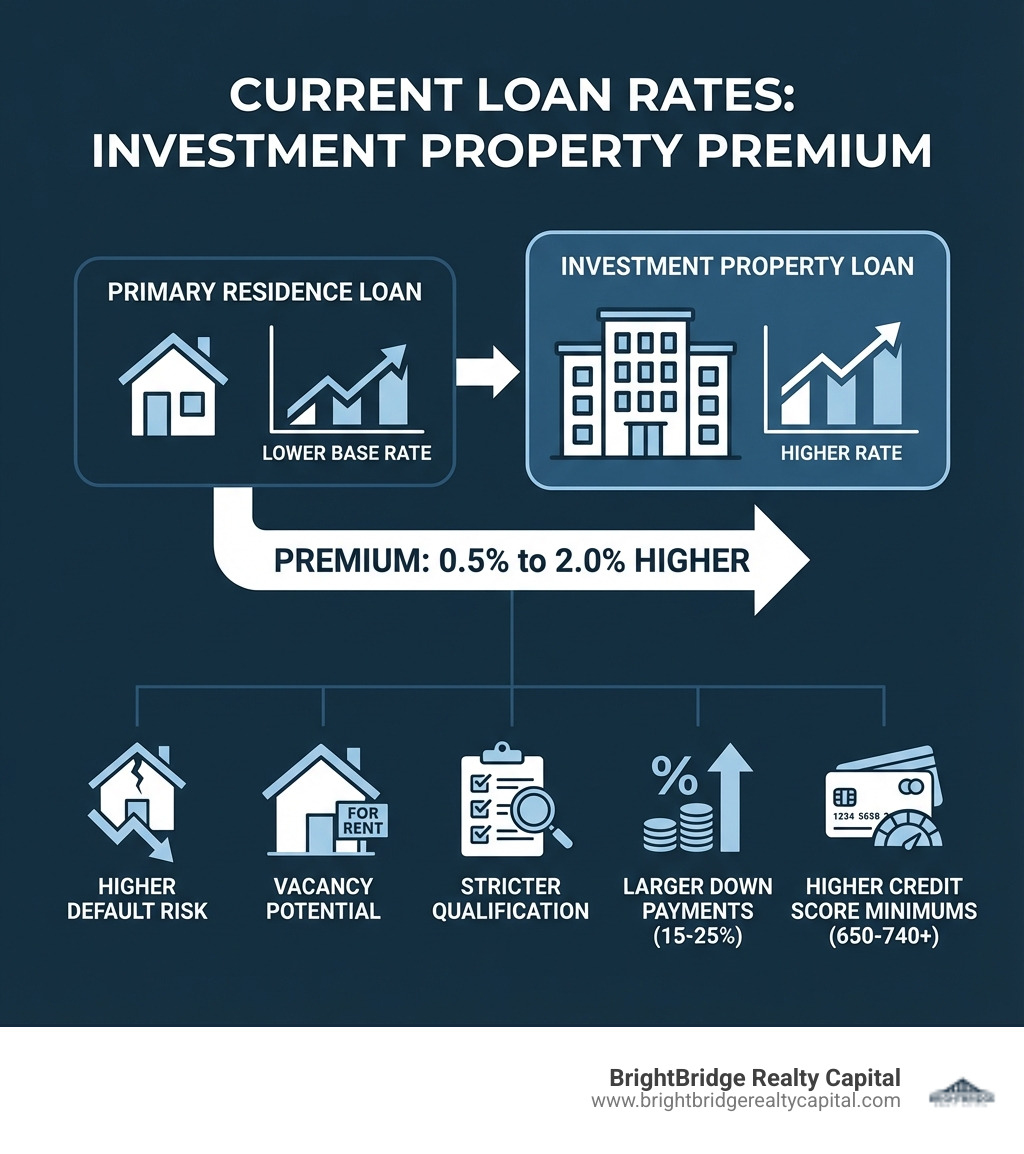
Current loan rates for investment property are a critical factor in your success as a real estate investor. As of early 2026, these rates typically range from 6.0% to 7.5% for well-qualified borrowers, though they can fluctuate based on your credit profile, down payment, property type, and broader market conditions. A key point to remember is that these rates are generally 0.5% to 2.0% higher than mortgages for a primary residence, a premium lenders charge to offset the increased risk associated with investment properties.
Quick Rate Comparison:
| Loan Type | Typical Rate Range | Down Payment |
|---|---|---|
| 30-Year Fixed Conventional | 6.5% - 7.5% | 15-25% |
| 15-Year Fixed Conventional | 6.0% - 7.0% | 15-25% |
| DSCR Loan (30-Year) | 6.5% - 7.5% | 20-25% |
| Portfolio Loan | 7.0% - 8.0%+ | 20-30% |
Rates as of January 2026, subject to change based on market conditions and borrower qualifications
Why does this premium matter so much? Every fraction of a percentage point directly impacts your monthly cash flow and long-term return on investment (ROI). Consider a $300,000 mortgage. A 1% rate difference (e.g., 6.5% vs. 7.5%) doesn't just sound small—it translates to a monthly payment difference of approximately $190. Over a year, that's over $2,280. Over the 30-year life of the loan, you'd pay an extra $68,000 in interest. That's capital that could have been a down payment on your next property, funded significant renovations, or simply boosted your passive income stream.
The problem is that most investors don't shop around enough. In the rush to close a deal, many accept the first offer they receive, assuming all lenders view their application through the same lens.
They don't.
Lenders have different risk appetites, specialized loan programs, and unique ways of evaluating a borrower's profile. Some excel at financing for W-2 employees, while others specialize in DSCR loans for self-employed investors. Some add hefty premiums for multi-unit properties, while others see them as a strong asset. The bottom line? A deep understanding of how current loan rates for investment property are determined gives you the power to negotiate from a position of strength, secure better terms, and ultimately, maximize your ROI.
I'm Daniel Lopez, a senior loan officer at BrightBridge Realty Capital. Having helped hundreds of investors across the nation secure competitive financing for their portfolios, I've seen firsthand how financial literacy transforms a good investment into a great one. Understanding the nuances of current loan rates for investment property is what separates amateur investors from those who systematically build wealth. In this comprehensive guide, I'll demystify how rates are set, what lenders look for, and the strategies you can use to secure the best possible terms for your next deal.
Important current loan rates for investment property terms:
- best lenders for rental property
- best refinance for investment property
- real estate investment funding
Understanding Today's Investment Property Loan Rates
When we discuss current loan rates for investment property, it's essential to recognize they exist in a separate ecosystem from primary residence mortgages. The fundamental reason for this divergence is risk. Lenders view investment properties as inherently riskier assets. In times of financial hardship, a homeowner will fight to make payments on their own home, but a rental property mortgage is often the first obligation to be neglected. This elevated default risk is priced directly into the interest rates offered to investors.
Typically, you can expect to pay a premium of 0.5% to 2.0% on an investment loan compared to a comparable owner-occupied loan. For instance, if the national average for a 30-year fixed mortgage on a primary home is 6.33% APR, an investor might be quoted a rate starting at 6.83% or higher for the same loan structure. Our internal data shows that a highly qualified investor (credit score 760+) seeking a 30-year DSCR loan might secure a rate around 6.500%, which is highly competitive but still reflects that built-in risk premium.
Macroeconomic Influences on Investment Loan Rates
Beyond individual risk, broader economic forces heavily influence current loan rates for investment property. These are the same forces that affect all mortgage rates, but they can have a pronounced impact on the investor market.
- The Federal Reserve: While the Fed doesn't directly set mortgage rates, its monetary policy is the primary driver. When the Fed raises the federal funds rate to combat inflation, it increases borrowing costs for banks. These costs are passed on to consumers in the form of higher interest rates on all loan types, including investment mortgages.
- Inflation: High inflation erodes the value of future fixed-income payments. To compensate for this, lenders demand higher interest rates on long-term loans like mortgages. When inflation is high and persistent, you can expect investment property rates to climb.
- The Bond Market (10-Year Treasury Yield): Mortgage rates, particularly for 30-year fixed loans, tend to track the yield on the 10-year Treasury note. This is because investors see both as similar long-term, relatively safe investments. When demand for Treasury bonds falls, their yields rise, and mortgage rates typically follow suit. Watching this yield can give you a good indication of which direction rates are heading.
- Investor Demand: The level of activity in the real estate investment market also plays a role. A surge in investor home purchases, like the one seen in previous years, can increase competition for financing and push rates up. Conversely, a recent pullback in investor activity, as noted in this Redfin analysis, has prompted some lenders to offer more competitive pricing to attract business, though the fundamental risk premium remains.
For a deeper dive into rate trends, our guide on the average interest rate for rental property provides additional context.
Why Investment Property Rates Are Higher: A Deeper Look
Let's break down the specific risk factors that lead to higher rates:
- Default Risk: This is the primary concern. Historical data shows that during recessions, default rates on non-owner-occupied properties are significantly higher. Lenders price this statistical probability into your rate.
- Vacancy and Upkeep: An empty property is a liability, not an asset. It generates no income to cover the mortgage, taxes, and insurance. Furthermore, tenants may not maintain a property to the same standard as an owner, potentially leading to deferred maintenance and a decline in property value. Both factors increase the lender's potential for loss.
- Loan-Level Price Adjustments (LLPAs): For conventional loans backed by Fannie Mae and Freddie Mac, LLPAs are explicit fees added for specific risk factors. Investment properties automatically trigger a significant LLPA. For example, an investor with a 720 credit score and 25% down (75% LTV) might face an LLPA of 2.125% of the loan amount. This can be paid as a closing cost or, more commonly, absorbed into the interest rate, increasing it by approximately 0.5% to 0.75%.
- Stricter Underwriting: To mitigate these risks, lenders impose tougher qualification standards across the board, including higher credit scores, larger down payments, and lower Debt-to-Income (DTI) ratios.
Pros and Cons vs. Primary Residence Mortgages
While the higher bar for investment loans can seem daunting, the potential rewards are substantial. It's a classic case of risk versus reward.

Pros of Investment Property Mortgages:
- Rental Income & Cash Flow: The primary benefit is generating income that covers the mortgage and other expenses, ideally creating positive cash flow each month.
- Long-term Appreciation: Real estate has historically appreciated over the long term, allowing you to build significant equity and increase your net worth.
- Portfolio Diversification: Real estate provides a tangible asset that can balance a portfolio heavily weighted in stocks and bonds, often performing differently in various economic cycles.
- Significant Tax Benefits: You can deduct mortgage interest, property taxes, and operating expenses. The most powerful benefit is depreciation, a non-cash expense that allows you to write off the value of the structure over 27.5 years, which can dramatically lower your taxable income.
- Leverage: Mortgages allow you to use leverage—controlling a large, valuable asset with a relatively small down payment (e.g., 20%). This amplifies your potential returns on the capital you invested.
Cons of Investment Property Mortgages:
- Higher Interest Rates: As discussed, you will pay a premium, which directly impacts your monthly payment and overall profitability.
- Larger Down Payments: Lenders require more skin in the game. Expect to need 15-25% down, tying up more of your capital upfront. Learn more in our article on investment property loan down payment.
- Stricter Qualifications: Qualifying is tougher. You'll need a stronger credit history, more income (or a property that cash flows well), and cash reserves.
- Higher Closing Costs: Fees for appraisals, origination, and title insurance can be slightly higher for investment properties due to the added complexity.
- Active Landlord Responsibilities: This is not a passive investment. You are responsible for finding tenants, handling maintenance requests, and managing the property, unless you hire a property manager (which is an additional expense).
Key Factors That Determine Your Interest Rate
Securing the best current loan rates for investment property is not a matter of luck; it's about meticulously preparing your financial profile to present yourself as a low-risk borrower. Lenders analyze a combination of your personal finances, your experience as an investor, and the characteristics of the property itself. Each factor is a lever that can move your interest rate up or down.

At BrightBridge Realty Capital, we guide investors through optimizing these factors to qualify for the most competitive financing, including low interest investment property loans. Here’s what lenders scrutinize most closely:
Credit Score
Your credit score is the single most important factor in determining your interest rate. It's a numerical summary of your credit history and a predictor of your likelihood to repay debt.
- Minimum Score: While some programs may allow a FICO score as low as 650, this is the absolute floor. Qualifying at this level will come with a significantly higher interest rate and may require a larger down payment.
- Ideal Score: To access the best current loan rates for investment property, you should aim for a score of 740 or higher. Borrowers in this top tier are considered the lowest risk and are rewarded with the best pricing. The difference between a 680 score and a 760 score can easily be 0.5% to 1.0% on your interest rate.
- Credit History Impact: Lenders look beyond the score to your full credit report. They want to see a long history of on-time payments, a low credit utilization ratio (ideally below 30%), and no recent major derogatory events like foreclosures or bankruptcies. A clean history demonstrates reliability and financial discipline.
Down Payment and Loan-to-Value (LTV)
Your down payment is your 'skin in the game.' A larger down payment reduces the lender's exposure and risk, which in turn lowers your interest rate.
- Minimum Down Payment: For a conventional loan on a single-unit investment property, the minimum is 15%. However, putting down less than 20% will require you to pay Private Mortgage Insurance (PMI), an extra monthly cost. For multi-unit properties (2-4 units), the minimum down payment is almost always 25%.
- Loan-to-Value (LTV): LTV is the inverse of your down payment. It's your loan amount divided by the property's appraised value. A $400,000 property with a $100,000 down payment has a loan of $300,000 and an LTV of 75% ($300k / $400k). Lower LTVs receive better pricing. An LTV of 75% is good, but an LTV of 70% (30% down payment) might get you an even better rate.
- Cash Reserves: This is a critical and often overlooked factor. Lenders require investors to have sufficient liquid assets to cover a certain number of months of PITI (Principal, Interest, Taxes, and Insurance) payments for the new property and any other properties you own. The standard requirement is 3-6 months of reserves. This proves you can handle unexpected vacancies or repairs without defaulting on the loan.
Debt-to-Income (DTI) Ratio
Your DTI ratio compares your total monthly debt obligations to your gross monthly income. It's a key measure of your ability to manage your payments.
- DTI Calculation: To calculate it, sum up all your monthly debt payments (mortgages, car loans, student loans, credit card minimums) and divide by your gross (pre-tax) monthly income. For example, if your debts are $3,000 and your income is $8,000, your DTI is 37.5%.
- Lender Preference: For conventional investment property loans, lenders typically cap the DTI ratio at 43%. Some may go higher, but 43% is a standard benchmark. A lower DTI (under 36%) makes you a much stronger candidate.
- Qualifying Income: For conventional loans, lenders use your documented personal income. They may allow you to use a portion (typically 75%) of the subject property's projected rental income to help you qualify, but this is not guaranteed. This is where DSCR loans offer a significant advantage, as they focus on the property's income instead of your personal DTI.
Property Type and Location
The property itself is part of the underwriting equation. Its type, condition, and location all influence risk and, therefore, the rate.
- Single-Family vs. Multi-Family: Single-family residences (SFRs) are the simplest to finance and often receive the best rates. Multi-family properties with 2-4 units are also eligible for conventional financing but are seen as more complex to manage, often requiring a larger down payment (25%) and resulting in a slightly higher rate.
- Condos vs. Homes: Condominiums can be more complicated. If a condo project is deemed 'non-warrantable' (meaning it doesn't meet Fannie Mae/Freddie Mac guidelines, perhaps because one entity owns too many units or there's pending litigation), it can be very difficult to finance with a conventional loan. This often requires a specialized portfolio loan, which may have higher rates.
- Location Risk: Lenders assess the economic health and rental demand of the property's market. A property in a growing city with low vacancy rates is viewed more favorably than one in an area with a declining population or a single dominant employer.
- Conforming vs. Jumbo Loans: Conforming loans adhere to the limits set by the FHFA, which are updated annually (e.g., $806,500 for a single-unit property in most of the U.S., but higher in high-cost areas like New York, NY). Loans that exceed these limits are called jumbo loans. Jumbo loans have their own underwriting rules and pricing, which can sometimes be more or less competitive than conforming loans depending on the market.
Comparing Your Investment Property Loan Options
Navigating the world of investment property financing means understanding that there is no one-size-fits-all solution. The best loan for a seasoned investor scaling their portfolio is likely different from the ideal loan for a first-time investor with a high W-2 income. At BrightBridge Realty Capital, our expertise lies in matching your specific financial profile and investment strategy to the optimal loan product, helping you find the best home loan for investment property available.
Conventional vs. DSCR Loans: The Two Pillars of Investor Finance
These are the two most popular loan types for financing 1-4 unit residential investment properties. Their core difference lies in what they prioritize: the borrower's personal finances versus the property's income potential.
| Criteria | Conventional Loan | DSCR Loan (Debt Service Coverage Ratio) |
|---|---|---|
| Income Verification | Full personal documentation: W-2s, tax returns, pay stubs, proof of all income sources. | No personal income verification. Based solely on the property's projected rental income. |
| Qualification Focus | Borrower's personal financial strength: credit score, DTI ratio, and personal income. | Property's ability to generate enough income to cover the mortgage payment (PITI). |
| Down Payment | Typically 15-25%. 15% possible for single-unit, but 20%+ is standard to avoid PMI. 25% for 2-4 units. | Typically 20-25%. A lower DSCR ratio or credit score may require a larger down payment (30%+). |
| Ideal Investor | W-2 employees, retirees with stable income, investors with low personal debt and few financed properties. | Self-employed individuals, real estate professionals, investors scaling a portfolio, or anyone wanting a faster, less document-intensive process. |
| Property Limits | Subject to Fannie Mae/Freddie Mac limits, typically up to 10 financed properties per borrower. | No limit on the number of properties an investor can finance. |
| Speed & Flexibility | Slower, more rigid underwriting process due to strict agency guidelines. | Often faster closings (2-3 weeks) with more flexible underwriting since it's a non-QM loan. |
Conventional Loans: As the workhorse of the mortgage industry, these loans follow the strict guidelines of Fannie Mae and Freddie Mac. They offer competitive rates and are an excellent choice for investors with strong, easily verifiable income and a low DTI ratio. However, the documentation process can be arduous, and they are subject to limitations, most notably the cap on financing more than 10 properties. Learn more about using a conventional loan for investment property.
DSCR Loans: A game-changer for many investors, the DSCR loan is a non-QM (non-qualified mortgage) product designed specifically for real estate investment. Qualification hinges on the Debt Service Coverage Ratio, calculated as: Gross Rental Income / PITI. A DSCR of 1.25 means the property's rent is 125% of the total mortgage payment. Many lenders will approve loans with a DSCR of 1.0 or even slightly less, especially with a larger down payment. This is the perfect tool for investors whose tax returns don't reflect their true cash flow (due to write-offs) or for those who want to acquire properties without impacting their personal DTI, allowing for faster scaling. Explore our dedicated resource on DSCR loans for real estate investors.
Other Important Loan Types to Consider
Beyond the two mainstays, other financing tools can be deployed for specific scenarios.
Portfolio Loans: These are non-QM loans that a lender originates and keeps on its own books (in its 'portfolio') rather than selling on the secondary market. This gives the lender, like us at BrightBridge Realty Capital, immense flexibility. We can create custom terms for unique situations, such as financing a non-warrantable condo, providing a loan to an investor with more than 10 properties, or creating a blanket loan covering multiple properties. While rates can sometimes be slightly higher than conventional loans, the flexibility is often worth it for serious investors. Many of our best rental portfolio loans are structured this way.
Hard Money Loans: These are short-term, asset-based loans, typically with terms of 6-24 months. They are provided by private investors or funds, not traditional banks. The focus is almost entirely on the property's value, particularly its after-repair value (ARV). Hard money is ideal for fix-and-flip investors who need to close quickly and finance both the purchase and renovation costs. Rates are much higher (9-15%+) and fees are significant, but they provide speed and leverage that traditional loans cannot. The strategy is to refinance into a long-term loan (like a DSCR loan) once the property is renovated and tenanted.
Bridge Loans: Similar to hard money, bridge loans are short-term financing solutions designed to 'bridge' a gap between two transactions. For example, an investor might use a bridge loan to pull equity from an existing property to use as a down payment on a new one, without having to sell the first property immediately. They offer speed and flexibility but at a higher cost than permanent financing.
What Are the Current Loan Rates for Investment Property?
While the market is in constant flux, it's helpful to have a baseline understanding of what current loan rates for investment property look like. The following figures, as of early 2026, represent typical rates for a well-qualified borrower with a 740+ credit score and a 25% down payment on a conforming loan.
- 30-Year Fixed-Rate Mortgage for Investment Property: Around 6.500% (APR 6.612%)
- 15-Year Fixed-Rate Mortgage for Investment Property: Around 6.000% (APR 6.175%)
- 5/1 Adjustable-Rate Mortgage (ARM) for Investment Property: Around 6.000% (APR 6.198%)
- Solar Loans for Investment Properties: Starting at 6.25% APR
It is crucial to compare the APR (Annual Percentage Rate), not just the interest rate. The APR represents the true cost of borrowing because it includes the interest rate plus lender fees, origination charges, and discount points. A loan with a lower advertised interest rate could have a higher APR if the fees are substantial.
A 30-year fixed mortgage rates for investment property is the most popular choice, offering predictable payments and maximizing monthly cash flow. A 15-year fixed mortgage builds equity much faster and saves a massive amount in total interest, but the higher monthly payments can strain cash flow. Adjustable-Rate Mortgages (ARMs) offer a lower introductory rate for a fixed period (e.g., 3, 5, or 7 years) before adjusting based on a market index. These can be strategic for investors who plan to sell or refinance before the adjustment period ends, but they carry the risk of future rate hikes.
How to Secure the Best Possible Rate: An Action Plan
Getting the best current loan rates for investment property requires a proactive, strategic approach. Here’s how to position yourself for success:
- Optimize Your Credit Score: Aim for a FICO score of 740 or higher. Months before applying, review your credit report for errors, pay all bills on time, and pay down credit card balances to lower your utilization. A higher score is the most direct path to a lower rate.
- Maximize Your Down Payment: While 15-20% is the minimum, pushing your down payment to 25% or even 30% (reducing your LTV) will unlock better pricing tiers from lenders. It demonstrates financial strength and reduces their risk.
- Reduce Your DTI Ratio: Before applying, pay down high-interest consumer debt like personal loans or credit cards. A lower DTI ratio not only helps you qualify for a conventional loan but also shows you have the financial capacity to handle the new mortgage payment with ease.
- Shop Multiple Lenders Strategically: Don't just take the first offer. Get quotes from different types of lenders: a large national bank, a local credit union, a mortgage broker, and a direct private lender like BrightBridge Realty Capital. Each will have different programs and pricing. Getting multiple Loan Estimates within a 14-day window will count as a single inquiry on your credit report.
- Negotiate Terms with Leverage: Once you have multiple offers, use the best one as leverage. Go back to your preferred lender and ask, "Can you match or beat this rate/fee structure?" Lenders have some discretion in their pricing, and they may be willing to compete for your business.
- Build and Document Cash Reserves: Lenders need to see that you have 3-6 months of PITI payments in a liquid account. Start building these reserves early and be prepared to provide bank statements to prove it. This is a non-negotiable item for most investor loans.
- Get Pre-Approved Early: A pre-approval based on a full review of your financial documents (not just a pre-qualification) shows sellers you are a serious buyer and allows you to lock in an interest rate if you see a favorable trend.
Following these steps will dramatically improve your chances of securing the lowest interest rate on investment property.
Understanding the Role of Personal Guarantees
When financing residential investment properties (1-4 units), nearly all loans are recourse loans. This means you will be required to sign a personal guarantee.
- What is a Recourse Loan? A recourse loan gives the lender the right to pursue your personal assets—beyond just the collateral property—to satisfy the debt if you default. If the foreclosure sale doesn't cover the outstanding loan balance, they can come after your other savings, investments, or even other properties.
- Why Lenders Require It: The personal guarantee is a critical layer of security for the lender. It ensures you are fully committed to repaying the loan and significantly mitigates their risk, which in turn allows them to offer more favorable terms.
- LLC Limitations: Many investors hold properties in an LLC for liability protection. While this is a smart legal strategy, it does not shield you from a personal guarantee on the mortgage. The lender will still require you, the individual member(s) of the LLC, to personally back the loan. Non-recourse loans, where the lender can only seize the property, are typically reserved for large commercial real estate deals and come with much higher down payments and stricter requirements. For more details, see our article on rental property loan rates for LLC.
Frequently Asked Questions about Investment Property Loans
As specialists in investor financing, we encounter a wide range of questions about securing the best current loan rates for investment property. Here are detailed answers to some of the most common inquiries we receive.
How much do I need to put down for an investment property?
The standard down payment for an investment property is between 15% and 25%. For a single-unit property (like a single-family home or condo), some conventional loan programs allow a 15% down payment. However, putting down at least 20% is highly recommended to avoid Private Mortgage Insurance (PMI) and to access better interest rates. For any multi-unit property (2-4 units), lenders almost universally require a minimum down payment of 25%. A larger down payment lowers your Loan-to-Value (LTV) ratio, which directly reduces the lender's risk and qualifies you for their best pricing tiers.
Can I use a DSCR loan for my first investment property?
Yes, absolutely. DSCR loans are an excellent tool for first-time investors, particularly those who are self-employed, have fluctuating income, or simply want a streamlined process that doesn't require digging up years of tax returns. Since a DSCR loan qualifies based on the property's ability to generate income rather than your personal DTI, it allows new investors to enter the market based on the strength of the deal itself. For example, a freelance consultant with significant business write-offs might have trouble qualifying for a conventional loan, but if they find a property where the projected rent is 125% of the mortgage payment, they can likely get approved for a DSCR loan. Our guide on DSCR loans explained: how to qualify and calculate your ratio walks you through the process.
What are the tax benefits of an investment property mortgage?
Owning a mortgaged investment property unlocks some of the most significant tax advantages available. These benefits can substantially boost your net returns:
- Mortgage Interest Deduction: The interest you pay on your loan is a business expense and is fully deductible against your rental income.
- Property Tax Deduction: The property taxes you pay are also fully deductible.
- Depreciation: This is the most powerful tax benefit. The IRS allows you to deduct a portion of your property's cost basis (the value of the building, not the land) over 27.5 years for residential properties. This is a 'phantom' non-cash expense that can reduce your taxable income to zero or even create a paper loss, even if the property is generating positive cash flow.
- Operating Expenses: All ordinary and necessary costs of managing the property are deductible. This includes insurance, repairs, property management fees, marketing costs, utilities, and travel expenses for managing the property.
It's also worth noting that investors can defer capital gains taxes by using a 1031 exchange to roll the proceeds from a sale into a new, like-kind property. Given the complexity, we always advise consulting with a qualified tax professional to create a strategy tailored to your situation.
What are typical closing costs on an investment property loan?
Closing costs for an investment property loan typically range from 2% to 5% of the loan amount. These costs are slightly higher than for a primary home due to higher fees for certain services. Common closing costs include:
- Lender Origination Fee: A fee for processing the loan, often around 0.5% to 1% of the loan amount.
- Appraisal Fee: Usually more expensive for investment properties, especially multi-unit buildings.
- Title Insurance and Escrow Fees: To ensure a clear title and manage the closing process.
- Prepaid Expenses: Such as the first year's homeowner's insurance premium and prepaid property taxes.
- Points: Discount points are prepaid interest you can pay to lower your rate. One point equals 1% of the loan amount.
How many financed investment properties can I own?
This depends on the loan type. For conventional loans, Fannie Mae and Freddie Mac impose a limit. Most borrowers are capped at 10 financed properties. This includes your primary residence. Reaching this limit is a common roadblock for investors looking to scale. This is where other loan products become essential. DSCR loans and portfolio loans do not have a limit on the number of properties you can finance, making them the go-to solution for professional investors building large portfolios.
What is 'seasoning' and why does it matter?
'Seasoning' refers to the period of time a lender requires you to own a property before you can refinance it, particularly for a cash-out refinance. For investors using the BRRRR (Buy, Rehab, Rent, Refinance, Repeat) strategy, this is a critical rule. Most lenders, including those following conventional guidelines, require a six-month seasoning period. This means you must hold the title to the property for at least six months before you can apply for a cash-out refinance to pull out the equity you've created through renovations. Some portfolio lenders may offer shorter seasoning periods, but six months is the industry standard.
Maximize Your ROI with the Right Financing
Navigating the world of current loan rates for investment property is a journey of strategic financial planning, not a game of chance. By understanding the macroeconomic forces that shape the market, the specific factors lenders use to assess your risk profile, and the diverse array of loan products at your disposal, you can transform yourself from a rate-taker into a rate-maker.
Key takeaways for savvy investors:
- Your Financial Profile is Paramount: A pristine credit score (740+), a low DTI ratio, and substantial cash reserves are your most powerful negotiating tools. Start preparing your finances months before you plan to buy.
- The Property's Potential is Your Leverage: For modern investment loans like DSCR, the property's ability to generate strong cash flow can be more important than your personal income. Learn to analyze deals like a lender would.
- Expand Your Toolkit Beyond Conventional Loans: While conventional loans are a great start, serious investors must understand how to use DSCR, portfolio, and even short-term bridge or hard money loans to scale their portfolios and overcome limitations like the 10-property cap.
- Always Shop Strategically: Never settle for the first offer. Comparing quotes from different lender types—banks, brokers, and direct lenders—is essential to ensure you're not leaving money on the table. Use competing offers to negotiate better terms.
- Understand the Long Game: Your choice between a 15-year vs. 30-year term, or a fixed vs. adjustable rate, should align with your specific investment strategy, whether it's long-term cash flow or short-term appreciation.
At BrightBridge Realty Capital, we are more than just a lender; we are a strategic partner for real estate investors. We specialize in providing customized financing solutions nationwide, with a strong presence in competitive markets like New York, NY. Our unique value proposition is our ability to act as a direct lender, cutting out intermediaries to deliver fast closings—often in as little as a week. This agility allows us to offer competitive rates and a seamless, transparent process tailored to the sophisticated needs of real estate investors. We believe that the right financing is the foundation upon which great real estate portfolios are built.
Ready to stop guessing and start investing with a competitive edge? Explore our rental loan programs to get started and let our team of experts help you secure the optimal financing for your next investment property.