Beginner's Guide to Bridge vs. Construction Loans


Summary
Unlock real estate success! Learn the key differences in bridge loan vs construction loan types to fund your next project or home.
Why Understanding Bridge Loan vs Construction Loan Options Matters for Real Estate Investors
Bridge loan vs construction loan decisions can make or break your real estate investment strategy. While both provide short-term financing for property investments, they serve completely different purposes and funding structures. Choosing the right instrument is not just a matter of preference; it's a critical strategic decision that directly impacts your project's timeline, budget, and ultimate profitability.
Quick Answer:
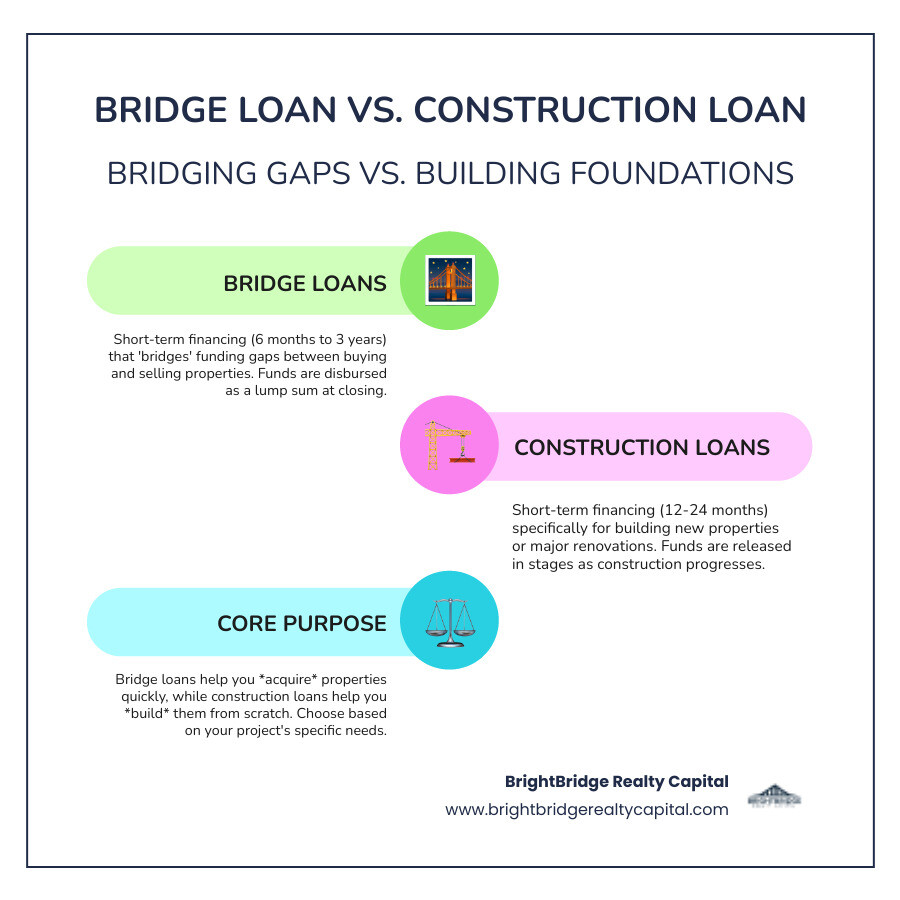
- Bridge Loans: Short-term financing (6 months to 3 years) that "bridges" funding gaps between buying and selling properties. Funds disbursed as a lump sum at closing, ideal for speed and acquisition.
- Construction Loans: Short-term financing (12-24 months) specifically for building or major renovations. Funds released in stages (draws) as construction progresses, ideal for ground-up projects.
- Key Difference: Bridge loans help you acquire properties quickly, while construction loans help you build them from scratch.
In today's dynamic real estate market, characterized by fluctuating interest rates and competitive inventory, the ability to act decisively is paramount. This is where specialized financing comes into play. Real estate financing can be complex, especially when timing is critical. As one industry expert notes, "Real estate projects have many moving parts, and financing is often the factor that can make or break a deal." Bridge loans typically have repayment periods ranging from 6 months to 3 years, while construction loans usually have terms between 12 and 24 months.
The choice between these loan types depends entirely on your project needs. Bridge loans excel when you need to move fast on acquisitions or cover funding gaps in a hot market. Construction loans work best when you're building new properties or doing major renovations that require staged funding releases tied to project milestones. Selecting the wrong loan can lead to a cascade of problems: a bridge loan for a major build could leave you without sufficient funds for later construction phases, while a construction loan for a simple acquisition would introduce unnecessary complexity, delays, and inspections, potentially causing you to lose the deal.
I'm Daniel Lopez, a loan officer at BrightBridge Realty Capital, where I help real estate investors steer complex financing decisions including bridge loan vs construction loan scenarios daily. With over a decade of experience structuring deals across residential and commercial projects, I've witnessed how the right loan choice can accelerate investment success, open up hidden opportunities, and maximize returns, while the wrong one can create costly delays, budget overruns, and jeopardize an entire project. My goal is to explain these options so you can finance your next project with confidence.
Bridge loan vs construction loan helpful reading:
Understanding Bridge Loans: Your Short-Term Funding Solution
Picture this: you're scrolling through property listings and find the perfect investment opportunity. The catch? You need to act fast, but your capital is tied up in another property that's pending sale. This is exactly when a bridge loan becomes your best friend, acting as a powerful tool for strategic acquisition.
A bridge loan is short-term financing that literally "bridges" the gap between two financial transactions. Think of it as a temporary financial solution that gives you quick access to capital when timing is everything. While traditional loans can drag on for weeks or months with cumbersome paperwork, bridge loans can close in as little as a week - which is why we at BrightBridge Realty Capital have made them one of our specialties.

Here's how it works: when you secure a bridge loan, you get all the funds upfront as a lump-sum disbursement at closing. No waiting, no staged releases, no construction inspections—just immediate access to the capital you need to close a deal. These loans typically run for 6 months to 3 years, giving you a defined window to execute your strategy while keeping the pressure manageable.
The beauty of bridge loans lies in their fast approval process. Instead of getting bogged down in lengthy income verification and personal financial history, lenders focus primarily on your property's equity (the collateral) and your clear, credible plan for repaying the loan (the exit strategy).
Primary Purposes and Uses of a Bridge Loan
Bridge loans are incredibly versatile tools that work in many different scenarios. Their flexibility makes them suitable for a range of real estate investment strategies:
- Buying a new home before selling the old one: The most common use for homeowners. A bridge loan lets you use the equity in your current home to make a non-contingent offer on a new one, avoiding the stress of temporary housing or losing your dream home.
- Winning in competitive real estate markets: For real estate investors, bridge loans provide the speed needed to compete with cash buyers. When you can make a cash-equivalent offer and skip the financing contingency clause (learn more about what is a contingency clause?), you immediately stand out and increase your chances of winning the deal.
- Acquiring time-sensitive investments: Maybe you've spotted a distressed property at a deep discount, an REO property, or a deal at auction that won't last long. Bridge loans let you move quickly without waiting for traditional financing to crawl through its 30-60 day approval process.
- Financing fix-and-flip projects: Many investors use bridge loans to cover both the acquisition and renovation costs of a property. The lump-sum disbursement allows you to purchase the property and immediately begin renovations, accelerating your project timeline. This is a key advantage over other loan types that might not fund repairs. If you're interested in this strategy, check out more info about fix-and-flip loans on our site.
- Stabilizing a property before long-term financing: A commercial property might be under-leased or in need of minor improvements to qualify for a traditional mortgage. A bridge loan can provide the capital to make those improvements and increase occupancy, "stabilizing" the asset and making it eligible for better long-term financing terms.
Who is a Bridge Loan Best For?
A bridge loan is an ideal financial tool for a specific type of borrower. It's best suited for experienced real estate investors who have a clear and viable exit strategy. This includes property flippers who can confidently project renovation costs and after-repair value (ARV), developers who need to acquire land quickly while securing construction financing, and business owners who need to purchase a new facility before selling their old one. The ideal candidate has significant equity in their existing property, a good credit score (typically 620+), and a solid understanding of the risks involved. It is not generally recommended for first-time homebuyers or investors with an uncertain plan for repayment, as the short-term nature and higher costs can create significant financial pressure if the exit strategy falters.
Benefits and Drawbacks of Bridge Loans
The biggest advantage of bridge loans is fast funding. When opportunity knocks, you can answer the door in days rather than months. This speed comes with remarkable flexibility too - lenders care more about your property's value and your exit strategy than perfect credit scores or W-2 income.
These borrower advantages make bridge loans particularly attractive for investors who need to move quickly or have unique financial situations that don't fit traditional lending boxes. You gain a significant competitive edge in the marketplace.
But let's be honest about the downsides. Higher interest rates are the price you pay for speed and flexibility. While a conventional mortgage might be 6-7%, a bridge loan could be anywhere from 9-12% or higher, plus origination fees of 1-4%. These loans typically cost more than traditional mortgages because lenders take on more risk with short repayment terms.
The financial risk is real, especially if you end up carrying two mortgages temporarily. If your original property doesn't sell as quickly as planned, or if your renovation project hits a snag, you could face serious financial pressure. For example, carrying a $500,000 bridge loan at 10% interest means a monthly interest-only payment of over $4,100, in addition to the mortgage on your existing property. This can quickly deplete cash reserves if your exit plan is delayed.
The key is having a solid, well-researched plan before you borrow. Bridge loans work brilliantly when you know exactly how you'll repay them, but they can create significant problems if you're gambling on uncertain outcomes.
When weighing bridge loan vs construction loan options, bridge loans excel at solving timing problems and providing quick capital access, while construction loans serve an entirely different purpose in the building process.
Understanding Construction Loans: Financing Your Build from the Ground Up
If bridge loans are about connecting two points, construction loans are all about creating something entirely new from nothing! Think of them as the financial foundation that turns architectural dreams into brick-and-mortar reality, whether it's a custom home, a commercial building, or a multi-unit development.
Construction loans work completely differently from traditional mortgages or bridge loan vs construction loan scenarios you might be familiar with. Instead of handing you a big check upfront, these loans release funds in carefully timed stages called "draws." Each draw corresponds to specific, verifiable construction milestones – like completing the foundation, finishing the framing, installing plumbing and electrical, or hanging drywall.
This phased funding approach makes perfect sense when you think about it. Why would a lender give you money for a roof when you haven't even poured the foundation yet? The draw schedule protects both you and the lender, ensuring money flows as actual progress happens on your project. An inspector must verify the completion of each stage before the next draw is released, providing crucial oversight.
Construction loans typically run for 12 to 24 months – just enough time to complete most building projects. They are designed to cover a comprehensive range of costs, including land acquisition, permits and fees, materials, labor, and even a contingency fund for those inevitable change orders that pop up during construction. Once your project is complete, the loan usually converts to a permanent mortgage or gets paid off through a sale or refinance.
Primary Purposes and Uses of a Construction Loan
Construction loans shine when you need to build something from scratch or completely transform an existing property. Here's where they make the most sense:
- Building your dream home: This is the classic use case. If you've always wanted a custom home designed exactly how you envision it, a construction loan provides the staged funding to make it happen. You'll work with your builder to establish draw schedules that align with construction phases.
- Commercial property development: Developers use these loans to finance large-scale projects like office buildings, retail centers, apartment complexes, and industrial facilities. These projects often involve millions of dollars and require the rigorous oversight and phased funding that construction loans provide to manage cash flow and risk.
- Investment property development: This allows savvy investors to create new rental properties from the ground up, such as building a duplex, a small apartment building, or a portfolio of single-family homes. This strategy can be particularly profitable in areas where existing inventory is limited or outdated. Learn more about the differences between Investment property classifications and their financing implications.
- Land acquisition combined with building costs: Instead of securing separate loans for land purchase and construction, you can finance both through a single construction loan. This streamlined approach is especially effective for "shovel-ready" properties where zoning and permits are already in place.
- Teardown and rebuild projects: Increasingly popular in established neighborhoods with high land values. When an existing structure is obsolete or beyond renovation, demolishing it and starting fresh often makes the most financial sense. Construction loans can finance both the demolition and new construction phases.
- Major renovations and additions: Projects that significantly alter a property's structure or footprint—like adding a second story or a large wing—often require construction loan financing. Unlike a home equity loan, a construction loan's draw schedule is better suited to the phased nature of a large-scale remodel. For comprehensive information about new construction financing, check out our guide on More info about ground-up construction loans.
Benefits and Drawbacks of Construction Loans
Construction loans offer unique advantages that make them perfect for building projects, but they also come with challenges you should understand upfront.
The benefits are compelling for the right projects. You'll enjoy interest-only payments during construction, which means you only pay interest on funds actually disbursed. This keeps your monthly payments manageable while your project takes shape. The phased funding approach ensures you're not paying interest on money you haven't used yet – a significant cost savings over time. Construction loans provide comprehensive project coverage, handling everything from land purchase and permits to materials and labor costs. They're designed for large-scale, long-term projects that traditional financing can't accommodate. Many lenders offer high loan-to-cost ratios – sometimes up to 90% of total project costs – meaning you need less upfront capital.
The drawbacks require careful consideration. The application process is notably complex. Be prepared to provide a full package of documentation, including:
- Detailed architectural plans and specifications.
- A comprehensive line-item budget and construction schedule.
- Proof of your builder's license, insurance, and a portfolio of past projects.
- An "as-completed" appraisal that estimates the property's value after construction.
- Personal financial statements, tax returns, and proof of a significant down payment (usually at least 20%).
Eligibility requirements are stringent. You'll typically need a credit score of 680 or higher, a substantial down payment, and demonstrated experience with construction projects, or a highly vetted and experienced builder on your team. First-time builders often face additional scrutiny.
Ongoing oversight and inspections mean less immediate control over funds. Each draw requires verification that work has been completed satisfactorily, which can slow progress if inspections or paperwork are delayed. Cost overruns and project delays are common in construction, and they can quickly eat into your contingency budget or extend your loan term, increasing interest costs.
Finally, conversion to permanent financing adds another layer of complexity. You have two main options here. A two-time close involves getting the construction loan first, then applying for a separate permanent mortgage after completion. This offers flexibility to shop for the best mortgage rates at the end, but you risk facing higher rates or failing to qualify. A one-time close (or construction-to-permanent loan) combines both into a single transaction. You lock in your permanent mortgage rate upfront, which simplifies the process and reduces closing costs, but you lose the flexibility to shop for a better rate later.
Understanding these trade-offs helps you determine whether a construction loan aligns with your project goals and risk tolerance. At BrightBridge Realty Capital, we work with borrowers to structure construction loans that accommodate project realities while maintaining reasonable risk levels for all parties involved.
Bridge Loan vs Construction Loan: The Key Differences
While both bridge loan vs construction loan options serve the real estate financing world, they're as different as a sports car and a bulldozer. Both are powerful tools, but they are engineered for entirely different tasks. Using the wrong one can be inefficient at best and disastrous at worst.
The fundamental difference comes down to purpose and funding mechanism. Bridge loans are your financial sprint runners – they're designed to get you from point A (needing capital now) to point B (securing long-term financing or selling) as quickly as possible. Construction loans, on the other hand, are more like marathon runners, built for the long, steady haul of creating a valuable asset from scratch.
Here's how these two financing tools stack up against each other:
| Feature | Bridge Loan | Construction Loan |
|---|---|---|
| Primary Purpose | Bridge funding gaps, quick acquisitions, minor renovations | Finance new construction or major renovations |
| Funding Method | Lump sum at closing | Staged draws based on construction milestones |
| Loan Term | 6 months to 3 years | 12-24 months |
| Interest Rates | Higher fixed rates (e.g., 9-12%) | Lower variable rates (e.g., Prime + margin) |
| Repayment | Interest-only payments, with a final balloon payment | Interest-only on drawn funds, then converts to a mortgage |
| Key Collateral | Equity in an existing property | The future value of the completed project ("as-completed" value) |
| Lender Oversight | Minimal; focused on the exit strategy | High; involves inspections and draw approvals |
| Ideal Borrower | Experienced investor needing speed and flexibility | Developer, builder, or individual with a detailed construction plan |
| Typical Fees | 1-4% origination points | 1-2% origination, plus inspection and draw fees |
How Repayment Terms and Funding Differ
The way you pay back these loans is where the strategic differences become clear. Bridge loan repayment is usually straightforward but intense – most require a balloon payment at the end of the term. This means you make smaller, interest-only payments monthly, then the entire principal balance is due when the loan matures. Borrowers must have a rock-solid plan to handle this, typically through refinancing into a traditional mortgage or by selling the property. It's like renting a car knowing you'll either buy it or return it at the end – you need a clear exit strategy from day one.
Construction loan repayment follows a completely different rhythm. During the building phase, you make interest-only payments on the funds you've actually drawn. If your contractor has drawn $200,000 out of your $500,000 loan, you only pay interest on that $200,000. This keeps carrying costs low during the non-income-producing construction period. Once construction wraps up, the loan must be paid off, which usually happens in one of two ways: it converts to a permanent mortgage (in a one-time close) or it's paid off with a new, separate mortgage (in a two-time close) or through the sale of the property.
The funding differences are equally important. Lump-sum funding from bridge loans gives you immediate, unrestricted access to capital, perfect for competitive bidding situations or time-sensitive opportunities. Draw schedules in construction loans provide built-in oversight and cost control, but require more patience, planning, and coordination with the lender.
Comparing Eligibility and Associated Risks
Getting approved for these loans requires different qualifications and involves distinct risk profiles.
Bridge loan eligibility focuses heavily on your property equity and credit score. Lenders want to see that you have substantial equity in existing properties (often requiring a loan-to-value ratio of 70% or less) and a solid credit history, typically 620 or higher. Most importantly, you need a clear and credible exit strategy. Lenders aren't just lending on your current situation – they're betting on your plan to pay them back. Whether that's selling a property, refinancing, or completing a renovation for resale, your strategy needs to be well-documented and believable. Learn more about developing an effective exit strategy.
Construction loan eligibility is more complex and demanding. Beyond good credit (often 680+) and a sufficient down payment (usually 20-25% of the total project cost), you need detailed project plans, architectural drawings, and permits. Lenders also require thorough vetting of your builder's credentials – they want to know your contractor has the experience, licensing, and insurance to complete the project on time and on budget. The appraisal process is also more involved, as it's based on the future "as-completed" value of the project, not its current state.
Lender Risk Mitigation: For bridge loans, lenders mitigate risk through high equity requirements and higher interest rates. For construction loans, their primary risk mitigation tool is the draw process itself, ensuring money is only paid for completed work, thus preventing the misuse of funds.
Bridge loan risks center around timing and market conditions. If your exit strategy fails – maybe your property doesn't sell as quickly as expected, or refinancing becomes difficult due to rising interest rates – you could face foreclosure. Carrying two mortgages temporarily can strain your finances, especially if rental income or property sales are delayed.
Construction loan risks involve the unpredictable nature of building projects. Cost overruns are a major threat; materials prices can spike, unexpected site conditions can emerge, or design changes can blow your budget. Project delays due to weather, permit issues, or contractor problems can extend your timeline, increase interest costs, and potentially push you past your loan term.
Scenario-Based Decision Guide
To make it clearer, let's apply this to real-world situations:
- Scenario 1: The Competitive Flip. You find an underpriced home in a hot neighborhood that needs cosmetic updates. Multiple offers are expected within days. Best Choice: Bridge Loan. You need speed to make a non-contingent offer and a lump sum to cover the purchase and immediate renovation costs. A construction loan would be too slow and complex.
- Scenario 2: The Custom Dream Home. You own a plot of land and have hired an architect and builder to construct your family's forever home from the ground up. Best Choice: Construction Loan. The project will take 18 months. The draw schedule will align with your builder's progress, and the interest-only payments will keep costs manageable during the build. A bridge loan's short term and balloon payment would be unsuitable.
- Scenario 3: The Major Gut Renovation. You've purchased a dilapidated historic building with the plan to convert it into four luxury condos. The project involves moving walls, all new systems, and structural changes. Best Choice: Construction Loan. Although you've already acquired the property, the scale of the renovation requires the oversight, phased funding, and longer timeline of a construction loan. A bridge loan might not provide enough capital or the right structure for a project this extensive.
At BrightBridge Realty Capital, we help borrowers understand and plan for these risks, ensuring they choose the right financing tool for their specific situation and have realistic timelines and budgets in place.