Don't Miss Out: The Latest HELOC Rates Revealed

Summary
Unlock your home equity! Explore current HELOC rates, compare options, and learn to secure the best deal. Get expert insights on heloc rates.
Understanding Today's HELOC Rate Landscape

HELOC rates are currently in a dynamic phase, with averages for well-qualified borrowers hovering around 7.63% to 8.10%. This range represents some of the most attractive levels seen in the past year, offering a welcome window of opportunity for homeowners and investors. To truly appreciate the current market, it's helpful to view it within a broader historical context. In the years following the 2008 financial crisis, rates were exceptionally low, and during the height of the pandemic, some borrowers secured rates as low as 4%. However, as the Federal Reserve began its campaign to curb inflation, rates climbed steadily, peaking at multi-year highs. The recent dip below the 8% threshold signals a potential stabilization and increased competition among lenders, making it a pivotal moment to consider tapping into home equity.
When compared to other common forms of financing, the value proposition of a HELOC becomes even clearer. Unsecured debt, which isn't backed by an asset, carries significantly more risk for lenders, a risk they pass on to borrowers through higher interest rates. For instance, credit cards, which average nearly 20% APR, are designed for short-term convenience, not long-term financing; carrying a large balance can become incredibly expensive. Personal loans, while cheaper than credit cards, still average around 12% and often come with shorter repayment terms and lower borrowing limits. A HELOC, secured by your property, mitigates lender risk and unlocks a much lower cost of capital.
Current HELOC Rate Snapshot:
| Rate Type | Current Average | 52-Week Low |
|---|---|---|
| HELOC | 7.63% - 8.10% | 7.63% |
| 5-Year Home Equity Loan | 7.99% - 8.23% | 7.99% |
| Credit Card | 19.75% - 20.12% | N/A |
Home equity lines of credit function as a revolving credit line secured by the equity in your home. This structure provides unparalleled flexibility: you are approved for a maximum credit limit but only borrow what you need, when you need it, during a specified 'draw period.' Crucially, you only pay interest on the outstanding balance, not the entire credit line. Most lenders permit borrowing up to a combined loan-to-value (CLTV) ratio of 80% to 85% of your home's value, though some specialized programs may go as high as 95% for certain borrowers. With rates primarily influenced by the Federal Reserve's monetary policy and the competitive landscape among lenders, a deep understanding of the market can translate into thousands of dollars in savings over the life of the loan.
The recent decline in rates is a direct reflection of the Fed's evolving monetary policy and a fiercely competitive lending environment. As one industry expert noted, "Home equity lines provide a lot of flexibility, especially for real estate investors looking to scale their businesses or tackle multiple projects without having to apply for a new loan each time." However, it's essential to remember that even favorable rates represent a significant financial commitment. A HELOC is a form of debt secured by your most valuable asset, so a strategic and disciplined approach to its use is not just recommended—it's essential for long-term financial health.
I'm Daniel Lopez, a loan officer at BrightBridge Realty Capital who specializes in helping real estate investors steer HELOC rates and structure flexible financing solutions for fix-and-flip projects and rental portfolios. With experience across residential and commercial deals, I've helped clients leverage home equity strategically to maximize returns while managing risk effectively.
Heloc rates definitions:
- best heloc lenders for investment property
- how does a home equity line of credit work
- what is a home equity line of credit
What Are the Current HELOC Rates and What's Driving Them?
The world of home equity financing can sometimes feel like a rollercoaster, with rates constantly shifting. Lately, though, it seems we've hit a pleasant dip, making HELOC rates particularly appealing. Understanding these movements is key to making informed decisions, especially for our savvy real estate investors.

Current Average HELOC Rates vs. Historical Data
As we've seen in our snapshot, current average HELOC rates are hovering between 7.63% and 8.10%. This is a notable drop, reaching a significant low point for the year. The 52-week average for HELOCs has been around 8.10% to 8.35%, indicating that we are currently at or near the lower end of that range. This downward trend is a welcome relief for borrowers who witnessed rates climb throughout the previous year.
It's a far cry from the rock-bottom rates of around 4% we saw during the pandemic era, a unique period of monetary stimulus. While a return to those ultra-low rates is unlikely in the near future, the current trend offers a substantial improvement over the recent peaks. This movement underscores the dynamic nature of the lending market, which is heavily influenced by a web of interconnected macroeconomic forces. For homeowners and investors, this means that the rate you see today is a product of decisions made by central banks, investor sentiment, and competitive pressures among financial institutions.
Key Factors Influencing the Market
So, what's behind these shifts in HELOC rates? It's a complex interplay of economic factors, each contributing to the final rate you're offered.
Federal Reserve Policy: The Federal Reserve's interest-rate decisions are the single most significant driver of variable-rate credit products. Most HELOCs are tied to the U.S. Prime Rate, which typically moves in lockstep with the Fed's benchmark federal funds rate. When the Federal Open Market Committee (FOMC) raises the federal funds rate to combat inflation, the Prime Rate increases almost immediately, and so do HELOC rates. Conversely, when the Fed cuts rates to stimulate the economy, HELOC borrowers benefit from lower interest payments. The market's anticipation of future Fed moves also plays a huge role, influencing rates even before an official announcement.
Inflation Expectations: Inflation erodes the future value of money. Lenders must price this risk into their rates to ensure they earn a real return on the money they lend. When inflation is high or expected to rise, lenders demand higher interest rates to compensate. Key indicators like the Consumer Price Index (CPI) and the Personal Consumption Expenditures (PCE) price index are watched closely. If these reports show that inflation is cooling, it can lead to lower HELOC rates as lenders feel more confident about the long-term value of their returns.
Economic Uncertainty: Broader economic health and stability are crucial. Events like geopolitical conflicts, potential government shutdowns, or major shifts in employment data create uncertainty. During uncertain times, lenders can become more risk-averse, sometimes tightening their lending standards or increasing the 'margin' they add to the Prime Rate to protect themselves. This can make it harder to qualify for a HELOC or result in a higher rate, even if the Prime Rate itself hasn't changed.
Lender Competition: The financial marketplace is highly competitive. Banks, credit unions, and online lenders are all vying for your business. When the economy is strong and demand for loans is high, this competition intensifies. Lenders may offer more attractive HELOC rates, introductory 'teaser' rates, or waive certain fees (like origination or annual fees) to attract qualified borrowers. This is why it's so important for consumers to shop around; the rate offered by your primary bank may not be the most competitive one available.
Underwriting Standards: While not a direct driver of market rates, a lender's internal underwriting criteria determine who qualifies and at what price. These standards can tighten or loosen based on the economy. In a risky environment, lenders might require higher credit scores, lower debt-to-income ratios, and more home equity. This practice, known as risk-based pricing, means that two borrowers applying on the same day could receive vastly different rate offers based on their individual financial profiles.
Housing Market Stability: The 'C' in HELOC stands for 'Credit,' but the 'H' and 'E'—Home Equity—are just as important. Lenders are more comfortable offering HELOCs in a stable or appreciating housing market because it protects the value of their collateral. If home prices are falling, the lender's position becomes riskier, as the homeowner's equity cushion shrinks. In such markets, lenders might reduce the maximum loan-to-value ratio they're willing to offer, limiting the amount you can borrow.
At BrightBridge Realty Capital, we constantly monitor these trends to ensure we're offering the most competitive solutions. You can always stay updated on the latest market insights and HELOC rate trends by visiting our blog at HELOC rate trends and market insights from BrightBridge Realty Capital.
HELOCs vs. Other Home Equity Financing Options: A Rate Comparison
When considering tapping into your home's equity, you'll encounter a few primary options. The most common are a Home Equity Line of Credit (HELOC) and a traditional Home Equity Loan. However, a third option, the cash-out refinance, is also a powerful tool in certain situations. While all three use your home as collateral, their structures, rate mechanisms, and ideal use cases are vastly different. It's like choosing between a credit card, a personal loan, and refinancing your entire car loan—each serves a distinct purpose.
HELOC vs. Home Equity Loan vs. Cash-Out Refinance
Let's break down the key differences in a more comprehensive comparison:
| Feature | Home Equity Line of Credit (HELOC) | Home Equity Loan | Cash-Out Refinance |
|---|---|---|---|
| Structure | Revolving line of credit | One-time lump-sum loan | Replaces your primary mortgage with a new, larger one |
| Interest Rate | Typically variable, tied to the Prime Rate | Typically fixed for the life of the loan | Fixed or variable, for the entire new mortgage |
| Access to Funds | Borrow as needed during a 'draw period' | Receive all funds at once after closing | Receive the 'cash-out' portion as a lump sum after closing |
| Payments | Often interest-only during the draw period | Fixed monthly payments (principal + interest) | A single, new monthly mortgage payment (P+I) |
| Loan Position | A second lien on your property | A second lien on your property | A first lien on your property |
| Best For | Ongoing, unpredictable expenses; project flexibility | A single, large, known expense (e.g., debt consolidation) | When current mortgage rates are lower than your existing one |
| Flexibility | High | Low | Low (after funds are disbursed) |
| Predictability | Lower (variable rate can change) | High (fixed rate and payment) | High (if you choose a fixed rate) |
A HELOC offers maximum flexibility. It's ideal for real estate investors needing capital for multiple small projects, homeowners undertaking a long-term renovation with uncertain costs, or anyone wanting a financial safety net for emergencies. You only pay interest on what you use, which can be highly efficient.
A Home Equity Loan provides stability. It's perfect for a single, large expense where you know the exact cost upfront, such as consolidating high-interest debt into one predictable payment or funding a specific project like a new roof. The fixed rate ensures your payment will never change.
A Cash-Out Refinance is a different beast entirely. You replace your existing mortgage with a new, larger one, and you pocket the difference. This can be a brilliant move if current mortgage rates are significantly lower than your existing rate, allowing you to pull out cash while also potentially lowering your monthly payment or interest rate. However, it involves refinancing your entire mortgage balance, which can reset your loan term and involves higher closing costs.
We dig deeper into the nuances of home equity loans in our Home Equity Loan Rates Guide and provide More info about Home Equity Loans on our site.
Comparing Today's HELOC Rates to Other Home Equity Credit
The reason HELOC rates and other home-secured financing are dramatically lower than credit cards or personal loans boils down to one word: collateral. By securing the loan with your home, you provide the lender with a tangible asset they can claim if you default. This massively reduces their risk, allowing them to offer much more competitive rates. Unsecured loans, by contrast, are based solely on your creditworthiness and promise to repay, a much riskier proposition for lenders.
Let's look at the numbers again to see the stark difference:
- HELOCs: Currently around 7.63% to 8.10% (variable)
- Home Equity Loans: Typically in a similar range, with a 5-year loan averaging 7.99% to 8.23% (fixed)
- Personal Loans: Averaging around 12.22% to 12.37% (unsecured)
- Credit Cards: A hefty 19.75% to 20.12% (unsecured)
The cost of borrowing via a HELOC is substantially lower, making it a powerful financial tool. However, the choice between a HELOC, a home equity loan, or a cash-out refinance depends entirely on your specific financial situation, your tolerance for risk (variable vs. fixed rates), and your goals for the funds.
Understanding the Fine Print: Key HELOC Terms and Fees
Navigating a HELOC offer can feel like learning a new language, filled with jargon and hidden costs. But understanding the fine print is the most critical step in securing a loan that works for you, not against you. Let's demystify the common terms and fees so you can approach any offer with confidence.

Common Fees Associated with HELOCs
While HELOCs are a cost-effective way to borrow, they are rarely free. Be prepared to encounter some of these fees. Always request a detailed fee schedule from your lender.
- Origination Fees: This is a fee charged by the lender for processing and underwriting your loan application. It's often calculated as a percentage of the total credit line (e.g., 1%). Some lenders waive this fee as a promotion, so it's a great point of comparison.
- Closing Costs: Similar to a mortgage, a HELOC involves third-party costs. These can include appraisal fees (to verify your home's value), title search fees (to ensure clean ownership), and recording fees (to register the lien with your county). These can range from a few hundred to a couple of thousand dollars. Many lenders offer to pay some or all of these costs, but be sure to ask if this requires you to keep the line of credit open for a certain period to avoid being charged back.
- Annual Fees: Some lenders charge an annual maintenance fee, typically ranging from $50 to $100, simply for keeping the line of credit open, whether you use it or not. Look for lenders who offer HELOCs with no annual fee.
- Prepayment Penalties / Early Closure Fees: This is a crucial one to watch for. Some lenders charge a significant penalty if you pay off and close your HELOC within a certain timeframe, often the first two to three years. This fee is meant to help the lender recoup closing costs they may have paid on your behalf. Always ask, "Is there any penalty for closing this line of credit at any time?"
- Inactivity Fees: If you have a HELOC but don't use it for a specified period (e.g., 6-12 months), some lenders may charge a fee. This is to encourage the use of the credit line. If you're opening a HELOC purely as an emergency fund, look for a product without this fee.
- Transaction Fees: Some HELOCs may charge fees for specific transactions, such as a fee for each draw you make or a fee to convert a portion of your balance to a fixed rate.
Key Terms to Know Before You Apply
Beyond fees, mastering this vocabulary will empower you to compare offers accurately.
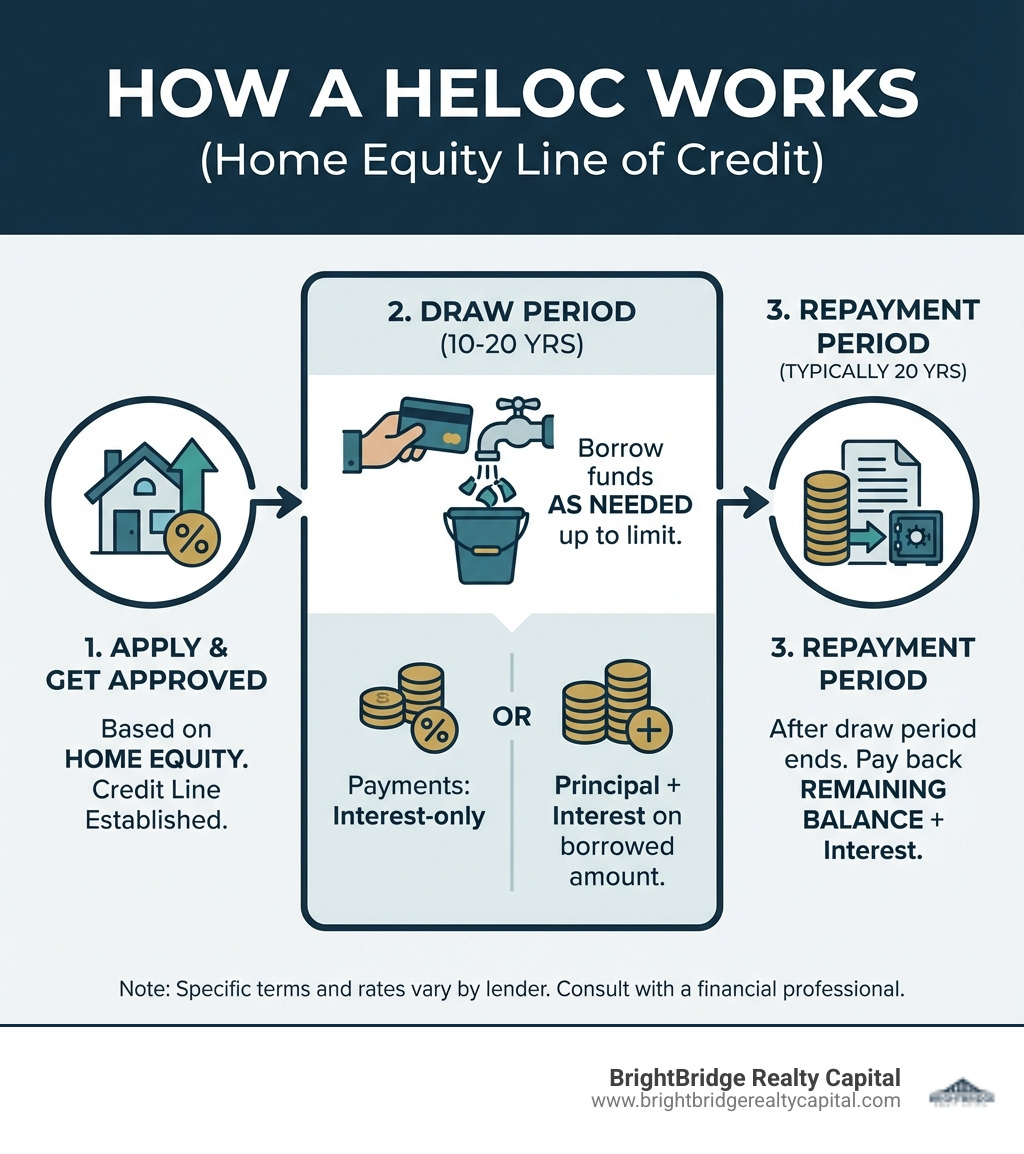
- Draw Period: This is the initial phase of your HELOC, typically lasting 10 years (though some can be 5 or 20). During this time, your HELOC acts like a credit card: you can borrow funds up to your limit, repay the balance, and borrow again. Payments during this period are often interest-only, which keeps them low but means you aren't reducing the principal balance.
- Repayment Period: Once the draw period ends, you can no longer borrow funds. The loan enters the repayment period, which typically lasts 10 to 20 years. Your outstanding balance is amortized over this term, and you must begin making regular principal and interest payments. This is a critical transition: your monthly payment can increase substantially, especially if you were making interest-only payments before. You must budget for this future payment shock.
- Variable vs. Fixed Rates: Most HELOCs have a variable interest rate. This rate is composed of two parts: an Index and a Margin. The Index is a benchmark rate that fluctuates with the market, most commonly the U.S. Prime Rate. The Margin is a fixed percentage the lender adds to the Index (e.g., Prime + 1%). Your rate changes whenever the Index changes. Some lenders offer a fixed-rate conversion option, allowing you to lock in a fixed rate on all or a portion of your outstanding balance, giving you payment stability.
- Rate Caps (Periodic and Lifetime): To protect borrowers from runaway rate increases, HELOCs often have rate caps. A periodic cap limits how much the rate can increase in a given period (e.g., no more than 2% per year). A lifetime cap limits the maximum interest rate you can ever be charged over the life of the loan (e.g., never to exceed 18%). These are vital safety features.
- APR (Annual Percentage Rate): This is the true annual cost of borrowing. It includes your interest rate plus some of the fees (like origination fees) associated with the loan, expressed as a yearly percentage. The APR is the best tool for making an apples-to-apples comparison of the cost of different loan offers.
- Prime Rate: As mentioned, this is the most common index for HELOCs. It's a benchmark interest rate used by banks and is heavily influenced by the Federal Reserve's federal funds rate. When you hear news that the Fed has raised rates, it almost always means the Prime Rate will rise, and so will your HELOC payment.
Understanding how a Home Equity Line of Credit works is crucial for successful utilization. We've got a comprehensive guide to help you further at How Does a Home Equity Line of Credit Work.
How to Qualify and Secure the Best HELOC Rates
Getting a HELOC isn't just about having equity in your home; it's about presenting a strong financial profile that assures lenders of your ability to manage the debt responsibly. Think of it as a financial health check-up. The better your vital signs—credit score, income, and existing debt—the better the HELOC rates and terms you'll be offered.
Factors That Influence Your Personal HELOC Rates
While market trends set the baseline, your individual financial situation is what truly determines your offer. Lenders use a practice called risk-based pricing, meaning they assess your personal risk level and adjust your rate accordingly. Here’s what they scrutinize:
Credit Score: This is paramount. Your FICO score is a snapshot of your creditworthiness. Lenders use it to predict the likelihood you'll repay your debt. To secure the best rates, you'll generally need a score of 740 or higher. While some lenders offer HELOCs to borrowers with scores in the 600s, the rates will be significantly higher, and the terms less favorable. A lower score signals higher risk, which lenders price into your rate. If your score is borderline, it can be worth taking a few months to improve it before applying.
Home Equity and Loan-to-Value (LTV) Ratio: Your available equity is the foundation of the loan. Lenders calculate your Combined Loan-to-Value (CLTV) ratio to determine how much you can borrow. The formula is:
(Current Mortgage Balance + Desired HELOC Limit) / Home's Appraised Value. Most lenders cap the CLTV at 80% or 85%. For example, on a $500,000 home with a $250,000 mortgage, an 85% CLTV means your total debt can't exceed $425,000. This leaves you with a potential HELOC of up to $175,000 ($425,000 - $250,000). A lower CLTV (meaning you're borrowing less against your home's value) is less risky for the lender and can result in a better interest rate.Debt-to-Income (DTI) Ratio: Your DTI ratio shows how much of your gross monthly income is consumed by debt payments. The formula is:
Total Monthly Debt Payments / Gross Monthly Income. This includes your mortgage, car loans, student loans, credit card minimums, and the potential new HELOC payment. Lenders typically want to see a DTI of 43% or lower. A high DTI suggests you might be overextended and could struggle to handle an additional payment, making you a riskier borrower.Income and Employment Stability: Lenders need to be confident that you have a stable, verifiable source of income to make your payments. They will typically ask for pay stubs, W-2s, and tax returns. For self-employed individuals or real estate investors, this may require more extensive documentation, such as several years of business tax returns and profit-and-loss statements. A long, stable employment history is a significant positive factor.
Lender Relationship: While not a formal metric, having a long-standing, positive relationship with a bank or credit union can sometimes provide a slight edge. They may offer relationship discounts on rates or fees to retain you as a customer. However, you should never assume your current bank will offer the best deal.
For our real estate investors looking at financing for their properties, these factors are even more critical. We specialize in solutions like HELOC Rates for Investment Property, where understanding these metrics is key.
Expert Tips for Finding the Best Offer
Finding the best HELOC rates is an active process. Don't just accept the first offer you get. Be a savvy shopper and a smart negotiator.
- Compare Multiple Offers: This is the single most important step. Get quotes from at least three to five different types of lenders: large national banks, smaller regional banks, credit unions (which often have great rates), and online-only lenders. Compare their APRs, fees, and terms side-by-side.
- Read ALL the Fine Print: An offer with a low introductory 'teaser' rate might look appealing, but you must know what the fully indexed rate (Index + Margin) will be after the promotional period ends. Pay close attention to rate caps, all fees (origination, annual, inactivity, early closure), and the terms of the draw and repayment periods.
- Negotiate Terms: If you have a strong financial profile, you have leverage. Don't be afraid to ask a lender if they can match a competitor's lower rate or waive a specific fee. The worst they can say is no, but you might be surprised at their flexibility.
- Prepare Your Documents in Advance: The application process will be much smoother if you have all your financial documents ready. This includes recent pay stubs, W-2s for the last two years, federal tax returns, bank statements, and statements for any existing mortgages or debts. Being organized shows you're a serious, responsible borrower.
- Understand the Draw and Repayment Periods: Make sure the loan structure aligns with your goals. If you need a long draw period for an extended project, confirm the lender offers it. More importantly, calculate what your estimated payment will be when the repayment period begins to ensure you can afford the increase.
- Consider Working with Specialists: For non-standard situations, like securing a HELOC on an investment property or if you're self-employed, a specialist lender like BrightBridge Realty Capital can be invaluable. We understand the unique challenges and can offer more flexible underwriting and products like a No-Doc Equity Line that traditional banks may not provide.
- Don't Try to Time the Market Perfectly: As one expert wisely put it, "Don't put your life on hold to play the market, as you can never forecast what the market will do perfectly." While it's good to be aware of rate trends, if you need the funds for a valuable project or investment, focus on securing the best rate available now that works for your budget.
Frequently Asked Questions about HELOCs
We hear a lot of great questions about HELOCs, and we're always happy to provide clear, straightforward answers. Let's tackle some of the most common inquiries to help you better understand this flexible financial tool.
What are the tax implications of a HELOC?
This is a critical question, as the rules changed significantly with the Tax Cuts and Jobs Act of 2017. The interest you pay on a HELOC can be tax-deductible, but only under specific conditions.
The Golden Rule: According to the IRS, interest paid on home equity debt is deductible only if the funds are used to "buy, build, or substantially improve" the home that secures the loan. A "substantial improvement" is one that adds value to your home, prolongs its useful life, or adapts it to new uses. Examples include renovating a kitchen, adding a new bathroom, building a deck, or replacing the roof.
The Catch: If you use the HELOC for personal expenses, the interest is not deductible. This includes using the funds to consolidate credit card debt, pay for a vacation, cover tuition costs, purchase a vehicle, or invest in the stock market. Meticulous record-keeping is essential to prove how the funds were used in case of an audit.
Loan Limits: The deduction is also subject to limits. For individuals, the total amount of home acquisition debt (which includes your primary mortgage plus any qualifying HELOCs or home equity loans) cannot exceed $750,000 ($375,000 if married filing separately). For example, if you have a $600,000 mortgage and take out a $200,000 HELOC for a home addition, your total debt is $800,000. You can only deduct the interest on the first $750,000 of that debt.
Because tax laws are complex, we always strongly advise consulting a qualified tax professional for guidance specific to your situation. For the official word, you can refer to the IRS directly: Interest paid on a HELOC is tax deductible under certain conditions, according to the IRS.
What are the pros and cons of using a HELOC?
Like any financial product, a HELOC has powerful advantages and significant risks. Weighing them carefully is key.
Pros:
- Unmatched Flexibility: It's a revolving line of credit. You can draw funds, repay them, and draw them again as needed, which is perfect for projects with uncertain timelines or costs.
- Lower Interest Rates: Because your home secures the loan, HELOC rates are substantially lower than unsecured debt like credit cards and personal loans, saving you a great deal in interest charges.
- Interest-Only Payments: Many HELOCs offer an interest-only payment option during the draw period. This keeps initial monthly payments very low, freeing up cash flow for other needs.
- Borrow Only What You Need: Unlike a lump-sum loan, you only pay interest on the amount you've actually borrowed, not the entire credit line.
- Convenient Access: Accessing your funds is simple, often through online transfers, special checks, or a dedicated debit/credit card.
Cons:
- Variable Rate Risk: The biggest drawback is the variable interest rate. If the Prime Rate rises, your monthly payment will increase. A series of rate hikes can significantly impact your budget.
- Risk of Foreclosure: This is the most serious risk. Your home is the collateral. If you are unable to make your payments for any reason, the lender can foreclose on your property.
- Temptation to Overspend: The ease of access can be a double-edged sword. It can be tempting to use the HELOC as an ATM for discretionary spending, leading to a large debt balance that can be difficult to repay.
- Potential for Payment Shock: The transition from an interest-only draw period to a principal-and-interest repayment period can cause your monthly payment to double or even triple, creating a significant financial shock if you aren't prepared.
- Fees and Costs: As detailed earlier, various fees (annual, inactivity, closing costs) can add to the overall cost of the loan.
Can I get a HELOC on an investment property or second home?
Yes, it is possible, but it's more challenging and the terms are typically less favorable than for a primary residence. Lenders view loans on non-owner-occupied properties as higher risk. As a result, they will often require a higher credit score, a lower loan-to-value (LTV) ratio (often capping it at 70-75%), and may charge a higher interest rate (a larger margin over the Prime Rate). Not all lenders offer HELOCs on investment properties, so you will need to seek out those that specialize in this area, like BrightBridge Realty Capital.
What happens to my HELOC if I sell my home?
A HELOC is a lien against your property, so it must be paid off when you sell the home. The outstanding balance of your HELOC will be paid off from the proceeds of the sale at closing, just like your primary mortgage. Once the HELOC is paid in full, the account is closed.
What are the current trends in the HELOC market?
The HELOC market is constantly evolving. Here are some key trends we're observing:
- Surge in Tappable Equity: Homeowners across the nation are sitting on record levels of home equity due to years of property value appreciation. This massive pool of wealth is the primary fuel for the growth in the home equity lending market.
- The 'Rate-Lock' Effect: Many homeowners are hesitant to sell and move because they don't want to give up the ultra-low mortgage rate they secured years ago. This 'rate-lock' effect encourages them to stay put and use their equity via a HELOC or home equity loan to fund renovations and upgrades instead of buying a new, more expensive house at a higher mortgage rate. You can read more about this trend on our site: Homeowners are Staying put and Tapping Equity Products.
- Rise of Debt Consolidation: While home improvements remain a popular use, there has been a significant increase in borrowers using HELOCs to consolidate high-interest debt from credit cards and personal loans. With rates on unsecured debt soaring, a HELOC offers a much cheaper way to manage and pay down these balances.
- Lender Optimism and Competition: Despite economic fluctuations, lenders remain optimistic about the growth of the home equity market. This optimism is fueling competition, leading to more innovative products, promotional offers, and a greater willingness to work with well-qualified borrowers.
Conclusion
The current landscape of HELOC rates presents an exciting opportunity for homeowners and real estate investors alike. With average rates dipping to levels not seen since early 2023, and remaining significantly lower than other forms of credit, a HELOC can be a powerful tool for achieving your financial objectives.
We've covered the crucial factors driving these rates, from Federal Reserve actions to lender competition, and explored how HELOCs stand apart from home equity loans and other credit options. Understanding the fine print, including fees and key terms like draw and repayment periods, is paramount to borrowing responsibly.
Securing the best HELOC rates involves more than just market timing; it requires understanding your own financial profile—your credit score, equity, and debt-to-income ratio—and being a proactive shopper. Compare offers, read every detail, and don't hesitate to negotiate.
At BrightBridge Realty Capital, we specialize in providing customized, flexible financing solutions for real estate investors. Whether you're looking to fund your next fix-and-flip, expand your rental portfolio, or simply leverage your home equity strategically, we're here to help you steer the market and find the best fit for your needs. We believe in providing fast closings and a seamless process, letting you put your equity to work quickly and efficiently.
Don't let opportunity pass you by. Explore how we can help you open up your home's potential and achieve your investment goals. We're ready to partner with you on your financial journey.