Unlock Your Portfolio: The Best Investor-Friendly Mortgage Lenders

Summary
Unlock your portfolio! Learn to qualify for investment loans and find the best investor friendly mortgage lender to scale your real estate.
Why Finding an Investor-Friendly Mortgage Lender Makes or Breaks Your Portfolio

An investor-friendly mortgage lender is a financial institution or private lending entity that specializes in meeting the unique needs of real estate investors through flexible underwriting, competitive rates, and fast closings. Unlike traditional retail banks that primarily serve owner-occupant homebuyers, these lenders have built their entire business model around financing income-producing properties. They understand that for an investor, a property is not a home; it's a business asset, an entry on a balance sheet. Their processes, products, and personnel are all aligned with the goal of helping you acquire and manage these assets effectively. This distinction is not merely semantic—it fundamentally alters every step of the borrowing process, from initial qualification to long-term portfolio management.
Unlike traditional lenders focused on primary residences, these lenders understand rental income, cash flow analysis, and portfolio expansion strategies. They speak the language of cap rates, net operating income (NOI), and the BRRRR (Buy, Rehab, Rent, Refinance, Repeat) method. They won't be thrown off by an applicant with ten existing mortgages or income derived from multiple LLCs; in fact, they expect it.
Key Traits of Investor-Friendly Lenders:
- Flexible Qualification Methods: Instead of relying solely on traditional W-2 income and personal debt-to-income ratios, they use more relevant metrics. This includes using a percentage of projected or actual rental income (typically 75% of gross rents to account for vacancy and maintenance), qualifying based on the property's Debt Service Coverage Ratio (DSCR), or verifying income through 12-24 months of bank statements for self-employed investors. This flexibility acknowledges that an investor's financial picture is often more complex than a salaried employee's.
- Portfolio Loan Products: Their product suite is built for investors. This goes far beyond conventional 30-year fixed loans. It includes specialized investment property mortgages, short-term bridge financing for fix-and-flips, hard money loans for distressed properties, and, most importantly, DSCR loans that qualify the property, not the person. They also offer portfolio loans, which can blanket multiple properties under a single mortgage, simplifying management and freeing up borrowing capacity.
- Fast Closings: In the competitive world of real estate investing, speed is a weapon. Investors often compete with all-cash offers, and a 45-day closing timeline from a traditional bank can mean a lost deal. Investor-friendly lenders, particularly direct private lenders, have streamlined processes that can lead to closings in as little as 1-3 weeks. This agility allows investors to make more aggressive and appealing offers.
- Higher Loan Limits & Scalability: Conventional lending guidelines from Fannie Mae and Freddie Mac typically cap an individual borrower at 10 financed properties. For an ambitious investor, this is a significant roadblock. Investor-friendly lenders do not have these constraints. They offer portfolio loans and other products that allow investors to scale well beyond this limit, enabling the growth of a substantial real estate empire.
- Direct Lending & Decision-Making: Many of these lenders are direct portfolio lenders, meaning they use their own capital and make their own rules. This eliminates the multiple layers of bureaucracy found at large banks. You often work directly with decision-makers who understand the nuances of your deal, leading to more common-sense underwriting and faster, more reliable answers.
Real estate investors face a fundamentally different challenge than homebuyers. While someone buying a primary residence might secure a loan with 3-5% down and a sub-4% interest rate, investment properties typically require a 20-25% down payment minimum and carry rates 0.25%-1.00% higher than primary home loans.
The difference isn't arbitrary. Lenders view investment properties as riskier due to vacancy periods, market fluctuations, tenant-related issues, and the statistical reality that borrowers will prioritize their own home payment over a rental property during financial hardship. Consider this common scenario: an investor with a strong credit score and significant assets is denied a $400,000 loan by their personal bank because their personal DTI is slightly too high. The bank's automated underwriting system sees only personal debt and W-2 income. An investor-friendly lender, however, would look at the same file and see a property projected to generate $3,500 in monthly rent. By factoring in 75% of that rental income ($2,625), they can easily offset the new mortgage payment, leading to an approval. This is where truly investor-friendly lenders separate themselves from traditional banks. They don't just tolerate investment properties—they specialize in them. They understand DSCR ratios, know how to evaluate rental comps, and structure loans that protect your cash flow while helping you scale.
At BrightBridge Realty Capital, our loan officers are not just mortgage originators; they are investment financing strategists. We specialize in helping investors navigate complex financing structures and find the right investor-friendly mortgage lender for their portfolio goals. We've helped clients structure everything from their first rental purchase to complex multi-property portfolio loans, always focusing on speed, transparency, and deals that actually make financial sense.
Investment vs. Traditional Mortgages: Understanding the Key Differences
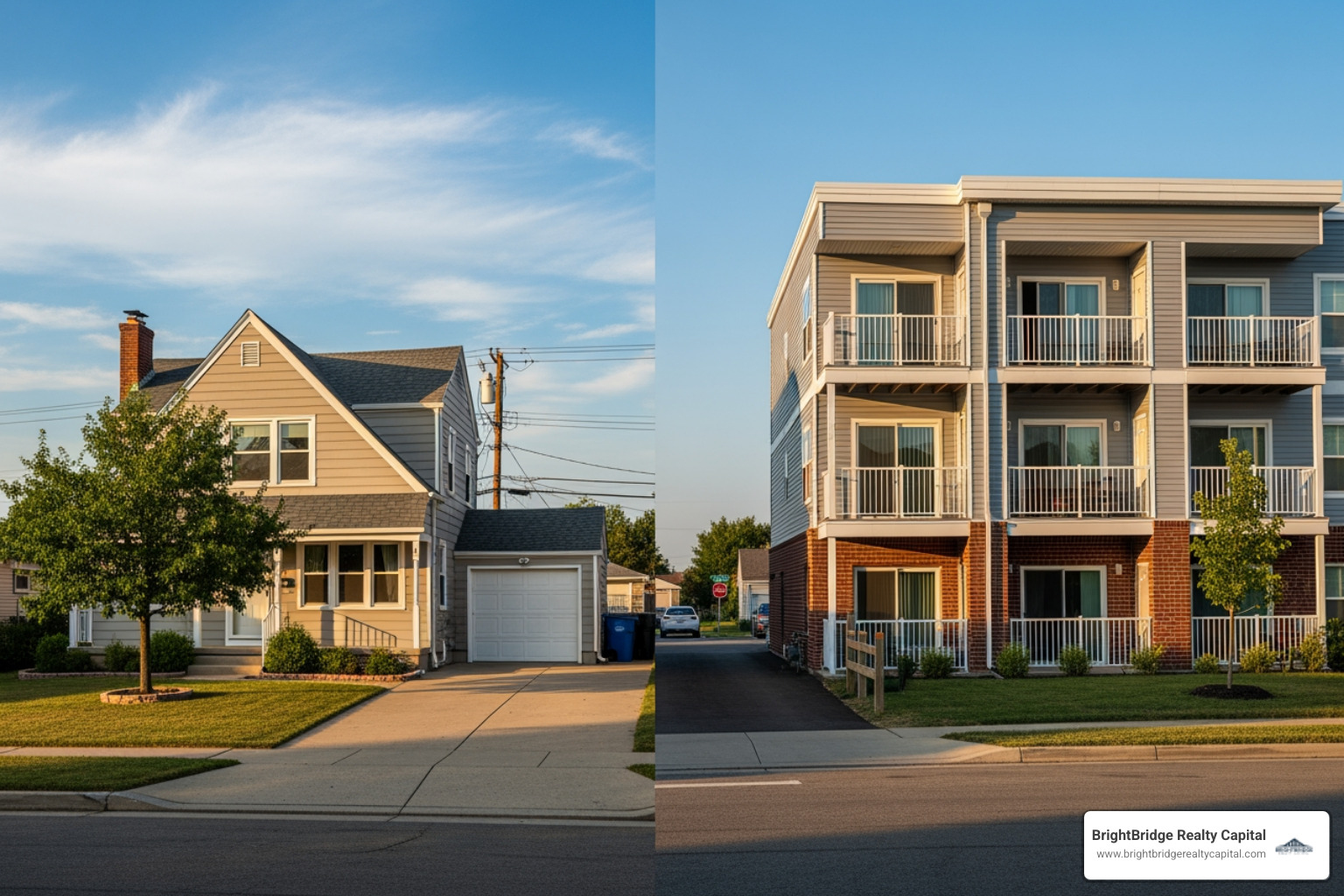
When we talk about mortgages, it's easy to assume they're all cut from the same cloth. But for real estate investors, understanding the fundamental differences between a loan for your primary residence and one for an investment property is crucial. It’s like comparing a cozy family sedan to a heavy-duty pickup truck – both are vehicles, but they’re engineered for vastly different purposes, have different performance capabilities, and are subject to different rules of the road. The sedan is about comfort and personal use; the truck is about utility, hauling capacity, and getting a job done. Similarly, a primary mortgage is about securing shelter, while an investment mortgage is a commercial instrument designed to generate profit.
The key distinction lies in the lender's perspective on risk and purpose. For your primary home, the loan is often seen as a personal commitment tied to your stability and well-being. Lenders know you will do almost anything to avoid losing your family's home. For an investment property, however, it's a business venture. The lender is essentially your business partner, and they are underwriting the viability of the business itself—the property's income-generating potential and your ability to manage it—not just your personal financial stability.
Higher Stakes, Higher Standards
This business-centric view leads to stricter requirements across the board. One of the first and most significant hurdles is the down payment. While government-backed programs like FHA and conventional loans with Private Mortgage Insurance (PMI) allow homebuyers to put down as little as 3-5% for a primary residence, these options are generally not available for investment properties. Investors are typically required to make a minimum down payment of 20%, and often 25% or more, especially for multi-unit properties or for investors with several existing mortgages. This larger down payment serves two purposes for the lender: it reduces their loan-to-value (LTV) ratio, giving them a bigger equity cushion, and it demonstrates that the investor has significant "skin in the game," making them less likely to walk away if the investment sours.
Then there's the interest rate. It's standard practice for investment property mortgages to carry rates that are 0.25% to 1.00% higher than those for primary homes. This is a direct reflection of risk-based pricing. Lenders perceive a higher probability of default on investment properties. They worry about potential vacancies leaving you without rental income, unexpected major repairs draining your cash reserves, and the simple fact that in a financial crisis, the rental property mortgage is the one you're more likely to stop paying first. This rate premium is the lender's compensation for taking on that elevated risk.
Table: Conventional vs. Investment Property Loans
| Feature | Primary Residence Loan | Investment Property Loan |
|---|---|---|
| Down Payment | As low as 3-5% (with mortgage insurance) | Typically 20-25% minimum, no PMI available |
| Interest Rates | Generally lower (baseline rates) | 0.25-1.00% higher due to increased risk premium |
| LTV Ratio | Higher (e.g., up to 97%) | Lower (e.g., 75-80% maximum) |
| Qualification | Focus on borrower's personal income (W-2s), credit, DTI | Focus on property's rental income (DSCR), borrower's experience, liquidity, and credit |
| Risk Perception | Lower (personal commitment, emotional attachment) | Higher (business venture, subject to market/tenant risk) |
| Purpose | Personal shelter | Rental income, capital appreciation, business profit |
| Appraisal Method | Primarily Sales Comparison Approach | Sales Comparison, Income, and Cost Approaches |
| Loan Programs | FHA, VA, USDA, Conventional | Conventional, DSCR, Portfolio, Bridge, Hard Money |
How Lenders and Appraisers View Your Application Differently
Lender scrutiny for investment properties is significantly more rigorous and multi-faceted. They're not just checking your credit score and income; they're conducting a full risk assessment of your potential business. This includes evaluating your experience as an investor. A first-time investor may face tougher terms than a seasoned professional with a proven track record of successfully managing rentals. They'll also scrutinize your liquidity, requiring you to have substantial cash reserves (often 6 months of PITI payments for each property) to weather vacancies or unexpected costs.
Furthermore, the property appraisal process itself is different. For a primary home, an appraiser primarily uses the Sales Comparison Approach, looking at what similar nearby homes have recently sold for. For an investment property, the appraiser will still use this approach, but they will also heavily weigh the Income Approach. This method values the property based on the amount of income it's expected to generate, using market rent data and operating expense ratios. A property that can't generate enough rent to be profitable will receive a lower valuation, regardless of what a similar building next door sold for. This ensures the lender is not over-extending on an underperforming asset.
At BrightBridge Realty Capital, we understand these nuances intimately. We know that for our New York City investors, every percentage point, every underwriting detail, and every day saved in the closing process matters. Our goal is to connect you with an investor-friendly mortgage lender who speaks your language, understands your investment goals, and has the tools and flexibility to help you navigate these higher standards with confidence and success.
How to Qualify: A Step-by-Step Guide to Getting Approved

Getting approved for an investment property mortgage can feel like assembling a complex puzzle, but with the right pieces and a clear strategy, it's entirely achievable. The key is to think like the lender and proactively provide everything they need to see you as a low-risk, high-potential borrower. We're here to guide you through the process, ensuring you're financially prepared and have all your ducks in a row for a smooth loan approval.
Assembling Your Comprehensive Documentation Package
Lenders for investment properties are thorough, and rightfully so. They need to be confident in your ability to manage the financial obligations of the investment, which is a business. This means providing a comprehensive set of documents that paint a full picture of your financial health and the property's potential.
- Income Verification: This is more than just your last two pay stubs. Expect to provide at least two years of complete federal tax returns, including all schedules. Lenders will pay close attention to Schedule E (Supplemental Income and Loss), where you report income from rental properties. If you're self-employed or have significant business income, lenders will typically ask for 12-24 months of business or personal bank statements to verify income, especially for specialized "Bank Statement" loan programs. They'll analyze deposit streams to establish a consistent, qualifiable monthly income, often applying an expense factor to the gross deposits.
- Credit Reports and History: Your FICO score is a critical gateway. While it's possible to get some loans with scores in the 600s, lenders usually look for a strong credit history with scores of 700, 720, or even 740+ to secure the best rates and terms. They will scrutinize the full report for any late payments (especially on other mortgages), high credit utilization, or recent credit inquiries that could signal financial distress. A clean, long-standing credit history is paramount.
- Asset and Reserve Details: You must prove you have sufficient liquid assets. This includes providing complete bank statements (all pages) and investment account statements to demonstrate you have the funds for the down payment, all closing costs, and the required post-closing liquidity (reserves). Lenders typically require 3-6 months of PITI (Principal, Interest, Taxes, and Insurance) payments in reserve for each financed property you own, including the one you're buying. These funds must be seasoned, meaning they have been in your account for a certain period (usually 60 days).
- Property and Deal Information: This is where the investment aspect really shines. You'll need to provide the fully executed purchase contract, details about the property (address, number of units, square footage), and, crucially, information on its income potential. This can include any existing lease agreements for a tenanted property or a professional market rent analysis (like an appraiser-prepared Form 1007) for a vacant one to support your income claims.
The Power of Rental Income in Your Application
This is a game-changer for investors and a key differentiator of an investor-friendly lender. Unlike a primary residence mortgage where only your personal income matters, the investment property itself can help you qualify. Lenders evaluate potential rental income to offset the new mortgage payment. A common rule of thumb is that lenders will use approximately 75% of the gross monthly rent. The 25% haircut is to account for potential vacancy and ongoing maintenance expenses. For example, if your property is projected to rent for $2,000 per month, a lender will add $1,500 to your qualifying income or use it to directly reduce the housing payment in your DTI calculation.
This calculation is often formalized in a Debt Service Coverage Ratio (DSCR) analysis, especially for DSCR loans. The formula is DSCR = Net Operating Income (NOI) / Total Debt Service. NOI is calculated as Gross Rental Income minus operating expenses (like taxes, insurance, management fees, utilities, and a vacancy factor). The goal is to ensure the property's income can comfortably cover its mortgage payments, with most lenders looking for a DSCR of 1.20x or higher.
Proactively Boosting Your Approval Odds
To present the strongest possible case to an investor-friendly mortgage lender, take these actionable steps well before you apply:
- Aggressively Reduce Your DTI Ratio: The less personal debt you carry, the more capacity you have for a new mortgage. Focus on paying down high-interest credit cards, auto loans, and personal loans. Avoid taking on any new debt in the months leading up to your application.
- Optimize Your Credit Score: Aim for a credit score well above 740. Pay all bills on time, keep credit card balances below 30% of their limits, and dispute any errors on your credit report. A higher score not only increases your approval chances but also directly impacts your interest rate and costs.
- Increase Your Down Payment: While 20-25% is the typical minimum, putting down 30% or more can significantly reduce the lender's perceived risk. This can lead to more favorable terms, a lower interest rate, and may help you avoid certain loan-level price adjustments (LLPAs) that increase closing costs.
- Build and Document Cash Reserves: Start saving early. Lenders want to see a stable, seasoned pool of liquid assets. This demonstrates your ability to weather unexpected costs or vacant periods without missing a mortgage payment. Having 6-12 months of reserves can make a lender much more comfortable with your file.
- Prepare a Business Plan for Vacant Properties: If you're buying a vacant property, don't let that be a weakness. Present the lender with a clear plan, including a detailed renovation budget, a timeline for completion, and a marketing strategy for securing a tenant, supported by market rent comps. This shows you are a proactive and professional operator.
What Makes a Mortgage Lender Truly 'Investor-Friendly'?
So, what exactly lifts a run-of-the-mill mortgage provider to the coveted status of an investor-friendly mortgage lender? It's more than just a slogan on their website or a willingness to finance a duplex. It’s a fundamental philosophy woven into their corporate DNA, a deep, institutional understanding of the investor's journey, and a suite of tools designed to facilitate wealth creation through real estate. For us at BrightBridge Realty Capital, being investor-friendly means providing the critical trifecta of speed, flexibility, and scalability that traditional banks often can't or won't match.
The Definitive Traits of an Investor-Friendly Mortgage Lender
An truly investor-friendly mortgage lender is a specialist, not a generalist. They recognize that an investment property is a business asset, and they underwrite it as such. Here are the non-negotiable traits we believe define them:
- Deep Understanding of Investor Strategies: They don't just process paperwork; they grasp your investment strategy. Whether you're executing a BRRRR (Buy, Rehab, Rent, Refinance, Repeat) strategy, building a long-term buy-and-hold portfolio, or engaging in short-term fix-and-flips, they understand the unique financing needs at each stage. They act as a strategic partner, not just a transactional service provider.
- A Specialized Menu of Loan Products: Their product offerings are a clear indicator of their focus. They move far beyond standard conventional loans, offering a diverse menu designed specifically for investors. This is where you find the powerful tools of the trade.
- Flexible and Realistic Underwriting: They understand that investors often have complex financials, with income from multiple sources, numerous LLCs, and significant tax write-offs. Their underwriting processes are designed to accommodate these realities, using common-sense approaches rather than rigidly adhering to the narrow box of W-2 income and perfect credit scores.
- Obsession with Fast Closings: Time kills deals. An investor-friendly mortgage lender prioritizes efficiency, often able to close deals in 7-21 days. This speed is a competitive advantage, allowing investors to compete with cash buyers and lock down opportunities in fast-moving markets like New York. Our unique selling proposition at BrightBridge Realty Capital is precisely this speed and seamless process.
- Streamlined Paperwork: While documentation is always necessary, these lenders strive to eliminate redundancy and focus on what's truly essential to evaluate the deal and the borrower. They won't ask for the same document five times or get bogged down in trivialities.
- Relationship-Based, Long-Term Lending: They value long-term relationships, understanding that today's single-property investor could be tomorrow's multi-property mogul. They are often direct lenders, which means fewer intermediaries, more direct communication, and a commitment to your continued success.
- Built-in Scalability Support: They offer solutions that support your growth. This means no arbitrary limits on the number of properties you can finance and providing access to portfolio loans that can grow with you as you expand your holdings.
Exploring Your Mortgage Product Choices: The Investor's Toolbox
The world of investment property mortgages is rich with options, each a specific tool for a specific job. An investor-friendly mortgage lender will offer a range of these products:
- Fixed-Rate Rental Property Loans: The workhorse for buy-and-hold investors. Available in 30, 20, and 15-year terms, they offer stability with consistent monthly payments, protecting you from interest rate fluctuations and making cash flow projections reliable.
- Adjustable-Rate Rental Property Loans (ARMs): These loans (e.g., 5/1, 7/1, 10/1 ARMs) offer a lower interest rate for an initial fixed period, after which the rate adjusts based on a market index. They can be advantageous if you plan to sell or refinance before the first adjustment period ends, or in a declining rate environment.
- Portfolio Rental Loans: These are loans kept "in-house" on the lender's own balance sheet rather than being sold on the secondary market. This gives the lender immense flexibility in underwriting and terms. They can be used to finance unique properties (like a mixed-use building) or to create a blanket loan covering multiple properties, simplifying payments and management.
- DSCR (Debt Service Coverage Ratio) Loans: The ultimate tool for experienced investors. These loans qualify the borrower based almost entirely on the property's cash flow, not personal income. If the property's Net Operating Income covers the mortgage payment by a certain ratio (e.g., 1.25x), you can be approved, regardless of your personal DTI. This is how investors scale their portfolios rapidly.
- Bridge Loans for Investment Properties: Short-term loans (typically 12-24 months) used to "bridge" a gap in financing. They are perfect for acquiring a property quickly, funding renovations, and stabilizing it with a tenant before refinancing into a long-term, permanent loan (the final "R" in BRRRR).
- Bank Statement Qualifying Loans: A lifeline for self-employed investors and entrepreneurs. Instead of tax returns, which may show low taxable income due to business deductions, these loans use 12-24 months of bank statements to verify income based on consistent deposit history. This allows successful business owners to access financing that traditional lenders would deny.
Finding the Right Investor-Friendly Mortgage Lender for Your Portfolio
Comparing lenders is not just about finding the lowest rate. It's about finding the best partner. When vetting a potential lender, ask pointed questions:
- What are your typical closing times for an investment property in my market?
- Do you offer DSCR, Bank Statement, and Bridge loan programs?
- What are your reserve requirements for an investor with [X] properties?
- Is there a limit to the number of properties I can finance with you?
- Can you finance a property held in an LLC?
- What are all the fees associated with this loan (origination, underwriting, processing, points)?
- Does this loan have a prepayment penalty? If so, how is it structured?
Working with a direct lender like BrightBridge Realty Capital often means faster processing, fewer headaches, and more direct access to decision-makers, which can be invaluable in a competitive market like New York. We connect you directly with the capital you need, without the unnecessary and time-consuming layers of intermediaries.
Managing Your Investments and Mitigating Risk
Investing in real estate is a marathon, not a sprint. Securing financing from an investor-friendly mortgage lender is a critical first step, but the real work of wealth creation happens over the long term through diligent management and proactive risk mitigation. Once you close on your first (or fifth!) property, your focus must shift to optimizing operations and protecting your assets. We want to ensure your portfolio thrives, not just survives.
Best Practices for Juggling Multiple Mortgages and Properties
As your portfolio grows, complexity increases exponentially. Managing one mortgage is simple; managing ten requires a system. Here's how to keep all those balls in the air:
- Centralize and Automate: Set up automatic payments for all your mortgages, insurance premiums, and property taxes. Use a single, dedicated business checking account for all rental income and a separate one for security deposits to avoid commingling funds. This simplifies bookkeeping and ensures you never miss a critical payment that could damage your credit.
- Leverage Technology: Use property management software (like AppFolio, Buildium, or even free options like Stessa) to track income and expenses for each property. This is not just for tax purposes; it provides real-time data on your portfolio's performance, allowing you to identify underperforming assets, track maintenance costs, and analyze cash flow trends.
- Maintain Robust Reserve Funds: This cannot be overstated. Beyond the reserves required for loan qualification, you must consistently build and maintain a separate, liquid emergency fund for your portfolio. A good rule of thumb is to have at least 6 months of PITI (Principal, Interest, Taxes, Insurance) for each property. This fund is your firewall against the two biggest threats to a landlord: unexpected vacancies and major capital expenditures (like a new roof or HVAC system).
- Conduct Regular Portfolio Reviews: At least once a year, conduct a deep-dive review of your entire portfolio. Analyze each property's performance: Is cash flow meeting projections? Is the property appreciating? Are there opportunities to increase rent? This review should also assess your overall portfolio metrics, such as total equity, portfolio-level LTV, and geographic or asset-type concentration.
- Strategic Refinancing: Don't just set and forget your mortgages. Keep an eye on interest rates and your properties' appreciation. A rate-and-term refinance can lower your monthly payments and boost cash flow. A cash-out refinance allows you to pull out equity from a performing asset, providing the capital for a down payment on your next acquisition. Be aware of lender "seasoning" requirements, which typically require you to own a property for 6-12 months before they will allow a cash-out refinance.
Navigating Market Shifts, Taxes, and Inevitable Risks
The real estate market is dynamic, and the financial landscape is always changing. Successful investors anticipate and adapt to these shifts.
Primary Investment Risks and Mitigation:
- Vacancy Risk: No property stays occupied 100% of the time. Budget for a vacancy rate of 5-10% of the gross annual rent. To mitigate this, focus on tenant retention through excellent service and proactive maintenance.
- Interest Rate Risk: If you use Adjustable-Rate Mortgages (ARMs), rising rates can crush your cash flow. Understand your ARM's caps and be prepared for the worst-case scenario. Many long-term investors prefer the stability of fixed-rate mortgages for this reason.
- Maintenance and CapEx Risk: Plan to budget 1-2% of the property's value each year for routine maintenance and major capital expenditures. A $300,000 property needs $3,000-$6,000 set aside annually for these costs.
- Tenant Risk: A bad tenant can be more costly than a vacancy. Implement a rigorous tenant screening process, including credit checks, background checks, employment verification, and references from previous landlords.
Maximizing Tax Advantages: A mortgage on an investment property unlocks significant tax benefits. Consult with a tax professional, but understand these key deductions:
- Mortgage Interest Deduction: The interest paid on your investment property mortgage is a primary business expense and is fully deductible.
- Property Tax Deduction: Your local property taxes are also a deductible business expense.
- Depreciation: This is a powerful "phantom" deduction. The IRS allows you to deduct a portion of your property's value (the building, not the land) over 27.5 years for residential property. This reduces your taxable income without being an actual cash expense. However, be aware of depreciation recapture when you sell.
- 1031 Exchange: When you sell a property, you'll face capital gains tax. A 1031 exchange allows you to defer paying those taxes by rolling the proceeds from the sale directly into a new, like-kind investment property.
Detailed Cash Flow Calculation: Understanding your true cash flow is the heartbeat of your investment. Here’s a more realistic calculation for a hypothetical property:Gross Scheduled Rent: $2,000/monthLess Vacancy (5%): -$100/monthEffective Gross Income: $1,900/month
Less Monthly Expenses:
- Mortgage (P&I): -$1,100
- Property Taxes: -$250
- Insurance: -$100
- Repairs/Maintenance (5%): -$100
- CapEx Savings (5%): -$100
- Property Management (8%): -$152Total Monthly Expenses: -$1,802
Net Monthly Cash Flow: $1,900 - $1,802 = $98Annual Cash Flow: $98 x 12 = $1,176
Frequently Asked Questions about Investor Mortgages
We often encounter similar questions from both new and seasoned investors in New York City. Navigating the world of investment financing can be complex, so we've compiled detailed answers to some of the most common inquiries we address.
What is a DSCR loan and how does it really work?
DSCR stands for Debt Service Coverage Ratio, and it is arguably the most powerful financing tool for scaling a real estate portfolio. A DSCR loan qualifies you based on the investment property's ability to generate enough income to cover its debt obligations, rather than on your personal salary or W-2 income.
The calculation is simple: DSCR = Net Operating Income (NOI) / Total Debt Service.
- Net Operating Income (NOI) is the property's gross rental income minus its operating expenses (e.g., property taxes, insurance, HOA fees, a vacancy factor). Note that the mortgage payment itself (principal and interest) is not included in NOI.
- Total Debt Service is the full monthly mortgage payment (Principal, Interest, Taxes, and Insurance - PITI).
Lenders look for a DSCR ratio above 1.0, which indicates the property's income covers its expenses. Most lenders require a ratio of 1.20x or higher for favorable terms. For example, if a property's NOI is $2,500/month and its PITI is $2,000/month, the DSCR is 1.25x ($2,500 / $2,000), which is a strong ratio. This loan type is a hallmark of an investor-friendly mortgage lender because it allows investors to acquire properties as long as the deals themselves make financial sense, without being limited by their personal debt-to-income ratio.
Can I get an investment property mortgage if I'm self-employed?
Absolutely! This is a common scenario, as many successful real estate investors are entrepreneurs. While traditional lenders often struggle with self-employed income due to fluctuating earnings or extensive tax write-offs that reduce taxable income, investor-friendly mortgage lenders have specific products to address this. The most popular is the Bank Statement loan.
Instead of tax returns or W-2s, lenders analyze 12 or 24 months of your business or personal bank statements to verify your income. They calculate an average monthly deposit amount and may apply an "expense factor" (e.g., 50%) to arrive at a qualifying income figure. This allows lenders to see your true, consistent cash flow, making it possible to qualify for a mortgage even if your tax returns don't show sufficient income. Another option for self-employed investors is the DSCR loan mentioned above, which bypasses personal income verification altogether.
How much cash reserves do I really need for an investment property?
This is a crucial question for risk management and a key underwriting checkpoint. Most investor-friendly mortgage lenders will require you to have a certain amount of liquid cash reserves available after you've paid your down payment and closing costs. The standard requirement is typically 3-6 months of PITI payments (Principal, Interest, Taxes, and Insurance) for the property you are acquiring.
Furthermore, many lenders will require you to have reserves for every other financed property you own as well. For example, if you own three properties with a total PITI of $6,000 and are buying a fourth with a PITI of $2,000, a lender might require you to show reserves of $24,000 (4 properties x $2,000 average PITI x 3 months). These reserves, which can be in checking/savings accounts, brokerage accounts, or retirement accounts (often at a percentage of their value), demonstrate to the lender that you can handle potential vacancies or unexpected repairs without defaulting on your mortgage.
How many investment properties can I finance?
With traditional lenders using conventional (Fannie Mae/Freddie Mac) loans, you will hit a hard wall. These guidelines typically limit an individual borrower to a maximum of 10 financed residential properties. For a serious investor, this is a major growth constraint. This is where an investor-friendly mortgage lender becomes essential. Because they offer non-conventional products like DSCR and portfolio loans, they are not bound by these limits. They can and will finance an investor's 11th, 20th, or 50th property, as long as the investor and the deals continue to meet their underwriting criteria.
Can I buy an investment property in an LLC?
Yes, and for liability protection and organizational purposes, it is highly recommended. However, most conventional loans must be made to an individual. An investor-friendly mortgage lender is well-equipped to lend to your Limited Liability Company (LLC). The process is similar, but the loan will be made in the LLC's name. As the owner of the LLC, you will almost always be required to sign a personal guarantee, which means you are still personally responsible for the debt if the LLC defaults. Lending to an LLC is a standard business practice for these specialized lenders.
What is a "seasoning" requirement?
Seasoning refers to the length of time a lender requires you to own a property before they will allow you to refinance it, particularly for a cash-out refinance. For example, in a BRRRR strategy, you buy a property, rehab it, and want to refinance to pull your cash back out. Many lenders have a seasoning requirement of 6 to 12 months. This means you must be on the property's title for that period before they will consider a new loan based on the property's higher, after-repair value (ARV). Understanding a lender's seasoning rules is critical for planning your investment timeline and capital recycling strategy.
Conclusion: Partner with the Right Lender to Scale Your Portfolio
Navigating the intricate world of investment property mortgages can be complex, but it is a challenge that can be transformed into a strategic advantage with the right financial partner. An investor-friendly mortgage lender is not just a provider of capital; they are a crucial component of your growth engine. Throughout this guide, we've explored the fundamental differences that separate investment loans from traditional home loans, detailed the rigorous requirements for qualification, defined what truly makes a lender investor-friendly, and outlined essential strategies for managing your portfolio and mitigating risk for long-term success.
The journey to building wealth through real estate is a marathon, not a sprint. It requires a solid understanding of financing instruments, a proactive approach to management, and a clear-eyed view of the risks involved. Your choice of lender directly impacts your ability to move quickly, secure favorable terms, and, most importantly, to scale your operations beyond just a few properties. The limitations of traditional banking—slow closings, rigid underwriting, and arbitrary property limits—are the very roadblocks that specialized investor lenders are designed to demolish.
The journey to building wealth through real estate is a strategic one, and choosing the right financial partner is paramount. At BrightBridge Realty Capital, we specialize in providing these customized real estate financing solutions for investors in New York City and nationwide. Our unique approach emphasizes what matters most to investors: fast closings, often within a week; flexible underwriting that looks at the whole picture; and a direct lending model without intermediaries, ensuring you get competitive rates and a seamless, transparent process.
Don't let financing be the hurdle that keeps you from unlocking your portfolio's full potential. The right loan products and the right lending partner can accelerate your journey from a single property to a thriving real estate enterprise.Get customized rental loan options and let us help you find the perfect financing solution for your next investment.