The Skinny on Bridge Loan Interest: What You Need to Know Before You Borrow

Summary
Understand bridge loan interest rates, fees & risks. Learn how to secure favorable terms and borrow confidently.
Why Bridge Loan Interest Matters More Than the Rate Alone

Bridge loan interest is the cost you pay to borrow short-term funds that help you buy a new property before selling your current one—but understanding the true cost means looking beyond just the interest rate. Here's what you need to know:
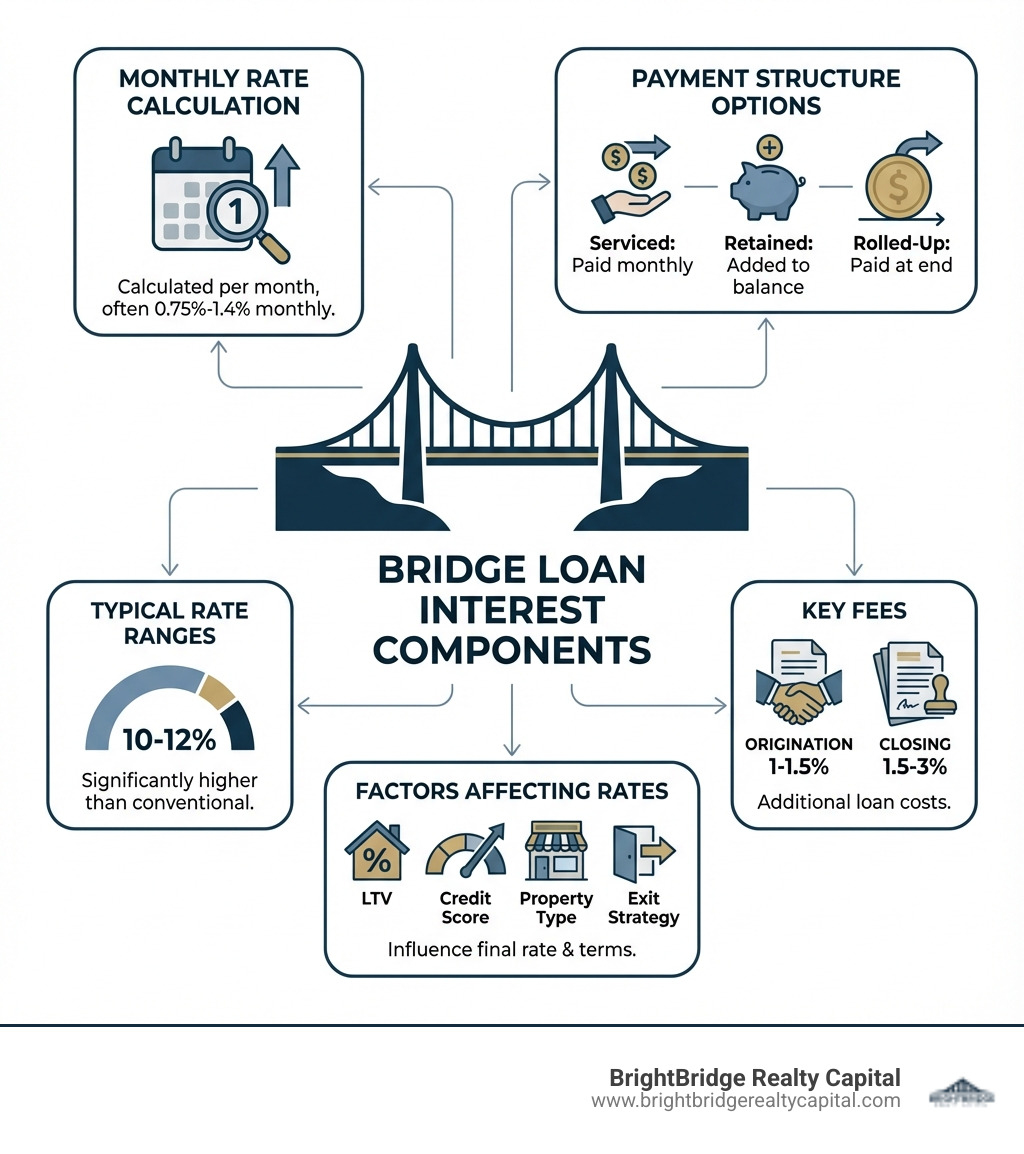
- Typical Rates: Bridge loan interest rates usually range from 10% to 12%, significantly higher than conventional mortgages (which have recently hovered around 6-7%).
- How It's Calculated: Most bridge loans charge interest monthly (e.g., 0.75%-1.4% per month in some markets), not annually like traditional mortgages.
- Payment Structures: You can pay interest monthly (serviced), have it added to your loan balance (retained), or pay it all at the end in a balloon payment (rolled-up).
- Total Cost: Beyond interest, expect origination fees (1-1.5%), closing costs (1.5-3% of loan), and potential exit or extension fees.
- What Influences Your Rate: Your loan-to-value ratio (LTV), credit score, property type, exit strategy strength, and the lender's assessment of risk all impact your final rate.
Bridge loans are designed for speed and flexibility, not long-term affordability. They bridge the gap between buying and selling, letting you make non-contingent offers in competitive markets or access your home equity fast. But that convenience comes at a price—sometimes 2-3 percentage points higher than traditional financing.
Why does this matter? If you don't understand how bridge loan interest works—how it's calculated, when it's charged, and what factors drive your rate—you could end up paying thousands more than expected or struggle to exit the loan on time.
I'm Daniel Lopez, a loan officer at BrightBridge Realty Capital, and I've helped investors and homebuyers steer bridge loan interest across residential and commercial deals, from structuring payments around renovation timelines to securing competitive rates in tight markets. My goal is to help you understand the real cost of bridge financing so you can make confident decisions that align with your investment strategy.
This guide breaks down everything you need to know: how bridge loan interest is calculated, what factors influence your rate, the hidden fees that add up, and how to secure the best terms possible. By the end, you'll know exactly what to expect—and what questions to ask your lender.
Bridge loan interest helpful reading:
Decoding Bridge Loan Interest: Key Influencing Factors
When it comes to bridge loan interest, it's not a one-size-fits-all scenario. Several dynamic factors play a crucial role in determining the rate you'll receive. Think of it like a finely tuned scale, where each element adds weight to one side or the other, ultimately impacting the cost of your loan. Understanding these factors is our first step toward securing the best possible terms.

Borrower and Property Profile
Your personal financial standing and the specifics of the property in question are paramount in how lenders assess risk and, consequently, set your bridge loan interest rate.
- Loan-to-Value (LTV): This is a big one. LTV represents the loan amount compared to the property's appraised value. For residential properties, we often see financing up to 90% of the appraised value. For commercial deals, lenders typically offer loans with 65% to 80% loan-to-cost (LTC) or up to 80% LTV based on the after-repair-value (ARV). The lower your LTV (meaning the more equity you have or the larger your down payment), the less risk you pose to the lender. This can directly translate to more favorable bridge loan interest rates. Research indicates that lower LTVs, especially below 50%, can result in significantly better rates.
- Credit Score & Liquidity: While bridge loans are often more flexible than traditional mortgages, your credit score still matters. A strong financial profile, often indicated by a credit score of 700 or higher for residential loans, will always put you in a better negotiating position. For commercial bridge loans, lenders might be less strict, sometimes approving scores below 680 (but rarely lower than 650), as their focus shifts more to the property's value. Beyond just your score, your overall financial liquidity—how much cash you can bring to the table for a larger down payment or renovations—can make a lender more comfortable, potentially leading to lower bridge loan interest.
- Debt-to-Income Ratio (DTI): Your DTI is another indicator of your ability to manage debt. Lenders typically prefer a debt-to-income ratio below 50%. A lower DTI signifies that you have more disposable income to cover potential payments, reducing the perceived risk.
- Borrower Experience: Especially in the investment real estate space, your track record speaks volumes. More experienced borrowers who have successfully completed similar projects instill greater confidence in lenders. This reduced perceived risk can lead to lower bridge loan interest rates. If you've been around the block a few times, make sure we highlight that expertise!
- Property Type: The type of property securing the loan significantly impacts the perceived risk.
- Residential vs. Commercial: Generally, residential properties (especially primary residences) are considered less risky than commercial properties.
- Asset Class: Within commercial real estate, the asset class matters. A stable, income-producing multifamily property might be seen as less risky than a vacant retail space or undeveloped land. Undeveloped land, for instance, typically falls on the higher end of the bridge loan interest rate spectrum due to its increased risk.
- Location: The property's location is always a key factor in real estate, and bridge loans are no exception. In competitive markets like New York, NY, where property values are generally strong and demand is high, lenders may offer more competitive rates due to the perceived stability and liquidity of the market.
Market Conditions and Your Exit Strategy
Even with a stellar borrower profile, external market forces and your well-defined plan for repayment heavily influence your bridge loan interest rate.
- Economic Trends: The broader economic landscape is a powerful determinant. We've seen significant shifts in recent years, with periods of Federal Reserve interest rate hikes in response to inflation, followed by discussions of potential rate adjustments. These macroeconomic movements have a trickle-down effect on lenders' pricing strategies, impacting bridge loan interest rates. The current market environment, with an upcoming wave of commercial real estate loans maturing into a higher interest rate environment, a dislocated investment sales market, credit tightening, and equity headwinds, creates a unique landscape for borrowers.
- Benchmark Rates: Bridge loan interest rates are heavily influenced by benchmark rates. Historically, LIBOR (London Interbank Offered Rate) was the primary reference rate used by financial institutions. However, the financial world has transitioned to SOFR (Secured Overnight Financing Rate).
- The Role of SOFR: SOFR is now the leading benchmark for most U.S. financial instruments, including bridge loans. It's considered more secure and accurate as it's based on actual overnight transactions backed by U.S. Treasury securities. This means that bridge loan interest rates are now tied more closely to market fluctuations in the short-term lending space. As SOFR adjusts in response to Federal Reserve policies, so too do bridge loan rates.
- Exit Strategy Strength: This is arguably one of the most critical factors. A bridge loan is, by nature, temporary. Lenders want to see a clear, viable plan for how you intend to repay the loan at the end of its term.
- Lender Assessment: We, as lenders, scrutinize your exit strategy. Is it to sell the property? Refinance into a long-term mortgage? Secure other permanent financing?
- Refinancing Plan: If your plan is to refinance, we'll assess your eligibility for that long-term loan.
- Property Sale Viability: If selling, we'll look at the market conditions, the property's appeal, and your realistic timeline. A well-defined and credible exit strategy demonstrates your ability to repay the loan, reassuring us of the short-term nature of the bridge loan and potentially leading to a more favorable bridge loan interest rate.
The True Cost: Understanding Rates, Fees, and Payment Structures
When we talk about the "cost" of a bridge loan, we're not just referring to the bridge loan interest rate. There's a whole symphony of fees and payment structures that contribute to the total expense. It's like buying a concert ticket: the face value is one thing, but then there are service charges, facility fees, and maybe even a VIP upgrade. For bridge loans, these additional costs can significantly impact your bottom line, so understanding them upfront is crucial.

Typical Bridge Loan Interest Rates and Fees
Let's explore the numbers that define the cost of bridging the gap.
- Current & Historical Rates: In the current market, bridge loan interest rates typically hover between 10% and 12%. This is a significant jump from earlier periods; for example, in early 2022, average bridge loan rates were lower, ranging from 7% to 9%. This increase is largely due to the recent inflationary cycle and the Federal Reserve's interest rate hikes. When looking at monthly rates, which are common for bridge loans, we often see them between 0.75% and 1.4% per month in the US market, which annualizes to approximately 9%-17%.
- Comparison to Traditional Mortgages: It's important to recognize that bridge loan interest rates are generally 2% to 3% higher than conventional loans for a primary residence. For context, recent conventional mortgage interest rates have been in the 6-7% range. This difference highlights that bridge loans are a premium product designed for speed and flexibility, not long-term affordability.
- Associated Fees: Beyond the interest rate, several other fees contribute to the overall cost:
- Origination Fees: This is a fee charged by the lender for processing the loan. For residential bridge loans, it typically ranges from 1% to 1.5% of the loan amount. For a $380,000 bridge loan, a 1% origination fee would be $3,800. These fees are often added to the loan amount or deducted from the proceeds.
- Closing Costs: Similar to traditional mortgages, bridge loans come with closing costs. These typically range from 1.5% to 3% of the total loan amount. These costs cover various services, including legal work, title searches, and administrative tasks.
- Appraisal Fees: Lenders require an appraisal to determine the property's value. This fee, usually around 0.1% of the property's value, is typically paid upfront.
- Legal Fees: These fees cover the legal work involved in drawing up and reviewing loan documents. While specific figures vary, they can be substantial.
- Exit Fees: While less common with some lenders, some bridge loans may include an exit fee, paid when the loan is repaid. We believe in transparency and strive to avoid these.
- APR vs. Rate: It's crucial to understand the difference between the nominal bridge loan interest rate and the Annual Percentage Rate (APR). The APR provides a more accurate picture of the total cost of borrowing by including certain fees alongside the interest rate. As LendingTree wisely points out, "understanding the full cost is crucial before committing." Always ask for the total APR, not just the base rate, to get the complete picture.
How Bridge Loan Interest Payments are Structured
The way you pay bridge loan interest can vary, and understanding these structures is key to managing your cash flow effectively.
- Serviced Interest: With serviced interest, you make regular (usually monthly) interest-only payments throughout the loan term. This option is less common for bridge loans but can be suitable if you have strong cash flow and prefer to keep your loan balance from growing.
- Retained Interest: In this structure, the interest charges are added to your loan balance. Essentially, the lender "retains" the interest from the disbursed loan amount or adds it to the principal, and you're charged interest on that new, higher balance. This means you won't make monthly payments, but the total amount you owe will increase over time.
- Rolled-Up Interest: This is often the most common repayment method for bridge loans. The interest is calculated and added to the loan balance at the outset. You don't make monthly payments; instead, all the accrued interest, along with the principal, is paid off in a single lump sum, known as a balloon payment, at the end of the loan term. While you might not pay interest on the added interest (unlike retained interest), the total amount due at the end can be significant. This structure is particularly popular because it frees up your monthly cash flow during the short loan period.
Smart Borrowing: Strategies, Risks, and Considerations
Bridge loans are powerful financial tools, but like any powerful tool, they come with both immense benefits and inherent risks. Navigating this landscape requires smart strategies and a clear understanding of the potential pitfalls. We want you to be a savvy borrower, equipped to make the best decisions for your real estate goals in New York, NY.
How to Secure a Favorable Rate
Getting a good bridge loan interest rate isn't just about luck; it's about preparation and presentation. Here's how you can position yourself for the best possible terms:
- Improve Credit & DTI: A strong financial foundation is your best friend. Work to improve your credit score (aim for 700 or higher for residential loans) and keep your debt-to-income ratio below 50%. This demonstrates to us that you're a responsible borrower with the capacity to repay.
- Increase Down Payment (Lower LTV): The more skin you have in the game, the better. By increasing your down payment, you lower the loan-to-value (LTV) ratio, which reduces the lender's risk. Lower LTVs almost always translate to lower bridge loan interest rates.
- Present a Strong Exit Strategy: This cannot be stressed enough. A clear, well-thought-out, and realistic exit strategy (how you plan to repay the loan) is paramount. Whether you intend to sell the property or refinance, having a detailed plan that demonstrates viability and a high probability of success will instill confidence in us and can lead to more favorable terms.
- Highlight Experience: If you're an experienced real estate investor, make sure we know it! Your track record of successful projects, especially in the New York, NY market, can significantly reduce the perceived risk and help you secure a lower bridge loan interest rate. We appreciate borrowers who know their stuff.
- Partner with a Specialized Lender: We at BrightBridge Realty Capital specialize in customized real estate financing solutions. Our direct lending model and expertise in the New York market mean we understand the nuances of your deals and can often offer competitive rates and a seamless process that others can't.
Understanding the Risks
While bridge loans offer incredible advantages, enter into them with open eyes. The convenience they offer comes with specific risks:
- High Cost: As we've discussed, bridge loan interest rates are inherently higher than traditional mortgages. This is the trade-off for speed, flexibility, and less stringent underwriting. If your exit strategy is delayed, these higher costs can quickly accumulate, eating into your profits or making repayment more challenging.
- Short Repayment Window: Bridge loans are short-term, typically ranging from 3 to 36 months, with many often between 6 to 12 months. This short window means you need to execute your exit strategy promptly. Delays in selling a property or securing long-term financing can create significant pressure.
- Two Mortgage Payments: The biggest potential downside is the risk of being stuck with two mortgage payments if your existing property doesn't sell as quickly as anticipated. This can place a substantial financial strain on your budget. It's a scenario we always discuss with our clients to ensure they have the financial liquidity to weather such a storm.
- Foreclosure Risk: Bridge loans are secured by real estate. If you are unable to repay the loan when it comes due, or if you miss payments, you risk losing the property (or properties) used as collateral. This is why a solid exit strategy and contingency planning are so vital. Furthermore, it's worth noting that unlike traditional mortgages, bridge loans may not always be covered by the Real Estate Settlement Procedures Act (RESPA), meaning lenders aren't always required to disclose all fees upfront. This makes asking for a detailed breakdown of all potential fees absolutely critical.
When a Bridge Loan Makes Sense
Despite the risks, bridge loans are an incredibly strategic tool in specific situations, especially in a dynamic market like New York, NY.
- Buying Before Selling: This is the classic scenario. If you've found your dream home or a lucrative investment property but haven't sold your current one, a bridge loan allows you to act quickly. It provides the funds for a down payment or even to pay off your old mortgage, giving you the flexibility to move into your new property before your old one sells.
- Making Non-Contingent Offers: In a competitive seller's market, offers contingent on the sale of your current home are often overlooked. A bridge loan empowers you to make a strong, non-contingent offer, giving you a significant edge over other buyers.
- Securing a New Property Before Listing: You might want to secure your next property before going through the hassle of listing and showing your current home. A bridge loan lets you do this, reducing the stress of a rushed sale.
- Funding Renovations or Flips: For real estate investors, bridge loans are excellent for quickly acquiring and funding renovations on a property, especially if you plan to sell it soon after completion. The speed of funding allows you to seize opportunities and get to work without delay.
- Refinancing Existing Properties: Bridge loans can also provide short-term liquidity to refinance existing properties, giving you capital for additional investments or enhancing cash flow while you arrange for more permanent financing.
A bridge loan is a powerful solution for specific, short-term needs. However, it requires careful consideration and a clear plan. We strongly emphasize consulting with a lending expert at BrightBridge Realty Capital. Our team can provide custom advice custom to your unique situation in New York, NY, helping you determine if a bridge loan is the right strategic fit for your goals.
Frequently Asked Questions About Bridge Loan Interest
We hear a lot of questions about bridge loan interest and the mechanics of these powerful short-term financial tools. Let's tackle some of the most common inquiries to shed more light on what you can expect.
Is bridge loan interest tax-deductible?
This is a common and excellent question, but the answer isn't a simple yes or no. It depends on how you use the loan and what it's secured by.
If your bridge loan is used to buy, build, or substantially improve your primary residence (and is secured by that residence), then the bridge loan interest may be considered "Home Acquisition Debt." This type of interest can often be tax-deductible, similar to traditional mortgage interest. However, if the loan is for an investment property or a secondary residence, the deductibility rules can become more complex and might fall under different categories, such as investment interest expense.
Tax laws are complex and frequently change. Therefore, while we can give you general information, we always recommend consulting with a qualified tax advisor. They can provide personalized advice based on your specific financial situation and the details of your loan. You can also refer to IRS Publication 936 for the latest guidelines on what qualifies as deductible home mortgage interest. Don't leave tax questions to chance!
How quickly can you get a bridge loan?
Speed is one of the most significant advantages of a bridge loan, and it's a key reason why many borrowers choose this option. While traditional mortgages can take an average of 41 days or more to close, bridge loans operate on a much faster timeline.
At BrightBridge Realty Capital, our unique selling proposition is fast closings, often within a week, and direct lending without intermediaries. We pride ourselves on our streamlined process, which allows us to provide quick, flexible funding. Some lenders can even approve funding in as little as 24 to 72 hours, with the money available within two weeks. This rapid turnaround is invaluable when you need to seize a time-sensitive opportunity in the New York, NY real estate market.
The exact speed can depend on the completeness of your application, the complexity of the deal, and the lender's internal processes, but generally, you can expect a bridge loan to be significantly quicker to obtain than conventional financing.
Are bridge loans a good idea?
"Good idea" is subjective, but for the right circumstances and with a clear understanding of the costs and risks, bridge loans can be an incredibly strategic and beneficial financial tool.
Bridge loans are a good idea if:
- You are confident that your current property will sell within the loan's short term.
- You need to make a non-contingent offer in a competitive market.
- You want to avoid the hassle of moving twice.
- You have a strong, well-defined exit strategy in place.
- You have sufficient financial liquidity to cover potential dual mortgage payments or unexpected delays.
- You need fast access to capital for a time-sensitive investment opportunity.
Bridge loans might not be a good idea if:
- You are unsure about your ability to sell your current property quickly.
- You are uncomfortable with higher bridge loan interest rates and fees.
- You don't have a clear or strong exit strategy.
- Your financial situation is already stretched thin, making dual payments a significant burden.
Whether a bridge loan is a "good idea" depends on your individual risk tolerance, financial stability, and the certainty of your exit strategy. They are designed for specific, short-term needs, not as a long-term financing solution. When used strategically, they can open up opportunities that would otherwise be out of reach.
Conclusion: Bridge the Gap with Confidence
We've covered a lot of ground today, from the fundamental definition of a bridge loan to the intricate details of bridge loan interest rates, fees, and payment structures. We've explored the myriad factors that influence your rate, from your personal profile and property type to broader market conditions and the strength of your exit strategy.
It's clear that bridge loans are a powerful tool, providing the speed and flexibility necessary to seize opportunities in a real estate market, particularly in a dynamic city like New York, NY. They enable you to make non-contingent offers, avoid the stress of a double move, and quickly fund investment projects.
However, this convenience comes at a price. Bridge loan interest rates are higher than traditional financing, and there are various fees to consider. The key to successful bridge loan utilization lies in careful planning, understanding all associated costs, and having a robust, well-defined exit strategy. Transparency is paramount, and we always encourage our clients to ask questions and seek a full breakdown of all potential expenses.
At BrightBridge Realty Capital, we understand the unique needs of real estate investors and homebuyers. We provide customized real estate financing solutions nationwide, specializing in quick, flexible funding. Our unique selling proposition is fast closings, often within a week, and direct lending without intermediaries, offering competitive rates and a seamless process.
Don't let the complexities of bridge loan interest deter you from pursuing your real estate goals. With the right knowledge and a trusted lending partner, you can bridge the gap with confidence.
Get a customized financing solution today and let us help you steer your next real estate venture.