The Best Custom Home Builders to Bring Your Vision to Life

Summary
Discover expert tips for custom home construction: build your dream home with step-by-step processes, financing, budgeting & top builders.
Why Custom Home Construction Is the Path to Your Dream Property

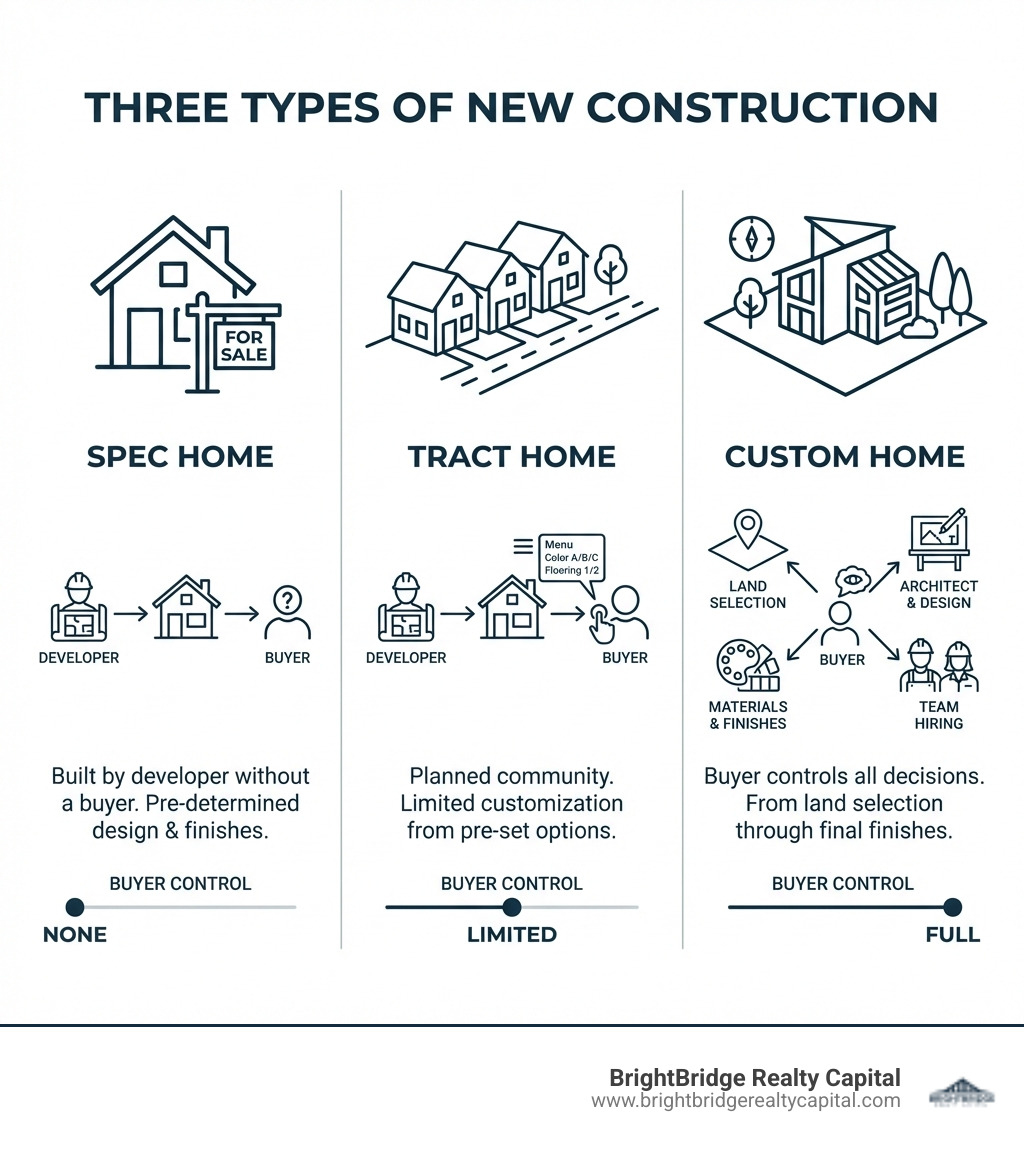
Custom home construction gives you complete control over every aspect of your future property—from floor plan and finishes to location and layout. Unlike spec homes built by developers or tract homes in planned communities, a custom build means you select the land, hire your own team of professionals, and design a home that reflects your unique vision and lifestyle needs. This process is the ultimate expression of homeownership, allowing you to prioritize the features that matter most to your family while ensuring the highest standards of quality and craftsmanship.
Quick Overview: What You Need to Know About Custom Home Construction
- Average Cost: $300 per square foot is a standard baseline, with total projects typically ranging from $300,000 to $1,200,000. However, in high-end markets like New York or for luxury builds, costs can easily exceed $500-$800 per square foot depending on material choices and architectural complexity.
- Timeline: 18 months on average from the initial planning stages to move-in day. This includes roughly 6 months for design and permitting and 12 months for active construction. Intricate designs or challenging site conditions can extend this to 24 months.
- Key Team Members: A successful build requires a licensed general contractor, an architect, an interior designer, and a structural engineer. You may also need specialized consultants for landscaping, smart home integration, or environmental sustainability.
- Financing: Unlike traditional mortgages, custom builds require construction loans. These typically demand a 20-25% down payment and are disbursed in "draws" tied to specific construction milestones rather than a lump sum.
- Process Phases: Land acquisition → Design & permitting → Site prep & foundation → Framing → Systems (HVAC, plumbing, electric) → Interior finishes → Final inspections.
Building a custom home is significantly different from buying an existing property or even a new spec home. You're not just purchasing a structure—you're creating a legacy tailored to your family's needs, your aesthetic preferences, and your long-term investment goals. The process involves careful coordination between designers, contractors, lenders, and local authorities, with every decision requiring your input and approval. This level of involvement ensures that the final product is a perfect fit for your lifestyle, but it also requires a significant commitment of time and mental energy.
For real estate investors, custom builds present unique opportunities for portfolio expansion or high-end flips. By controlling the design, investors can target specific market demands that production builders often overlook. However, these projects also require specialized financing that traditional mortgages can't provide. The staged funding model, permit requirements, and extended timelines demand a lender who understands construction financing inside and out.
I'm Daniel Lopez, a loan officer at BrightBridge Realty Capital, where I've helped clients structure financing for ground-up construction projects ranging from single-family custom homes to multi-unit developments. My experience with custom home construction financing has taught me that the right funding partner can make the difference between a smooth build and a stalled project. We focus on providing the liquidity and flexibility needed to navigate the complexities of the New York construction landscape.
Explore more about custom home construction:
Defining Custom Home Construction: Vision vs. Reality
When we talk about custom home construction, we aren't just talking about picking out a paint color or choosing between granite and quartz. We are talking about starting with a blank canvas. In a market like New York, where space is at a premium and architectural history is everywhere, "custom" means building something that has never existed before. It is the process of translating abstract desires into a physical structure that balances aesthetics, functionality, and local building codes.
Unique Identity and Legacy Building
A custom home is an unmistakable reflection of your unique identity. Whether you are envisioning a sleek, modern glass structure in the Hamptons or a timeless brownstone-inspired build in a New York suburb, you are creating a legacy for generations. This is the ultimate form of Ground-Up Construction Projects. Unlike production homes, where you might have three floorplans to choose from, custom builds offer unlimited possibilities.
If you want a secret room behind a bookshelf, a basement that doubles as a professional-grade golf simulator, or a kitchen designed specifically for a professional chef, you can have it. This level of customization ensures that the home grows with you. For example, many modern custom builds now include "flex spaces" that can transition from a nursery to a home office to a guest suite over the decades. You aren't just building for today; you are building for the next thirty years of your life.
The Architectural Program: Needs vs. Wants
Before the first shovel hits the dirt, we recommend developing an "architectural program." This is essentially a roadmap that separates your "must-haves" from your "nice-to-haves." This document serves as the foundation for your architect's work and helps keep the project grounded in reality.
- Needs: These are non-negotiables. Number of bedrooms, home office space (essential in today's remote-work world!), accessibility requirements for aging in place, and basic square footage requirements.
- Wants: These are features that enhance your lifestyle but aren't strictly necessary. That wine cellar you saw on Pinterest, high-end professional kitchen appliances, or a spa-like primary bathroom with a steam shower.
- Dreams: These are the "reach" items. A rooftop terrace with a view of the skyline, an indoor-outdoor infinity pool, or a fully integrated smart-home system that controls everything from lighting to security via voice command.
By ranking these features early, you can ensure your design stays within the realm of reality while still pushing the boundaries of creativity. As noted in the Complete Guide to Building a Custom Home, starting with a clear vision helps prevent "scope creep," which is a fancy way of saying "accidentally spending your retirement fund on Italian marble." A well-defined program also makes the bidding process more accurate, as contractors can see exactly what level of finish you expect.
Sustainability and Future-Proofing
In today's market, custom home construction often involves a heavy focus on sustainability. Custom builders have the unique opportunity to integrate energy-efficient technologies from the ground up. This includes geothermal heating and cooling, solar arrays integrated into the roof design, and high-performance insulation that exceeds standard building codes. Future-proofing also means preparing for technological shifts, such as installing high-speed fiber optic cabling throughout the house and ensuring the garage is pre-wired for multiple electric vehicle (EV) chargers. These choices not only reduce your environmental impact but also significantly increase the long-term resale value of the property.

The Step-by-Step Custom Home Construction Process
The road to a custom home is a marathon, not a sprint. It’s a complex choreography of professionals, permits, and physical labor. Understanding the Construction Financing Process is key to keeping this timeline on track, as delays in funding can lead to delays on the job site.
Phase 1: Pre-Construction and Permitting
This is where the "boring" but vital work happens. You’ll work with an architect to create construction drawings and detailed specifications. In New York, obtaining building permits and zoning clearances can be a significant hurdle. You’ll need to ensure your plans comply with local setbacks, height restrictions, and environmental regulations. If your lot is near wetlands or in a historic district, expect additional layers of scrutiny. According to the Steps to Building a House, this phase alone can take 3 to 6 months, and it requires constant communication between your architect and the local building department.
Phase 2: Site Preparation and Foundation
Once the paperwork is signed and the permits are in hand, the heavy machinery arrives. The land is cleared of trees and debris, graded for proper drainage, and excavated for the foundation. This is a critical stage; if the soil isn't properly compacted or the drainage isn't handled correctly, you could face basement flooding or structural settling years down the line. Then comes the foundation. While a production home might have a standard slab poured in a few days, a custom home—especially one with complex footprints, walk-out basements, or reinforced retaining walls—may take weeks to form, pour, cure, and waterproof.
Phase 3: Framing and Dry-In
This is the exciting part where your house actually starts to look like a house! The floors, walls, and roof trusses are installed. This stage is often referred to as the "skeleton" of the home. Once the framing is complete, the structure must be "dried in." This means installing the roof shingles, windows, and exterior doors to protect the interior from the elements. In the Northeast, getting a home dried in before the first winter snow is a major milestone that allows interior work to continue regardless of the weather.
Phase 4: Rough-In Systems and Interior Finishes
With the shell complete and protected from rain, the "veins and arteries" of the home are installed: plumbing lines, electrical wiring, HVAC ducts, and smart home cabling. This is the last time you will see the inside of your walls, so it's common to do a "walk-through" to ensure every outlet and light switch is in the right place. After municipal inspections are passed, the insulation and drywall go up. Finally, the "jewelry" of the home is added—flooring, cabinetry, countertops, and lighting fixtures. This phase requires meticulous attention to detail, as the quality of the finish work is what truly defines a custom home.
Budgeting and Timelines for Your Dream Build
Let’s talk numbers. Custom homes are generally at least 30% more expensive than building from pre-set plans because every element is unique. In the New York area, costs can fluctuate wildly based on material availability, specialized labor rates, and the complexity of the site.
Average Costs and Expectations
Research shows that building a custom home costs an average of $300 per square foot. However, for luxury builds with high-end finishes like imported stone, custom millwork, or advanced home automation, this can easily exceed $500 or even $700 per square foot. Most homeowners pay between $300,000 and $1,200,000 for the construction alone, not including the cost of the land or "soft costs" like architectural fees and permits.
| Feature | Production Home | Custom Home |
|---|---|---|
| Average Cost | $150 - $200/sq ft | $300 - $500+/sq ft |
| Timeline | 6 - 9 Months | 12 - 24 Months |
| Design Flexibility | Limited (Pre-set) | Unlimited (Bespoke) |
| Buyer Input | Low | High (Constant) |
| Equity Potential | Market Standard | High (Unique Value) |
The 18-Month Timeline
How Long Does It Take to Build a Custom Home? The average answer is 18 months. This includes roughly 6 months for design and permitting and 12 months for active construction. We’ve seen projects take up to two years if the design is particularly intricate or if the New York winter decides to be especially stubborn. Delays in material deliveries—such as custom windows or specialized appliances—can also ripple through the schedule, pushing back the move-in date.
Soft Costs vs. Hard Costs
When budgeting, it is vital to distinguish between hard costs (the physical build) and soft costs. Soft costs include architectural fees (usually 8-15% of the build cost), structural engineering, land surveys, soil testing, and permit fees. Many first-time builders forget to account for these, which can easily add $50,000 to $100,000 to the total project cost before a single nail is driven.
The Golden Rule: The 20% Contingency Buffer
If there is one piece of advice we give every client at BrightBridge, it’s this: budget for surprises. Whether it’s an unexpected rock ledge during excavation that requires blasting or a sudden price hike in lumber, having a 20% contingency fund is the difference between a finished home and a half-built headache. This buffer also allows you to make small upgrades during the process without stressing over the bottom line. Securing New Construction Loans that account for these variables is a smart financial move that provides peace of mind throughout the build.
Assembling Your Expert Team and Selecting the Perfect Plot
You wouldn't try to perform surgery on yourself, so don't try to build a custom home without the right experts. Your team is your greatest asset, and their ability to collaborate will determine the success of your project.
Selecting the Land
The plot of land you choose dictates what you can build. Before you buy, you need a topographic survey to understand the slope and a soil evaluation to ensure the ground can support a foundation. In parts of New York, you might deal with rocky terrain, high water tables, or strict septic requirements that can add tens of thousands to your foundation costs. We often help clients with a Bridge Ground-Up Construction Loan to secure the land quickly before transitioning into a full construction loan once the plans are finalized.
The Essential Professionals
- Architect: The visionary who turns your "wants" into blueprints. They ensure the home is aesthetically pleasing and structurally sound while maximizing the potential of your specific lot.
- General Contractor (GC): The "conductor" of the orchestra. They manage the subcontractors (plumbers, electricians, framers), the timeline, and the budget. A good GC is your primary point of contact and your advocate on the job site.
- Interior Designer: They ensure the inside of the home is as functional and beautiful as the outside. They help with everything from spatial flow to selecting the perfect hardware for your kitchen cabinets.
- Structural Engineer: The person who makes sure the house doesn't fall down. They calculate the loads and design the support systems, which is especially important for modern designs with large open spans or heavy glass walls.
Vetting Your Team
Don't just hire the first person who gives you a quote. Check references, visit their previous job sites, and ensure they are fully licensed and insured in the state of New York. Ask how they handle challenges and how they communicate delays. A team that communicates well is worth their weight in gold during the high-pressure phases of custom home construction.
Financing Your Custom Home Construction Project
Financing a custom home is not like getting a traditional 30-year fixed mortgage. Since the collateral (the house) doesn't exist yet, lenders take on more risk. This is where BrightBridge Realty Capital shines. We specialize in the nuances of custom home construction financing, providing the capital needed to turn a vacant lot into a luxury residence.
Construction-to-Permanent Loans
Most custom builds utilize a construction loan that eventually converts into a permanent mortgage once the certificate of occupancy is issued. During the build, you typically make interest-only payments on the funds that have been disbursed. This keeps your monthly carrying costs lower while you are still paying for your current housing. Once the home is finished, the loan is refinanced into a standard mortgage based on the final appraised value of the property.
The Draw Schedule and Inspections
Lenders don't just hand you $800,000 and wish you good luck. The money is released in "draws" tied to specific milestones. Before each draw is released, an inspector will visit the site to verify that the work has been completed to a professional standard. For example:
- Draw 1: Site prep, excavation, and foundation complete.
- Draw 2: Framing, roof trusses, and exterior sheathing complete.
- Draw 3: Rough-ins (plumbing, electric, HVAC) and insulation complete.
- Draw 4: Drywall, interior trim, and initial cabinetry installed.
- Draw 5: Final finishes, flooring, and landscaping complete.
LTC vs. LTV: Understanding the Math
In construction lending, we often look at the Loan-to-Cost (LTC) ratio, which is the percentage of the total construction and land costs we are willing to fund. We also look at the Loan-to-Value (LTV) based on the "as-completed" appraisal. If you are building a home that will be worth $1.5 million, but it only costs $1 million to build, your equity position is very strong. Understanding How to Get a Construction Loan involves preparing detailed plans and a realistic budget that accounts for these ratios.
Why Direct Lending Matters
At BrightBridge, we offer asset-based lending with fast closings—often within a week. We don't have the red tape of traditional banks, which can take months to approve a construction draw. We focus on the value of the project and the strength of the plan. We also offer specialized Builder Loans for investors looking to scale their operations and build multiple custom homes simultaneously.
Frequently Asked Questions about Custom Home Construction
What are common delays in custom home construction?
The most common "timeline killers" are weather impacts (especially in the Northeast), permitting backlogs at the city level, and supply chain issues. However, the biggest delay often comes from the homeowner! Selection delays—taking three weeks to decide on a kitchen faucet or a specific tile—can ripple through the entire schedule, as subcontractors may move on to other jobs if they can't finish yours. Keeping your Construction Loan Documentation organized helps us move quickly on our end, but the build speed is often up to the coordination of the GC and your ability to make timely decisions.
What is a "Change Order" and how does it affect my budget?
A change order is a formal amendment to the construction contract. It happens when you decide to change something after the contract is signed—like upgrading to a more expensive flooring or moving a wall. Change orders almost always involve additional costs and can cause significant delays. It is best to finalize as many details as possible during the design phase to minimize these during construction. If you do need a change, ensure it is documented in writing with a clear price and timeline impact.
What warranty should I expect for my custom home?
A reputable builder should provide a tiered warranty to protect your investment. The industry standard is often referred to as a 1-2-10 warranty:
- 1 Year: Labor and materials (covers things like drywall cracks, trim issues, or paint touch-ups).
- 2 Years: Mechanical systems (HVAC, plumbing, electrical systems).
- 10 Years: Structural defects (the foundation, load-bearing walls, and roof framing).Post-construction support is vital. You want a builder who will answer the phone six months after you move in. This is part of why Residential Construction Financing usually requires a licensed and insured builder with a proven track record.
How do I ensure the design reflects my lifestyle?
Don't just look at 2D floorplans; they can be deceiving. Ask your architect for 3D renderings and virtual walkthroughs. This allows you to "walk" through your kitchen and realize that the island is too far from the fridge before a single nail is driven. Think about your daily routine. Do you enter through the garage? Then you need a mudroom with heavy-duty storage and a charging station. Do you host Sunday dinners? Then an open-concept dining area with a butler's pantry is a must. Understanding the New Build Loan Process allows you to budget for these lifestyle-specific amenities early on, ensuring the final home is a perfect fit.
Conclusion
Building a custom home is one of the most rewarding challenges a property owner can undertake. It is the chance to build not just a structure, but a sanctuary that fits your life like a glove. From the initial architectural sketches to the final coat of paint, every step of custom home construction is an opportunity to create something truly unique. While the process requires patience, a solid budget, and a dedicated team of professionals, the end result is a property that offers unparalleled comfort, efficiency, and personal pride.
At BrightBridge Realty Capital, we are dedicated to being the bridge between your vision and your reality. Based right here in New York, we understand the local market, the high costs of materials, and the urgency required for successful ground-up projects. We offer nationwide financing solutions, but our heart is in the direct, personal relationships we build with our clients. With our fast closings, flexible terms, and deep understanding of the construction process, we ensure that your project never stalls due to lack of capital.
Ready to start your Ground-Up Construction? Whether you are a first-time builder or a seasoned developer, let’s build something incredible together. Reach out to us today to discuss your project and see how our seamless lending process can bring your dream home to life.