Crossing the Funding Chasm with Startup Bridge Loans

Summary
Bridge loan startup funding: Cross the chasm between rounds with fast 6-12 month capital. Learn terms, risks, benefits & qualify now!
When Cash Runs Out Before the Next Round: Understanding Bridge Loan Startup Financing
A bridge loan startup strategy is short-term financing that keeps a company running between major funding rounds. In the volatile world of venture capital, timing is rarely perfect. You might have the product, the team, and the traction, but the macro-economic environment or a prolonged due diligence process can leave your bank account dangerously low. This is where bridge financing steps in as a vital lifeline.
| Key Question | Quick Answer |
|---|---|
| What is it? | A short-term loan (typically 6-12 months) that fills the gap between funding rounds |
| Who uses it? | Startups running low on cash before their next equity raise |
| Typical cost | 8-12% interest, plus 1-3% origination fees |
| How fast? | Terms in as little as 48 hours; funding in days |
| Common structures | Convertible notes, SAFE agreements, revenue-based loans |
| Biggest risk | Equity dilution or debt accumulation if not managed carefully |
The numbers tell a sobering story. 82% of small business failures are tied to cash flow problems. In 2022 alone, 44% of startups failed simply because they ran out of money. And with the gap between Series A and Series B now averaging 28 months — the longest stretch since 2012 — more founders than ever are staring down a very real funding chasm. This "Series A Crunch" has forced many high-growth companies to rethink their capital structure, moving away from a pure equity model toward a hybrid approach that includes strategic debt.
Bridge financing isn't a sign of failure. In 2023-2024, bridge rounds made up 60-70% of all funding rounds. It's become standard practice for even the most successful unicorns to take an "extension round" or a bridge loan to ensure they have the leverage needed to negotiate favorable terms in their next major equity event. Without this cushion, founders are often forced into "fire sales" or predatory term sheets that strip away their control of the company.
As Tim Berry put it plainly: "One of the toughest years my company had was when we doubled sales and almost went broke." Growth doesn't always protect you. In fact, rapid growth often accelerates cash burn, making the need for a bridge loan startup strategy even more acute. Timing doesn't just protect you; it defines your valuation.
I'm Daniel Lopez, a loan officer at BrightBridge Realty Capital with hands-on experience structuring short-term financing solutions — including navigating the bridge loan startup landscape where speed and deal structure can make or break a company's trajectory. In the sections below, I'll walk you through everything you need to know to use bridge financing strategically, not desperately. We will explore the mechanics of these loans, the psychological shift required to manage debt in a startup environment, and the specific milestones you must hit to ensure your bridge leads to a solid foundation rather than a dead end.
Bridge loan startup vocab explained:
What is a Bridge Loan Startup Strategy?

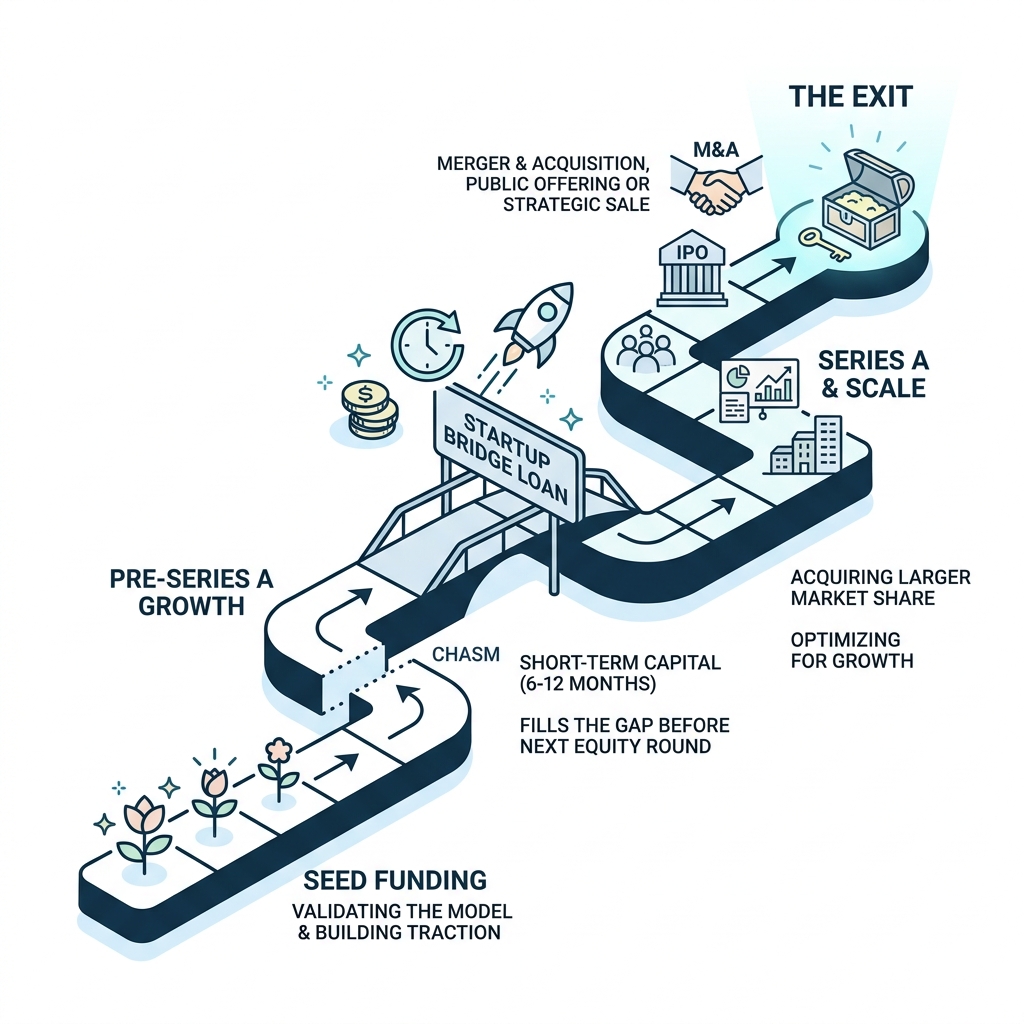
In the simplest terms, a bridge loan startup strategy is about buying time. It is a form of short-term capital intended to "bridge" the gap between the present moment—where cash might be tight—and a future liquidity event, such as a Series A or B equity round, a merger, or an IPO.
Typically, these loans have a 6-12 month duration. They aren't meant to be long-term debt that sits on your balance sheet for years. Instead, they function as a burst of working capital to keep the lights on, the developers coding, and the sales team hunting while the founders finalize a larger deal. Understanding the bridge loan meaning is crucial: it is a transition tool, not a permanent foundation. It is the financial equivalent of an extra tank of oxygen for a diver who is just a few meters from the surface.
At the heart of this strategy is liquidity management. When we look at a startup's health, we look at the cash burn rate. If your company brings in $50,000 a month but spends $110,000 to maintain growth, you have a "burn" of $60,000. Without a fresh injection of capital, that math eventually hits zero. A bridge loan provides the necessary Bridge Financing to ensure that zero-day never arrives. However, it's not just about avoiding zero; it's about maintaining the "Burn Multiple"—a metric that VCs use to see how much you are spending to generate each dollar of ARR. A well-timed bridge loan allows you to optimize this ratio before your next pitch.
Key Differences from Traditional Startup Financing
Why not just go to a big bank or wait for a VC? The biggest differentiator is speed of execution. Traditional venture capital rounds can take four to six months to close, involving dozens of meetings, partner votes, and exhaustive legal reviews. A bridge loan can often be structured and funded in a fraction of that time, sometimes in as little as 72 hours if the documentation is in order.
Furthermore, the structure is fundamentally different from a standard bank loan. While a bank might demand three years of audited tax returns and massive collateral (like the founder's personal home), bridge financing for startups often focuses on the "convertibility" of the debt. Many bridge rounds are structured so that the debt converts into equity during the next funding round, often at a discount (like 20%) to reward the bridge lenders for their early risk. This means the lender isn't just looking at your current assets; they are looking at the probability of your next round closing.
Key differences include:
- Debt vs. Equity: Traditional rounds sell a piece of the company immediately, setting a new valuation. Bridge loans are debt that might become equity later, often delaying the valuation conversation until the company is in a stronger position.
- Interest-Only Payments: Most bridge loans are structured with interest-only payments or even "PIK" (Payment-in-Kind) interest, where the interest is added to the principal balance. This preserves precious cash for operations rather than forcing the company to pay down principal during a growth phase.
- Covenants: While faster, these loans may include specific "milestone" covenants. For example, a lender might require the startup to maintain a certain number of active users or hit a specific revenue target to keep the funding active. These are designed to ensure the company remains attractive to future equity investors.
- Warrants: Unlike traditional bank loans, bridge lenders often ask for warrants—the right to purchase equity at a fixed price. This gives the lender "upside" potential if the company becomes a massive success, which justifies the high risk of lending to an unprofitable startup.
For a deeper dive into these mechanics, check out our bridge loan financing complete guide.
When to Utilize Bridge Financing for Your Venture
Timing is everything in the startup world. Knowing when to pull the trigger on a bridge loan startup round can be the difference between a successful exit and a quiet liquidation. It requires a cold, hard look at your financial projections and an honest assessment of the current venture market.
The most common scenario is a cash flow gap. Statistics show that 50% of companies fail in the period between receiving Seed A funding and Seed B funding. This "valley of death" is where bridge financing shines. If your runway is down to three months but your next lead investor is still doing due diligence, you need a bridge. Waiting until you have only two weeks of cash left is a recipe for disaster, as lenders can smell desperation, and it will cost you in the form of harsher terms.
Other critical times to consider this route include:
- Milestone Achievement: Sometimes you are just $200,000 away from proving a key metric—such as a specific Customer Acquisition Cost (CAC) or a technical breakthrough—that will double your valuation in the next round. Using bridge loans quick to hit that milestone is a savvy move to prevent excessive dilution. Why sell 20% of your company today at a $10M valuation if a $500k bridge can get you to a $20M valuation in six months?
- Market Shifts: As we saw in 2023, the VC market can cool down instantly. When rounds take longer to close (averaging 28 months between A and B now), you need to extend your runway to survive the winter. This is often called "defensive bridging." It's about staying "default alive" rather than "default dead."
- IPO or M&A Preparation: If a company is preparing for an acquisition or an initial public offering, there are often significant legal and accounting "burst" costs. A bridge loan covers these expenses so they don't eat into daily operations. Furthermore, having cash in the bank gives you "walk-away power" in acquisition talks.
- The "Bridge to Profitability": For some startups, the goal isn't another VC round, but reaching break-even. If you are 10% away from being cash-flow positive, a bridge loan can be the final piece of capital you ever need to take, allowing you to retain maximum ownership.
According to research on Dissecting Startup Failure Rates by Stage, running out of cash is the second most common reason for failure. A bridge loan acts as an insurance policy against that outcome. It provides the psychological peace of mind that allows founders to focus on product-market fit rather than staring at a dwindling bank balance every morning.
Navigating Terms, Risks, and Qualifications
Before you sign on the dotted line, you need to understand the "price" of speed. Bridge loans are riskier for lenders because they are often subordinated to other debt and rely on a future event that may not happen. The terms reflect this risk profile.
Typical interest rates for a bridge loan startup range from 8% to 12% APR. While this is higher than a mortgage or a prime-rate business loan, it is significantly cheaper than the "cost of equity." If you sell 5% of your company for $500k, and that company eventually sells for $100M, that $500k effectively cost you $5M. In that context, a 10% interest rate is a bargain.
On top of interest, you’ll usually see origination fees of 1% to 3% (often called "points"). For example, on a $500,000 loan, a 3-point fee means $15,000 is taken off the top or added to the balance.
Other terms to watch:
- Maturity Dates: These are short, usually 12 months or less. Some loans include an "extension option" for an additional fee, providing a safety net if the next round takes longer than expected.
- Conversion Features: If the loan is a "convertible note," it will include a valuation cap and a discount rate (typically 20%) for when it turns into stock. The valuation cap is the maximum price at which the loan converts, protecting the lender if the company's value skyrockets.
- Warrants: Some lenders may ask for "warrant coverage," giving them the right to buy more stock at a set price later. This is common in venture debt and bridge rounds for high-growth tech firms.
- Liquidation Preference: In the event of a sale, bridge lenders are usually paid back before equity holders. You must ensure this doesn't conflict with the rights of your existing preferred shareholders.
When preparing your bridge loan application, transparency is your best friend. Lenders want to see a clear path to the "exit"—which, in this case, is usually the next funding round. They will look at your "Data Room," including your cap table, historical financials, and most importantly, your pipeline of potential investors.
Qualifying for a Bridge Loan Startup Round
You don't need to be profitable to qualify, but you do need a plan. Lenders typically look for:
- Monthly Recurring Revenue (MRR): Even if you aren't profitable, consistent revenue proves product-market fit and provides a baseline for repayment capacity.
- Existing Investor Support: If your current investors are willing to put in "pro-rata" (their share) of the bridge, it signals to outside lenders that the company is worth saving. This is often a prerequisite for many bridge lenders.
- Asset Collateral: In some cases, especially for real estate, hardware, or biotech startups, physical assets or Intellectual Property (IP) can be used to secure the loan.
- Financial Projections: You need to show exactly how this bridge gets you to the next milestone. A vague "we need money to grow" won't work; you need a line-item budget showing how the $500k will be spent.
If you're new to this, we recommend reading bridge loans for dummies to get grounded in the basics of underwriting standards and how to present your startup in the best possible light to debt providers.
Strategic Benefits and Potential Pitfalls
The most obvious benefit of a bridge loan startup is rapid funding access. In many cases, we can provide terms within 48 hours and fund within a week. This speed allows founders to stop worrying about payroll and get back to building. In the startup world, momentum is a fragile thing; a bridge loan preserves that momentum.
Strategically, bridge loans can also be used to improve your position in Inside M&A negotiations. If a buyer knows you are out of cash, they will lowball you, knowing you have no choice but to accept. If you have a fresh bridge loan, you have the "staying power" to negotiate for a higher price or even walk away from a bad deal. It changes the power dynamic from "supplicant" to "partner."
However, there are pitfalls that every founder must navigate. Debt accumulation is real. If the next round of funding doesn't materialize, that bridge loan becomes a weight that can pull the company under. Unlike equity, debt must be repaid. If you can't repay it and can't raise more money, the lender may have the right to seize your assets or force a liquidation.
Over-leveraging—taking on more debt than your future valuation can support—is a common mistake. If you take a $2M bridge loan but your next round only values the company at $5M, the debt and its conversion features might wipe out the founders' equity entirely. This is known as a "cram-down."
Furthermore, you must ensure your bridge terms don't "scare off" future investors. If a bridge lender has too many rights, a massive liquidation preference, or a "blocking right" on future rounds, Series B investors might pass on the deal because the "cap table" is too messy. They don't want their fresh capital going immediately to pay off an old bridge loan; they want it going toward growth. This is why choosing the right bridge financing companies is a decision that impacts your company for years. You need a lender who understands the startup ecosystem and is willing to be flexible as you scale.
Frequently Asked Questions about Bridge Loans
How quickly can a startup access bridge funds compared to VC rounds?
The difference is night and day. While a VC round involves months of meetings, partner votes, and deep-dive due diligence, bridge financing is built for speed. Many platforms offer 24-48 hour terms and same-day funding options once the paperwork is verified. For a startup in a cash crunch, these weeks saved are literally lifesavers. While a VC is looking for a 10-year home run, a bridge lender is looking for a 12-month safe bet.
How does bridge financing impact future equity rounds and valuations?
It can be a double-edged sword. On the positive side, it signals that your current investors or savvy lenders believe in your "bridge" to the next level. If you use the funds to hit a major milestone, it can actually increase your valuation in the next round by proving your business model is resilient. On the negative side, if not framed correctly, it can look like a "distress signal." Smart founders often frame bridge rounds as "extension rounds" or "strategic growth capital" to maintain a positive narrative with future investors. The key is to show that the bridge was a choice, not a last resort.
Are there alternatives to bridge loans for early-stage companies?
Yes, and sometimes they are preferable depending on your business model.
- Invoice Factoring: If you have unpaid B2B invoices from reputable clients, you can get an advance on that cash (usually 80-90%) without taking on traditional debt. This is excellent for service-based startups.
- Asset-Based Lending: Using equipment, inventory, or even real estate as collateral. This is often cheaper than a bridge loan but requires tangible assets.
- Revenue-Based Financing: Repaying the loan as a percentage of your monthly sales. This is great for SaaS companies with fluctuating income because the payment scales with your revenue—if you have a slow month, your payment drops.
- Grants and Crowdfunding: "Free" money that doesn't require equity or interest, though it is often slower to obtain and requires significant marketing effort.
- Venture Debt: Usually reserved for companies that have already raised a significant Series A, venture debt is a longer-term version of a bridge loan with more complex terms.
What happens if the "bridge" doesn't lead to a round?
This is the risk every founder takes. If the maturity date hits and you haven't raised your next round, you must either negotiate an extension, find an alternative repayment source, or face a potential default. Most bridge lenders prefer to work with founders rather than force a bankruptcy, as they want to see the company succeed, but it is a high-pressure situation that requires proactive communication.
Conclusion
At BrightBridge Realty Capital, we understand that a bridge loan startup isn't just a financial transaction—it's a strategic move to protect the future of your company. Whether you're navigating a 28-month gap between rounds, dealing with a sudden market shift, or preparing for a major acquisition in New York, our goal is to provide the quick, flexible funding you need to keep moving forward. We believe that founders should spend their time building products, not begging for capital.
We specialize in direct lending without the red tape of intermediaries, allowing us to close deals often within a single week. In an industry where 82% of failures are tied to cash flow, having a reliable partner can make all the difference between becoming a market leader or a cautionary tale. We pride ourselves on transparency, offering clear terms without hidden fees, so you can plan your runway with confidence.
If you're looking for companies that offer bridge loans with a focus on speed, reliability, and a deep understanding of the startup lifecycle, we're here to help you cross that chasm. Don't let a temporary cash gap stop your long-term vision.
Visit us at https://www.brightbridgerealtycapital.com to start your application today and secure the runway your company deserves.


