Stop Dreaming and Start Investing with These Property Loans

Summary
Secure your investment property loan today! Learn qualification tips, down payments, DSCR options & scale your rental portfolio fast.
What Is an Investment Property Loan (and Is It Right for You)?
An investment property loan is a mortgage used to purchase a property you don't plan to live in — one you intend to rent out, flip for profit, or hold as part of a growing real estate portfolio. Unlike a primary residence mortgage, which is designed to help individuals achieve the dream of homeownership, an investment property loan is a financial tool designed to facilitate wealth creation and business growth.
In the world of real estate, the way you finance an asset is often just as important as the asset itself. A well-structured loan can maximize your cash flow, provide significant tax advantages, and allow you to leverage your capital to acquire more properties than you could with cash alone. However, because these loans carry a different risk profile for lenders, the requirements are more stringent than what you might have experienced when buying your own home.
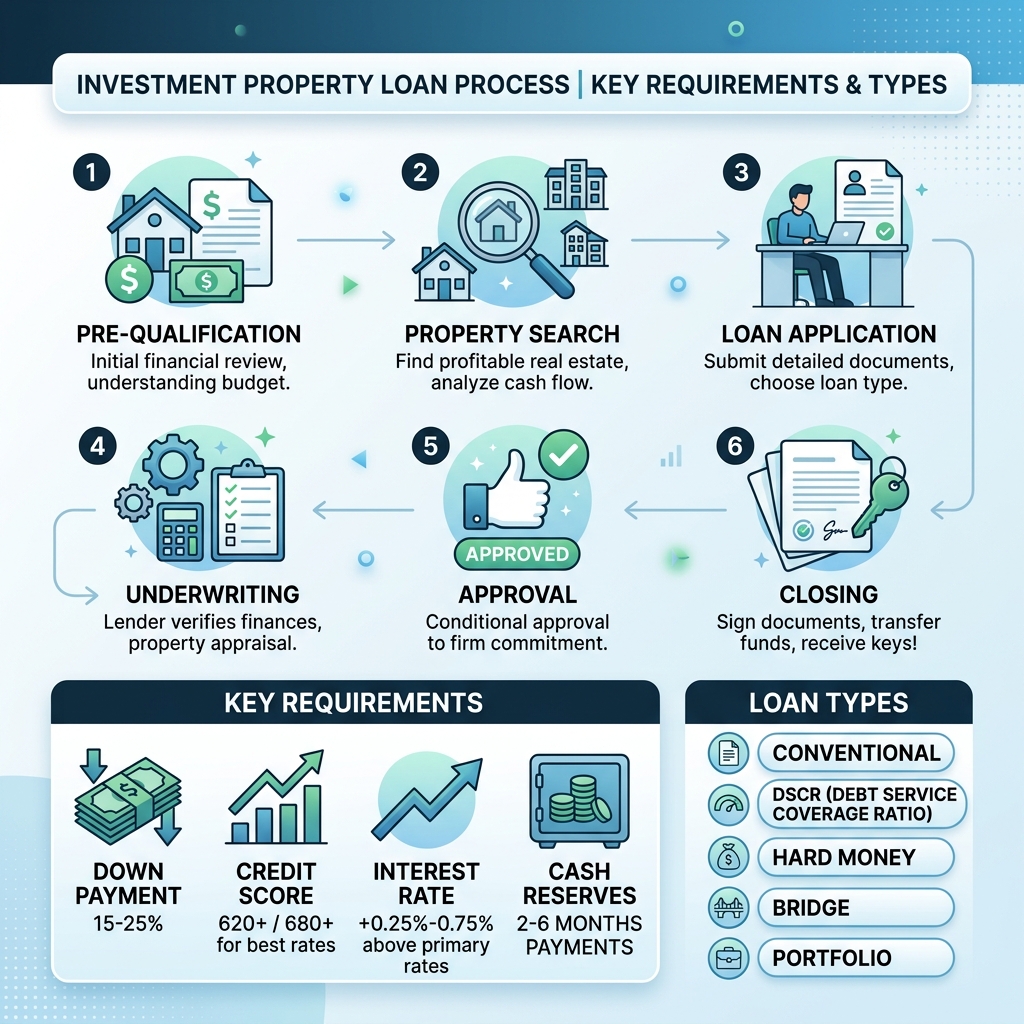
Here's a quick snapshot of what to expect in the current lending environment:
| Factor | Typical Requirement |
|---|---|
| Down payment | 15–25% (Higher for multi-unit properties) |
| Minimum credit score | 620+ (740+ for the most competitive pricing) |
| Interest rate premium | 0.25%–0.875% above primary residence rates |
| Cash reserves | 2–6 months of mortgage payments (PITI) |
| Loan types | Conventional, DSCR, hard money, bridge, portfolio |
| Max financed properties | 10 (conventional); unlimited with DSCR or portfolio |
| Debt-to-Income (DTI) | Typically capped at 43% to 45% for conventional |
These loans work differently from standard home mortgages because lenders view rental and investment properties as higher risk. Historical data shows that during times of financial hardship, borrowers are far more likely to default on an investment property than on the roof over their own heads. To mitigate this risk, banks and private lenders require larger down payments, higher credit scores, and more significant cash reserves.
But the potential rewards are real and multifaceted. Rental properties can generate consistent passive income that grows over time as rents increase. They build long-term equity through both mortgage paydown and market appreciation. Furthermore, real estate offers unique tax advantages, such as depreciation and the ability to defer capital gains through a 1031 exchange. This combination of benefits is why nearly a third of all homes sold in Texas in 2022 went to investors, according to the National Association of Realtors. This trend isn't limited to the South; across the country, from New York to California, savvy investors are using specialized financing to secure their financial futures.
Whether you're buying your first rental or scaling an existing portfolio, understanding how these loans work is the first step toward making a smart move. I'm Daniel Lopez, a New York-based loan officer at BrightBridge Realty Capital with hands-on experience helping investors navigate the investment property loan landscape — from first-time rentals to complex multi-unit deals. In the sections below, I'll break down everything you need to know to find the right financing and move forward with confidence.
Simple Investment property loan word guide:
Understanding the Investment Property Loan

When we talk about an investment property loan, we are referring to financing for income-generating assets that are strictly non-owner occupied. These typically include 1-4 unit residential buildings, such as single-family homes, duplexes, triplexes, or fourplexes. Unlike a primary residence where you intend to sleep every night, these properties are business tools designed to produce cash flow or capital appreciation.
The distinction is vital because Investment Property Financing is governed by different rules, regulations, and underwriting standards. For instance, while you might get into a primary home with as little as 3% down through certain conventional programs or 3.5% through FHA, an investor is looking at much higher stakes. According to a report from the National Association of Realtors, the influx of investors in markets like Texas shows that even with stricter lending, the appetite for real estate remains high because the long-term ROI often outweighs the upfront borrowing costs.
| Feature | Primary Residence | Investment Property |
|---|---|---|
| Occupancy | Owner-occupied | Tenant-occupied / Rental |
| Down Payment | 3% - 20% | 15% - 25%+ |
| Interest Rates | Market Base | Base + 0.25% to 0.875% |
| DTI Limits | Up to 50% (sometimes) | Strictly 43% - 45% (Conventional) |
| Reserves | Minimal | 2 - 6 Months PITI |
| Gift Funds | Allowed | Generally Not Allowed |
| Appraisal | Standard Value | Value + Rent Schedule (1007) |
Qualifying for an Investment Property Loan
To qualify for an investment property loan, we look closely at your financial "fitness." While conventional guidelines technically allow for a 620 minimum FICO score, most lenders prefer seeing 680 or higher to offer competitive terms. If your score sits at 740+, you’ll likely unlock the best available rates. Credit scores for investors are scrutinized more heavily because they serve as a proxy for financial responsibility in a business context.
Beyond credit, we evaluate your Debt-to-Income (DTI) ratio. For conventional rental property loans, lenders generally cap this at 43% to 45%. This means your total monthly debt payments (including the new mortgage, taxes, and insurance) shouldn't exceed 45% of your gross monthly income. Following solid Investment Property Mortgage Tips, such as paying down credit card balances or avoiding new car loans before applying, can significantly improve your DTI and approval odds. It is also important to note that while we can use potential rental income to help you qualify, we cannot use 100% of it, which we will discuss in the financial planning section.
Down Payment and Reserve Requirements
The days of "no money down" for rentals are largely gone for traditional products. You should expect an Investment Property Loan Down Payment of at least 15% for a single-unit property. However, if you are looking at a 2-4 unit building, most lenders will require 25% down. This higher equity stake ensures that the investor is committed to the property's success and provides a buffer for the lender in case of a market downturn.
Lenders also require "cash reserves." This is liquid money (savings, stocks, or 401k funds) that stays in your account after the deal closes. Usually, you’ll need 2 to 6 months of PITI (Principal, Interest, Taxes, and Insurance) for every property you own. If this is your first rental, 6 months is a safe bet to show you can handle a vacancy or an unexpected repair without defaulting. For investors with a large portfolio, the reserve requirements can become quite substantial, sometimes requiring 6 months of reserves for the subject property and 2-3 months for every other financed property in the portfolio.
Exploring Your Investment Mortgage Options
There is no "one-size-fits-all" in real estate. Depending on your goals, you might choose between standard conforming loans or more specialized products like jumbo loans for high-value properties in New York NY. Understanding the Types of Loans for Investment Property allows you to tailor your debt to your strategy. For many, Rental Loans are the bread and butter of their portfolio, offering 30-year fixed terms that provide stability against rising interest rates and predictable monthly expenses.
Specialized Investment Property Loan Programs
If you don't fit the "conventional" box—perhaps because you are self-employed, have a high DTI due to other investments, or already own more than 10 financed homes—specialized programs are your best friend. These "Non-QM" (Non-Qualified Mortgage) products are designed specifically for the needs of professional investors.
- DSCR Loans: A Debt Service Coverage Ratio loan is a game-changer for scaling. Instead of looking at your tax returns, W-2s, or personal income, we look at the property’s income. If the rent covers the mortgage (usually a 1.0x to 1.2x ratio), you can qualify. This is ideal for investors who have significant write-offs on their taxes that make their income look lower than it actually is. Check out our guide on DSCR Loans for Investors for more details on how to calculate your ratio.
- Hard Money & Bridge Loans: These are short-term solutions (typically 12–24 months) used for "fix and flip" projects or to "bridge" the gap while you renovate a property to stabilize it. They close fast—often within a week—and focus on the property's After Repair Value (ARV) rather than your personal credit history. These loans are interest-only, which keeps monthly payments low during the renovation phase. See the Best Loans for Fix and Flip to understand how to leverage these for quick profits.
- Portfolio Loans: These are loans held by the lender on their own balance sheet rather than being sold to Fannie Mae or Freddie Mac. This allows for much more flexible underwriting. For example, a portfolio lender might allow you to finance a property in the name of an LLC or ignore the 10-property limit that stops many investors in their tracks.
- Blanket Mortgages: For advanced investors, a blanket mortgage allows you to group multiple properties under a single loan. This can simplify your monthly payments and sometimes unlock better interest rates by increasing the total loan volume.
Strategic Financial Planning for Rental Success
Success in real estate is a math game. When budgeting for an investment property loan, you must account for interest rate premiums. Typically, you will pay 0.25% to 0.75% (and sometimes up to 0.875%) more than a homeowner would. This premium accounts for the higher default risk associated with non-owner-occupied properties. Over a 30-year term, even a half-percent difference can amount to tens of thousands of dollars, so shopping for the best rate is paramount.
One way we help you qualify is through the "rental income offset." Lenders don't just count the debt; they also count the potential income. However, they don't count 100% of the rent. Usually, we apply a 25% vacancy factor, meaning we use 75% of the projected or actual rent to help offset the mortgage payment in your DTI calculation. For example, if a property rents for $2,000, we count $1,500 as income. If your PITI is $1,600, only the $100 difference counts against your DTI. Keeping an eye on Investment Property Loan Rates is essential as market shifts can change your cash flow projections overnight.
It’s also critical to stay compliant with IRS rental income and tax guidelines. All rental income must be reported, but you can also deduct many expenses, including mortgage interest, property management fees, and repairs. Understanding the tax code is what separates amateur landlords from professional real estate investors.
The Appraisal and Documentation Process
The appraisal for an investment property loan is more involved than a standard one. The appraiser will complete a "Fair Market Rent Account" (Form 1007 for single units or Form 1025 for multi-family). This confirms to the lender that the rent you expect to collect is realistic for the New York NY area. If your projected rent is significantly higher than the appraiser's market rent, the lender will use the lower of the two numbers for qualification.
In terms of paperwork, be prepared to provide a comprehensive "loan package":
- Two years of personal and business tax returns (including all schedules).
- Recent W-2s and pay stubs for the last 30 days.
- Two months of bank statements to prove you have the down payment and required reserves.
- Existing lease agreements if the property is already occupied.
- A detailed "Schedule of Real Estate Owned" (SREO) listing all your current properties, their values, and their mortgage balances.
Reviewing your Investment Property Mortgage Options early allows you to gather this documentation before you find the "perfect" deal, ensuring you can move quickly when it's time to make an offer. In a competitive market, being "pre-approved" with a full file review is often the difference between a winning bid and a missed opportunity.
Scaling Your Real Estate Portfolio
Conventional lenders often have a "10-property limit." Once you have 10 properties financed with traditional mortgages, they view you as "tapped out." This is where Investment Property Capital and portfolio lending come into play. Professional investors often transition from conventional loans to DSCR or portfolio loans once they hit this limit.
Financing your properties under an LLC can provide liability protection and allow for easier partnership management as your empire grows. While conventional loans usually require you to close in your personal name, many specialized investment loans allow (and even prefer) that you close in the name of a business entity. This keeps your personal credit report cleaner and provides a layer of separation between your personal assets and your business ventures.
Frequently Asked Questions about Investment Loans
Can I use gift funds for an investment property loan?
Generally, no. For a conventional investment property loan, Fannie Mae and Freddie Mac require the down payment to come from your own documented funds. This is a major difference from primary residence loans, where a family member can "gift" you the down payment. Lenders want to see that the investor has their own "skin in the game." However, some Non-QM or portfolio programs may allow for more flexibility, such as using business funds or even a gift in specific circumstances, so it is always worth asking us about your specific situation.
How do lenders calculate rental income for qualification?
We use the lesser of two numbers: the actual lease agreement or the appraiser's market rent analysis. We then apply a 25% vacancy factor (multiplying by 0.75). For example, if the appraiser says the home should rent for $2,000, we count $1,500 toward your income. This $1,500 is then used to "offset" the PITI of the new loan. If the $1,500 covers the full mortgage payment, the property is considered "self-sufficient" and has a neutral or positive impact on your DTI.
What are the tax implications of owning investment properties?
Owning real estate is one of the most tax-efficient ways to build wealth in the United States.
- Depreciation: You can "depreciate" the structure of the building over 27.5 years. This is a non-cash expense that creates a "paper loss" to offset your actual rental income, often resulting in tax-free cash flow.
- Deductions: Almost every expense related to the property is deductible, including mortgage interest, property taxes, insurance, maintenance, and even travel to visit the property.
- 1031 Exchange: This powerful tool allows you to sell a property and reinvest the proceeds into a new "like-kind" property while deferring all capital gains taxes indefinitely. This allows your wealth to compound much faster than it would in a taxed environment.
What is a "Seasoning Requirement" for refinancing?
If you buy a property, renovate it, and want to pull your cash back out through a refinance (the BRRRR method), most conventional lenders require a "seasoning period" of 12 months before they will lend based on the new, higher appraised value. However, some of our specialized investment programs have seasoning requirements as short as 3 to 6 months, allowing you to recycle your capital much faster.
Are interest rates higher for multi-family properties?
Yes, typically. Lenders view 2-4 unit properties as slightly higher risk than single-family homes. You can expect a small "add-on" to the interest rate and often a requirement for a 25% down payment rather than 15% or 20%. However, the increased cash flow from multiple units often more than compensates for the slightly higher borrowing costs.
Conclusion
Investing in real estate doesn't have to be a dream for "someday." At BrightBridge Realty Capital, we specialize in turning those dreams into addresses. Based in New York NY, we understand the nuances of the local market while providing nationwide financing solutions tailored to the needs of modern investors. We believe that every investor deserves a lender who acts as a partner, not just a service provider.
Whether you need the speed of a bridge loan to secure a fixer-upper in a competitive market or the long-term stability of a 30-year rental loan to build your retirement nest egg, our direct lending model ensures fast closings—often within a week—without the red tape and bureaucracy of traditional banks. We offer customized programs designed to help you scale, from your first unit to your fiftieth, providing the capital and expertise you need at every stage of your journey.
The real estate market moves fast, and opportunities often disappear as quickly as they arise. Don't let a great deal slip away because of slow, outdated financing methods. Secure your investment property funding today and start building your legacy with a partner who moves as fast as you do. Your future portfolio starts with the right loan today.


