Quick Turnaround Loans: A Guide to Fast Cash and Faster Decisions

Summary
Discover Finance short term strategies: bridge loans, high-yield investments, debt payoff tips for quick cash and fast decisions.
What "Finance Short Term" Really Means — and Why It Matters
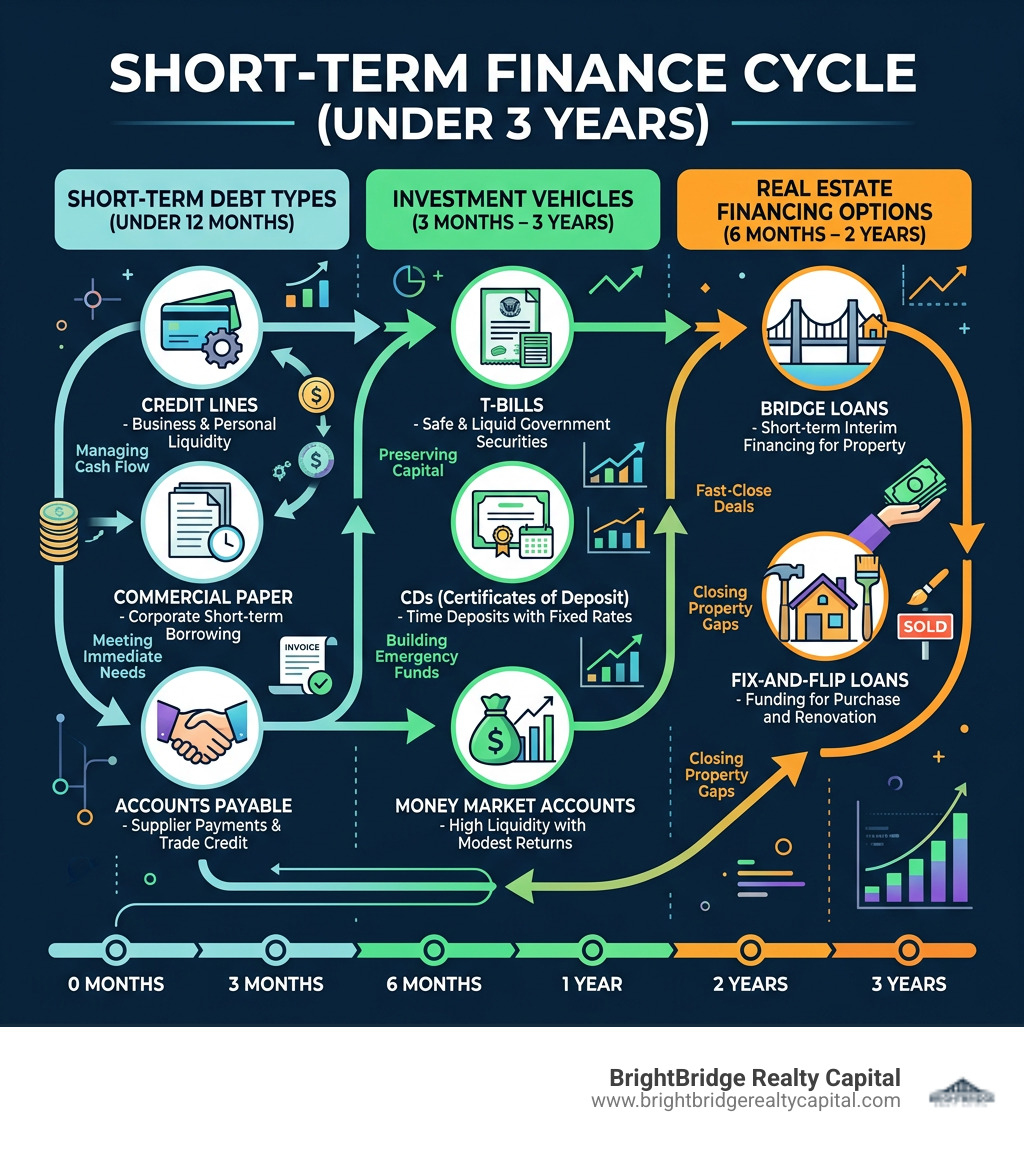
In the complex world of global economics, finance short term refers to the vital financial tools — encompassing both borrowing and investing — that operate within time horizons typically under three years. These instruments are specifically engineered to meet immediate cash flow requirements, preserve capital against market volatility, or bridge critical funding gaps during transitional periods. While long-term finance is the foundation of a building, short-term finance is the electricity and plumbing that makes the structure habitable and functional on a day-to-day basis.
Understanding this sector is crucial because it dictates how quickly a business can respond to an opportunity or how safely an individual can store money intended for a near-term goal. Here's a comprehensive breakdown of what falls under this expansive umbrella:
| Category | What It Is | Common Examples | Typical Timeframe |
|---|---|---|---|
| Short-term debt | Money owed and due soon to maintain operations | Credit lines, commercial paper, accounts payable, revolving credit | Under 12 months |
| Short-term investments | Highly liquid assets earning modest, safe returns | T-bills, CDs, money market accounts, high-yield savings | 3 months – 3 years |
| Short-term real estate financing | Fast-close, asset-based loans for property deals | Bridge loans, fix-and-flip loans, hard money lending | 6 months – 2 years |
Whether you're a business owner managing the delicate dance of accounts receivable and payroll, an individual building a robust emergency fund to weather economic storms, or a real estate investor racing against the clock to close a competitive deal — short-term finance is the high-octane engine that keeps the wheels of commerce turning. Without these mechanisms, the economy would grind to a halt as capital became trapped in long-term illiquid assets.
Short-term funding markets sit at the absolute core of how money flows through the broader global economy. They provide the necessary liquidity that allows banks to lend, enable maturity transformation (the process of turning short-term deposits into long-term loans), and serve as the "canary in the coal mine" — providing early warning signals when financial systems come under systemic stress. This isn't just abstract textbook theory; it is the reason why major institutions, from the U.S. Federal Reserve to the Office of Financial Research, monitor these specific markets with microscopic detail every single day. When the short-term markets "freeze," as they did in 2008, the entire global financial system faces an existential threat.
For everyday investors and local business owners, the stakes are far more personal and immediate. Choosing the wrong financing vehicle can lead to a cascade of negative outcomes: paying exorbitant interest rates that eat into profit margins, missing out on a once-in-a-lifetime property deal because of slow funding, or running short on liquid cash at the exact moment an unexpected expense arises.
I'm Daniel Lopez, a New York-based loan officer at BrightBridge Realty Capital. My daily life involves helping real estate investors and entrepreneurs navigate the nuances of finance short term. From structuring complex bridge loans for multi-family acquisitions to identifying the precise amount of leverage needed for a six-month fix-and-flip timeline, I've seen how the right short-term strategy can transform a risky gamble into a calculated, profitable success. In this comprehensive guide, I'll walk you through every facet of this market to help you make faster, smarter, and more confident decisions with your capital.
Must-know Finance short term terms and resources:
Understanding the Fundamentals of Finance Short Term
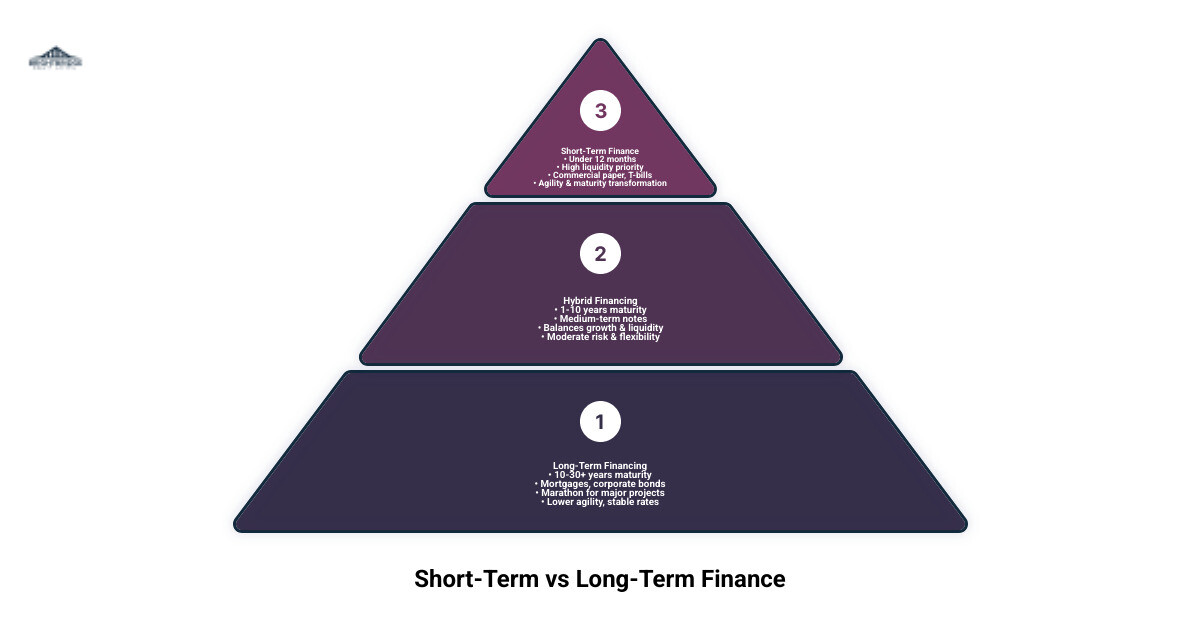
When we discuss finance short term, we are essentially analyzing the "sprint" of the financial world. Unlike long-term financing, which is meticulously constructed for the marathon of 10 to 30 years — such as 30-year fixed-rate mortgages or corporate bonds issued to fund the construction of a new manufacturing plant — short-term options are defined by their agility, speed, and responsiveness. In a world where market conditions can change in a heartbeat, the ability to move capital quickly is a competitive advantage that cannot be overstated.
The primary objective of short-term financial management is often liquidity. Liquidity is the ease with which an asset can be converted into ready cash without affecting its market price. In the short-term realm, cash is king. We also focus heavily on maturity transformation. This is a sophisticated financial process where institutions take capital that is available for a very short duration (like your checking account deposit) and use it to fund immediate needs or short-term loans. This constant recycling of capital is what allows the economy to remain dynamic.
Defining the 12-Month Threshold in Accounting
In the professional accounting and corporate finance sectors, "short-term" is not a vague concept; it has a very specific expiration date: 12 months. On a standard corporate balance sheet, any obligation that is due to be settled within one year is classified as a current liability. This classification is vital for investors because it shows how much pressure a company is under to generate cash in the near future.
For a corporation to officially count an asset as a short-term investment, it must satisfy two rigorous criteria. First, it must be a marketable security, meaning there is an active market where it can be sold almost instantly (like a Treasury bill). Second, there must be an explicit, documented intent by management to sell or convert that asset into cash within the next 12-month cycle.
A classic, high-stakes example of this is Microsoft Corp. In their April 2022 financial filings, the tech giant reported a staggering $92.2 billion in short-term investments. To put that in perspective, $78.4 billion of that total was strategically placed in U.S. government securities. Microsoft doesn't intend to hold these billions for decades; they keep this capital liquid so they can pivot into new technologies, acquire competitors, or settle massive operational bills at a moment's notice. You can explore more info about short term capital to see how both small businesses and global titans use these liquid "war chests" to maintain their market dominance.
The Strategic Role of Financial Leverage
Short-term debt should never be viewed simply as "owing money." When managed correctly, it is a precision tool for leverage. Leverage allows an investor or business to use a relatively small amount of their own equity to control a much larger asset. By borrowing for a short period, you can amplify your returns on equity, provided the investment's return exceeds the cost of the debt.
However, with great power comes the need for great oversight. Financial health is often measured by specific ratios that monitor short-term stability. The debt-to-equity ratio provides a snapshot of how much of the business is owned by shareholders versus how much is owed to creditors. Even more critical for short-term survival is the quick ratio (also known as the acid-test ratio). This is calculated by taking current assets, subtracting inventory (which might be hard to sell quickly), and dividing the remainder by current liabilities. This ratio tells us if a company can pay its immediate bills tomorrow if all sales suddenly stopped today. Balancing these ratios is the secret to healthy capital movement, ensuring you don't fall into a "liquidity trap" where you own valuable assets but lack the actual cash to pay your employees or the electric bill.
Common Types of Short-Term Debt and Funding Markets
The short-term funding market is often described as the "plumbing" of the global economy. Much like the pipes in your home, you don't think about them when they are working perfectly, but the moment they clog, the entire system becomes unusable. This market deals in massive volumes of high-quality, low-risk (under normal conditions) instruments that keep the world's largest banks and corporations functioning.
One of the most significant players in this space is commercial paper. This is an unsecured, short-term debt instrument issued by corporations, typically used for the financing of accounts payable and inventories and meeting short-term liabilities. Because commercial paper has a maturity that does not exceed 270 days, it is exempt from many of the rigorous SEC registration requirements that apply to long-term bonds. This exemption makes it an incredibly fast and cost-effective way for blue-chip companies to raise millions of dollars for payroll or seasonal inventory spikes without the bureaucratic red tape of a major public offering.
Market Dimensions: Collateral, Tenor, and Volume
To truly grasp how these markets function, we must look at the four dimensions that define every short-term transaction:
- Collateral: This is the security backing the loan. In the "Repo" (repurchase agreement) market, which sees trillions of dollars in daily volume, the collateral is usually high-quality government bonds like Treasury bills.
- Tenor: This refers to the duration of the loan. In the short-term world, tenors are often "overnight," meaning the money is borrowed today and repaid tomorrow morning. Other common tenors include 30, 60, or 90 days.
- Volume: The scale is astronomical. The short-term markets move trillions of dollars every single day, facilitating the global flow of trade.
- Rates: The cost of this money is heavily influenced by the Federal Funds rate. For years, the London Interbank Offered Rate (LIBOR) was the benchmark, but the world has recently transitioned to the Secured Overnight Financing Rate (SOFR) as a more transparent and reliable measure.
The way these interest rates transmit through the economy is a subject of intense study. If you want to dive deep into the mechanics, there is fascinating scientific research on money market transmission that explains how a tiny shift in overnight rates eventually trickles down to affect the interest rate on your personal car loan or the credit card in your wallet.
Strategic Uses of Finance Short Term for Businesses
Successful businesses don't use short-term debt because they are struggling; they use it because they are growing. Strategic debt management allows a company to optimize its cash flow and maximize its return on invested capital.
- Trade Credit: This is perhaps the most common form of short-term finance. It is essentially a "buy now, pay later" arrangement with suppliers. For example, a "2/10, net 30" agreement means the buyer gets a 2% discount if they pay within 10 days; otherwise, the full amount is due in 30. This is an interest-free loan if managed correctly.
- Accounts Payable Management: This involves strategically timing the payment of bills to keep cash in the company's bank account for as long as possible without damaging relationships with vendors.
- Banker’s Acceptance: This is a promised future payment by a bank, which has been "accepted" by that bank. It functions like a guaranteed check and is a staple of international trade, allowing a seller in one country to feel secure shipping goods to a buyer in another.
For those operating in the fast-paced worlds of real estate development or heavy construction, these timing gaps are often filled by specialized bridge products. You can find more info about fast bridge loans for business to see how modern companies bridge the gap between an initial purchase and the securing of long-term, permanent financing.
High-Yield Short-Term Investment Options for 2026
In the current economic climate of 2026, the strategy for managing idle cash has shifted dramatically. If you have significant capital sitting in a standard checking account earning a nominal 0.01% interest, you are effectively losing purchasing power every day due to the erosive effects of inflation. The landscape for finance short term investments is currently very favorable for those who prioritize safety and liquidity but still want their money to work for them.
Current yields for high-yield savings accounts (HYSAs) and money market accounts (MMAs) are currently hovering in the 3.5% to 4.2% range. These vehicles are ideal because they offer nearly instant access to your funds while providing a return that often keeps pace with or exceeds inflation. When choosing a home for your short-term cash, always verify that the institution adheres to FDIC insurance guidelines, which protect your deposits up to $250,000 per depositor, per insured bank, for each account ownership category.
Maximizing Returns with Finance Short Term Vehicles
If your timeline is slightly longer — perhaps you don't need the cash for six months to two years — you can often capture even higher yields by moving slightly further out on the yield curve. Consider these options:
- Certificates of Deposit (CDs): By agreeing to leave your money with a bank for a fixed term (e.g., 12 months), you can often lock in a higher rate than a standard savings account. This protects you if interest rates fall in the future.
- No-Penalty CDs: These have become increasingly popular in 2026. They offer a fixed, competitive rate but allow you to withdraw your full balance (including interest earned) without the typical early withdrawal penalty, providing a perfect blend of yield and flexibility.
- Treasury Bills (T-Bills): These are short-term debt obligations backed by the "full faith and credit" of the U.S. government. They are sold in maturities ranging from four weeks to 52 weeks and are widely considered the safest investment on the planet. In many states, the interest earned on T-Bills is also exempt from state and local taxes, which can significantly boost your after-tax yield.
A sophisticated strategy many of our high-net-worth clients utilize is known as CD laddering. Instead of depositing $100,000 into a single 2-year CD, you might split the capital into four $25,000 chunks. You put one chunk into a 6-month CD, one into a 12-month CD, one into an 18-month CD, and the last into a 24-month CD. Every six months, one of your CDs matures, giving you the option to either use the cash or reinvest it at the current market rate. This ensures you are never more than six months away from a portion of your liquidity while still capturing the higher rates of longer-term instruments.
Fitting Investments into Overall Financial Goals
It is important to remember that short-term investments are not designed to make you wealthy overnight; their primary purpose is to protect your "peace of mind" funds and ensure capital preservation. They should be categorized based on their specific purpose:
- Emergency Funds: Financial experts generally recommend keeping 3 to 6 months of essential living expenses in a highly liquid money market account. This is your shield against job loss or medical emergencies.
- Targeted Savings (e.g., Home Down Payments): If you are planning to purchase a home in a high-cost market like New York within the next 24 months, the stock market is far too volatile for that cash. A short-term bond fund or a series of T-bills is a much more appropriate choice.
- Capital for Future Deals: For real estate investors, keeping a "dry powder" fund in short-term vehicles allows them to act instantly when a deal appears. If you are looking for ways to leverage that capital even further, you might want to look at more info about short term investment loans to see how to use borrowed capital to acquire more assets while keeping your own cash in reserve.
Effective Strategies for Managing and Paying Off Debt
While we frequently discuss using debt as a powerful tool for growth, it is equally important to address the dangers of "bad" short-term debt. High-interest obligations, such as credit card balances or predatory payday loans, can act as a lead weight on your financial progress, dragging down your credit score and eating up the cash flow you could be using for investments. If you find yourself managing multiple high-interest balances, you need a disciplined battle plan to regain your financial freedom.
The two most effective and psychologically proven methods for debt repayment are:
- The Debt Snowball Method: This strategy focuses on human psychology. You list all your debts from the smallest balance to the largest, regardless of the interest rate. You pay the minimum on everything except the smallest debt, which you attack with every extra dollar you have. Once that smallest debt is gone, you take the money you were paying on it and move it to the next smallest. The quick "wins" of seeing accounts hit zero provide the dopamine hit and momentum needed to stay the course.
- The Debt Avalanche Method: This is the mathematically superior approach. You list your debts from the highest interest rate to the lowest. By focusing all your extra capital on the debt with the highest rate first, you minimize the total amount of interest paid over time. This method requires more discipline because it may take longer to see an entire account closed, but it saves the most money. You can use a Debt Avalanche Calculator to see exactly how much time and money you will save by choosing this path.
Prioritizing High-Interest Obligations and Principal Reduction
The single biggest mistake borrowers make is only paying the minimum monthly requirement. Credit card companies design minimum payments to keep you in debt for decades. By paying even just 20% or 50% more than the minimum, you can often cut your total repayment timeline by years. Furthermore, whenever you receive a financial windfall — such as a tax refund, a work bonus, or a gift — you should apply it directly to the principal of your highest-interest loan. Experian provides an excellent breakdown on 3 Reasons to Pay More than the Minimum that every consumer should study to understand the long-term impact on their credit health.
Consolidation and Strategic Refinancing
Sometimes, the most efficient way to handle a chaotic mix of five or six different high-interest loans is to consolidate them into a single, lower-interest loan. This simplifies your monthly finances into one manageable payment and can significantly reduce your total interest expense. In the world of real estate and business, this is often where bridging finance plays a starring role. A bridge loan can be used to pay off several smaller, more expensive debts, giving the borrower breathing room to secure a long-term, low-interest mortgage or SBA loan. You can find more info about bridging finance to see if this consolidation strategy is the right fit for your current financial situation.
Short-Term Real Estate Financing: Bridging the Gap
In the high-stakes New York real estate market, speed is often the only thing that matters. If you discover a distressed property in a trending neighborhood in Brooklyn or a prime fix-and-flip opportunity in Queens, you simply do not have the luxury of waiting 60 to 90 days for a traditional big-box bank to process a mortgage application. In the time it takes for a bank's committee to meet, a cash buyer will have already closed the deal and started renovations.
This is precisely where finance short term real estate products, such as bridge loans and hard money loans, become indispensable. At BrightBridge Realty Capital, we specialize in these "quick turnaround" scenarios, providing the capital that traditional lenders are too slow or too rigid to offer.
Speed and Flexibility in Competitive Property Markets
Unlike traditional mortgages that are heavily focused on your personal W-2 income, debt-to-income ratios, and years of tax returns, short-term property loans are primarily asset-based. We look at the deal itself. Specifically, we focus on the After Repair Value (ARV) — what the property will be worth once the renovations are complete.
- Ultra-Quick Closing: While a traditional bank might take months, we can often move from application to closing in as little as 5 to 10 business days. This allows our clients to compete head-to-head with all-cash buyers.
- Interest-Only Payment Structures: Most of our short-term loans feature interest-only payments during the term of the loan. This is a massive advantage for investors because it keeps monthly overhead low, preserving cash for the actual construction and renovation costs.
- High Leverage for Rehab: We understand that the purchase price is only half the battle. Many of our bridge loan products cover up to 90% of the purchase price and 100% of the renovation costs, allowing investors to keep their own capital liquid for other opportunities.
Whether you are an entrepreneur looking for a short term rental loan to quickly stabilize a property for the Airbnb market, or a seasoned developer who needs short term property loans to bridge the gap between a fast acquisition and a long-term refinance into a permanent commercial loan, these tools are specifically designed to match the "speed of the deal." In real estate, the most expensive loan is the one you didn't get in time to win the property.
Frequently Asked Questions about Short-Term Finance
What is the main difference between short-term and long-term financing?
The primary distinction lies in the tenor (the duration of the loan) and the intended purpose. Short-term financing is generally defined as having a duration of less than one year, though in real estate, it can extend up to three years. It is used for immediate operational needs, inventory purchases, or bridging a gap until a major event occurs. Long-term financing, such as a 15 or 30-year mortgage, is used for permanent capital assets. While short-term debt often carries a higher annual percentage rate (APR) than long-term debt, the total interest paid is usually much lower because the debt is retired so quickly.
What are the best short-term investments for money needed in six months?
When your time horizon is only six months, your primary goal must be capital preservation; you cannot afford to lose 10% of your principal in a market downturn. The best vehicles for this are high-yield savings accounts, money market accounts, and 6-month Treasury bills. These options currently offer very competitive rates (often between 3.5% and 4.5% in the 2026 market) while ensuring that every dollar of your principal is safe and accessible when you need it.
Why is commercial paper often exempt from SEC registration?
Commercial paper is granted an exemption under Section 3(a)(3) of the Securities Act of 1933 because it is a short-term instrument (maturing in 270 days or less) and the proceeds are used for "current transactions" like payroll or inventory. Furthermore, commercial paper is typically sold in large denominations to "sophisticated" institutional investors, such as pension funds and insurance companies, rather than the general retail public. This allows corporations to access the capital markets with incredible speed and minimal administrative cost.
Can short-term finance help improve my credit score?
Yes, if managed correctly. Short-term credit lines and trade credit contribute to your "payment history" and "credit mix," which are major factors in your credit score. However, you must be careful with "credit utilization." If you have a $10,000 short-term line of credit and you are constantly using $9,500 of it, your score may actually drop. The key is to use the credit and pay it off promptly to demonstrate reliability to future lenders.
Conclusion
Navigating the fast-moving world of finance short term can initially feel like a whirlwind of acronyms and complex ratios, but mastering these tools is one of the most powerful skill sets any business owner, real estate investor, or individual can possess. Whether you are meticulously managing your company's daily liquidity, building a sophisticated "ladder" of high-yield CDs to outpace inflation, or utilizing a high-leverage bridge loan to snag a lucrative New York real estate deal, the ultimate goal remains the same: achieving total financial stability and maximum flexibility.
At BrightBridge Realty Capital, we don't just facilitate loans; we live and breathe the dynamic world of short-term lending every day. We understand that in the competitive landscape of modern business and real estate, a delay of even a few days can be the difference between a massive profit and a missed opportunity. Our mission is to provide customized, direct lending solutions that move as fast as you do, ensuring you always have the capital you need, exactly when you need it.
Short-term finance is not just about surviving the next few months; it's about positioning yourself to thrive over the next few decades. By using the right debt tools and the smartest investment vehicles, you create a foundation of liquidity that allows you to be proactive rather than reactive.
Ready to take the next decisive step in your investment journey? Whether you're looking to flip your first property, expand a growing rental portfolio, or bridge a gap in your business operations, we're here to provide the expertise and the capital to make it happen.
Apply for a Rental Loan today and let's work together to get your next deal across the finish line.