Unpacking Short-Term Capital: Your Quick Guide to Gains and Taxes


Summary
Master short term capital. Understand gains, taxes, and smart strategies to reduce your tax burden effectively.
Understanding Short-Term Capital Gains: Why It Matters for Your Investments
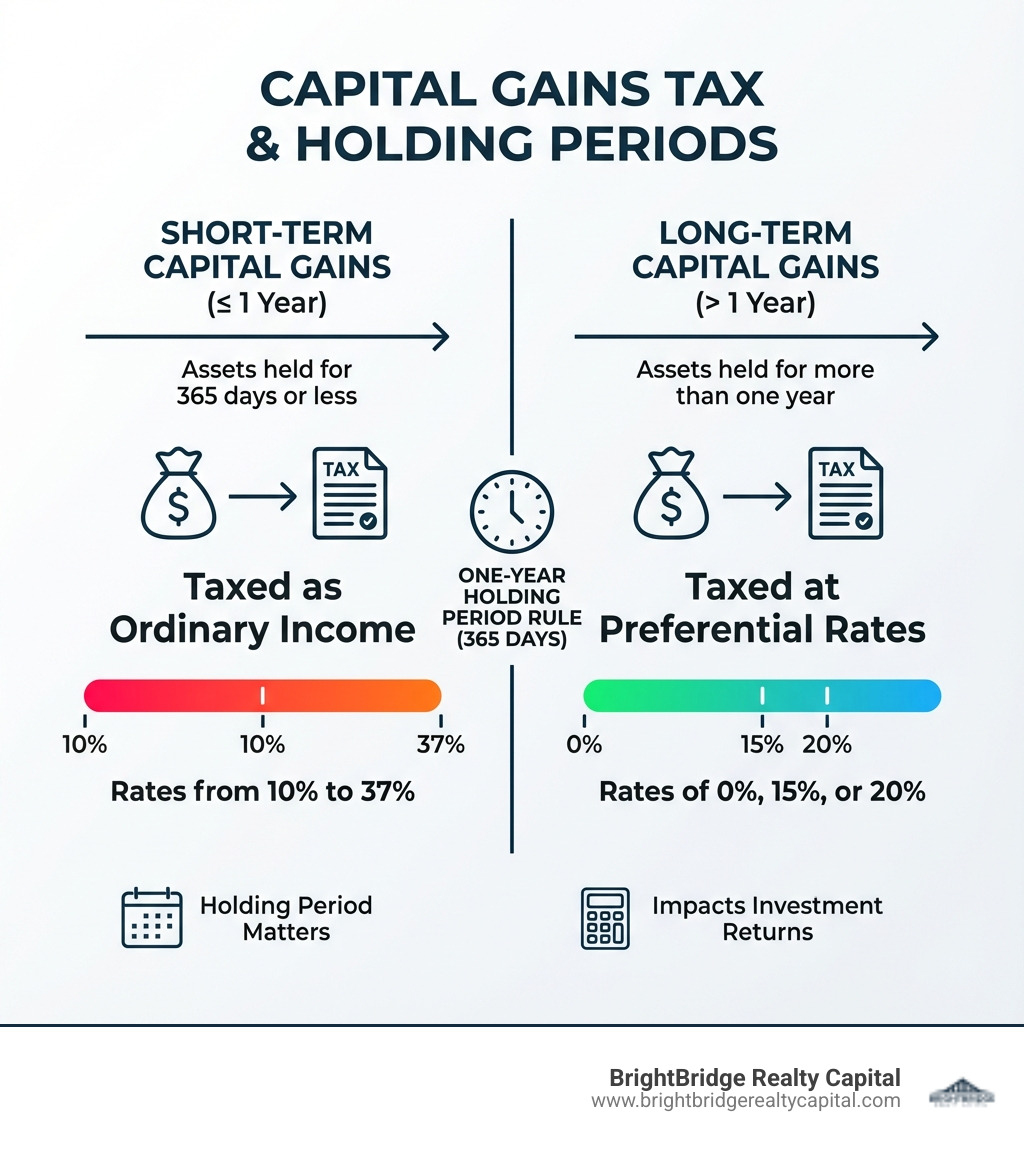
Short term capital refers to the profit generated from the sale or disposition of an asset that you have owned for one year or less. These gains are taxed in a fundamentally different way than their long-term counterparts—and almost always at significantly higher rates. This distinction is not just a minor detail in the tax code; it is a critical factor that can dramatically influence your investment strategy, your net returns, and your overall financial health.
Here's what you need to know right away:
- Holding Period: The defining line is the holding period. Assets held for one year or less (365 days or fewer) generate short-term capital gains.
- Tax Treatment: Short-term gains are taxed as ordinary income. This means they are added to your other income (like your salary) and taxed at your regular federal income tax bracket, which currently ranges from 10% to 37%.
- Key Difference: In stark contrast, long-term gains, which come from assets held for more than one year, are taxed at preferential rates of 0%, 15%, or 20%, depending on your income level.
- Additional Taxes: The tax burden doesn't stop at the federal level. Short-term gains can also be subject to state and local income taxes. Furthermore, high-income investors may be liable for an additional 3.8% Net Investment Income Tax (NIIT).
- Reporting: All capital gains and losses must be meticulously reported to the IRS, primarily using Form 8949 and Schedule D of your tax return.
Why does this matter? The implications of the short-term capital gains tax are far-reaching. If you're an active investor, the difference between a 37% tax rate and a 15% rate can slash your profits by tens of thousands of dollars, or even more. This isn't just a concern for Wall Street day traders. It affects a wide range of investors:
- Real Estate Investors: A house flip completed in six months generates short-term capital gains, taxed at high ordinary income rates. Holding that same property for just over a year could result in substantial tax savings.
- Stock Market Traders: Active traders who frequently buy and sell stocks within a few weeks or months will see their profits heavily taxed.
- Cryptocurrency Investors: The volatile crypto market often encourages rapid buying and selling. Each profitable trade within a year is a short-term capital event.
- Collectors: Selling valuable collectibles like art, wine, or classic cars for a profit within a year also triggers short-term capital gains.
Understanding how short term capital gains work is essential for making smarter decisions about when to sell assets and how to structure your investments for maximum tax efficiency. It encourages a shift in mindset from simply chasing profits to focusing on after-tax returns.
As Daniel Lopez at BrightBridge Realty Capital, I've spent years guiding real estate investors through the intricate financing side of their projects. A core part of my advisory role involves helping clients understand how timing and capital structure directly impact their financing options and, crucially, their short term capital gains tax exposure. My experience structuring complex financing solutions like hard money loans and 12-month bridge loans for fix-and-flip projects and rental acquisitions has repeatedly shown me that proactive tax planning is not a luxury—it is an absolute necessity for maximizing investor returns and building sustainable wealth.
Short term capital further reading:
What Are Short-Term Capital Gains and How Are They Calculated?
At its core, a capital gain is the profit you make when you sell a capital asset for more than you paid for it. The IRS defines a capital asset as almost everything you own for personal use or as an investment, including stocks, bonds, real estate, cryptocurrency, and collectibles. The "short-term" designation is determined entirely by how long you held that asset before selling it.

When we talk about short term capital gains, we're discussing the profits from assets held for a relatively brief period. For real estate investors, this is most common in fix-and-flip projects where properties are acquired, renovated, and sold in a matter of months. Understanding the precise mechanics of how these gains are calculated is the first step toward managing your tax obligations and maximizing your investment returns. If you're looking for more info about short-term real estate loans, we can help you align your financing with your tax strategy.
Defining the Holding Period
The holding period is the exact length of time you own an asset, and it is the single most important factor in determining whether a capital gain is short-term or long-term. The rule is simple but strict: if you hold an asset for one year or less, any profit from its sale is a short term capital gain. If you hold it for more than one year, the profit is a long-term capital gain.
The clock starts ticking the day after you acquire the asset (the trade date, not the settlement date) and stops on the day you sell it. For example, if you buy a stock on April 1, 2024, your holding period begins on April 2, 2024. To qualify for long-term capital gains treatment, you must sell it no earlier than April 2, 2025. Selling it on April 1, 2025, would mean you held it for exactly one year, resulting in a short-term gain. This distinction is paramount because it dictates how much of your hard-earned money you get to keep. As Fidelity aptly puts it, understanding what is the short-term capital gains tax? is crucial for any investor.
Special rules apply in certain situations:
- Inherited Property: When you inherit an asset, you automatically receive long-term capital gains treatment, regardless of how long you or the deceased person owned it. The asset's basis is also "stepped up" to its fair market value at the time of the owner's death.
- Gifted Property: If you receive an asset as a gift, you inherit the original owner's holding period and their cost basis. For example, if your friend bought a stock six months ago and gives it to you today, you only need to hold it for another six months and one day to qualify for long-term treatment.
The Role of Basis in Calculating Short Term Capital
To calculate your short term capital gain (or loss), you must first determine your basis. The basis is essentially your total investment in the asset. The calculation involves two key components: the acquisition basis and the disposition basis.
- Acquisition Basis (or Cost Basis): This is your total cost to acquire the asset. It's not just the purchase price. It includes all associated costs, such as commissions, transfer fees, and sales tax. For real estate, the acquisition basis is much more comprehensive. It includes the purchase price plus many closing costs, such as legal fees, recording fees, survey costs, title insurance, and any capital improvements (e.g., a new roof, a kitchen remodel) you make to the property. Repairs, on the other hand, are generally expensed and not added to the basis.
- Disposition Basis (or Sale Proceeds): This is the net amount you receive from selling the asset after deducting any selling expenses. For a stock, this would be the sale price minus any broker commissions or fees. For real estate, it's the sale price minus significant costs like realtor commissions, advertising expenses, legal fees, and other closing costs.
The formula is straightforward:
Disposition Basis - Acquisition Basis = Capital Gain or Loss
Let's use a more detailed example from our research: Suppose you buy 100 shares of a stock at $50 per share, paying a $10 commission. Your total purchase price is $5,000 + $10 = $5,010. This is your acquisition basis. Six months later, you sell all 100 shares at $58 per share, paying another $10 commission. Your total sale proceeds are $5,800, and after the commission, your disposition basis is $5,790. Your short term capital gain would be:
$5,790 (Disposition Basis) - $5,010 (Acquisition Basis) = $780
This $780 profit would then be added to your taxable income for the year and taxed at your ordinary income rate. For a deeper dive into these calculations, Investopedia provides an excellent resource on What Are Short-Term Capital Gains? Definition, Rates, and Tax Implications.
The Tax Implications of Short Term Capital
The tax treatment of short term capital gains is where the financial consequences become most apparent. Unlike long-term gains, which benefit from preferential tax rates as an incentive for long-term investment, short-term gains are treated by the IRS as equivalent to your regular earned income, such as a salary or wages. This means they are subject to your marginal income tax bracket, which can be as high as 37% at the federal level. On top of that, you may face state and local taxes, and high-income earners could be hit with the 3.8% Net Investment Income Tax (NIIT).

How Short-Term Capital Gains Are Taxed
As we've established, short term capital gains are taxed as ordinary income. This is a critical distinction with profound effects. When you realize a short-term gain, that profit is added directly to your other taxable income for the year (your Adjusted Gross Income, or AGI). This can have a significant compounding effect, potentially pushing you into a higher tax bracket than you would have been in otherwise. For example, imagine you are a single filer with a taxable income of $95,000, placing you in the 22% tax bracket for 2024. If you realize a $20,000 short-term capital gain from a quick property flip, your new taxable income becomes $115,000. This gain not only gets taxed itself, but it also pushes a portion of your income ($14,475 of it) from the 22% bracket into the 24% bracket, increasing your overall tax liability on all income in that higher bracket.
This starkly contrasts with long-term capital gains. While short term capital gains can be taxed as high as 37%, long-term gains are taxed at 0%, 15%, or 20%. This enormous difference underscores the immense value of strategic holding periods.
| Feature | Short-Term Capital Gains | Long-Term Capital Gains |
|---|---|---|
| Holding Period | One year or less | More than one year |
| Tax Rate | Ordinary income tax rates (10% to 37%) | Preferential rates (0%, 15%, or 20%) |
| Impact on Income Bracket | Can push you into a higher ordinary income tax bracket | Does not affect your ordinary income tax bracket |
| Primary Purpose | Often associated with active trading or quick flips | Encourages long-term investment and market stability |
State Taxes and the Net Investment Income Tax (NIIT)
Your total tax bill on short-term gains often extends beyond federal rates. Most states tax capital gains as regular income, just like the federal government. This means if you live in a high-tax state like California (with a top rate of 13.3%) or New York (top rate of 10.9%), your combined top marginal rate on a short-term gain could exceed 50%. Conversely, residents of states with no income tax, such as Texas, Florida, or Nevada, only have to worry about federal taxes.
Furthermore, higher-income taxpayers may be subject to the Net Investment Income Tax (NIIT). This is a 3.8% surtax on the lesser of your net investment income or the amount by which your modified adjusted gross income (MAGI) exceeds a certain threshold. The 2024 thresholds are:
- $250,000 for married couples filing jointly
- $200,000 for single or head of household filers
- $125,000 for married couples filing separately
Net investment income includes short-term capital gains. So, a high-earning investor could face a 37% federal rate + 3.8% NIIT + state taxes, making the tax bite on short-term profits incredibly deep.
2024 and 2025 Tax Rates
Below are the federal income tax brackets that apply to short term capital gains for 2024 and 2025, based on your taxable income and filing status.
2024 Federal Income Tax Brackets (Short-Term Capital Gains Rates)
| Tax Rate | Single | Married Filing Jointly | Head of Household | Married Filing Separately |
|---|---|---|---|---|
| 10% | $0 to $11,600 | $0 to $23,200 | $0 to $16,550 | $0 to $11,600 |
| 12% | $11,601 to $47,150 | $23,201 to $94,300 | $16,551 to $63,100 | $11,601 to $47,150 |
| 22% | $47,151 to $100,525 | $94,301 to $201,050 | $63,101 to $100,500 | $47,151 to $100,525 |
| 24% | $100,526 to $191,950 | $201,051 to $383,900 | $100,501 to $191,950 | $100,526 to $191,950 |
| 32% | $191,951 to $243,725 | $383,901 to $487,450 | $191,951 to $243,700 | $191,951 to $243,725 |
| 35% | $243,726 to $609,350 | $487,451 to $731,200 | $243,701 to $609,350 | $243,726 to $365,600 |
| 37% | Over $609,350 | Over $731,200 | Over $609,350 | Over $365,600 |
2025 Federal Income Tax Brackets (Short-Term Capital Gains Rates)
| Tax Rate | Single | Married Filing Jointly | Head of Household | Married Filing Separately |
|---|---|---|---|---|
| 10% | $0 to $11,925 | $0 to $23,850 | $0 to $17,000 | $0 to $11,925 |
| 12% | $11,926 to $48,475 | $23,851 to $96,950 | $17,001 to $65,050 | $11,926 to $48,475 |
| 22% | $48,476 to $103,350 | $96,951 to $206,700 | $65,051 to $103,350 | $48,476 to $103,350 |
| 24% | $103,351 to $197,300 | $206,701 to $394,600 | $103,351 to $197,300 | $103,351 to $197,300 |
| 32% | $197,301 to $250,525 | $394,601 to $501,050 | $197,301 to $250,500 | $197,301 to $250,525 |
| 35% | $250,526 to $626,350 | $501,051 to $751,600 | $250,501 to $626,350 | $250,526 to $375,800 |
| 37% | Over $626,350 | Over $751,600 | Over $626,350 | Over $375,800 |
(Source: Investopedia, TurboTax, IRS.gov)
Reporting Gains and Losses to the IRS
When tax season arrives, you must report all your capital asset transactions to the IRS. This is done on Form 8949, Sales and Other Dispositions of Capital Assets. On this form, you'll list each individual sale, including the asset description, acquisition date, sale date, sale price, and cost basis. The form separates short-term transactions from long-term ones. The totals from Form 8949 are then summarized and transferred to Schedule D (Form 1040), Capital Gains and Losses, which calculates your net capital gain or loss for the year.
Accurate and detailed record-keeping is absolutely essential. You need to document every detail for every asset you sell. Without these records, calculating your basis and determining the holding period becomes a nightmare, and you risk overpaying taxes or facing an IRS audit. For more detailed information, the IRS provides Topic no. 409 on Capital gains and losses. If this process seems daunting, you're not alone. Many investors seek professional help. As TurboTax suggests, you can let a local tax expert get your taxes done right with TurboTax.
Strategies to Manage and Reduce Your Tax Burden
While short term capital gains are taxed at high ordinary income rates, this does not mean you are powerless. A proactive and informed investor can employ several powerful, IRS-sanctioned strategies to manage, defer, or reduce their tax liability. Smart tax planning involves a deep understanding of holding periods, the strategic use of losses, and the powerful advantages of tax-advantaged accounts.
Tax-Loss Harvesting
One of the most effective and widely used strategies for managing short term capital gains is tax-loss harvesting. This involves intentionally selling investments at a loss to offset any realized capital gains. The IRS rules for this are quite favorable. Capital losses must first be used to offset capital gains of the same type (short-term losses offset short-term gains, long-term losses offset long-term gains). If you have any net losses remaining in one category, you can use them to offset gains in the other category.
If your total capital losses exceed your total capital gains, you can then use up to $3,000 of those net losses to offset your high-taxed ordinary income each year. Any remaining losses beyond that $3,000 are not lost; they can be carried forward indefinitely to offset capital gains or up to $3,000 of ordinary income in future years.
For example, imagine you have a $10,000 short term capital gain from selling a stock. In the same year, you sell another stock for a $15,000 short-term loss and a third investment for a $2,000 long-term loss. Here's how it works:
- Your $15,000 short-term loss first offsets your $10,000 short-term gain, leaving you with a net short-term loss of $5,000.
- You now have a $5,000 short-term loss and a $2,000 long-term loss, for a total capital loss of $7,000.
- You can use $3,000 of this loss to reduce your taxable ordinary income for the year.
- The remaining $4,000 loss is carried forward to the next tax year.
This can significantly reduce your current and future tax bills. Many financial institutions offer tools to help with this. Fidelity has a Tax-Loss Harvesting Tool to help reduce taxes. For real estate investors, managing capital can also involve more info about short-term investment loans to bridge financing gaps.
Understanding the Wash Sale Rule
While tax-loss harvesting is powerful, you must navigate the "wash sale" rule. The IRS implemented this rule to prevent taxpayers from claiming a tax loss on a security while essentially maintaining their economic position in it. A wash sale occurs if you sell an investment at a loss and then buy a "substantially identical" security within 30 days before or after the sale (creating a 61-day window).
If you trigger the wash sale rule, your loss is disallowed for tax purposes in the current year. For instance, if you sell 100 shares of XYZ stock at a loss on June 15th and then buy 100 shares of XYZ stock on July 5th, the IRS will disallow your loss. "Substantially identical" can also include acquiring options to buy the stock or certain related ETFs. The disallowed loss isn't lost forever; it's added to the cost basis of the new replacement shares. This effectively defers the tax benefit of the loss until you sell the new shares.
Using Tax-Advantaged Accounts
Another cornerstone strategy for managing short term capital gains is to conduct your active trading within tax-advantaged accounts. These include retirement accounts like 401(k)s and IRAs (Traditional and Roth), as well as education savings accounts like 529 plans.
Inside these accounts, your investments grow on a tax-deferred or tax-free basis. This means you don't pay capital gains taxes—short-term or long-term—on the transactions you make within the account. This provides several powerful advantages:
- Tax Deferral/Elimination: Any gains, including short term capital gains, are not taxed year-to-year. This allows your investments to compound more rapidly without the drag of annual taxes.
- Frictionless Rebalancing: You can sell an asset for a gain and buy another one immediately without triggering a taxable event. This allows you to rebalance your portfolio and pursue new opportunities freely.
- Retirement Planning: With traditional accounts, withdrawals are eventually taxed as ordinary income, but you might be in a lower tax bracket during retirement. With Roth accounts, qualified withdrawals are completely tax-free.
Investing in Qualified Opportunity Zones (QOZs)
A more advanced strategy created by the Tax Cuts and Jobs Act of 2017 involves investing in Qualified Opportunity Zones. This program is designed to spur economic development in distressed communities. For investors, it offers a powerful way to defer and reduce capital gains. If you take the proceeds from any capital gain (short-term or long-term) and reinvest them into a Qualified Opportunity Fund (QOF) within 180 days, you can defer paying taxes on that original gain until the end of 2026. If you hold the QOF investment for at least 10 years, any new capital gains generated from the QOF investment itself can be completely tax-free. This is a highly specialized but potentially lucrative strategy for those with significant capital gains. For businesses looking to grow, a Bridge Loan for Business Acquisition can provide immediate capital for strategic moves, including those related to QOZ investments.
Special Considerations for Real Estate Investors
Real estate investors operate in a unique landscape where the line between active business and passive investment can be blurry. The tax implications, especially concerning short term capital, are complex and require careful navigation. Whether you're a professional house flipper or a landlord managing a portfolio of rental properties, understanding how the IRS views your activities is paramount to protecting your profits.
Strategic financing is often the key to unlocking tax-efficient real estate strategies. Explore our bridge loans for real estate investors: a practical expert guide to learn how flexible capital can support your goals.
House Flipping: Dealer vs. Investor Status and FICA Taxes
House flipping—the practice of buying, renovating, and quickly selling a property for profit—is the quintessential example of an activity that generates short term capital gains. However, the tax treatment can be even more severe than standard short-term gains. The IRS often classifies individuals who flip houses frequently and as their primary business as "dealers" rather than "investors."
This distinction is critical. An "investor" pays capital gains tax on their profits. A "dealer," on the other hand, is considered to be running a business, and their profits are treated as business income. This means the profits are not only subject to ordinary income tax rates but also to self-employment taxes (FICA), which cover Social Security and Medicare. The self-employment tax rate is 15.3% on net earnings (up to the Social Security wage base). This means a house flipper in a 24% federal income tax bracket could face a combined federal and FICA tax rate of nearly 40% on their profits. To mitigate this, maximizing every deductible business expense—renovation costs, materials, labor, marketing, insurance, and professional fees—is absolutely vital. For those needing immediate funding for such projects, Gap Funding for Fix and Flip is a common financing solution.
The Primary Residence Exclusion
One of the most generous tax breaks in the entire U.S. tax code is the primary residence exclusion, a powerful tool for real estate owners. If you own and live in a property as your primary residence for at least two of the five years leading up to the sale, you can exclude a massive portion of your capital gains from taxation.
- Individual Filers: Can exclude up to $250,000 of capital gains.
- Married Couples Filing Jointly: Can exclude up to $500,000 of capital gains.
This strategy, often called a "live-in flip," can turn a fully taxable short-term gain into a completely tax-free event. Even if you don't meet the full two-year requirement, you may still qualify for a partial exclusion if you had to sell the home due to a change in employment, health reasons, or other unforeseen circumstances. As the IRS states, the IRS does not charge capital gains tax on certain home sale profits under these conditions.
Depreciation Recapture on Investment Properties
For investors who own rental properties, depreciation is a valuable annual deduction that reduces taxable income. However, it's not a free lunch. When you sell the property, the IRS wants to "recapture" the benefit you received. Any portion of your gain that is attributable to the depreciation you claimed over the years is taxed at a special, maximum rate of 25%. This is known as "unrecaptured Section 1250 gain."
Here's an example: You buy a rental property for $400,000. Over five years, you claim $50,000 in depreciation deductions. Your adjusted cost basis is now $350,000. You then sell the property for $550,000, resulting in a total gain of $200,000. The first $50,000 of that gain (equal to the depreciation you took) is taxed at the 25% recapture rate. The remaining $150,000 of gain is taxed at the appropriate long-term capital gains rate (0%, 15%, or 20%), assuming you held the property for more than a year. Understanding this is crucial for accurately projecting the after-tax proceeds from a sale. For managing rental portfolios, learn more about DSCR Loans for rental properties.
Deferring Gains with a 1031 Exchange
A cornerstone strategy for long-term real estate investors is the Section 1031 exchange, also known as a like-kind exchange. This powerful provision in the tax code allows an investor to defer paying capital gains taxes (including depreciation recapture) on the sale of an investment property by reinvesting the proceeds into another "like-kind" property.
To execute a successful 1031 exchange, you must follow strict rules and timelines:
- Like-Kind Property: You must exchange for another property held for investment or business use. The definition is broad; you can exchange an apartment building for raw land, for example.
- 45-Day Identification Period: From the day you close the sale of your original property, you have 45 days to formally identify potential replacement properties.
- 180-Day Closing Period: You must close on the purchase of the new property within 180 days of the original sale.
By rolling your gains from one property to the next, you can continue to grow your real estate portfolio on a tax-deferred basis, allowing your full proceeds to compound over time. This is an advanced but indispensable tool for serious real estate wealth-building.
Frequently Asked Questions about Short-Term Capital Gains
Navigating the world of short term capital gains can be confusing, and investors often have pressing questions. Here, we address some of the most common inquiries we receive, providing clear, actionable answers to help you make more informed financial decisions.
What is the main difference between short-term and long-term capital gains?
The primary and most critical difference lies in two areas: the holding period and the resulting tax rates.
- Short-term capital gains are generated from profits on assets you've held for one year or less. These gains are taxed at your ordinary income tax rates, which are the same rates that apply to your salary and can range from 10% up to 37% at the federal level.
- Long-term capital gains are generated from profits on assets you've held for more than one year. These gains are rewarded with much lower, preferential tax rates of 0%, 15%, or 20%, depending on your overall taxable income.
In essence, the government uses the tax code to incentivize long-term investment over short-term speculation. The financial impact of this difference can be enormous, making the holding period a key strategic consideration for any investor.
Can I use short-term losses to offset long-term gains?
Yes, absolutely. The IRS has a specific and logical process for netting your capital gains and losses. The steps are as follows:
- First, you net gains and losses of the same type. Short-term losses are used to offset short-term gains, and long-term losses are used to offset long-term gains.
- If you have a net loss in one category and a net gain in the other, you can then use the loss to offset the remaining gain. For example, if you have a net short-term loss of $5,000 and a net long-term gain of $8,000, you can use the loss to reduce your taxable long-term gain to just $3,000.
- If you have a net capital loss for the year after all offsetting is complete, you can deduct up to $3,000 of that loss against your ordinary income. Any remaining loss is carried forward to future tax years.
This process, often part of a tax-loss harvesting strategy, is a powerful tool for improving your overall tax efficiency.
How are cryptocurrency gains taxed?
The IRS treats cryptocurrencies like Bitcoin and Ethereum as property, not currency. This means that the same capital gains tax rules that apply to stocks and real estate also apply to crypto.
- If you buy a cryptocurrency and sell it for a profit within one year, you have a short term capital gain, taxed at ordinary income rates.
- If you hold it for more than a year before selling, you have a long-term capital gain, taxed at the lower rates.
- This also applies to using crypto to buy goods or services. If you buy a coffee with Bitcoin that has appreciated in value since you acquired it, you are technically realizing a capital gain on that transaction.
What happens with inherited assets?
Inherited assets receive a very favorable tax treatment. When you inherit an asset like stock or real estate, its cost basis is "stepped up" to its fair market value on the date of the original owner's death. This means that all the appreciation that occurred during the decedent's lifetime is never subject to capital gains tax. For example, if your grandfather bought a stock for $10 and it was worth $150 when he passed away, your basis becomes $150. If you sell it immediately for $150, you have zero capital gain. Furthermore, any gain you do realize on an inherited asset is automatically treated as long-term, regardless of how long you've actually held it.
How do I avoid short-term capital gains tax?
While you can't illegally "avoid" taxes, there are several legal and effective strategies to minimize or defer your short term capital gains tax liability:
- Extend Your Holding Period: The simplest method is to be patient. By holding an appreciating asset for more than one year, you transform a high-taxed short-term gain into a lower-taxed long-term gain.
- Utilize Tax-Loss Harvesting: As detailed above, strategically selling losing investments can offset your gains and potentially reduce your ordinary income.
- Invest in Tax-Advantaged Accounts: Use accounts like 401(k)s, IRAs, and HSAs for your active trading. Gains within these accounts are not taxed annually, allowing for tax-free compounding.
- Gift Appreciated Assets: You can gift appreciated assets to someone in a lower tax bracket, such as a child. When they sell the asset (after holding it long enough for long-term treatment), the gain will be taxed at their lower rate. Be mindful of gift tax rules.
- Donate to Charity: Donating a highly appreciated asset directly to a qualified charity allows you to potentially claim a tax deduction for the full fair market value of the asset while avoiding the capital gains tax altogether.
- Leverage Real Estate Strategies: Use the primary residence exclusion or a 1031 exchange to eliminate or defer capital gains on real estate.
Conclusion: Key Takeaways for Smart Investing
Navigating the world of short term capital gains and their tax implications is a fundamental requirement for any serious investor. As we've explored, the distinction between holding an asset for one year or less versus holding it for longer is not a minor detail—it's a critical divide that can dramatically impact your net returns. Profits from short-term activities are subject to high ordinary income tax rates, while patience is rewarded with preferential long-term rates.
For active investors, especially those in the dynamic real estate market, mastering these concepts is essential for maximizing wealth. It's about shifting your focus from gross profits to sustainable, after-tax returns. We've covered a host of powerful tools to help you achieve this: the disciplined practice of tax-loss harvesting, the careful avoidance of the wash sale rule, and the strategic use of tax-advantaged accounts like IRAs and 401(k)s. These strategies are not just for Wall Street experts; they are accessible and vital for anyone looking to build wealth through investing.
For real estate professionals, the stakes are even higher. Understanding the nuanced differences between being a "dealer" versus an "investor," the immense benefits of the primary residence exclusion, the mechanics of depreciation recapture, and the game-changing power of a 1031 exchange can mean the difference between a modest profit and a significant financial victory. These advanced strategies allow you to defer taxes, protect your capital, and compound your growth more effectively over time.
At BrightBridge Realty Capital, we recognize that sophisticated real estate investors need more than just capital; they need a financial partner who understands the interplay between financing, tax strategy, and investment goals. Our commitment is to provide not only the fast, flexible financing you need to seize opportunities but also the insights required to make informed, tax-efficient decisions. Whether you're using a bridge loan to acquire a property for a 1031 exchange or need a stabilized product to hold a property long enough to secure long-term capital gains treatment, our solutions are designed to support your strategic objectives. Explore our stabilized bridge loan solutions to see how we can help you build a more profitable and tax-efficient real estate portfolio.