Pledge and Prosper: Everything About Collateral Loans

Summary
Unlock capital with collateral based loans. Learn how they work, their benefits, risks, and common assets. Pledge and prosper!
Understanding Collateral Based Loans: Your Fast Track to Real Estate Financing

Collateral based loans are secured financing arrangements where borrowers pledge valuable assets—most commonly real estate—as security for a loan. If you're looking to unlock capital quickly for your next investment, here's what you need to know:
Quick Answer: What Are Collateral Based Loans?
- Definition: Loans secured by physical assets that lenders can seize if you default
- Common Collateral: Real estate, equipment, inventory, securities, or accounts receivable
- Key Benefit: Lower interest rates (often several percentage points less than unsecured loans)
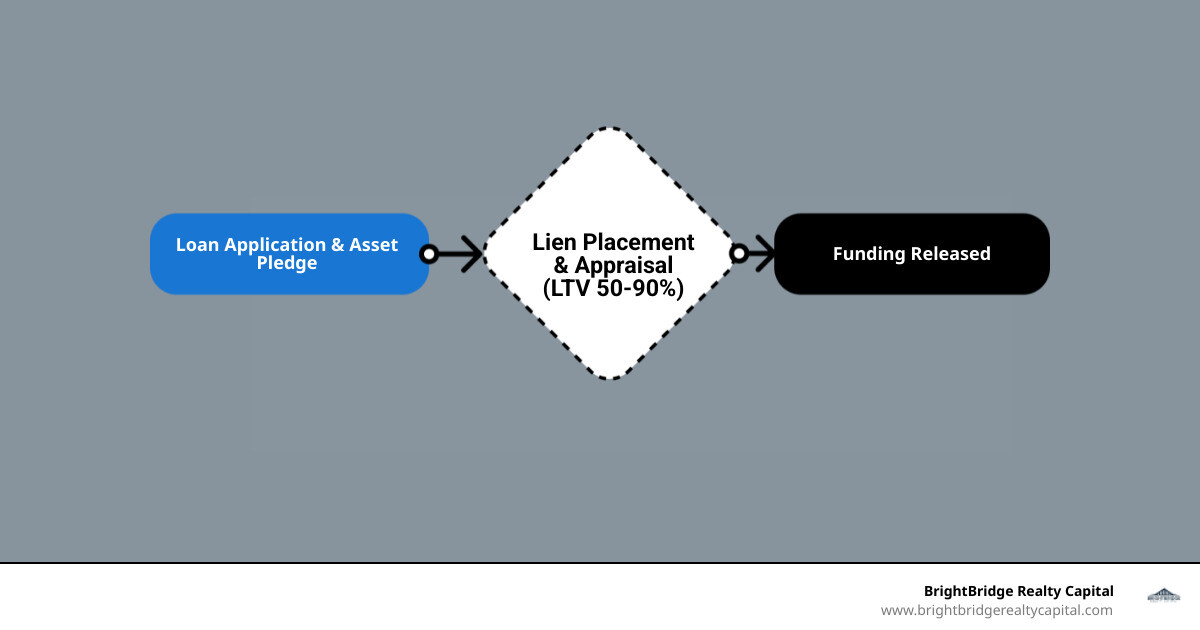
- How They Work: Lenders place a lien on your asset and lend 50-90% of its appraised value
- Main Risk: You lose the pledged asset if you can't repay
- Best For: Real estate investors, startups without credit history, and businesses needing quick capital
The fundamental difference between secured and unsecured lending comes down to risk. When you pledge an asset, lenders reduce their exposure—and pass those savings to you through better rates, higher loan amounts, and faster approvals. For real estate investors, this means accessing capital based on property value rather than just credit scores.
Traditional banks typically require collateral equal to or greater than 100% of the loan amount. But the trade-off is clear: while unsecured loans like credit cards can carry APRs above 24%, collateralized real estate loans often come in at 6-15%, depending on the asset and borrower profile.
I'm Daniel Lopez, a loan officer at BrightBridge Realty Capital, where I've helped countless investors structure collateral based loans that accommodate tight renovation timelines and competitive market conditions. My focus is making complex financing structures simple so you can move quickly on opportunities that matter.
Glossary for collateral based loans:
What is a Collateral Based Loan and How Does it Work?

At its core, a collateral based loan is a "secured" loan. This means the borrower provides a guarantee to the lender in the form of a physical or financial asset. If the borrower stops making payments, the lender has a legal right—known as a lien—to seize that asset to recoup the debt.
How does this work in practice? Let’s break down the mechanics:
- The Asset Pledge: You identify an asset you own (like a rental property) and offer it as security.
- Lien Placement: We place a legal claim on that asset. This ensures that you cannot sell the property without first paying off the loan.
- Loan-to-Value (LTV) and Advance Rates: Lenders don’t usually lend 100% of an asset's value. Instead, they use an "advance rate." For example, if a property is worth $500,000 and the lender offers a 75% LTV, you would receive a loan of $375,000. This provides a "buffer" for the lender in case the market value of the asset drops.
- Lender Protection: Because the loan is backed by an asset, the lender's risk is lower. This is why we can often approve these loans for borrowers who might not qualify for traditional bank financing.
To understand the difference between this and a standard personal loan, look at the table below:
| Feature | Secured (Collateral-Based) | Unsecured |
|---|---|---|
| Security | Physical asset (Real Estate, etc.) | Signature/Credit History only |
| Interest Rates | Lower (due to less risk) | Higher (often double digits) |
| Loan Amounts | Typically much higher | Limited by income/credit |
| Approval Speed | Fast (asset-focused) | Slower (deep credit dive) |
| Consequence of Default | Loss of asset | Credit score damage/Legal action |
For a deeper dive into the technical definitions, you can explore this Collateral finance overview). However, for most business owners and investors, the key takeaway is that an Asset-Based Loan turns your equity into immediate, working capital.
Common Assets Used to Secure Financing
While real estate is the most popular form of collateral, it isn't the only one. Depending on the type of business you run, different assets can be "monetized" to secure funding:
- Equipment: Heavy machinery, commercial vehicles, or specialized medical equipment.
- Inventory: For retail or manufacturing businesses, the stock in your warehouse can sometimes serve as security.
- Marketable Securities: Stocks and bonds held in brokerage accounts can be used for securities-based lending.
- Accounts Receivable: Also known as "factoring," where businesses use unpaid invoices as collateral to get cash immediately rather than waiting 30 or 60 days for a client to pay.
In real estate investing, many owners choose to take out a Secured Loan on Buy-to-Let Property. This allows them to use the equity in an existing rental property to fund the down payment on a new acquisition, creating a powerful snowball effect for portfolio growth.
Real Estate as the Gold Standard for Collateral Based Loans
Real estate is widely considered the "gold standard" for collateral. Why? Because buildings and land are permanent, generally appreciate over time, and are easier for lenders to value than, say, a pile of seasonal inventory.
There are several ways investors use real estate as collateral:
- Residential Properties: Single-family homes or condos used for "fix and flip" projects.
- Commercial Properties: Office buildings, retail spaces, or multi-family units.
- Bridge Financing: Short-term loans (12-24 months) used to "bridge" the gap until long-term financing can be secured.
- Hard Money: Loans that focus almost entirely on the property's After-Repair Value (ARV) rather than the borrower’s personal income.
If you are a professional flipper or developer, Real Estate Hard Money Loans are often the preferred choice because they allow you to close deals in days, not months.
The Strategic Advantages of Pledging Assets
You might wonder, "Why would I put my property at risk by using it as collateral?" The answer lies in the massive strategic advantages that collateral based loans offer over their unsecured counterparts.
1. Lower Interest RatesBecause the lender has a "safety net," they don't need to charge exorbitant interest rates to cover potential losses. This can save you thousands of dollars over the life of the loan.
2. Higher Loan AmountsUnsecured lenders are often capped at $50,000 or $100,000 based on your personal debt-to-income ratio. With collateral, you can access millions of dollars, provided the asset value supports it.
3. Credit BuildingFor startups or individuals with "bruised" credit, a collateralized loan is an excellent way to rebuild. By making timely payments on a secured loan, you demonstrate reliability, which improves your credit score for future borrowing.
4. Faster ApprovalTraditional banks can take 45 to 60 days to process a loan. At BrightBridge Realty Capital, our focus on the asset allows us to move much faster. In many cases, we can close a deal in as little as one week.
5. Flexible TermsCollateralized loans often offer more "breathing room." Since the asset provides security, we can often structure interest-only payments or balloon payments that align with an investor's exit strategy (like selling a flipped house).
For many, Bridge Loans Real Estate provide the necessary speed to beat out cash buyers in a competitive market like New York.
Why Investors Choose Collateral Based Loans Over Unsecured Options
In the high-stakes world of real estate, "cash is king," but "speed is queen." Investors often choose collateralized options because:
- Risk Reduction for the Lender = Better Terms for You: By offering security, you negotiate from a position of strength.
- Asset-Based Approval: We care more about the property’s potential than your tax returns from three years ago. This is vital for self-employed investors who may have complex income structures.
- Capital Access: You can't renovate a 20-unit apartment complex with a credit card. You need the deep capital pools that only asset-backed lending provides.
To understand the practical application of these tools, check out our What is a Hard Money Loan: A Practical Guide.
Navigating Risks and the Consequences of Default
We would be remiss if we didn't discuss the risks. The most obvious risk of collateral based loans is the potential loss of the asset.
If a borrower defaults (fails to make payments as agreed), the lender can initiate the foreclosure process. In New York, this is a legal proceeding where the lender takes ownership of the property to sell it and recover the loan balance.
Recourse vs. Non-Recourse LoansIt is crucial to understand which type of loan you are signing:
- Recourse Loans: If the property is sold and doesn't cover the full debt, the lender can come after your other personal assets (cars, bank accounts, etc.).
- Non-Recourse Loans: The lender's recovery is limited only to the collateral property. If the sale doesn't cover the debt, they generally cannot pursue your personal assets.
However, even non-recourse loans often include "Bad Boy Carve-outs." These are clauses that trigger personal liability if the borrower engages in "bad" acts like fraud, intentional damage to the property, or misappropriation of funds.
History shows that over-leveraging can lead to trouble. For those interested in the academic side of lending risks, you can read this Research on debt dilution and mortgage crises.
Frequently Asked Questions about Collateralized Borrowing
What happens to the collateral if I default?
If you default, the lender will first attempt to work out a repayment plan. If that fails, they will enforce the lien. Through the foreclosure process, the asset is seized and typically sold at auction. If it's a recourse loan, you may still be liable for the "deficiency balance"—the difference between the auction price and what you owe.
How is the value of my collateral determined?
We use professional, third-party appraisals to determine the Fair Market Value. The appraiser looks at "comps" (comparable properties sold recently in the area), the condition of the asset, and its income potential. For "fix and flip" projects, we also look at the After-Repair Value (ARV) to determine how much the property will be worth once your renovations are complete.
Conclusion
Collateral based loans are a powerful tool for anyone looking to grow their real estate portfolio or fund a business venture quickly. By leveraging the value of your assets, you can access the capital you need with better rates and fewer hurdles than traditional unsecured financing.
At BrightBridge Realty Capital, we understand that in real estate, time is money. That’s why we specialize in:
- Fast Closings: We often fund deals within a single week.
- Direct Lending: You work directly with us, not a middleman.
- Nationwide Solutions: While we love our home base in New York, NY, we provide financing solutions across the country.
- Seamless Process: Our asset-based approach means less paperwork and more focus on your project's success.
Ready to take your next step? Whether you're eyeing a distressed property for a flip or need a bridge loan for a commercial acquisition, we're here to help you prosper.
For More info about fix and flip services, visit our dedicated service page and see how we can turn your property goals into reality.