How to Finance Income Property Without Losing Your Mind


Summary
Discover direct private lending for fast income property financing. Skip bank hassles with flexible loans, quick closings, and expert guidance.
Why Direct Private Lending is Revolutionizing Real Estate Finance

Direct private lending is a form of non-bank financing where lenders provide loans directly to borrowers—typically real estate investors—without intermediaries like traditional banks or public markets. It offers speed, flexibility, and asset-based qualification when conventional mortgages fall short. In the modern financial landscape, this sector is often referred to as "private credit" or "shadow banking," though the latter term is a misnomer as these entities are highly professionalized and often backed by institutional capital.
Key characteristics of direct private lending:
- Faster closings: Days or weeks vs. months with banks. In a competitive real estate market, the ability to close in 7 to 10 days can be the difference between winning a bid and losing it to a cash buyer.
- Flexible qualification: Based on property value and exit strategy, not just credit score. Lenders look at the "story" of the deal rather than just a computer-generated credit profile.
- Asset-based underwriting: Focuses on collateral (LTV ratios) rather than rigid income requirements. This is particularly beneficial for self-employed individuals or those with complex tax returns.
- Higher rates: Typically 175-200 basis points above conventional loans, reflecting an illiquidity premium and the increased risk the lender assumes by moving quickly.
- Shorter terms: Usually 1-2 years for bridge loans, fix-and-flip, or construction financing, designed to be replaced by long-term debt or property sale.
- Senior secured debt: First lien position with protective covenants, ensuring the lender has the primary claim to the asset in the event of a default.
The direct private lending market has exploded since the 2008 financial crisis. In 2010, private credit assets under management stood at $300 billion. By 2023, that figure reached $2.1 trillion globally—with direct lending accounting for roughly half. This growth was fueled by a massive retreat from middle-market lending by traditional banks. Following the implementation of Basel III regulations and Dodd-Frank compliance costs, banks found it increasingly expensive to hold "risky" real estate loans on their balance sheets. This created a massive funding gap that private lenders, unencumbered by the same capital reserve requirements, rushed to fill.
For real estate investors, this shift means access to capital that banks simply won't provide: loans for non-residents, rush closings, foreclosure rescues, spousal buyouts, and properties needing significant renovation. While traditional banks tightened standards and slowed processes, direct private lenders built their businesses on saying "yes" to deals that make financial sense—even when they don't fit a cookie-cutter underwriting box. This evolution has democratized access to high-leverage capital for professional investors who treat real estate as a business rather than a passive hobby.
I'm Daniel Lopez, a loan officer at BrightBridge Realty Capital, and I've helped hundreds of investors structure direct private lending solutions for time-sensitive deals, unique property types, and scenarios where traditional financing couldn't deliver. I have seen firsthand how the transition from "hard money" (which was often predatory and disorganized) to "institutional private lending" has stabilized the market. Whether it's a fix-and-flip that needs to close in 10 days or a rental portfolio expansion for a self-employed borrower, I've seen how the right private loan unlocks opportunities that would otherwise slip away. The following guide explores the mechanics, benefits, and risks of this essential financial tool.
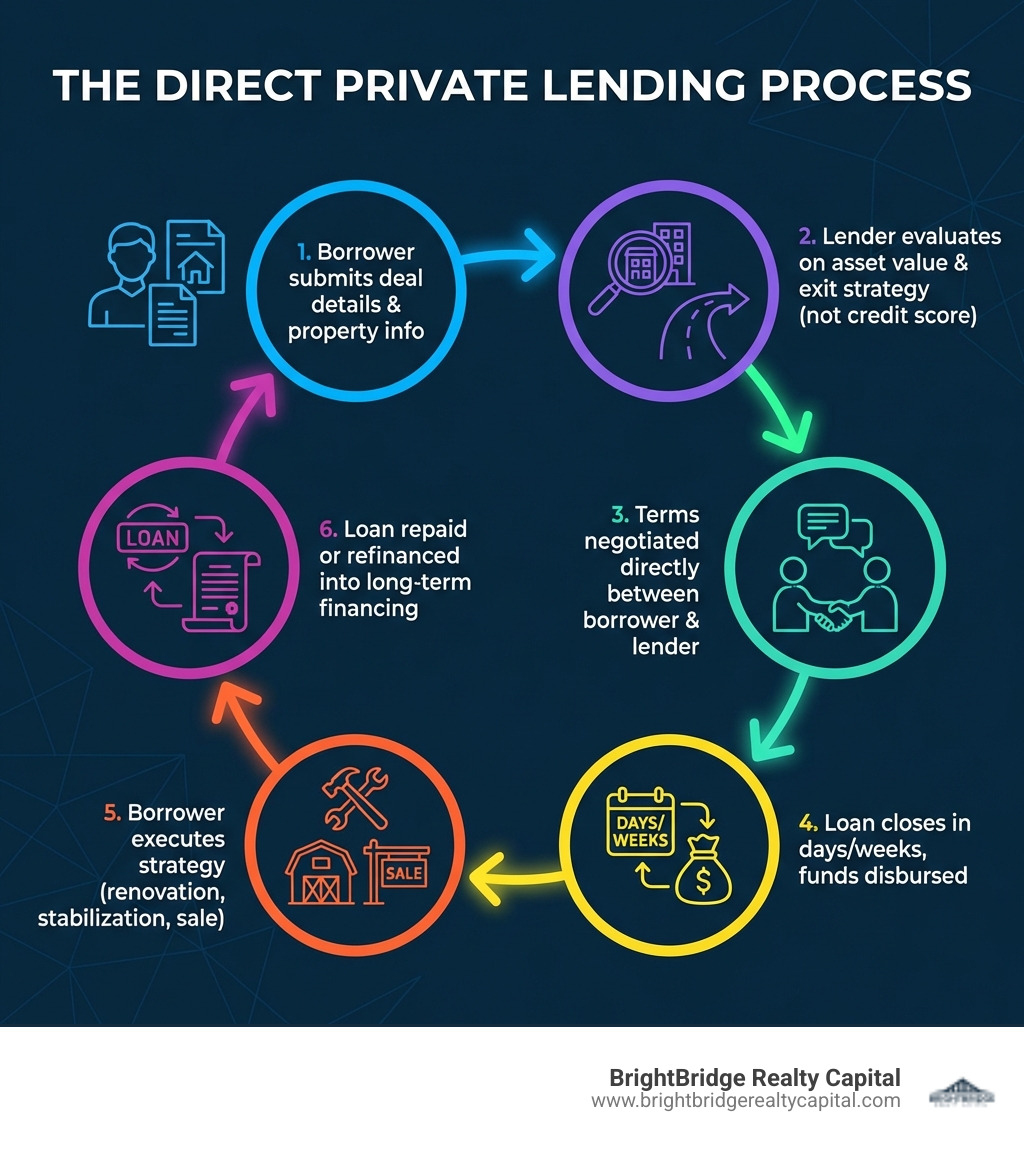
Simple Direct private lending word guide:
What is Direct Private Lending and Why is it Surging?
If you've ever tried to get a mortgage for an investment property from a big bank, you know the feeling: endless paperwork, invasive questions about your financial history that seem irrelevant to the property at hand, and a closing date that keeps sliding into the next fiscal year. This is where Direct private lending steps in to save your sanity. It represents a fundamental shift in how capital is deployed in the real estate sector, moving away from centralized, bureaucratic institutions toward agile, specialized firms.
At its core, direct lending is corporate or real estate debt provided by non-bank entities. Unlike the "broadly syndicated loan" (BSL) market where a bank originates a loan and then sells pieces of it to dozens of other institutions (a process that can take months and requires a high degree of standardization), direct lending is bilateral. It’s a one-on-one relationship between us (the lender) and you (the borrower). This bilateral nature allows for "bespoke" loan documents that can be tailored to the specific needs of a project, such as custom draw schedules for construction or flexible prepayment options.
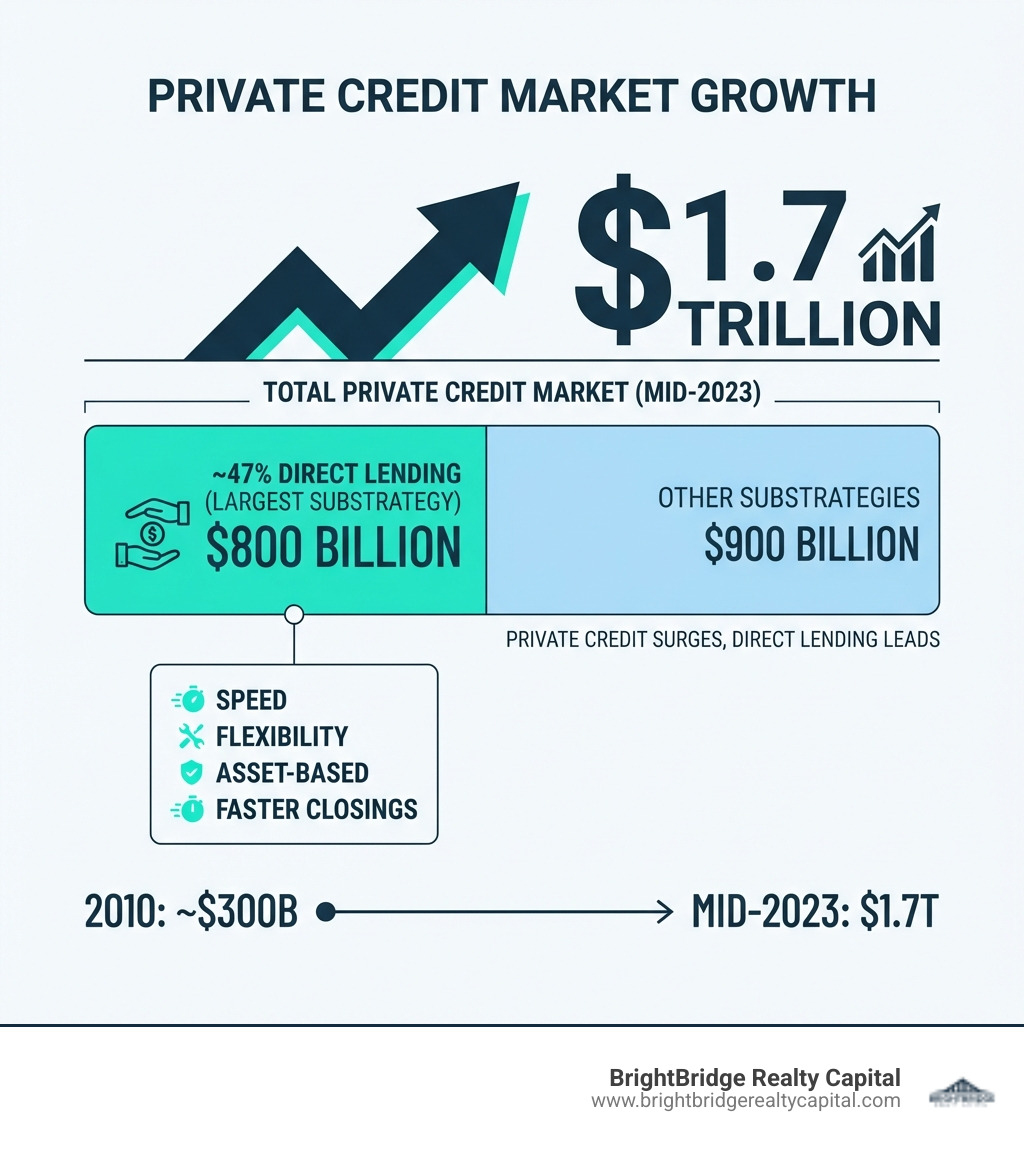
The surge we’re seeing isn’t an accident. Following the Global Financial Crisis (GFC), regulators introduced strict rules like Basel III and the Dodd-Frank Act. These were designed to make banks safer by requiring them to hold more capital against "non-standard" loans. While this made the banking system more resilient, it had a side effect: it made it incredibly difficult for banks to lend to "middle-market" companies or real estate investors with complex profiles. According to a Private Debt Investment Update, assets under management in private credit grew fourfold between 2013 and 2023. This isn't just a trend; it's a structural realignment of the global financial system.
Investors are flocking to this space because it offers "capital velocity." In real estate, speed isn't just a luxury; it's a competitive advantage. If you can close in seven days and your competitor needs sixty, you win the deal—even if your interest rate is slightly higher. This velocity allows investors to turn over their capital more frequently, potentially leading to higher annual returns despite the higher cost of debt. Furthermore, direct lenders often provide "unitranche" financing, which combines senior and junior debt into a single loan, simplifying the capital stack and reducing the number of parties involved in the closing.
The Mechanics of Direct Private Lending for Real Estate
How does this actually work on the ground? It starts with "bilateral origination." This means we handle everything in-house, from the initial phone call to the final wire transfer. We don't need to check with a credit committee in a different time zone or wait for a third-party "syndication" partner to sign off on the risk. This internal control allows for a level of certainty that banks simply cannot match.
Our underwriting is primarily asset-based. While we certainly care that you aren't a secret supervillain and we do perform basic background checks, we focus most of our energy on the property’s current market value and its potential. We look at Loan-to-Value (LTV) ratios—typically capping out around 75% for most projects—to ensure there is enough equity to protect the investment. We also look at the "After Repair Value" (ARV) for renovation projects, which allows us to lend based on what the property will be worth, not just what it is worth today.
You can find more info about direct lending services that highlight how these loans often feature floating rates. This protects the lender against inflation while giving the borrower the flexibility of shorter-term debt. Most of our loans are "senior secured," meaning they are first in line to be paid back if things go south. This security allows us to offer capital to borrowers who might be rejected by banks due to "headline risk" or unconventional income streams.
Solving Complex Borrower Needs with Direct Private Lending
Standard banks love standard borrowers: W-2 employees with 800 credit scores buying pristine suburban homes. But real estate investors often live in the "non-standard" world. They are entrepreneurs, risk-takers, and problem solvers who need a financial partner that speaks their language.
- Rush Closings: We’ve seen scenarios where a developer needs to close on a multi-family building within a week to satisfy a 1031 exchange requirement. A bank can't even finish a background check in that time, let alone an appraisal and a full committee review.
- Non-Resident Investors: Foreign buyers often find it nearly impossible to get US bank financing because they lack a domestic credit history. We can facilitate these deals using remote signing, legal partnerships, and a focus on the US-based asset.
- Credit-Challenged Individuals: Maybe you had a messy divorce, a medical emergency, or a business setback that dinged your credit score. If the property has strong equity and a clear exit strategy, we can often make the deal work because we are looking at the future of the asset, not the past of the borrower.
- Foreclosure Rescue: When a borrower is facing a deadline to save a property from the auction block, the speed of direct lending is the only viable solution to bridge the gap until a long-term refinance can be arranged.
Whether it’s a foreclosure rescue or a complex spousal buyout, Direct private lending provides the "creative deal structuring" that traditional institutions lack. For a deeper dive, check out our direct bridge lenders complete guide.
Direct Private Lending vs. Traditional Bank Mortgages
To help you decide which path is right for your next project, let's look at how these two worlds stack up side-by-side. Understanding the nuances between these two options is critical for optimizing your capital structure and ensuring your project's success.
| Feature | Traditional Bank Loan | Direct Private Lending |
|---|---|---|
| Closing Time | 45–90 Days | 5–14 Days |
| Approval Focus | Borrower Income/Credit | Property Value/Equity |
| Flexibility | Rigid, "Box" Underwriting | Bespoke, Creative Terms |
| Interest Rates | Lower (Prime + small margin) | Higher (Risk-adjusted) |
| Loan Term | 15–30 Years | 1–2 Years (Bridge/Construction) |
| Prepayment | Often penalized | Often flexible/Open |
| LTV/LTC | Conservative (60-70%) | Aggressive (Up to 80-90% LTC) |
| Reporting | Heavy ongoing compliance | Minimal, project-focused |
The biggest difference is the Debt-Service Coverage Ratio (DSCR). While banks focus on your personal global cash flow (your salary, your spouse's income, your car payments), we look at whether the property generates enough income to cover the debt. This is a game-changer for self-employed investors who have high expenses but lower "taxable" income due to legitimate business write-offs. By focusing on the asset's performance, we allow investors to scale their portfolios without being limited by their personal debt-to-income ratios.
When considering private lending vs bank financing, private loans are often interest-only. This keeps your monthly carry costs low while you're renovating or stabilizing a property, allowing you to maximize cash flow for the project itself. In a fix-and-flip scenario, every dollar saved on monthly interest is a dollar that can be reinvested into the renovation, ultimately increasing the final sale price and the investor's profit margin.
Typical Borrowers and Lenders in the Private Market
Who is on the other side of these transactions? It’s not just "rich guys with briefcases full of cash" (though that would make for a great movie). The market has matured into a sophisticated ecosystem of institutional capital.
Typical borrowers include:
- Real Estate Developers: Needing quick capital for land acquisition, horizontal development, or to "bridge" the gap between construction completion and permanent financing.
- Fix-and-Flip Operators: Who need to move fast on distressed inventory, often buying properties at auction or from wholesalers where traditional financing is not an option.
- Buy-and-Hold Investors: Using bridge loans to stabilize a property (increasing occupancy or completing minor repairs) before refinancing into long-term, lower-interest debt.
- Commercial Entities: Businesses looking to purchase their own owner-occupied facilities without the hassle of SBA loan timelines.
On the lender side, the market has become highly institutionalized. Direct lending investors now include massive pension funds (which hold about 31% of private credit assets), insurance companies, family offices, and sophisticated asset managers. These institutions are attracted to the "yield enhancement" that private debt provides compared to government bonds. This institutional backing means more stability, more standardized processes, and larger loan capacities—some private deals now exceed $80 million in size, rivaling the capabilities of regional banks.
Key Features and Risks of Private Debt Products
Before you jump in, it’s important to understand the "flavor" of the products available. Most Direct private lending falls into a few categories, each designed for a specific stage of the real estate lifecycle:
- Bridge Loans: Short-term financing used to "bridge" the gap until permanent financing or a sale can be secured. These are ideal for "stabilizing" an asset—for example, buying a half-empty apartment building, renovating the units, and increasing the rent before moving to a 30-year bank loan.
- Fix-and-Flip Financing: Loans specifically designed for heavy renovations. These often include a "draw" schedule where the lender releases funds in stages as construction milestones are met. This ensures the project stays on track and the lender's collateral is being improved.
- Construction Loans: For ground-up projects where the value is created through the build. These are the most complex private loans, requiring detailed budgets, architectural plans, and experienced contractors.
- DSCR Loans: Long-term (30-year) private loans that focus solely on the property's rental income. While these have longer terms, they are still considered "private" because they don't follow Fannie Mae or Freddie Mac guidelines.
These private real estate loans come with an "illiquidity premium." Because these loans aren't traded on a public exchange like a stock or a treasury bond, lenders charge a higher rate (usually 175–200 basis points over comparable public debt) to compensate for the fact that their money is "locked up" for the duration of the loan. This premium also covers the cost of the intensive due diligence and manual underwriting that private lenders perform.
Risks to Consider:
- Exit Strategy: This is the most critical part of your application. How are you going to pay us back? Whether it's a sale or a refinance, you need a Plan A, B, and C. If your plan is to refinance, what happens if interest rates double? If your plan is to sell, what happens if the market cools? A lender will want to see that you've thought through these scenarios.
- Shorter Durations: These aren't forever loans. If your project stalls due to permit delays or supply chain issues and your loan hits maturity, you could face expensive extension fees or even default. Managing your timeline is just as important as managing your budget.
- Floating Rate Stress: Many private loans are tied to an index like SOFR (Secured Overnight Financing Rate). If the Federal Reserve raises rates sharply, your monthly payments could increase, squeezing your margins. Some borrowers choose to purchase a "rate cap" to mitigate this risk.
- Concentration Risk: For investors, relying too heavily on high-cost private debt can be dangerous if multiple projects stall simultaneously. It is often wise to balance private debt with more stable, long-term financing where possible.
Regulatory Protections and Market Stability
Is the private market a "Wild West"? Not exactly. While it doesn't have the same retail banking regulations as your local Chase or Wells Fargo, there is significant oversight and a strong incentive for lenders to maintain a good reputation. The industry has moved away from the "loan-to-own" mentality of the past toward a partnership-based model.
In Canada, for example, mortgage brokers must be licensed, and you can search online databases here to verify their status. There are also specific laws like the Cost of Credit Disclosure and Payday Loans Act that ensure borrowers aren't hit with hidden, predatory fees. In the US, while commercial lending is less regulated than consumer lending, lenders are still subject to state-level usury laws and federal anti-fraud regulations.
From a macro perspective, the private credit market has shown remarkable stability. Default rates in direct lending were actually lower than those in the high-yield bond market throughout much of 2023. Furthermore, because we are "direct" lenders, if a borrower runs into trouble, we can sit down at a table and work out a solution much faster than a bank with a 500-page compliance manual. Recovery rates for middle-market private loans have historically averaged around 68%, which is higher than for large corporate syndicated loans. This is because private lenders are often more "hands-on" and can step in to help manage a project to completion if necessary.
Frequently Asked Questions about Private Real Estate Debt
How do interest rates compare to conventional mortgages?
Expect to pay more. Private rates are "risk-adjusted." Because we are moving faster, requiring less documentation, and taking on more "story" risk (unconventional files), our rates reflect that. Historically, the illiquidity premium adds about 1.75% to 2.00% to the rate you might see at a traditional bank. However, most of our loans are floating rate, meaning they move with the market. It's important to view the interest rate not as a cost, but as an investment in speed and certainty.
What role do mortgage brokers play in these deals?
Brokers are the matchmakers of the private lending world. They help "source" unconventional files and bring them to lenders like us. A good broker understands our specific "appetite"—for example, that we love New York multi-family but might be less interested in a rural farmhouse. They help negotiate fees, organize the borrower's documentation, and ensure the borrower’s "exit strategy" is clearly articulated. While you can go direct to a lender, a broker can often help you compare multiple private options to find the best fit.
Can I get a loan if I have a low credit score?
Yes, but it depends on the equity. We are "equity-based lenders." If you have a 550 credit score but you’re buying a property at 50% of its market value, that’s a deal we can look at. Our focus is on the collateral value and your ability to execute the project. We care more about your "track record" as an investor—how many houses have you flipped? how many rentals do you own?—than a number from a credit bureau. However, a very low credit score may result in a lower LTV (meaning you need to bring more cash to the table).
What is the difference between LTV and LTC?
LTV (Loan-to-Value) is the ratio of the loan amount to the current value of the property. LTC (Loan-to-Cost) is the ratio of the loan amount to the total cost of the project (purchase price plus renovation costs). Private lenders often look at both. For example, we might lend 80% of the purchase price and 100% of the renovation costs, as long as the total loan doesn't exceed 70% of the After Repair Value (ARV).
Are there prepayment penalties on private loans?
This varies by lender and product. Many bridge loans and fix-and-flip loans have no prepayment penalty, or perhaps a small "minimum interest" requirement (e.g., 3 or 4 months of interest). This is because the lender knows these are short-term projects. However, longer-term DSCR loans often have a "step-down" prepayment penalty (e.g., 5-4-3-2-1%) to protect the lender's yield. Always read the fine print in your term sheet.
Conclusion: Securing Your Investment Future
At the end of the day, Direct private lending is a tool. Like a high-end power tool, it costs a bit more to operate, but it gets the job done faster, handles the tough materials that standard tools can’t touch, and allows for a level of precision that manual methods lack. As the financial world continues to evolve and traditional banks become more constrained by regulation, the importance of having a reliable private lending partner will only grow.
At BrightBridge Realty Capital, we pride ourselves on being a direct relationship lender. We don't hide behind intermediaries or automated algorithms. When you call us, you're talking to the people who make the decisions, analyze the risk, and fund the deals. We specialize in fast closings (often within a week) and nationwide reach, ensuring that whether you're in New York, Florida, or anywhere else in the country, you have the capital you need to grow your portfolio. We understand that in real estate, time is money, and we have built our entire process around that reality.
Don't let a rigid bank "no" stop your next great deal. Whether you're looking to finance your next rental property or need a bridge loan for a complex acquisition, we're here to provide the seamless process, creative structuring, and competitive rates that keep your investment strategy on track. The future of real estate finance is private, direct, and agile. Let's build something together. Contact us today to see how our customized financing solutions can turn your next property vision into a reality.