Direct Access: Finding Your Ideal Bridge Loan Partner

Summary
Need quick financing? Explore direct bridge lenders for fast, flexible capital. Streamline your real estate or business funding needs.
Why Speed and Direct Access Matter in Bridge Financing
In the high-stakes world of real estate investment, timing isn't just a factor; it's often the entire game. Opportunities materialize and vanish in the blink of an eye, and the ability to act decisively is what separates successful investors from those left on the sidelines. This is the environment where direct bridge lenders thrive. These are not your typical banks; they are specialized, private financial institutions that provide short-term, asset-based loans using their own capital. By operating without the intermediaries that bog down traditional finance—such as brokers, syndication partners, or third-party investors—direct lenders offer a streamlined, transparent, and incredibly fast path to funding.
This direct model is built on a foundation of efficiency and control. Because we fund loans from our own balance sheet, we have full discretion over the lending process. This autonomy allows us to deliver faster approvals, more flexible terms, and a level of direct communication that is simply impossible in a layered, bureaucratic system. When you work with a direct lender, you are speaking with the source of the capital, ensuring clarity and accountability from the initial conversation to the final repayment.
Key Characteristics of Direct Bridge Lenders:
- In-house funding: Direct lenders use their own discretionary capital. This means the decision to lend is made internally, without needing to seek approval or funds from outside sources. This is the cornerstone of their speed and certainty.
- Single point of contact: The relationship is managed by a dedicated loan officer who understands your project intimately. This eliminates the frustrating game of telephone that often occurs when dealing with brokers or large institutions with segregated departments.
- Fast closings: While traditional bank loans can languish in underwriting for 45-90 days, direct bridge lenders can move from application to funding in as little as 5-30 days. This speed is a powerful tool for winning competitive bids or capitalizing on time-sensitive opportunities like a 1031 exchange.
- Flexible terms: Loan structures are not one-size-fits-all. Terms typically range from 6-36 months and often include built-in extension options, interest reserves to cover payments during renovations, and customized draw schedules for construction funds.
- Asset-based focus: A direct lender's primary underwriting focus is the intrinsic value of the real estate asset and the viability of the borrower's exit strategy. While borrower experience is important, factors like W-2 income or personal tax returns are secondary, opening the door for investors with complex financial profiles.
- Loan amounts: These lenders are equipped to handle significant transactions, with loan amounts generally starting around $2 million and scaling up to $75 million or more for prime commercial, industrial, and multifamily properties.
Imagine you've found the perfect value-add multifamily property in a hot market. The seller wants to close in 20 days. A traditional bank would laugh at that timeline. A direct bridge lender, however, sees it as business as usual. They can underwrite the asset's potential, approve the loan, and get you to the closing table before your competition has even finished their initial paperwork. This is the direct lender advantage.
The bridge lending market has matured significantly since its origins as a niche product for distressed assets. The 2008 financial crisis created a vacuum as traditional banks tightened their lending standards, and private lenders stepped in to fill the void. Today, bridge financing is a mainstream, sophisticated tool used by savvy real estate investors, developers, and business owners for a wide array of strategic purposes, from flipping homes and developing properties to expanding rental portfolios and acquiring operating businesses.
However, it's crucial to distinguish true direct lenders from those who are merely brokers or correspondents. Some will take your application and shop it to a network of capital sources, adding another layer of delay and uncertainty. Others may require complex capital stacks involving third-party mezzanine debt or multiple senior lenders. A true direct lender originates, underwrites, funds, and services the loan entirely in-house. This vertical integration provides an unparalleled certainty of execution and a single, accountable relationship to manage.
I'm Daniel Lopez, a senior loan officer at BrightBridge Realty Capital. Over my career, I've structured and closed hundreds of millions of dollars in financing for investors who require speed and flexibility. My role is to demystify the lending process and serve as a strategic partner, helping clients leverage financing from direct bridge lenders to achieve their goals, whether it's a quick fix-and-flip or a large-scale commercial acquisition. I ensure my clients have the capital they need, precisely when opportunity strikes.
What Makes a Direct Lender Different?

The fundamental difference between working with direct bridge lenders and navigating traditional financing channels is best illustrated by an analogy: it's the choice between taking a non-stop express highway to your destination versus a winding, scenic road fraught with detours, toll booths, and unexpected stops. The direct lending model is that express highway, meticulously designed to get you funded with maximum efficiency and transparency.
Direct lenders like us at BrightBridge Realty Capital operate on our own capital. This is the critical distinction. We are not brokers who collect your information only to shop your deal to a hidden network of lenders, adding fees and delays at every turn. We are not large banks that require your loan package to survive a gauntlet of committees, each with its own opaque criteria and timeline. We control the entire process from start to finish. This vertical integration translates directly into two key benefits for you: faster decisions and unwavering accountability. You communicate directly with the decision-makers—the people whose capital is at stake—eliminating the frustrating delays, misinterpretations, and communication black holes that plague intermediated processes.
This in-house funding model provides a surety of execution that is arguably the most valuable commodity in real estate investing. When a direct lender issues a term sheet, it comes with a high degree of confidence that the loan will close as specified, provided due diligence confirms the initial information. This is invaluable when you are facing a hard closing date, have non-refundable earnest money at risk, or are competing against all-cash buyers. With a direct lender, you can make offers with confidence, knowing your financing is secure. This contrasts sharply with the uncertainty of brokered deals, which can fall apart at the eleventh hour if the broker's chosen capital source backs out.
Furthermore, the single point of contact is more than just a convenience; it's a strategic advantage. Your loan officer is your dedicated partner, deeply familiar with the nuances of your project, your business plan, and your goals. They are empowered to solve problems and navigate complexities without having to escalate issues through a rigid corporate hierarchy. This ensures clear, consistent, and intelligent communication throughout the life of the loan, from the initial sizing to the final payoff.
From a financial perspective, the direct model often leads to reduced net fees. While a direct lender charges an origination fee to cover underwriting and processing, you eliminate the separate commission that a broker would charge. These broker fees can add 1-2% to the loan cost without adding commensurate value. By cutting out the middlemen, you are engaging in a more cost-effective transaction. When compared to traditional banks, which are notoriously slow, inflexible, and focused on historical cash flow, direct bridge lenders are purpose-built for the dynamic needs of modern real estate investors. We understand that market opportunities don't adhere to a 60-day approval cycle, and our entire business is structured to deliver capital at the speed of your business.
Want to dive deeper into how this model can transform your financing experience? Check out our guide on Direct Lending Solutions to see what's possible when you cut out the middlemen and work directly with your funding source.
Common Use Cases for Bridge Financing
Bridge loans are the Swiss Army knife of real estate finance—remarkably versatile tools designed to bridge the gap when timing, opportunity, and capital needs don't align with the slow, rigid framework of conventional lending. Their application isn't confined to a single type of investor or project; this flexibility makes them indispensable across a vast spectrum of real estate scenarios, from fast-paced commercial acquisitions in New York City to extensive residential rehab projects in growing suburban markets. For a deeper dive into how these loans specifically empower investors, our comprehensive guide on Bridge Loans for Real Estate Investors is an essential read.
Who are the Primary Borrowers?
The power of bridge financing is evident in the diverse array of borrowers who rely on it to achieve their strategic objectives. Each has unique needs and timelines, but all share a common requirement for speed and certainty.
- Real Estate Investors: This is the largest group of bridge loan borrowers. Fix-and-flip investors use them to acquire and renovate properties quickly, maximizing their return on investment by minimizing holding costs. Landlords and portfolio investors, including those employing the BRRRR (Buy, Rehab, Rent, Refinance, Repeat) strategy, use bridge loans for the crucial acquisition and renovation phases before stabilizing the property and securing long-term, permanent financing.
- Property Developers: For developers, bridge loans are a critical tool for overcoming the initial hurdles of a project. They can be used to acquire land and fund pre-development costs like zoning entitlements, architectural plans, and permits, setting the stage for a larger construction loan. For value-add renovations, bridge loans provide the capital for both the acquisition and the rehab budget, allowing developers to transform an underperforming asset into a stabilized, income-producing property. Our guide on Bridge Loans for Developers explores these complex scenarios in detail.
- Homebuyers in Competitive Markets: While less common for commercial lenders, a bridge loan can be a homeowner's secret weapon. In a hot market like New York, making an offer contingent on the sale of your current home is a non-starter. A bridge loan allows you to tap the equity in your existing home to make a non-contingent, near-cash offer on a new property, securing it before it's snapped up by another buyer.
- Businesses Needing Working Capital or Assets: Companies often turn to bridge loans when they need to move faster than their traditional credit lines allow. This could involve acquiring a new warehouse to fulfill a sudden surge in orders, purchasing a competitor's assets in a distressed sale, or simply bridging a seasonal cash flow gap to fund operations and expansion.
How are Bridge Loans Used?

The applications of bridge financing are as varied as the borrowers themselves, but they all hinge on the need for speed, flexibility, and creative structuring that traditional financing simply cannot accommodate.
- Time-Sensitive Property Acquisition: This is the classic use case. When you need to close on an off-market deal, a real estate auction purchase, a 1031 exchange deadline, or a highly competitive bidding situation, a bridge loan provides the cash-like closing speed to secure the asset decisively.
- Mismatched Closing Dates: A bridge loan elegantly solves the common dilemma of needing to close on a new property before the sale of an existing one is finalized. It "bridges" this timing gap, providing the down payment or even the full purchase price, thereby preventing the collapse of a promising deal.
- Value-Add and Rehab Projects: Bridge loans are ideal for properties that are not yet stabilized and therefore cannot qualify for permanent financing. Lenders can provide capital for both the acquisition and the full rehabilitation budget, often disbursing renovation funds in draws as work is completed. Once the property is renovated, leased, and stabilized, the investor can execute their exit strategy by selling for a profit or refinancing into a long-term loan based on the higher, after-repair value (ARV).
- Construction Financing: While distinct from traditional ground-up construction loans, bridge financing can be instrumental in getting a project off the ground. It can fund land acquisition and horizontal improvements, or provide the initial vertical construction funds while a more complex, long-term construction facility is being arranged.
- Resolving Distressed Situations: Bridge loans are a powerful tool for solving complex financial problems under pressure. This includes situations like a partner buyout, a maturing loan that the current lender will not extend, a discounted payoff (DPO) opportunity, or a bankruptcy or foreclosure workout. The speed of a direct lender can provide the liquidity needed to resolve the situation and preserve the equity in the asset.
For more detailed information on financing strategies for income-producing assets, visit our dedicated page on Bridge Loan for Commercial Property.
Understanding Loan Terms and Eligibility from Direct Bridge Lenders
When you're considering bridge financing, it's essential to understand the landscape of loan terms and eligibility requirements. The approach taken by direct bridge lenders is fundamentally different from that of traditional banks. We operate on an asset-based lending model, which means our primary focus is on the quality and potential of the real estate asset itself, along with the borrower's plan to repay the loan (the exit strategy). This contrasts sharply with banks, which place heavy emphasis on the borrower's historical income, credit score, and global debt-to-income ratios. This asset-centric philosophy is precisely what grants us the ability to offer greater flexibility and unparalleled speed.
What are the typical loan terms?
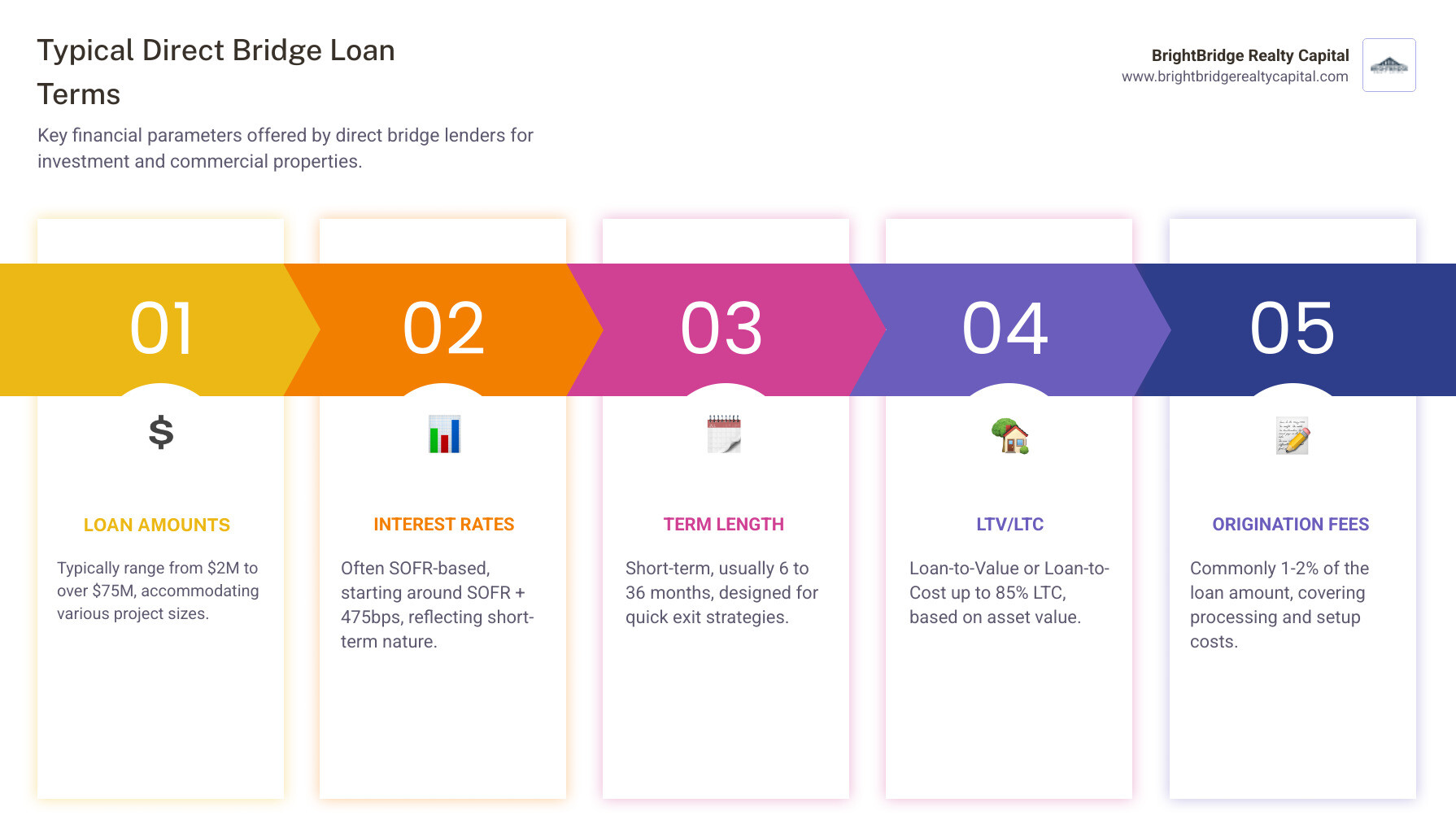
While every loan is tailored to the specific project, property, and borrower, there are common ranges and structures you can expect from a direct bridge lender. The following table provides a general overview based on industry standards, as reflected in publications like the PERE Credit: Bridge Lending Report 2025, and our own offerings at BrightBridge Realty Capital.
| Term Category | Typical Range for Direct Bridge Lenders (Investment/Commercial) |
|---|---|
| Loan Amount | $2 Million – $75 Million+ |
| Interest Rate | Starting from SOFR + 475bps (Basis Points) |
| Term Length | 6 – 36 months (with extension options) |
| Loan-to-Value (LTV/LTC) | Up to 85% of Loan-to-Cost (LTC) or 75% of Loan-to-Value (LTV) |
| Origination Fees | Typically 1-2% of the loan amount |
| Property Types | Multifamily, Commercial (Office, Retail, Mixed-Use), Industrial, and select Residential (non-owner occupied) |
Let's break these down further. The interest rate is often quoted as a spread over a benchmark rate like SOFR (Secured Overnight Financing Rate). For example, SOFR + 475bps means the annual rate is the current SOFR rate plus 4.75%. Loan-to-Cost (LTC) is common for value-add or construction projects and is calculated against the total project cost (purchase price + renovation budget). Loan-to-Value (LTV) is based on the appraised value of the property, either "as-is" at the time of purchase or "as-stabilized" upon project completion.
What are the risks and how are they mitigated?
Bridge loans are powerful but come with a distinct risk profile that borrowers must understand and manage. A reputable direct lender will work proactively with you to mitigate these risks.
- Higher Interest Rates: Bridge loan rates are higher than those of 30-year conventional mortgages. This reflects the short-term nature, higher perceived risk, and the immense value of speed and flexibility provided.
- Mitigation: The key is to focus on the total cost of capital versus the opportunity cost of losing the deal. The short duration of the loan (typically 12-24 months) means the total interest paid is often a small, manageable fraction of the project's overall profit. A successful, quick exit makes the higher rate a worthwhile investment in opportunity.
- Short Repayment Window: These are temporary financing solutions, not permanent debt. The loan has a maturity date, and you must be prepared to pay it off.
- Mitigation: The exit strategy is paramount. Before we ever fund a loan, we rigorously underwrite your plan for repayment. This means creating a clear and viable exit plan from day one. This could be a sale, supported by a conservative broker opinion of value (BOV), or a refinance to permanent debt, supported by a pro-forma analysis showing the property will meet a traditional lender's debt-service coverage ratio (DSCR) requirements upon stabilization.
- Risk of Failed Exit Strategy: The biggest risk is that your plan to sell or refinance does not materialize in time due to market shifts (interest rates rise, property values fall), construction delays, or slower-than-expected lease-up.
- Mitigation: We build in multiple layers of protection. First, we stress-test your exit plan against potential market changes. Second, most of our loans include extension options (e.g., one or two 6-month extensions) that provide a crucial safety net if the market or project timeline shifts. Third, we discuss recourse. While many loans are full recourse, we also offer non-recourse options for strong sponsors and assets. A non-recourse loan limits the lender's claim to the property itself in a default scenario, protecting the borrower's other personal assets. These loans still include standard "bad boy carve-outs," which hold the borrower personally liable for acts of fraud, waste, or other specified bad acts.
Our primary objective is to structure Flexible Bridge Loan Options that not only empower you to seize opportunities but also provide a clear and secure path to success by proactively managing and mitigating inherent risks.
Your Step-by-Step Guide to Securing a Loan

Navigating the loan process shouldn't feel like traversing a maze. With a direct lender like BrightBridge Realty Capital, we've intentionally dismantled the convoluted, opaque process of traditional lending and replaced it with a transparent, efficient, and logical path. Our process can be broken down into a few clear stages, designed to get you from initial inquiry to a funded loan with speed and clarity.
How to Prepare Your Application
A swift approval is born from a well-prepared application. The more organized and thorough you are upfront, the faster we can move. Before submitting a formal application, you should gather the following key documents and information. This preparation demonstrates your professionalism and allows our team to underwrite your request efficiently.
- Property Details: This includes the property address, the purchase and sale agreement (if applicable), current rent roll, operating expenses, and for renovation projects, the estimated after-repair value (ARV).
- Business Plan & Scope of Work: A concise yet detailed summary of your project is crucial. What is your vision for the property? This should include your proposed budget for renovations or construction, a clear timeline for completion, and the overall strategy.
- Exit Strategy: This is the most critical component of your application. You must present a clear, data-supported plan for repaying the bridge loan. If your exit is a sale, provide market comparables. If your exit is a refinance, provide a pro-forma analysis showing how the property will be stabilized to qualify for permanent financing.
- Entity Information: Most commercial loans are made to a business entity, typically an LLC or corporation, for liability protection. You'll need your formation documents, operating agreement, and EIN.
- Borrower Information: This includes a summary of your real estate investment experience (a schedule of real estate owned or "REO schedule"), and a personal financial statement (PFS). Even as asset-based lenders, we need to see that you have the experience and liquidity to execute the business plan and handle unforeseen circumstances.
For a comprehensive checklist to ensure you have everything in order, review our detailed Bridge Loan Application guide.
The Approval and Closing Process with Direct Bridge Lenders
This is where the direct lending model truly shines, transforming a months-long ordeal into a matter of days.
- Step 1: Initial Inquiry & Term Sheet (1-2 Days): The process begins with a conversation with one of our loan officers. We'll discuss your project to determine if it's a good fit. If it aligns with our lending criteria, we can typically issue a detailed term sheet outlining the proposed rate, term, and fees within 24-48 hours.
- Step 2: Due Diligence & Underwriting (3-10 Days): Once you accept the term sheet, we move into formal underwriting. Our in-house team will analyze the property, the market, and your business plan. We will order third-party reports, such as an appraisal and an environmental site assessment. Because we are not waiting on external committees, this process is incredibly efficient.
- Step 3: In-House Approval & Legal (2-4 Days): Our loan committee, comprised of senior decision-makers, reviews the final underwriting package. This internal meeting happens quickly, leading to a final approval. Simultaneously, our in-house or designated legal counsel will draft the loan documents and coordinate with your attorney.
- Step 4: Closing and Funding (1 Day): We work with a title company to schedule the closing. Once all documents are signed, the funds are wired directly. The entire journey, from initial call to funded loan, typically takes just 5 to 15 business days. This gives you a powerful, cash-like advantage in competitive markets like New York, allowing you to seize opportunities without the financing contingencies and delays that plague your competitors.
Frequently Asked Questions about Direct Bridge Lenders
Navigating any new type of financing can bring up questions. We believe in transparency, so we've compiled answers to some of the most common inquiries we receive about working with direct bridge lenders. Understanding these points will give you the confidence to leverage bridge financing effectively.
How fast can I get a bridge loan from a direct lender?
This is the most common question, and the answer highlights our primary value proposition: speed. While a traditional bank loan process can drag on for 45 to 90 days or more, a direct lender operates on an entirely different timeline. At BrightBridge Realty Capital, we can typically provide a formal term sheet within 24-48 hours of receiving a complete initial request. From there, the closing process is exceptionally rapid, often taking just 5 to 15 business days. This velocity is not just a convenience; it's a strategic weapon that allows you to compete with cash buyers, meet tight closing deadlines, and capitalize on fleeting market opportunities. For a closer look at how we achieve this, explore our insights on Fast Bridge Loans.
Are bridge loans only for commercial real estate?
No, the application of bridge loans is incredibly broad, though most direct lenders focus on loans for business purposes to avoid the heavy regulation of consumer lending. While they are a staple for commercial real estate (multifamily, office, retail, industrial), they are also widely and effectively used for:
- Residential Investment Properties: This is a massive category. Bridge loans are perfect for fix-and-flip projects, acquiring rental properties that need renovation (the BRRRR method), and purchasing portfolios of single-family homes.
- Land Acquisition: A bridge loan can be used to quickly secure a parcel of land for a future development project, especially if it's already entitled and ready for construction to begin.
- Owner-Occupied Homes (in a business context): While we do not provide consumer mortgages, a bridge loan can sometimes be structured to help a business owner or high-net-worth individual purchase a new primary residence before their current one is sold, though these are more complex and less common.
What is the most important factor for getting approved?
While a borrower's experience and financial stability are certainly important, a direct bridge lender's approval process is overwhelmingly weighted toward two critical factors:
- The Asset: We are, first and foremost, asset-based lenders. Our primary underwriting focus is on the real estate itself—its location, its current condition, its income-producing potential, and its value in the current market. A strong, well-located property with clear potential is the bedrock of any successful bridge loan.
- The Exit Strategy: A bridge loan is, by definition, temporary. Therefore, a clear, credible, and well-documented plan for repaying the loan is just as important as the asset itself. We need to see a viable path to repayment, whether it's through a sale of the improved property (supported by market comps) or a refinance into a long-term mortgage (supported by a realistic pro-forma showing the property will be stabilized and cash-flowing).
A strong property combined with a solid exit strategy will almost always get a direct lender's attention.
What's the difference between a bridge loan and a hard money loan?
This is a common point of confusion. The terms are often used interchangeably, but there's a nuance. "Hard money" is the older term, sometimes associated with individuals or small, less-regulated shops lending at very high rates on distressed properties. Direct bridge lenders, like BrightBridge Realty Capital, represent the institutional evolution of this space. We are professional, private financial firms that use our own balance sheets, but we operate with more standardized processes, more sophisticated underwriting, and often more competitive pricing for high-quality projects and sponsors. Think of us as institutionalized private credit: more flexible and faster than a bank, but more reliable and professional than the traditional hard money stereotype.
Can I get a bridge loan with bad credit?
Yes, it's possible. Because our lending decision is based primarily on the asset and the exit strategy, a lower personal credit score is not an automatic disqualifier, as it would be at a conventional bank. However, it doesn't mean credit is ignored. We still review your credit history to understand your financial habits. A low score due to a past event that can be explained is one thing, but a history of financial mismanagement, recent bankruptcies, or foreclosures are red flags that will require significant explanation and may impact the loan terms or our willingness to lend. In these cases, the strength of the real estate and the clarity of the exit plan become even more critically important.
Conclusion
So, where does this leave us? After a comprehensive exploration of direct bridge lenders, one truth emerges with undeniable clarity: in the world of real estate, where speed is currency and opportunity is fleeting, these specialized lenders provide an indispensable service. When traditional banks are too slow, too rigid, or too risk-averse, direct lenders offer a clear, efficient, and powerful alternative. They provide a straightforward path to capital that bypasses the endless paperwork, opaque committee reviews, and agonizing wait times that define conventional finance.
Consider the practical implications. In a hyper-competitive market like New York, NY, the ability to close a deal in 10 days versus 60 is not merely a convenience—it is a profound competitive advantage. It's the difference between winning a bid and explaining to your partners why you lost it. It's the confidence to make a non-contingent offer, putting you on equal footing with all-cash buyers. Direct bridge lenders are not just aware of this reality; our entire business model is engineered to thrive within it.
Throughout this guide, we've delved into the specifics. We've seen how bridge financing is the lifeblood for a diverse range of players—from the fix-and-flip investor racing to acquire their next project, to the property developer funding pre-development costs, to the business owner seizing a strategic acquisition. The common thread woven through every scenario is a critical need for speed, flexibility, and a financing partner who possesses a deep, nuanced understanding of the project's goals. The beauty of the direct lending model lies in this partnership. There are no middlemen, no brokers shopping your deal to the highest bidder, and no faceless committees. You have direct, unfiltered communication with the decision-makers and a dedicated relationship manager who knows your project inside and out. This is why an approval can happen in 24-48 hours and a closing can be scheduled in 5-15 days.
Looking ahead, the future of private real estate credit and bridge lending is exceptionally bright. As the real estate market continues to accelerate and evolve, the demand for agile, intelligent financing solutions will only intensify. Savvy investors and developers increasingly recognize that the cost of a bridge loan is a small price to pay for the speed and certainty required to capitalize on valuable opportunities. Major industry analyses, including the PERE Credit: Bridge Lending Report 2025, confirm this trend. In an uncertain economic climate where traditional capital sources may retreat, direct lenders step forward, providing essential liquidity and becoming a permanent, vital component of the capital stack.
At BrightBridge Realty Capital, we are more than just a lender; we are a strategic partner in your success. We understand the pressures of the New York market and the intricacies of value-add real estate. We are committed to providing the fast, transparent, and flexible financing you need to execute your vision with confidence. Whether you are acquiring your next property, renovating a portfolio, or simply need to move with decisive speed, we are here to build the bridge between your opportunity and its realization.
Ready to experience the profound difference that working with true direct bridge lenders can make for your next project? Secure your stabilized bridge loan with us today and let's build your next success together. Your opportunity is here—we'll make sure you don't miss it.