The Modern Guide to Stated Income Loans and Alternatives


Summary
Discover stated income loans & modern alternatives like bank statement & DSCR loans for self-employed. Guide to qualify in 2025.
Why Stated Income Loans Still Matter for Real Estate Investors in 2026
Stated income loans were once the go-to solution for self-employed borrowers and investors who couldn't document income the traditional way. After the 2008 housing crisis, the rules changed dramatically — but flexible lending options never went away. They just evolved into a sophisticated suite of products designed for the modern economy. In 2026, as the gig economy and independent entrepreneurship have become the standard rather than the exception, these loans are more relevant than ever.
Quick answer for investors searching for stated income loan alternatives:
| Loan Type | Best For | Income Verification | Min. Credit Score |
|---|---|---|---|
| Bank Statement Loan | Self-employed, 1099 earners | 12-24 months bank statements | 600+ |
| DSCR Loan | Rental property investors | Property cash flow only | 620+ |
| Asset Depletion Loan | Retirees, high-net-worth buyers | Liquid assets divided by 360 | 620+ |
| Hard Money Loan | Fix-and-flip investors | Property value/equity | Flexible |
| No-Doc Mortgage | Investors with complex income | Minimal documentation | 650+ |
Today, true "no verification" loans — where a borrower could simply write any income number on an application — no longer exist for owner-occupied homes. The Dodd-Frank Act of 2010 made that illegal to protect consumers from predatory lending practices. But for real estate investors and business-purpose borrowers, a robust set of modern alternatives has taken their place, offering the same speed and ease without the systemic risk.
These non-QM (non-qualified mortgage) programs are built for people whose income is real but just doesn't show up cleanly on a tax return. Think of the small business owner who writes off every legal expense to minimize tax liability, the freelancer with fluctuating 1099 income from multiple high-paying contracts, or the seasoned investor whose rental portfolio generates strong cash flow that traditional lenders still won't count due to depreciation schedules. In the current 2026 market, where interest rates have stabilized but inventory remains tight, the ability to close quickly using these alternative methods is a significant competitive advantage.
The challenge isn't your ability to repay. It's proving it using outdated paperwork systems designed for W-2 employees who have worked the same job for twenty years. Modern underwriting has caught up to the reality of the 21st-century workforce.
I'm Daniel Lopez, a loan officer at BrightBridge Realty Capital, and I've helped countless investors and self-employed borrowers navigate stated income loans and non-QM alternatives when traditional banks said no. In this guide, I'll break down exactly how these programs work in 2026, who qualifies, and how to choose the right one for your situation.
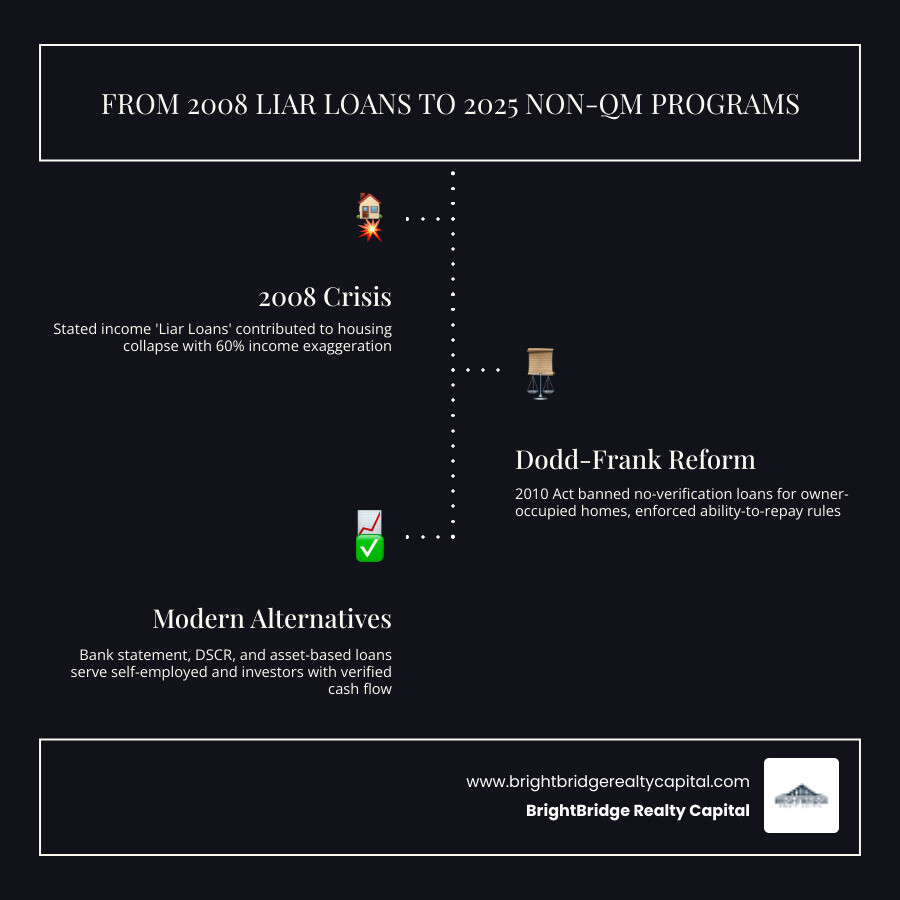
Stated income loans terms you need:
What Are Stated Income Loans and How Have They Changed?

To understand where we are today, we have to look back at where the industry went wrong. In the early to mid-2000s, stated income loans (often called SISA or "Stated Income, Stated Assets") became a dominant force in the mortgage market. Originally designed for people with complex but high-net-worth backgrounds—such as doctors in private practice or international business consultants—they eventually trickled down to the general public with disastrous results. The industry moved from "Stated Income, Verified Assets" (SIVA) to the much riskier "No Income, No Assets" (NINA) products.
During that era, lenders like Ameriquest and New Century pioneered programs that required little to no proof of earnings. As documented in Inside the Liar Loan: How the Mortgage Industry Nurtured Deceit, the industry essentially invited exaggeration. A study of 100 stated income mortgage applications compared to IRS records found that nearly 60% of borrowers overstated their income by more than 50%. Even more shocking, 90% exaggerated their income by at least 5%. This wasn't just a borrower problem; it was a systemic failure where loan officers often coached applicants on what numbers to write to ensure the loan would clear the automated underwriting systems.
By 2005, roughly 37% of all loans sold in the United States were originated without income being proven. In high-stakes markets like New York, these numbers were even more pronounced as buyers struggled to keep up with skyrocketing property values. This lack of verification is widely cited as a primary catalyst for the 2008 financial crisis, leading to a massive wave of defaults when borrowers realized they couldn't actually afford the payments they had "stated" they could handle. For more context on how these evolved, you can read our more info about no-doc home loans.
The Legacy of "Liar Loans"
The term "liar loan" didn't come from nowhere. It was a nickname given to these products because they practically required dishonesty to function in a hyper-competitive market. According to an NPR report on Liar Loans, the subprime sector was particularly vulnerable. By 2004, nearly 50% of adjustable-rate mortgages (ARMs) with interest-only features lacked full documentation. These loans were often bundled into mortgage-backed securities that were rated AAA by credit agencies, despite the underlying lack of verification.
Lenders were offloading these risky loans to the secondary market almost as fast as they could sign them. Because the banks weren't holding the risk, they had little incentive to verify if the borrower’s "stated" $150,000 salary was actually $45,000. When the bubble burst, the "liar loan" became the poster child for predatory and irresponsible lending, leading to the collapse of major financial institutions and a global recession.
Modern Regulation and the Dodd-Frank Act
The Wild West ended in 2010 with the passage of the Dodd-Frank Wall Street Reform and Consumer Protection Act. This legislation introduced the "Ability-to-Repay" (ATR) rule, which fundamentally changed the mortgage landscape. Under these CFPB ability-to-repay requirements, lenders are legally obligated to make a reasonable, good-faith determination that a borrower can afford the loan based on verified financial information.
This effectively banned the old-school version of stated income loans for primary residences. Today, if you are buying a home to live in, we must verify your income through some objective means. However, the law left room for "Non-Qualified Mortgages" (Non-QM). These loans still require verification, but they allow us to use alternative methods—like bank statements, asset totals, or property cash flow—instead of just tax returns and W-2s. For investors, this opened a new door that bypasses the rigid debt-to-income (DTI) ratios of Fannie Mae and Freddie Mac. Check out our more info about no-income verification mortgages to see how these modern rules apply to your next project.
Modern Alternatives: Bank Statement and DSCR Loans
Since we can no longer simply take a borrower's word for it, we've developed sophisticated ways to prove income that don't involve the IRS. For the self-employed professional in New York NY or the real estate mogul building a nationwide portfolio, two main products have replaced the old stated income loans: Bank Statement Loans and DSCR Loans. These products are the backbone of the private lending market in 2026, providing liquidity where traditional banks fear to tread.
These are perfect for 1099 earners, freelancers, and business owners who have high cash flow but use legitimate business deductions to lower their taxable income. If you're looking for more info about no-doc loans for real estate or more info about no-doc commercial real estate loans, these are the categories you need to explore.
Bank Statement Loans as a Stated Income Loan Alternative
A Bank Statement Loan is exactly what it sounds like. Instead of looking at your tax returns (which might show a "loss" due to depreciation and expenses), we look at your actual cash flow. This is the modern evolution of the stated income loan, where the "statement" is backed by hard data from your financial institution.
Typically, we require 12 to 24 months of personal or business bank statements. We add up all the deposits, apply a standard expense ratio (often 50% for businesses with employees, or as low as 10-20% for service-based freelancers), and use that "real world" income to qualify you. This allows a business owner who nets $200,000 but shows only $40,000 on tax returns to qualify for the home they actually deserve.
- Requirements: Usually requires being in business for at least 2 years in the same industry.
- Documentation: Often requires a CPA letter confirming you are still in business and providing an estimated expense ratio.
- Benefit: It captures your gross income before all those tax-saving deductions are taken out, reflecting your true purchasing power.
This is the gold standard for low-documentation mortgage loans in 2026. It proves you have the money coming in without forcing you to pay higher taxes just to get a mortgage.
DSCR Loans for Real Estate Investors
For our investor clients, the Debt Service Coverage Ratio (DSCR) loan is even more streamlined. With a DSCR loan, we don't look at your personal income at all. We don't care about your W-2s, your tax returns, or even your personal bank statements. This is the closest thing to a "no-doc" loan available in the modern market.
Instead, we look at the income potential of the property you are buying. If the monthly rent covers the monthly mortgage payment (including taxes, insurance, and HOA fees), the loan is viable. This allows investors to scale their portfolios infinitely, as they aren't limited by their personal debt-to-income ratio.
- The Math: A DSCR of 1.0 means the rent exactly covers the debt. Lenders often look for a 1.2 or higher, but many "no-ratio" programs exist for properties with high equity (30-40% down).
- The Catch: This is strictly for investment properties. You cannot live in the home, and you must sign an affidavit stating the property is for business purposes.
Explore more info about no-doc DSCR loans to see if your current rental target qualifies. These loans are particularly popular for short-term rentals (Airbnbs) where the income potential often far exceeds traditional long-term rents.
Asset Depletion Loans
Another powerful alternative is the Asset Depletion loan. This is designed for high-net-worth individuals who may not have a traditional job but have significant liquid assets. We take your total qualifying assets (stocks, bonds, cash, retirement accounts), apply a haircut (usually 70-100% of value), and divide that total by 360 months. That resulting number is added to your monthly income for qualification purposes. It's a perfect solution for retirees or tech founders who have exited their companies and are living off their wealth.
Qualifying for a Stated Income Loan in 2026
While the documentation is "lighter," the standards for modern stated income loans and their alternatives are much stricter than they were in 2006. Because we are taking on more risk by not seeing your tax returns, we balance that risk with higher requirements in other areas. This is known as "risk-based pricing" and "compensating factors."
To get the best rates from no-doc mortgage lenders, you generally need to be a "strong" borrower on paper in every other category. This is true whether you are looking for a purchase or more info about no-doc construction loans. Underwriters in 2026 use advanced AI tools to verify the validity of bank statements and property data, so while the paperwork is less, the scrutiny of the data you do provide is higher.
Documentation Requirements for Modern Stated Income Loans
"No-doc" is a bit of a misnomer in 2026. You won't provide tax returns, but you will provide a targeted set of documents that prove your financial stability:
- Bank Deposits: Proof of consistent money moving into your accounts over a 12-24 month period. Large, one-time deposits will be scrutinized to ensure they aren't "gifted" or borrowed funds.
- Asset Statements: Verification of your credit history and liquidity. Lenders want to see that you have enough cash to cover the down payment, closing costs, and several months of reserves.
- Business License: Proof that your entity is active and legal. This might include Articles of Incorporation or a simple DBA (Doing Business As) certificate.
- P&L Statements: Sometimes a self-prepared or CPA-signed Profit and Loss statement is required to bridge the gap between bank statements and reality, especially for businesses with high overhead.
- Entity Documents: If you are closing in the name of an LLC (which we highly recommend for investors), you'll need to provide the Operating Agreement and an EIN letter from the IRS.
Improving Your Chances of Approval
If you want to qualify for the best terms and avoid the highest interest rate tiers, we recommend a few strategic moves:
- Boost Your Credit: Aim for a 700+ score. While some programs go down to 600, a 700+ score significantly lowers your interest rate and can reduce the required down payment by 5-10%.
- Increase Your Down Payment: Most non-QM loans require 20-30% down. The more "skin in the game" you have, the more flexible the lender becomes. A 35% down payment often triggers "exception" processing where other minor credit flaws can be overlooked.
- Season Your Funds: Lenders want to see that your down payment has been in your account for at least 60 days. This is to prevent "seasoning" issues where money is moved around just to pass an inspection.
- Maintain Reserves: Having 3 to 6 months of mortgage payments (PITI) sitting in a liquid savings account after closing is often a hard requirement. For larger loan amounts (over $1M), lenders may ask for 12 months of reserves.
If you have significant equity in other properties, you might also consider more info about no-doc equity lines to fund your next down payment, allowing you to keep your cash liquid for renovations or other investments.
Pros, Cons, and Risks of Non-QM Lending
Every financial product is a trade-off. Stated income loans and their modern alternatives offer speed and flexibility, but they come at a price. Whether you're looking for a purchase or more info about no-doc refinance loans, it's important to weigh these factors against your long-term financial goals. In a market like 2026, where the cost of capital is higher than the previous decade, understanding these nuances is critical.
Benefits for Self-Employed and Investors
The biggest "pro" is obvious: you can actually get the loan. Traditional banks often look at a self-employed person's tax return, see the real estate income offset by depreciation, and conclude the borrower makes $0. We know better. We understand that depreciation is a non-cash expense and that your actual bank balance tells a different story.
- Speed: Because we aren't waiting for IRS transcripts (which can take weeks) or manual verification of employment from HR departments, we can often close in a fraction of the time—sometimes in as little as one to two weeks. This allows you to compete with cash buyers.
- Flexibility: We use "common sense" underwriting. If you had a one-time credit event three years ago but have been perfect since, we can usually work around it. Traditional banks are bound by rigid algorithms that offer no room for human judgment.
- Portfolio Growth: DSCR loans allow you to scale your rental portfolio without your personal debt-to-income ratio stopping you. You can theoretically own 50 properties this way, whereas a conventional lender will usually cut you off after 10.
- Opportunity Cost: The ability to secure a property now rather than waiting two years to show "clean" tax returns can save you hundreds of thousands in appreciation gains.
For those in high-cost areas, more info about no-doc loans in NY can be the difference between securing a property and losing it to a cash buyer who doesn't have to worry about financing contingencies.
Potential Risks and Drawbacks
We wouldn't be doing our job if we didn't mention the risks. These loans are powerful tools, but they must be used responsibly.
- Higher Interest Rates: Expect to pay 1% to 3% more than a conventional "full-doc" loan. This is the "risk premium" lenders charge for the lack of traditional documentation.
- Prepayment Penalties: Many investor-focused loans (especially DSCR) include a penalty if you pay the loan off or refinance within the first 3 years. This is how lenders ensure they make a return on their investment. Always ask about the "step-down" structure (e.g., 3% in year one, 2% in year two, 1% in year three).
- Higher Down Payments: You won't find 3% down programs here. You'll need real capital, typically 20% to 25% at a minimum.
- Default Risk: If you over-leverage yourself based on "stated" income that isn't stable, you risk foreclosure. Unlike primary residences, investment properties can be foreclosed upon much more quickly in many jurisdictions.
Before you jump in, check more info about no-doc refinance options to see what your exit strategy might look like. Many investors use these loans as a short-term bridge (2-5 years) before moving into more permanent financing.
Frequently Asked Questions about Stated Income Loans
What is the availability of stated income loans for owner-occupied primary residences versus investment properties?
As we mentioned, federal law (Dodd-Frank) has made true stated income loans for primary residences nearly impossible to find. Lenders must verify your ability to repay if you're going to live in the house. However, we can use Bank Statement programs for primary residences to satisfy that requirement. This is a legal and compliant way to verify income without tax returns.
Investment properties are a different story. Because they are considered "business purpose" loans, they are exempt from many of the consumer protection rules that govern primary mortgages. This is why DSCR and No-Doc programs are so prevalent for investors. At BrightBridge Realty Capital, we specialize in these investment and commercial exceptions. Learn more with more info about no-documentation mortgages.
What are the options for refinancing a non-QM loan?
Many of our clients use a non-QM loan to "get into" a property quickly, then refinance once they have two years of clean tax returns or the property has appreciated significantly. You can refinance from one non-QM loan to another (for example, to get a lower rate as the market shifts) or move into a conventional mortgage later.
To move to a conventional loan, you'll generally need:
- Two years of tax returns showing sufficient income after all deductions.
- A credit score that has remained stable or improved (usually 680+ for conventional).
- At least 20% equity in the property.
- A clean payment history on your current non-QM loan for at least 12 months.
See our more info about no-doc home loans for refinance-specific strategies.
How long does the application process take?
At BrightBridge Realty Capital, our direct lending model cuts out the middlemen. While a traditional bank might take 45 to 60 days due to layers of bureaucracy, our typical timeline is 2 to 3 weeks. If the appraisal and title search come back quickly, we’ve been known to fund even faster.
The "no-doc" nature speeds things up because there's less back-and-forth about your 2022 tax amendments or why your business had a slow month three years ago. If you have your bank statements and a clean credit report ready, you’re already 90% of the way there. We also offer more info about no-doc lines of credit for those who need ongoing access to capital for multiple projects.
Can foreign nationals or ITIN holders qualify?
Yes. One of the biggest advantages of modern stated income alternatives is their accessibility to foreign investors. Since we are looking at the property's income (DSCR) or US-based bank statements, we can often fund loans for individuals who do not have a US social security number or a long-standing US credit history. These programs typically require a slightly higher down payment (30-35%) but provide a vital bridge for international capital entering the US real estate market.
Conclusion
The world of stated income loans has changed, but the spirit of flexible lending is alive and well. Whether you are a self-employed creative, a seasoned real estate investor, or a business owner looking to expand your footprint, you shouldn't be penalized for having a complex financial life. The traditional banking system is designed for a world that no longer exists; modern private lending is designed for the world of 2026.
At BrightBridge Realty Capital, we provide customized real estate financing solutions nationwide. We specialize in quick, flexible funding for investors who need to move at the speed of the market. Our unique selling proposition is simple: fast closings (often within a week) and direct lending without intermediaries. This means you get competitive rates, clear communication, and a seamless process from application to funding. We don't just look at your credit score; we look at the deal and the person behind it.
Based in New York NY, we understand the hustle and the unique challenges of the local market—from co-ops to mixed-use buildings—while offering the reach of a nationwide lender. We have the capital and the expertise to handle complex scenarios that leave other lenders scratching their heads. Don't let a "no" from a traditional bank stop your momentum or prevent you from building generational wealth through real estate.
Ready to take the next step and see what you qualify for? Apply for Fix and Flip Financing today and let us help you build your portfolio with the modern tools of the trade. Our team is standing by to provide a free, no-obligation scenario review for your next project.