Unlock Your Rental Empire: A Deep Dive into Investment Property Financing

Summary
Unlock your rental empire! Learn about investment property mortgage, qualification, loan types & tax benefits. Start investing today.
Why Investment Property Financing Matters for Your Portfolio

An Investment property mortgage is a specialized loan used to purchase or refinance real estate you don't plan to live in—properties you'll rent out, hold for appreciation, or flip for profit. This financing is the engine that powers real estate investment, allowing you to leverage a smaller amount of your own capital to control a much larger and more valuable asset. Unlike mortgages for primary residences, which are designed to help people buy a home to live in, these loans are commercial in nature. They are underwritten with the understanding that the property is a business venture, and as such, the stakes and risks are fundamentally different.
Lenders view these loans as inherently riskier. A homeowner will typically do everything possible to avoid foreclosure on their personal residence. An investor, on the other hand, may be more willing to walk away from a property if it becomes unprofitable, tenants stop paying, or the market takes a downturn. This elevated risk of default is why lenders have established a more rigorous set of qualification standards. These loans typically require a down payment of 15-25%, feature interest rates that are 0.5% to 2% higher than those for primary homes, and demand stricter qualification criteria, including higher credit scores (usually 680 or above) and lower debt-to-income ratios (typically capped at 44-45%).
Key Differences from Primary Residence Mortgages: A Deeper Look
The gap between financing a home and financing an investment is significant. Understanding these distinctions is the first step to successfully securing an investment property mortgage.
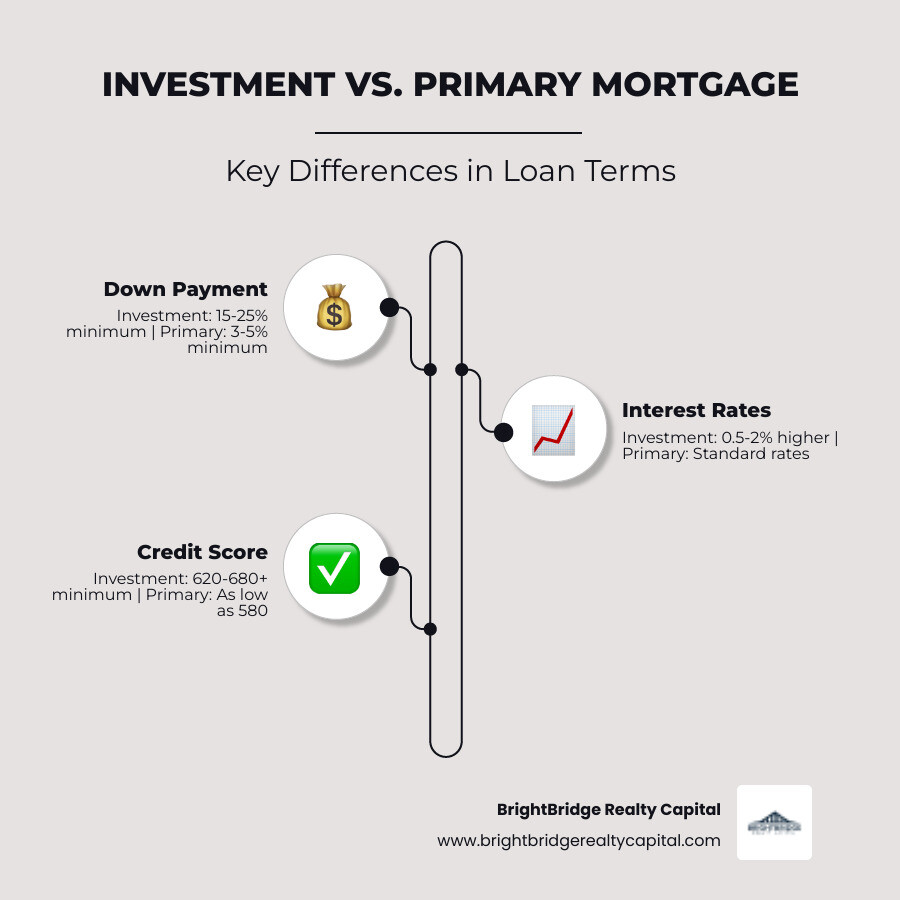
- Down Payment: The minimum down payment is substantially higher, usually 15-25% compared to the 3-5% possible for primary homes. This larger equity stake, or "skin in the game," reduces the lender's potential loss if you default.
- Interest Rates: Expect to pay a premium of 0.5% to 2% over standard mortgage rates. This is a direct reflection of the higher perceived risk and is how lenders are compensated for taking on that risk.
- Credit Score: While you might secure a primary home loan with a score in the low 600s (or even 580 for FHA loans), investment property lenders generally look for a minimum score of 620-680, with the best terms reserved for those with scores of 740+.
- Loan-to-Value (LTV): The maximum LTV for an investment property is typically 80%, corresponding to a 20% down payment. This is much more conservative than the up to 97% LTV available for some primary residence loans.
- Cash Reserves: Lenders for investment properties almost always require you to have significant liquid assets on hand after closing. This is typically calculated as six months of total mortgage payments (including principal, interest, taxes, and insurance) for the new property. This proves you can cover expenses during vacancies or unexpected repairs.
- Income Verification: The documentation process is more intensive. While lenders may allow you to use 75% of a property's projected rental income to help you qualify, they will also scrutinize your personal income and financial stability more closely.
Real estate can be a powerful component of a diversified financial portfolio, offering cash flow, appreciation, and tax advantages. However, the financing is a critical piece of the puzzle. I'm Daniel Lopez, a loan officer at BrightBridge Realty Capital. I've helped countless investors, from first-timers to seasoned professionals, structure investment property mortgage solutions tailored to their unique goals. The right financing strategy is not just about getting a loan; it's about setting your investment up for long-term success.
Investment property mortgage basics:
What is an Investment Property Mortgage? (And How It's Different)
An investment property mortgage is a loan secured for a piece of real estate that you do not intend to occupy as your primary residence. Instead, the property's sole purpose is to generate income. This can be achieved through various strategies, such as long-term rentals (e.g., single-family homes, duplexes, or multi-unit apartment buildings), short-term vacation rentals, or through appreciation by buying, renovating, and selling a property (a "fix and flip"). The fundamental distinction is its function as an income-generating business asset, which places it in a different risk category for lenders.
Lenders perceive investment properties as a higher risk because a borrower's commitment to a non-owner-occupied property is purely financial. Homeowners have a deep personal and emotional attachment to their primary residence, making them extremely unlikely to default. An investor, however, might make a calculated business decision to default on an investment property mortgage if the property is vacant for an extended period, the tenant stops paying rent, or repair costs exceed the rental income. This higher perceived risk is the primary driver behind the stricter lending criteria and less favorable terms compared to a standard home loan.
It's also crucial to differentiate an investment property from a second home. A second home is a property intended for the owner's personal enjoyment, such as a vacation cabin or a city condo for weekend use. While not a primary residence, it is not intended to be a primary source of income. Consequently, the lending rules for second homes often fall into a middle ground—they are stricter than for a primary residence but generally less stringent than for a pure investment property. The IRS has specific rules that help define this difference; for example, if you personally use a property for more than 14 days a year or more than 10% of the total days it's rented out, it's typically classified as a second home, which has different tax implications.

Key Differences in Loan Terms Explained
The terms of an investment property mortgage are designed to mitigate lender risk. Here’s a deeper dive into why they differ so much from a primary residence loan:
- Higher Interest Rates: Expect rates to be anywhere from 0.50% to 2% higher. This "rate premium" is a form of risk-based pricing. Lenders are compensated for the increased statistical likelihood of default on an investment property. This higher interest payment must be carefully factored into your cash flow analysis to ensure the property remains profitable.
- Larger Down Payment Requirements: While government-backed programs allow for down payments as low as 3-5% on primary homes, investment properties typically require a minimum of 15% to 25%. This larger initial investment from the borrower reduces the lender's exposure and ensures you have significant "skin in the game," making you less likely to default.
- Lower Loan-to-Value (LTV) Ratios: LTV is a direct reflection of the down payment. An 80% LTV (requiring a 20% down payment) is a common maximum for investment properties. In contrast, a primary residence might qualify for an LTV of up to 97%. A lower LTV provides the lender with a larger equity cushion, protecting their capital if they have to foreclose and sell the property.
- Shorter Amortization Periods: While 30-year fixed-rate mortgages are the standard for primary homes, they can be more difficult to secure for investment properties. Many lenders cap the amortization period at 25 years. A shorter amortization period means higher monthly payments but also faster equity buildup for the investor. While 30-year options exist, they may come with stricter requirements or higher rates. For more insights, check out our article on 30-Year Mortgage Rates for Investment Property.
Here's a quick comparison:
| Feature | Primary Residence Mortgage | Investment Property Mortgage |
|---|---|---|
| Interest Rates | Lower, market-dependent | 0.5% - 2% higher than primary rates |
| Down Payment | As low as 3-5% | Typically 15-25% minimum |
| LTV Ratio | Up to 97% | Up to 80% |
| Amortization | Commonly 30 years | Typically 25 years (some 30-year options) |
| Credit Score | Can be lower (e.g., 580) | Generally 620-680+ minimum |
| Cash Reserves | Minimal or none | Often 6 months of payments required |
| Lender Risk View | Lower | Higher |
Understanding Loan-to-Value (LTV) in Depth
The Loan-to-Value (LTV) ratio is a cornerstone of mortgage underwriting. It's a simple calculation: Loan Amount / Appraised Value of the Property. For example, if you're getting a $200,000 loan on a property appraised at $250,000, your LTV is 80% ($200,000 / $250,000).
For investment properties, lenders are far more conservative with LTV. The 80% LTV cap is a firm industry standard for most conventional loans. This is because private mortgage insurance (PMI), which protects lenders on high-LTV primary home loans, is generally not available for investment properties. Therefore, the borrower's 20% equity stake is the lender's primary protection against losses. A lower LTV demonstrates a significant financial commitment from the borrower and reduces the moral hazard of walking away from the investment. We explore various financing scenarios and their LTV implications in our guide to financing for rental property.
The Blueprint for Approval: Qualifying for an Investment Property Mortgage
Securing an investment property mortgage is less about your desire to invest and more about demonstrating to the lender that you are a financially robust and reliable borrower. Lenders will place your financial life under a microscope, scrutinizing your credit history, income stability, existing debts, and available assets far more closely than they would for a primary residence loan. They are looking for a clear picture of stability and the capacity to handle the financial obligations of an investment property, even in a worst-case scenario where rental income temporarily disappears. Mastering these key eligibility criteria is your blueprint for approval.

Down Payment Requirements: More Than Just a Number
The down payment is the most significant financial hurdle for most new investors. For an investment property mortgage, lenders typically require a minimum of 15% to 25% down. For a conventional loan on a single-unit investment property, 15% is sometimes possible, but 20-25% is far more common and will secure you better interest rates and terms. For multi-unit properties (2-4 units), the minimum down payment is almost always 25%.
This substantial down payment serves two purposes: it lowers the lender's risk by creating an immediate equity cushion, and it demonstrates your financial capacity and commitment to the investment. Sourcing this down payment is a key part of the process. Funds can come from personal savings, the sale of other assets, or gift funds (though lenders have strict rules on how gift funds can be used for investment properties and will require a formal gift letter). Creative strategies, such as using a HELOC on your primary residence, are also common. While "no money down" options are exceptionally rare and often come with significant trade-offs, we can discuss strategies to minimize your out-of-pocket cash, as explored in our article on investment property loans with no down payment.
Credit Score and Debt-to-Income (DTI) Ratio: Your Financial Report Card
Your personal financial health is paramount. Lenders use your credit score and DTI ratio as primary indicators of your ability to manage debt responsibly.
- Credit Score: While a score of 620 might get your foot in the door with some lenders, a score of 680 or higher is generally needed to access competitive programs. For the best possible interest rates and terms, lenders prefer scores of 740+. A higher credit score directly translates to a lower perceived risk for the lender, which can save you thousands of dollars over the life of the loan. If your score is on the lower end, options may still be available, but they will be more expensive. We discuss this in our article on investment lending low credit score.
- Debt-to-Income (DTI) Ratio: Your DTI ratio compares your total monthly debt payments (including your current housing payment, car loans, student loans, credit card payments, and the proposed payment for the new investment property) to your gross monthly income. For most investment property mortgage programs, lenders cap the DTI at 45%. A lower DTI demonstrates that you have ample cash flow to manage all your obligations, even with the added expense of a new mortgage and potential fluctuations in rental income. Before applying, it's wise to calculate your DTI and take steps to improve it, such as paying down credit card balances or other personal loans.
How Lenders View Your Income, Assets, and Documentation
Be prepared for a deep dive into your financial records. Lenders need to verify every aspect of your financial profile to feel comfortable extending credit.
Required Documentation:We will typically ask for a comprehensive package of documents, including:
- Your last two years of personal and business (if applicable) federal tax returns.
- W-2s from the past two years if you are a salaried employee.
- Recent pay stubs covering the last 30 days.
- For self-employed borrowers: A year-to-date profit and loss (P&L) statement and balance sheet.
- Bank statements for the last two to three months for all checking, savings, and investment accounts. This is to verify your assets for the down payment, closing costs, and required cash reserves.
- A fully executed purchase contract for the property.
- If the property is currently rented, copies of the existing lease agreements.
Cash Reserves and Appraisals:Lenders will verify you have sufficient cash reserves—liquid funds left over after closing. The standard requirement is six months of PITI (Principal, Interest, Taxes, and Insurance) payments for the subject investment property. For investors with multiple financed properties, the reserve requirement can be even higher. This liquidity ensures you can weather vacancies or unexpected major repairs without risking default.
An appraisal is always required, and for investment properties, it's more complex. The appraiser will not only determine the property's market value using the sales comparison approach but will also provide a Comparable Rent Schedule (Form 1007) to estimate its fair market rental value. This rental estimate is crucial for underwriting.
Using Rental Income to Qualify:A key advantage in qualifying is the ability to use the property's own income. Lenders will typically take the gross projected rental income (from the appraisal's rent schedule or existing leases) and apply a 25% vacancy factor. This means they will add 75% of the monthly rent to your gross monthly income. For example, if the property is projected to rent for $2,000 per month, $1,500 ($2,000 x 0.75) will be added to your income for DTI calculation purposes, which can significantly boost your borrowing power. Our article on home loans that take rent into consideration explores this topic in greater detail.
Navigating the Landscape of Investment Property Loan Types
The world of investment property mortgage options is vast and can be complex. The best loan for you depends entirely on your financial situation, the type of property you're buying, and your overall investment strategy. At BrightBridge Realty Capital, we specialize in guiding investors in New York, NY, and nationwide through this landscape to find the perfect financing vehicle. Understanding the fundamental differences between traditional loans and more specialized products is crucial for making an informed decision.
Whether you are a W-2 employee with excellent credit looking for a long-term rental or a self-employed investor executing a quick fix-and-flip, there is a loan product designed for your needs. For a comprehensive overview, explore our articles on types of loans for investment property and real estate loans for investors.
Traditional and Alternative Loans
- Conventional Loans: These are the most common type of investment property mortgage. Originated by banks, credit unions, and mortgage lenders, these loans must conform to the guidelines set by Fannie Mae and Freddie Mac. They offer some of the most competitive interest rates and terms available but come with the strictest requirements regarding credit score (often 680+), down payment (15-25%), DTI ratio (under 45%), and cash reserves. A significant limitation is that Fannie Mae and Freddie Mac generally limit an individual borrower to a maximum of 10 financed properties. These loans are ideal for well-qualified borrowers with stable W-2 income purchasing standard 1-4 unit residential properties.
Specialized Financing for Real Estate Investors
For investors who don't fit the rigid conventional lending box, a world of specialized financing opens up. These products are designed for the unique circumstances of real estate investing.
- Non-QM Loans (Non-Qualified Mortgages): Non-QM loans are for borrowers who can't be approved through conventional guidelines. This category includes a wide range of products for self-employed borrowers (who can use bank statements instead of tax returns to prove income), foreign nationals, or investors with unique credit events. They offer much-needed flexibility but typically come with higher interest rates and fees than conventional loans.
- DSCR Loans (Debt Service Coverage Ratio Loans): This is the most popular Non-QM loan for real estate investors. DSCR loans qualify you based on the investment property's cash flow, not your personal income. The lender calculates the DSCR by dividing the property's gross monthly rental income by its monthly PITI payment. A ratio of 1.25 or higher is typically required, meaning the property's income must be at least 25% greater than its expenses. This is a game-changer for investors looking to scale their portfolio without having their personal DTI scrutinized. We specialize in DSCR loans for real estate investors.
- Portfolio Loans: These are loans that a lender (often a smaller community bank or credit union) originates and keeps on its own books rather than selling on the secondary market. This gives them the flexibility to set their own underwriting guidelines. Portfolio loans can be a great solution for investors who have already reached the 10-property limit for conventional loans or who have a unique property or financial situation.
- Blanket Loans: A blanket loan is a single mortgage that covers multiple properties. This is an efficient tool for seasoned investors who want to finance a portfolio of properties at once or pull cash out from several properties simultaneously. These loans often include a "release clause," which allows the investor to sell one of the properties without having to pay off the entire blanket mortgage, offering valuable flexibility.
- Hard Money Loans: These are short-term (typically 6-24 months), asset-based loans from private lenders. Qualification is based almost entirely on the property's value, specifically its After Repair Value (ARV) for fix-and-flip projects. Personal credit and income are secondary. While interest rates (8-15%) and origination points (2-5) are high, these loans can be funded in a matter of days, making them perfect for time-sensitive deals and renovation projects where speed is critical. BrightBridge Realty Capital specializes in providing hard money real estate loans for investors in New York, NY.
Using Home Equity and Other Creative Financing
Your existing assets can be a powerful source of capital for your next investment.
- Home Equity Line of Credit (HELOC): A HELOC is a revolving line of credit secured by the equity in your primary residence. You can draw funds as needed up to your credit limit, making it an incredibly flexible tool for funding down payments, renovations, or even entire cash purchases. However, it's crucial to remember you are putting your own home on the line as collateral. Learn more about what is a home equity line of credit.
- Cash-Out Refinance: This strategy involves replacing your existing mortgage on your primary home or another investment property with a new, larger loan. You then receive the difference between the two loan amounts in cash. This can provide a substantial lump sum for a down payment, but it also permanently increases your mortgage debt and monthly payment on the refinanced property.
- Private Loans: Sourced from individuals or private investment companies rather than traditional financial institutions, private loans offer maximum flexibility and speed. Terms are entirely negotiable between the borrower and the lender. These are often used for unique or complex deals that banks won't touch. As a direct private lender, BrightBridge Realty Capital provides these quick, customized solutions for real estate investors in New York, NY.
We have a dedicated guide on using a home equity loan to buy a rental property to help you weigh these powerful options.
Weighing the Pros, Cons, and Responsibilities of Your Investment
Embarking on an investment property journey is an exciting prospect, but it's a serious business decision that extends far beyond signing the papers for an investment property mortgage. A successful real estate investment is built on a clear-eyed understanding of the potential rewards, the inherent risks, and the day-to-day responsibilities of being a landlord. We encourage all our clients to carefully consider both sides of the coin before committing their capital.
The Rewards: Cash Flow, Appreciation, and Tax Benefits
The allure of real estate is powerful because it offers multiple avenues for wealth creation, often simultaneously.
- Positive Cash Flow: This is the lifeblood of a rental property investment. Cash flow is the monthly profit left over after you collect rent and pay all operating expenses, including the mortgage (PITI), property management fees, maintenance, and reserves for future repairs. Consistent positive cash flow provides a reliable, passive income stream that can supplement or eventually replace your primary income.
- Appreciation: Over the long term, real estate has historically tended to increase in value. This market appreciation can significantly grow your net worth without any additional effort on your part. Furthermore, you can create "forced appreciation" by making strategic renovations and improvements that increase the property's value and rental income.
- Building Equity: Every month, a portion of your tenant's rent payment goes toward paying down the principal on your investment property mortgage. This process, called amortization, systematically builds your equity in the asset. This equity becomes a source of wealth that you can later tap into through a sale or a cash-out refinance.
- Inflation Hedge: Real estate is a powerful hedge against inflation. As the cost of living rises, so do rental rates and property values. This means your income and the value of your asset can grow alongside inflation, protecting your purchasing power over time.
- Unparalleled Tax Deductions: Investment properties offer some of the most significant tax advantages available. You can deduct a wide range of expenses, including mortgage interest, property taxes, insurance, maintenance and repair costs, property management fees, and travel expenses related to the property. The most powerful deduction is depreciation—a non-cash expense that allows you to deduct a portion of the property's value over 27.5 years for residential real estate, which can dramatically reduce your taxable income. (Note: Always consult a qualified tax professional for advice specific to your situation in New York, NY).
The Reality of Being a Landlord: The Three T's (Tenants, Toilets, and Trash)
While the financial rewards are compelling, they don't come without effort. Being a landlord is a hands-on job with significant responsibilities and potential headaches.
- Property Management: This is a major commitment. It involves marketing the property, screening potential tenants (including background and credit checks), drafting and enforcing leases, collecting rent, and handling all tenant communications and complaints. You can hire a professional property manager for 8-12% of the monthly rent, but this cost must be factored into your cash flow calculations.
- Maintenance, Repairs, and Capital Expenditures: Properties require constant upkeep. There are routine maintenance tasks, emergency repairs (like a burst pipe at 2 a.m.), and large, expensive capital expenditures (CapEx) like replacing a roof or an HVAC system. Smart investors budget 1-2% of the property's value annually for maintenance and set aside funds for future CapEx.
- Vacancy Costs: Your property will not be occupied 100% of the time. There will be periods of vacancy between tenants, and during these times, you are responsible for the mortgage, taxes, insurance, and utilities with no offsetting rental income. A conservative financial projection always includes a vacancy factor (typically 5-10% of the annual rent).
- Legal and Regulatory Compliance: Landlords must operate within a complex web of federal, state, and local laws. These include the Fair Housing Act, laws governing security deposits, eviction procedures, and local ordinances regarding property standards and rent control. A single misstep can lead to costly legal disputes and fines.
- Market Fluctuations and Risks: Real estate is not a risk-free investment. Property values can decline, local economies can falter leading to higher vacancies, and rising interest rates can impact your ability to refinance. You are investing in a specific market, and its health will directly impact your returns.
- Specialized Landlord Insurance: A standard homeowner's insurance policy is not sufficient. You will need a specific landlord insurance policy that provides property coverage (for the structure itself) and liability coverage (to protect you if a tenant is injured on the property). You can also get endorsements for rent loss to cover vacancies due to a covered peril.
Effectively managing these responsibilities is the difference between a profitable investment and a financial drain. Our guide on how to manage rental property finances offers practical advice for setting yourself up for success.
Frequently Asked Questions about an Investment Property Mortgage
Navigating the world of investment financing can bring up many questions. Here are detailed answers to some of the most common queries we receive from investors.
Can I use first-time home buyer programs for an investment property?
Generally, no. Government-backed loan programs like FHA and VA loans, as well as most state and local first-time home buyer assistance programs, are designed exclusively for primary residences. They come with strict owner-occupancy requirements, meaning you must live in the property for a minimum period, typically at least one year after closing.
The one major exception is a strategy known as "house hacking." You can use an FHA loan (which allows for a low 3.5% down payment) or a VA loan (which allows for 0% down for eligible veterans) to purchase a multi-unit property with two to four units, as long as you occupy one of the units as your primary residence. You can then rent out the other units to generate income that helps cover the mortgage. This is a powerful strategy for new investors, but it does not apply to purchasing a pure, non-owner-occupied investment property. For a standard single-family rental or a property you don't plan to live in, these programs are not an option.
Are there lenders that specialize in investment property financing?
Absolutely. While almost any bank or credit union will offer an investment property mortgage, working with a lender that specializes in financing for real estate investors offers significant advantages. These lenders understand the unique needs, strategies, and challenges that investors face.
BrightBridge Realty Capital is a prime example of a specialist. As direct lenders focused on real estate investment, we offer a streamlined process, flexible underwriting, and fast closings—often in a fraction of the time it takes a traditional bank. Our expertise allows us to structure creative solutions for complex deals.
Beyond direct lenders like us, the landscape includes:
- Portfolio Lenders: These are often smaller community banks or credit unions that hold their loans "in-portfolio" instead of selling them. This gives them the freedom to create their own lending rules, making them a great resource for investors who may not fit the rigid conventional mold or who have more than 10 financed properties.
- Private Lenders & Hard Money Lenders: These are individuals or private companies that provide short-term, asset-based loans. They focus on the property's value rather than the borrower's personal finances, offering speed and flexibility for projects like fix-and-flips. The trade-off is higher interest rates and fees.
Working with a specialist who understands your goals is crucial. Check out our insights on the best investment property lenders and the advantages of working with direct mortgage lenders.
How does refinancing an investment property work?
Refinancing an investment property is a common strategy for experienced investors, but it follows the same strict underwriting as a purchase loan. The process involves getting a new loan to pay off the existing one. Investors typically refinance for three main reasons:
- Rate-and-Term Refinance: This is done to secure a lower interest rate or change the loan term (e.g., from an adjustable-rate to a fixed-rate). This can lower your monthly payment and improve the property's cash flow. LTV for this type of refinance is typically capped at 80%.
- Cash-Out Refinance: This allows you to tap into the property's accumulated equity. You take out a new mortgage for a larger amount than you currently owe and receive the difference in cash. This cash can then be used as a down payment for another property, to fund renovations, or for other purposes. Lenders are more conservative with cash-out refinances on investment properties, typically capping the LTV at 70-75%.
- Change Loan Program: An investor might refinance out of a short-term hard money loan into a long-term, fixed-rate conventional or DSCR loan once a renovation is complete and the property is stabilized with a tenant.
The qualification process will re-examine your credit, DTI, and the property's value and rental income. Many lenders also have a "seasoning" requirement, meaning you must have owned the property for a certain period (often 6-12 months) before they will allow a refinance, especially a cash-out.
For more detailed information, explore our guides on refinancing investment property loan and finding the best refinance for investment property.
How many investment properties can I finance?
This is a critical question for any investor looking to scale their portfolio. For conventional loans that conform to Fannie Mae and Freddie Mac guidelines, there is a well-known limit: an individual borrower can have a maximum of 10 financed properties. Once you reach this limit, you can no longer use conventional financing. The requirements also become stricter as you acquire more properties (e.g., for properties 5-10, a higher credit score and larger down payment are often required).
To grow beyond 10 properties, investors must turn to alternative financing solutions like the specialized loans discussed earlier: DSCR loans, portfolio loans from local banks, blanket loans covering multiple properties, or commercial loans. These products do not have the same strict limits as conventional financing, allowing successful investors to continue expanding their portfolios indefinitely.
What are the typical closing costs on an investment property mortgage?
Closing costs for an investment property loan are similar to those for a primary residence but are often slightly higher. You should budget for 2% to 5% of the loan amount to cover these expenses. Common closing costs include:
- Loan Origination Fee: A fee charged by the lender for processing the loan, typically 0.5% to 1% of the loan amount.
- Appraisal Fee: Often higher for investment properties because it includes a rental analysis (Comparable Rent Schedule).
- Title Insurance and Attorney Fees: To ensure the property has a clear title and to handle the legal paperwork.
- Prepaid Expenses: You'll typically need to prepay several months of property taxes and landlord insurance premiums into an escrow account.
- Points: On some loans, particularly hard money or Non-QM loans, you may pay "points" upfront (1 point = 1% of the loan amount) to secure the loan or lower the interest rate.
Conclusion: Your Partner in Real Estate Investment
Navigating the complexities of an investment property mortgage can seem like a formidable challenge, but it is a manageable and highly rewarding process when you have the right knowledge and the right partner. Throughout this guide, we've journeyed from the fundamental definition of an investment loan to the detailed blueprint for getting approved. We've explored the critical differences that set these mortgages apart from primary home loans, delved into the stringent qualification criteria, and mapped out the diverse landscape of loan types available to every kind of investor in New York, NY, and across the country.
Successfully building a real estate portfolio is not a solo endeavor. It requires a professional team composed of a knowledgeable real estate agent, a savvy financial advisor, a qualified tax professional, and, crucially, a specialized lender who understands the nuances of investment financing. At BrightBridge Realty Capital, we are more than just a lender; we are a strategic partner committed to your long-term success. We understand the fast-paced demands of real estate investing and have built our processes to provide the fast, flexible, and customized financing you need to seize opportunities.
Our direct lending model eliminates the bureaucracy of traditional banks, ensuring a transparent, seamless process with competitive rates and terms. We take pride in our ability to close loans quickly and efficiently, giving our clients a critical edge in a competitive market. Whether you are purchasing your very first rental property and need guidance on a conventional loan, or you are a seasoned professional looking to scale your portfolio with a DSCR or blanket loan, we have the expertise and the capital to help you achieve your goals.
The path to building wealth through real estate begins with a solid financial foundation. Let us help you lay that first stone. Explore your rental loan options with BrightBridge Realty Capital today and take the definitive next step towards securing your financial future through real estate.