The ABCs of Bridge Loans: Purpose, Terms, and Options Explained


Summary
Unlock opportunities with bridge loan financing. Learn how to bridge gaps in real estate & business, understand costs, pros, & cons.
Why Bridge Loan Financing Matters for Real Estate Investors

Bridge loan financing is a specialized, short-term lending solution meticulously designed to provide immediate capital when you need to act with decisive speed—long before permanent financing can be secured or an existing asset is sold. Think of it as a financial express lane. While traditional financing moves at a steady, deliberate pace, bridge loans are built for the moments that demand acceleration. Whether you're a seasoned real estate investor looking to close on a time-sensitive property deal, a homeowner navigating the complex transition of buying a new home before selling your current one, or a business owner needing to cover critical operational gaps during a growth phase, bridge loans are the essential tool that spans the financial chasm between where you are and where you need to be.
This concept isn't new; it has evolved from the world of corporate finance, where it was used to fund companies between major equity financing rounds. Today, its primary application is in the fast-paced real estate market, where opportunity waits for no one.
Quick Answer: What is Bridge Loan Financing?
- Purpose: To provide immediate, short-term funding that covers financial gaps until a long-term financing solution is arranged or an asset is liquidated. It's the capital that says "yes" when traditional loans are still processing paperwork.
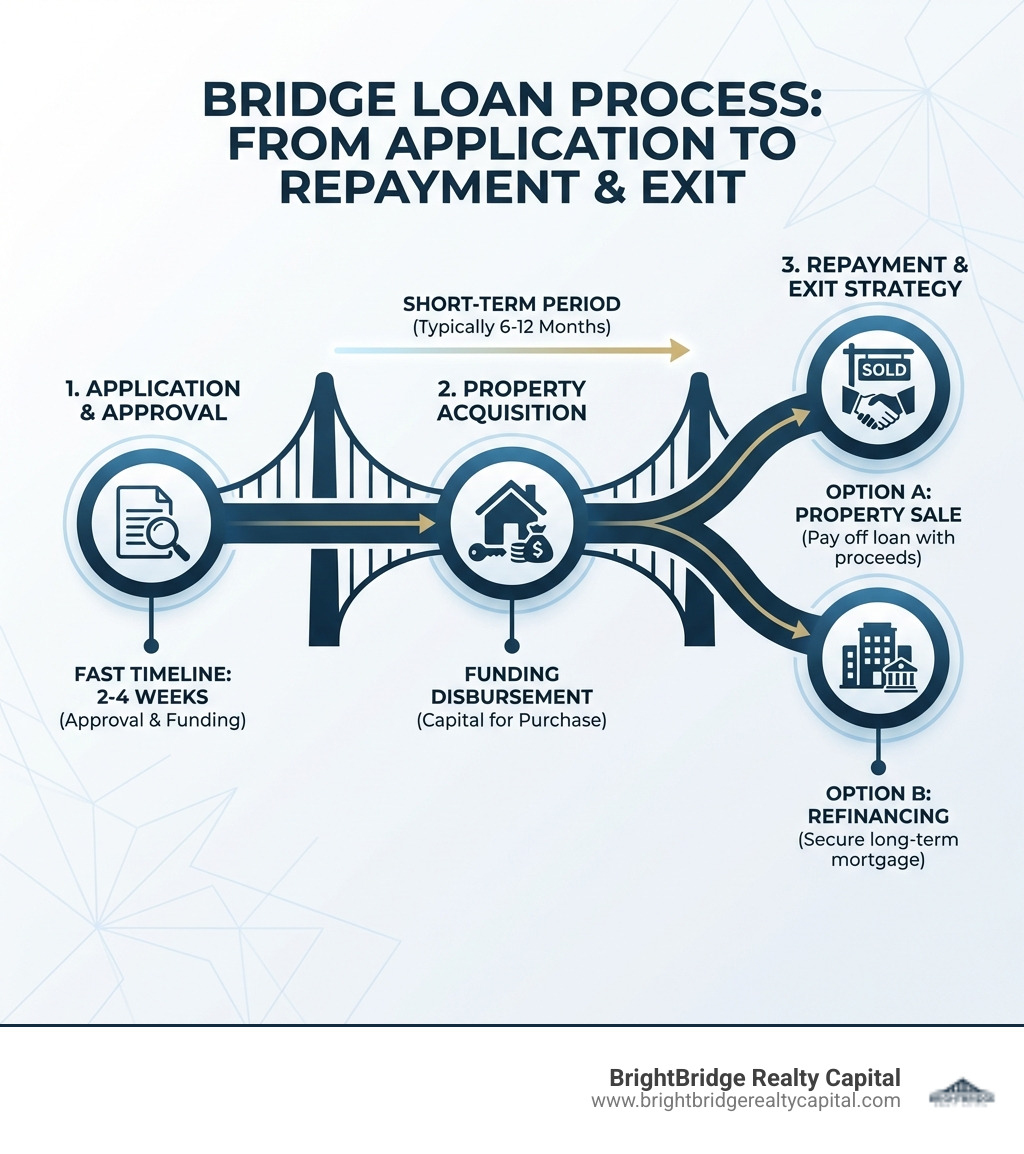
- Term Length: Typically ranges from six to twelve months. However, depending on the complexity of the transaction and the exit strategy, terms can be as short as a few weeks for simple flips or extend up to three years for larger commercial stabilization projects.
- Interest Rates: Expect higher rates than traditional mortgages. They usually start at the prime rate and go up, often to prime + 2% or more. This premium reflects the lender's increased risk, the speed of deployment, and the short duration of the loan, which limits the lender's total interest earnings period.
- Collateral: These are asset-backed loans, almost always secured by real estate. The equity in your current property, the new property being acquired, or other real estate holdings serves as the lender's security.
- Speed: This is their hallmark. Approval and funding are exceptionally fast, often taking place in just two to four weeks, compared to the 45-90 days common for conventional loans.
- Common Uses: The most frequent scenarios include buying a new home before selling a current one, funding fix-and-flip projects, acquiring properties at auction, and providing working capital for businesses awaiting a larger funding event.
The Real-World Need
Imagine you've found the perfect investment property—a distressed duplex in a rapidly gentrifying Brooklyn neighborhood with enormous upside potential. The seller is highly motivated and wants to close in 15 days. But there's a problem: you can't secure a traditional mortgage that quickly, and the capital you need is tied up in the equity of your current investment property, which isn't even on the market yet. Competing all-cash offers are circling. This is the precise, high-stakes scenario where bridge loan financing becomes a game-changer.
These loans are engineered for time-sensitive opportunities where the rigid, slow-moving process of traditional financing is a non-starter. They grant you the power of a cash buyer, offering rapid access to capital, flexible repayment terms that can be tailored to your situation, and the ability to move forward decisively without being held back by a pending sale or a lengthy underwriting process.
The trade-off for this speed and flexibility is, of course, the cost. With higher interest rates and origination fees, bridge loans are undeniably more expensive than their conventional counterparts. Lenders are compensated for taking on the additional risk of a short-term transaction and for providing the infrastructure to fund deals at lightning speed. However, for sophisticated investors who have done their due diligence, understand the costs, and have a clear, viable exit strategy, a bridge loan is not an expense; it's a powerful strategic tool for seizing rare opportunities and accelerating wealth creation.
As someone who has spent years on the front lines with real estate investors in New York's hyper-competitive market, I've seen countless deals that were made or broken by the availability of fast, reliable capital. I'm Daniel Lopez, a loan officer at BrightBridge Realty Capital. My specialty is demystifying complex lending products and helping clients structure financing that aligns perfectly with their ambitious goals, whether that involves tight timelines, extensive renovations, or unique property types. My mission is to empower you with the financial tools and confidence to act when opportunity knocks.
Explore more about Bridge loan financing:
What is a Bridge Loan and How Does It Work?
At its core, a bridge loan is a type of short-term financing that acts as a financial "bridge" connecting two distinct points in time. You might also hear it referred to by other names like interim financing, gap financing, or a swing loan. While these terms are often used interchangeably, "swing loan" typically refers specifically to residential scenarios where a homeowner "swings" from one house to the next. Regardless of the name, the function is identical: to provide immediate, temporary capital until a more permanent, long-term solution can be secured. This future solution, or "exit," is the destination on the other side of the bridge, and it could be a traditional mortgage, the proceeds from the sale of an existing asset, or a new round of equity financing for a business.

The defining characteristic of a bridge loan is its short-term nature. While traditional loans might stretch over 15, 20, or 30 years, bridge loans are sprints, not marathons. They typically run for just a few months, with six to twelve months being the most common term. Some lenders offer terms as short as three months for quick flips, while others might extend up to three years for more complex commercial projects that require stabilization (e.g., leasing up a vacant building) before a traditional lender will refinance.
Most bridge loans are collateral-based, meaning they are secured by a tangible asset, which is almost always real estate. This collateral provides a strong safety net for the lender, which in turn allows for a significantly faster and more streamlined approval and funding process compared to traditional loans that rely heavily on personal income and credit history. There are two main types: closed bridge loans, which are available to a borrower who has already signed a contract to sell their existing property, and open bridge loans, which are for borrowers who have not yet sold their property and thus carry more risk and a higher interest rate.
For example, let's flesh out the scenario: a homeowner in New York City finds their dream $2 million brownstone in Park Slope, but their current $1.5 million apartment in Chelsea hasn't sold. They have $800,000 in equity in the apartment. To secure the brownstone and avoid a financing contingency, they need a 20% down payment ($400,000) plus closing costs. A bridge loan lender could provide a loan of $400,000, using the equity in the Chelsea apartment as collateral. This allows the homeowner to close on the brownstone immediately. Three months later, the apartment sells. The homeowner uses the proceeds to pay off the $400,000 bridge loan plus interest and fees, seamlessly transitioning into their new home without having lost the opportunity.
How Bridge Loans Differ from Traditional Loans
While both bridge loans and traditional loans provide capital, their fundamental structures, purposes, and philosophies set them worlds apart. Understanding these differences is absolutely critical to determining if bridge loan financing is the right strategic choice for your situation.
| Feature | Bridge Loans | Traditional Loans |
|---|---|---|
| Term Length | Short-term (e.g., 3-18 months, typically 6-12 months) | Long-term (e.g., 15-30 years) |
| Interest Rate | Higher (e.g., prime rate + 2%, 6-12%) | Lower, fixed or variable |
| Approval Speed | Extremely Fast (e.g., 1-3 weeks) | Slower (e.g., 45-90 days) |
| Underwriting Focus | Asset value (LTV/ARV) and viability of exit strategy | Borrower's credit score, income (DTI), and history |
| Use Case | Temporary financing gap, time-sensitive opportunities | Long-term asset acquisition, stable financing |
| Collateral | Typically real estate, often based on equity | Real estate (mortgages), various for personal loans |
| Documentation | Streamlined; focused on asset and exit plan | Extensive; tax returns, pay stubs, bank statements |
| Repayment | Interest-only, deferred, or balloon payment | Amortized monthly principal and interest payments |
| Lender Type | Private lenders, hard money lenders, specialized banks | Conventional banks, credit unions, mortgage companies |
The most striking difference lies in speed versus cost. Bridge loans offer a significantly faster application, approval, and funding process because the underwriting is focused primarily on the value of the collateral and the feasibility of the exit plan. This expedited service comes at a premium, with higher interest rates and origination fees to compensate for the lender's increased risk and the short repayment period. However, this speed and flexibility can be invaluable. For instance, in a competitive real estate market, being able to close quickly without a financing contingency can make your offer as attractive as an all-cash bid. We've seen this give our clients a winning edge time and again in the New York real estate scene. The streamlined documentation requirements—often forgoing deep dives into tax returns in favor of bank statements and asset verification—also contribute to the speed, allowing us to focus on the deal's viability rather than getting bogged down in endless paperwork.
Key Use Cases for Bridge Loan Financing
Bridge loan financing isn't just a niche product for a single scenario; it's a versatile and strategic financial tool that serves a wide variety of purposes for real estate investors, homebuyers, and business owners alike. Its primary value is unlocked in situations where timing is the most critical variable, enabling users to seize time-sensitive opportunities that would otherwise evaporate while waiting for slower, more conventional funding.

Whether you're looking to capitalize on a hot property deal in Brooklyn, acquire a commercial building in Manhattan, or need quick capital to expand your business, bridge loans can provide the immediate funding you need to move forward with confidence and speed.
Bridging the Gap in Real Estate
The real estate sector is where bridge loan financing truly shines. It is perfectly suited for dynamic and competitive markets where the ability to act decisively is paramount.
- Buying Before Selling: This is the classic use case. A family finds their dream home, but their current property isn't sold. A bridge loan provides the down payment for the new purchase, eliminating the need for a home sale contingency. Once their old property sells, they repay the bridge loan. This removes immense stress and prevents them from losing their dream home to another buyer.
- Removing Sales Contingencies & Making Competitive Offers: In a seller's market, offers contingent on the sale of another property are often dismissed. A bridge loan transforms your offer into a near-cash equivalent, giving you immense negotiating power and significantly increasing your chances of acceptance. This is a critical advantage for our clients navigating New York's fast-paced real estate landscape.
- Property Acquisitions & Fix-and-Flip Projects: This is a cornerstone for real estate investors. Bridge loans are ideal for quickly acquiring distressed properties that traditional banks won't finance. For example, an investor buys a rundown property for $400,000 with a renovation budget of $100,000. A bridge lender might fund 80% of the purchase and 100% of the renovation costs, based on an After Repair Value (ARV) of $750,000. The investor uses the loan to buy and renovate the property over 6-9 months, then sells it for a profit, repaying the bridge loan from the proceeds.
- Real Estate Auction Purchases: Property auctions require the winning bidder to provide a significant deposit immediately and close the transaction within a very short timeframe (often 30 days or less). Traditional financing is impossible. A bridge loan provides the certainty of funds needed to confidently bid and close on auction properties.
- Renovation and Stabilization Financing: An investor might buy a partially vacant commercial property. A bridge loan can cover the acquisition cost plus the funds needed for renovations, marketing, and carrying costs while the investor works to lease up the remaining space. Once the property is stabilized with tenants and generating consistent cash flow, it becomes eligible for attractive long-term financing, which is then used to pay off the bridge loan.
- Loan-to-Value (LTV) and Loan-to-Cost (LTC) Ratios: Understanding these metrics is key. For real estate, lenders assess a loan-to-value (LTV) ratio, which is the loan amount divided by the property's appraised value. For bridge loans, LTV ratios generally do not exceed 65-70% for commercial properties or 80% for residential properties. For construction or renovation projects, lenders often use Loan-to-Cost (LTC), capping the loan at a percentage (e.g., 85%) of the total project cost. Some lenders might go higher, with some offering up to 85% of your home's value, depending on your equity and creditworthiness.
Fueling Business and Corporate Finance
Beyond real estate, bridge loan financing plays a vital role in the corporate world, helping businesses navigate transitional periods and seize growth opportunities without losing momentum.
- Working Capital for Seasonal or Cyclical Businesses: A retail business may need to purchase a large amount of inventory in August to prepare for the holiday season, but their revenues won't materialize until November and December. A bridge loan can provide the necessary working capital to stock up, ensuring they don't miss their most profitable time of year.
- Business Expansion and Acquisitions: A successful restaurant group identifies a prime location for a new establishment, but the opportunity requires immediate commitment. A bridge loan can fund the deposit and initial build-out costs while the company finalizes a larger SBA or conventional business loan.
- Covering Expenses Until Long-Term Funding is Secured: This is a classic scenario for startups and growing companies. A tech company might be in the final stages of securing a $5 million Series A venture capital round, but the deal won't close for another 60 days. A bridge loan can cover essential interim expenses like payroll, rent, and marketing, ensuring the business continues to operate smoothly and hit its milestones.
- Management Buyouts (MBOs): When a management team wants to purchase the company they work for, they often need to move quickly. A bridge loan can provide the initial capital required to secure the deal, which is later refinanced with more permanent financing structured around the company's cash flow.
Understanding Bridge Loan Costs, Terms, and Eligibility
While bridge loan financing offers unparalleled speed and flexibility, it's imperative to approach it with a clear understanding of the financial implications. These are premium financial products, and their cost structure and eligibility requirements reflect their short-term, high-speed, and high-risk nature. At BrightBridge Realty Capital, we believe in complete transparency, ensuring you are fully aware of all financial requirements, lender criteria, and borrower qualifications so you can make a truly informed decision.
Typical Interest Rates, Fees, and Repayment Terms
Bridge loans are, by design, more expensive than traditional loans. This isn't a flaw; it's a feature that compensates lenders for the unique risks and services they provide.
- Higher Interest Rates: Bridge loan interest rates are significantly higher than those for 30-year mortgages. They can range from the prime rate plus a few points to well into the double digits, often falling between 6% and 12% annually. This higher rate compensates lenders for the shorter repayment period (meaning less time to earn interest) and the specialized, expedited nature of the financing.
- Origination Fees: Lenders charge origination fees for processing, underwriting, and funding the loan. These fees are typically calculated as a percentage of the total loan amount and can range from 1% to 3%. For a $500,000 loan, this could mean an upfront cost of $5,000 to $15,000.
- Closing Costs: Similar to traditional loans, bridge loans have closing costs. These can include appraisal fees (which may be higher for a rush job), title insurance, escrow fees, notary fees, and legal fees. These costs can add another 1% to 2% to the total loan expense.
- Loan Points: In addition to origination fees, lenders often charge "points." One point is equal to 1% of the loan amount. For typical terms of up to 12 months, it's common to see 2 to 4 points charged. These points are paid upfront or rolled into the loan and, along with other fees, are amortized over the very short loan period, which significantly increases the effective monthly cost compared to a traditional loan.
- Short Loan Terms: As discussed, bridge loan terms are brief, usually six to 12 months. This short duration creates pressure and underscores the absolute necessity of having a clear, realistic, and executable exit strategy from day one.
- Repayment Structure: Repayment terms for bridge loans are designed for cash flow flexibility during the loan's life. Common structures include:
- Interest-Only Payments: You pay only the accrued interest each month, keeping payments lower than a fully amortized loan. The full principal is then due as a balloon payment at the end of the term.
- Deferred Payments: In some cases, both interest and principal payments can be deferred. The interest accrues and is rolled into the principal, with the entire lump sum due as a balloon payment when the loan matures. This is common in fix-and-flip scenarios where there is no cash flow until the property is sold.
How to Qualify for Bridge Loan Financing
While the underwriting process for bridge loans is fast, it is still rigorous. Lenders need to be confident in your ability to execute the plan and repay the loan. Our goal is to help you understand these criteria to present the strongest possible application.
- Significant Equity (The Cornerstone): For real estate bridge loans, substantial equity in your current property (the collateral) is the most important factor. Most lenders require you to have at least 20% equity, calculated as (Appraised Value - Outstanding Mortgage Balance) / Appraised Value. Having more equity (e.g., 40-50%) makes you a much stronger candidate and can lead to better terms.
- Credit Score: A strong credit history demonstrates financial responsibility. While the asset is the primary focus, your credit still matters. Lenders typically look for a minimum credit score of 680. Borrowers with scores above 740 are considered top-tier and may qualify for lower rates and fees.
- Debt-to-Income (DTI) Ratio: Lenders need to know you can handle the payments. They will calculate your DTI, including the potential new bridge loan payment and your existing mortgage. While some specialized lenders allow a DTI ratio as high as 50%, a lower ratio (under 43%) is always preferred. Lenders may also consider a "projected DTI" based on the assumption that the existing home will be sold, but they will still want to see that you have the cash reserves to handle the overlap period.
- Strong Financial Standing and Cash Reserves: Lenders want to see overall financial stability. This means having ample cash reserves (liquid funds) to cover several months of interest payments on the bridge loan, plus payments on your existing mortgage and other debts. A common rule of thumb is having enough cash to cover 6 months of total housing expenses.
- A Viable Exit Strategy: This is not just a plan; it's a core part of your application. You must be able to clearly articulate and document how you will repay the loan, whether through a signed sales contract on your existing property or a pre-approval letter for a long-term refinance.
- Property Appraisal: The property serving as collateral will undergo a professional appraisal to determine its current market value. For renovation projects, the lender will likely order an appraisal that provides both the "As-Is" value and the "After Repair Value" (ARV), which is crucial for determining the loan amount.
The Pros, Cons, and Risks of Bridge Loans
Like any powerful financial tool, bridge loan financing comes with a distinct set of advantages and potential pitfalls. It is a high-performance solution designed for specific situations, and when used strategically, it can unlock incredible opportunities. However, it is not a one-size-fits-all solution and carries significant risks that must be fully understood and mitigated. We believe in providing a balanced, unvarnished perspective so you can weigh your options with clarity and confidence.
A thorough risk assessment and robust financial planning are not just recommended—they are paramount before committing to a bridge loan.
Advantages of Using a Bridge Loan
When the circumstances are right, the benefits of a bridge loan can be transformative, revolving around speed, flexibility, and strategic opportunity.
- Fast Funding and Quick Closing: This is the number one advantage. The bridge loan process is built for speed. While a traditional mortgage closing can take 45-60 days, a bridge loan can often be funded in as little as 10-21 days. This velocity is a game-changer in competitive markets like New York, allowing you to act decisively on time-sensitive deals.
- Flexibility in Repayment: Unlike the rigid monthly principal-and-interest structure of traditional loans, many bridge loans offer flexible repayment options. Structures like interest-only payments or deferred payments (where interest accrues and is paid in a lump sum at the end) can significantly ease your short-term cash flow burden, especially if you're juggling multiple property expenses.
- Increased Purchasing Power and Competitiveness: A bridge loan effectively turns you into a cash buyer. By providing immediate, certain access to capital, it allows you to make a strong, non-contingent offer on a new property. In a bidding war, an offer without a financing or sale contingency is vastly more attractive to sellers and can be the deciding factor that secures your desired asset.
- Seizing Time-Sensitive Opportunities: The world is full of opportunities with short expiration dates. Whether it's acquiring a prime investment property before it hits the open market, buying a new home that has multiple offers, or funding a critical business expansion, bridge loans allow you to capitalize on these moments that require rapid action and immediate capital. They literally "bridge the gap" between your current financial state and your next big move.
- Less Documentation and Asset-Focused Underwriting: Compared to the often-onerous paperwork of traditional loans (W-2s, tax returns, employment verification), bridge loan applications are typically more streamlined. The lender's primary focus is on the value of the collateral and the strength of your exit strategy, which further contributes to their speed and efficiency.
Disadvantages and Risks of Bridge Loan Financing
While the advantages are compelling, it is critically important to be aware of the significant downsides and potential risks. These are high-stakes, short-term solutions, and the consequences of a failed plan can be severe.
- Higher Costs: Speed and convenience come at a price. As highlighted earlier, bridge loans are substantially more expensive than conventional financing. The combination of higher interest rates (often double that of a mortgage), origination fees (1-3%), and loan points (2-4) results in a much higher cost of capital. For a $500,000 loan over 12 months, the total fees and interest can easily exceed $50,000, versus a fraction of that for a traditional loan over the same period.
- The Stress of Managing Two Housing Payments: If you use a bridge loan to buy a new home before selling your old one, you will likely be responsible for three major payments simultaneously: your old mortgage, your new bridge loan payment, and your regular living expenses. This can place immense financial and psychological strain on your household budget. A delay of even a month or two in selling your old home can deplete cash reserves rapidly.
- Exit Strategy Failure: The Ultimate Risk: This is the single biggest danger. Bridge loans are predicated on a clear and timely exit strategy—usually the sale of an existing property or securing long-term financing. If this exit fails or is significantly delayed, you can find yourself in a precarious financial trap. A market downturn could prevent your home from selling at the expected price, or a change in your financial situation could cause your long-term refinancing to be denied. This leaves you with a high-interest, short-term loan that is due in full.
- Foreclosure Risk: This is the dire consequence of a failed exit strategy. If your current home doesn't sell and you cannot repay the bridge loan when the balloon payment is due, the lender can initiate foreclosure proceedings on the property you used as collateral. Bridge loans rarely include protections for the borrower if the sale of the old home falls through, making a robust, conservative exit plan absolutely essential.
- The Pressure of a Short Repayment Window: The short loan terms, typically 6-12 months, create a ticking clock. This can create immense pressure to sell a property quickly, potentially forcing you to accept a lower offer than you otherwise would. If your exit plan is delayed, your only options might be to seek a costly extension, attempt to refinance the bridge loan with another high-interest short-term loan, or, in the worst-case scenario, forfeit your collateral.
The Application Process and Strategic Considerations
Successfully navigating bridge loan financing requires more than just understanding the basics; it demands a meticulous, strategic approach to both the application process and your overarching financial plan. It's about choosing the right tool for the right job and having a clear blueprint for success before you even begin.
At BrightBridge Realty Capital, we emphasize decision-making rooted in sound financial strategy, ensuring our clients are positioned for success from start to finish.
The Streamlined Application and Approval Process
One of the hallmark features of bridge loans is their expedited nature. In the worlds of real estate and business, time is the most valuable commodity, and the bridge loan process is engineered to conserve it.
- Faster Than Traditional Loans: While a conventional mortgage can feel like a marathon of paperwork and waiting, taking weeks or even months to close, a bridge loan is a sprint. With a prepared borrower and a responsive lender, funding can often be secured in as little as two to three weeks.
- Less Documentation, More Focus: The documentation required is generally less burdensome than for conventional financing. Instead of deep dives into years of tax returns and employment history, the focus is on the essentials that prove the viability of the deal. Typically, you'll need:
- A completed loan application
- Photo ID
- The purchase contract for the new property
- Mortgage statements and a recent appraisal (or estimate of value) for the property being used as collateral
- Bank statements to verify liquid assets and cash reserves
- A clear, written explanation of your exit strategy
- Quick Underwriting: Our in-house teams are structured for rapid underwriting. We prioritize analyzing the strength of your collateral (the property) and the feasibility of your exit strategy over a lengthy personal financial history review.
- Funding Timeline: While timelines can vary based on the complexity of the deal and third-party services like appraisals, we pride ourselves on fast closings. For our prepared New York clients, closing within two weeks is an achievable goal.
Our typical loan processing steps are designed for efficiency:
- Initial Review & Consultation: Once your application is submitted, it's reviewed by a loan officer to ensure the project aligns with our lending criteria and to discuss your goals.
- Order Kick-off: The processor initiates orders for title reports, insurance verification, and a property appraisal.
- Property Appraisal/Inspection: A third-party appraiser visits the property to assess its current condition and market value (and After Repair Value, if applicable).
- Document Upload & Scope of Work (SOW): You'll upload the required documents to our secure online portal and, for renovation projects, provide a detailed Scope of Work.
- Underwriting & Clarification: The underwriter reviews the complete loan package. If any questions arise, your processor will reach out for clarification.
- Feasibility Review & Approval: The package moves to our in-house feasibility team for a final review and official loan approval.
- Closing & Funding: Documents are signed, and funds are disbursed.
Building Your Bulletproof Exit Strategy
This is the most critical element of a successful bridge loan experience. You must have a primary and even a secondary plan for repaying the loan.
- Exit 1: Sale of Existing Property: This is the most common exit. Your strategy should include a conservative market analysis of your property's value, a signed listing agreement with a reputable real estate agent, and a clear timeline. Your financial plan must account for the possibility that the property sells for slightly less or takes longer to sell than anticipated. What is your price reduction strategy if you don't get offers in 30 days?
- Exit 2: Refinancing into a Permanent Loan: This is common for investors. Before taking the bridge loan, you should already be in conversation with a mortgage broker or bank about the requirements for the long-term loan you'll need. Get a pre-approval letter for your refinance. Understand the credit score, income, and property condition requirements you'll need to meet in 6-12 months to qualify for that loan.
- Contingency Planning: What if your primary exit fails? Could you rent out one of the properties to cover the costs? Do you have access to other lines of credit or assets you could liquidate? A solid plan addresses the 'what-ifs.'
When to Consider Alternatives
Bridge loan financing is not always the answer. Depending on your situation, other options might be more suitable and less costly:
- Home Equity Line of Credit (HELOC): If you have significant equity in your home and a good credit score, a HELOC can provide a flexible line of credit that you can draw on as needed. It's often cheaper than a bridge loan, but the approval process can be longer.
- Home Equity Loan (Second Mortgage): This provides a lump-sum payment based on your home's equity. Rates are typically lower than a bridge loan, but like a HELOC, the underwriting process is more akin to a traditional mortgage.
- 80-10-10 Loan: This involves taking out a first mortgage for 80% of the new home's price, a second mortgage for 10%, and making a 10% down payment. This can help you avoid a jumbo loan or private mortgage insurance, but requires you to qualify for two loans at once.
- Seller Leaseback: In some cases, you can negotiate with the buyer of your current home to let you rent it back for a short period after closing. This gives you the cash from the sale to buy your new home and extra time to move.
Choosing the right path comes down to a careful analysis of your timeline, risk tolerance, and financial position. Working with an experienced lender like BrightBridge Realty Capital, who can honestly assess your situation and discuss all available options, is crucial. We are committed to providing direct, transparent lending solutions that empower our clients to make the best strategic decisions.
Conclusion
We've journeyed through the intricate world of bridge loan financing, dissecting its core definition and mechanics, exploring its diverse applications in both real estate and business, and carefully examining the critical considerations of costs, terms, and eligibility. We've also placed its significant advantages and formidable risks side-by-side, providing a comprehensive framework for you to determine when this powerful financial tool can be your greatest strategic ally.
At its heart, a bridge loan is a specialized instrument engineered for speed and strategic positioning. It is not a financial crutch but a springboard. It empowers savvy investors and decisive homebuyers to seize fleeting opportunities—whether that's securing a new home before selling an old one, making a winning non-contingent offer on a prime property, or injecting essential working capital into a business at a pivotal moment. While the higher interest rates and fees are a significant factor, the ability of a bridge loan to provide immediate capital and accelerate your plans can unlock value that far outweighs its cost, preventing missed opportunities that could have generated substantial returns.
However, the central theme of our discussion, and the most important takeaway, is the absolute necessity of a clear, conservative, and executable exit strategy. The short-term nature of these loans creates a high-pressure environment. A robust plan for repayment—typically through the confirmed sale of an asset or a pre-vetted plan for securing long-term financing—is not just advisable; it is the fundamental prerequisite for a successful bridge loan experience. Without a well-defined exit, the advantages of speed can quickly be overshadowed by the pressures of high costs and the risk of severe financial strain.
Before you proceed, ask yourself these critical questions:
- Is the opportunity I'm pursuing valuable enough to justify the higher cost of short-term financing?
- Is my exit strategy realistic and based on conservative market assumptions?
- Do I have a contingency plan (Plan B and even Plan C) if my primary exit strategy is delayed?
- Do I have the cash reserves to comfortably manage all my financial obligations during the loan term, even with potential delays?
For discerning real estate investors and businesses in New York seeking fast, flexible, and strategic funding solutions, bridge loan financing offers a powerful path forward. It's about having the right capital at your disposal, precisely when you need it, to maintain momentum and achieve your ambitious goals.
If you've considered the risks and are ready to explore how bridge loan financing can support your next big move, we invite you to connect with us. Our team at BrightBridge Realty Capital specializes in providing customized real estate financing solutions. As direct lenders, we offer a streamlined process to meet your unique needs and help you confidently bridge the gap to your success.