The Fixer-Upper's Friend: How Bridge Loans Fuel Your Flips

Summary
Fuel your fix & flip projects! Learn how bridge loans for fix and flip investors provide fast funding, competitive advantage, and higher leverage.
Why Bridge Loans Are the Fix and Flip Investor's Secret Weapon

Bridge loans for fix and flip investors are specialized, short-term financing tools meticulously designed to help you acquire and renovate properties with unparalleled speed. With closing times that can be as fast as 7 to 14 days, these loans empower you to capitalize on time-sensitive deals before they are snapped up by competing cash buyers. They are the financial engine that drives a successful flipping business in today's fast-paced market.
What Bridge Loans for Fix and Flip Investors Offer:
- Fast Funding: Close in 7-14 days (some lenders in as few as 3-5 days)
- High Leverage: Up to 90% of purchase price + 100% of rehab costs
- Flexible Terms: 6-24 months, interest-only payments
- Asset-Based Approval: Focus on property value and ARV, not just your credit score
- Competitive Edge: Make cash-like offers to win deals in tight markets
You've found the perfect distressed property, but there's a catch: traditional bank financing takes 30-60 days, and the seller, who may be facing foreclosure or needs to relocate quickly, needs to close in two weeks. This is precisely where bridge loans shine. They give you the ability to present an offer that functions like cash—it's fast, reliable, and has a high certainty of closing. For a seller, this eliminates the anxiety of a deal falling through due to lengthy underwriting or a low appraisal, making your offer significantly more attractive, even if it's not the highest bid.
In competitive real estate markets, speed is everything. A delay of even a few days can mean the difference between securing a profitable project and losing it to another investor. Bridge loans provide the immediate capital required to move quickly, fund the necessary renovations, and execute your flip before the opportunity vanishes. Unlike conventional mortgages, which are heavily reliant on your personal income, tax returns, and debt-to-income ratios, bridge loans focus on the property's potential value (its After-Repair Value, or ARV). This asset-centric approach means faster approvals, less paperwork, and the ability to scale your real estate portfolio without tying up all your personal cash in a single project.
I'm Daniel Lopez, a loan officer at BrightBridge Realty Capital, and I've helped countless investors, from first-time flippers to seasoned professionals, structure bridge loans for fix and flip investors to secure the most competitive deals on the market. In this comprehensive guide, I'll walk you through exactly how these loans work, what they cost, how to get approved, and how you can strategically use them to fuel your next profitable flip.
What is a Fix and Flip Bridge Loan and Why Is It Essential?
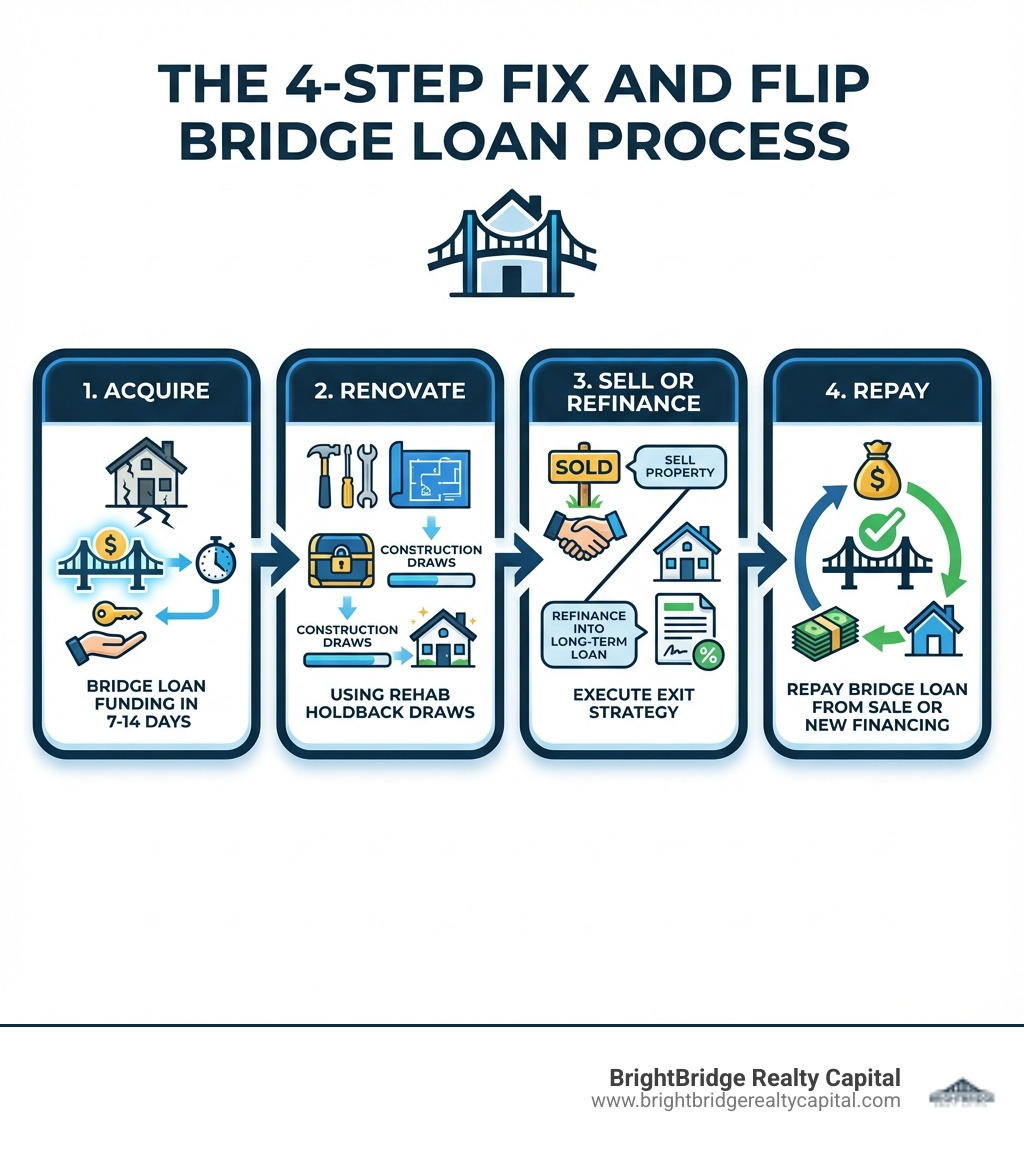
At its core, a bridge loan is a short-term financing option that acts as a "bridge" over a temporary funding gap. For fix and flip investors, this gap exists between the immediate need to purchase a property and the eventual sale or long-term refinancing of that same property. We specialize in these flexible, short-term real estate loans, typically spanning 6 to 18 months, to provide you with the rapid access to capital that is critical for success. Think of it as a dedicated credit line for a specific real estate project, available when you need it most.

When you uncover a fantastic deal—perhaps a property at a foreclosure auction or an off-market home from a motivated seller—immediate action is required. Traditional lenders, with their bureaucratic processes and lengthy underwriting timelines, simply can't keep up. A bridge loan is essential because it allows you to move with the agility and confidence of a cash buyer. This speed not only helps you secure time-sensitive opportunities but also gives you a crucial competitive advantage in negotiations, often allowing you to acquire properties at a better price.
To dive deeper into the fundamentals, you can explore our detailed guide: What Is a Bridge Loan Real Estate.
How Bridge Loans Specifically Benefit Fix and Flip Investors
Bridge loans for fix and flip investors are not just generic short-term loans; they offer a suite of benefits custom-tailored to the unique cycle of property renovation and resale:
- Unmatched Speed of Closing: This remains the single greatest advantage. While a conventional loan application can languish in underwriting for 45-60 days, a bridge loan can be approved and funded in as little as 10-14 days, with some lenders closing even faster. This speed is what allows you to confidently make offers with short closing dates, beating out slower, traditionally financed bidders.
- Comprehensive Access to Capital: A well-structured bridge loan doesn't just cover the purchase price. It can also finance the entire renovation budget. This is a game-changer, as it frees up your personal capital. Instead of sinking all your cash into one project's rehab, you can hold it for reserves, use it for down payments on other properties, or cover carrying costs, effectively allowing you to scale your business faster.
- Financing for Non-Traditional Properties: Distressed properties—the bread and butter of fix and flip investing—often have issues that make them ineligible for traditional financing. This can include a lack of a certificate of occupancy, missing kitchens or bathrooms, foundation issues, or fire damage. Bridge lenders are not deterred by these problems because they focus on the property's "after-repair value" (ARV), making them the perfect financing tool for these value-add projects.
- Structured Funding for Renovation Costs: These loans are designed to manage the renovation process. Lenders often include a construction holdback, which is a portion of the loan earmarked for repairs. These funds are not given as a lump sum but are released in draws as you complete pre-agreed renovation milestones. This ensures the project stays on track and the funds are used as intended. We can fund up to 100% of the rehab budget this way.
- Higher Leverage to Maximize Your Reach: Bridge loans typically offer higher Loan-to-Cost (LTC) and Loan-to-Value (LTV) ratios than traditional loans. This means you can finance a larger portion of the total project cost with less cash out of pocket. For example, you might be able to borrow up to 90% of the purchase price and 100% of the renovation costs, up to a total of 75% of the property's ARV.
For a more comprehensive understanding, check out our resource on Fix and Flip Loans for Investors.
Ideal Scenarios for Using a Bridge Loan
Bridge loans for fix and flip investors are most effective and powerful when deployed in these specific situations:
- Fast-Moving, Competitive Markets: In seller's markets where properties receive multiple offers within days, a bridge loan lets you make a strong, cash-like offer that stands out and is more likely to be accepted.
- Off-Market and Auction Deals: These opportunities often come with non-negotiable, quick closing deadlines that are impossible to meet with conventional financing. Bridge loans are designed for exactly this kind of speed.
- Properties Needing Significant Repairs: When a property is uninhabitable or has major structural issues, traditional banks will not lend on it. Bridge loans are specifically designed for these value-add projects that others avoid.
- Scaling Your Portfolio Quickly: A bridge loan can cover the funding gap when you find a new deal before you've sold an existing property. This allows you to continuously acquire new projects without being constrained by the sales timeline of your current flip.
- Acquiring Distressed Properties: This includes bank-owned (REO) properties, short sales, and homes from motivated sellers who need a fast, certain sale. Bridge loans provide the immediate capital needed to purchase and rehab these often-undervalued properties.
These scenarios highlight why bridge loans are not just a financing option but a core strategic tool for any serious investor pursuing Fix and Flip Real Estate Investing.
The Competitive Edge: How Bridge Loans for Fix and Flip Investors Win Deals
In the high-stakes game of real estate investing, speed and flexibility are your superpowers. Bridge loans for fix and flip investors equip you with both, transforming you from a hopeful bidder into a formidable, deal-closing contender. The ability to move quickly and with certainty is what separates successful investors from those who consistently get outbid.

By enabling you to make cash-like offers, bridge loans allow you to bypass the long, uncertain contingency periods associated with traditional financing. Sellers, especially those in distress or with multiple offers on the table, overwhelmingly favor the swift, certain closing that a bridge-loan-backed offer represents. This often becomes the deciding factor that wins you the property, even over slightly higher offers that come with financing contingencies.
Beyond winning single deals, bridge loans are a powerful catalyst for scaling your entire investment portfolio. As you build a track record of successful flips financed by a reliable lending partner, you establish credibility. This can lead to even better terms, higher leverage, and faster funding on future projects, creating a virtuous cycle of growth. To learn more about optimizing your long-term investment plan, explore our insights on the Fix and Flip Strategy.
Gaining Leverage with High LTC and ARV Financing
A key strategic advantage of bridge loans for fix and flip investors is the availability of high leverage. This allows you to control more assets and take on larger projects with less of your own capital tied up. This leverage is calculated using two key metrics:
- Loan-to-Cost (LTC): This metric compares the loan amount to the total project cost (purchase price plus the renovation budget). Lenders may offer up to 90% LTC, and often 100% of the rehab costs. This structure is designed to minimize your out-of-pocket expenses.
- After-Repair Value (ARV): This is the estimated market value of the property after all your planned renovations are complete. Lenders will typically cap the total loan amount at a percentage of the ARV, often up to 75%. This ARV-based lending is what makes it possible to finance properties in poor condition.
Let's illustrate with a real-world example: You find a property for $300,000 that needs $100,000 in renovations. The total project cost is $400,000. After your work, the ARV is projected to be $600,000.
- A lender offering 90% LTC would lend up to $360,000 ($400,000 x 0.90). This covers the entire purchase price and $60,000 of your rehab budget, leaving you to cover just $40,000 plus closing costs.
- The loan is also subject to an ARV cap. At 75% of ARV, the maximum loan would be $450,000 ($600,000 x 0.75). Since the $360,000 loan amount is below this cap, you're good to go.
Renovation funds are managed through construction holdbacks and disbursed in draws as you complete work and pass inspections. This structured funding ensures you have the capital exactly when you need it for materials and labor. By understanding and leveraging these financing structures, you can maximize your capital efficiency and take on more profitable projects simultaneously. For a deeper dive into how ARV is calculated and impacts your investment, read our guide on ARV analysis.
Common Exit Strategies for a Profitable Flip
Every successful flip begins with the end in mind. A clear, viable exit strategy to repay your short-term bridge loan is not just a good idea—it's a requirement for any reputable lender. Here are the most common approaches:
- Selling the Property: This is the classic fix and flip model. Once renovations are complete and the property is staged, you list it on the market. The proceeds from the sale are used to pay off the bridge loan principal, interest, and fees, with the remainder being your profit.
- Refinancing into a Long-Term Rental Loan (BRRRR Strategy): For investors looking to build a rental portfolio and long-term wealth, the "Buy, Rehab, Rent, Refinance, Repeat" (BRRRR) strategy is exceptionally popular. After renovating the property using the bridge loan, you place a qualified tenant. With the property stabilized and generating income, you then refinance the expensive bridge loan into a long-term, lower-interest rental loan (like a DSCR loan). This refinance often allows you to pull out most or all of your initial invested capital, which you can then "repeat" the process with on a new property.
- Paying Off the Loan with Proceeds from Another Sale: Sometimes an investor will use a bridge loan to acquire a new property (Property B) while they are in the process of selling another investment property (Property A). The bridge loan provides the immediate funds for the new purchase. Once Property A sells, its proceeds are used to pay off the bridge loan on Property B.
Having a robust primary exit plan and at least one backup strategy is crucial for mitigating risk and ensuring a profitable outcome. Learn more about your refinancing options in our Refinance Bridge Loan Complete Guide.
Deconstructing the Deal: Typical Terms, Costs, and Risks
Before you jump into your next flip, it's absolutely crucial to understand the detailed financial mechanics of bridge loans for fix and flip investors. While these loans offer incredible speed and flexibility, they come at a higher cost than traditional financing. Careful and conservative financial planning is paramount. You must ensure that the higher costs associated with this speed don't unexpectedly erode your projected profits, turning a promising deal into a financial loss. For a deeper understanding of how interest rates are calculated and how they factor into your project's budget, refer to our Fix and Flip Loan Interest Rates guide.
Typical Terms and Conditions of a Fix and Flip Bridge Loan
When you begin evaluating offers for bridge loans for fix and flip investors, you'll encounter a standard set of terms. Understanding these terms is the first step to comparing loan offers effectively.
- Loan Amounts: These can range widely, typically from $150,000 to over $5 million, depending on the lender and the project's scope. We often structure loans to fund up to 90% of the property's purchase price and 100% of the budgeted rehab costs.
- Interest Rates: Rates are notably higher than conventional mortgages, often falling in the 7% to 12%+ range. This higher rate is the premium you pay for speed, leverage, and asset-based underwriting. The potential for a quick and profitable flip is what justifies this cost.
- Repayment Period: These are definitively short-term loans. Terms typically range from 6 to 24 months. Our most common loan terms are 13 or 19 months, which provides a comfortable buffer for completing renovations and marketing the property. Many lenders also offer extension options, though these come with a fee.
- Interest-Only Payments: To aid cash flow during the project, most bridge loans are structured with interest-only payments. This means your monthly payment is significantly lower because you are only servicing the interest, not paying down the principal. This frees up capital for ongoing project expenses.
- Balloon Payments: The full principal amount of the loan is due as a single, large "balloon payment" at the end of the loan term. This payment is typically made from the proceeds of the property's sale or from the funds received from a long-term refinance.
- Loan-to-Value (LTV): For purchase transactions, LTV can be as high as 80-85% of the "as-is" value. For cash-out refinances on a property you already own, the LTV is generally more conservative, often around 70-75%.
To gain more insight into the operational flow of these loans, visit our page on How Do Bridge Loans Work.
Understanding the Costs: Fees and Profitability Impact
Beyond the interest rate, several fees contribute to the total cost of bridge loans for fix and flip investors. These must be factored into your financial model to accurately project your net profit.
- Origination Fees (Points): This is an upfront fee charged by the lender for processing and funding the loan. It's calculated as a percentage of the total loan amount, typically ranging from 1% to 3% (1 to 3 points).
- Appraisal and Inspection Fees: Lenders require a third-party appraisal to determine two values: the property's current "as-is" value and its projected "after-repair value" (ARV). You will also pay for inspections that are required to release construction funds from your rehab holdback.
- Closing Costs: Similar to any real estate transaction, these include title insurance, escrow fees, attorney fees, and recording fees. These can collectively range from 1% to 5% of the loan amount, depending on the location and complexity of the deal.
- Lender-Specific Fees: Be sure to ask about other potential charges, such as underwriting fees, processing fees, document preparation fees, or extension fees if you need more time.
To accurately gauge profitability, you must create a detailed spreadsheet. Sum all of these fees and the total projected interest payments for the life of the loan, and subtract this total financing cost from your projected gross profit (ARV minus purchase price and rehab costs). A fast flip can still yield a very high annualized ROI, but diligent financial modeling is non-negotiable. For a detailed breakdown of this calculation, consult our guide on the Fix and Flip Formula.
Potential Disadvantages and How to Mitigate Them
While powerful, bridge loans for fix and flip investors are not without risks. Acknowledging these potential downsides and planning for them is the mark of a savvy investor.
- Higher Costs: The primary trade-off for speed and flexibility is higher interest rates and fees compared to bank loans.
- Mitigation: Your deal analysis must be conservative. Ensure your projected return on investment (ROI) can comfortably absorb these higher costs with room for error. A deal with thin margins is not a good candidate for a bridge loan.
- Short Repayment Terms: The 6-24 month term creates a hard deadline, putting pressure on your execution.
- Mitigation: Before closing on the loan, develop a realistic, detailed project timeline with built-in contingencies for potential delays (e.g., permit issues, weather, contractor availability). Have your primary and secondary exit strategies clearly defined and vetted.
- Market Risk: A sudden downturn in the real estate market could lower your expected sale price, jeopardizing your profit.
- Mitigation: Conduct thorough market research on recent comparable sales and current inventory levels. Understand the local market trends. Your backup plan should be to rent the property (the BRRRR strategy), so ensure the numbers work for a rental scenario as well.
- Renovation Cost Overruns: Unexpected problems like hidden mold, foundation cracks, or outdated electrical systems can inflate your budget and extend your timeline.
- Mitigation: Always include a contingency fund in your budget, typically 10-20% of the total renovation cost. Get multiple, detailed bids from vetted contractors before you finalize your budget. Never rely on a single, vague estimate.
Getting Approved: The Fast-Track Underwriting Process
One of the most compelling and revolutionary aspects of bridge loans for fix and flip investors is the streamlined, asset-focused approval process. Unlike conventional banks that conduct a forensic examination of your personal finances, private bridge lenders prioritize the viability of the real estate deal itself. This asset-based approach means significantly less red tape, fewer documentation requirements, and dramatically faster approvals.
Our primary focus is on the property's economic potential and your strategic plan to unlock that potential. This philosophy ensures a rapid and logical path from your initial inquiry to the funding of your loan, empowering you to act quickly in the market. To see how simple it is to get started, you can explore our Bridge Loan Application Online.
How the Underwriting Process for Bridge Loans for Fix and Flip Investors Differs
The underwriting methodology for bridge loans for fix and flip investors is fundamentally different from that of a traditional mortgage lender. Understanding these differences is key to preparing a successful application.
- Focus on Property Value vs. Personal Income: We prioritize the property's current value and, more importantly, its "after-repair value" (ARV). Your personal debt-to-income (DTI) ratio, while sometimes considered, is not the primary qualifying factor. The loan is secured by the asset, and the lender's main concern is the asset's ability to repay the loan upon sale or refinance.
- The Central Importance of ARV: In the fix and flip world, the ARV is king. We are essentially lending on the property's future potential. This is what makes these loans perfect for fixer-uppers that traditional banks, which only lend on current, habitable value, would immediately reject.
- Significantly Less Paperwork: While you will need to provide key documents (like a purchase agreement, scope of work, and entity documents), the overall burden is significantly lighter than for a conventional mortgage. You generally won't be asked for years of tax returns or detailed profit and loss statements, which drastically speeds up the processing time.
- Common-Sense, Holistic Underwriting: We employ a flexible, logical approach. We look at the complete picture: the strength of the deal, your experience level, your liquidity, and the clarity of your exit strategy. We consider your credit score (typically requiring a minimum in the mid-600s), but it's just one piece of a larger puzzle, not an automatic disqualifier.
This distinct, business-oriented philosophy enables us to provide fast, creative financing solutions where traditional lenders see only problems. For experienced investors with strong deals, our No Doc Bridge Loans can offer an even more streamlined process.
Key Eligibility Requirements for Investors
To qualify for bridge loans for fix and flip investors and secure the best possible terms, we look for a combination of a strong deal and a capable borrower. Here are the key indicators we assess:
- Investor Experience: A proven track record of successful flips is highly valued and can lead to better terms (higher leverage, lower rates). However, we also work with first-time flippers. A first-timer can compensate for lack of experience by presenting an exceptionally well-researched deal, a strong team (e.g., an experienced contractor and real estate agent), and ample cash reserves.
- Minimum Credit Score: A FICO score in the mid-600s is typically the minimum threshold. Borrowers with higher scores (680+) will generally qualify for more favorable terms and higher leverage, as it demonstrates a history of financial responsibility.
- Liquidity and Cash Reserves: You must demonstrate that you have sufficient cash on hand to cover your down payment, closing costs, and several months of interest payments. Lenders also want to see that you have a reserve fund for unexpected costs and holding expenses (taxes, insurance, utilities) that will accrue during the project.
- Business Entity (LLC): For liability protection and professional separation, loans are made to a business entity, such as a Limited Liability Company (LLC) or corporation, not to an individual. You can learn more about choosing a business structure from the U.S. Small Business Administration.
- Detailed Scope of Work (SOW): A professional, itemized renovation plan and budget is crucial. This document justifies the rehab costs and is used by the appraiser to determine the ARV. A vague or incomplete SOW is a major red flag for underwriters.
- Clear and Viable Exit Plan: You must present a well-defined exit strategy. If you plan to sell, you should have comparable sales data (comps) to support your target price. If you plan to refinance, you should have an idea of the rental market and the type of long-term loan you will seek.
Meeting these requirements demonstrates your professionalism and positions you for a smooth, fast approval process. For more specifics, refer to our Fix and Flip Loan Requirements.
Typical Timelines from Application to Funding
The incredible speed of funding is a defining hallmark of bridge loans for fix and flip investors. Here’s a breakdown of a typical timeline:
- Application & Preliminary Term Sheet (1-2 Days): After you submit your online application with basic deal information, we can typically review it and provide a preliminary term sheet outlining the proposed rates and terms within 24-48 hours.
- Underwriting & Due Diligence (3-7 Days): Once you accept the term sheet, we move to underwriting. This involves ordering the appraisal (for both as-is and ARV), conducting a title search, and reviewing your submitted documents (SOW, entity info, etc.). Because our process is asset-based, this is much faster than a bank's.
- Closing & Funding (1-2 Days): Once underwriting is complete and all conditions are met, loan documents are drawn up and sent for your signature. After the documents are signed and returned, the loan is funded, and the funds are wired to escrow for closing. The entire process, from start to finish, is typically completed within 7-14 business days, with some of our partners funding in as little as 48-72 hours for straightforward deals.
This expedited timeline is a true game-changer in competitive real estate markets. If you're looking for quick, reliable capital, explore our options for Fast Funding Bridge Loans.
Navigating Your Options: Bridge vs. Hard Money vs. Fix & Flip Loans
The terminology in private real estate financing can sometimes feel like a tangled web of overlapping terms. You'll frequently hear "bridge loans," "hard money loans," and "fix and flip loans" used, often interchangeably, which can lead to confusion for new and even experienced investors. While there is significant overlap, understanding the subtle but important nuances can help you choose the most appropriate and cost-effective financing for your specific project.
Many private lenders, including BrightBridge Realty Capital, offer products that fall under all these categories. The unifying principle is that these are all asset-based loans, meaning they prioritize the value of the collateral (the property) over the borrower's personal credit history. This shared DNA is what allows for faster approvals, more flexible underwriting, and the ability to fund deals that traditional banks would reject. However, their intended uses and structures can differ.
Bridge Loans: The Strategic Connector
At its most classic definition, a bridge loan is designed to "bridge" a short-term gap in financing. Its primary purpose is to provide immediate capital to secure a new opportunity before long-term financing is arranged or before another asset is sold. For a fix-and-flip investor, this often means acquiring a property quickly with a bridge loan, renovating it, and then securing an exit either by selling it or refinancing into a permanent rental loan. The key feature is its role as a connector between two transactions, emphasizing speed and flexibility above all else. They can be used for various property types, not just flips.
Hard Money Loans: The Asset-Focused Tool
"Hard money" is a broader term that often serves as an umbrella for asset-based, short-term loans funded by private investors or funds rather than banks. The "hard" refers to the hard asset—the real estate—that secures the loan. While many bridge loans are a type of hard money loan, the term "hard money" can also apply to loans where the primary basis is the property's current "as-is" value, with less emphasis on its future potential. They are often used for quick acquisitions, land deals, or situations where a borrower has poor credit but significant equity. The defining characteristic is the lender's primary reliance on the collateral's value as the main source of security.
Fix & Flip Loans: The All-in-One Solution
A "fix and flip loan" is a highly specialized type of bridge or hard money loan created specifically for the business of renovating and reselling property. Its structure is purpose-built for this process. The key differentiator is that it is almost always based on the property's After-Repair Value (ARV) and, crucially, it includes financing for the renovation itself. These loans are structured with a construction holdback, where the rehab funds are disbursed in draws as work is completed. This all-in-one structure—funding both the acquisition and the renovation—makes it the most common and fitting choice for investors focused purely on the fix-and-flip model.
Ultimately, it's important to ask your lender for clarification on their specific loan program nomenclature. While the names might differ, the core principle remains the same: providing fast, flexible, asset-based capital to empower real estate investors. For a deeper understanding of these options, particularly in the context of private lenders, dig into our guide on Hard Money Bridge Loan Lenders.
Finding Your Funding Partner: Choosing the Right Lender
Selecting the right lender for your bridge loans for fix and flip investors is as crucial to your success as finding the right property. A subpar lender can cause delays, introduce unexpected costs, and turn a great deal into a nightmare. Conversely, a great lender becomes a true strategic partner, offering not just capital but also invaluable market expertise, a smooth process, and the reliability you need to build and scale your business.
Here are the key features we believe you must look for when evaluating and choosing your funding partner:
Demonstrable Speed of Closing: This is non-negotiable in the fix and flip world. Don't just take a lender's word for it; ask for case studies or references. Look for lenders who consistently close deals in days, not weeks or months. A lender who can't perform quickly negates the primary advantage of using a bridge loan in the first place. We pride ourselves on quick, reliable funding, with most of our deals closing in 7-14 days, and some even faster for repeat clients.
Radical Transparency in Fees: A reputable lender will be completely transparent about all costs from the very beginning. You should receive a detailed term sheet or letter of intent that clearly outlines all origination fees (points), appraisal costs, underwriting fees, processing fees, and any potential extension or prepayment penalties. Hidden costs that appear just before closing are a major red flag and a sign of an untrustworthy partner.
Deep Experience with Fix and Flip Projects: Choose a lender who lives and breathes the fix and flip market. They should deeply understand ARV calculations, realistic renovation budgets, and local market dynamics. This expertise is invaluable, as they can often act as a second set of eyes on your deal, helping you spot potential risks or opportunities you might have missed. An experienced lender can structure a loan that genuinely supports your project's unique needs.
Flexible and Logical Underwriting: The best lenders use a common-sense underwriting approach that focuses on the property's potential and the strength of your business plan, rather than rigid, impersonal bank criteria. This is particularly important when dealing with distressed properties that don't fit into a neat box. They should be willing to listen to the story of the deal.
Competitive High Leverage Options: A lender offering high Loan-to-Cost (LTC) and Loan-to-Value (LTV) ratios is a key partner for growth. By allowing you to finance a larger portion of the deal (e.g., 90% of purchase and 100% of rehab), they help you maximize your capital, keep more cash in reserve, and take on more deals simultaneously, accelerating your portfolio's growth.
A Clear and Efficient Draw Process: If your loan includes a construction holdback for rehab funds, the lender's draw process must be straightforward and efficient. Ask them to walk you through it. How do you request a draw? What inspections are required? How long does it take to get the funds? Delays in draw funding can bring your project to a grinding halt, leading to costly timeline overruns and disputes with contractors.
The Advantage of Direct Lending: Working with a direct lender like BrightBridge Realty Capital, as opposed to a broker, often means a more streamlined process, better communication, and a single point of accountability. Because there are no intermediaries, decisions can be made faster, and you may secure more competitive rates. You are speaking directly to the source of the capital.
By carefully evaluating these critical factors, you can find a lender who acts as a true ally, helping you navigate challenges and achieve success in your fix and flip ventures. To learn more about what direct lenders offer, check out our Direct Bridge Lenders Complete Guide.
Conclusion: Bridge the Gap to Your Next Profitable Flip
Bridge loans for fix and flip investors are more than just a financing tool; they are a foundational strategic advantage in the hyper-competitive world of modern real estate investing. As we've explored, they provide the critical speed to seize time-sensitive opportunities, the leverage to maximize your capital and investment potential, and the decisive competitive edge to win the best deals against slower, traditionally-financed competition.
This guide has walked you through the entire lifecycle of using these powerful loans. You now understand what they are and why they're essential, how to leverage them to win deals, and how to deconstruct the terms, costs, and risks involved. We've demystified the fast-track approval process and clarified the differences between various loan types, empowering you to choose the right product and the right lending partner for your goals.
At BrightBridge Realty Capital, we understand the dynamic, fast-paced needs of fix and flip investors because we are specialists in this space. Our mission is to empower you to act decisively, transforming neglected properties into profitable assets and building your real estate portfolio with confidence and momentum. Our commitment is to provide customized financing solutions that are quick, transparent, flexible, and perfectly tailored to your unique projects.
Don't let another profitable opportunity pass you by because of slow financing. It's time to build your bridge to success.