Bridging the Gap: A Short-Term Loan for Long-Term Success
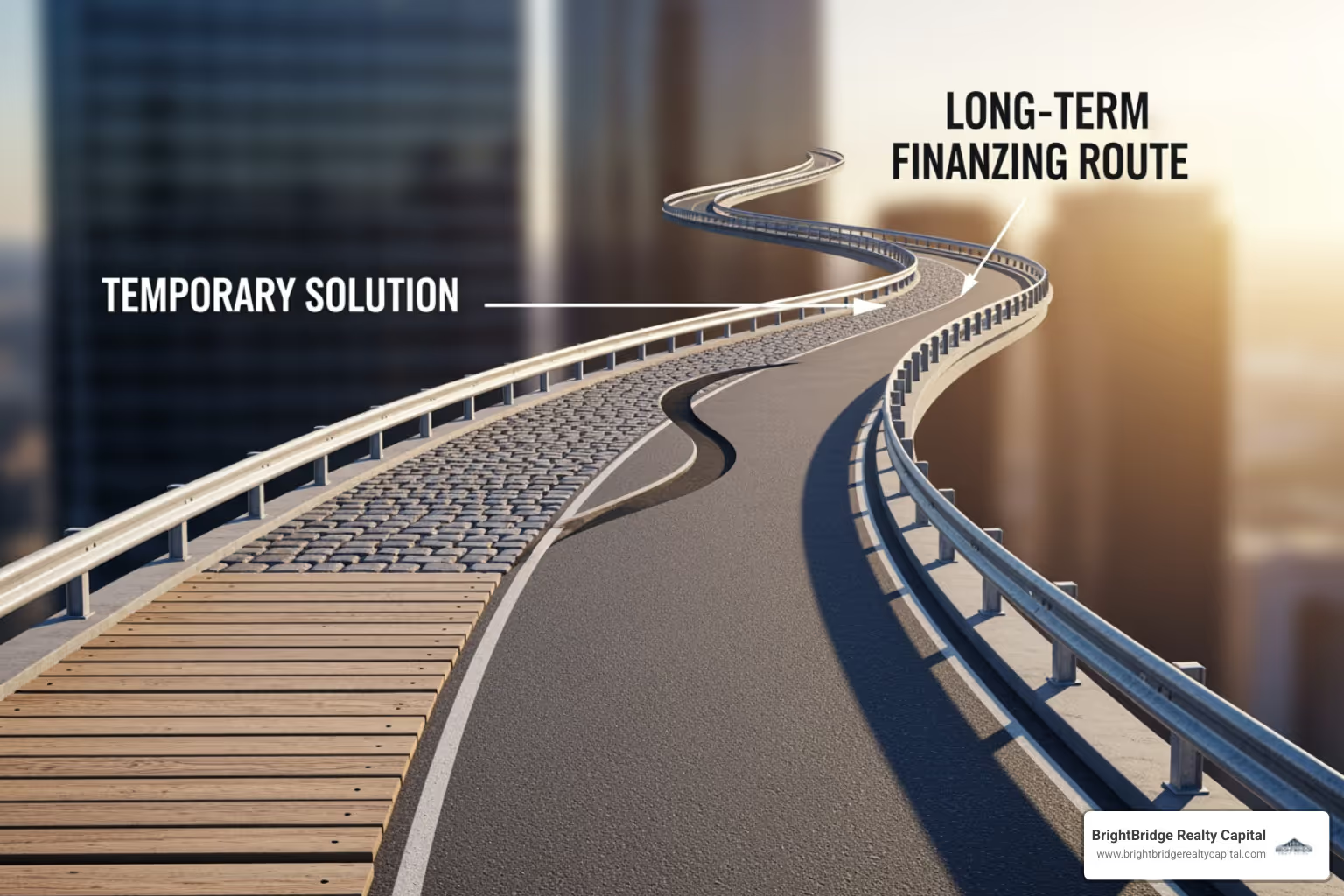

Summary
Need to refinance bridge loan? Explore options, avoid risks & secure long-term success with our expert guide.
Understanding Bridge Loan Refinancing: When Short-Term Becomes More Complex
A refinance bridge loan replaces an existing short-term bridge loan with new financing when your original exit strategy is delayed. It's a crucial tool for real estate investors facing unexpected project extensions or market shifts.
Quick Answer: Your Refinance Bridge Loan Options
- Re-bridging: Take out a new bridge loan to pay off the existing one, requiring a credible new exit plan.
- Longer-term bridge loan: Convert to extended financing with terms up to 2-5 years for stabilized properties.
- Developer exit finance: Specialized financing for completed developments needing more time to sell.
- Traditional mortgage: Refinance to a permanent loan if the property meets all lender criteria.
Key Requirements:
- Minimum 20% home equity
- Debt-to-Income ratio below 50%
- Credit score of 700+ (typically)
- Clear exit strategy for repayment
Bridge loans are designed for short terms (3-12 months), but real estate projects don't always stick to the schedule. Development delays, slow property sales, or renovation overruns are common reasons to refinance. This isn't a sign of failure but a normal part of real estate investing.
The key to a successful refinance is preparation. Starting the conversation 2-3 months before your loan expires provides leverage to secure better terms and avoid a costly default.
I'm Daniel Lopez, a loan officer at BrightBridge Realty Capital. I specialize in helping investors steer refinance bridge loan scenarios to keep their projects on track. My focus is on creative financing that accommodates project challenges while keeping clients informed.
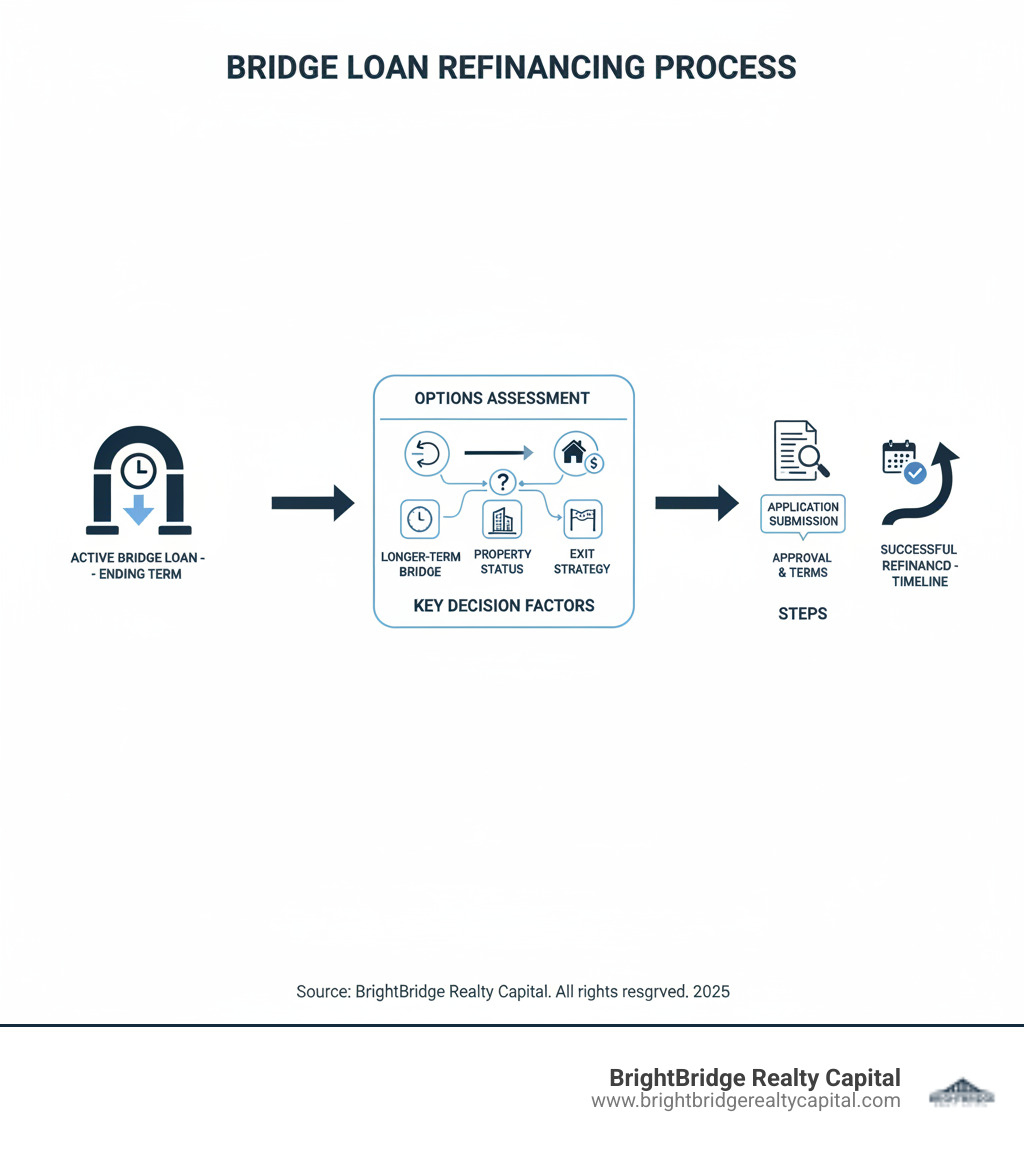
Simple guide to refinance bridge loan:
Introduction: What is a Bridge Loan?
Before discussing a refinance bridge loan, let's define a bridge loan. It's a short-term financing tool designed to "bridge" a financial gap, such as the time between buying a new property and selling an existing one. Also known as "swing loans" or "gap financing," they provide immediate capital to seize time-sensitive real estate opportunities.
For investors and homeowners in competitive markets like New York City, bridge loans are invaluable. They allow you to make non-contingent offers and act decisively by open uping the equity in your current property. The loan is secured by this equity, and repayment is typically made in a lump sum (balloon payment) when the original property sells or long-term financing is secured.
Bridge loans differ significantly from traditional mortgages:
- Loan Term: Bridge loans are short-term, usually 3-12 months (though some extend to 5 years), while traditional mortgages are long-term (10-30 years).
- Interest Rates: Due to their short-term nature, bridge loans have higher interest rates, typically 6% to 12% for residential and 9.99% to 13.99% for investment properties.
- Approval Speed: Bridge loans are fast. While a mortgage can take 30-45 days, a bridge loan can close in as few as 3-5 business days, allowing investors to compete with cash buyers.
- Payment Options: Unlike the standard principal and interest payments of a mortgage, bridge loans often feature flexible options like interest-only or deferred payments.
- Use Cases: Mortgages are for long-term ownership. Bridge loans are for transitional periods, like funding a fix-and-flip project or acquiring a property before permanent financing is in place.
Why You Might Need to Refinance a Bridge Loan

Even the best-laid real estate plans can go awry. A bridge loan is temporary, but what happens when your project takes longer than expected? This is when a refinance bridge loan becomes essential. Needing to refinance is not a sign of poor planning; it's a common reality in real estate, where timelines can stretch due to market shifts or project surprises.
Primary Reasons to Refinance a Bridge Loan
Common reasons for considering a refinance bridge loan include:
- Development Overruns: Construction projects, especially in markets like New York City, often face delays from material shortages, labor challenges, or permitting issues that extend them beyond the loan's term.
- Slow Property Sales: An unexpected market cooldown can mean it takes longer to find the right buyer at the right price. Refinancing avoids a rushed, discounted sale.
- Unforeseen Renovation Costs: Finding hidden structural, plumbing, or electrical issues can add significant time and cost to a project. A refinance can provide additional funds and extend the timeline.
- Favorable Market Changes: Sometimes, refinancing is an offensive move to secure better long-term rates or more favorable terms as your property's value increases.
- Avoiding Default: The most critical reason is to avoid default as a loan's maturity date approaches. Starting the refinance process 2-3 months early is key to securing new terms and preventing severe consequences.
The Risks of Not Refinancing in Time
Failing to repay or refinance a bridge loan on time carries severe penalties that can jeopardize your financial future and your investment.
- Default Interest Rates: Lenders impose substantially higher interest rates once a loan is in default. This default rate is often the original rate plus a significant penalty margin (e.g., 5% or more), applied to the entire outstanding balance. For a $1 million loan at 10%, a default could spike the rate to 15% or higher, dramatically increasing your carrying costs and eroding your equity with every passing day.
- Penalty Fees: On top of default interest, the loan agreement will specify a range of fees, including late fees, extension fees (if an extension was requested and denied), and other administrative charges that can add thousands to your debt.
- Credit Score Damage: A default is a major derogatory event that will seriously damage your credit score for up to seven years. This makes it significantly more difficult and expensive to secure any future financing—from mortgages and car loans to business credit lines—hindering your ability to invest for years to come.
- Forced Sale of Property: The worst-case scenario is foreclosure. Once in default, the lender can initiate legal proceedings to seize the property. This typically involves a notice of default, followed by a public auction. The lender's primary goal is to recoup their loan amount, not to achieve the highest market price for you. This often results in a sale far below market value, leading to the complete loss of your asset, your initial investment, and any equity you've built.
Understanding Your Options to Refinance a Bridge Loan
When your original exit plan is delayed, several refinance bridge loan options can extend your timeline and protect your investment. The right choice depends on your property's status—whether it's still under renovation, awaiting sale, or stabilized and generating income.

| Factor | Re-Bridging (Another Bridge Loan) | Refinancing to a Term Mortgage / Longer-Term Bridge Loan |
|---|---|---|
| Term Length | Typically 3-18 months, extending the short-term window | 10-30 years for traditional mortgage; 2-5 years for longer-term bridge for investment properties |
| Interest Rate | Often similar to or slightly higher than initial bridge loan | Generally lower than bridge loans, especially for traditional mortgages |
| Ideal Use Case | Need more time for sale/renovation; original exit strategy delayed but still viable | Property is stabilized/rent-ready/habitable; ready for permanent financing or longer-term hold |
| Property Status | Still in transition, undergoing work, or awaiting sale | Completed renovations, tenanted, or ready for long-term ownership |
| Exit Strategy | New, credible plan to complete sale/project within extended bridge term | Long-term hold, rental income, or eventual sale after extended period |
| Approval Speed | Can be relatively fast (10-14 working days for re-bridging) | Slower than bridge loans, more extensive underwriting |
For additional perspective, see How to refinance a bridging loan: Options and pitfalls.
Option 1: Re-Bridging (Another Bridge Loan)
Re-bridging means taking out a new bridge loan to pay off the expiring one. This is the best option when your original plan is still viable but delayed—for instance, if a property sale fell through or renovations need a few more months. It provides an extended timeline (typically 3-12 months) to complete your project. Lenders will require a credible new exit plan with a revised timeline and clear repayment strategy. The process is relatively fast, often closing within 10-14 working days.
Option 2: Refinancing into a Longer-Term Bridge Loan
If you need more than a few months, a longer-term bridge loan may be appropriate. These loans, with terms from 2 to 5 years, are ideal for investment properties that are now stabilized (renovated, occupied, and/or generating income) but may not yet qualify for traditional permanent financing. For multifamily investors in New York, options like Bridge-to-Agency loans help season a property to qualify for the best long-term rates. The key is demonstrating the property is past the heavy construction phase and is now a stable, income-producing asset.
The Step-by-Step Process to Refinance a Bridge Loan
Navigating a refinance bridge loan is straightforward with a clear process:
- Assess Your Situation: Honestly evaluate why you need to refinance (e.g., construction delays, slow market) to choose the right option and build a strong case for lenders.
- Gather Documentation: Be prepared to present a comprehensive package. This includes your original loan agreement, an updated property appraisal, recent personal and business bank statements, and a revised project timeline and budget. For investment properties, you will also need current rent rolls, copies of leases, and your business entity documents (like an LLC operating agreement).
- Find the Right Lender: Partner with an experienced lender like BrightBridge Realty Capital that understands your market and can offer customized solutions. A lender specializing in bridge financing will grasp the nuances of your situation better than a traditional bank.
- Apply and Undergo Underwriting: Complete the application. The lender will review the property's current value, your financial standing, and, most importantly, the viability of your new exit strategy. For investment loans, underwriting focuses heavily on the asset's value and business plan. Be prepared to explain the story behind the delay and provide evidence that the original obstacles have been addressed.
- Close the Loan: Upon approval, the new loan pays off the existing one, giving you the time and flexibility needed. With an efficient lender, closing can happen in as little as a week, providing a swift resolution to a time-sensitive problem.
Starting this process 2-3 months before your loan expires is crucial for a smooth, strategic transition.
Key Terms, Requirements, and Considerations
Understanding the financial details of a refinance bridge loan is crucial. While costs are higher than traditional financing, the flexibility gained can prevent a forced sale at a loss.

Typical terms include:
- Interest Rates: 6% to 12% for residential, and 9.99% to 13.99% for investment properties.
- Origination Fees: 1% to 3% of the loan amount to cover processing and underwriting.
- Loan Duration: 3 to 18 months for a re-bridge, or 2 to 5 years for a longer-term bridge loan.
- Balloon Payment: The full principal is due in a lump sum at the end of the term.
Eligibility Requirements for Refinancing
Lenders look for a solid financial foundation. Key criteria include:
- Home Equity: A minimum of 20% equity in the property is typically required. This translates to a maximum Loan-to-Value (LTV) ratio of 80%. A lower LTV makes you a stronger candidate.
- Debt-to-Income (DTI) Ratio: For residential properties, lenders prefer a DTI below 50%. However, for investment properties, many lenders focus more on the property's income potential using the Debt Service Coverage Ratio (DSCR). DSCR is the ratio of the property's Net Operating Income to its total debt payments. A DSCR above 1.25x is often required, proving the property can sustain itself.
- Credit Score: According to Experian, the minimum credit score for a bridge loan is 700, as this indicates a history of responsible borrowing. Some lenders may consider lower scores if there are strong compensating factors, such as significant cash reserves, extensive real estate experience, or a very low LTV.
- Property Appraisal: A current appraisal is mandatory to establish the property's fair market value and confirm the LTV ratio for the new loan.
Potential Benefits of a Successful Refinance
A well-executed refinance bridge loan offers significant advantages:
- Avoids Default: Sidesteps catastrophic outcomes like penalty rates, credit damage, and foreclosure.
- Provides Time: Gives you the breathing room needed to complete a project or wait for better market conditions without pressure.
- Improves Cash Flow: Longer-term options may offer interest-only payments, easing monthly financial strain.
- Access to Capital: Some refinance structures allow you to borrow additional funds for value-add improvements.
- Peace of Mind: Allows you to focus on executing your strategy instead of worrying about a looming deadline.
Risks and Pitfalls to Avoid
Be aware of the potential downsides:
- Higher Interest Costs: You are extending a period of higher-cost borrowing, so ensure the benefit outweighs the expense.
- Compounding Fees: Refinancing means paying origination fees a second time, which should be factored into your budget.
- Wrong Refinance Option: Choosing a term that is too short can put you in the same position again in a few months.
- No Solid Exit Strategy: Lenders will not approve a refinance without a credible, detailed plan for repayment. "Hope" is not a strategy.
Alternatives to Refinancing Your Bridge Loan

While a refinance bridge loan is often the best solution, simpler alternatives may exist for minor delays.
Note: The following alternatives are included for informational purposes only and may not be offered by BrightBridge Realty Capital.
When to Choose an Alternative
An alternative might work if you only need a brief extension.
- Loan Modification/Extension: If you only need a few extra weeks, ask your current lender for an extension. This can be faster and cheaper than a full refinance, though it will likely come with an extension fee.
- Sale-Leaseback: In rare cases, you can sell the property to an investor and lease it back. This provides immediate cash but means you lose ownership and future equity. It's a complex transaction with significant downsides.
When Refinancing is the Better Choice
In most cases, a proper refinance bridge loan is the superior strategic choice.
- Significant Time is Needed: If you need several months or more, refinancing provides a structured timeline that is less stressful and often cheaper than stringing together short-term extensions.
- The Original Plan is No Longer Viable: When major project changes or market shifts require a new strategy, a refinance provides the time and flexibility to pivot correctly.
- Default is Imminent: If your loan is maturing and you cannot repay it, refinancing is necessary to protect your credit, avoid massive fees, and prevent foreclosure.
Starting the refinance conversation early with a partner like BrightBridge Realty Capital ensures you have the leverage to secure the best solution for your revised timeline.
Frequently Asked Questions about Bridge Loan Refinancing
Here are answers to common questions we receive from New York investors about refinance bridge loan options.
Can you pay off a bridge loan early?
Yes. Most bridge loans, including those from BrightBridge Realty Capital, do not have prepayment penalties. This flexibility is a key feature. Paying the loan off as soon as your property sells or you secure permanent financing is encouraged, as it saves you money on interest payments. Always confirm this by checking your loan agreement for any prepayment penalty clauses.
How long does it take to refinance a bridge loan?
A refinance bridge loan typically takes about 10-14 working days to close. The process is faster if you are organized with your documentation (appraisal, financials, new exit plan). Working with a direct lender who understands your situation, especially your original lender, can also expedite the timeline. We recommend starting the process 2-3 months before your current loan expires.
What is the difference between a refinance and an extension?
An extension is a modification of your existing loan agreement with your current lender, usually granting a short-term delay (e.g., 1-3 months) in exchange for a fee. A refinance, on the other hand, is a completely new loan that pays off and replaces the original one. Refinancing allows you to change lenders, adjust the loan amount, and secure a much longer term, offering a more comprehensive solution for significant delays.
Can I get a cash-out refinance on a bridge loan?
Yes, this is a common strategy for value-add projects. If your renovations have significantly increased the property's value, a new appraisal can confirm this higher value. A cash-out refinance allows you to borrow against this new equity, providing capital to finish the project, cover unexpected costs, or even fund your next investment. Lenders will typically cap the loan-to-value (LTV) for a cash-out refinance, often around 65-75% of the new appraised value.
What happens if I can't refinance my bridge loan?
If you cannot repay or refinance your bridge loan by its maturity date, it goes into default. The consequences are severe:
- Financial Penalties: Your interest rate will increase significantly, and you will be charged substantial penalty fees.
- Credit Damage: A default will severely harm your credit score, making future borrowing difficult and expensive.
- Foreclosure: The lender has the right to foreclose and force the sale of the property to recover their funds, potentially wiping out your equity and investment.
Proactive communication is key. Contact your lender as soon as you anticipate a delay to explore your options.
Conclusion: Securing Your Long-Term Success
Real estate investing in a dynamic market like New York City is rarely predictable. Project delays and market shifts are common challenges, not failures. Understanding your refinance bridge loan options is a key part of a successful investment strategy.
When your project's timeline changes, refinancing is a strategic tool to protect your investment. Whether you need to re-bridge for a few more months or transition to a longer-term loan for a stabilized property, the right solution provides the time needed to execute your plan properly. The key is timing and partnership—starting the conversation with your lender 2-3 months before your loan matures transforms a potential crisis into a manageable transition.
At BrightBridge Realty Capital, we specialize in providing the speed and flexibility that real estate investors need. As direct lenders, we close quickly, but more importantly, we partner with you to craft custom financing solutions. When you need a refinance bridge loan, we work to protect your investment and ensure your long-term success.
Your projects deserve financing that adapts to your needs. If you're facing an unexpected delay or need more time to maximize your property's value, we're here to help you bridge the gap with confidence.
Ready to explore a customized financing solution for your New York property? Find the right stabilized bridge loan for your investment strategy and find the benefits of working with a true lending partner.