Construction Bridge Loans: The Short-Term Solution for Long-Term Success


Summary
Accelerate your projects! Discover how Construction bridge financing provides fast, flexible capital for long-term success.
Why Construction Bridge Financing Matters in Today's Real Estate Market

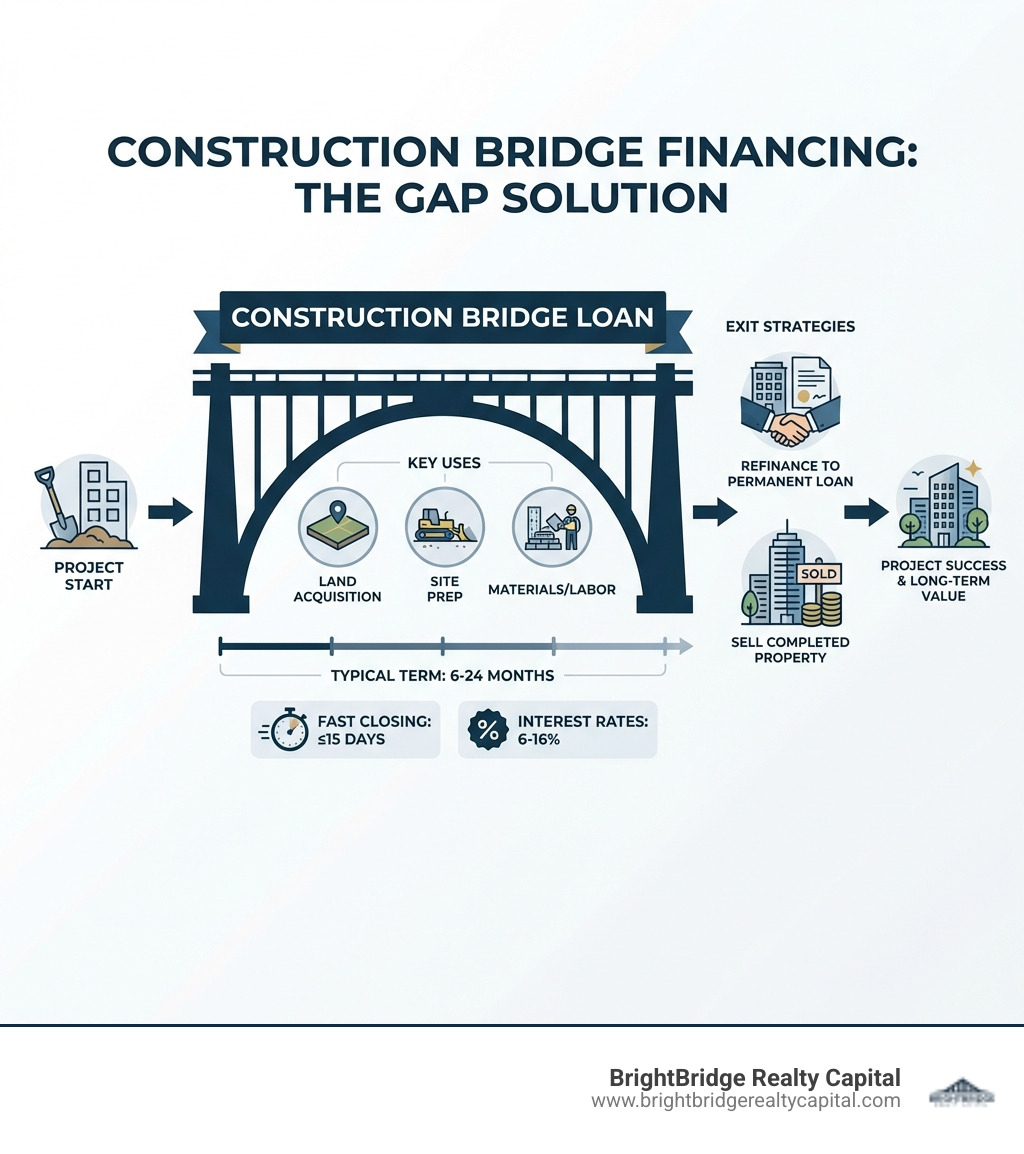
In the high-stakes world of real estate development, momentum is everything. Construction bridge financing has emerged as an essential financial instrument, acting as a short-term loan specifically engineered to inject immediate capital into projects when conventional financing timelines create costly delays. These loans, which typically mature in 6 to 24 months, empower developers and investors to secure funding with remarkable speed—often closing in as little as 15 days—thereby bridging the critical financial gap while they arrange for permanent financing or position the completed project for a profitable sale.
Quick Definition:
- What it is: A specialized, short-term loan that "bridges" the financial void between the start of a construction project and the securing of long-term financing or the sale of the property.
- Typical duration: 6 to 24 months, often with options for extension.
- Interest rates: Generally range from 6% to 16%, reflecting the speed and flexibility offered.
- Key advantage: Unparalleled speed, with closing times as fast as 15 days, compared to the months-long process of traditional banks.
- Primary use: Covering urgent, upfront costs such as land acquisition, entitlement and permitting fees, site preparation, initial material purchases, and labor mobilization before a traditional construction loan's draw schedule begins.
In today's volatile market, characterized by supply chain disruptions, fluctuating material costs, and intense competition for prime land, delays are not just inconvenient—they are financially crippling. Holding costs accumulate, market windows close, and contractor availability evaporates. As one industry expert aptly stated, "Delays cost money in construction," and bridge loans are the strategic antidote to these costly pauses. When a traditional lender's draw schedule leaves a cash flow chasm between construction phases, or when a time-sensitive acquisition opportunity arises, bridge financing ensures the project continues to advance without interruption.
Consider a developer who identifies an off-market parcel of land perfect for a multifamily development. The seller requires a 21-day close. A traditional bank would need 60-90 days for underwriting, making the deal impossible. A construction bridge loan provides the capital to acquire the land swiftly. The developer can then use the subsequent months to finalize architectural plans, secure permits, and arrange for a traditional, lower-cost construction loan to take out the bridge loan and fund the vertical build. Without the bridge loan, the opportunity would have been lost.
These loans operate on a fundamentally different philosophy than traditional construction financing. Instead of a bureaucratic, multi-committee approval process that can take months, bridge lenders focus on the intrinsic value of the real estate collateral and the project's economic viability. The underwriting is asset-centric. Payments are typically structured as interest-only during the loan term, preserving the developer's cash for construction costs. The principal is then repaid in a lump sum when the project is either refinanced with permanent debt or sold.
I'm Daniel Lopez, a senior loan officer at BrightBridge Realty Capital. Over the years, I've specialized in structuring bespoke construction bridge financing solutions for a diverse range of clients, from seasoned developers building large-scale commercial projects to investors tackling complex renovation and repositioning efforts. My expertise lies in navigating tight timelines, competitive market dynamics, and unique project requirements. My focus is on demystifying complex financing structures, providing clear and actionable guidance so you can make confident, strategic decisions that keep your projects on schedule and on budget.
Explore more about Construction bridge financing:
Understanding Construction Bridge Loans vs. Traditional Financing
When navigating the complexities of funding a new construction project, developers are presented with a spectrum of financing options. While traditional construction loans from banks are a well-trodden path, a more agile and powerful alternative, construction bridge financing, is rapidly gaining prominence. Also known as interim financing or swing loans, these solutions are purpose-built to deliver capital with exceptional speed when timing is the most critical variable. Both traditional and bridge loans serve the ultimate goal of funding construction, but their methodologies, approval speeds, flexibility, and core philosophies diverge significantly. A deep understanding of these distinctions is crucial for selecting the right financial tool for your project.
For a foundational overview of the bridge loan concept, Investopedia provides an excellent resource: What Is a Bridge Loan and How Does It Work, With Example.
Here’s a detailed comparison of Construction Bridge Loans and Traditional Construction Loans:
| Feature | Construction Bridge Loans | Traditional Construction Loans |
|---|---|---|
| Speed & Closing | Extremely fast; private lenders can close in 15-30 days. | Slow; bank underwriting and approval takes 60-120 days or more. |
| Lender Type | Typically private lenders, debt funds, and specialized non-bank institutions. | Primarily commercial banks, credit unions, and institutional lenders. |
| Loan Term | Short-term; 6-24 months, with pre-negotiated extension options. | Longer short-term; often aligns with the construction period (18-36 months). |
| Interest Rates | Higher, ranging from 6% to 16%; often floating rates tied to a benchmark like SOFR. | Lower, but still higher than permanent loans; typically variable rates. |
| Approval Criteria | Asset-focused: strong emphasis on collateral value, project pro forma, developer experience, and a clear exit strategy. | Borrower-focused: requires strong personal credit (680+ FICO), extensive financial history, low debt-to-income ratio, and significant liquidity. |
| Flexibility | Highly flexible and customizable terms; can fund non-traditional costs (e.g., entitlements); often no prepayment penalties. | Rigid and standardized; funds are released on a strict draw schedule; less adaptable to project changes. |
| Collateral | Primarily secured by the real estate asset; lenders may cross-collateralize with other properties for higher leverage. | Secured by the property, with strict Loan-to-Cost (LTC) and Loan-to-Value (LTV) limits. |
| Recourse | Often non-recourse with standard "bad boy" carve-outs, protecting the borrower's personal assets. | Almost always full recourse, requiring personal guarantees from the developer/sponsor. |
| Use of Funds | Can be used for a wide range of purposes, including land acquisition, closing costs, and soft costs, before major construction begins. | Strictly for hard and soft construction costs, disbursed according to a pre-approved budget and inspection schedule. |
What is a Construction Bridge Loan?
At its essence, a construction bridge loan is a tactical, short-term financial solution designed to provide immediate liquidity. It acts as a temporary financial "bridge," carrying a project over a funding gap until a more permanent or long-term financing solution—the "take-out"—is secured, or the property is sold. This makes it the ideal tool when a developer needs to act with urgency. Scenarios include acquiring a prime piece of land before a competitor, funding pre-construction activities like demolition and site work, or simply maintaining project momentum between the distinct phases of a complex build.
These loans are defined by their short duration, typically 6 to 24 months. Their primary function is to satisfy immediate capital needs, covering a wide array of expenses from land acquisition and permits to initial material orders and labor costs. A key differentiator is their asset-focused underwriting. Unlike traditional banks, which heavily scrutinize a borrower's personal credit history and tax returns, bridge lenders are more concerned with the economic viability of the project and the underlying value of the collateral—the property itself. The repayment is structured around a single event: the closing of a permanent loan (the take-out) or the sale of the asset, at which point the bridge loan principal and accrued interest are paid off in full.
Key Differences from Traditional Construction Loans
While both loan types facilitate construction, their operational mechanics and strategic applications are worlds apart:
Speed and Approval Process: The most significant advantage of bridge financing is speed. Traditional commercial construction loans from banks are notoriously slow, involving a labyrinthine approval process that can stretch for several months. This delay can be fatal for time-sensitive opportunities. Construction bridge financing, offered by more nimble direct lenders, is built for speed. We can analyze a deal, issue a term sheet, and close a loan in as little as 15 days, enabling developers to seize opportunities and execute their vision without delay.
Draw Schedules and Cash Flow Management: Traditional construction loans operate on a rigid draw system. Funds are disbursed in stages only after specific construction milestones are completed and verified by an inspector. This can create cash flow bottlenecks, as developers must often pay for labor and materials out-of-pocket and then wait for reimbursement. Bridge loans are far more flexible. They can provide a lump sum upfront or a more adaptable draw schedule to cover these interim periods, ensuring contractors are paid on time and the project never loses momentum.
Interest-Only Payments and Capital Preservation: Both loan types commonly feature interest-only payments during the construction phase. This structure is particularly beneficial as it minimizes the monthly debt service, allowing the developer to preserve precious capital for the high-burn rate of active construction. The principal is not amortized but is due as a balloon payment at maturity.
Leverage and Equity Requirements (LTC/LTV): Traditional banks are conservative, typically capping their Loan-to-Cost (LTC) ratio at 75-80%. This means the developer must contribute at least 20-25% of the total project cost in cash equity. Bridge lenders are often more aggressive, willing to offer higher leverage, sometimes up to 85% LTC or even higher by using the projected "as-completed" value. This higher leverage can significantly reduce the developer's upfront cash requirement, allowing them to spread their capital across multiple projects.
Recourse vs. Non-Recourse Structures: The majority of traditional construction loans are full recourse. If the project fails and the sale of the property doesn't cover the debt, the lender can pursue the developer's personal assets. This presents a significant risk to the sponsor. In contrast, many construction bridge financing options are structured as non-recourse or limited-recourse debt. This means the lender's claim is limited to the collateral (the property) itself. These loans include standard "bad boy carve-outs," which protect the lender from borrower fraud, environmental contamination, or other specified acts of misconduct, but they offer a crucial layer of protection for the developer's personal wealth.
Key Benefits and Strategic Uses

In the fast-paced arena of real estate development, timing isn't just a factor; it's the currency of success. Our construction bridge financing solutions are meticulously designed to provide a decisive strategic advantage, enabling developers to seize fleeting opportunities, master their cash flow, and sustain critical project momentum. Let's delve into the profound benefits and the most common tactical applications of this powerful financial tool.
The Primary Benefits for Developers
For savvy developers, the advantages of deploying construction bridge financing are not just marginal—they are transformative:
Immediate Access to Capital for Time-Sensitive Deals: Imagine an off-market opportunity arises for a perfectly located parcel of land, but the seller demands a 20-day closing. Traditional bank financing, with its 60-90 day underwriting period, is a non-starter. A bridge loan provides the immediate capital to secure the asset, ensuring you don't lose a prime deal to a more liquid competitor. This speed-to-close capability is arguably the single most important benefit.
Enhanced Flexibility in Project Planning and Entitlement: Bridge loans offer highly customizable terms tailored to a project's specific lifecycle. This is invaluable for value-add projects. For example, a developer can acquire a warehouse with a bridge loan and use the loan term to navigate a complex and lengthy rezoning and entitlement process to convert the site for multifamily use. A traditional lender would be unlikely to fund a project without entitlements already in place.
Streamlined and Asset-Focused Qualification: The qualification process for traditional loans can be an arduous, document-intensive ordeal focused on the borrower's personal financial history. Bridge lenders, by contrast, employ a more streamlined, asset-focused approach. They prioritize the project's economic potential, the value of the real estate collateral, and the credibility of the developer's exit strategy. For experienced developers with a solid plan but perhaps less-than-perfect personal financials, this is a game-changer.
Solving Complex Timing and Cash Flow Gaps: Real estate development is rarely linear. A developer might need to close on a new construction project before an existing property has sold. A bridge loan can cover the down payment, preventing the developer from being caught in a liquidity crunch. It effectively "bridges the gap" between closings, ensuring continuity and preventing the collapse of a deal chain.
Gaining a Competitive Edge in a Fierce Market: In today's dynamic real estate landscape, the ability to act with certainty and speed is a formidable competitive weapon. Construction bridge financing empowers developers to make all-cash-equivalent offers, acquire land rapidly, and commence construction ahead of competitors who are encumbered by the slow pace of traditional financing. This agility allows them to lock in contractors and material pricing sooner, mitigating risks associated with market volatility.
Common Uses for Construction Bridge Financing
Our clients strategically leverage construction bridge financing across a wide spectrum of scenarios to ensure their projects remain on schedule and profitable:
Land Acquisition and Banking: This is the classic use case. A developer can quickly purchase a raw or under-utilized parcel of land, even without immediate construction plans. The bridge loan allows them to "bank" the land, holding it while they work on design, entitlements, and securing a take-out construction loan.
Funding Pre-Construction and Site Preparation Costs: A traditional construction loan won't release funds until permits are pulled and construction is ready to begin. However, significant costs are incurred before this stage. A bridge loan can fund essential early-stage work like environmental remediation, demolition of existing structures, soil testing, grading, and installation of utilities, allowing the project to be "shovel-ready" when the main loan closes.
Covering Initial Material Deposits and Labor Mobilization: To lock in pricing and secure high-demand subcontractors, developers often need to make substantial upfront payments. A bridge loan provides the necessary capital to kickstart construction, ensuring long-lead-time materials are ordered and labor is on-site and paid during the crucial initial phases of a project, before the first draw from a traditional loan is available.
Heavy Renovation and Repositioning Projects: For projects involving a gut renovation or a change of use (e.g., converting an old office building into apartments), a bridge loan is ideal. It provides the capital to acquire the property and fund the heavy construction required to reposition the asset for a quick sale or refinance based on its higher, post-renovation value.
Filling Gaps in Draw Schedules: Even on a project funded by a traditional construction loan, unexpected cash flow gaps can emerge between draw requests and disbursements. A smaller bridge loan can be used as a supplemental source of working capital to maintain project velocity, pay subcontractors promptly, and avoid costly stop-work orders and delays.
The Nuts and Bolts of Construction Bridge Financing

To effectively leverage construction bridge financing, a developer must understand its mechanics—from the initial application to the final repayment. It’s not merely about accessing capital; it’s about comprehending the lender's perspective, the structure of the deal, and the critical path to a successful exit. Our objective is to demystify this process, providing a transparent, step-by-step guide so you know precisely what to expect when partnering with a direct bridge lender.
The Application and Approval Process
We have engineered our process for maximum efficiency, recognizing that our clients' most valuable asset is time. Here’s how it typically unfolds:
- Initial Consultation and Project Vetting: The journey begins with a detailed conversation. We want to understand your vision, project scope, construction timeline, budget, and specific funding requirements. Our team of seasoned professionals will ask targeted questions to quickly assess the project's viability and alignment with our lending criteria.
- Submission of a Streamlined Document Package: We guide you in compiling a concise package of essential documents. While less burdensome than a bank's requirements, this will generally include: an executive summary, detailed construction budget (sources and uses), project pro forma (including lease-up or sales projections), architectural plans, sponsor's real estate resume (track record), and entity documents. The goal is to provide a clear picture of the project and the team behind it.
- Rapid Underwriting and Due Diligence: This is where we diverge sharply from traditional lenders. Our underwriting team focuses on the asset and the deal's economics. We conduct a thorough evaluation of the project’s feasibility, market analysis, and the collateral's current and projected future value (the "as-completed" or "as-stabilized" value). We look beyond historical credit scores to focus on the project's inherent strengths and the sponsor's ability to execute.
- Credit and Background Review: While our underwriting is asset-focused, we do perform a credit and background check. This is not to disqualify based on a FICO score, but to ensure financial responsibility and identify any major red flags like past bankruptcies, foreclosures, or litigation that could jeopardize the project.
- Term Sheet, Commitment, and Fast Closing: Thanks to our streamlined process, we can often provide initial feedback and a detailed term sheet within 24-48 hours. Once the term sheet is executed, we move swiftly through final due diligence (appraisal, environmental, title) to close the loan, often in as little as 15 to 30 days.
Eligibility Criteria: What Lenders Look For
When we evaluate a construction bridge financing application, we are essentially partnering with the developer. Our assessment is based on these key pillars:
- Developer Experience and Track Record: Your expertise is paramount. We look for a demonstrated history of successfully completing similar projects on time and within budget. A strong track record provides confidence in your ability to execute the business plan.
- Project Feasibility and Realistic Economics: The numbers must make sense. We scrutinize the construction budget for completeness and accuracy, and we stress-test the pro forma assumptions (e.g., sales prices, lease rates, absorption pace) against market realities. A well-conceived project with a detailed, credible business plan is essential.
- Value of Collateral and Protective Equity (LTV/LTC): As asset-based lenders, the property is our primary security. We assess the Loan-to-Value (LTV) and Loan-to-Cost (LTC) ratios to ensure there is sufficient protective equity in the deal. We often lend up to 85% of the total project cost, but this depends on the project type, location, and sponsor strength.
- A Clear and Credible Exit Strategy: This is non-negotiable. A bridge loan is temporary by definition, so you must have a well-defined and viable plan for repayment. This could be refinancing with a permanent loan from a pre-identified lender or the sale of the completed property. We need to see a clear path to a successful exit before we fund the loan.
- Sponsor Liquidity and Financial Capacity: We need to know you have the financial capacity to handle the unexpected. We assess your net worth and, more importantly, your liquidity (cash on hand) to ensure you can cover interest payments, potential cost overruns, and other contingencies that may arise during the project.
Typical Loan Terms, Rates, and Fees
Our construction bridge financing products are designed for flexibility and competitiveness:
- Loan Terms: Terms are short, typically ranging from 6 to 24 months. We structure the term to align with your project's specific timeline, and we can often build in extension options (e.g., two 6-month extensions) for added flexibility.
- Interest Rates: Rates for bridge loans generally fall between 6% and 16%. They are often floating rates, calculated as a spread over a benchmark index like the SOFR (Secured Overnight Financing Rate). The rate reflects the risk profile of the loan, the speed of execution, and the short-term nature of the financing.
- Fees: Fees are standard in the private lending industry and are clearly disclosed upfront:
- Origination Fees: A one-time fee for structuring and underwriting the loan, typically 1.00% to 2.00% of the loan amount, paid at closing.
- Exit Fees: A fee paid when the loan is repaid, often around 1.00%. This fee may sometimes be waived if you refinance with one of the lender's affiliated partners.
- Extension Fees: If you exercise an option to extend the loan term, a fee (e.g., 0.50% of the outstanding balance) typically applies.
- Third-Party Costs: Borrowers are responsible for third-party reports like the appraisal, environmental survey, and legal fees, which can often be rolled into the loan.
- Prepayment Flexibility: A significant advantage of our bridge loans is the flexibility regarding prepayment. Many of our loans have minimal or no prepayment penalties, allowing you to exit the loan early without extra cost as soon as your permanent financing is secured or the property is sold.
Crucial Exit Strategies for Repayment
A well-articulated exit strategy is the cornerstone of a successful construction bridge financing application. It demonstrates foresight and provides the lender with a clear roadmap for repayment:
- Refinancing with a Permanent Loan: This is the most common exit. Once construction is complete and the property is stabilized (i.e., leased up to a certain occupancy), you can refinance the high-interest bridge loan with a lower-rate, long-term permanent loan from a bank or agency lender (like Fannie Mae or Freddie Mac).
- Sale of the Completed Property: For developers building on a speculative basis or undertaking a fix-and-flip project, the exit strategy is the sale of the asset. The proceeds from the sale are used to repay the bridge loan, with the remainder representing the developer's profit.
- Recapitalization of the Partnership: In some cases, the exit may involve a recapitalization of the ownership structure. This could mean bringing in a new equity partner who buys out the developer's position and repays the bridge loan, allowing the new partner to hold the asset for the long term.
- Phased Payout from Investor Capital: For projects funded with a mix of debt and syndicated equity, the equity raise can be structured so that a final capital call from investors is timed to coincide with the maturity of the bridge loan, providing the funds for repayment.
Navigating Risks and Strategic Considerations
While construction bridge financing is a potent tool for accelerating growth, it is not without risk. A prudent developer approaches this form of leverage with a comprehensive understanding of its potential downsides and a keen awareness of how external market forces can impact a project's trajectory. Meticulous strategic planning, rigorous due diligence, and proactive risk mitigation are your most reliable allies.
Key Risks of Using Construction Bridge Financing
Every sophisticated financial instrument carries a unique risk profile. For construction bridge loans, developers must carefully consider the following:
Higher Interest Rates and Carrying Costs: The convenience of speed and flexibility comes at a price. Bridge loans carry higher interest rates (6-16%) than traditional financing. This increased cost of capital must be meticulously factored into your project's pro forma. Every day of delay translates into significant additional interest expense, which can erode profits.
- Mitigation Strategy: Build conservative timelines into your pro forma. Include a healthy contingency budget for both time and money. Model a "worst-case" scenario for interest carry to ensure the project remains profitable even with delays.
The Pressure of a Short Repayment Window: The short-term nature of a bridge loan (typically 6-24 months) creates a hard deadline. You have a finite window to complete construction, stabilize the property, and execute your exit strategy. Unforeseen delays—due to weather, permitting, or supply chain issues—can quickly compress this timeline, creating immense pressure to repay the loan.
- Mitigation Strategy: Negotiate extension options upfront. Before closing the bridge loan, begin conversations with potential take-out lenders to get a preliminary understanding of their terms and timeline. This ensures your exit path is warm before you even start.
The Peril of a Failed Exit Strategy: This is the most significant risk. What happens if your planned take-out financing is denied due to tightening credit markets? What if the property doesn't sell as quickly or for the price you projected? A failed exit can trigger a default, leading to costly extension fees, penalty interest, and potentially a forced, discounted sale of the asset or foreclosure.
- Mitigation Strategy: Develop both a primary and a secondary exit strategy. Your primary exit might be a refinance, but your secondary exit could be a sale. Constantly monitor market conditions and maintain relationships with a network of brokers and lenders.
The Burden of Dual Loan Payments: In scenarios where a bridge loan is used to acquire a new site before an old one is sold, you may find yourself temporarily servicing two loans simultaneously. This can place a significant strain on cash flow and requires careful financial management.
- Mitigation Strategy: Ensure you have sufficient liquidity reserves to cover multiple months of payments on both properties. Structure the bridge loan with an interest reserve, where a portion of the loan funds is set aside to cover the initial payments, easing the cash flow burden.
How Market Conditions Affect Bridge Loans
The success of a project funded by a bridge loan is inextricably linked to the broader economic and real estate landscape:
- The Interest Rate Environment: In a rising rate environment, the floating-rate nature of most bridge loans means your monthly payments will increase. Furthermore, rising rates can make your take-out financing more expensive and harder to obtain, potentially jeopardizing your exit.
- Real Estate Market Health and Liquidity: A strong, liquid real estate market with high sales velocity makes for an easy exit. Conversely, a cooling market with declining property values or a dislocated investment sales environment can make it incredibly difficult to sell or refinance, trapping you in a high-cost loan.
- Lender Appetite for Risk: During periods of economic uncertainty, all lenders, including bridge lenders, tend to tighten their credit standards. They may reduce leverage (requiring more equity from you), increase pricing, or simply pause lending on certain asset classes, making it harder to secure financing.
- Availability and Cost of Take-Out Financing: The viability of your exit strategy depends entirely on the availability of permanent financing. If traditional banks and agency lenders pull back, your ability to refinance the bridge loan disappears. This is a critical factor to monitor throughout the project lifecycle.
- Construction Costs and Supply Chain: Unprecedented volatility in material costs and labor shortages can lead to significant budget overruns and project delays. This directly impacts the project's profitability and can extend the time you are paying high-interest rates on the bridge loan.
The Contractor's Role and Perspective
While the developer is the borrower, the general contractor is a pivotal stakeholder whose performance is critical to the project's success and, by extension, its financial stability. From a contractor's perspective, understanding the project's financing is a crucial element of self-preservation.
- Conducting Due Diligence on the Owner: Experienced contractors should assess a developer's financial capacity with the same rigor as a lender. Before signing a contract, inquire about the funding sources. Is the project fully capitalized? Is there a reputable lender involved? This diligence can prevent getting stuck on a project that runs out of money.
- Understanding the Loan Agreement and Draw Process: Lenders often require contractors to sign an "Agreement to Complete" or a "Consent of Contractor." These documents subordinate the contractor's rights to the lender's in case of a developer default. It is vital for contractors to have these agreements reviewed by legal counsel to understand their obligations and risks. Furthermore, contractors must be familiar with the loan's specific requirements for payment applications and lien waivers to ensure a smooth and timely payment process.
- Maintaining Open Communication: A transparent relationship between the owner, lender, and contractor is the bedrock of a successful project. Regular meetings to discuss progress, budget, and potential issues can prevent misunderstandings and allow for proactive problem-solving.
- Red Flags for Contractors: Contractors should be vigilant for warning signs that a project's financing may be in jeopardy:
- An owner who is reluctant to provide proof of financing or details about the lender.
- Incomplete or constantly changing plans without approved change orders and funding allocation.
- A pattern of slow or delayed payments.
- An overly complex ownership or financing structure.
- An inexperienced developer leading a large, complex project.
- Unusual invoicing requests, such as billing for materials not yet on site.
- Any request for the contractor to provide upfront cash, invest in the project, or finance a portion of the work—a major red flag.
The contractor's on-the-ground insight is invaluable. By flagging issues early, they not only protect their own interests but also provide a crucial early warning system for both the developer and the lender, helping to keep the project on a stable financial footing.
Conclusion: A Strategic Tool for Modern Development
Construction bridge financing has firmly established itself as an indispensable tool in the modern real estate developer's arsenal. It offers a powerful, strategic pathway to navigate the timing challenges, capital gaps, and competitive pressures that traditional financing is often too slow or rigid to address. Throughout this discussion, we've explored how these short-term, flexible loans provide the immediate capital necessary to seize opportunities, bridge crucial financial voids between project phases, and maintain the vital momentum that underpins long-term success and profitability.
While these loans inherently come with higher interest rates and the pressure of a shorter repayment window, the strategic advantages frequently justify the cost. The unparalleled benefits of speed-to-close, a streamlined and asset-focused qualification process, higher leverage, and the ability to act with decisiveness in competitive markets are what empower developers to build their pipelines and outperform the competition. However, success is not automatic. It demands a comprehensive understanding of the application process, a realistic assessment of eligibility criteria, a clear-eyed view of the terms, and, most critically, a robust and well-vetted exit strategy.
Leveraging these powerful financial instruments effectively requires not just capital, but expertise. The nuances of structuring the loan, negotiating terms, and planning for a seamless exit are where a knowledgeable lending partner becomes invaluable. A great bridge lender acts as a strategic advisor, helping you anticipate challenges and structure a financing solution that aligns perfectly with your project's lifecycle.
At BrightBridge Realty Capital, we specialize in providing precisely these kinds of customized construction bridge financing solutions. Our deep expertise as direct private lenders allows us to offer the rapid execution—with closings often in as little as 15 days—and the creative, flexible structures that your unique real estate projects demand. We have successfully funded a wide array of projects, including ground-up multifamily developments, industrial redevelopments, and complex value-add renovations. We understand that in the world of construction, time is irrevocably money, and our core mission is to ensure your ventures move forward, unhindered by unnecessary financial delays.
Don't let financing gaps or slow institutional timelines derail your next project. Partner with us to secure the right capital at the right time, and build your vision with confidence.