Mastering Property Math: A Deep Dive into ARV and LTV
Summary
Unlock fix-and-flip profits! Learn to calculate after repair value (ARV) & LTV. Master comps, costs, and financing for smart investing.
Why After Repair Value Drives Smart Real Estate Decisions
After repair value (ARV) is the estimated market value of a property after all planned renovations and improvements are completed. For real estate investors, it's the single most important number when evaluating a fix-and-flip deal or rental property upgrade. It’s the financial North Star that guides every decision, from the initial offer to the final nail hammered into place. Without a firm grasp of ARV, an investor is flying blind, risking their capital on little more than a hunch.
Imagine two investors looking at the same distressed property. The first, relying on gut feeling, sees a low purchase price and assumes profit. The second, a seasoned professional, immediately begins calculating the ARV. This investor understands that the purchase price is only one part of a complex equation. The real question isn't "What does it cost?" but "What will it be worth?" This fundamental shift in perspective is what separates successful, repeatable real estate ventures from costly one-off mistakes.
Quick Answer: What is After Repair Value?
- Definition: The projected selling price of a property after all repairs and strategic renovations are complete, reflecting its full market potential, not its current distressed value.
- Formula: ARV = Current Property Value + Value Added by Renovations. This simple formula hinges on the complex task of accurately estimating the value created, not just the cost of the work.
- Primary Use: It is the cornerstone for determining the Maximum Allowable Offer (MAO) to ensure profitability and is a critical metric for securing acquisition and construction financing from lenders.
- Key Calculation: The most reliable method involves a detailed Comparative Market Analysis (CMA), comparing the subject property to recently sold, fully renovated properties ("comps") in the immediate vicinity.
- Critical for: Fix-and-flip investors who need to project a sale price, BRRRR method investors who rely on it for the cash-out refinance step, and any value-add investor seeking to force appreciation.
If you're looking at a dilapidated house that could be the perfect canvas for your next flip, how do you know if the numbers actually work? The answer lies in mastering ARV—and understanding exactly what that renovated property will be worth when you're done. Most investors lose money not because they can't renovate well, but because they overpay at purchase or over-invest in renovations. ARV gives you the guardrails. It establishes the market ceiling—the absolute most a buyer will pay for a finished product in that specific neighborhood. This, in turn, dictates the maximum you can afford to spend on the entire project, including acquisition and repairs, while still securing your desired profit.
But ARV isn't just about protecting your downside. Lenders use it too. When you apply for a fix-and-flip loan, your lender calculates Loan-to-Value (LTV) based on the after-repair value, not the purchase price. This is a game-changer. A strong, well-documented ARV demonstrates to the lender that the project is viable and that their investment is secured by a valuable asset. This can open up significantly more financing, often covering a large portion of both the purchase and renovation costs, and lead to more favorable terms.
As Daniel Lopez, a loan officer at BrightBridge Realty Capital, I've helped dozens of investors structure deals where accurate after repair value calculations made the difference between a funded project and a rejected application. I’ve seen firsthand how a meticulously prepared ARV analysis, complete with strong comps and a detailed scope of work, gives lenders the confidence to fund projects quickly. My role is ensuring investors understand both the math and the strategy behind ARV so they can confidently move forward on profitable deals that build wealth.
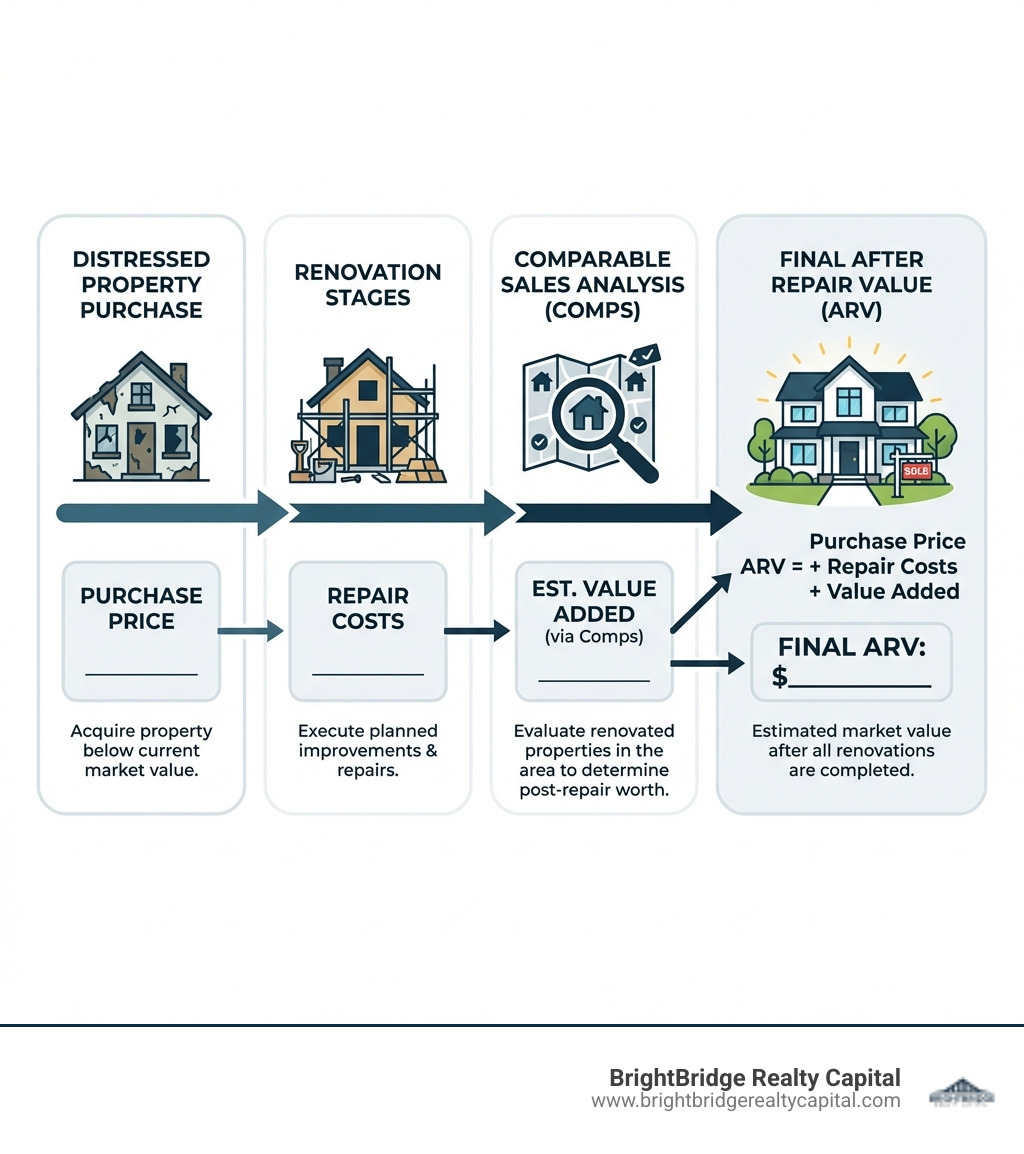
After repair value basics:
- fix and flip loan requirements
- how to get into flipping homes
- flip house loans
Decoding ARV: The Foundation of Your Investment Strategy
For any real estate investor, mastering the concept of after repair value is like having a crystal ball for your property investments. In a world of market fluctuations and unforeseen challenges, ARV provides a beacon of clarity. It's the cornerstone of a successful value-add strategy, allowing us to cut through the noise, accurately analyze potential deals, and project future returns with a high degree of confidence. Without a solid grasp of ARV, our investment analysis would be little more than guesswork, and our property appraisal efforts would fall flat, leaving our capital exposed to unnecessary risk.
What is After-Repair Value (ARV)?
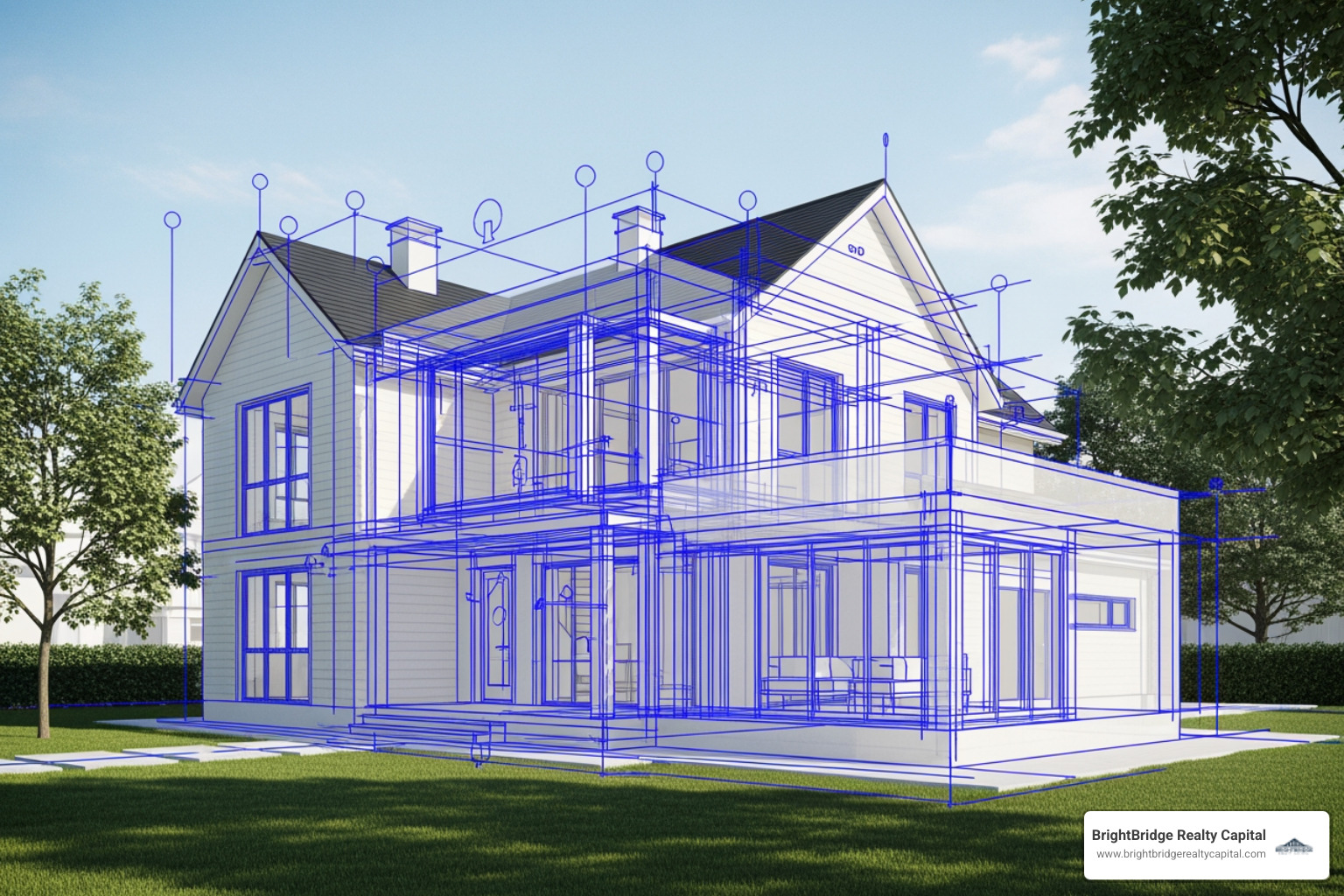
At its core, after repair value (ARV) is simply the estimated market value of a property after any repairs, renovations, or improvements have been completed. Think of it as the projected selling price once we've transformed a distressed, neglected property into a shining, market-ready gem. It’s the anticipated value of the property post-renovation, and it's the single most important metric that helps us determine whether a fixer-upper is a hidden treasure or a financial trap.
ARV is crucial not only for fix-and-flip investors aiming for a quick and profitable sale but also for those employing more complex strategies. For investors using the BRRRR (Buy, Rehab, Rent, Refinance, Repeat) method, a high ARV is essential for the "Refinance" stage, as it allows them to pull out their initial capital (and sometimes more) to fund the next deal. For long-term buy-and-hold investors, ARV justifies the initial capital outlay for renovations that will lead to higher rental income and long-term appreciation. It’s a powerful, versatile tool that helps us estimate our potential profit, secure financing, and ensure we're making smart financial moves that align with our investment goals.
ARV vs. Current Market Value (As-Is Value)
It’s easy to confuse after repair value with a property's current market value, also known as its As-Is Value (AIV). However, these are two distinct—and equally important—points in a property's investment lifecycle. The difference between them represents the entire scope of your value-add opportunity.
The As-Is Value (AIV) is what a property is worth today, in its current state. It accounts for all the flaws: the leaky roof, the outdated kitchen, the peeling paint. This is your starting line, the basis for your purchase negotiation. The after repair value, on the other hand, is the finish line. It's the projected value after you've executed your renovation plan and brought the property up to its full potential. The space between the AIV and the ARV is the value you create. Your profit is found within this gap, after subtracting the costs of renovation, holding, and selling.
Let's break down the distinction further:
| Feature | After-Repair Value (ARV) | Current Market Value (As-Is Value) |
|---|---|---|
| Definition | Estimated market value after renovations are completed. | Current market value of the property before any improvements. |
| Condition Reflected | Fully renovated, updated, and in prime market condition. | Its current state, including any necessary repairs or deficiencies. |
| Purpose | Determines potential resale price, profit, and financing. | Establishes initial purchase price and starting point for investment. |
| Calculation Basis | Comparable sales of renovated properties. | Comparable sales of similar condition properties. |
| Timeframe | Future-looking (post-renovation). | Present-day (pre-renovation). |
Understanding both of these valuation stages is critical for making informed investment decisions. A low AIV might seem attractive, but if the ARV isn't significantly higher after accounting for renovation costs, the deal has no merit. Conversely, a high ARV is meaningless if the AIV is already too close to it, leaving no room for a profitable renovation. As one source puts it, the market value is the current worth of a property as-is, while ARV estimates its value after repairs and renovations, both assessing property worth but at different stages of property development. Your job as an investor is to accurately assess both and master the process of bridging the gap between them.
The Mechanics of Calculating After Repair Value
Calculating after repair value isn't just a numbers game; it's an art backed by science. It requires meticulous due diligence, a deep understanding of local market desires, and a brutally honest assessment of costs. A precise ARV calculation is the bedrock of a successful project, while a sloppy one is a recipe for disaster. Let’s dive into the core formula and the granular details of its essential components.

The Core ARV Formula and Its Components
The basic formula for after repair value is deceptively simple:
ARV = Property Purchase Price + Value of Renovations
However, the critical nuance lies in the term "Value of Renovations." This is not the cost of your repairs; it's the increase in market value that those repairs generate. Spending $50,000 on a kitchen doesn't automatically add $50,000 to the sale price. This is where strategic investment becomes paramount.
Let's break down the key components we need to master:
- Property Purchase Price: The initial acquisition cost. This is your starting point and the largest single expense.
- Value of Renovations: This is the estimated market value added by your planned improvements. We must focus on improvements that buyers in the local New York, NY market genuinely value and are willing to pay a premium for. Renovations fall into several categories:
- Cosmetic Repairs: High-impact, visually appealing upgrades like fresh neutral paint, refinishing hardwood floors, new carpeting, modern light fixtures, and updated landscaping. These provide a high perceived value for a relatively low cost.
- Structural & Mechanical Repairs: These address the home's core systems: roofing, foundation, plumbing, electrical, and HVAC. While less glamorous, they are critical for safety, functionality, and insurability. A new roof or updated electrical panel provides peace of mind to buyers and can be a major selling point.
- Curing Obsolescence: This involves updating features that are functionally or economically outdated. A kitchen with a poor layout suffers from functional obsolescence; a home with shag carpeting and wood-paneled walls suffers from economic obsolescence. Smart renovations here can unlock significant value.
- Detailed Renovation Costs: This is the total, all-in cost to complete the renovations. It must be comprehensive and include materials, labor, permits, and professional fees.
- Holding Costs: These are the silent profit killers. Expenses incurred during the renovation period must be factored into your total project cost. This includes loan interest payments, property taxes, insurance (specialized builder's risk policies are often required), utilities, HOA fees, and basic maintenance like lawn care.
- Contingency Fund: We always budget for the unexpected because it always happens. A contingency fund, typically 10-20% of the estimated repair costs, is non-negotiable. This covers unforeseen issues like discovering mold behind a wall, finding termite damage in floor joists, or needing to upgrade a whole plumbing line when you only planned to replace a fixture.
Mastering the Art of Sales Comparables (Comps)
The most reliable way to estimate after repair value is through a Comparative Market Analysis (CMA). This is where you become a real estate detective, hunting for clues about what similar, fully renovated properties are selling for in your target micro-market.
Here's our professional approach:
- Source Your Comps: Use the most reliable, up-to-date sources. The Multiple Listing Service (MLS), accessed via a real estate agent, is the gold standard. Public records, Zillow, and Redfin are useful secondary sources for cross-referencing.
- Define Your Search Criteria:
- Timeframe: Look for properties sold within the last 3-6 months. In a fast-moving market like New York, NY, sales older than 90 days may already be outdated.
- Proximity: Stay as close as possible, ideally within a half-mile radius. Never cross major dividing lines like highways or school district boundaries, as values can change dramatically.
- Physical Characteristics: Match the property as closely as possible in terms of square footage (within 10-15%), bedroom/bathroom count, age, and architectural style.
- Focus on Condition: This is the most important step for ARV. You must find comps that have been renovated to the same standard you are planning. A comp with a basic cosmetic update is not comparable to your planned gut renovation.
- Make Adjustments: No two properties are identical. You must adjust the sale prices of your comps to account for differences. For example, if your comp has a two-car garage and your subject property only has one, you must subtract the value of that extra garage space from the comp's sale price. Common adjustments include garages, pools, finished basements, and extra bathrooms. A local appraiser or experienced agent can help you determine appropriate adjustment values for your market.
- Calculate and Average: After selecting at least three to five strong, adjusted comps, calculate the price per square foot (PSF) for each (Sale Price / Square Footage). Average these PSF values to get a reliable market metric.
- Example: You find three renovated comps with an average adjusted PSF of $550. Your subject property is 1,500 sq ft. Your initial ARV estimate would be $825,000 (1,500 sq ft * $550/sq ft).
- Sanity Check: Does the final number make sense? Is it in line with the overall values in the neighborhood? Never rely on the math alone; apply your market knowledge as a final filter.
For more insights into what ARV entails, check out this guide: What is after-repair value (ARV)?
Estimating Renovation Costs Accurately
An accurate ARV is useless if your renovation budget is a fantasy. Underestimating costs is the fastest way to erase your profit margin.
Our professional process involves:
- Develop a Hyper-Detailed Scope of Work (SOW): This is your project's bible. It should list every single task, room by room, from demolition to final paint touch-ups. Specify materials, finishes, and brand names where possible. A vague SOW leads to vague, unreliable contractor bids.
- Get Multiple, Itemized Bids: Never rely on a single verbal estimate. Obtain at least three to five written, itemized quotes from vetted, licensed, and insured contractors. An itemized bid allows you to compare costs for specific tasks (e.g., plumbing, electrical, tile work) and spot any outliers.
- Factor in All Expenses: Your budget must include:
- Labor Costs: All tradespeople involved.
- Material Costs: From lumber and drywall to faucets and light fixtures.
- Permit Fees: Research the requirements and costs with your local municipality (e.g., in New York, NY). Skipping permits can lead to stop-work orders, fines, and major problems at resale.
- Professional Fees: Costs for architects, engineers, or designers if the project requires them.
- Dumpster/Disposal Fees: The cost of removing construction debris.
- Contingency: That crucial 10-20% buffer for the inevitable surprises.
- Identify High-ROI Renovations: Focus your budget on the "money rooms." Kitchen and bathroom renovations consistently offer the highest return on investment. Curb appeal—including landscaping, front door, and exterior paint—is also a high-ROI category as it creates a powerful first impression. Avoid over-improving with finishes that the local market won't support.
Applying ARV: From Deal Analysis to Securing Financing
Once we've meticulously calculated our after repair value and built a comprehensive renovation budget, we can put this powerful data to work. ARV transitions from a theoretical number to a practical tool that drives our entire investment strategy. It becomes our compass for deal analysis, helping us formulate a winning offer with the Maximum Allowable Offer (MAO) formula, and serves as the linchpin for securing the financing needed to bring the project to life.
The 70% Rule: Your Quick Deal-Screening Tool
The 70% Rule is a foundational guideline in real estate investing, especially for fix-and-flip projects. It's a quick, back-of-the-napkin calculation that helps us instantly screen potential deals and determine if there's enough potential profit margin to justify a deeper dive. It builds in a buffer for costs, profit, and the unforeseen.
The rule states:
Maximum Allowable Offer (MAO) = (ARV × 0.70) - Estimated Renovation Cost
But what does that 30% account for? It's not just arbitrary. A professional investor understands this buffer is allocated to cover three critical areas:
- Profit: The primary reason for the investment. Typically, investors aim for a 10-15% profit margin based on the ARV.
- Selling Costs: The expenses incurred when you sell the property. This includes real estate agent commissions (typically 5-6%), closing costs, transfer taxes, and attorney fees. These can easily add up to 7-10% of the final sales price.
- Holding & Financing Costs: The costs of owning the property during the renovation, including loan interest, insurance, taxes, utilities, plus a contingency buffer for unexpected expenses. This can account for another 5-10%.
Let’s walk through a detailed example:
- We identify a property in a desirable New York, NY neighborhood with a solidly researched after repair value (ARV) of $1,000,000.
- Our detailed scope of work and contractor bids give us an estimated renovation cost of $100,000.
Using the 70% Rule:
- Calculate 70% of the ARV: $1,000,000 * 0.70 = $700,000. This is the maximum total amount we can have in the property (purchase + repairs) to adhere to the rule.
- Subtract the estimated renovation costs: $700,000 - $100,000 = $600,000.
Therefore, our Maximum Allowable Offer (MAO) for this property is $600,000. Paying more than this begins to erode the 30% buffer, jeopardizing our profit and increasing our risk. While this is a guideline—in highly competitive markets, some experienced investors may use a 75% or even 80% rule for straightforward cosmetic flips—the 70% rule remains an invaluable discipline for new and seasoned investors alike to avoid overpaying.
For a deeper dive into the formula and its applications, you can explore: After-Repair Value (ARV) | Formula + Calculator.
How Lenders Use After Repair Value for LTV and LTC Calculations
After repair value is not just an investor's tool; it's the primary language lenders speak when evaluating value-add projects. For lenders like us at BrightBridge Realty Capital, who specialize in fix-and-flip and bridge loans, the ARV is the most critical data point in our underwriting process. It allows us to assess the project's viability and structure a loan that benefits both the borrower and the lender.
Here’s a look inside the lender's process:
- Loan-to-Value (LTV): For a standard mortgage, LTV is based on the current value or purchase price. For a renovation loan, we calculate LTV based on the after-repair value. This is a huge advantage for the investor. For instance, private and hard money lenders typically offer a maximum loan amount of 65-75% of the ARV. This allows the loan to cover not just the purchase but also the renovation itself.
- Loan-to-Cost (LTC): Lenders also look at the Loan-to-Cost ratio, which compares the loan amount to the total project cost (Purchase Price + Renovation Costs). We often fund up to 85-90% of the total cost. Lenders will typically cap the loan amount at the lesser of the LTV and LTC maximums. For example, if a loan is capped at 70% LTV and 90% LTC, we calculate both and approve the lower amount, ensuring the investor has "skin in the game."
- The Lender's Appraisal: To verify your ARV, we will order a "subject-to" appraisal. An independent appraiser will review your purchase contract, your detailed scope of work (SOW), and your budget. They will then perform their own CMA to arrive at an official ARV, contingent on the completion of the specified renovations. A strong, well-documented ARV analysis from the investor makes this process smoother and more likely to result in a favorable appraisal.
- Risk Assessment and Exit Strategy: A credible ARV demonstrates a clear and profitable exit strategy. It shows us that upon completion, the property will have sufficient value to either be sold for a profit (paying off our loan) or be refinanced into a long-term mortgage (also paying off our loan). The combined cost of the property (purchase price + repairs + holding costs) should generally be no more than 75% of the ARV to qualify for most refinancing products, ensuring the investor has at least 25% equity post-renovation.
At BrightBridge Realty Capital, we specialize in providing customized real estate financing solutions nationwide, including New York, NY. Our unique selling proposition is fast closings, often within a week, and direct lending without intermediaries. We understand that in a competitive market, speed is everything. We leverage our expertise in evaluating ARV to make quick, confident lending decisions, ensuring our investors have the capital they need to secure a deal and start their project without delay.
Benefits for the Savvy Real estate Investor
Mastering the calculation and application of after repair value transforms real estate investing from a gamble into a calculated business, offering a wealth of benefits:
- Profit Maximization: ARV allows you to reverse-engineer your project. By knowing the end value, you can set a precise budget for renovations that maximize ROI, focusing on features buyers in your market desire without over-improving and wasting capital.
- Superior Risk Mitigation: ARV is your primary risk management tool. It forces you to establish a disciplined purchase price, creating a crucial buffer against cost overruns, market shifts, and other unforeseen issues.
- Data-Driven Decision-Making: ARV removes emotion and guesswork from deal analysis. It provides a clear, objective framework to evaluate opportunities, compare potential projects, and walk away from deals that don't meet your financial criteria.
- Enhanced Access to Capital: A well-substantiated ARV is the key that unlocks financing. It demonstrates your professionalism and the viability of your project to lenders, leading to higher loan amounts, better terms, and faster funding.
- Significant Competitive Advantage: In a crowded market, investors who can quickly and accurately analyze ARV can make confident, decisive offers. This speed and precision allow them to secure the best deals before less-prepared competitors even have a chance.
Navigating the Pitfalls: Risks and Accuracy Factors
While after repair value is an indispensable tool, it's crucial to remember that it's an estimate, not a guarantee. It is a projection of a future value in a dynamic market. Relying on a single ARV number without appreciating its inherent risks and the factors that can affect its accuracy can lead to significant financial setbacks. A savvy investor is not just an optimist; they are a prepared realist.
Factors That Can Skew Your ARV Estimate
Several elements can introduce errors into your ARV calculation, turning a seemingly profitable deal into a costly mistake. Vigilance in these areas is key:
- Inaccurate or Poorly Chosen Comps: Your ARV is only as good as your comparable sales data. This is the most common point of failure. Using a comp from a slightly more desirable school district, one that was renovated to a much higher standard, or one that sold during a market peak six months ago can dramatically inflate your ARV. For example, in New York, NY, values can shift block by block. Using a comp from the other side of a major avenue could lead to a $100,000 overestimation, instantly wiping out your profit.
- Grossly Underestimated Repair Costs: This is the silent killer of fix-and-flip profits. A quick walkthrough might reveal the need for paint and new floors, but what lies beneath? A project can quickly spiral out of control when you open a wall and discover outdated knob-and-tube wiring, a crumbling plumbing stack, or extensive termite damage. A case study: an investor budgeted $15,000 for a bathroom remodel but found a rotted subfloor and hidden mold, requiring an additional $10,000 in remediation and structural work that wasn't in the plan.
- Over-Improving for the Neighborhood (Functional Supremacy): There is a ceiling to what a property is worth in any given neighborhood. If the highest-priced homes in the area sell for $800,000, installing $150,000 worth of ultra-luxury finishes won't make your property sell for $950,000. It will simply be the most expensive, over-improved $800,000 house in the area. Buyers look for homes that fit the neighborhood standard. A cautionary tale: an investor put imported Italian marble and top-of-the-line Viking appliances in a starter home community. The property sat on the market for months because the price was too high for the local buyer pool, eventually selling for barely more than comps with standard granite and stainless steel, resulting in a massive loss on the renovation investment.
- Ignoring Shifting Market Trends: The real estate market is not static. A project that takes 4-6 months to complete is subject to market shifts during that time. A sudden rise in interest rates can shrink the pool of qualified buyers, increasing your property's time on the market and putting downward pressure on your final sale price. Conversely, a sudden drop in inventory could work in your favor. A smart investor keeps an eye on key indicators like days on market, inventory levels, and mortgage rate trends throughout their project.
- Subjective Buyer Perception and Staging: You can build the perfect house on paper, but value is ultimately determined by what a buyer is willing to pay. Your choice of a trendy backsplash tile might be a major turn-off for a particular buyer. This is why professional staging is so critical. An empty, sterile house can feel cold and uninviting, making it difficult for buyers to envision themselves living there. Poor photos or a cluttered presentation can also lead to a lower perceived value and a sale price below your projected ARV.
The Risks of Relying Solely on ARV
While ARV is a powerful metric, it should never be your only consideration. A myopic focus on a single number without a holistic view of the project and market can be perilous:
- Overpaying for the Property: An inflated ARV directly leads to an inflated Maximum Allowable Offer. If your ARV is off by 10%, you could end up overpaying for the asset by a significant margin, locking in a loss before you even begin renovations. The 70% Rule is designed to protect against this, but it's useless if the ARV input is flawed.
- Negative Return on Investment (ROI): The ultimate risk is losing money. This happens when renovation cost overruns collide with a sale price that falls short of the projected ARV. The profit margin in flipping is often thinner than it appears, and a few key mistakes can quickly turn a positive ROI into a negative one.
- Financing and Appraisal Gaps: Lenders base their loan amounts on ARV. If your project is complete and the final, as-is appraisal comes in lower than your initial "subject-to" ARV estimate, you can face a serious problem. This "appraisal gap" can jeopardize your ability to refinance into a permanent loan (in a BRRRR scenario) or force a price reduction in a sale. As one source points out, the main risk is that the ARV may not be accurately estimated, leading to insufficient refinancing and forcing you to leave more cash in the deal than planned.
- Unforeseen Market Downturns: The real estate market moves in cycles. An investor who bought a property at the peak of the market in 2006 with a rosy ARV projection likely faced foreclosure in 2008 when values plummeted. While no one can perfectly predict the market, a conservative ARV estimate and a healthy contingency fund provide a buffer against moderate downturns. The unpredictability of real estate values means we should always stress-test our numbers and plan for a less-than-ideal outcome.
ARV is an estimate based on educated assumptions, and the actual value can and will vary. It's a critical piece of the puzzle, but it must be considered alongside a thorough risk analysis, a conservative budget, and a deep understanding of the market.
Conclusion
Mastering after repair value is not just about crunching numbers; it's about developing a strategic mindset that underpins every successful real estate investment. It is the discipline that transforms speculation into a calculated business venture. From identifying genuinely undervalued properties in a sea of listings to securing the right financing on the best terms, ARV guides our decisions, mitigates our most significant risks, and ultimately paves the way for profitable, repeatable success.
Our key takeaways for you, the savvy investor, are:
ARV is Your Financial North Star. It represents the potential of a property after your vision is realized. It must be the focal point of your analysis, guiding your offer, your renovation budget, and your exit strategy. Without a clear and accurate ARV, you are navigating without a map.
Accuracy is a Non-Negotiable Prerequisite. Your ARV is only as reliable as the data and assumptions behind it. This demands meticulous research into truly comparable sales, brutally honest renovation cost estimates from vetted professionals, and a clear-eyed view of market realities. Cutting corners here is the most expensive mistake an investor can make.
The 70% Rule is Your Most Powerful Filter. Use this simple but effective rule to quickly screen deals and maintain discipline in your offers. Understanding that the 30% buffer is a calculated allocation for profit, costs, and contingencies will prevent you from overpaying and entering into deals with insufficient margins.
Lenders Speak the Language of ARV. A well-supported, professionally presented ARV analysis is crucial for securing the capital you need. It demonstrates to lenders like us that you are a sophisticated investor with a viable plan, which opens the door to higher leverage, competitive rates, and the fast funding necessary to compete for the best deals.
Acknowledge and Plan for the Pitfalls. Confidence is essential, but it must be paired with a healthy respect for risk. Always be conservative in your estimates, build in robust contingency funds, and stay aware of market dynamics. The most successful investors don't avoid risks; they anticipate and plan for them.
At BrightBridge Realty Capital, we understand the intricacies of property valuation and the critical role after repair value plays in your success. We see hundreds of deals and know what a solid, defensible ARV looks like. We provide customized real estate financing solutions designed to empower investors across New York, NY, and nationwide with fast closings and direct, no-nonsense lending. We’re not just a source of capital; we’re your financial partner, committed to helping you navigate the complexities of real estate investment with confidence and speed.
Ready to put your ARV calculations to the test and fund your next profitable project?
Secure your next fix-and-flip project with BrightBridge Realty Capital and experience the difference of a true financial partnership that values your time and your vision.