The Investor's Edge: Unlocking Opportunities with Bridge Loans


Summary
Unlock real estate opportunities with a bridge loan for real estate investors. Get fast funding, a competitive edge, and flexible solutions.
Why Speed and Timing Define Success in Real Estate Investing

A bridge loan for real estate investors is a short-term financing tool providing quick capital to acquire, renovate, or refinance properties while awaiting permanent financing or a sale.
Key Features:
- Loan Duration: 6-24 months
- Closing Speed: 7-14 days (vs. 30-60 for traditional loans)
- Typical Rates: Starting around 9-12%
- Loan Amount: Up to 75% LTV (loan-to-value)
- Payments: Interest-only to preserve cash flow
- Focus: Property value and exit strategy
Best Used For:
- Fix-and-flip projects
- Time-sensitive acquisitions
- Value-add properties
- Bridging to permanent financing
- Competing with cash buyers
In competitive real estate markets, timing is everything. Traditional mortgages take 30-60 days to close, but prime investment properties can be gone in hours. This creates a timing problem: your capital is tied up, but new opportunities won't wait. Miss a deal, and you've lost the entire potential return.
Bridge loans solve this. Closing in under two weeks, they let you act like a cash buyer and execute value-add strategies without conventional financing delays. As one expert noted, "Where the banks say 'No', the Hard Money and private lenders can still say 'Yes'!"
The numbers tell the story: while 88% of house flips are profitable, 43% of commercial loans are denied by traditional banks. Bridge loans address this gap between opportunity and capital access.
I'm Daniel Lopez, a loan officer at BrightBridge Realty Capital. I help investors structure bridge loans for real estate investors to capitalize on time-sensitive deals, from fix-and-flips to multifamily acquisitions. My focus is making complex financing simple and closing deals fast, so you can focus on creating value.
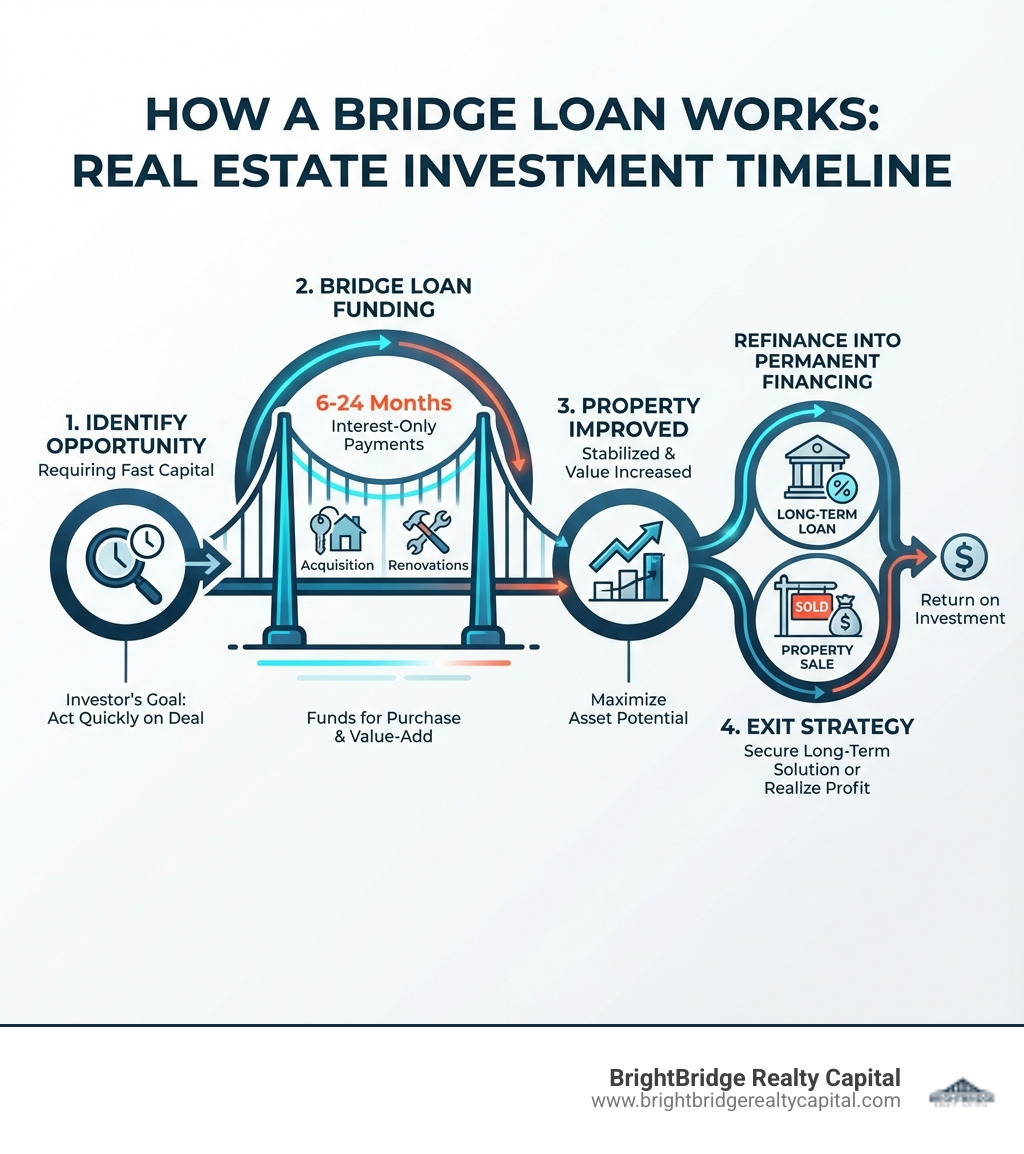
What is a Bridge Loan and How Does It Work?
A bridge loan for real estate investors is a short-term financial solution—also known as interim or gap financing. Its purpose is to provide immediate capital to cover a financial gap until permanent financing is secured or an asset is sold. Think of it as a temporary bridge connecting two points in your investment journey.
Unlike traditional bank loans bogged down by paperwork, bridge loans are designed for speed. With streamlined underwriting, they can close in under two weeks. This is a game-changer in fast-moving markets. The loan is asset-based, meaning it's secured by the real estate itself. Lenders focus more on the property's value and potential than solely on the borrower's credit score, allowing for greater flexibility and quicker decisions.

The Mechanics for Real Estate Investors
For investors, bridge loans are about leveraging existing assets to seize new opportunities. If you find a prime property but your capital is tied up, a bridge loan can fill that funding gap. You use the equity in a current property or the value of the new acquisition as collateral. This immediate cash enables you to secure the new property without delay, making your offer as strong as a cash buyer's.
The underwriting process focuses on the property's value and your exit strategy, meaning less scrutiny on traditional metrics. This approach allows us to provide financing much faster than conventional lenders, ensuring you don't miss out on lucrative deals.
Types of Bridge Loans for Real Estate Investors
The most prominent type for investors is the "Hard Money Bridge Loan." These are asset-based, making them accessible for investors who might not fit the rigid criteria of traditional banks.
As direct private lenders, we design our bridge loans to be flexible and customized. Whether you need financing for a Fix and Flip, a Cash Out Refinance, or a Purchase, a bridge loan can be custom to your needs. Our direct lending model cuts out intermediaries, leading to faster decisions and a seamless process, giving you the capital you need, when you need it.
The Strategic Advantages: When to Use a Bridge Loan for Real Estate Investors
In real estate investing, speed is often synonymous with success. A bridge loan for real estate investors is a strategic tool that provides an undeniable edge. Our clients often say the ability to act quickly is the most important factor in securing the best deals.
Bridge loans offer unparalleled speed, closing in under two weeks compared to 30-60 days for traditional mortgages. This lets you seize time-sensitive opportunities like auctions or off-market deals. They also offer significant flexibility, with terms customized to your needs and LTV ratios up to 75% that maximize your purchasing power.

Common Scenarios for a Bridge Loan for Real Estate Investors
A bridge loan for real estate investors is indispensable in many situations:
- Fix-and-Flip Projects: These projects are the quintessential use case for bridge financing. Success in flipping hinges on acquiring the right property at the right price, often before it hits the mass market. A bridge loan provides the immediate capital needed to both purchase an undervalued property and fund the entire renovation budget. The loan is structured around the project's total cost and timeline, with an interest-only payment structure that preserves the investor's liquidity for construction draws and holding costs. This alignment is critical, as it allows the investor to focus on executing the rehab and marketing the property for a profitable sale within the typical 6-18 month loan term.
- Real Estate Auctions: Auctions demand that buyers close within a very short timeframe, often 30 days or less, and require proof of funds to even place a bid. A bridge loan pre-approval acts as that proof, allowing you to bid with the confidence of a cash buyer and meet the stringent closing deadlines that traditional lenders simply cannot accommodate.
- Value-Add Properties: This strategy involves acquiring underperforming assets—like an apartment complex with high vacancies and below-market rents, or an outdated retail center. A bridge loan funds not only the acquisition but also the capital improvements (renovating units, modernizing facades, improving amenities) needed to stabilize the property, increase net operating income (NOI), and ultimately force appreciation. Once the property is stabilized and cash-flowing, the investor can execute their exit by refinancing into a lower-cost, long-term permanent loan.
- Acquiring Distressed Properties: Distressed assets, such as bank-owned properties (REOs) or short sales, often come with compressed timelines and are sold 'as-is.' Banks and sellers are highly motivated to close quickly with a reliable buyer. Bridge loans enable investors to act decisively, securing these high-potential opportunities by providing the fast, certain financing required to close the deal before competitors can.
- Covering Closing Costs or Funding Gaps: Sometimes an investor has most of the capital for a purchase but faces a small but critical shortfall for closing costs, initial repairs, or other unexpected expenses. A small, fast bridge loan can fill this gap, preventing the entire deal from collapsing and ensuring the acquisition moves forward smoothly.
- Off-Market Deals: The most lucrative deals are often found through networking and are never publicly listed. These opportunities require discretion and speed. A seller in this situation wants a quick, hassle-free closing. Having a direct private lender ready to fund a bridge loan allows an investor to immediately commit to the deal and secure an exclusive opportunity before it ever hits the open market.
- Temporary Relief During Refinancing Delays: Even well-laid plans can face setbacks. If an investor's permanent financing for a stabilized property is unexpectedly delayed, a bridge loan can provide crucial temporary liquidity. This can be used to pay off a maturing loan, avoid default penalties, or simply cover operating expenses, preventing the loss of a valuable asset due to a bureaucratic hold-up.
- Competing Against Cash Buyers: In hyper-competitive markets like New York, NY, offers contingent on traditional financing are often dismissed. A cash offer is king because it represents speed and certainty. A bridge loan allows you to make a non-contingent, fast-closing offer that is functionally equivalent to cash. This puts you on a level playing field, dramatically increasing the likelihood that your offer will be accepted, even if it's not the highest bid.
Property Types Suited for Bridge Loans
The versatility of bridge loans extends across many real estate asset classes:
- Multifamily Housing: Ideal for acquisition and rehab before transitioning to long-term agency loans. This includes SFR, fractured condos, student housing, and more.
- Office Buildings: Provides agility for acquiring, renovating, or repositioning office spaces in dynamic markets.
- Retail Property: Facilitates rapid acquisition or funds tenant improvements to attract new businesses.
- Industrial: Offers quick capital for expansion or repositioning of warehouses and distribution centers.
- Self-Storage: Helps investors quickly acquire or develop these high-demand facilities.
- Hospitality: Bridges financial gaps during renovations or ownership changes for hotels and other hospitality assets.
- Land Development: Provides initial capital to acquire land while awaiting zoning or construction financing.
Our flexible bridge loans accommodate a full range of value-add strategies for both partial and non-cash-flowing properties.
Navigating the Terms and Qualifications
Understanding the terms and qualifications for a bridge loan for real estate investors is crucial. While they offer speed and flexibility, these are serious financial commitments with specific requirements. Key metrics include Loan-to-Value (LTV), a robust exit strategy, and a thorough property appraisal.
Typical Loan Terms, Rates, and Fees
When considering a bridge loan, be aware of the typical financial parameters:
- Loan Duration: These are short-term loans, typically ranging from 6 to 18 months, though some can extend up to three years with renewal options.
- Interest Rates: Reflecting their speed and short-term nature, bridge loan rates are higher than conventional loans, often starting around 9%. These rates are typically floating, meaning they can fluctuate, and are frequently tied to benchmarks like SOFR (Secured Overnight Financing Rate).
- Interest-Only Payments: A key benefit is that payments are often interest-only. This preserves cash flow for renovations or other operational needs.
- Fees: Expect origination fees (typically around 1.00% of the loan amount) and potentially exit fees. However, many lenders offer flexibility with no prepayment penalties, a crucial feature for investors planning a quick exit.
- Loan Amount: You can typically borrow up to 75% LTV, with some commercial loans reaching 80% LTC (Loan-to-Cost). Loan amounts can range from $100,000 to over $75 million.
Key Eligibility Factors for a Bridge Loan for Real Estate Investors
While more flexible than traditional financing, lenders still consider crucial eligibility factors to ensure your success:
- Sufficient Equity or Collateral: As purely asset-based loans, the property itself is the primary security. Lenders are focused on the value of the collateral, typically lending up to 75% of the property's 'as-is' value for a purchase or up to 80% of the total project cost (Loan-to-Cost) for deals involving construction. For a refinance, you may be able to borrow up to 75% of the current appraised value. This focus on the asset means that even if a borrower has other financial blemishes, a deal with strong collateral can still be funded.
- Strong Exit Strategy: This is the single most critical component of a bridge loan application. Lenders must see a clear and credible path to repayment. Your exit strategy should be detailed and supported by data. It generally falls into two categories:
- Sale of the Property: Primarily for fix-and-flip or development projects. Your plan should include a detailed After-Repair Value (ARV) analysis based on comparable recent sales (comps), a realistic project timeline, and a marketing plan. The lender needs to be confident that the improved property can be sold quickly and for a price that comfortably covers the loan, carrying costs, and your profit.
- Refinance into Permanent Financing: For value-add and stabilization projects. Your plan must demonstrate how the bridge loan will be used to increase the property's Net Operating Income (NOI) to a level that will qualify for long-term financing. This includes showing how renovations will lead to higher rents, how improved management will reduce vacancies, and providing pro forma financials that meet the Debt Service Coverage Ratio (DSCR) requirements of typical long-term lenders (e.g., banks, CMBS, or agency lenders).
- Real Estate Experience: While not always a deal-breaker, a proven track record significantly strengthens an application. Lenders want to see that you have successfully completed similar projects in the past. This experience demonstrates your ability to manage a budget, oversee construction, and execute an exit strategy. For newer investors, this requirement can often be satisfied by partnering with an experienced mentor or by assembling a strong team, including a reputable general contractor, property manager, and real estate agent who have extensive local market experience.
- Project Financials: A professional and detailed financial presentation is essential. Lenders will scrutinize your numbers to ensure the project is viable. Key documents include a line-item renovation or construction budget, a 'sources and uses' summary showing where all capital is coming from and how it will be spent, a current rent roll and operating statements (T-12) for income properties, a pro forma income statement detailing projected income and expenses post-stabilization, and contractor bids with a detailed scope of work.
- Credit Score and DTI Ratio: While less credit-dependent than traditional loans, a good credit score (often 660+) and a low debt-to-income (DTI) ratio are still preferred. Most private lenders want to see that you have sufficient liquidity (cash reserves) to cover interest payments during the loan term, as well as a contingency fund for unexpected project costs. This demonstrates you can service the debt and handle unforeseen challenges without jeopardizing the project. Some programs are also available for foreign nationals.
Bridge Loans vs. Other Financing Options
Understanding how a bridge loan for real estate investors stacks up against alternatives is key to choosing the right loan for your specific situation. Bridge loans are designed for speed and flexibility during transitional periods, setting them apart from both other short-term options and long-term solutions.
Bridge Loans vs. Other Short-Term Financing
Let's compare bridge loans to other common short-term options:
- Home Equity Lines of Credit (HELOCs): A HELOC acts like a credit card against your home's equity. While rates may be lower, they are tied to your primary residence, often have a longer approval process, and may not offer the speed or leverage needed for a fast-moving investment deal.
- Home Equity Loans: These are lump-sum loans against your home's equity with longer repayment terms. They are more affordable but lack the rapid deployment and asset-focused underwriting of a bridge loan designed for investment properties.
- Personal Loans: While an option for those with strong credit, loan amounts are often smaller and rates can be high. They are generally not suited for the large capital needs of real estate investing.
The key difference is that bridge loans from direct lenders like us prioritize the property's value and your exit strategy over personal financial history. This allows for faster, more customized solutions for time-sensitive investment opportunities.
Bridge Loans vs. Longer-Term Financing
The contrast with longer-term financing, like conventional or agency loans, is even starker, as they serve different purposes.
- Purpose: A bridge loan for real estate investors is a temporary solution for quick acquisition and renovation. Long-term financing is for stabilized, income-generating properties you plan to hold.
- Loan Structure: Bridge loans are typically interest-only, preserving cash flow for improvements. Long-term loans are usually amortized, with principal and interest payments.
- Collateral: Bridge loans focus on a property's current and projected value, even if it's not stabilized. Traditional lenders prefer stabilized properties with consistent cash flow.
- Terms: Bridge loans are short (6-24 months) with a clear exit plan. Long-term loans can span 10-30 years.
- Interest Rates: Bridge loans have higher rates due to their speed and risk profile, while long-term loans for stabilized assets offer lower rates.
A bridge loan is the right fit when speed is critical, the property needs value-add work, or you're transitioning between financing. The "bridge-to-permanent pathway" is a powerful strategy: use a bridge loan to acquire and stabilize an asset, then refinance into a lower-rate, long-term loan.
Crafting Your Success: The Process and Exit Strategy
Securing a bridge loan for real estate investors is only half the battle; the other is executing a bulletproof exit strategy. Without a clear repayment plan, even the best loan can lead to complications. Understanding the application process is the first step toward a successful funding and project execution. As a dedicated direct lender, we've refined our process for maximum speed and transparency, providing certainty of execution so you can focus on the deal itself.
The Step-by-Step Bridge Loan Application Process
While significantly faster than a bank, the bridge loan process still involves several key stages of due diligence to protect both the borrower and the lender. Here’s a typical breakdown:
Initial Consultation and Term Sheet: The process begins with a conversation. You'll present your deal scenario to the loan officer, outlining the property, your business plan, and your requested loan amount. If the project aligns with the lender's criteria, they will issue a preliminary term sheet. This non-binding document outlines the proposed loan amount, interest rate, term, and fees, giving you a clear picture of the financing structure before you commit.
Formal Application and Document Submission: Once you accept the term sheet, you'll complete a formal loan application. At this stage, you will submit a package of due diligence documents. This typically includes: entity documents (LLC operating agreement, etc.), a signed purchase and sale agreement, personal financial statements, a detailed renovation budget and scope of work, and any existing property information like rent rolls or operating statements.
Underwriting and Third-Party Reports: This is where the lender does its deep dive. The underwriting team will analyze your submitted documents, verify your experience, and scrutinize your exit strategy. Simultaneously, they will order third-party reports, the most important of which is the property appraisal. Unlike a conventional appraisal, a bridge loan appraisal often includes both an “as-is” valuation and an “after-repair value” (ARV) or “as-stabilized value,” which projects the property’s worth after your improvements are complete. This future value is critical for justifying the loan amount, especially when renovation funds are included.
Loan Commitment and Closing: Upon successful completion of underwriting and a satisfactory appraisal, the lender will issue a formal loan commitment. This is a binding agreement to fund the loan according to the specified terms. From here, the loan documents are drafted by legal counsel and sent to a title company or closing attorney. The closing process is coordinated with all parties, and once all documents are signed, the loan is funded. With a direct lender, this entire process, from initial call to funding, can be completed in as little as 7-10 business days.
Developing a Bulletproof Exit Strategy
A bridge loan for real estate investors is a temporary solution, so its success hinges on a viable exit strategy. Lenders prioritize borrowers who can articulate a strong repayment plan.
Here are the primary exit strategies:
- Refinancing into Long-Term Debt: This is a common "bridge-to-permanent pathway." Use the bridge loan to acquire and improve a property, then refinance into a lower-rate, long-term loan once the asset is stabilized and performing well.
- Selling the Property: For fix-and-flip investors, the exit is straightforward: acquire, renovate, and sell for a profit. The sale proceeds repay the bridge loan. This requires accurate market analysis and a realistic timeline.
- Stabilizing the Asset: For commercial properties, the bridge loan provides capital to improve operations, increase occupancy, and raise rents. Once stabilized, the property's value increases, making it ready for a profitable sale or long-term financing.
- Increasing Property Value: This underpins both refinancing and selling. By funding strategic improvements, you force appreciation and create the basis for a successful exit.
Developing this strategy requires foresight and planning. We encourage clients to highlight a clear exit strategy in their applications, as it demonstrates professionalism and a solid investment plan.
The Role of a Direct Lender
Working with a direct lender like BrightBridge Realty Capital is pivotal. Our model is built on efficiency, transparency, and a client-centric approach. A key advantage is having fewer intermediaries, which means less red tape and a direct line to decision-makers. This results in faster decisions and a seamless process. We pride ourselves on 24-hour responses and closing loans in a week or less.
As a direct lender, we also offer customized solutions, tailoring terms to fit your unique needs and exit strategy. We are more than a capital provider; we are a partner committed to your success, from acquisition through to permanent financing.
Conclusion
The dynamic landscape of real estate investing demands agility, foresight, and access to capital that moves as fast as the market. A bridge loan for real estate investors is not merely a temporary fix; it's a powerful and strategic tool that empowers you to seize fleeting opportunities, outmaneuver competitors, and open up significant value in your portfolio. From facilitating rapid acquisitions and funding crucial renovations to bridging the gap to permanent financing, bridge loans offer the speed, flexibility, and leverage essential for success.
We've explored how these short-term, asset-based solutions work, the specific scenarios where they provide an undeniable edge, and the critical terms and qualifications you need to steer. We've also highlighted their distinct advantages over other financing options, emphasizing their role in enabling a robust "bridge-to-permanent pathway." The investor's edge in today's market is about having a clear strategy and the right financial partners to execute it swiftly.
At BrightBridge Realty Capital, we understand that timing is everything. Our mission is to provide customized real estate financing solutions nationwide, specializing in quick, flexible funding for investors like you. With fast closings, often within a week, and direct lending without intermediaries, we offer competitive rates and a seamless process designed to get your deals done.
Ready to gain your edge and transform opportunities into profits? Explore stabilized bridge loan solutions with us today and let's build your success story together.