Direct Lender in Real Estate: The Straightforward Path to Funding


Summary
Uncover the direct lender meaning in real estate. Learn how direct lenders offer a straightforward path to funding with speed and flexibility.
Understanding Direct Lenders and Why They Matter
The direct lender meaning in real estate is a financial institution that originates, underwrites, and funds loans with its own capital, eliminating intermediaries like brokers. This streamlined approach connects borrowers directly to the funding source.
Key characteristics of a direct lender:
- Originates loans directly with borrowers
- Underwrites using in-house criteria
- Funds from their own balance sheet or capital sources
- Services the loan throughout its life
- No middleman fees or broker commissions
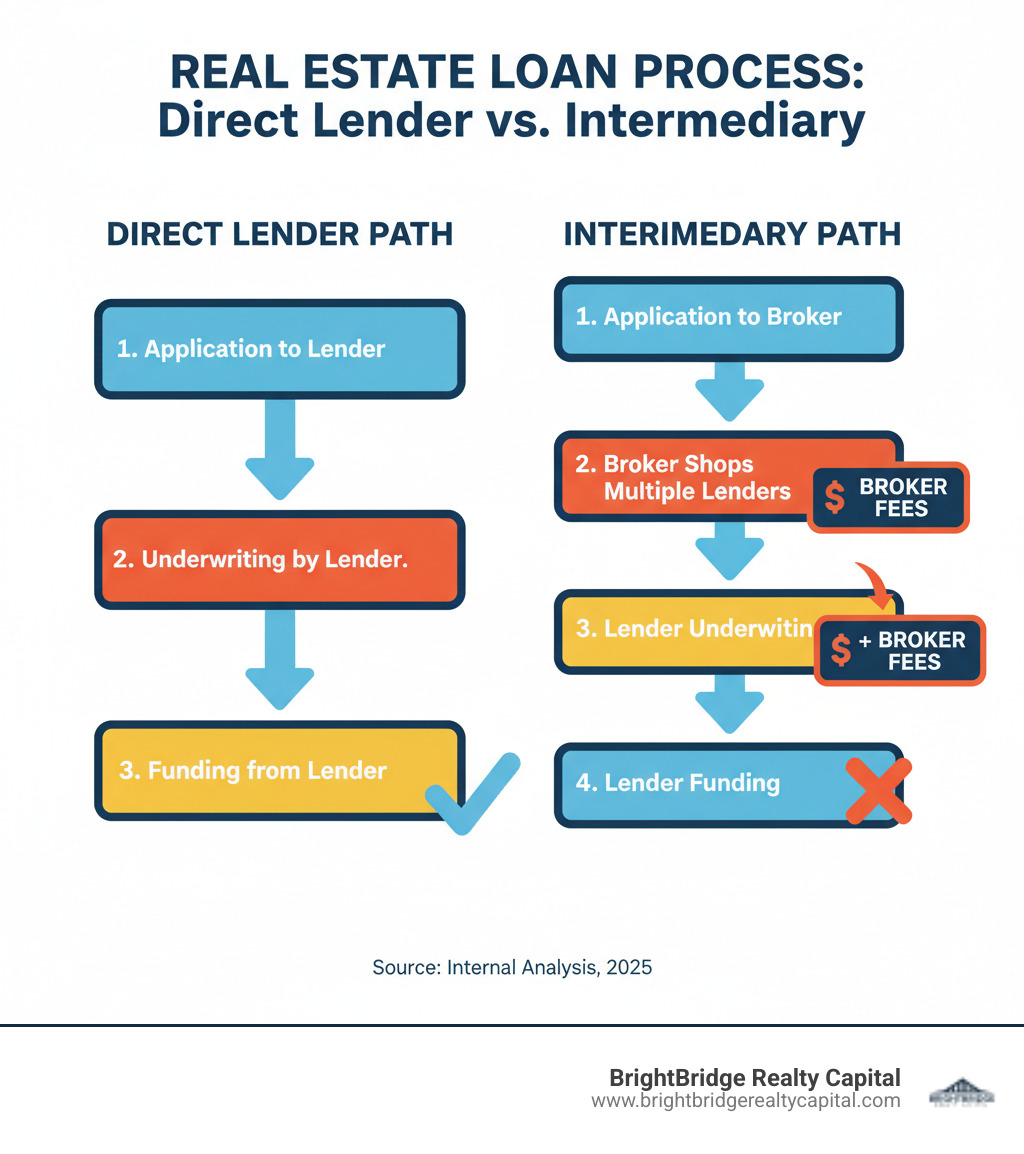
When financing a property, your choice between a direct lender and an intermediary impacts closing speed, costs, and your overall experience. Direct lenders handle the entire loan process internally—from application to funding—which often results in faster approvals and a smoother process.
Traditional banks are direct lenders, but so are private lending companies, hard money lenders, and specialized mortgage companies. What sets them apart from brokers is simple: they use their own money to fund your loan, rather than shopping your application to other institutions.
For real estate investors, this distinction is critical. When you need to close quickly on a property, a direct lender's streamlined process can mean the difference between winning a deal and losing it. However, working with a direct lender also means you're limited to their specific loan products, which is why savvy borrowers still shop around.
I'm Daniel Lopez, a loan officer at BrightBridge Realty Capital. I specialize in helping investors steer direct lending, making complex financing feel straightforward so you can focus on building your portfolio.
What is a Direct Lender in Real Estate?
A direct lender is a one-stop shop for your real estate financing. We are the financial institution that handles everything from application to closing. Unlike a broker who shops your loan to various lenders, with a direct lender, you're dealing with the source of the funds.
This means origination, underwriting, and funding all happen in-house. Our team processes your application, reviews your financials, makes the lending decision, and wires the funds—all under one roof. You get a single source of contact, which simplifies the experience and gives you a clear line of communication with someone who knows your file.
The real advantage is how this integrated approach streamlines everything. Our Direct Loan Process describes this seamless flow where decisions don't bounce between multiple companies. This means fewer delays, less confusion, and you always know where your loan stands. For investors on tight deadlines, this efficiency can be the difference between securing a deal and losing it.
The Role of the Loan Originator
In direct lending, your loan originator is your primary contact and personal mortgage advisor. They get to know your investment strategy, understand your goals, and guide you to the right loan products.
A good loan originator doesn't just process paperwork—they coordinate with underwriting, answer your questions, and are committed to getting you to the closing table. This personalized approach defines Direct Lending Services and is why many borrowers prefer working directly with their funding source.
How Direct Lenders Fund Their Loans
How do we get the money to fund your loans? Understanding the different paths helps explain why direct lenders operate differently.
Balance sheet lending is when a lender uses its own capital to fund loans. This is common among private lenders and allows for maximum speed and flexibility.
Some direct lenders use warehouse lines of credit—a credit line from a larger financial institution. We fund your loan, then sell it to investors, repay the warehouse line, and repeat the cycle to keep capital flowing.
Traditional mortgage lenders often sell their loans to the secondary market, like Fannie Mae and Freddie Mac, to replenish their capital.
In private lending, capital partnerships, debt syndication, and "One Investor, One Loan" arrangements are also common. As long as the capital partner doesn't charge you an origination fee, it's still considered direct lending. You're dealing with one entity that handles everything.
Our Direct Portfolio Lending approach often uses these structures. It gives us access to deeper funding pools and lets us approve more complex deals while maintaining the speed and service you expect from a direct lender.
Direct Lenders vs. Other Financing Channels: A Clear Comparison
When seeking real estate financing, you have several options. Understanding the difference between a direct lender, an intermediary, and a traditional bank is key to choosing the right path for your investment strategy. Each has its place, but the best one depends on your goals and timeline.

Direct Lender vs. Intermediary
The most important distinction is between a direct lender and an intermediary (a mortgage broker). A direct lender handles the entire loan process in-house with its own capital. A broker acts as a matchmaker, connecting you with various lenders but not lending money themselves. You can dive deeper into this topic in our article, What is the difference between a direct lender and an intermediary?.
Here's how these two approaches compare:
| Feature | Direct Lender | Intermediary (Mortgage Broker) |
|---|---|---|
| Role | We are the funding source. We originate, underwrite, and service your loan directly. | Connects you with multiple lenders. They don't provide the funds themselves. |
| Cost | You pay us directly for services like origination, appraisal, and processing. We often offer competitive rates because there's no middleman markup. | May charge a broker fee on top of the lender's fees. Sometimes they can find lower rates by shopping your loan to multiple sources. |
| Loan Options | Limited to our specific products and underwriting guidelines. | Access to a wider variety of loan products from different lenders, including specialized options. |
| Process | Streamlined and in-house, often resulting in faster closings. You communicate directly with decision-makers. | Can take longer since brokers collect your information and then shop it around. Communication goes through an extra layer. |
| Relationship | Direct, personal connection with our team throughout your loan and beyond. | Your relationship is primarily with the broker, who manages relationships with multiple lenders on your behalf. |
The direct lender meaning in real estate is clear in this comparison. When you work with us at BrightBridge Realty Capital, you come straight to the funding source. There's no middleman adding fees or steps to the process. This direct connection makes Direct Mortgage Lenders attractive to borrowers who value efficiency and transparency.
Direct Lender vs. Traditional Bank
While traditional banks are technically direct lenders, there are significant differences between them and a specialized direct lender like us, especially for real estate investment financing.
At BrightBridge Realty Capital, real estate financing is all we do. This specialization creates meaningful advantages for our borrowers.
Flexibility in underwriting is a key difference. Banks have rigid criteria and often add "overlays"—stricter requirements that make it tough for borrowers with unique situations. As specialized Direct Real Estate Lenders, we can be more flexible, focusing on the property's value and project potential.
Speed matters in real estate investing. Banks have extensive bureaucracy that can slow things down. We've streamlined our process for fast funding—often closing in a week or less. That speed can be the difference between winning and losing a deal.
Customer service is also different. We work specifically with real estate investors, so we understand your needs intimately. We build a trustworthy relationship and act as your long-term financing partner.
Loan product variety also differs. Banks offer standardized mortgages, while we specialize in creative financing for investors, such as fix-and-flip projects, rental portfolios, and commercial properties that don't fit the traditional mold.
The Pros and Cons of Working with a Direct Lender
Choosing a direct lender involves trade-offs. Understanding the pros and cons helps you align your financing with your investment goals and timeline, ensuring you pick the right tool for the job.

Advantages of Direct Lending
When you need to move fast or require financing that banks won't touch, a direct lender can be your secret weapon.
Speed is everything in real estate. Direct lenders can provide rapid loan decisions and funding because we're not waiting on third parties. Our Direct Funding Mortgage process is built for investors who need to act quickly.
Faster closing times are a natural result of our streamlined approach. Since we handle everything in-house, we can close deals in a week or less. This is a major advantage in competitive markets.
Direct communication is a game-changer. You talk directly to the decision-makers, creating a trustworthy relationship and getting clear, immediate answers.
Underwriting flexibility is where the direct lender meaning in real estate truly shines. We look at the whole picture—the property's potential, your experience, and the project's viability—not just your credit score. This flexibility opens doors for investors with non-traditional income or unique properties.
Competitive rates often surprise borrowers. By eliminating intermediary fees and focusing on real estate financing, we can often match or beat other rates. Plus, you're not paying a broker commission, which keeps your overall costs down.
Potential Disadvantages of Direct Lending
It's important to be honest about where direct lending might not be a perfect fit.
Limited loan selection is the main trade-off. Each direct lender specializes in certain loan types. We excel at investment property financing, but if you need a conventional 30-year mortgage for a primary residence, a traditional bank may be better. That said, as Time.com notes, some specialized programs like our Direct Lender Loans are only available through direct lenders.
You'll need to shop around yourself to compare offers. A broker does this for you, but working directly with lenders requires more initial effort from the borrower.
Potential for rejection exists with any lender. If your project doesn't fit our specific criteria, you'll get a straightforward no. However, our flexible underwriting means we approve many projects that traditional banks turn down.
Fewer physical branches might matter if you prefer face-to-face meetings. Many specialized direct lenders operate primarily online. Most investors prefer the convenience of digital communication, but it's a factor to consider.
Understanding the direct lender meaning in real estate means recognizing that we're optimized for speed, flexibility, and direct relationships. If those are your priorities, the advantages usually outweigh the limitations.
Understanding the Direct Lender Meaning in Real Estate Investment
For real estate investors, the direct lender meaning in real estate is about strategy. In commercial properties, fix-and-flip projects, or time-sensitive bridge loans, direct access to capital can be the key to securing a profitable deal.
In real estate investment, timing is everything. A great deal won't last long. That's where the power of Direct Real Estate Investment financing shines—you cut straight to the source of funds, eliminating delays and streamlining your path to closing.
Types of Direct Lenders for Real Estate Investors
The landscape of direct lending for investors is diverse. Knowing which type aligns with your project can save time and money.
Commercial banks offer conventional loans with competitive rates but have strict underwriting and slow closing times, often taking weeks or months.
Private equity firms pool investor capital for real estate projects. They are more flexible than banks and consider complex deals but often have higher interest rates to reflect the added risk.
Debt funds focus exclusively on providing debt financing. They can structure specialized loans for unique projects, making them ideal for non-standard financing needs.
When you work with a Direct Private Lender, you're dealing with a specialist focused on investment properties. These lenders provide financing to corporate entities for non-owner-occupied real estate. Their key advantages are remarkable flexibility and speed.
Hard money lenders are specialists in short-term, asset-based financing. They care more about the property's after-repair value (ARV) than your credit score. As industry experts note, these Direct Hard Money Loans use the property as collateral, making them perfect for fix-and-flip projects where speed is critical. Rates are higher, but the ability to close in days often justifies the cost.
Online lenders use technology to streamline credit assessments and offer convenient digital applications, though their product offerings vary widely.
The direct lender meaning in real estate for your project
Choosing the right direct lender is about finding the best fit for your situation. Key factors should guide your decision.
Your loan purpose is critical. Are you acquiring, constructing, or renovating? Different lenders specialize in different niches. A Direct Commercial Loans scenario requires a different lender than a residential flip.
Speed requirements often dictate your path. If you need to close in a week, you'll need a hard money or private direct lender. For a more relaxed timeline, a commercial bank's lower rates might be a reasonable trade-off.
Your financial profile—credit score, investment experience, and liquidity—will determine your options and terms. Hard money lenders focus more on the asset's value than your credit score.
Project complexity can narrow your options. Unique properties or creative financing structures often require the flexibility of private equity firms or debt funds, which can create custom solutions.
At BrightBridge Realty Capital, our Direct Lending Solutions are designed for real estate investors. We understand your success depends on speed and flexibility. That's why we focus on quick closings—often within a week—and maintain direct communication to eliminate confusion. When evaluating the direct lender meaning in real estate for your next project, consider the entire relationship and how it supports your strategy.
Frequently Asked Questions about Direct Lending
We often get questions about the nuances of direct lending. Here are some common ones that help clarify the direct lender meaning in real estate.
Does working with a direct lender guarantee faster closing or better terms?
While direct lenders are known for speed, a fast closing isn't guaranteed. Our in-house process allows for closings often within a week, but the final timeline depends on market conditions, project complexity, and the borrower providing documents promptly.
Similarly, "better terms" are relative. Direct lenders can be more competitive due to their specialized focus and lack of intermediary fees, but it's not a universal rule. As PrivateLenderLink.com notes, investors won't always get the best terms just because a lender is direct. We recommend comparing term sheets from multiple lenders. Our Direct Lending Solutions are designed to be competitive, but your due diligence is always key.
How do I verify if a direct lender is legitimate?
Due diligence is crucial when choosing a financial partner. Here are some steps to take:
- Check Licensing: For mortgage lenders, verify their licensing through the Nationwide Multistate Licensing System & Registry (NMLS). Visit www.nmlsconsumeraccess.org and search for the company or loan officer.
- Read Online Reviews and Testimonials: Look for customer reviews on reputable platforms to gauge a lender's reputation and responsiveness.
- Ask for References: A legitimate lender should be willing to provide references from past clients with similar projects.
- Review Their Website and Materials: A professional online presence with clear explanations of their process, terms, and contact information is a good sign.
What is the direct lender meaning in real estate compared to a correspondent lender?
These terms highlight different operational models in the lending industry.
- Direct Lender: A direct lender (like BrightBridge Realty Capital) originates, underwrites, and funds loans using its own capital. We handle the entire process and are the initial funding source.
- Correspondent Lender: This lender originates and funds loans with their own money but does so on behalf of a larger lender, who purchases the loan shortly after closing.
- Table Funding: A type of correspondent lending where the end investor funds the loan directly at closing, even though the correspondent lender originated it.
- Wholesale Lending: A lending institution that provides its loan programs through mortgage brokers or correspondent lenders, not directly to borrowers.
While both direct and correspondent lenders fund loans, the key distinction is whether the loan is held or immediately sold to a pre-arranged buyer. You can find more detailed definitions in the Private Lending Glossary. For us at Direct Lending Investors, our focus is on providing capital directly to ensure consistency and clarity for our clients.
Conclusion: The Straightforward Path to Your Next Real Estate Deal
Navigating real estate financing can feel like a maze, but understanding the direct lender meaning in real estate can illuminate a clear path forward. We've seen that direct lenders offer a compelling blend of speed, simplicity, and flexibility, often cutting through the bureaucracy that can slow down traditional financing options. This direct approach fosters clear communication and can provide custom solutions that align perfectly with your unique investment goals.
At BrightBridge Realty Capital, we are committed to being that straightforward path for real estate investors. We understand that your projects demand quick, efficient, and reliable funding. By working directly with us, you gain access to our expertise, our capital, and a partner dedicated to your success.
Ready to experience the difference of direct lending?