Beyond the Bank: Hard Money Loan Requirements for Your Next Flip
Summary
Unlock your next flip! Learn fix and flip hard money loan requirements & get fast funding with BrightBridge Realty Capital.
Why Understanding Hard Money Loan Requirements is Your First Step to Faster Funding
In the high-stakes world of real estate investing, speed and preparation are your most valuable assets. Before you even make an offer on a promising fixer-upper, your first move should be to deeply understand the landscape of fix and flip hard money loan requirements. While these requirements are notably simpler and more streamlined than those of traditional bank loans, they are specific and non-negotiable. Mastering them is the critical first step that separates successful, fast-closing investors from those who get stuck in paperwork and lose deals. Where conventional banks might take a painstaking 30-60+ days to scrutinize your W-2s, tax returns, and debt-to-income ratios, hard money lenders prioritize the property's profit potential, enabling them to fund deals in as little as 7-15 days. This guide breaks down exactly what lenders look for, empowering you to prepare a bulletproof application and secure funding with confidence.
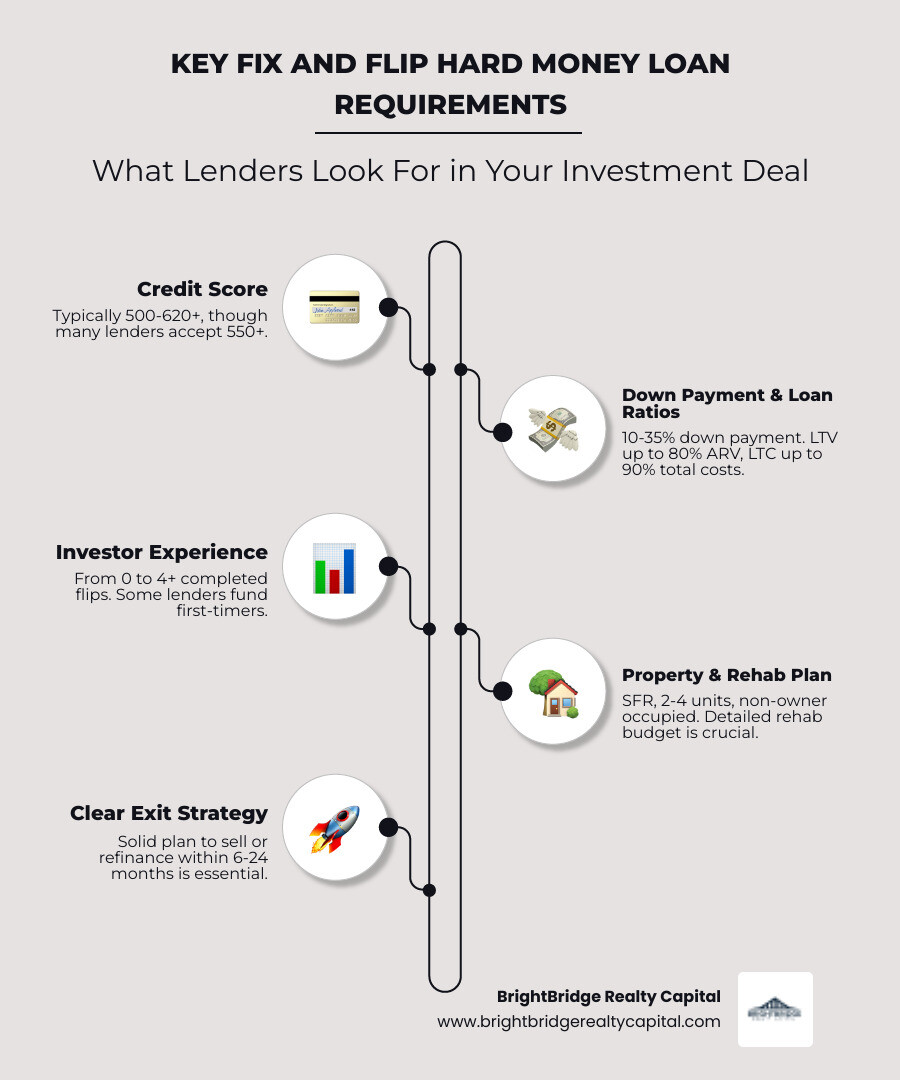
Here’s a comprehensive overview of what most reputable hard money lenders will require:
Core Fix and Flip Hard Money Loan Requirements:
- Credit Score: A minimum score between 500-620+ is often acceptable. Lenders are less concerned with a perfect score and more interested in the absence of recent major credit events like bankruptcies or foreclosures.
- Down Payment: Expect to contribute 10-35% of the purchase price or total project cost. This is your \"skin in the game,\" demonstrating your commitment to the project's success.
- Experience: While not always mandatory, having 0-4 completed flips in the last 2 years can significantly improve your terms. First-time flippers can often substitute strong financials or a solid professional team.
- Loan-to-Value (LTV): Lenders will typically finance up to 65-80% of the property's After-Repair Value (ARV), the cornerstone metric of asset-based lending.
- Loan-to-Cost (LTC): This ratio determines how much of the total project cost (purchase + rehab) the lender will cover, usually up to 85-90%.
- Property Type: The focus is almost exclusively on non-owner occupied residential properties, including single-family homes and 2-4 unit multi-family buildings.
- Exit Strategy: You must present a clear, viable plan to repay the loan, either by selling the property to a retail buyer or refinancing into a long-term rental loan.
- Rehab Budget: A detailed, itemized scope of work (SOW) and contractor estimates are required to justify the renovation loan amount and structure the draw schedule.
- Cash Reserves: You must provide proof of liquid funds to cover the down payment, closing costs, interest payments during the loan term, and a contingency for unexpected overruns.
- Interest Rates: Rates are higher than conventional loans, typically ranging from 8-15%, reflecting the higher risk and short-term nature of the financing.
- Loan Term: These are short-term bridge loans, with terms usually lasting from 6 to 24 months.
I'm Daniel Lopez, a senior loan officer at BrightBridge Realty Capital. Over the years, I've guided hundreds of real estate investors, from first-timers to seasoned professionals, through these exact requirements to secure the fast, reliable financing they need to grow their portfolios. My mission is to demystify the lending process, helping you understand the lender's perspective so you can structure your deal for a swift and certain approval.
What is a Fix and Flip Hard Money Loan?
A fix and flip hard money loan is a specialized, short-term financing tool provided by private lenders and designed specifically for real estate investors. Its fundamental characteristic is that it's secured by the property itself—a \"hard asset\"—rather than being primarily based on the borrower's personal income and credit history. These loans are structured to cover both the acquisition cost of a distressed property and the funds needed for its renovation. This allows an investor to execute the classic fix and flip model: acquire an undervalued property, increase its value through improvements, and then sell it for a profit. The entire cycle is typically completed within a 6 to 24-month timeframe. The immense popularity of real estate shows like \"Fixer Upper\" has brought house flipping into the cultural mainstream, but what isn't always shown on television is the critical financing strategy that makes these projects possible.

Who Typically Uses These Loans?
Hard money loans are the preferred financing vehicle for investors who prioritize speed, flexibility, and the ability to act on opportunities that traditional financing can't accommodate.
- Real Estate Investors and House Flippers: This is the primary audience. Whether they are seasoned pros managing multiple projects or first-time investors taking on their initial flip, this group relies on hard money to execute the buy, renovate, and sell strategy efficiently.
- Borrowers with Lower or Limited Credit: Because the loan is asset-based, a pristine credit history is not the main qualifying factor. Lenders focus on the viability of the deal itself, making this a accessible option for investors with credit scores as low as 500-550 who have a strong project plan.
- Investors Needing to Close Quickly: In competitive real estate markets, the ability to close in 7-15 days provides a decisive advantage. A hard money pre-approval allows an investor to make offers that are nearly as strong as cash, giving sellers the confidence of a fast and certain closing.
- BRRRR Strategy Investors: Hard money is the perfect tool for the initial stages of the \"Buy, Renovate, Rent, Refinance, Repeat\" (BRRRR) strategy. It provides the capital for the \"Buy\" and \"Renovate\" phases. Once the property is stabilized with a tenant, the investor can \"Refinance\" with a long-term, lower-rate conventional or DSCR loan to pay off the hard money lender and pull cash out, then \"Repeat\" the process.
- Investors Buying Distressed Properties: Traditional banks are wary of lending on properties that are uninhabitable or in poor condition. Hard money lenders, however, specialize in this niche. They are comfortable with fixer-uppers because their underwriting is based on the After-Repair Value (ARV), not the property's current, dilapidated state.
Core Fix and Flip Hard money Loan Requirements: The Lender's Checklist
When you submit an application for a fix and flip hard money loan, lenders undertake a dual-track evaluation, assessing both you as the borrower and the property as the collateral. This process is designed to confirm that the project has a high probability of success and a clear path to profitability. At BrightBridge Realty Capital, our underwriting is built on identifying a well-conceived plan and an investor capable of executing it. While specific criteria can vary slightly from one lender to another, the following requirements represent the industry standard and form the basis of any lender's checklist.

Breaking Down Borrower-Specific Fix and Flip Hard Money Loan Requirements
Our borrower requirements are designed to be more flexible and holistic than a traditional bank's because our primary focus is on your capacity to successfully complete the proposed project. We look at the full picture, not just a single data point.
- Experience Level: A track record of successfully completing 1-4 flips within the last two years is a significant advantage and can help you secure the best possible terms (lower rates, higher leverage). However, inexperience is not an automatic disqualifier. First-time investors can strengthen their application by partnering with an experienced mentor, hiring a vetted general contractor, or presenting an exceptionally well-researched deal with strong profit potential. Don't let a lack of flips stop you from applying; a strong plan can speak volumes.
- Down Payment: Your down payment, often referred to as \"skin in the game,\" is a critical component of your application. It typically ranges from 10% to 35% of the total project cost or purchase price. For example, a first-time investor might be required to put down 20-35%, while a seasoned investor with a strong track record may only need to contribute 10-20%. This capital contribution assures the lender that your financial interests are aligned with theirs and that you are fully committed to the project's success.
- Cash Reserves: Beyond the down payment, lenders need to see that you have sufficient liquid funds to manage the project through completion. These cash reserves are meant to cover holding costs (which include monthly interest payments, property taxes, and insurance), potential renovation cost overruns, and any unexpected delays. A good rule of thumb is to have reserves equal to 3-6 months of total monthly expenses, plus a 10-15% contingency on your total rehab budget.
- Credit Score: While we do pull a credit report, it is not a strict pass/fail metric like it is at a bank. Some lenders work with scores as low as 500, though a score of 620+ will generally open up more favorable options. Our primary goal is to check for major recent derogatory events such as an active bankruptcy, a recent foreclosure, or significant unresolved judgments. A lower score can often be offset by other strengths, such as more experience or a larger down payment.
- Exit Strategy: This is one of the most critical elements of your application. A hard money loan is a short-term bridge, and we need to see a clear and realistic plan for how you will repay it. A strong exit strategy is detailed: if you plan to sell, you should provide comparable sales (comps) of recently sold renovated properties in the area to support your projected sales price. If you plan to refinance, you should have an idea of the long-term loan product you'll use (like a DSCR loan) and the rental income needed to qualify.
- Background Check & Personal Guarantee: We conduct a standard background check to screen for recent financial felonies or other red flags that could impact your ability to manage the project. Additionally, you will almost always be required to sign a personal guarantee. This is true even if you are purchasing the property through an LLC. The personal guarantee is a promise that you, the individual, will repay the loan if the business entity cannot, demonstrating your personal commitment and accountability.
Understanding Property-Specific Fix and Flip Hard Money Loan Requirements
The property itself is the primary collateral—the \"hard asset\"—that secures the loan. Therefore, a significant portion of our due diligence is focused on the property's characteristics and its potential for appreciation in a market that can support a quick sale or refinance.
- Property Type: We, like most hard money lenders, primarily focus on residential properties. This includes single-family homes (SFRs) and multi-family buildings with 2-4 units. These property types have the most liquid markets and standardized valuation methods. Some lenders may also consider condos, townhomes, or even smaller apartment buildings (5+ units), but 1-4 unit properties are the bread and butter of the industry.
- Non-Owner Occupied: It is crucial to understand that these are business-purpose loans intended for investment properties only. Federal and state consumer protection laws (like Dodd-Frank and RESPA) place strict regulations on loans for primary residences. Therefore, you cannot live in the property while you are renovating it with a hard money loan.
- Detailed Rehab Budget & Scope of Work (SOW): This is your project's business plan. We require a highly detailed, itemized breakdown of all anticipated renovation costs, from demolition and materials to labor and permits. The SOW should clearly spell out the specific repairs, upgrades, and finishes you are planning. This document is not just for approval; it becomes the roadmap for disbursing renovation funds in draws as you complete work.
- Distressed Properties: Unlike traditional banks that shy away from properties needing significant repairs, we welcome them. Our entire lending model is built around a property's future potential. We are comfortable with fixer-uppers, fire damage, or incomplete construction because we base our loan amount on the property's After-Repair Value (ARV), not its current condition.
- Appraisal & Title Insurance: An independent appraisal is a mandatory step. The appraiser will provide two key values: the current \"as-is\" value and the projected ARV based on your SOW and market comps. This third-party valuation validates the deal's potential. We also require a lender's title insurance policy to protect all parties from any unforeseen ownership claims, liens, or encumbrances that could jeopardize the title to the property.
Hard Money vs. Traditional Loans: A Tale of Two Timelines
When it comes to financing a fix and flip project, investors are faced with two primary options: traditional bank loans (like a conventional mortgage) or hard money loans. The path you choose will have a profound impact on your ability to compete, your timeline to profit, and whether you can secure a deal before another investor does. The comparison is akin to choosing between the express checkout lane and the regular line at a grocery store—one is specifically designed for speed and efficiency, while the other is built for a different, slower-paced purpose.
Here's a detailed breakdown of how they stack up against each other:
| Feature | Hard Money Loans | Traditional Mortgages |
|---|---|---|
| Funding Speed | Extremely Fast: 7-15 business days | Extremely Slow: 30-60+ days |
| Approval Basis | Asset-Based: Primarily on the property's After-Repair Value (ARV) | Income-Based: Borrower's credit, income, DTI, and tax history |
| Credit/Income Focus | Flexible on credit (500-620+), no W-2 or tax return requirements | Strict credit score (700+), extensive DTI checks, 2 years of income verification |
| Loan Term | Short-Term: 6-24 months, designed for a quick exit | Long-Term: 15-30 years, designed for homeownership |
| Interest Rates | Higher: Typically 9-15% to compensate for risk and speed | Lower: Varies with market, but significantly lower than hard money |
| Property Condition | Welcomes Distress: Ideal for fixer-uppers and uninhabitable properties | Requires Stability: Prefers move-in ready or lightly damaged homes |
| Paperwork | Streamlined: Focus on property docs, SOW, and entity info | Exhaustive: Tax returns, pay stubs, bank statements, letters of explanation |
| Best Use Case | Transactional Investing: Fix and flip, BRRRR, quick closes, auction buys | Long-Term Holding: Owner-occupied homes, stabilized long-term rentals |
Why Hard Money Wins for Speed and Agility
In the competitive arena of real estate investing, timing is not just important—it's everything. The single greatest advantage of a hard money loan is the ability to close with incredible speed. While a traditional mortgage process drags on for 30, 60, or even 90 days, a proficient hard money lender can take a deal from application to funded in just 7 to 15 business days. This velocity is your ultimate competitive edge, especially when multiple investors are vying for the same undervalued property.
The reason for this speed lies in a fundamentally different underwriting philosophy. We cut through the bureaucratic red tape by focusing on what matters for an investment: the quality of the asset. Our underwriting is collateral-focused. We analyze the property's potential value (ARV) and your plan to unlock that value. We don't spend weeks analyzing two years of your tax returns or questioning every deposit into your bank account. This streamlined approach allows you to make aggressive offers that can rival cash buyers, giving sellers the assurance of a fast, reliable closing and making your offer stand out.
At BrightBridge Realty Capital, our entire operation is built for speed. We understand that when you find a profitable deal, the clock is ticking. We are a direct lender, which means we use our own capital and make our own decisions, eliminating the delays associated with brokers and institutional capital partners. Get financing with BrightBridge Realty Capital and discover the power of a lender that moves at the speed of your business.
Where Traditional Loans Fall Short for Flips
Using a traditional mortgage for a fix and flip project is like trying to fit a square peg in a round hole—it's the wrong tool for the job. The slow, cumbersome approval process means that by the time you are finally approved for a loan, the best deals have long been sold to cash or hard money buyers. Furthermore, the strict income and credit verification processes can be a major roadblock for many real estate investors. Self-employed individuals or those who use legitimate tax strategies to minimize their W-2 income often struggle to meet the stringent debt-to-income (DTI) ratios required by banks.
Perhaps the most significant obstacle is how conventional lenders view property condition. Banks and the government-sponsored entities that back them (Fannie Mae and Freddie Mac) are inherently conservative. Their guidelines are written for owner-occupants buying safe, stable, move-in ready homes. If a property has a missing kitchen, significant mold, foundation issues, or is otherwise uninhabitable, they see it as unacceptable collateral and will refuse to lend. This is the exact opposite of what a house flipper is looking for. Hard money lenders, in stark contrast, specialize in assessing a property's After-Repair Value (ARV). We fund deals based on the property's future potential, not its current state of disrepair, making us the ideal financial partner for value-add, distressed property investments.
The Numbers Game: Understanding Loan Terms, Rates, and Key Metrics
To truly master fix and flip hard money loan requirements, you must become fluent in the language of finance. Profitability in a flip is determined by the numbers, and understanding the cost of capital, the amount of leverage you can obtain, and the key metrics lenders use is absolutely crucial. This knowledge will not only help you get approved but will also empower you to accurately forecast your potential return on investment.
Key Metrics: LTV, LTC, and ARV Explained
These three acronyms—ARV, LTV, and LTC—are the foundational pillars of hard money lending. Every loan decision revolves around them.
- After-Repair Value (ARV): This is the most important number in fix and flip financing. ARV is the estimated market value of a property after all proposed renovations are completed and it is in its best possible condition. A licensed appraiser determines this value by analyzing recent sales of comparable, fully renovated properties in the immediate vicinity. Lenders base their loan amount on this future value because it represents the collateral's true potential and the source of the project's profit.
- Loan-to-Value (LTV): This ratio compares the total loan amount to the property’s value. In the context of hard money, it's almost always calculated against the ARV. Lenders typically offer up to 65-80% of the ARV. For instance, if a property has a projected ARV of $400,000, a lender offering a 75% LTV loan would be willing to lend a maximum of $300,000.
- Loan-to-Cost (LTC): This metric compares the loan amount to the total project cost, which is the purchase price plus the renovation budget. Lenders often provide up to 85-90% LTC. This metric determines how much of your own cash you'll need to bring to the deal. For example, if you're buying a house for $200,000 and have a $50,000 rehab budget, your total cost is $250,000. A 90% LTC loan would cover $225,000, meaning you'd need to bring $25,000 plus closing costs.
The \"Lesser Of\" Rule in Practice:Lenders will typically cap their loan amount at the lesser of the maximum LTV or the maximum LTC. Let's use the example above:
- Total Project Cost: $250,000
- ARV: $400,000
- Max LTC (90%): $250,000 * 0.90 = $225,000
- Max LTV (75% of ARV): $400,000 * 0.75 = $300,000In this scenario, the lender would use the lower figure, capping the total loan amount at $225,000.
Typical Loan Terms, Rates, and Fees
Hard money loans have a distinct pricing structure that reflects the speed, flexibility, and higher risk they entail compared to traditional mortgages. It's vital to factor all these costs into your analysis.
- Interest Rates: Expect rates to range from 8% to 15%. The specific rate you receive will depend on factors like your experience level, credit profile, the strength of the deal, the loan-to-value ratio, and the lender you choose.
- Loan Duration: These are short-term instruments. Loan terms typically range from 12 to 24 months, providing ample time to renovate and sell or refinance the property.
- Origination Fees: Also known as \"points,\" these are upfront fees charged by the lender for creating the loan. They typically range from 1% to 5% of the total loan amount and are paid at closing. A $300,000 loan with 2 points would have a $6,000 origination fee.
- Interest-Only Payments: To keep monthly carrying costs low during the renovation phase when there is no income from the property, most hard money loans are structured with interest-only payments. This means your monthly payment only covers the interest accrued. The full principal loan amount is then repaid in a single \"balloon payment\" when you sell or refinance the property.
- Other Fees: Transparency is key. Be prepared for other standard costs associated with the loan. These can include an underwriting fee ($500-$1,500), a processing fee, an appraisal fee ($500-$1,000+), document preparation fees, and draw inspection fees ($150-$250 per inspection) to verify construction progress before releasing rehab funds. At BrightBridge Realty Capital, we believe in providing a clear, upfront term sheet that outlines all associated costs so you can calculate your true profit margin with no surprises.
The Application and Beyond: From Paperwork to Payoff
You've identified the perfect fixer-upper, run the numbers, and are ready to make your move. The great news is that the process of applying for a fix and flip hard money loan is intentionally designed to be far more straightforward and efficient than traditional bank financing. At BrightBridge Realty Capital, we have meticulously refined our process to be as quick and transparent as possible, because we know that in real estate investing, time is your most valuable and perishable commodity.
Your Step-by-Step Application Guide
The entire journey from submitting your initial application to having funds wired at closing can take as little as 7-15 business days with a prepared borrower and an efficient lender. Here’s a detailed look at how the process unfolds:
- Find a Reputable Lender: Your first step is to partner with the right lender. Look for a direct lender, not just a broker, who specializes in fix and flip projects in your market. A direct lender uses their own capital and makes their own underwriting decisions, which means faster answers and more reliable closings. Check reviews, ask for referrals from other investors, and have an initial conversation with a loan officer to gauge their expertise and communication style.
- Prepare Your Deal Package: Organization is key to a fast closing. Before you even apply, gather all your project documentation into a "deal package." This should include: the fully executed purchase agreement, high-resolution photos or a video walkthrough of the property, a detailed Scope of Work (SOW), a comprehensive line-item budget with contractor estimates, your entity documents (LLC Operating Agreement, Articles of Organization), and a summary of your real estate experience (a portfolio of past projects if you have one).
- Submit Your Application: Most modern lenders, including us, offer a streamlined online application portal. You'll provide basic personal information, details about your business entity (LLC), and upload the documents from your deal package. After submission, a loan officer will typically contact you within 24 hours to discuss the project in detail.
- Underwriting & Appraisal: Once the loan officer confirms the deal fits the lender's guidelines, your file moves to underwriting. The underwriter is the lender's risk analyst. They will review your entire package, verify your information, and order a third-party appraisal. The appraisal is critical, as it will confirm both the current \"as-is\" value and the projected After-Repair Value (ARV). The underwriter will also conduct background checks and ensure all compliance items are met.
- Closing & Funding: Once the appraisal is in and the underwriter issues a final approval, you will be issued a loan commitment. The lender’s closing department will then work with a title company or closing attorney to prepare the final loan documents and schedule your closing. Once you sign the documents, the funds are wired to the title company, allowing you to officially purchase the property and begin your project. Because we are direct lenders, we control this entire process, ensuring you get your funds fast.
Ready to take the first step? Start Your Application with BrightBridge Realty Capital and experience a financing process built for investors.
Common Mistakes to Avoid
Even the most experienced investors can make costly errors. Being aware of these common pitfalls is the first step to avoiding them.
- Underestimating Rehab Costs: This is the most common and dangerous mistake. Always get multiple, detailed bids from licensed and insured contractors. What you can't see behind the walls—like outdated wiring, hidden mold, or foundation issues—can quickly derail your budget. A vague budget is a major red flag for lenders.
- No Contingency Fund: Never go into a project without a financial cushion. Lenders will often require it. Set aside at least 10-20% of your total rehab budget for unexpected expenses and delays. A surprise is merely an inconvenience when you have a contingency fund; it's a potential catastrophe without one.
- Poor Contractor Vetting: Your project is only as good as your contractor. Don't just hire the cheapest bid. Thoroughly check references, verify their license and insurance, and look at examples of their previous work. Insist on a detailed contract that ties payments to completed milestones, not arbitrary dates. This ensures they are motivated to finish the work to your satisfaction.
- Lacking a Solid Exit Strategy: You must know exactly how you will repay the loan—selling or refinancing—before you even apply. This means running comps to determine a realistic sales price and understanding the holding costs (interest, taxes, insurance) you'll incur. Having a Plan B (like refinancing to a rental if the market shifts) is a sign of a sophisticated investor.
- Overlooking Lender Fees: Your profit margin can be eroded by unforeseen costs. Factor in all lender fees—interest rate, origination points, underwriting fees, draw fees, and closing costs—from day one. A good lender will provide a detailed term sheet and closing estimate so you can accurately calculate your net profit.
- Choosing the Wrong Property in the Wrong Location: A great flip starts with a great buy. You make your money when you buy, not just when you sell. Research local market trends, school districts, and neighborhood dynamics to ensure there will be strong buyer demand for your finished product. A beautiful renovation in a bad location is a recipe for a long, costly holding period.
Frequently Asked Questions about Fix and Flip Hard Money Loan Requirements
Navigating the world of hard money can bring up many questions, especially for those new to the process. Here are detailed answers to some of the most common inquiries we receive about fix and flip hard money loan requirements.
What happens if I can't repay the loan on time?
This is a valid concern, as fix and flip projects can face unexpected delays. The most important thing to do if you foresee a problem is to communicate with your lender early and often. Proactive communication is key. Since the property itself secures the loan, the ultimate risk of non-payment is foreclosure. However, foreclosure is a costly and time-consuming process that most lenders prefer to avoid. Reputable lenders, including BrightBridge Realty Capital, are typically willing to work with borrowers who have been transparent about their challenges. Many will offer an extension, usually for a period of 1-6 months. These extensions typically come with a fee, often 1-2% of the loan balance, and may involve a slightly higher interest rate. A solid, well-researched exit strategy and a healthy contingency fund are your best defenses against repayment issues.
Can I get 100% financing for a fix and flip?
While the idea of 100% financing is highly appealing, it is extremely rare in the hard money world and often misleadingly advertised. Most lenders require the borrower to have \"skin in the game\" through a down payment, which typically amounts to 10-20% of the total project cost. This ensures your financial interests are aligned with the lender's. The rare instances of true 100% financing are usually reserved for highly experienced investors with a long and successful track record with a specific lender. It often involves cross-collateralization, where the investor pledges equity from another property they own as additional security for the loan. More commonly, investors can find high-leverage loans that cover 100% of the renovation costs, but still require a down payment on the purchase price. This structure can significantly reduce your out-of-pocket cash requirement while still ensuring you are invested in the deal's success.
How are renovation funds disbursed?
Lenders do not hand over the full renovation budget as a lump sum at closing. Instead, to protect all parties and ensure the project progresses as planned, renovation funds are held in an escrow account. They are then released in stages, known as \"draws,\" as you complete work. The draw process is tied to a pre-agreed-upon draw schedule based on your detailed Scope of Work (SOW). For example, a typical draw schedule might look like this:
- Draw 1: Released after demolition, foundation work, and framing are complete.
- Draw 2: Released after rough-in plumbing, electrical, and HVAC are installed and inspected.
- Draw 3: Released after insulation, drywall, and exterior painting are finished.
- Final Draw: Released after all finishes, fixtures, and landscaping are complete, and the property is ready for market.To request a draw, you submit a request form with any required documentation. The lender will then send an inspector to the property to verify that the work for that phase has been completed satisfactorily. Once verified, the funds are reimbursed to you or paid directly to your contractor.
Do I need an LLC to get a hard money loan?
While not every lender requires it, forming a legal entity like a Limited Liability Company (LLC) is highly recommended and often a mandatory requirement. There are two primary reasons for this. First, it provides crucial liability protection, separating your personal assets from your business activities. If something goes wrong on the job site, your personal home and savings are shielded. Second, lending to a business entity helps the lender clearly establish that the loan is for a business purpose, which keeps it exempt from the strict consumer lending regulations (like RESPA and Dodd-Frank) that govern loans for personal residences. This simplifies the loan process for everyone involved.
How is the After-Repair Value (ARV) determined?
The ARV is the cornerstone of the loan approval, and it must be determined by a neutral, qualified third party. The lender will order an appraisal from a licensed, independent appraiser who has experience in the specific submarket of your property. The appraiser will conduct a thorough analysis, which includes inspecting the property, reviewing your detailed Scope of Work, and performing a comparative market analysis. They will find recent sales (typically within the last 6-12 months) of properties that are similar in size, style, and location to your subject property and have been renovated to a similar standard. By analyzing the sale prices of these \"comps,\" the appraiser forms a professional opinion of what your property will be worth once your specific renovations are complete. This unbiased valuation gives the lender the confidence to lend on the property's future value.
Conclusion: Secure Your Next Flip with the Right Financing
Throughout this guide, we've demystified the essential fix and flip hard money loan requirements. The single most important takeaway is that hard money lending is built on a foundation of speed, flexibility, and asset-based underwriting. This unique combination empowers you to seize opportunities and close deals in a mere 7-15 days—a timeline that is simply impossible for traditional banks, which can take months to approve a loan, if they approve it at all.
The asset-based advantage is the engine that drives this efficiency. By focusing on your property's After-Repair Value (ARV) rather than getting bogged down in years of your personal tax returns, we open the door to profitable projects for a wide spectrum of investors. Whether you are a seasoned professional juggling multiple flips or an ambitious first-timer with a well-researched deal, hard money provides a clear path to funding.
Yes, the interest rates are higher and a down payment is a non-negotiable requirement. However, for a successful investor, these are calculated costs of doing business. The slightly higher cost of capital is often a small price to pay for the immense opportunity to act decisively, beat out slower-moving competition, and secure profitable deals that would otherwise be out of reach. The ability to leverage a lender's capital allows you to scale your business far more quickly than if you were relying solely on your own cash.
At BrightBridge Realty Capital, we have built our reputation on being more than just a lender; we are a strategic partner for our clients. We provide what real estate investors truly need: fast and certain closings, competitive and transparent terms, and a dedicated team committed to your long-term success. We understand that your success is our success.
You are now equipped with the knowledge to move forward with confidence. The next step is to translate that knowledge into action. Prepare your deal, vet your team, and partner with a lender who understands your vision.
Ready to build your real estate empire, one successful flip at a time? Partner with us for your next fix and flip project and experience what modern real estate financing should be: fast, flexible, and relentlessly focused on helping you achieve your goals.