Don't Get Rate-d Out: Finding the Sweet Spot in Commercial Property Loans
Summary
Find your sweet spot! Understand commercial investment property loan rates, key factors, and loan types to secure flexible, fast funding.
Why Commercial Investment Property Loan Rates Matter for Your Next Deal

Commercial investment property loan rates are the single most critical variable in the complex equation of real estate finance. They don't just dictate your monthly payment; they determine your debt service coverage, your internal rate of return (IRR), and ultimately, the viability of your entire investment strategy. As we navigate the economic landscape of January 2026, we are seeing a market characterized by cautious stabilization. Rates currently range from 5.18% to 12.75%, a spread that reflects the diverse risk profiles of modern commercial assets, from stabilized multi-family complexes to opportunistic industrial redevelopments.
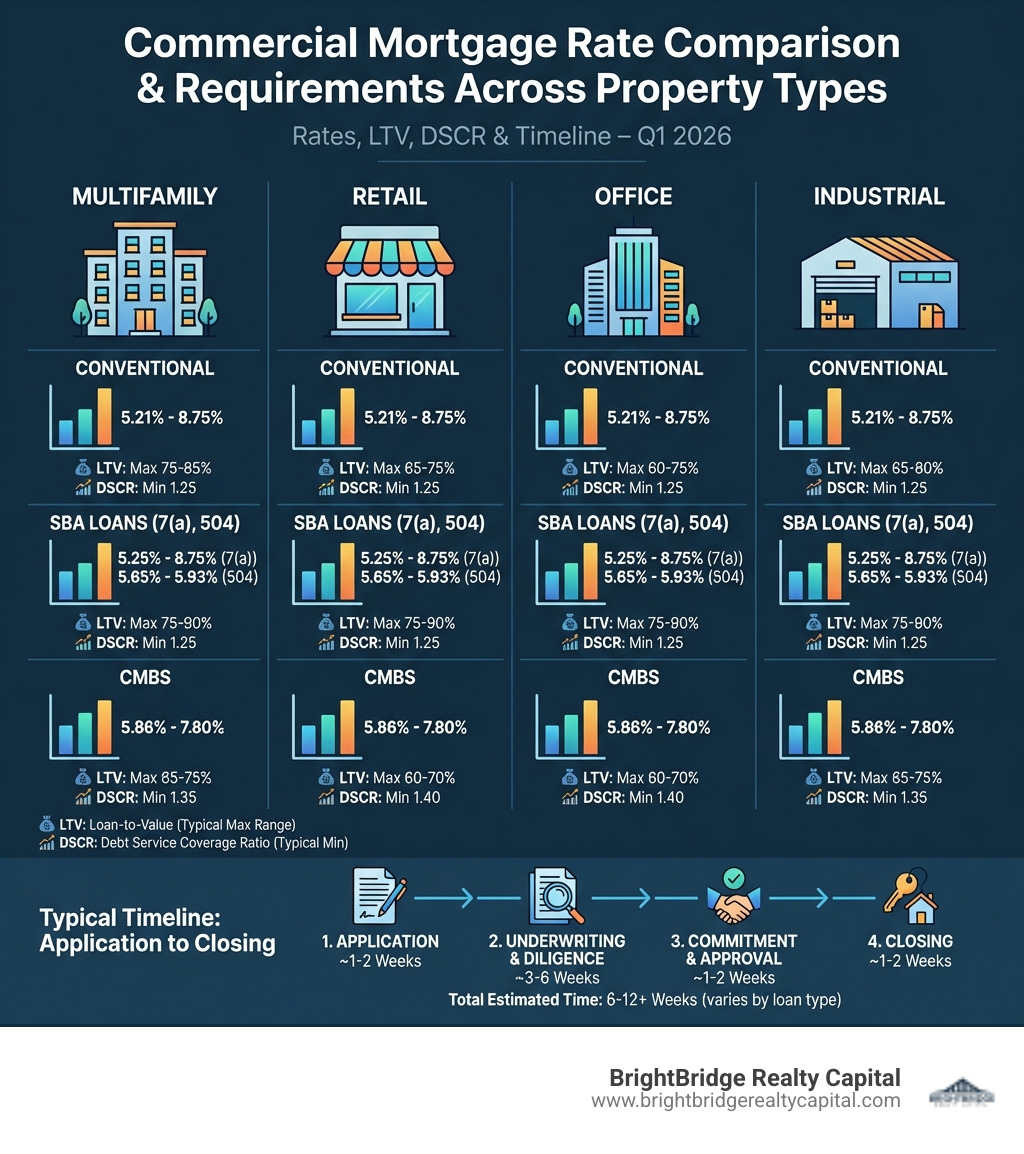
Current Rate Ranges by Loan Type (January 2026):
- Conventional Commercial: 5.21% - 8.75% (Best for stabilized assets with strong cash flow)
- SBA 7(a): 5.25% - 8.75% (Ideal for owner-occupied business real estate)
- SBA 504: 5.65% - 5.93% (Fixed-rate options for long-term asset acquisition)
- CMBS (Conduit): 5.86% - 7.80% (Non-recourse options for seasoned investors)
- Bridge Loans: 5.75% - 12.75% (Short-term capital for transitions and renovations)
Key Rate Drivers and Underwriting Benchmarks:
- Loan-to-Value (LTV) ratio: While 60-75% is standard, some programs allow up to 85% for high-quality multi-family assets.
- Debt Service Coverage Ratio (DSCR): A 1.25 minimum is the industry baseline, but 1.35+ is often required for the most competitive rates.
- Property Type and Location: Tier 1 markets (like New York or Chicago) often command lower spreads than rural or tertiary markets.
- Borrower Credit and Experience: A track record of successful exits can shave 25-50 basis points off a quote.
- Market Conditions and Fed Policy: The Federal Reserve's stance on inflation continues to be the primary driver of the underlying benchmark indexes.
To put this into perspective, consider the mathematical impact of a rate shift. The difference between a 6% and 8% rate on a $2 million loan is approximately $3,800 more per month in interest expense. Over a typical 3-year bridge term, that equates to $136,000 in lost cash flow. For an investor, that capital could have been used for tenant improvements, capital expenditures, or as a down payment on a subsequent acquisition. This is why securing the right rate isn't just a preference—it's a financial necessity.
Commercial rates are inherently higher than residential rates because the risk profile is fundamentally different. In residential lending, the primary security is the borrower's personal income and the high liquidity of single-family homes. In commercial lending, the security is the property's ability to generate revenue. If a major tenant leaves or a market sector (like retail) shifts, the lender's collateral is at risk. Banks price this uncertainty into every quote through the "spread" over the benchmark index.
However, the "best rate" is a nuanced concept. A 6% rate might come with a 1.40 DSCR requirement and a heavy prepayment penalty, while a 7% rate might offer interest-only payments and no exit fees. The latter might actually be the better deal for a value-add investor planning to refinance in 18 months. I'm Daniel Lopez, a loan officer at BrightBridge Realty Capital, and I specialize in helping investors navigate these trade-offs. I've structured dozens of deals where we prioritized flexibility over the absolute lowest rate to ensure the investor's exit strategy remained intact.
Quick commercial investment property loan rates terms:
- best lenders for rental property
- real estate investment funding
- best refinance for investment property
Understanding Current Commercial Investment Property Loan Rates
Navigating the landscape of commercial investment property loan rates requires a deep dive into the mechanics of global finance. These rates are not static; they are a reflection of the market's collective expectation of risk, inflation, and economic growth. At BrightBridge Realty Capital, we monitor these fluctuations daily to provide our clients with the most accurate and timely advice. As of late January 2026, the market has seen a period of relative stability, but the spread between different loan products remains wide, ranging from 5.18% to 12.75%.
Benchmark Indexes and Rate Calculation
To understand your quote, you must understand the formula: Index + Spread = Fully Indexed Rate. The index represents the cost of money in the broader economy, while the spread represents the lender's assessment of the risk associated with your specific deal.
Benchmark Indexes: These are the foundational pillars of commercial lending.
- Prime Rate: Historically the most common index for small business loans, the Prime Rate is typically 3% above the Federal Funds Rate. In January 2026, it sat around 6.750%. It is the base rate for many SBA loans and short-term bank lines of credit.
- SOFR (Secured Overnight Financing Rate): This has become the gold standard for floating-rate commercial debt, replacing the now-defunct LIBOR. SOFR is based on actual transactions in the Treasury repurchase market, making it a robust and transparent benchmark. For example, the 30-day SOFR was approximately 3.910% in early 2026. Investors using bridge loans often see their rates quoted as "SOFR + 300 basis points."
- United States Treasury Bonds: The yields on 5-year, 7-year, and 10-year Treasury notes are the primary benchmarks for fixed-rate commercial mortgages. Lenders view Treasuries as "risk-free" assets. If the 10-year Treasury is at 3.880%, a lender might add a spread of 200 basis points (2%) to offer a 5.88% rate on a stabilized apartment building.
- Swap Spreads: For longer-term fixed rates, lenders often use interest rate swaps to hedge their risk. The swap rate reflects the market's expectation of where interest rates will be over the next decade. This is particularly common in CMBS and large institutional lending.
The Spread: This is where the lender's expertise—and your property's quality—come into play. The spread covers the lender's operating costs, their profit, and a "risk premium." Factors that compress (lower) the spread include high occupancy, a strong DSCR, a low LTV, and a borrower with significant liquidity. Conversely, a property in a declining neighborhood or a borrower with a history of defaults will face a much wider spread.
Market Volatility and Rate Changes
Commercial investment property loan rates are sensitive to a variety of macroeconomic triggers. Even a minor shift in economic data can cause lenders to adjust their rate sheets.
- Federal Reserve Policy Updates: The Fed's "dot plot" and policy statements are scrutinized by every commercial lender. If the Fed signals a "hawkish" stance (raising rates to fight inflation), benchmark yields rise immediately. If they signal a "dovish" stance (lowering rates to stimulate growth), we often see a corresponding dip in commercial quotes.
- Monthly Inflation (CPI) Reports: Inflation erodes the value of future interest payments. When the Consumer Price Index (CPI) comes in higher than expected, bond investors demand higher yields, which pushes up the cost of commercial mortgages.
- Global Labor Market Stability: Strong employment data suggests a robust economy, which can lead to higher rates as the market anticipates increased demand for capital. Conversely, a spike in unemployment can lead to a "flight to quality," where investors buy Treasuries, driving yields down.
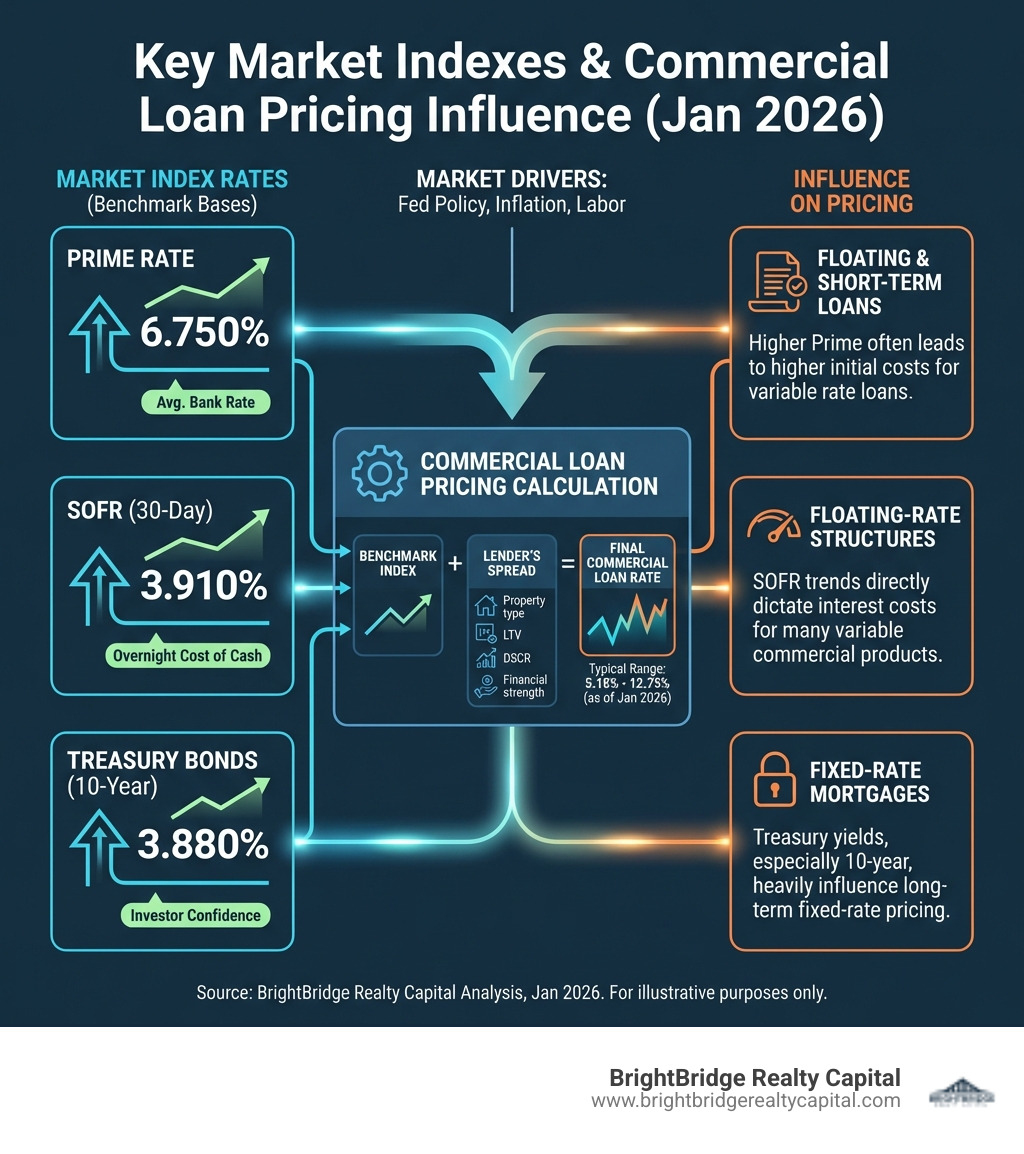
At BrightBridge Realty Capital, we emphasize that while you cannot control the index, you can influence the spread. By presenting a professional loan package with clear financial statements and a well-defined business plan, we help you secure the tightest possible spread in any market environment.
Key Factors Influencing Lending Decisions
When a lender reviews a commercial loan application, they are essentially performing a forensic analysis of risk. Unlike residential lending, which is largely automated, commercial underwriting is an art form that balances hard data with market intuition. To secure the best commercial investment property loan rates, you must understand the variables that move the needle for an underwriter.
How Property Type Impacts Commercial Investment Property Loan Rates
Lenders view different asset classes through different lenses of risk. The "stability" of the income stream is the primary concern.
- Multi-Family (Apartments): Generally considered the lowest-risk commercial asset. Everyone needs a place to live, and the granular nature of the tenant base (many small leases) means the loss of one tenant doesn't jeopardize the loan. Consequently, multi-family properties often enjoy the lowest commercial investment property loan rates.
- Industrial and Warehouse: This sector has seen a massive surge in demand due to e-commerce. Modern "last-mile" distribution centers are highly prized by lenders. However, older industrial sites with environmental concerns or specialized layouts may face higher rates due to limited resale potential.
- Retail: This is a bifurcated market. Grocery-anchored centers are viewed favorably, while unanchored strip malls or regional malls are often seen as high-risk. Lenders look closely at "tenant credit"—a lease from a national brand like Starbucks is worth much more than a lease from a local boutique.
- Office: In the post-pandemic era, office space is under intense scrutiny. Lenders are cautious about high-rise office towers in CBDs (Central Business Districts) and often require higher DSCRs and lower LTVs, leading to higher effective rates.
- Specialized Real Estate: Hotels, car washes, and self-storage facilities are considered "operationally intensive." Their success depends heavily on management quality. Because these are often single-purpose buildings, they carry an "illiquidity premium," meaning rates are typically 1% to 2% higher than multi-family assets.
Borrower Creditworthiness and Financials
While the property is the primary collateral, the borrower's financial health provides the secondary source of repayment. Lenders want to know that if the property has a bad quarter, the borrower has the "dry powder" to cover the mortgage.
- Business Credit Score: Lenders use the FICO SBSS score to pre-screen SBA loans. A score of 160+ is generally the target. For larger deals, the Dun & Bradstreet PAYDEX Score is vital. A score of 80+ indicates that the business pays its bills on time, which builds trust with the lender's credit committee.
- Personal Credit Score: Even for non-recourse loans, lenders often check the personal FICO scores of any principal with a 20% or greater stake. A score below 680 can be a deal-breaker for conventional bank financing, while a 720+ score can help unlock the most competitive tiers of commercial investment property loan rates.
- Net Operating Income (NOI) and Global Cash Flow: Lenders don't just look at the property's income; they look at the borrower's "global" position. If you own ten other properties that are all struggling, the lender will view your new application as high-risk, regardless of how well the subject property is performing.
- Experience and Track Record: For value-add projects or new construction, experience is non-negotiable. A developer who has successfully completed five similar projects will receive much better terms than a first-time investor. Lenders often ask for a "Schedule of Real Estate Owned" (SREO) to verify your history in the market.
- Liquidity and Net Worth: Most lenders require the borrower's net worth to be at least equal to the loan amount, and they want to see "post-closing liquidity" (cash in the bank) equal to 6-12 months of debt service payments.
Navigating Loan Types and Structures
The "menu" of commercial financing is extensive, and choosing the wrong item can be a costly mistake. Each loan type has a specific purpose, and the commercial investment property loan rates associated with them reflect that purpose. Whether you are looking for long-term stability or short-term speed, there is a structure designed for your needs.
The Spectrum of Commercial Loan Products
- Conventional Commercial Mortgages: These are the bread and butter of the industry. Offered by local and national banks, they provide competitive rates for stabilized properties. They typically feature 5, 7, or 10-year terms with 20 or 25-year amortization. The downside? They almost always require a personal guarantee (recourse) and have strict reporting requirements.
- SBA 504 loan: This is a powerful tool for business owners who want to own their facility. By combining a bank loan with a CDC loan, you can achieve 90% financing. The SBA portion is a 20 or 25-year fixed rate, which is incredibly attractive in a rising-rate environment. This program is specifically for owner-occupied properties (51%+ for existing buildings, 60%+ for new construction).
- CMBS (Conduit) Loans: These loans are pooled into bonds and sold to investors. They are famous for being "non-recourse," meaning the lender's only recourse in a default is the property itself, not the borrower's personal assets. CMBS loans offer high leverage and long amortization, but they are very rigid. Once the loan is closed, making changes to the property or the ownership structure can be difficult and expensive.
- Bridge Loans: At BrightBridge Realty Capital, we see bridge loans as a strategic bridge to a better future. These are short-term (1-3 years) and carry higher commercial investment property loan rates (often 8% to 12%). They are used when a property isn't yet ready for a conventional loan—perhaps it needs renovation, or it's currently vacant. The goal is to use the bridge capital to increase the property's value and then refinance into a low-rate permanent loan.
- Hard Money Loans: When speed is the only thing that matters, hard money is the answer. These loans are funded by private individuals or small groups. They don't care about your credit score as much as they care about the property's "as-is" value. Rates are high (10%+), but we can often close these in 7 days, allowing you to snap up a distressed asset before the competition even gets an appraisal.
- Agency Loans (Fannie Mae & Freddie Mac): These are the gold standard for multi-family lending. They offer the lowest commercial investment property loan rates, non-recourse terms, and supplemental financing options. However, they are only available for high-quality apartment buildings and require experienced sponsors.
Critical Structural Terms to Consider
- Loan-to-Value (LTV) vs. Loan-to-Cost (LTC): For a purchase, lenders look at LTV. For a renovation project, they look at LTC. If you are buying a building for $1M and putting $500k into it, a lender might give you 75% of the total $1.5M cost. Understanding the difference is key to managing your capital stack.
- Debt Service Coverage Ratio (DSCR): This is the property's "breathing room." If your NOI is $125,000 and your annual mortgage payments are $100,000, your DSCR is 1.25. Lenders use this to ensure that even if income drops slightly, you can still pay the mortgage. A higher DSCR often unlocks lower commercial investment property loan rates.
- Amortization vs. Term: A loan might have a 5-year term but a 25-year amortization. This means your monthly payments are calculated as if you had 25 years to pay it off, but at the end of year 5, the entire remaining balance (the balloon) is due. This creates "refinance risk," which is why investors must always have an eye on future market conditions.
- Prepayment Penalties: This is where many investors get blindsided.
- Yield Maintenance: A complex formula that ensures the lender gets the same profit they would have made if you had kept the loan to maturity. It can be incredibly expensive if rates have dropped.
- Defeasance: Instead of paying cash to the lender, you buy a portfolio of Treasuries that mimics the loan's cash flow. This is common in CMBS loans.
- Step-Down (e.g., 5-4-3-2-1): A simple percentage of the loan balance that decreases each year. This is the most borrower-friendly option and provides the most flexibility for an exit.
Frequently Asked Questions
In our daily interactions with investors across the country, we encounter a wide range of questions regarding commercial investment property loan rates. Here, we provide detailed answers to the most common queries to help you prepare for your next application.
How do commercial mortgage rates differ from residential rates?
The gap between residential and commercial rates is driven by three factors: risk, liquidity, and complexity.
- Risk and Underwriting: Residential loans are backed by the "ability to pay" of an individual, often supported by a stable W-2 job. Commercial loans are backed by the "ability to perform" of a business or property. Because business income is more volatile than a salary, lenders charge a higher rate to compensate for that volatility.
- Liquidity Premium: If a bank forecloses on a house, they can usually sell it in 30-60 days. If they foreclose on a specialized chemical plant or a half-vacant shopping mall, it could take years to find a buyer. This "illiquidity" is a major risk for banks, and they price it into the commercial investment property loan rates as a premium, typically 0.50% to 1.00% higher than residential rates.
- Recourse vs. Non-Recourse: Most residential loans are effectively recourse (you are personally liable). In the commercial world, many large loans are non-recourse. To offer a loan where the lender cannot sue the borrower for a deficiency, the lender charges a higher interest rate to offset the increased risk.
What are the typical closing costs for a commercial loan?
Closing a commercial loan is a significant financial undertaking. While a residential closing might cost $5,000, a commercial closing can easily exceed $50,000 depending on the deal size. You should budget between 1% and 5% of the loan amount for these costs.
- Origination and Underwriting: Lenders charge an origination fee (usually 1 point) to cover the cost of putting the deal together. Underwriting fees cover the internal labor of the credit team.
- The Appraisal: A commercial appraisal is a massive document, often 100+ pages, that analyzes market trends, comparable sales, and income potential. These cost anywhere from $3,000 for a small office to $20,000+ for a complex industrial site.
- Environmental Due Diligence: Lenders require a Phase I Environmental Site Assessment (ESA) to ensure there is no soil or groundwater contamination. If the Phase I finds issues, a Phase II (drilling and testing) may be required, which can cost an additional $10,000 to $20,000.
- Legal and Title: Commercial title insurance is more expensive because the policies are larger and the searches are more complex. Additionally, you will likely pay for the lender's legal counsel to draft the loan documents, which can range from $5,000 to $25,000.
How long does the commercial loan process take?
The timeline for a commercial loan is measured in months, not weeks. The median time to close a conventional commercial mortgage is approximately 90 days.
- The Due Diligence Phase (Weeks 1-4): This is when the lender collects your tax returns, P&Ls, rent rolls, and bank statements. They will also order the appraisal and environmental reports during this time.
- The Underwriting Phase (Weeks 5-8): The lender's credit team analyzes the reports and the property's cash flow. They may ask for "clarifications" on certain expenses or tenant leases. This is often the most stressful part of the process for the borrower.
- The Closing Phase (Weeks 9-12): Once the loan is approved by the credit committee, the lawyers take over. They perform title searches, verify insurance, and finalize the loan agreement.
At BrightBridge Realty Capital, we recognize that in real estate, time is money. While a bank might take 90 days, we have optimized our internal processes to move much faster. We can often provide a term sheet within 48 hours and close bridge or hard money loans in as little as 7 to 10 business days. Our goal is to provide the speed of a private lender with the professionalism and competitive commercial investment property loan rates of a major institution.
Conclusion
Mastering the world of commercial investment property loan rates is a journey that requires both a macro view of the economy and a micro view of your specific asset. As we have seen, the rate you are quoted is the result of a complex calculation involving benchmark indexes like SOFR and Treasuries, combined with a risk spread that accounts for everything from your property's tenant mix to your personal credit history.
In the current 2026 market, the difference between a successful investment and a financial burden often comes down to the structure of the debt. A low rate is meaningless if the loan's restrictive covenants prevent you from executing your business plan. Conversely, a higher-rate bridge loan can be the most profitable tool in your arsenal if it allows you to stabilize a property and unlock its true value. The key is to align your financing with your exit strategy.
At BrightBridge Realty Capital, we pride ourselves on being more than just a source of capital; we are a strategic partner for our clients. Based in New York, NY, but operating nationwide, we offer a streamlined, direct lending experience that bypasses the bureaucracy of traditional banks. Whether you are looking for the long-term security of a conventional mortgage, the high leverage of an SBA loan, or the rapid execution of a bridge loan, we have the expertise to guide you.
Our commitment is simple: we provide quick, flexible funding with transparent terms and competitive commercial investment property loan rates. We understand the New York market and the national landscape, and we are ready to help you secure the financing you need to grow your portfolio. Don't let the complexities of commercial finance slow you down—partner with a lender that moves at the speed of your business.