How to Access and Use an Investment Property Equity Line at Once

Summary
Unlock real estate potential! Learn how to access and strategically use an investment property equity line for growth and renovations.
Why Investment Property Equity Lines Are Essential for Real Estate Investors
An investment property equity line, often referred to as a HELOC on an investment property, is a powerful financial instrument for savvy real estate investors. It functions as a revolving line of credit secured by the equity you've built in a rental or investment property. Unlike traditional term loans that provide a single lump sum, an equity line allows you to draw funds as needed, up to a pre-approved limit. This flexibility is a game-changer, as you only accrue and pay interest on the portion of the credit line you actively use. This structure makes it an exceptionally efficient and adaptable tool for managing the dynamic financial needs of a growing real estate portfolio.
Key Features of Investment Property Equity Lines:
- Loan-to-Value (LTV) Ratios: Lenders typically allow you to borrow up to a combined loan-to-value (CLTV) of 70-80% of your property's appraised value, minus any existing mortgage balances.
- Draw Period with Interest-Only Payments: These products feature a designated “draw period,” usually lasting from 5 to 15 years. During this phase, you can access funds and are typically only required to make interest payments on the outstanding balance, which helps maintain lower monthly carrying costs.
- Variable Interest Rates: The interest rates on these lines of credit are almost always variable, meaning they are tied to a benchmark index like the Wall Street Journal Prime Rate. As the prime rate fluctuates, so will your interest rate and monthly payment.
- Stricter Qualification Standards: Due to the perceived higher risk associated with investment properties, lenders impose more rigorous qualification criteria. This often includes a minimum credit score of 700-720, a comprehensive review of your debt-to-income ratio, and a requirement to hold substantial cash reserves, often equivalent to 6 or more months of total property expenses.
Leveraging the equity in your existing properties can open up significant capital, enabling you to seize new investment opportunities without the need to liquidate your current assets. However, it's crucial to recognize that these specialized equity lines are more challenging to secure than their primary residence counterparts. They are harder to find, as many major national banks do not offer them, necessitating a search for specialized lenders. Furthermore, they invariably come with higher interest rates and stricter underwriting to compensate the lender for the increased risk. This makes finding a knowledgeable lending partner absolutely essential.
I'm Daniel Lopez, a senior loan officer at BrightBridge Realty Capital. With years of experience in real estate finance, I've successfully guided countless investors through the process of securing and strategically deploying an investment property equity line to scale their portfolios. While obtaining these products demands more thorough preparation and a stronger financial profile, they frequently represent the most direct and rapid path to accessing the capital needed to close your next deal and continue your growth trajectory.
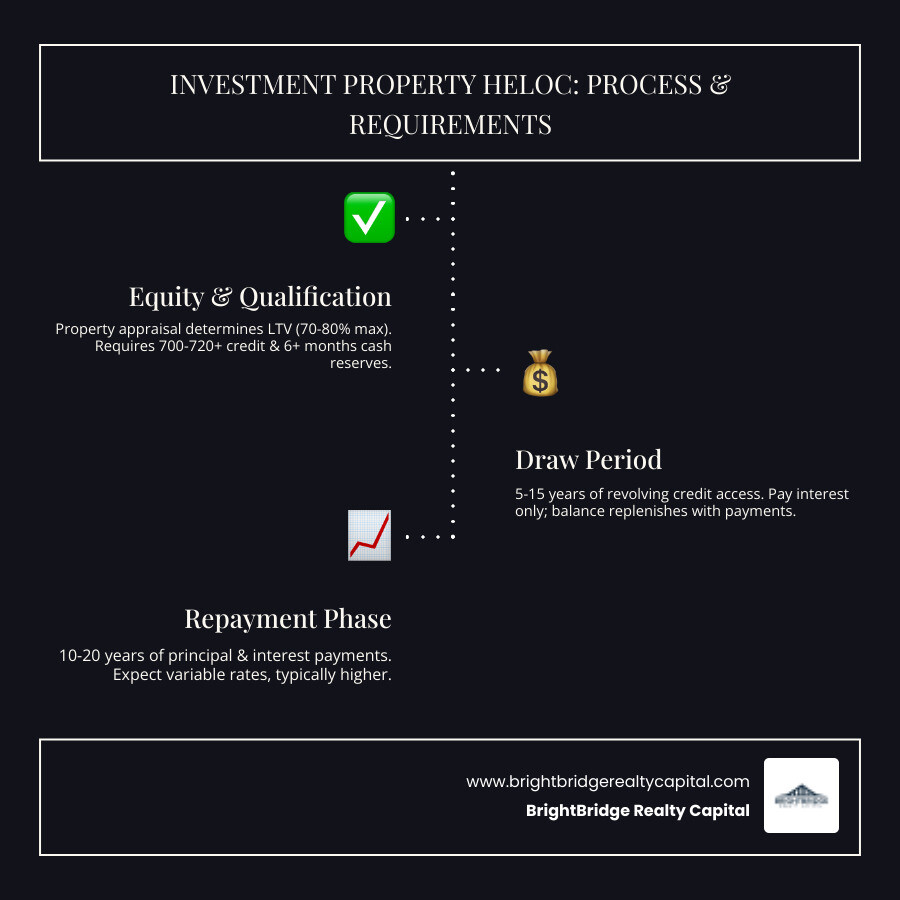
Common investment property equity line vocab:
Understanding the Investment Property Equity Line
Think of an investment property equity line as a sophisticated, high-limit credit card that is secured by your real estate asset. Legally, it is a second-position mortgage that establishes a revolving line of credit. This structure allows you to borrow funds up to a predetermined limit, repay the balance, and then borrow again as needed throughout the life of the draw period. A key advantage is that you only pay interest on the amount you have actually drawn, not the total credit limit. This on-demand access to capital provides unparalleled financial agility for an active investor.
Here's a more detailed breakdown of how it works: The loan is bifurcated into two distinct phases. It begins with the draw period, which typically spans 5 to 15 years. During this time, you have the freedom to access funds whenever you need them, for any business purpose. Your monthly payments are usually interest-only, which significantly lowers your monthly outlay and preserves cash flow for other operational needs. For instance, if you secure a $100,000 line of credit but only need $30,000 to cover renovation costs for a new acquisition, your interest calculation and payment will be based solely on that $30,000, not the full $100,000.
Once the draw period concludes, you enter the repayment period. This phase typically lasts from 10 to 20 years. During this time, you can no longer borrow new funds from the line of credit. Your monthly payment is then recalculated (or amortized) to include both principal and interest, ensuring the entire outstanding balance is paid off by the end of the loan term. This transition results in a substantially higher monthly payment, a factor that must be carefully planned for in your long-term financial strategy.
The primary variable to manage is the interest rate. The vast majority of investment property equity lines feature variable interest rates. These rates are composed of a benchmark index, such as the Wall Street Journal Prime Rate, plus a margin set by the lender (e.g., Prime + 2%). As the benchmark rate changes with market conditions, your interest rate will adjust accordingly, leading to fluctuations in your monthly payment.
For more details, check out our HELOC on Investment Property and Second Home Equity Loan resources.
Key Differences: Investment vs. Primary Residence HELOCs
From a lender's perspective, an investment property carries a significantly higher risk profile than a primary residence. The underwriting logic is straightforward: if an individual faces financial hardship, they will prioritize the mortgage payment on the home they live in over a payment on a rental property. This fundamental difference in perceived risk leads to a series of more stringent requirements for an investment property equity line.
- Credit Score: While a primary residence HELOC might be attainable with a credit score in the 650-680 range, lenders will almost universally require a score of 700-720 or higher for an investment property. Some specialized lenders may even look for scores of 740+ for their best terms.
- Loan-to-Value (LTV) Ratio: Lenders are more conservative with investment properties. They typically cap the combined loan-to-value (CLTV) for an investment property HELOC at 70-80%. In contrast, you might be able to borrow up to 85-90% on your primary home. This means you need to have a larger equity stake—at least 20-30%—in your investment property to qualify.
- Cash Reserves: This is a critical underwriting point. Lenders will want to see proof of significant liquid assets. Be prepared to show 6 to 12 months of reserves (covering principal, interest, taxes, and insurance for the subject property) in a verifiable bank or brokerage account. This requirement is far less stringent for primary residences.
- Interest Rates: The higher risk translates directly to higher costs. Expect interest rates to be approximately 1.5 to 3 percentage points higher for an investment property HELOC compared to a primary one. In today's market, this could mean rates falling between 12-15%, depending on your qualifications.
- Lender Availability: The market for these products is much smaller. Far fewer lenders offer investment property HELOCs. Most large, national banks avoid them due to the risk, pushing investors toward specialized non-bank lenders, regional banks, and credit unions that have expertise in real estate investment financing.
- Right of Rescission: This is a crucial legal distinction. For a primary residence HELOC, federal law grants you a three-day “right of rescission,” allowing you to cancel the loan without penalty after closing. This right does not apply to investment properties. Once you sign the closing documents, the loan is final and binding.
Qualifying for and Securing Your Equity Line

Getting approved for an investment property equity line is a meticulous process that demands solid financial standing and thorough preparation. Success hinges on a three-part journey: conducting a rigorous self-assessment of your financial profile, strategically identifying and approaching the right lender, and skillfully navigating the underwriting and closing stages.
Step 1: Assess Your Financial Profile and Equity
Before you even think about filling out an application, you must have a crystal-clear understanding of your financial position from a lender's point of view. Lenders require a complete and verifiable picture of your financial stability and capacity to handle additional debt.
- Credit Score: This is your first hurdle. Aim for a FICO score of 700-720 or higher. A score above 740 will put you in the top tier and give you access to the best possible rates and terms. If your score is below this threshold, it is wise to pause and take concrete steps to improve it—such as paying down credit card balances and correcting any errors on your report—before applying.
- Debt-to-Income (DTI) Ratio: Lenders will scrutinize your DTI, which compares your total monthly debt payments to your gross monthly income. For investment properties, some lenders may allow a DTI up to 50%, but this often depends on the strength of other factors like credit score and cash reserves. Crucially, they will typically include a portion of the anticipated rental income from the property in your income calculation, which can help you qualify.
- Cash Reserves: This is a non-negotiable requirement and a key indicator of your financial resilience. Lenders want to see that you can cover at least 6 months of PITIA (principal, interest, taxes, insurance, and association dues) for the investment property, in addition to the potential HELOC payment. These funds must be liquid and accessible, not tied up in retirement accounts.
- Equity Calculation: You must have substantial equity to tap into. Lenders will only allow you to borrow against a portion of it. The standard formula is: (Property's Appraised Value x Maximum LTV %) - Existing Mortgage Balance = Maximum HELOC Amount. For example: ($500,000 Value x 75% LTV) - $250,000 Mortgage = $125,000 HELOC. You'll need at least 20-30% equity to even be considered.
Step 2: Find the Right Lender and Apply
Since many large, consumer-focused banks do not offer an investment property equity line, your search must be more targeted. You'll need to look for lenders who specialize in financing for real estate investors.
- Where to Look: Your best bets are often credit unions, small regional banks, and direct private lenders like BrightBridge Realty Capital. These institutions have the underwriting expertise to evaluate investment properties and investor profiles. Online lenders are another viable option, but perform due diligence to ensure they have a proven track record with investment properties, not just primary homes.
- Shop Around and Compare: Never take the first offer. Obtain quotes and term sheets from at least three to five different lenders. Compare not just the interest rate, but also the draw period length, repayment terms, closing costs, annual fees, and any prepayment or cancellation penalties. Loan amounts can vary significantly, typically ranging from $20,000 to over $200,000.
- Gather Your Documentation: Be prepared to provide a comprehensive documentation package. This will include two years of personal and business tax returns, recent pay stubs or year-to-date P&L statements if self-employed, copies of all current mortgage statements, property tax and insurance declarations, and at least two months of bank statements to verify your cash reserves. For the property itself, you'll need a copy of the current lease agreement to prove rental income.
Step 3: Steer Underwriting and Closing
Once your application is submitted, it moves to the underwriting department. The underwriter's job is to verify every piece of information you've provided. They will order a full appraisal of the property to confirm its value. They will scrutinize your rental history, the terms of your lease, and the stability of your personal income. Be prepared to answer questions and provide additional documentation promptly to keep the process moving.
The closing process for an investment property equity line can be remarkably fast compared to a traditional mortgage—sometimes closing in as little as two to three weeks, though 30-45 days is a more standard timeframe. This speed can be a significant competitive advantage when a time-sensitive investment opportunity arises.
There is no right of rescission on investment property loans. The moment you sign the closing documents, the loan is final. It is imperative that you review all loan documents with extreme care. Pay close attention to the interest rate structure (including any rate caps), the exact terms of the draw and repayment periods, and all potential fees.
Weighing the Pros and Cons of Using Your Equity

Leveraging your property's equity is a significant financial decision that can dramatically alter your investment trajectory. An investment property equity line can serve as a powerful catalyst, accelerating your portfolio's growth and enhancing your operational agility. However, this power comes with commensurate risk. You are placing an additional lien on your asset, using it as collateral for a new line of credit. A clear-eyed assessment of both the advantages and the potential pitfalls is essential before proceeding.
The Advantages of an Investment Property Equity Line
The primary appeal for sophisticated investors lies in the unparalleled flexibility and efficiency of this financial tool. Unlike a lump-sum loan, a HELOC provides a reservoir of capital that you can tap into precisely when and how you need it.
- Flexible Cash Access: You can draw funds as needed for various purposes, repay the balance, and draw again. This revolving nature is ideal for managing multiple concurrent projects, covering unexpected capital expenditures, or having dry powder ready for a new acquisition. You only pay interest on what you use, making it a cost-effective way to maintain liquidity.
- Interest-Only Payments: During the initial draw period (which can last up to 15 years), your required monthly payments are typically interest-only. This results in a much lower monthly payment compared to an amortizing loan, which significantly improves your property's cash flow and frees up capital for other investments.
- Lower Rates than Unsecured Debt: While rates are higher than a primary residence HELOC, they are generally much lower than those for unsecured financing options like personal loans or credit cards. Because the debt is secured by a valuable real estate asset, lenders can offer more favorable rates.
- Protects Your Primary Residence: By leveraging an investment property, you are insulating your personal home from the direct risks of your investment activities. This separation is a cornerstone of sound asset protection strategy for any serious real estate investor.
- Potential Tax Benefits: The interest paid on the loan may be tax-deductible. According to current IRS guidelines, if you use the funds to buy, build, or substantially improve the investment property that secures the loan, the interest is generally deductible as a business expense. As always, tax laws are complex and subject to change, so you must consult with a qualified tax advisor to confirm how this applies to your specific financial situation.
- Speed and Agility: In the competitive world of real estate, speed is a weapon. Specialized lenders can often close an investment property equity line in as little as two weeks. This allows you to make more compelling offers and close on deals much faster than competitors relying on slower, traditional financing.
The Disadvantages and Risks to Consider
It's time for a reality check. These financial instruments are not without significant risks and drawbacks that demand careful consideration and disciplined management.
- Limited Availability: The market for these loans is a niche one. Fewer lenders offer them, which means less competition and potentially less favorable terms. Finding a lender with the right product and expertise can be a challenge in itself.
- Higher Costs and Fees: Be prepared for higher costs across the board. Interest rates are typically 1.5 to 3 percentage points higher than for a primary residence HELOC. You may also encounter annual fees to keep the line open, as well as early closure or cancellation penalties if you pay it off and close it within a certain timeframe (usually the first 2-3 years).
- Variable Rate Risk: The variable interest rate is a double-edged sword. While it may start low, it can rise if the benchmark Prime Rate increases. A significant rate hike could dramatically increase your monthly payment, potentially straining your cash flow and disrupting your financial projections.
- Foreclosure Risk: This is the most significant risk. An investment property HELOC is a secured loan, meaning the property is the collateral. If you are unable to make the payments for any reason—such as extended vacancy or unexpected personal financial hardship—the lender has the legal right to foreclose on your investment property, and you could lose the asset entirely.
- Risk of Negative Equity: If the real estate market experiences a downturn and property values fall, you could find yourself in a position of negative equity, where you owe more on the property (including the first mortgage and the HELOC) than it is worth. This “underwater” position makes it extremely difficult to sell or refinance the property and can trap you in the investment.
An investment property equity line is best suited for disciplined, experienced investors who fully understand these risks and have a clear, profitable strategy for deploying the funds.
Strategic Ways to Use Your Investment Property Equity Line

An investment property equity line is not just a loan; it's strategic fuel for your real estate empire. The most successful investors view it as a tool to multiply opportunities and accelerate returns, allowing them to move with a speed and confidence that saving cash alone cannot provide. The fundamental principle is to use these borrowed funds for strategies that generate a return on investment (ROI) that is significantly higher than the cost of borrowing. When used correctly, it creates a powerful cycle of growth.
Fund a New Property Purchase
This is arguably the most powerful and common use of an equity line for portfolio expansion. It allows you to leverage the success of a past investment to fund a future one.
- Source Your Down Payments: Instead of spending years painstakingly saving up the 20-25% down payment required for a new investment property, you can tap your existing equity. This allows you to acquire new income-producing assets much more frequently, compounding your growth.
- Make All-Cash Offers: In a competitive real estate market, a cash offer is king. It signals strength and certainty to sellers, often allowing you to beat out other financed offers or even negotiate a lower purchase price. You can use your HELOC to purchase a property with cash, then secure long-term financing on the new property after the closing (a strategy known as the BRRRR method's refinancing step) to pay back the equity line.
- Diversify Your Portfolio: Use the funds to strategically diversify your holdings. If your portfolio is concentrated in single-family homes, you might use your equity line to purchase a small multifamily property like a duplex or quadplex. Alternatively, you could use the capital to expand into a new geographic market with higher growth potential, reducing your overall risk.
For more information on expanding your portfolio, explore our guide on investment property loans.
Renovate or Upgrade Existing Properties
Sometimes the best investment you can make is in the properties you already own. Your investment property equity line is the perfect vehicle for funding value-add improvements that can generate substantial returns.
- Boost Rental Income and Force Appreciation: A strategic renovation—such as modernizing a kitchen with new countertops and stainless steel appliances, updating bathrooms, or adding a bedroom—can justify a significant rent increase. This not only improves your monthly cash flow but also “forces” the appreciation of the property's value beyond standard market growth.
- Create a Positive Equity Feedback Loop: This is a powerful wealth-building concept. You borrow against today's equity to fund renovations. Those renovations increase the property's value and rental income, which in turn creates even more equity. You can then use that newly created equity for your next project, creating a self-sustaining growth cycle.
- Attract and Retain Higher-Quality Tenants: An updated, modern, and well-maintained property is far more attractive to premium tenants. These tenants are more likely to pay rent on time, take better care of the unit, and stay for longer periods, which reduces your turnover costs and vacancy rates.
If you're planning major renovations, learn about our ground up construction loans.
Cover Business and Emergency Expenses
Professional real estate investing is a business, and like any business, it has unpredictable expenses and cash flow gaps. An investment property equity line serves as a crucial financial safety net and operational tool.
- Manage Vacancy Periods: Even the best properties experience tenant turnover. Your equity line can provide the liquidity to cover mortgage payments, utilities, and other carrying costs during these vacant periods without forcing you to dip into your personal savings.
- Handle Unexpected Major Repairs: When an HVAC system fails in the middle of summer or a roof begins to leak after a major storm, you need access to funds immediately. Delaying repairs can lead to more extensive damage and tenant disputes. A HELOC provides the quick cash needed to address these costly emergencies promptly.
- Scale Your Operations: As your portfolio grows, you may need to invest in your business infrastructure. Use the funds to hire a property manager, invest in accounting software, or launch a marketing campaign to fill vacancies faster. These are investments that can improve your efficiency and profitability over the long term.
Investment Property Equity Line vs. Alternatives
While an investment property equity line is a uniquely powerful tool, it's not the only option for accessing capital from your real estate assets. A sophisticated investor understands the full spectrum of available financing to choose the right product for a specific goal, as each is designed for different scenarios. The answer to can you get a home equity loan on investment or rental property? is a definitive yes, but the structure of that loan matters significantly.
Home Equity Loan (HELOAN)
A HELOAN, or home equity loan, functions very differently from an equity line. It provides a one-time, lump-sum disbursement of funds at a fixed interest rate. This structure results in a predictable, stable monthly payment that will not change over the life of the loan. It's an excellent choice for large, singular expenses where you know the exact cost upfront, such as a major property renovation with a fixed contractor bid or the precise down payment needed for another property. The key difference from an equity line is the complete lack of flexibility; you receive all the funds at once and begin paying interest on the full amount immediately. This makes it less suitable for ongoing projects with uncertain costs, or for use as a general emergency fund where you don't want to pay interest on unused capital.
Cash-Out Refinance
A cash-out refinance involves replacing your current mortgage with a new, larger one, and you receive the difference between the two loan amounts in cash. This can be a highly effective strategy, particularly if you can also secure a lower interest rate on your new primary mortgage, consolidating your debt at a more favorable rate. However, this process requires a full mortgage application and underwriting, which means higher closing costs and a longer timeline (typically 30-60 days) compared to an equity line. You are also resetting the clock on your mortgage amortization schedule, which could mean paying more in total interest over the long term. It's a strategy best deployed when market interest rates are low and you plan to hold the property for many more years.
For more information about similar financing strategies, check out our resources on stabilized bridge loans.
Exploring Other Alternatives to an Investment Property Equity Line
- Bridge Loans: These are short-term financing instruments (typically with terms of 6-24 months) designed to “bridge” a financial gap, such as between buying a new property and selling an existing one or stabilizing a property before securing long-term financing. They offer very fast funding but come with higher interest rates and origination fees. They are ideal for time-sensitive transactions, like a fix-and-flip project or securing a property at auction, where speed is more critical than cost.
- Portfolio Loans: For seasoned investors with multiple properties, a portfolio loan is a powerful tool. It allows you to borrow against the combined equity of your entire portfolio under a single, often cross-collateralized, loan. Because these loans are kept in-house by the lender (not sold on the secondary market), they can offer more flexible and customized terms, as well as streamlined management compared to juggling multiple individual loans.
- DSCR Loans: Debt Service Coverage Ratio (DSCR) loans are a game-changer for many investors. These loans qualify you based almost entirely on the property's rental income rather than your personal DTI. If the property's income is sufficient to cover the mortgage payments (typically a DSCR of 1.25x is required), you can get approved. This is an excellent alternative for self-employed investors, those with complex personal finances, or anyone looking to scale without impacting their personal borrowing capacity. Explore our DSCR loans for more details.
- Personal Loans: These are unsecured loans, meaning they don't require any collateral. This makes them easier to obtain for smaller amounts, but the lack of security results in significantly higher interest rates and much shorter repayment terms compared to an equity line. They are best suited for minor repairs or small business expenses, not for funding significant real estate investments.
- Small Business Loans (SBA): If your real estate activities are structured as a formal business entity, an SBA loan or other commercial loan could be an option. These can provide substantial capital for larger-scale projects, portfolio acquisitions, or major operational costs. However, they often involve a lengthy, complex, and document-intensive application process with very strict federal requirements.
Frequently Asked Questions about Investment Property Equity Lines
Here are straight, no-nonsense answers to the most common questions investors ask when considering an investment property equity line.
Are there tax benefits with an investment property HELOC?
Yes, in many cases, there can be significant tax benefits, but the rules are specific. The interest you pay on an investment property HELOC may be tax-deductible as a business expense. According to IRS regulations, this is generally permissible if you use the funds to buy, build, or substantially improve the property that is securing the loan. For example, using the HELOC to fund a complete kitchen and bath renovation on that same property would likely allow you to deduct the interest. Conversely, if you use the funds for personal expenses like buying a car or paying for a vacation, the interest is not deductible. Tax laws are intricate and can change. Therefore, it is absolutely essential to consult a qualified tax advisor or CPA to understand precisely how the rules apply to your unique financial situation and investment strategy.
How much can I borrow with an investment property equity line?
The amount you can borrow is a function of your property's equity and the lender's specific guidelines on Loan-to-Value (LTV). Most lenders will allow you to borrow up to a combined loan-to-value (CLTV) of 70-80% of your property's current appraised value, minus your outstanding mortgage balance.
Here’s a practical example: Let's say your investment property has a current market appraisal of $500,000, and you still owe $200,000 on your first mortgage. If a lender offers a HELOC with an 80% CLTV limit, the calculation would be: ($500,000 x 80%) - $200,000 = $200,000. In this scenario, you could be approved for a maximum credit line of $200,000. The final approved amount will also depend on your credit score, DTI, and cash reserves. Loan amounts typically range from a minimum of $20,000 to well over $200,000 for qualified borrowers with high-value properties.
Can I get an investment property HELOC if the property is in an LLC?
Yes, you absolutely can, but this is a critical point of differentiation among lenders. You must work with the right kind of lender. Most large, traditional banks are hesitant or will outright refuse to lend to a Limited Liability Company (LLC) for this type of product. However, specialized private and portfolio lenders who cater to real estate investors understand that using an LLC is a standard and prudent practice for liability protection and business organization.
Holding investment property in an LLC is a smart strategy to shield your personal assets from potential lawsuits related to the property. When applying for a loan on a property held in an LLC, you will need to provide the LLC's formation documents, such as the operating agreement and articles of organization, in addition to your personal financial information. Be aware that even when the property is in an LLC, the lender will almost always require a personal guarantee from you as the principal of the company. At BrightBridge Realty Capital, we specialize in working with investors who use LLCs and have streamlined our process to accommodate this common and intelligent business structure.
Conclusion
An investment property equity line is a transformative financial tool that converts the dormant, trapped equity in your rental properties into active, working capital ready for deployment. For the serious real estate investor, it represents a flexible, reliable, and reusable source of funds that allows you to act with decisiveness when opportunity knocks, rather than being sidelined by a lack of liquidity.
With its core benefits of flexible, on-demand access to funds, low interest-only payments during the lengthy draw period, and the ability to close in as little as two weeks, an investment property equity line provides the speed and agility that are critical for success in a competitive market. While it's true that the qualification requirements are stricter and the interest rates are higher than for a loan on a primary residence, the strategic advantage gained is often well worth the cost for a well-prepared and disciplined investor.
Whether your immediate goal is to acquire a new property, execute a value-add renovation on an existing one, or simply establish a robust financial safety net for your business, this tool provides the capital to act with confidence. The key to open uping this potential lies in thoroughly understanding the requirements—from the 700+ credit score and cash reserve mandates to the inherent variable rate risk—and, most importantly, in partnering with a lender who specializes in serving real estate investors.
At BrightBridge Realty Capital, we live and breathe real estate investment finance. We understand the unique challenges and opportunities that investors face because we are dedicated to this market. We specialize in providing fast, flexible funding solutions that are designed to match your ambitions. Our direct lending model means no middlemen, fewer delays, and highly competitive rates custom to your profile.
Are you ready to open up the potential sitting idle in your property? Let's have a conversation about how we can help you turn that equity into your next success story. Explore our comprehensive resources on rental loans and find how we can partner with you to build the real estate portfolio you've always envisioned.