The DIY Approach: Navigating Real Estate Without a Broker
Why No Broker Real Estate is Reshaping the Market
No broker real estate is a model where property buyers, sellers, and renters connect directly, eliminating the need for traditional real estate agents and their associated commission fees. This direct-to-consumer approach is gaining significant traction as technology empowers individuals to take control of their own transactions. Here's a more detailed look at what you need to know:
- How it works: Property owners take on the responsibilities of an agent. They research market prices, prepare and list their homes on specialized platforms or the MLS (Multiple Listing Service) via a flat-fee service, market the property through various channels, conduct showings, and communicate directly with potential buyers or renters. Once an agreement is reached, both parties handle negotiations and paperwork, typically with the assistance of a real estate attorney to ensure legal compliance.
- Main benefit: The primary driver for most is significant financial savings. Sellers can save tens of thousands of dollars in commission fees, which traditionally range from 5-6% of the home's sale price. For buyers, this can translate into lower purchase prices or more room for negotiation, as the seller isn't factoring a large commission into their bottom line.
- Key trade-offs: This autonomy comes at the cost of your time and effort. You are responsible for every aspect of the sale, from professional photography and marketing to scheduling dozens of showings and navigating complex legal disclosures. Furthermore, data from the National Association of Realtors (NAR) consistently shows that homes sold by owner (FSBO) tend to have a lower median sale price than agent-assisted sales—a gap that was recently reported to be around $55,000-$58,000. This potential price difference is a critical factor to weigh against commission savings.
- What you'll need: Success in the no-broker space requires a specific skill set and resources. This includes a deep knowledge of your local real estate market to price your home accurately, a thorough understanding of your state's required legal disclosures to avoid liability, strong marketing and negotiation skills, and, most importantly, the guidance of a qualified real estate attorney to handle contracts and closing procedures.
The traditional real estate commission model has been under immense pressure for years, and recent landmark legal settlements are accelerating this change. In 2025, a 6% commission on a median-priced California home could easily exceed $25,000. That's a substantial sum of money that could otherwise be used to fund your next investment, cover significant renovations, or simply remain in your pocket as hard-earned equity.
The internet has fundamentally changed how real estate transactions happen. What was once an opaque industry controlled by gatekeepers is now an open marketplace. Modern platforms connect property owners directly with a global pool of buyers and renters, effectively cutting out the middleman. Advanced technology, including high-definition virtual tours, AI-driven property recommendations, and access to hyperlocal neighborhood data (crime rates, school ratings, amenities), means buyers can conduct extensive due diligence and make highly informed decisions without an agent guiding every single step.
But going broker-free isn't without its significant challenges. You'll be handling every task an agent typically manages: strategic pricing, creating a marketing plan, staging, hosting open houses, vetting potential buyers, understanding and completing state-mandated disclosures, leading negotiations, and coordinating the closing process. In California alone, the paperwork is extensive; sellers must provide a buyer and seller advisory form, transfer disclosure statement, Megan's Law disclosure, natural and environmental hazards disclosure, and potentially a lead-based paint disclosure. Failing to complete any of these correctly can lead to serious legal and financial repercussions.
The decision isn't just about saving money—it's about control, transparency, and a realistic assessment of your own capabilities and time. Some sellers thrive with the autonomy and challenge, finding the process rewarding. Others, particularly those with busy schedules or limited real estate experience, find the time commitment and legal complexity to be overwhelming.
I'm Daniel Lopez, a loan officer at BrightBridge Realty Capital. I've worked with many savvy investors navigating no broker real estate transactions who need fast, flexible financing for deals they've sourced themselves. Whether you're buying a foreclosure, purchasing from an FSBO seller, or building a rental portfolio, understanding the broker-free landscape is the first step to moving confidently when opportunities arise.
Learn more about no broker real estate:
What is No Broker Real Estate and How Does It Work?
No broker real estate represents a fundamental shift in how property transactions are conducted, empowering individuals to connect directly with buyers or tenants without intermediaries. This peer-to-peer model sidesteps traditional real estate agents, aiming to eliminate their substantial commission fees and place control, transparency, and savings back into the hands of the property owner.
Historically, the real estate market was notoriously opaque. Information was siloed, and access was controlled by licensed agents who acted as gatekeepers. This structure necessitated the use of middlemen who charged hefty commissions, often with little transparency into the work being done. The no broker real estate movement, fueled by the internet and proptech innovation, directly disrupts this century-old model by creating a more efficient, transparent, and cost-effective C2C (consumer-to-consumer) marketplace.
The Core Principle: Direct Connection and Unfiltered Communication
The guiding philosophy behind no broker real estate is the power of direct connection. Instead of an agent acting as a go-between—filtering information, managing communications, and potentially introducing delays or misinterpretations—property owners and prospective buyers or tenants communicate directly. If you're a seller, you are speaking one-on-one with the people who may buy your home. If you're a landlord, you're interacting directly with potential tenants. This unfiltered dialogue fosters a level of clarity and trust that is often missing in traditional transactions.
This direct interaction extends to every critical stage of the process. You schedule property visits based on your own availability, answer detailed questions about the property's history and features with firsthand knowledge, negotiate price and terms based on your own financial goals, and discuss lease terms with a clear understanding of your expectations as a landlord. This directness not only builds rapport but also often leads to faster, more amicable deals because both parties have a clear and immediate understanding of each other's needs, motivations, and limitations.
How Platforms Ensure a Broker-Free Environment
Maintaining the integrity of a broker-free ecosystem is paramount for these platforms. They employ a multi-faceted approach that combines technology, verification processes, and community oversight to connect genuine property owners with genuine tenants and buyers.
First, these platforms lean heavily on technology. Sophisticated algorithms and data science are used to analyze user behavior and listing data in real-time. This technology can identify and flag suspicious activity that suggests broker involvement, such as a single account posting an unusually large number of properties, the use of generic marketing language common among agents, or contact information that traces back to a brokerage. This automated first line of defense is crucial for keeping the marketplace clean at scale.
Second, robust user verification is a critical layer of security. Platforms often require users to prove their identity and their connection to the property. This can involve a variety of methods, including uploading government-issued ID, submitting property tax documents or utility bills to prove ownership, and completing phone or two-factor authentication. This rigorous screening process helps ensure that the individuals interacting on the platform are who they say they are—genuine owners, buyers, and tenants, not professional brokers attempting to exploit the system for leads.
Finally, many platforms empower their user base to police the community through reporting mechanisms, which are supported by manual review teams. If a user suspects a listing is posted by a broker or finds an interaction disingenuous, they can easily report it. This report triggers an internal investigation by a human team that reviews the evidence and takes appropriate action, which may include removing the listing and banning the user. This powerful combination of automated technology, stringent verification, and human oversight is essential for preserving the trust and integrity of the no broker real estate model.
| Feature | Traditional Broker Approach | No Broker Approach |
|---|---|---|
| Intermediary | Real estate agent | None (direct owner-to-buyer/tenant) |
| Commission | Typically 5-6% of sale price (seller pays, split with buyer's agent) | 0% brokerage fee (flat fees for services may apply) |
| Cost to Seller | High (e.g., $25,000+ on a $500k home) | Low (e.g., $99-$500 for MLS listing, legal fees) |
| Cost to Buyer | Indirectly through inflated home price, or direct buyer's agent fee in some markets | Potentially lower purchase price due to seller savings |
| Communication | Through agent(s) | Direct between parties |
| Negotiation | Agent-led | Direct between parties |
| Marketing | Agent handles listing, MLS, showings | Seller handles all marketing, showings, and inquiries |
| Paperwork | Agent assists, attorney for closing | Seller responsible, attorney for legal review/closing |
| Time Commitment | Lower for seller/buyer | Higher for seller/buyer |
| Transparency | Can be limited by agent communication | High (direct dialogue) |
The Financial Benefits and Realities of Going Broker-Free
The primary allure of no broker real estate often boils down to one powerful word: savings. While the financial benefits are tangible and significant, it’s crucial to approach this path with a clear-eyed, balanced understanding of both the potential gains and the financial realities of the market.
How You Save Money on Brokerage
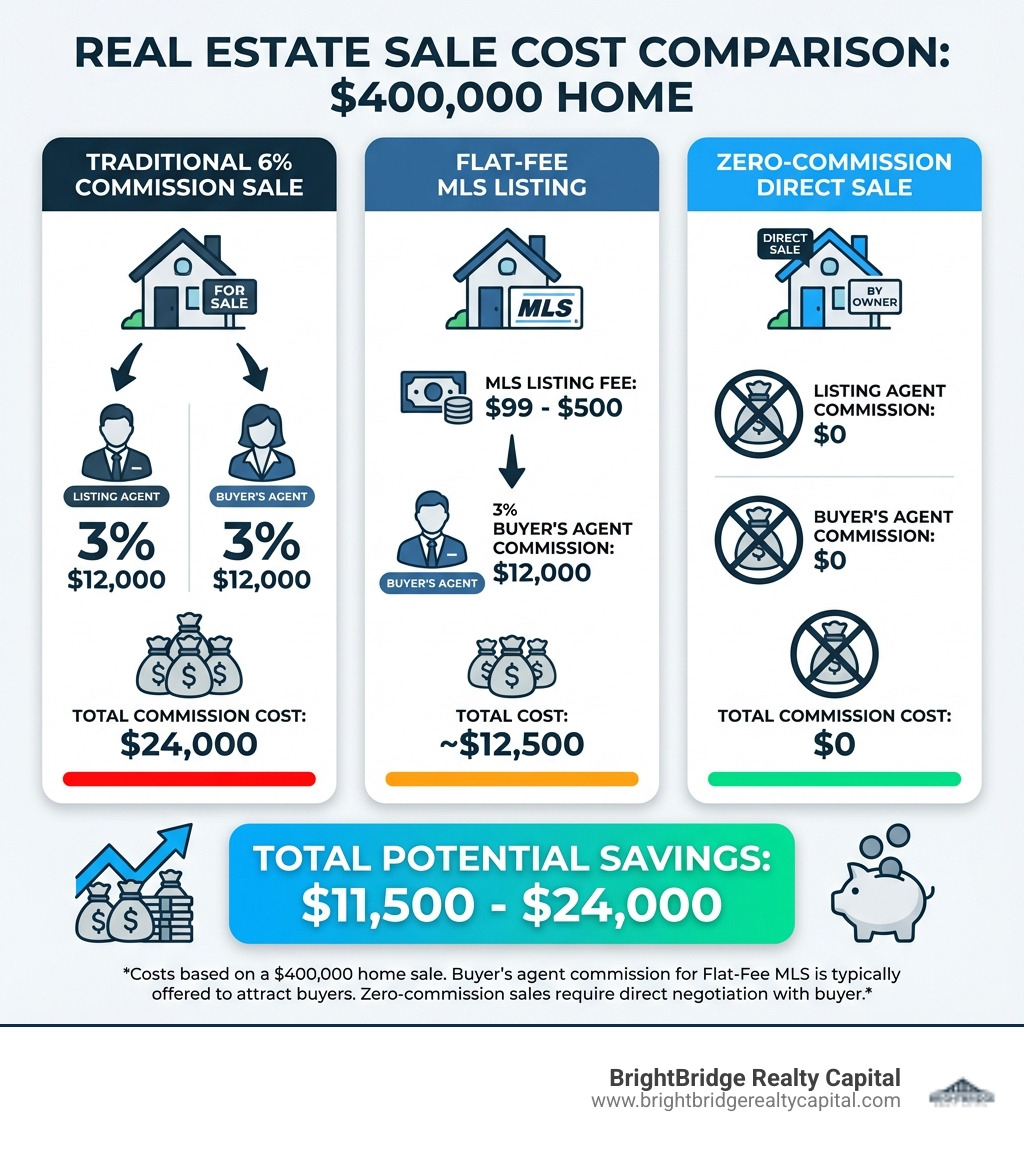
In the traditional U.S. real estate model, sellers are typically responsible for paying a commission of 5% to 6%, which is then split between the seller's agent and the buyer's agent. On a $500,000 home, that amounts to $25,000 to $30,000—a staggering amount of money that comes directly out of the seller's profit. To put that in perspective, for an average homeowner, it can take five to seven years of mortgage payments and market appreciation just to build up that much equity. Losing it in a single transaction can be a major financial setback.
With no broker real estate, that percentage-based commission is drastically reduced or completely eliminated. Instead of a variable fee tied to your home's value, you might pay a small, predictable flat fee for specific à la carte services. For instance, many companies allow you to list your home on the Multiple Listing Service (MLS)—the primary database used by all real estate agents—for a flat fee, often ranging from just $99 to $500. This single action gets your property maximum exposure on sites like Zillow, Redfin, and Realtor.com without committing to a full commission. One seller reported saving $5,250 in listing commission by using a local broker for a flat-fee MLS listing while still offering a competitive commission to the buyer's agent.
For real estate investors, these savings are not just a bonus; they are a critical component of a successful strategy. The thousands saved on commissions can directly improve the capitalization rate (cap rate) and overall return on investment (ROI), potentially turning a marginal deal into a highly profitable one.
A Balanced View: Potential Downsides and Costs
While the savings are compelling, the no broker real estate route is not a simple path to riches. It demands significant effort, market knowledge, and realistic expectations about the potential financial trade-offs.
One of the most cited concerns is the potential for a lower final sale price. According to data from the National Association of Realtors (NAR), homes sold by owners (FSBOs) consistently sell for less than agent-assisted sales. Recent 2024 NAR data suggests the median FSBO home sold for about $55,000 less than the median selling price of all homes. This gap can be attributed to several factors: agents often have superior negotiation skills honed over many transactions, a broader marketing reach through established networks, and access to a larger pool of vetted, serious buyers. Additionally, many buyers approach a FSBO sale with the expectation of a discount, assuming the seller is saving on commission and should pass those savings along.
Another major consideration is the significant time commitment. When you go broker-free, you are the sole project manager. You become the marketing expert, the showing coordinator, the negotiator, and the paperwork administrator. This requires a substantial investment of personal time and energy, which can be particularly challenging for those with demanding jobs or family commitments.
Factoring in Your Own Marketing and Other Costs
While you save on commission, you don't eliminate all costs. To compete with professionally listed homes, you will likely need to spend money on marketing. These costs, while far lower than a 3% commission, must be factored into your budget. A typical marketing budget might include:
- Professional Photography & Videography: $300 - $800. High-quality visuals are non-negotiable in today's market.
- Flat-Fee MLS Listing: $99 - $500. Essential for broad exposure.
- Yard Signs & Flyers: $50 - $150.
- Online Advertising: $100 - $300 for social media boosts or featured listings.
- Home Staging Consultation or Services: $200 - $2,000+, depending on the level of service.
Finally, there are the legal and closing risks. Real estate transactions are governed by complex contracts and a web of state-specific disclosure requirements. A mistake in a disclosure form or a poorly worded clause in a contract can lead to costly legal disputes down the road. While no law requires you to use an agent, we strongly recommend hiring a real estate attorney for legal review and closing, especially in states with intricate real estate laws like New York or Massachusetts. The attorney's fee (typically $800 - $2,500) is a crucial investment to protect your interests. For more insights, we recommend reviewing resources like "Selling Your House Without an Agent".

A Step-by-Step Guide to Selling Your Home Without a Broker
If you've weighed the pros and cons and are ready to embrace the DIY spirit of no broker real estate, this path offers unparalleled control and significant potential savings. However, it demands preparation, diligence, and attention to detail. Here's our comprehensive step-by-step guide to navigating a successful broker-free home sale.
Step 1: Pricing and Preparing Your Property
Accurate pricing and impeccable presentation are the twin pillars of any successful home sale. Getting these right from the start will save you time, frustration, and money.
- Conduct a Detailed Comparative Market Analysis (CMA): Pricing your home correctly is the most critical step. Start by researching comparable sold homes ("comps") in your immediate neighborhood from the last 3-6 months. Use online portals like Zillow and Redfin (look for the 'sold' filter) and check your county's public property records. Look for homes that are highly similar in square footage, age, number of bedrooms/bathrooms, lot size, and overall condition. Be objective and make adjustments for differences—a brand-new roof adds value, while a dated kitchen subtracts it. To avoid emotional pricing (either overvaluing your own home or underpricing for a quick sale), consider hiring an independent appraiser for a professional, unbiased valuation. This $400-$600 investment can prevent you from leaving thousands on the table or languishing on the market.
- Master Home Staging and Make Key Repairs: First impressions are everything. Begin by aggressively decluttering every room, closet, and surface. Depersonalize the space by removing family photos and quirky decor so buyers can envision themselves living there. Make necessary minor repairs: fix leaky faucets, patch drywall holes, replace burnt-out light bulbs, and ensure all doors and windows operate smoothly. A fresh coat of neutral-colored paint (like light gray or beige) is one of the highest-ROI improvements you can make. Finally, invest in professional photography and, if possible, a virtual tour. Most buyers decide whether to visit a home based on its online photos.
- Invest in a Pre-listing Inspection: A pre-listing home inspection is a powerful strategic tool. For a few hundred dollars, an inspector will identify potential issues with the roof, foundation, plumbing, and electrical systems. This allows you to either fix the problems upfront or disclose them and price the home accordingly. This transparency builds immense buyer confidence, prevents nasty surprises during the buyer's inspection period, and minimizes the risk of a deal falling apart or facing last-minute renegotiations.
Step 2: Listing and Marketing Your Home
Once your property is priced and polished, it's time to launch your marketing campaign and get the word out to as many potential buyers as possible.
- Write a Compelling Listing Description: Your description should tell a story. Go beyond just listing facts. Highlight unique features (e.g., "south-facing windows that flood the living room with natural light," "a fully-fenced backyard perfect for pets," "a new HVAC system installed in 2023"). Use descriptive, evocative language and mention nearby amenities like parks, top-rated schools, or popular restaurants.
- Utilize a Flat-Fee MLS Listing Service: For maximum exposure, this is your most important marketing tool. The Multiple Listing Service (MLS) is the central database that all real estate agents use. By paying a flat fee to a licensed broker (providers like Brokerless.com or Houzeo.com offer packages from $99 to $188), your home gets listed on the local MLS. This automatically syndicates your listing to all major public real estate portals like Zillow, Realtor.com, and Redfin, putting it in front of millions of buyers and their agents.
- Leverage Social Media and Digital Marketing: Share your professional photos and listing link widely on your personal social media accounts. Post in local Facebook community groups and on Facebook Marketplace. Create a short video walkthrough for Instagram Reels or YouTube. Encourage friends and family to share your posts to expand your reach.
- Manage Open Houses and Showings: Be prepared to host open houses (typically on weekends) and accommodate private showings. This requires flexibility and keeping your home in a constant state of readiness. For security, have visitors sign in at open houses and consider pre-qualifying buyers for private showings by asking for a mortgage pre-approval letter.
- Diversify Your Marketing Channels:
- Online Portals: In addition to the MLS-fed sites, list on dedicated FSBO platforms like FSBO.com.
- Yard Signage: A professional "For Sale By Owner" sign with your phone number is a simple but highly effective tool for capturing local interest.
- Flyers/Brochures: Create high-quality, full-color flyers with photos and key details that visitors can take with them after a showing.
- Networking: Tell everyone—colleagues, neighbors, friends—that your home is for sale. Word-of-mouth remains a powerful marketing force.
Step 3: Navigating Disclosures, Offers, and Closing
This is the most legally sensitive part of a no broker real estate transaction, where professional legal guidance is essential.
- Complete All State-Specific Disclosure Forms: Every state has unique laws regarding what a seller must disclose about a property's condition. For example, New York requires a detailed Property Condition Disclosure Statement or a $500 credit to the buyer at closing. Other common disclosures relate to lead-based paint (for homes built before 1978), natural hazards (like flood zones or earthquake faults), and known material defects. A real estate attorney is invaluable for ensuring you have and correctly complete all the necessary forms to avoid future lawsuits.
- Evaluate Offers and Negotiate Terms: When offers arrive, look beyond the headline price. Carefully evaluate contingencies, such as the buyer's need to secure financing (financing contingency), the results of a home inspection (inspection contingency), and the property appraising for the sale price (appraisal contingency). A cash offer with no contingencies may be more attractive than a slightly higher offer with many. Be prepared to negotiate directly with the buyer or their agent on price, closing date, and which party covers certain costs.
- The Essential Role of a Real Estate Attorney: While you can legally sell your home without an agent, we strongly advise against doing so without a real estate attorney. Your attorney will draft and review the purchase and sale agreement, ensure all disclosures are correctly handled, resolve any title issues, prepare property transfer documents, and oversee the closing. Their job is to protect your legal and financial interests and ensure the deal is legally sound.
- The Closing Process: At the closing (or "settlement"), legal ownership is transferred. Your attorney will coordinate with the buyer's attorney, the lender, and the title company to ensure all funds are collected and disbursed correctly and all documents are signed. As a seller, you'll be responsible for certain closing costs, which may include transfer taxes, recording fees, your attorney's fee, and potentially a portion of the title insurance premium. Before the closing day, you must ensure the home is clean and in the condition agreed upon for the buyer's final walk-through before you hand over the keys.
The Expanded No Broker Ecosystem
No broker real estate has rapidly evolved beyond simple property listing websites into a comprehensive proptech ecosystem. The most innovative platforms now operate as one-stop-shops, offering a full suite of value-added services designed to make the end-to-end transaction smoother, more transparent, and more affordable for the modern consumer.
Services Beyond Property Listings
The true innovation in the no broker real estate space lies in providing a complete toolkit for every stage of the real estate journey. By integrating ancillary services, these platforms eliminate the friction of finding and vetting multiple vendors. We’ve seen platforms offer an impressive array of services:
- Legally Compliant Rental Agreements: For landlords, digital platforms can facilitate the drafting, customization, and e-signing of legally compliant rental agreements. Many now include options for online notary services, creating a legally binding document without ever leaving the platform.
- Integrated Packers and Movers: To ease the logistical nightmare of moving, many platforms integrate with vetted relocation companies. Users can get instant quotes from multiple packers and movers, compare prices, and book their services directly through the platform's interface.
- Streamlined Home Loans: Instead of sending users to a bank, many platforms now partner directly with lenders or operate as mortgage brokers themselves. They offer integrated tools to check loan eligibility, compare rates from different financial institutions, and submit a home loan application directly, streamlining the financing process for buyers.
- On-Demand Home Services: To prepare a property for sale or help a new owner settle in, platforms are creating marketplaces for trusted local professionals. This can include connecting users with interior designers for staging advice, renovation contractors, cleaners, electricians, carpenters, and plumbers.
- Accessible Legal and Title Services: Recognizing the legal complexity of transactions, some platforms offer access to comprehensive legal services for drafting and reviewing sales agreements. A growing number are also integrating with title and escrow companies, allowing users to manage this critical part of the closing process within the same digital environment.
- Convenient Online Rent Payment: For tenants and landlords, the convenience of paying and collecting monthly rent online is a major perk. These systems often include features like automatic payments, payment tracking, and even reward programs for on-time payments.
These expanded offerings demonstrate a clear commitment to providing holistic, end-to-end solutions, transforming the often-fragmented process of a real estate transaction into a seamless, integrated experience.
Technology's Role in Improving the Experience
Technology is the engine driving the no broker real estate revolution. These platforms leverage cutting-edge tools not just to cut out the middleman, but to create a genuinely superior user experience.
- Hyperlocal Intelligence: Modern platforms provide a rich ecosystem of hyperlocal intelligence that goes far beyond basic property details. By integrating multiple data sources, they can display information on school ratings, crime statistics, local amenities (parks, grocery stores, gyms), public transportation routes, and even neighborhood walkability scores, helping users make highly informed lifestyle decisions.
- AI-Driven Recommendations: Data science and machine learning are at the heart of personalization. By analyzing a user's search patterns—properties they click on, features they filter for, time spent on certain listings, and saved searches—the platform's algorithms can intelligently learn their preferences and proactively suggest other properties that fit their unique lifestyle and budget.
- Immersive Virtual Tours and High-Quality Visuals: High-resolution images are the bare minimum. Leading platforms now emphasize immersive virtual tours, whether through 3D walkthroughs (like Matterport) or professionally shot videos. This technology allows buyers and renters to explore every corner of a property remotely, helping them to efficiently shortlist properties and save time by avoiding physical visits to unsuitable homes.
- Google Maps Platform Integration: The most sophisticated platforms integrate deeply with the Google Maps Platform. This includes using the Maps JavaScript API for interactive, customizable maps; the Geocoding API to ensure precise address and location data; and the Places API to pull in surrounding points of interest, creating a rich, map-based search experience.
- A Streamlined and Intuitive Customer Journey: Ultimately, the goal of this technology is to create a seamless and frictionless user journey. From the initial property search to scheduling a tour, making an offer, and managing closing documents, technology is used to minimize pain points, automate repetitive tasks, and provide users with the right information at the right time, all within a single, intuitive interface.
Frequently Asked Questions about No Broker Real Estate
Navigating the no broker real estate landscape for the first time can bring up many questions and uncertainties. Here, we address some of the most common concerns to help you make an informed decision.
Is it legal to sell a house without a real estate agent?
Absolutely. It is 100% legal in all 50 states to sell your home without a real estate agent. This practice is commonly known as "For Sale By Owner" (FSBO), and there is no law that requires you to hire a licensed agent to represent you in a real estate transaction.
However, when you choose the FSBO path, you become solely responsible for all the duties an agent would typically handle. This includes pricing, marketing, showings, negotiations, and, most critically, all the legal paperwork. Each state has its own specific disclosure laws that you must follow to the letter. For example, New York has the Property Condition Disclosure Statement, while California requires a comprehensive Transfer Disclosure Statement and Natural Hazard Disclosures. Due to these legal complexities and the high financial stakes, it is strongly recommended that every FSBO seller hire a real estate attorney to draft and review contracts, ensure compliance with all laws, and oversee the closing process to protect their interests.
Do I still have to pay the buyer's agent commission?
While you automatically save the 2.5-3% commission you would have paid your own listing agent, the buyer's agent commission is a separate and negotiable issue. The landscape around this fee is changing rapidly, particularly in light of recent industry-wide legal settlements.
- Be Prepared to Offer a Commission: The vast majority of buyers in the market work with an agent. To attract this large pool of potential buyers, you will likely need to offer a commission to their agent (typically in the 2-3% range). If you don't, many agents may be reluctant to show your home to their clients. This offer should be clearly stated in your MLS listing.
- Everything is Negotiable: The commission you offer is not set in stone. You have the power to negotiate this fee. You might offer a slightly lower percentage than the market average or even a flat fee. Following recent NAR rule changes, it is becoming more common for buyers to negotiate this fee with their own agents or for sellers to state that the buyer is responsible for their agent's compensation.
- Clarity in the Purchase Agreement: To prevent disputes at closing, ensure the final purchase agreement explicitly states who is responsible for paying the buyer's agent commission and the exact amount or percentage.
How do I handle showings and keep my property secure?
Managing showings without an agent requires a proactive and organized approach to ensure both convenience and security.
- Scheduling and Communication: Be responsive to inquiries and flexible with your time. Use a shared digital calendar (like Google Calendar) to manage appointments and send confirmations to potential buyers. Grouping showings into blocks of time can be more efficient than scheduling them sporadically.
- Verifying Buyers: Before scheduling a private showing, it's wise to vet the potential buyer. Ask if they are working with an agent and, more importantly, if they have a mortgage pre-approval letter from a lender. This simple step helps filter out casual lookers from serious, financially qualified buyers.
- Security Measures:
- Secure Valuables: Before any person enters your home, remove or lock away all valuables. This includes jewelry, cash, small electronics, important documents (like passports and financial statements), and all prescription medications.
- Supervise Showings: You or another trusted adult should always be present during showings. Do not allow buyers to wander through your home unsupervised. For added peace of mind, consider using a smart doorbell or temporary, visible security cameras (be sure to comply with local laws regarding recording).
- Open House Safety: For open houses, have at least two adults present—one to greet visitors at the door and another to monitor the home. Require all visitors to sign in with their name and contact information. After the event, double-check that all windows and doors are locked.
- Remove Personal Information: Clear countertops and desks of any mail, bills, or other documents that contain personal information.
What are the biggest mistakes FSBO sellers make?
Many FSBO sellers make a few common, avoidable mistakes. Being aware of them can significantly increase your chances of success.
- Overpricing the Home: This is the most common mistake. Sellers often have an emotional attachment that leads them to overvalue their property. An overpriced home will languish on the market, lose its initial momentum, and ultimately sell for less than if it had been priced correctly from the start.
- Poor Marketing and Photography: Cell phone pictures in a cluttered room will not attract serious buyers. Professional photos, a compelling description, and a listing on the MLS are essential to compete with agent-listed properties.
- Not Understanding the Paperwork: Failing to provide the correct disclosure forms or misunderstanding the terms of a purchase agreement can lead to lawsuits. This is why hiring a real estate attorney is so critical.
- Emotional Negotiations: It's hard not to take a lowball offer personally when it's your home. Successful FSBO sellers learn to detach emotionally, treat it as a business transaction, and negotiate calmly and professionally.
How do I handle negotiations without an agent's help?
Negotiating directly can be intimidating, but it's a skill you can master with preparation.
- Know Your Numbers: Before you even list, determine your absolute bottom-line price and your ideal price. This gives you a clear framework for evaluating offers.
- Get Everything in Writing: Verbal agreements are unenforceable in real estate. All offers, counteroffers, and acceptances must be in writing and signed.
- Respond to All Offers: Even if an offer is offensively low, respond professionally with a counteroffer. This keeps the negotiation alive. The buyer's first offer is rarely their best.
- Negotiate More Than Price: A strong offer isn't just about price. You can negotiate the closing date, contingencies, who pays for certain repairs, and what fixtures are included. Sometimes a buyer who is flexible on terms is better than one offering a slightly higher price with difficult demands.
Conclusion
The rise of no broker real estate marks a significant and permanent evolution in the property market. It is a movement fundamentally driven by a demand for transparency, the empowerment of technology, and the desire for individuals to take financial control of their most valuable assets. By eliminating hefty commission fees, providing direct lines of communication, and streamlining complex processes with advanced tech, the benefits for savvy sellers, buyers, and investors are undeniably compelling.
However, as we've explored in detail, this DIY approach is not a shortcut; it is a hands-on commitment. Success in the no-broker arena requires a serious investment of time and a dedication to understanding market dynamics, meticulous property preparation, diligent and creative marketing, and the careful navigation of intricate legal complexities. The key to a successful outcome lies in balancing the potential for massive savings against the realities of the work involved. The most successful participants perform thorough due diligence and arm themselves with the right resources—most notably, the guidance of a real estate attorney.
The no-broker path is about more than just saving money; it's about empowerment. It's for the homeowner who wants to maximize their hard-earned equity and the real estate investor who understands that every dollar saved on transaction costs directly enhances their return on investment. Whether you're a seasoned investor sourcing off-market deals or a first-time homeowner looking to take control of your sale, understanding the nuances of no broker real estate is a crucial skill in today's changing market.
At BrightBridge Realty Capital, we specialize in providing customized real estate financing solutions nationwide, and we champion the spirit of the independent investor. We support clients who are savvy enough to source their own deals through FSBOs, auctions, or direct outreach. Our fast closings and direct lending model, free from the intermediaries and bureaucracy of traditional banks, ensure you have the capital you need, precisely when you need it, to seize those valuable opportunities you've worked hard to find.
Ready to take control of your real estate investments?