The Speedy Solution: What is Quick Bridging Finance and How Does It Work?


Summary
Unlock fast property deals with quick bridging finance. Learn how this speedy solution works for real estate investors.
Understanding Quick Bridging Finance: Your Fast-Track Funding Solution

In the fast-paced world of real estate, timing is everything. Opportunities appear and disappear in the blink of an eye, and the difference between success and failure often comes down to the ability to act decisively. This is where quick bridging finance emerges as an indispensable tool. It is a specialized, short-term loan meticulously designed to "bridge" a temporary financial gap, most commonly in a property transaction. Think of it as a financial crossing that allows you to get from your current position to your desired destination without waiting for the slower, more conventional routes to clear.
It’s the ideal solution when you need to secure a new property before your existing one has sold, pounce on a property at auction, or fund urgent renovations to maximize an asset's value. To truly grasp its power, let's break down its core components.
What Exactly Is It?At its heart, quick bridging finance is a short-term secured loan. The term typically ranges from as little as one month up to 36 months, making it a temporary, not permanent, financing solution. The loan is "secured" against a high-value asset, which is almost always property or real estate. This can include residential homes, commercial buildings, plots of land, or even a portfolio of multiple properties. Because the loan is secured by tangible collateral, lenders can focus more on the asset's value and less on the borrower's income history, which is a key differentiator from traditional mortgages.
Just How Fast Is "Quick"?The defining characteristic of this financial product is its speed. While a conventional mortgage application can languish for 45 to 90 days, bogged down by extensive paperwork and multi-layered underwriting, quick bridging finance operates on an accelerated timeline.
- Initial Decisions: Lenders can often provide a decision in principle (DIP) in as little as a few hours, and almost always within 24-48 hours.
- Funds Availability: Once approved, the capital can be in your bank account in a timeframe ranging from 72 hours to three weeks, depending on the complexity of the deal and the efficiency of the legal process.This rapid deployment of capital is what empowers investors to compete with cash buyers and seize opportunities that would otherwise be lost.
Common Scenarios for Use:
- Purchasing Properties at Auction: Auction houses demand completion within a strict timeframe (usually 28 days), making traditional financing impossible. A bridge loan provides the necessary funds to meet this deadline.
- Preventing Property Chain Breaks: It allows you to purchase your new dream home even if the sale of your current property is delayed or falls through, saving the entire chain from collapse.
- Funding Fix-and-Flip Projects: Investors can acquire a property and fund its renovation with a single loan, often based on the After Repair Value (ARV), before selling for a profit.
- Securing Time-Sensitive Opportunities: This includes below-market-value deals, off-market properties, or distressed assets where the seller requires a fast, guaranteed sale.
Key Features to Understand:
- Loan Amounts: These are highly flexible, ranging from as low as $25,000 for minor projects to over $250 million for large-scale commercial developments.
- Loan-to-Value (LTV): Lenders will typically finance 65-80% of the property's value. This means the borrower must contribute the remaining percentage as a down payment.
- Higher Interest Rates: The convenience of speed and flexibility comes at a cost. Interest rates are higher than traditional loans, reflecting the short-term nature and increased risk for the lender. This is the trade-off for unparalleled speed.
- A Clear Exit Strategy: This is non-negotiable. Every application must be accompanied by a clear, credible plan for repaying the loan, such as refinancing to a long-term mortgage or selling the property.
When time is money, quick bridging finance is the mechanism that allows you to act while competitors are still waiting for bank approvals. The higher short-term cost is the price for seizing an opportunity that might otherwise be lost forever.
I'm Daniel Lopez, a loan officer at BrightBridge Realty Capital. I specialize in structuring quick bridging finance for time-sensitive deals, helping investors move with confidence on opportunities that traditional lenders won't touch.
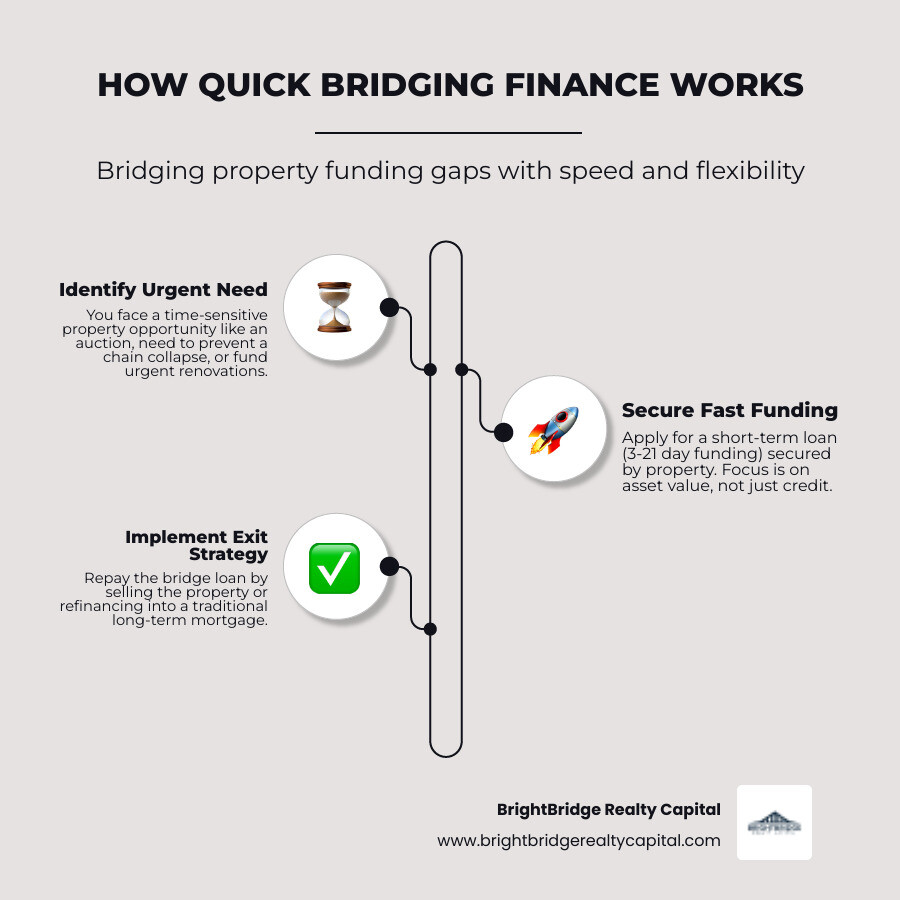
Quick look at quick bridging finance:
When is Quick Bridging Finance the Right Move?
Quick bridging finance is a powerful strategic tool for real estate investors and homeowners who understand that in a competitive market, speed is a currency of its own. Unlike traditional loans that can take months to approve, a bridge loan is engineered for velocity, allowing you to seize time-sensitive opportunities with the confidence of a cash buyer. It's a game-changer in urgent situations where immediate capital is the key to unlocking significant potential and outmaneuvering the competition.
Here's a detailed look at the primary scenarios where quick bridging finance is not just beneficial, but often essential:
- Securing Properties at Auction: Beat the 28-day completion deadline with ease.
- Preventing a Property Chain Collapse: Buy your new home before you sell your old one.
- Funding Renovations and Flips: Acquire and renovate properties that are unmortgageable in their current state.
- Capitalizing on Below-Market-Value (BMV) Opportunities: Act instantly when a seller needs a fast, guaranteed sale.
- Covering Funding Gaps for Commercial Real Estate: Bridge shortfalls in development projects or large-scale acquisitions. See our guide on commercial real estate for more.
- Meeting Urgent Business Obligations: Use property equity to quickly resolve a tax bill or inject emergency cash flow into a business.
Securing Auction Properties and Beating Deadlines
Property auctions are a high-stakes environment. Successful bidders are legally obligated to complete their purchase within a very short timeframe, typically 28 days. This deadline makes securing a traditional mortgage virtually impossible, as their underwriting process is far too slow. This is where quick bridging finance becomes your secret weapon. By securing financing in advance, you can bid with the same power as a cash buyer. It allows you to confidently secure a property, knowing the funds are ready to be deployed to meet the strict auction deadline. We've seen countless investors use bridge loan acquisition finance to build their portfolios, giving them a significant competitive advantage. Walking into an auction with the financial agility to act decisively is a powerful position that prevents you from losing your deposit and the deal itself.
Mending a Broken Property Chain
A property chain break is one of the most stressful experiences in real estate. You’ve found your dream home, your offer has been accepted, but the sale of your own property falls through, putting the entire transaction at risk. In a volatile market, this is an all-too-common nightmare. Quick bridging finance can save the deal. It provides a financial 'bridge,' allowing you to purchase your new property independently of your sale. This effectively mends the broken chain and removes the dependency on your buyer. This flexibility to buy before you sell means you won't lose out on your perfect property due to circumstances beyond your control. It transforms a high-stress, uncertain situation into a manageable one, giving you breathing room to sell your existing property at the right price, rather than accepting a lowball offer out of desperation. For more insights, check out our Bridge Loan for Home Purchase guide.
Funding Renovations and Flips
For savvy investors, the greatest profits are often found in value-add projects. You spot a diamond in the rough—a property with great potential but in need of significant work. However, traditional lenders often shy away from funding renovations on properties deemed uninhabitable or in poor condition. Quick bridging finance is perfectly suited for these scenarios. It provides the immediate capital to both acquire the property and fund the necessary renovations. Whether you're flipping houses for a quick profit or undertaking a major construction project, a bridge loan offers the speed and flexibility to get your project off the ground. Lenders can even structure the loan to release funds in stages (draws) as renovation milestones are met, helping you manage cash flow effectively and turn neglected assets into highly profitable ventures.
The Mechanics of Fast Funding: How It Works from Application to Cash
Understanding how quick bridging finance achieves its remarkable speed is crucial for any investor looking to leverage it. Unlike traditional mortgages that are heavily weighted on a borrower's personal income, credit history, and debt-to-income ratios, bridging loans operate on an asset-centric model. The primary focus is the intrinsic value of the property being used as security and the viability of your plan to repay the loan (the exit strategy). This streamlined, collateral-based approach is the engine that drives rapid funding.

The journey from inquiry to cash in hand is a masterclass in efficiency. It begins with a simple inquiry, followed by a streamlined application. Our underwriting team then performs a rapid assessment, concentrating on two key elements: the property's market value and your repayment plan. This is a stark contrast to the cumbersome, document-heavy real estate loan process of conventional banks. Our singular goal is to achieve fast loan approval and get funds into your hands precisely when you need them.
How Fast is "Quick"? A Step-by-Step Timeline
When we say "quick," we mean it. A bridging loan operates on a completely different clock from a traditional mortgage.
- Day 1: Inquiry and Decision in Principle (DIP). You submit your initial inquiry. Based on the top-line details, a lender can often issue a DIP within hours, outlining the potential loan terms.
- Days 2-7: Due Diligence and Valuation. You submit your formal application and supporting documents. The lender instructs a valuer to assess the property. To save time, this can be a desktop valuation or a physical inspection, depending on the asset.
- Days 5-15: Legal Process. Solicitors for both the lender and borrower work in parallel to handle the legal requirements, including title searches and placing a legal charge on the property.
- Days 7-21: Funding. Once all legal work and due diligence are complete, the funds are transferred to your account. The entire process can be completed in as little as 3-21 days, with unregulated investment loans being significantly faster than regulated loans for personal residences. This rapid turnaround is a hallmark of fast loan funding and is often the deciding factor between seizing an opportunity and watching it pass you by.
Key Eligibility Criteria for Quick Bridging Finance
What does it take to qualify? The focus on the asset and exit strategy means the criteria are more flexible than a bank's.
- Valuable Property as Security: The loan must be secured against a real estate asset (residential, commercial, or land). The loan amount is a percentage of this property's value. Lenders can secure the loan with a 'first charge' (if there's no existing mortgage) or a 'second charge' (if there's an existing mortgage).
- Sufficient Equity (Loan-to-Value - LTV): LTV is the loan amount relative to the property's value. We typically offer LTVs up to 75-80%. For example, on a $1M property, you could borrow up to $800,000. The remaining $200,000 is your equity contribution.
- A Viable Exit Strategy: This is the most critical element. You must have a clear, credible, and documented plan for how you will repay the short-term loan at the end of its term.
- Borrower Experience (Preferred but not Essential): While not always mandatory, a track record of successful real estate projects can strengthen your application and may lead to better terms.
- Less Emphasis on Credit Score: We take a holistic view. Adverse credit, such as a low score or past defaults, is not an automatic barrier if the property has sufficient equity and the exit strategy is robust.
For a comprehensive overview, refer to our Bridge Loan Requirements.
The Crucial Role of Your Exit Strategy
Your exit strategy is not a mere formality; it is the cornerstone of your application. It provides the lender with the assurance that their capital will be returned upon the loan's maturity. Our deep understanding of what is a bridge loan real estate confirms that a clear repayment plan is paramount.

A viable exit strategy gives the lender confidence. Typical strategies include:
- Sale of the Financed Property: The most common exit for property flippers who buy, renovate, and sell for a profit.
- Refinancing onto a Long-Term Mortgage: Ideal for investors who buy an unmortgageable property, renovate it to meet traditional lending standards, and then refinance to a cheaper, long-term loan to hold as a rental.
- Sale of an Existing Property or Asset: Used by homeowners buying a new home before their old one is sold, or by investors selling another property in their portfolio to clear the debt.
Without a robust and realistic exit strategy, supported by evidence, your application will likely be declined.
Required Documentation for a Speedy Application
To ensure your application moves at maximum speed, prepare your documentation in advance. Being organized is the single best thing you can do. Here's a general list of what we need for a bridge loan application online:
- Identification (ID): Proof of identity (e.g., passport) and address (e.g., utility bill) for all applicants.
- Property Details: Full address, photos, and any purchase agreements for the property you're offering as security.
- Valuation Report: An up-to-date valuation of the property. In many cases, the lender will instruct their own valuer for an independent assessment.
- Proof of Funds: Evidence of your equity contribution (e.g., bank statements).
- Exit Strategy Evidence: This is vital. Provide documentation supporting your exit plan, such as market comparables for a planned sale, a Decision in Principle from a mortgage lender for a refinance, or a sale agreement for another property.
- Financial Overview: While credit scores are less critical, a summary of your assets and liabilities and recent bank statements can help build a complete picture of your financial standing.
- Loan Usage Details: A clear, concise explanation of what the loan is for.
Weighing the Pros and Cons of Quick Bridging Finance
Like any powerful financial tool, quick bridging finance comes with a distinct set of advantages and drawbacks. A thorough understanding of both sides of the equation is essential for any investor or homeowner to make an informed, strategic decision. It's a cost-benefit analysis where the potential rewards of speed and opportunity must be carefully weighed against the associated costs and risks.
Here's a summary of the key considerations:
| Advantages | Disadvantages |
|---|---|
| Unparalleled Speed (Funding in Days) | Higher Interest Rates Than Mortgages |
| Seize Time-Sensitive Opportunities | Multiple Fees (Arrangement, Exit, Legal) |
| Flexible, Asset-Focused Underwriting | Short Repayment Terms (1-36 Months) |
| Custom Solutions for Complex Deals | Risk of Asset Repossession on Default |
| Solves Property Chain Breaks | Requires a Watertight Exit Strategy |
| Funds Unmortgageable Properties | Potential for Dual Loan Payments |
The Main Advantages: Speed, Flexibility, and Opportunity
The overwhelming benefits of quick bridging finance revolve around a single core concept: speed. In real estate, speed translates directly into opportunity and profit.
- Rapid Access to Capital: With decisions in hours and funding in as little as 72 hours, it's the fastest way to secure significant capital for property deals.
- Seize Time-Sensitive Opportunities: This allows you to act decisively on auction properties, below-market-value deals, and urgent renovation projects, effectively letting you compete with cash buyers.
- Flexible Underwriting Criteria: Lenders focus on the property's equity and your exit strategy, not just your credit score or income history. This opens doors for self-employed individuals, investors with complex income streams, or those with minor credit blemishes.
- Custom Solutions for Unique Projects: We offer flexible bridge loan options and can structure loans to fit specific project needs, such as releasing funds in draws for construction.
- Solution for Property Chain Breaks: It provides the certainty to proceed with a purchase even if your own sale is delayed, preventing the loss of your dream home or investment.
- Allows for Unmortgageable Properties: It provides the capital to purchase and renovate properties that traditional lenders won't touch due to their condition (e.g., no kitchen or bathroom).
Potential Drawbacks: Costs, Risks, and Rates
It's equally important to be clear-eyed about the potential drawbacks. At BrightBridge Realty Capital, we believe in full transparency so our clients can make the best decisions.
- Higher Interest Rates: This is the most significant trade-off. Due to their short-term, high-risk, and high-speed nature, bridge loans carry higher interest rates than traditional mortgages. Rates are often quoted monthly (e.g., 0.5% to 1.5%), which can seem low but equates to a higher annual percentage rate (APR). This makes them unsuitable for long-term financing. See our Real Estate Loan Rates page for more context.
- Various Fees: The interest rate isn't the only cost. Be prepared for several fees:
- Arrangement/Origination Fee: Typically 1-2% of the loan amount, charged by the lender for setting up the loan.
- Valuation Fee: Paid to the surveyor who assesses the property's value.
- Legal Fees: You will need to cover both your own and the lender's legal costs.
- Exit Fee: Some lenders charge a fee (often 1% of the loan amount) when you repay the loan. It's crucial to check if this applies.
- Short Repayment Terms: These are not 'set and forget' loans. With terms typically between 1 and 36 months, you must have a clear and achievable exit strategy that aligns with this timeframe.
- Risk of Asset Repossession: This is the most serious risk. As with any secured loan, if you fail to repay the loan at the end of the term, the property used as collateral is at risk of being repossessed by the lender. This is why a solid, realistic exit strategy with a backup plan is non-negotiable. The Consumer Financial Protection Bureau (CFPB) offers valuable resources for homeowners to understand these risks. Always think carefully before securing debts against your property.
- Potential for Dual Payments: If you use a bridge loan to buy a new home before selling your old one, you may have to cover payments on both your existing mortgage and the bridge loan simultaneously for a period, which can strain cash flow.
The key is to perform a careful calculation to ensure the potential profit or benefit from the opportunity significantly outweighs these combined costs and risks.
How to Accelerate Your Bridging Loan Application
To truly leverage the "quick" in quick bridging finance, your preparation is paramount. While we pride ourselves on an exceptionally streamlined quick loan approval process, the borrower's proactivity can dramatically improve the real estate loan speed and ensure a seamless experience from start to finish.
Preparing for a Seamless Process
The fastest applications are invariably the most prepared ones. Delays are most often caused by missing information or unforeseen complications. Here’s how to set yourself up for success:
- Gather Documents in Advance: Before you even apply, compile a digital folder with all your essential paperwork: proof of ID and address, details of the security property, bank statements showing proof of funds for your contribution, and, most importantly, evidence supporting your exit strategy. Having this ready to go shaves days off the process.
- Be Completely Transparent: Be upfront and honest about every aspect of your deal and financial situation. If there are credit issues, complexities with the property title, or potential hurdles in your exit plan, disclose them from the start. This allows us to identify the right solution and anticipate challenges, rather than being surprised late in the process, which inevitably causes delays.
- Solidify Your Exit Plan: Your exit strategy cannot be a vague idea; it must be a clear, viable, and well-documented plan. If you plan to sell, have comparable sales data ready. If you plan to refinance, have a Decision in Principle from a mortgage lender. The more concrete your plan, the more confidence a lender will have.
- Engage an Experienced Solicitor: Do not underestimate the importance of legal counsel. A solicitor who is unfamiliar with the speed and mechanics of bridging finance can become a major bottleneck. Choose a firm that has proven experience in this area. They will understand the urgency and be able to work proactively with the lender’s legal team. We can often recommend legal counsel with the requisite experience.
The Role of a Specialist Broker vs. a Direct Lender
When seeking quick bridging finance, you have two primary routes: working with a specialist broker or approaching a direct lender. Understanding the difference is key to choosing the fastest path for your needs.
Specialist Broker (The Market Navigator):A broker acts as an intermediary, using their knowledge and network to connect you with a wide panel of bridge loan lenders.
- Pros: They can scan the entire market to find the most suitable or cheapest deal, which is useful for complex or unusual cases. They handle the application on your behalf.
- Cons: This adds an extra layer of communication, which can slow things down. Information has to pass from you to the broker, then to the lender, and back again. Brokers also charge a fee for their services.
Our Approach as a Direct Lender (The Direct Route):As a direct lender, BrightBridge Realty Capital is the source of the funds. We make the lending decisions and manage the entire process in-house. This offers distinct advantages for speed.
- Pros: You deal directly with the decision-makers, eliminating communication delays. We can provide immediate feedback and rapid decisions. Our integrated process is designed for maximum efficiency, and you avoid paying separate broker fees.
- Cons: A direct lender can only offer its own products. However, for investors whose needs align with our expertise—namely, fast, reliable funding for real estate deals—this is often the most efficient path. See our Private Bridge Lenders Complete Guide for more.
Understanding Regulated vs. Unregulated Loans
The distinction between regulated and unregulated loans is critical for understanding the potential speed of quick bridging finance.
Regulated Bridging Loans: These loans are for personal use and are secured on a property that is (or will be) occupied by the borrower or a close family member. They fall under strict consumer protection laws (similar to standard mortgages). This means the process includes more rigorous affordability checks, mandatory consideration periods, and a greater focus on protecting the borrower. While offering more security, these regulations inherently make the process slightly longer.
Unregulated Bridging Loans: These are for business or investment purposes. Examples include buying a property to flip, acquiring a buy-to-let asset, or purchasing commercial premises. Because they are considered a business-to-business transaction, they are not covered by the same consumer credit regulations. The underwriting process is faster and more streamlined, focusing almost exclusively on the quality of the asset and the business case (i.e., the exit strategy). This is the environment where funding in as little as 72 hours becomes a reality.
As a direct lender specializing in real estate investment, BrightBridge Realty Capital primarily focuses on unregulated bridging finance for investors, allowing us to deliver the exceptional speed our clients need to capitalize on opportunities in the New York market and nationwide.
Frequently Asked Questions about Quick Bridging Finance
We understand that navigating the world of quick bridging finance can bring up many questions. To provide clarity, we've compiled detailed answers to some of the most common inquiries we receive from investors and property owners.
How much can I borrow and what are the typical LTVs?
The loan amount is primarily determined by the value of the property used as security and the strength of your application. At BrightBridge Realty Capital, we offer loans from $5 million up to $75 million, with larger, more complex deals considered on a case-by-case basis.
The Loan-to-Value (LTV) ratio is a key metric. We generally work with LTVs up to 75-80% of the property's current market value (or sometimes the After Repair Value for renovation projects). For example, on a property valued at $10 million, a 75% LTV would allow for a loan of $7.5 million. The exact LTV offered will depend on factors like the property type (e.g., residential vs. commercial vs. land), its condition, location, and the robustness of your exit plan.
Can I get a bridging loan with bad credit?
Yes, it is often possible. This is a significant advantage of bridging finance over traditional bank loans. Bridge loan providers, as asset-based lenders, place the highest priority on the property's value (equity) and your exit strategy. A perfect credit score is not a prerequisite.
While a clean credit history is always helpful and may result in better rates, issues like a low credit score, past defaults, or County Court Judgements (CCJs) are not necessarily deal-breakers. We use a common-sense underwriting approach. If you have significant equity in the security property and a well-documented, credible exit plan, your application will be seriously considered. The perceived risk might be reflected in a slightly higher interest rate, but the funding opportunity remains open.
What are the main alternatives to bridging finance?
While quick bridging finance is an excellent tool for time-sensitive situations, it's wise to know the alternatives. Depending on your specific needs, you might consider these options, some of which BrightBridge Realty Capital also provides:
- Hard Money Loans: Often used interchangeably with bridge loans, these are also fast, short-term, asset-based loans from private lenders. They are functionally very similar and serve the same purpose of providing rapid capital for real estate deals. We offer a variety of hard money loans.
- Traditional Mortgages/Long-Term Financing: If speed is not a critical factor, a conventional mortgage is a better choice. It offers much lower interest rates and long-term stability but involves a slow, stringent approval process that can take several months.
- Home Equity Line of Credit (HELOC): If you have significant equity in your primary residence, a HELOC can provide flexible access to funds. However, the application process is similar to a mortgage, it can take weeks or months, and the loan amount may be more limited.
- Private Equity/Joint Ventures: For large-scale development projects, partnering with a private equity firm or entering a joint venture can provide the necessary capital. The trade-off is that you will have to share ownership, control, and a significant portion of the profits.
- Seller Financing: In some cases, a seller may be willing to finance the purchase themselves, acting as the bank. This is rare but can be a flexible and fast option if available.
What is the difference between a 'first charge' and 'second charge' loan?
A 'charge' is a legal claim over a property that secures a debt.
- First Charge: This is the primary loan secured against a property that has no other debt on it. If the borrower defaults, the first charge lender is first in line to be repaid from the sale of the property.
- Second Charge: This is a loan secured on a property that already has a first charge mortgage on it. It sits 'behind' the primary mortgage. Because the second charge lender is second in line to be repaid, these loans are considered higher risk and often come with higher interest rates.
What happens if my exit strategy fails?
This is a critical question. If your primary exit plan—selling the property or refinancing—falls through, you must communicate with your lender immediately. Lenders prefer to find a solution rather than default. Options may include:
- A Loan Extension: If you need more time, the lender may agree to extend the loan term, though this will involve additional fees and interest.
- Re-bridging: You may be able to take out a new bridge loan to pay off the first one, giving you another 12-24 months to execute your exit.
- Default: If no solution can be found, the loan will go into default. This will incur penalty interest and negatively impact your credit. As a last resort, the lender will begin repossession proceedings to sell the property and recover their capital.
Conclusion: Is Quick Bridging Finance Your Next Move?
In the high-stakes arena of real estate, opportunities are fleeting and decisive action is rewarded. Quick bridging finance is the agile, powerful tool that empowers savvy investors to seize those moments. Throughout this guide, we've explored what it is, the specific scenarios where it excels, and the mechanics of how it delivers unparalleled speed. While the costs are higher than those of traditional, slower-moving loans, the strategic value is undeniable. The unparalleled speed and flexibility can unlock significant profits, save a crucial purchase from collapsing, and prevent once-in-a-lifetime opportunities from slipping through your fingers.
The key to using this tool successfully lies in understanding the trade-off between speed and cost, and most importantly, in having a meticulously planned exit strategy. For the prepared investor, a bridge loan is not just a debt instrument; it's a competitive advantage.
At BrightBridge Realty Capital, we specialize in providing these rapid and flexible funding solutions for real estate investors in New York and nationwide. As a direct lender, we have engineered our process for maximum efficiency, cutting out the middlemen to provide fast closings, often within a week. We offer direct access to decision-makers and competitive rates, ensuring you have the support and capital you need, precisely when you need it.
If you are an investor facing a time-sensitive deal, preparing for a property auction, planning a renovation project, or find yourself in any situation where immediate capital is the key to success, then quick bridging finance might just be your most strategic next move. Don't let a valuable opportunity be lost to the slow pace of traditional financing.
Ready to act with speed and confidence? Take the first step. Explore your fix and flip financing options with BrightBridge Realty Capital today or contact our team for a direct, no-obligation consultation on your next project.