The Airbnb Lending Landscape: A Comprehensive Guide
Summary
Unlock your Airbnb investment potential. This guide to airbnb lending covers loans, strategies, and challenges for successful property financing.
Why Airbnb Lending is Reshaping Real Estate Investment
Airbnb lending is a critical gateway for investors tapping into the booming short-term rental (STR) market, a sector that has fundamentally altered modern travel and real estate investment. The numbers are compelling and paint a clear picture of a paradigm shift: the STR market has grown an explosive 105% in just three years. This isn't a fleeting trend; it's a reflection of changing consumer preferences for unique, flexible travel accommodations and a growing desire among individuals for alternative income streams. With over 8 million active Airbnb listings worldwide and hosts earning an average of $14,000 annually—a figure that can be much higher in prime markets—the financial incentive is undeniable. This explosive growth has created a specialized financial niche to support it.
What is Airbnb lending?It's a category of financing specifically designed for purchasing or refinancing properties intended for use as short-term rentals. Unlike traditional mortgages that prioritize a borrower's personal income, Airbnb lending focuses on the property's revenue-generating potential.
- Specialized financing for properties intended as short-term rentals. This means the loan is underwritten with the understanding that the property will be occupied by a rotating series of guests rather than a long-term tenant or the owner.
- Higher down payments (15-25%+) and interest rates (0.25-1% above standard rates). Lenders view the fluctuating income of an STR as higher risk than a stable, 12-month lease, so they require more capital upfront and charge a premium for the loan.
- Focus on property income potential over personal income. This is the key differentiator. Lenders use data analytics to project a property's potential earnings, which can help an investor qualify even if their personal income wouldn't be sufficient.
- Multiple loan types: conventional, DSCR, hard money, and equity-based options. The financing ecosystem has evolved to offer a diverse toolkit, allowing investors to choose a loan that aligns with their specific strategy, whether it's a quick renovation or a long-term hold.
Key differences from traditional mortgages:
- Investment property classification vs. primary residence. A loan for an Airbnb is almost always classified as a business or investment loan, subjecting it to different rules, costs, and underwriting standards.
- Projected rental income is considered in underwriting. While a traditional lender wants to see signed leases, an Airbnb lender will analyze market data, comparable property performance, and seasonality to forecast income.
- Flexible occupancy requirements for guests. These loans are built for the STR model, so they don't contain the restrictive owner-occupancy clauses found in many conventional mortgages that prohibit running a hotel-like business.
- Specialized lenders who understand the vacation rental market. These lenders have expertise in the unique risks and opportunities of the STR industry, from seasonal cash flow swings to regulatory hurdles.
In top-tier markets, a single well-managed property can generate nearly $7,000 in monthly revenue, but unlocking this potential hinges on securing the right financing. Traditional banks, often constrained by rigid, outdated underwriting models, frequently struggle with verifying and accepting the variable income of an STR. This is where specialized lenders provide immense value, offering faster approvals, more flexible terms, and a deeper understanding of the business model. The primary challenge for investors is navigating the complex loan requirements and identifying the right financial partner who sees the same opportunity they do.
I'm Daniel Lopez, a loan officer at BrightBridge Realty Capital. I specialize in helping investors structure innovative airbnb lending solutions. My experience has shown me time and again that the right financing strategy doesn't just enable a purchase; it transforms a good investment into a great one by optimizing cash flow and maximizing returns.

Similar topics to airbnb lending:
Understanding the Basics: Traditional Mortgages vs. Airbnb Loans
Financing an Airbnb investment is fundamentally different from getting a mortgage for your primary home. The loan that worked for the house you live in is likely unsuitable, and potentially non-compliant, for a property you intend to operate as a short-term rental business. The core difference lies in how lenders perceive and calculate risk.

A traditional mortgage is built on the assumption that you will live in the home, making you emotionally and financially invested in making payments to avoid losing your primary shelter. This perceived stability lowers the lender's risk. Airbnb lending, in contrast, treats the property as a commercial enterprise—a business venture with a unique risk profile tied to market demand, seasonality, and operational success. Think of it as financing a taxi versus a personal car; while the asset is similar, its purpose and income model completely change the financial equation.
This distinction dramatically alters the underwriting process. Traditional lenders conduct a deep dive into your personal financial stability, scrutinizing your W-2s, tax returns, pay stubs, and employment history to ensure you can cover the payments. Specialized Airbnb lenders, while still verifying your financial health, are far more interested in the property's income-generating potential. This pivotal shift affects every aspect of the loan, from how income is verified and the types of occupancy clauses included to the interest rates and fees you'll pay.
Traditional Mortgages
Traditional mortgages are engineered for owner-occupied properties. They are defined by a primary residence focus, meaning lenders underwrite the loan with the legal expectation that you will live there for the majority of the year. This is not merely a suggestion; it's often a contractual obligation.
The occupancy rules can be strict and unforgiving. Many conventional mortgage agreements contain clauses that explicitly prohibit or severely restrict commercial activities, including short-term rentals. Attempting to run an Airbnb on a property with such a loan can lead to accusations of occupancy fraud, potentially causing the lender to call the entire loan due. Government-backed loans are even more explicit; FHA loan guidelines, for instance, forbid using the property for "transient or hotel purposes."
The primary benefits of traditional mortgages are their lower interest rates and down payments, which can be as low as 3-20%. However, these advantages are tied directly to the lower-risk, owner-occupied model. Lenders in this space also heavily prefer the predictable, stable income from a long-term lease agreement over the fluctuating, seasonal income of an Airbnb, which they often struggle to quantify and may disregard entirely during qualification.
Loans for Airbnb Properties
Airbnb lending is a specialized financial product designed for properties that are operated as small businesses. These loans carry an investment property classification, a designation that fundamentally changes their structure and terms to align with the realities of commercial use.
You should expect higher down payments, typically in the range of 15-25% or more. This larger equity stake reduces the lender's risk and demonstrates your commitment to the investment's success. Interest rates are also typically 0.25% to 1% higher than those for traditional mortgages. This premium is the price for the flexibility to engage in short-term renting without violating your loan covenants.
The true game-changer in this space is that many specialized lenders will use projected rental income to qualify you for the loan. Instead of relying solely on your personal tax returns, they employ sophisticated data tools to analyze market trends, the performance of comparable local properties (comps), and seasonal demand to forecast your property's earning potential. This data-driven approach means a promising property can essentially help qualify for its own loan, opening doors for investors who might not qualify based on personal income alone.
At BrightBridge Realty Capital, we empower investors by focusing on a property's income potential, not just a borrower's W-2. The key to success in this market is partnering with a financing expert who sees the immense opportunity in short-term rentals where traditional lenders only see unacceptable risk.
Key Financing Options for Your Airbnb Investment
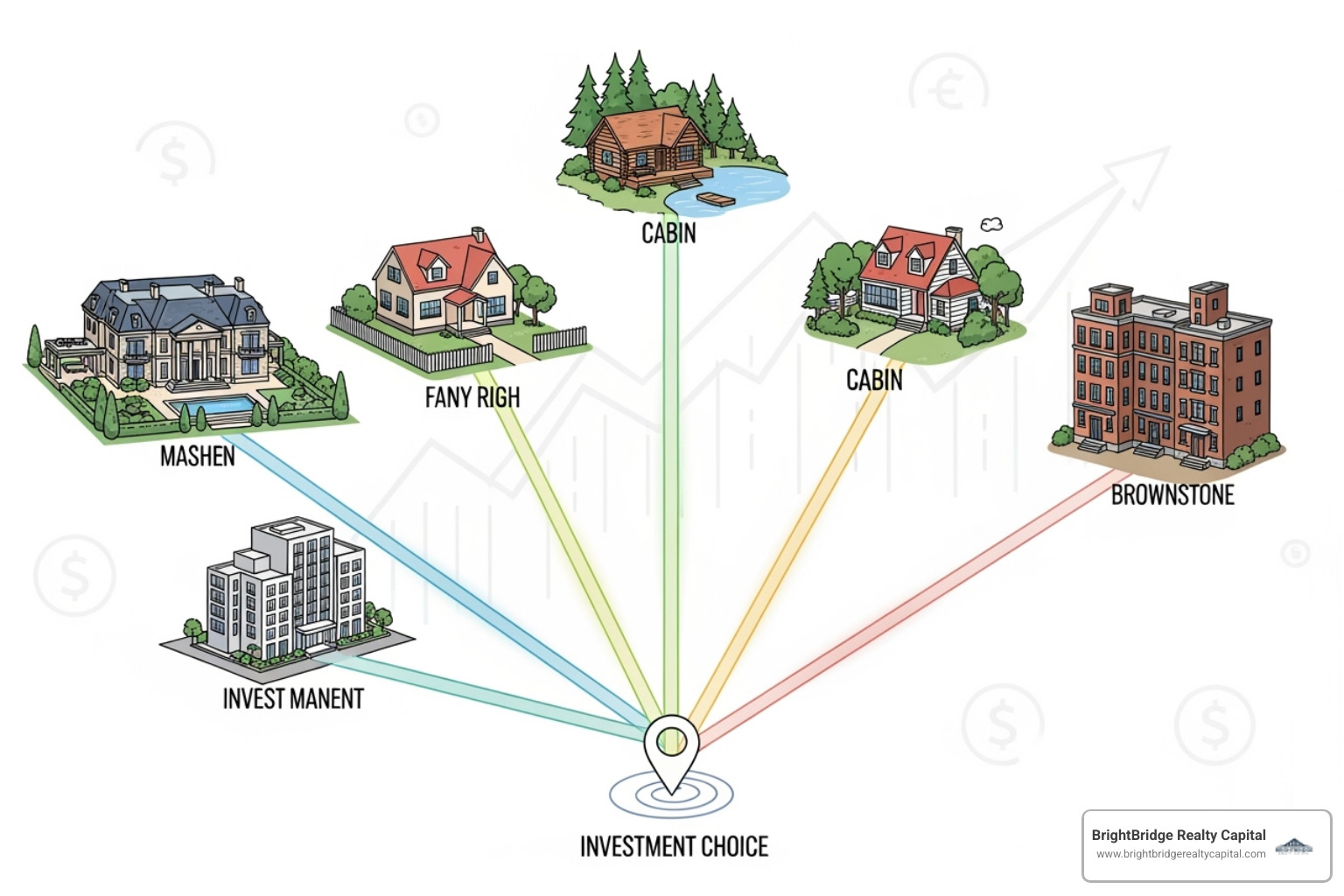
Your financing options for airbnb lending are diverse, and the right choice depends on your specific investment strategy, whether you plan to live on-site, your access to existing equity, and your acquisition timeline. Each loan type is a specialized tool, and selecting the correct one is crucial for maximizing your return on investment.
| Loan Type | Down Payment | Credit Score (Min) | Speed of Funding | Key Feature for Airbnb |
|---|---|---|---|---|
| Conventional (Inv) | 15-25%+ | 640+ | Moderate | Widely available, but stricter for STR income |
| DSCR Loan | 20-30%+ | 640+ | Moderate-Fast | Qualifies based on property's cash flow |
| Hard Money Loan | 25-50%+ | 500-600+ | Very Fast (days) | Asset-based, for quick acquisition/renovation |
Conventional and Government-Backed Loans
Conventional investment property loans are the most common starting point. They follow guidelines set by Fannie Mae and Freddie Mac, making them widely available from most banks and mortgage brokers. However, this broad availability comes with strict underwriting. Expect to need a down payment of at least 15-25% and a solid credit score, typically 640 or higher. The primary challenge is that many conventional lenders are hesitant to use projected short-term rental income for qualification, often requiring a signed 12-month lease instead. Some investors try to use a second home loan, which has a lower down payment (often 10%), but this comes with strict occupancy requirements and is not intended for properties that will be rented out year-round.
For investors employing a "house hacking" strategy by living on-site in a multi-family property (up to four units), government-backed loans become a powerful option. FHA loans allow for down payments as low as 3.5%, but their strict prohibition of "transient or hotel purposes" makes them risky for a primary Airbnb business. VA loans are a fantastic benefit for eligible veterans, offering zero down payment. They are generally more flexible on rental use than FHA loans, but the borrower must still certify their intent to occupy the property as their primary residence, which can complicate a full-time rental strategy.
Leveraging Existing Assets and Equity
Your existing property equity is a potent source of capital that can be used to fund your next investment. This strategy allows you to unlock the value you've already built.
- A cash-out refinance replaces your current mortgage with a new, larger loan, allowing you to pocket the difference in cash. This tax-free lump sum is perfect for covering a down payment, funding major renovations, or furnishing your new rental property.
- Home equity loans (HELOANs) function as a second mortgage, providing a fixed lump sum at a fixed interest rate. This is an excellent choice when you have a specific, large expense in mind and want the predictability of a stable monthly payment.
- A Home Equity Line of Credit (HELOC) is more like a credit card secured by your home. You are approved for a certain credit limit and can draw funds as needed, paying interest only on the amount you've borrowed. Its flexibility makes it ideal for covering ongoing or unexpected project costs, such as repairs or furnishing upgrades over time.
At BrightBridge, we frequently help investors create a capital stack by combining equity-based strategies with specialized loans, such as our fix and flip loans, to ensure comprehensive funding for the entire project lifecycle.
Alternative and Business-Focused Financing
When traditional and equity-based loans don't fit your needs, alternative financing provides other paths to success.
Hard money loans are short-term, asset-based loans funded by private investors. Their primary advantage is speed; they can often close in a matter of days, not weeks. While interest rates (10-18%) and down payments (25-50%) are significantly higher, this speed is invaluable for securing a competitive property or funding a rapid renovation. They are a cornerstone of the BRRRR (Buy, Rehab, Rent, Refinance, Repeat) strategy, acting as a bridge loan to acquire and improve a property before refinancing into a long-term, lower-rate loan like a DSCR loan.
Personal loans, which are typically unsecured, can be a good option for covering smaller, initial costs like furniture, decor, and smart-home technology, with loan amounts often reaching up to $100,000. For larger-scale operations, business loans, including SBA programs like the 7(a) loan, can provide essential working capital for marketing, staffing, and other operational expenses. Understanding the landscape of what are commercial loans can open up new funding possibilities as you scale your venture from a single property to a full-fledged portfolio.
Navigating the Challenges of Airbnb Lending
Securing financing for an Airbnb property is not always a straightforward process. The world of airbnb lending comes with a unique set of challenges that can frustrate unprepared investors. However, understanding these obstacles upfront can help you navigate the process efficiently. The most significant hurdles typically involve proving variable income, meeting stricter financial requirements, and maneuvering through a complex web of local regulations.

Proving Income and Strengthening Your Financial Profile
Traditional lenders are conditioned to favor the predictability of a 12-month lease over the seasonal and market-driven fluctuations of Airbnb income. To overcome this skepticism, you must present an exceptionally strong financial profile.
- Document Your History: If you are an existing Airbnb host, meticulous record-keeping is your best asset. Provide at least two years of detailed records, including official income statements from the rental platform, profit and loss (P&L) statements for the property, and booking histories that show occupancy rates and nightly prices.
- Use Bank Statements: For self-employed investors or those whose tax returns don't fully reflect their cash flow, specialized lenders offer bank statement programs. These are a type of non-qualified mortgage (non-QM) loan that qualifies you based on the cash deposits into your business bank accounts over 12-24 months, providing a more accurate picture of your business's health.
- Improve Your Credit Score: While some loan programs accept scores as low as 620, a credit score of 680 or higher is essential for improving your approval chances and securing favorable interest rates. A score of 740+ places you in the top tier, giving you access to the best possible terms.
- Manage Your DTI: Lenders want to see a debt-to-income (DTI) ratio below 50% (and ideally below 43%) to feel confident that you can comfortably handle the new mortgage payment alongside your existing obligations.
- Build Cash Reserves: Be prepared to show significant liquid savings. Most lenders will require at least six months of mortgage payments (including principal, interest, taxes, and insurance) in reserves. This reassures them that you can cover expenses during a slow season or handle unexpected major repairs without defaulting.
The Impact of Local Zoning and Regulations
The regulatory landscape for short-term rentals is a minefield that varies dramatically from one city to the next and is in a constant state of flux.
- Zoning Laws: Before you even make an offer, you must verify that the property is located in a zone where short-term rentals are legally permitted. A quick call to the local planning or zoning department is a critical first step.
- Permits and Licenses: Many municipalities require hosts to obtain specific business licenses, short-term rental permits, and pass safety inspections. These often come with fees and annual renewals. For instance, New York City has some of the strictest laws, requiring hosts to register with the city and be present during the stay for rentals under 30 days. Other cities, like Las Vegas, have licensing requirements and occupancy limits. This regulatory patchwork means due diligence is non-negotiable.
- HOA Restrictions: Even if a city permits STRs, a homeowners' association (HOA) or condo board can prohibit them. Always obtain and thoroughly review the HOA covenants and bylaws before closing on a property.
Lenders are acutely aware of these regulatory risks. Attempting to finance a property in an area with a pending ban or restrictive laws makes it a much riskier investment, which can derail your financing approval.
How to Improve Your Chances of Loan Approval
You can take several concrete steps to fortify your loan application and present yourself as a low-risk, high-potential borrower.
- Make a Larger Down Payment: Putting more money down reduces the lender's loan-to-value ratio and, therefore, their risk. It demonstrates your commitment and can often lead to better interest rates and smoother underwriting.
- Create a Detailed Business Plan: Treat the acquisition like a true business startup. Your business plan should include a detailed market analysis of your target location, a competitive analysis of similar listings (your “comps”), a five-year projection of income and expenses (including maintenance, cleaning, and management fees), and a clear marketing strategy for attracting guests.
- Strengthen Your Financials: This is an ongoing process. Continuously work on improving your credit score, paying down consumer debt to lower your DTI, and consistently building your cash reserves.
- Choose the Right Property: Focus on properties in high-demand tourist or business travel areas with a proven history of strong rental demand. A property that can be easily converted to a traditional long-term rental provides a valuable fallback plan, which lenders appreciate.
- Work with Experienced Professionals: Partnering with specialists in Airbnb lending, like the team at BrightBridge Realty Capital, is perhaps the most critical step. We understand these unique challenges and can guide you in structuring your application to present the strongest possible case to underwriters.
Advanced Strategies for Securing Airbnb Lending
For seasoned investors looking to scale their portfolio or new investors seeking a competitive edge, employing advanced strategies can secure better terms and faster approvals for airbnb lending. The overarching theme is to shift the lender's focus from you as an individual to the property as a high-performing business asset. This requires finding a financing partner who speaks the language of investment real estate.

Why Use a Specialized Lender for airbnb lending?
Traditional banks and credit unions, bound by rigid internal policies and federal regulations designed for primary residences, often struggle with the short-term rental model. They demand long-term leases and stable, predictable rental history, which an Airbnb business cannot provide. Specialized lenders, such as direct private lenders and portfolio lenders, operate differently.
- Industry Expertise: These lenders live and breathe real estate investment. They understand the seasonal cash flow cycles of the STR market—from the summer peak at a beachfront property to the winter rush at a ski chalet—and factor these business realities into their underwriting decisions.
- Faster Approvals: Because their processes are specifically built for STR investments, they can move from application to funding far more quickly than traditional lenders. While a bank may take 45-60 days, a specialized lender can often close in 30 days or less.
- Focus on Cash Flow: This is their core philosophy. They prioritize the property's ability to generate positive cash flow over your personal W-2 income. Their primary question is not just "Can you pay?" but "Can the property pay for itself and generate a solid return?"
The Role of Projected Income in airbnb lending
Sophisticated airbnb lending is forward-looking, focusing on what a property can earn, not just on historical tax returns. This is where data-driven analysis becomes paramount.
Debt Service Coverage Ratio (DSCR) loans are the ultimate tool for this approach. These loans qualify you based almost entirely on the property's ability to pay its own mortgage, making your personal income largely irrelevant. The DSCR is calculated by dividing the property's Net Operating Income (NOI) by its total annual mortgage payments (PITI - Principal, Interest, Taxes, Insurance). For example:
- Projected Gross Annual Income: $60,000
- Operating Expenses (vacancy, management, maintenance, utilities @ 35%): $21,000
- Net Operating Income (NOI): $39,000
- Annual Mortgage Debt (PITI): $30,000
- DSCR = $39,000 / $30,000 = 1.30x
Most lenders require a DSCR of at least 1.20x, meaning the property generates $1.20 in income for every $1.00 of mortgage debt. To project income accurately, lenders use data tools like AirDNA and Mashvisor, which analyze thousands of data points on comparable properties and market trends. This data-driven approach replaces guesswork with statistical confidence. Furthermore, appraisals with a rental analysis addendum (Form 1007) provide a formal, third-party validation of a property's earning potential, giving the lender the documentation they need to approve the loan.
Using a Business Structure (LLC) for Financing
Operating your Airbnb business under a Limited Liability Company (LLC) offers powerful strategic advantages for financing, protection, and long-term growth.
- Asset Protection: This is the most critical benefit. An LLC creates a legal barrier between your business and personal finances. If a guest were to sue, your personal assets—like your primary home, savings, and retirement accounts—are shielded from the lawsuit.
- Separate Finances and Enhanced Credibility: Keeping all business income and expenses in dedicated LLC bank accounts creates a clean, professional financial picture. This demonstrates to lenders that you are running a serious business, not a casual hobby, which strengthens your application.
- Financing Advantages: Many specialized lenders, particularly those offering DSCR loans, prefer or even require the property to be held in an LLC. This simplifies their underwriting by allowing them to focus solely on the business entity's performance.
- Building Business Credit: An LLC can obtain an Employer Identification Number (EIN) and establish its own credit profile, separate from your personal credit. By opening business credit cards and trade lines, you build a financial identity for your business that can help you secure financing for future properties without impacting your personal credit score, making it easier to scale your portfolio.
At BrightBridge Realty Capital, our DSCR loans are specifically designed to work with LLC structures. We focus on property performance to create a financing solution that protects you and grows with your investment strategy.
Frequently Asked Questions about Financing an Airbnb
Investors who are new to the world of airbnb lending often have similar questions about the rules, requirements, and realities of financing a short-term rental. Here are detailed answers to the most common inquiries.
Can I list my house on Airbnb if I have a mortgage?
Generally, yes, but this question is layered with critical caveats. You cannot simply start renting without doing your homework. First, and most importantly, you must review your mortgage documents for an occupancy clause. Most conventional mortgages for a primary residence require you to live in the property for a set period, typically one year. Violating this clause constitutes mortgage fraud, which could allow the lender to trigger an acceleration clause, making your entire loan balance immediately due.
I always advise clients to inform their lender of their plans. Transparency is your best protection. Some lenders may be willing to modify your loan or refinance you into a more appropriate product. Hiding your rental activity is a significant risk.
Next, you must consider insurance. A standard homeowner's policy does not cover commercial activities. If a guest is injured or causes significant damage, your claim will likely be denied, leaving you personally liable. You will need to secure a specialized short-term rental insurance policy.
Finally, check local laws and HOA rules. Many cities and homeowners' associations have strict regulations or outright bans on short-term rentals. It's crucial to confirm that your property is compliant before you list it.
How much down payment is required for an Airbnb property?
The required down payment depends heavily on the loan type and your overall investment strategy. There is no single answer, but here are the general guidelines:
For conventional investment loans, which are used for properties that are not your primary residence, you should expect a down payment of 15% to 25% or more. Lenders require more skin in the game because data shows that investors are more likely to default on an investment property than their own home during financial hardship.
An owner-occupied or "house hacking" strategy can significantly lower this requirement. If you purchase a multi-unit property (2-4 units) and live in one of the units while renting out the others, you may qualify for an FHA loan with as little as 3.5% down or a VA loan with no down payment at all. However, you must be mindful of the strict rules, especially the FHA's prohibition on using the property for "transient or hotel purposes."
The exact percentage will ultimately depend on your lender, credit score, DTI ratio, and overall financial profile. A larger down payment always reduces the lender's risk and often results in better interest rates and a smoother approval process.
Are interest rates higher for Airbnb loans?
Yes, as a rule, interest rates for airbnb lending are typically higher than for a standard mortgage on a primary residence. Lenders use risk-based pricing, meaning the higher the perceived risk, the higher the interest rate. Investment properties are considered higher risk for several reasons:
- Income Volatility: Short-term rental income can fluctuate dramatically with seasons, market trends, and competition.
- Increased Wear and Tear: A constant rotation of guests leads to more maintenance and potential damage than a single long-term tenant or owner.
- Higher Default Risk: As mentioned, investment properties have a statistically higher default rate.
Generally, you can expect investment property loan rates to be 0.25% to 1% higher than standard residential rates. While this increased cost is a factor, it's the price of doing business. Moreover, specialized lenders who understand the STR market can often offer more competitive rates than traditional banks because they are better equipped to accurately assess the property's income potential and your strength as an operator.
What kind of insurance do I need for an Airbnb property?
A standard homeowner's policy is insufficient for an Airbnb. It is designed for personal use and typically excludes coverage for commercial activities. Operating an Airbnb is a business, and you need specialized insurance to protect your asset and shield yourself from liability. Key options include:
- A Rider or Endorsement: Some insurance companies offer an add-on to your existing homeowner's policy that provides limited coverage for occasional short-term renting.
- Landlord or Business Insurance: A commercial policy, such as landlord insurance, may be more appropriate, though you must ensure it specifically covers short-term rentals, not just long-term tenants.
- Specialized Short-Term Rental Insurance: This is the most comprehensive and recommended option. Companies like Proper Insurance or Safely offer policies designed specifically for the Airbnb model. They typically bundle property coverage (for your building and contents), liability coverage (for guest injuries), and loss of income coverage (to replace lost bookings after a covered event like a fire). Lenders will require proof of adequate insurance before funding your loan.
Conclusion
The world of Airbnb lending, while certainly more complex than traditional home financing, unlocks a realm of incredible opportunities for savvy investors. With the potential for top performers to earn nearly $7,000 monthly from a single property, mastering the financing process is a highly worthwhile endeavor. The growth of the short-term rental market is not slowing down, and those who position themselves correctly stand to build significant wealth.
The most critical takeaway is that your short-term rental is a business and demands a financing strategy that reflects its commercial nature. While traditional banks, with their rigid underwriting, often struggle to accommodate the STR model, the modern financing landscape is rich with specialized options. Conventional investment loans, data-driven DSCR loans, equity-leveraging products like HELOCs, and short-term hard money loans all provide viable paths to funding, each tailored to a different investment strategy.
Successfully navigating the challenges of proving variable income, meeting higher down payment requirements, and complying with local regulations is entirely manageable with the right preparation. A strong personal financial profile, a meticulously crafted business plan, and thorough due diligence on your target market will dramatically improve your chances of loan approval. Above all, the single most impactful decision you can make is to partner with a lender who possesses deep expertise in the short-term rental business.
At BrightBridge Realty Capital, we deliver precisely what modern real estate investors need most: speed, flexibility, and expertise. We understand that great properties don't wait for slow bank bureaucracy. As direct lenders, we have the autonomy to offer fast closings—often in weeks, not months—and cut through the red tape that holds back so many investors. We don't just provide a loan; we partner with you to help you build a thriving real estate portfolio.
The short-term rental market is a dynamic and rewarding frontier. With the right financing partner and a clear, strategic vision, your Airbnb investment can become a powerful cornerstone of your financial future.
Ready to turn your Airbnb vision into a profitable reality? Explore our rental loan solutions and discover how our specialized financing can be tailored to match your ambitious investment goals.