Unlock Your Bridge Loan Potential: A Calculator Walkthrough


Summary
Unlock your potential! Use the best bridging loan calculator to estimate costs, compare options, and secure your property deal with confidence.
Understanding How a Bridging Loan Calculator Can Transform Your Investment Strategy
A best bridging loan calculator is an essential tool for real estate investors who need to estimate costs, monthly payments, and borrowing power before committing to short-term financing. These calculators help you quickly determine if a bridge loan fits your project by inputting key details like property value, loan amount, and loan term.
What a Best Bridging Loan Calculator Shows You:
- Net Loan Amount – The actual funds you'll receive after fees and interest
- Total Interest Payable – Monthly or rolled-up interest based on your loan term
- Loan-to-Value (LTV) – How much you can borrow against your property's value
- Total Fees – Arrangement, valuation, legal, and exit fees
- Monthly Payment Estimate – If servicing interest monthly
Bridging loans are short-term financing solutions—typically lasting 1 to 24 months—designed to "bridge the gap" when you need to act fast. Whether you're purchasing a property at auction, securing a fix-and-flip deal before traditional financing is available, or buying before selling your current home, a bridging loan provides the speed and flexibility traditional mortgages can't match.
The challenge? These loans come with higher interest rates (often 0.4% to 2% per month) and multiple fees that can add up quickly. That's where a calculator becomes invaluable. It breaks down the true cost of borrowing, helps you compare scenarios, and ensures you're not caught off guard by hidden expenses.
As Daniel Lopez, a loan officer at BrightBridge Realty Capital, I've guided hundreds of investors through the bridging loan process, helping them use calculators to model deals and structure financing that fits their timelines and exit strategies. A solid understanding of the best bridging loan calculator is the first step toward making confident, informed investment decisions.
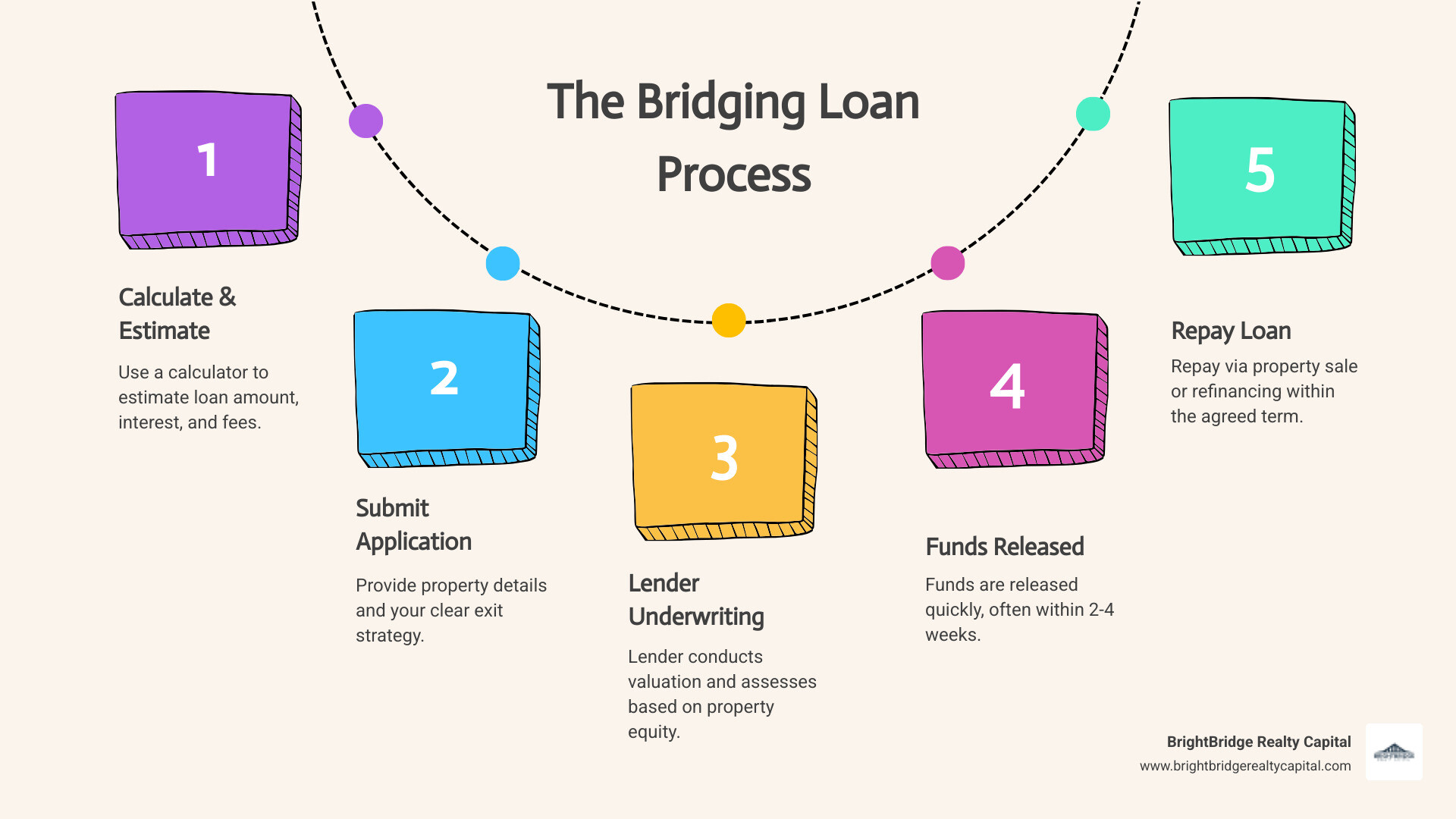
Best bridging loan calculator vocab to learn:
What is a Bridging Loan and Why Use a Calculator?
Imagine you’ve found the perfect investment property in New York, NY, but your current property hasn't sold yet, or you need fast cash for a renovation. That's where a bridging loan swoops in like a financial superhero! A bridging loan is a short-term, secured loan designed to "bridge the gap" in your finances. It provides immediate capital when you need to act quickly, typically for property acquisition, auction purchases, or fix-and-flip projects.
Unlike traditional loans that can drag on for weeks or months, bridge loans are all about speed. They allow you to seize opportunities that demand rapid funding, such as buying a property at auction or making a cash offer that stands out in a competitive market. Most bridge loans are short-term, usually lasting between 1 and 24 months, with many lenders offering terms of 12 to 18 months.
So, why bother with a best bridging loan calculator? Because while bridge loans offer incredible speed and flexibility, they also come with higher interest rates—often ranging from 0.69% to 2% per month, or 6% to 10% annually—and various fees. A calculator helps you:
- Estimate borrowing power: Quickly see how much you might qualify for.
- Compare scenarios: Play around with different loan amounts and terms to find what works best.
- Understand the true cost: Get a clear picture of interest and fees before you commit.
- Plan your exit: Ensure your project remains profitable even with the loan costs.
Without a calculator, you're essentially flying blind. We believe that informed decisions are the best decisions, and a reliable bridging loan calculator is your co-pilot.
Bridging Loans vs. Traditional Mortgages
Let's face it, bridging loans and traditional mortgages are like apples and oranges, though both are fruits of the financial tree. Here’s how they differ:
- Loan Term Differences: Traditional mortgages are long-haul commitments, typically stretching over 25 to 30 years. Bridging loans, on the other hand, are sprinters, designed for short-term needs, usually lasting 1 to 24 months.
- Interest Rate Structure: Bridging loans generally carry higher interest rates due to their short-term nature and the higher risk lenders take. Rates often start around Prime + 2-3% or 0.69% per month, while traditional commercial loan rates can range from 1.176% to 12%.
- Approval Speed: This is where bridge loans shine. While a traditional mortgage can take weeks or even months to process, bridge loans can be approved and funded in a matter of days or a few weeks. This speed is critical for time-sensitive real estate deals.
- Underwriting Focus: Traditional mortgages heavily scrutinize your credit score, income, and debt-to-income ratios. Bridge loans, however, focus more on the property itself – its equity, After-Repair Value (ARV), and your clear exit strategy. This means that even if your credit score isn't perfect, a strong property and a solid plan can still get you approved.
Key Scenarios for Using a Bridging Loan
Bridging loans are incredibly versatile and can be the perfect solution for a variety of real estate investment scenarios, especially in a dynamic market like New York, NY.

- Property Chain Break: One of the most common uses. If you're buying a new home before your current one sells, a bridging loan can provide the funds for the down payment on the new property, ensuring you don't lose your dream home.
- Development Projects: For investors undertaking fix-and-flip or renovation projects, a bridge loan offers quick access to capital to purchase the property and fund the rehab. This allows you to transform a property rapidly and get it back on the market.
- Below Market Value Purchase: Sometimes, an incredible deal pops up that requires an all-cash offer or a lightning-fast closing. A bridging loan turns you into a cash buyer, giving you a competitive edge to secure properties below market value.
- Quick Closing Needs: Auctions are a prime example. Properties bought at auction often require completion within 30 days. Traditional financing simply can't move that fast, but a bridge loan can. We’ve seen investors in New York, NY use bridge loans to secure fantastic opportunities this way.
A Practical Guide to Using the Best Bridging Loan Calculator
Using a best bridging loan calculator isn't rocket science, but it does require a bit of attention to detail. This section walks you through the mechanics of using a calculator to get a clear financial picture, helping you make informed decisions about your next investment.
Key Inputs for the Best Bridging Loan Calculator
To get an accurate estimate from any best bridging loan calculator, you'll need to provide some essential information. Think of it as feeding the calculator the ingredients for your financial recipe.

- Property Purchase Price: This is the price you're paying for the new property.
- Estimated Property Value (or ARV): For renovation projects or fix-and-flips, the After-Repair Value (ARV) is crucial. This is the estimated value of the property once all improvements are completed. Lenders often base their loan amounts on this figure, and it helps you determine your potential profit.
- Loan Amount Required: How much capital do you need to borrow? This might cover the purchase price, renovation costs, or simply bridge a down payment gap.
- Existing Mortgage Balance: If you're using the equity from an existing property as collateral (e.g., buying a new home before selling your current one), you'll need to input the outstanding balance on that mortgage.
- Loan Term (in months): Bridging loans are short-term, so you'll typically input a term between 1 and 24 months. Consider your exit strategy carefully when choosing this.
Interpreting the Outputs from the Best Bridging Loan Calculator
Once you've diligently entered your details into the best bridging loan calculator, it will churn out some valuable figures. Understanding these outputs is key to making sense of your potential loan.
- Gross Loan Amount: This is the total amount the lender is willing to advance before any fees or interest are deducted.
- Net Loan Amount: This is the actual cash you'll receive after all upfront fees and any retained interest (more on that later!) have been subtracted from the gross loan amount. This is your usable capital.
- Total Interest Payable: The calculator will estimate the total interest you'll pay over the loan term. This can be calculated in different ways, which we’ll explore shortly.
- Monthly Payment Estimate: If your loan structure involves servicing the interest monthly, the calculator will provide an estimate of these regular payments.
- Total Fees Breakdown: A good calculator will itemize the various fees involved, such as arrangement fees, valuation fees, legal costs, and potential exit fees. This helps you avoid any nasty surprises.
- Loan-to-Value (LTV) Percentage: This figure indicates the percentage of the property's value that the loan covers. For example, if a property is valued at $1,000,000 and the loan is $750,000, your LTV is 75%. Many lenders offer up to 75% LTV on a gross loan basis, with some even going up to 80% for residential properties.
Understanding Your Bridging Loan Costs and Terms
Bridging loans, while incredibly useful, are not without their costs. It's crucial to understand these expenses upfront to ensure your project remains profitable.
Factors That Influence Your Rates and Fees
The interest rate and fees you'll pay for a bridging loan aren't pulled out of a hat. Several factors influence these figures:
- Loan-to-Value (LTV): This is perhaps the biggest factor. A lower LTV (meaning you're borrowing less against the property's value) generally translates to lower risk for the lender, and thus, better rates. Most lenders offer up to 75% LTV, but for residential properties, we've seen figures up to 80%. Commercial properties typically cap out around 65% LTV.
- Property Type: Residential properties are generally considered less risky than commercial properties, often leading to more favorable rates.
- Exit Strategy Strength: A clear, well-defined, and robust exit strategy (how you plan to repay the loan) significantly reduces lender risk. If your plan is solid, lenders are more likely to offer you better terms.
- Borrower's Experience: Experienced real estate investors with a proven track record may receive better rates and terms. Lenders appreciate knowing you know what you’re doing!
- Your credit score: While bridging loans are asset-based (secured by the property), your credit score still plays a role. A higher score can help secure better terms. However, some lenders are more flexible and will consider loans even with lower scores, especially if the property and exit strategy are strong. Traditional lenders may look for scores around 650-680, while alternative lenders might accept 550-600.
Common Fees and Interest Calculation Methods
Beyond the interest rate, bridging loans come with a suite of fees that contribute to the total cost. A good best bridging loan calculator will help you account for these.
- Arrangement Fees: Also known as facility fees, these are typically 1-2% of the loan amount, with some starting as low as 0.79%.
- Valuation Fees: Lenders need to assess the property's value. These fees can range from several hundred to over two thousand dollars, depending on the property's complexity and location.
- Legal Costs: You'll incur legal fees for setting up the loan and for its redemption. These can start from around $750 and go upwards, often between $200-$300 for the loan itself, and more for complex cases.
- Exit Fees: Some lenders charge an exit fee, typically around 1% of the loan amount, when the loan is repaid.
- Other Administrative Fees: These can include application fees, administrative fees ($200-$500), and CHAPS fees (for fast bank transfers).
Now, let's talk about how that interest is actually calculated. There are three main methods:
| Interest Calculation Method | Description ```