Don't Get Burned: A Guide to Commercial Bridge Loan Costs
Summary
Discover the best rates for commercial bridging loans in 2025. Uncover costs, LTV factors, fees & exit strategies to secure optimal funding fast.
Why Overpaying on a Commercial Bridge Loan Can Kill Your Deal
In the high-stakes world of commercial real estate, timing is often more than just a factor—it is the entire game. Whether you are looking to acquire a distressed asset at a steep discount, reposition a vacant office building, or bridge the gap between a construction loan and permanent financing, the cost of your capital can make or break your pro forma. The best rates for commercial bridging loans in 2025 typically fall between 0.75% and 1.4% per month in the UK, and roughly 5.75% to 10% annualized in the US. However, these headline figures are merely the starting point for a much deeper conversation about risk, leverage, and liquidity.
Many investors make the mistake of viewing bridge loans as a commodity. They assume that a 7% rate from one lender is identical to a 7% rate from another. In reality, the structure of the loan—including how interest is calculated, the presence of exit fees, and the flexibility of extension options—can result in an "all-in" cost that varies by hundreds of basis points. Overpaying by even 0.5% on a $10 million bridge loan represents a $50,000 annual hit to your cash flow, which can significantly erode your internal rate of return (IRR) and make the transition to permanent financing more difficult.
Here's a quick snapshot of where rates land by borrower and loan strength in the current market:
| Borrower/Loan Tier | Typical Rate (US Annualized) | Typical Rate (UK Monthly) | Max LTV |
|---|---|---|---|
| Strong (Platinum) | 5.75% - 6.00% | 0.75% - 0.84% | 75% |
| Good (Gold) | 6.00% - 7.00% | 0.85% - 1.00% | 70-75% |
| Average (Standard) | 7.50% - 9.00% | 1.00% - 1.20% | 65-70% |
| Weak / Hard Money | 9.00% - 12.00% | 1.20% - 1.40% | Up to 65% |
Rates improve significantly at lower LTVs (under 50-65%) or on larger loans (typically $1M+ / £700k+).
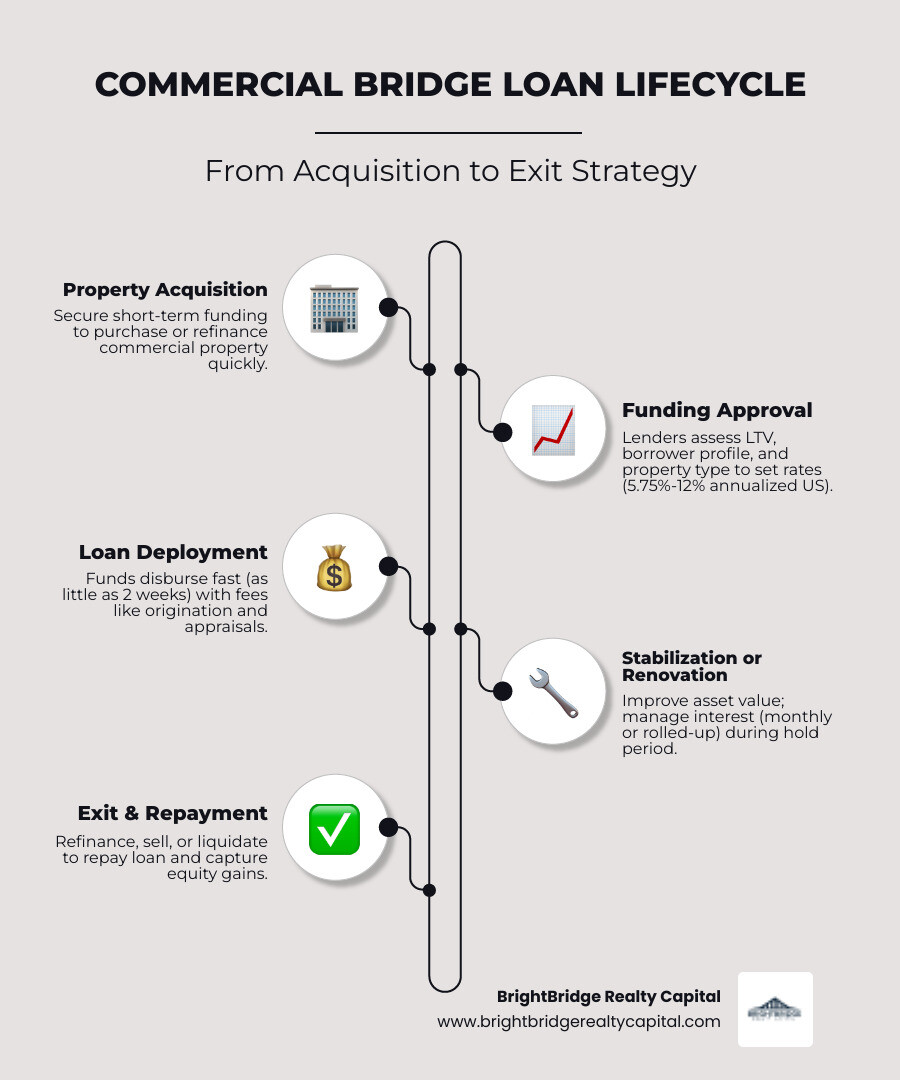
Commercial bridge loans move fast—sometimes closing in as little as two weeks. But speed comes at a price if you don't know what to look for. Many borrowers focus only on the headline interest rate and get blindsided by origination fees, exit fees, valuation costs, and unfavorable interest structures that quietly inflate the true cost of the loan. Furthermore, in a volatile interest rate environment, understanding the difference between a fixed-rate bridge and a floating-rate bridge is paramount for protecting your downside.
This guide breaks down exactly how lenders price commercial bridge loans, which factors push your rate up or down, and what you need to know to compare deals without getting burned. We will explore the nuances of the capital stack, the impact of property type on pricing, and the "hidden" fees that often lurk in the fine print of a term sheet.
I'm Daniel Lopez, a loan officer at BrightBridge Realty Capital, where I specialize in helping real estate investors structure short-term financing and secure the best rates for commercial bridging loans across a wide range of property types and deal scenarios. In the sections below, I'll walk you through everything that actually moves the needle on your rate—from LTV and borrower profile to fees most lenders bury in the fine print. Our goal is to provide you with the transparency needed to make an informed decision that aligns with your long-term investment strategy.
Basic best rates for commercial bridging loans vocab:
Understanding the Best Rates for Commercial Bridging Loans in 2025

As we navigate the 2025 financial landscape, the "average" rate for a commercial bridge loan is a moving target. In the New York market, where we operate, rates are fundamentally driven by the risk-free rate (such as 10-Year Treasuries or the Federal Funds Rate) plus a spread that accounts for the specific risks of the property and the borrower. This spread is not arbitrary; it represents the lender's assessment of liquidity risk, credit risk, and the complexity of the underlying asset.
Most modern commercial bridge loans are structured using SOFR-based floating rates. The Secured Overnight Financing Rate (SOFR) has largely replaced LIBOR as the benchmark for short-term lending. SOFR is considered a more robust and transparent benchmark because it is based on actual transactions in the Treasury repurchase market, rather than expert judgment. Typically, you will see a rate expressed as "SOFR + [Spread]." For example, if SOFR is at 5.3% and your spread is 350 basis points (3.5%), your annualized rate is 8.8%.
When hunting for the best rates for commercial bridging loans, it is vital to distinguish between monthly and annualized percentages. While UK-based lenders often quote monthly rates (e.g., 0.75% pm), US lenders typically quote an annual percentage rate (APR). A 0.75% monthly rate equates to a 9% annual simple interest rate, but when compounded or when fees are included, the effective APR can be higher. Understanding this distinction is the first step in accurately comparing international or cross-border financing options.
To give you a clearer picture of how we categorize these opportunities, we often look at tiered programs that reflect the risk-reward profile of the deal:
- Platinum Programs: Reserved for the strongest borrowers with high liquidity, high credit scores (740+), and stabilized or near-stabilized properties in Tier 1 markets. These deals often involve "light touch" renovations or simple bridge-to-perm transitions. Rates can be as low as 5.75% to 6.00%.
- Gold Programs: Designed for value-add projects where the borrower has a solid track record but the property needs some "TLC" or significant lease-up to reach its full potential. These are the bread and butter of the bridge market. Expect rates in the 6.00% to 7.50% range.
- Standard/Hard Money: For distressed assets, borrowers with credit challenges, or deals requiring extreme speed (closing in under 7 days). These loans often ignore the borrower's personal income and focus almost exclusively on the liquidation value of the collateral. Rates here typically start at 9.00% and can climb to 12.00% or higher.
For a deeper dive into how these structures work, check out our guide on commercial-bridge-loans.
How LTV Ratios Determine the Best Rates for Commercial Bridging Loans
The single most influential factor in your interest rate is the Loan-to-Value (LTV) ratio. From a lender's perspective, the more equity you have in the deal, the lower our risk. Equity acts as a buffer; if the market dips or the project encounters cost overruns, the lender's principal is still protected by the value of the property.
Research and market data show that LTV shifts can impact your rate by as much as +/- 3%. For instance:
- Low LTV (under 50%): These are the "sweet spot" for lenders. If you are only borrowing half the value of the asset, you might secure a rate near the risk-free baseline because the margin of safety is so high. Lenders compete aggressively for these low-risk deals.
- Standard LTV (65-75%): This is where most commercial deals sit. Rates are competitive but reflect the standard market risk. At this level, lenders will look more closely at the property's cash flow and the borrower's experience.
- High LTV (80%+): These are often referred to as "stretch seniors" or participating debt. Because the lender is taking on more risk—essentially acting more like an equity partner—you can expect rates to jump significantly, often into the double digits. Some lenders may also require a "profit share" or "equity kicker" at these levels.
Understanding the relationship between your down payment and your interest rate, as well as monitoring six-month SOFR index trends, is essential for optimizing your capital stack. If you can bring an extra 5% to the closing table, you might save 1% on your interest rate, which could result in massive savings over the life of the loan. You can read more about this dynamic in our article on bridge-loan-commercial-real-estate.
Key Factors That Influence Your Interest Rate
While LTV is the "big kahuna" of rate drivers, lenders also look at the "Three Cs": Collateral, Capacity, and Character. In the context of bridge-lenders-commercial-real-estate, this translates to the property type, your financial strength, and your experience. A bridge loan is a story-driven product. Unlike a traditional bank loan that relies on a rigid algorithm, bridge lenders want to understand the narrative of the deal: Why is this loan needed? How will the value be created? And how will the loan be repaid?
We don't just look at a spreadsheet; we look at the track record. A borrower with a 20-year history of successful "fix-and-flips" or commercial redevelopments in Manhattan will almost always secure a better rate than a first-time investor, even if their credit scores are identical. Experience reduces execution risk, and in the eyes of a lender, execution risk is the primary threat to a bridge loan's exit strategy.
Property Type and Market Quality
Not all square footage is created equal. Lenders categorize properties based on how easily they could be liquidated if the deal goes south. This liquidity directly correlates to the interest rate spread.
- Multifamily/Apartments: These are considered the "gold standard" of commercial real estate. Because housing is a fundamental need, these assets are highly liquid and eligible for the lowest rates. Even in a downturn, multifamily properties tend to maintain value better than other asset classes.
- Industrial/Warehouses: With the continued rise of e-commerce and the need for "last-mile" delivery hubs, industrial space is in high demand. These properties often fetch rates nearly as good as multifamily, especially if they are located near major transportation corridors.
- Retail and Office: These sectors are currently viewed with more caution. A vacant office building in a secondary market will carry a much higher interest rate than a grocery-anchored retail center in a prime New York borough. Lenders will look closely at the "WALT" (Weighted Average Lease Term) and the creditworthiness of the tenants.
- Hospitality and Special Use: Hotels, self-storage, and assisted living facilities are considered operational businesses as much as real estate. These require specialized underwriting and often carry higher rates due to the volatility of their daily or monthly income streams.
Market quality also plays a role. A "Class A" property in a high-growth area provides more security than a "Class C" property in a declining neighborhood. For more on how we evaluate these assets, see our list of commercial-bridge-lenders.
Borrower Profile and Credit Requirements
While bridge loans are primarily "asset-based," the borrower's profile still matters for the best rates for commercial bridging loans. Lenders want to know that the person behind the deal has the financial wherewithal to handle unexpected challenges.
- Credit Score: Most lenders look for a 650-680 minimum. While you can get a bridge loan with lower credit, you'll pay a premium for it. A score above 720 often unlocks the most competitive "Platinum" pricing tiers.
- Debt Service Coverage Ratio (DSCR): Lenders want to see that the property can eventually cover its debt. While many bridge loans are for non-stabilized assets (where the current DSCR might be below 1.0), the lender will look at the pro forma DSCR. A projected DSCR of 1.25 or higher is typically required for the best pricing.
- Net Worth and Liquidity: Lenders often want to see a net worth at least equal to the loan amount and enough liquidity (cash or cash equivalents) to cover 6-12 months of interest payments and any planned capital expenditures (CapEx).
- Personal Recourse: If you are willing to sign a personal guarantee (recourse), you can often shave 1-2% off your interest rate. Non-recourse loans are available—where the lender's only recourse is the property itself—but these usually come with higher rates, stricter LTV limits, and "bad boy carve-outs" for fraud or environmental issues.
To find lenders who specialize in these customized profiles, check out our resources on commercial-bridge-loan-direct-lenders.
Beyond Interest: Hidden Costs and Fees to Watch For
The headline interest rate is just the tip of the iceberg. To truly find the best rates for commercial bridging loans, you have to look at the "all-in" cost, often referred to as the Constant Annual Yield. At BrightBridge Realty Capital, we pride ourselves on transparency, but the industry is rife with "junk fees" that can turn a seemingly cheap loan into an expensive burden.
Administrative and Third-Party Expenses
When you receive a Term Sheet, look closely at the following fees, which are often negotiable but always present:
- Origination Fees (Points): Usually 1% to 2% of the total loan amount. This is paid at closing and covers the lender's costs for underwriting and processing. On a $5M loan, 2 points is $100,000.
- Exit Fees: Some lenders charge 0.25% to 1% when you pay off the loan. This is particularly common in the UK market. Always ask if the exit fee can be waived if you refinance with the same lender.
- Extension Fees: If your project takes longer than expected—which happens frequently in construction or renovation—you may have to pay 0.25% to 1% of the loan balance to extend the term for another 3-6 months.
- Valuation/Appraisal Fees: These can range from $3,000 for a standard property to $15,000+ for complex commercial assets or portfolios. Lenders usually require an appraisal from a firm on their "approved list."
- Legal Fees: You are typically responsible for both your legal costs and the lender's legal costs. This can be a significant expense, especially if the loan involves complex corporate structures or multiple properties.
- Site Visit and Due Diligence Fees: Some lenders charge for their own team to visit the property or for third-party reports like Phase I Environmental Site Assessments (ESA) and Property Condition Assessments (PCA).
These "soft costs" can add up quickly. A loan with a 7% interest rate and 3 points (3%) in fees might actually be more expensive than a loan with an 8% rate and only 1 point in fees, depending on how long you hold the loan. If you plan to exit in 6 months, the points have a much larger impact on your effective APR than the interest rate.
Learn more about these structures at bridge-financing-commercial-real-estate and what-is-a-bridge-loan-commercial-real-estate.
Interest Structures: Serviced vs. Rolled-Up
How you pay the interest can be just as important as the rate itself. This choice affects your monthly cash flow and the total amount of debt you will eventually need to repay.
- Serviced Interest: You make monthly interest-only payments. This is best for cash-flowing properties where the income from tenants covers the debt service. It keeps the loan balance from growing.
- Rolled-Up/Retained Interest: The interest for the entire term is calculated and added to the loan balance or "retained" from the initial disbursement. This is common for heavy rehab projects where the property isn't yet generating income. For example, if you have a $1M loan at 10% for one year, the lender might only give you $900,000 at closing, keeping $100,000 to pay the interest.
Be careful with rolled-up interest; because you are borrowing the money to pay the interest, you are effectively paying "interest on interest." This can significantly increase your total repayment amount and reduce your actual leverage. For a breakdown of which is right for you, visit bridge-loan-for-commercial-property.
Strategic Exit Plans and Speed of Funding
A bridge loan is, by definition, temporary. It is a means to an end, not the end itself. Lenders will not give you the best rates for commercial bridging loans unless you have a rock-solid exit strategy. In fact, the first question most bridge lenders ask is: "How do I get my money back?"
Common exit strategies include:
- Refinancing: Moving into a long-term commercial mortgage (CMBS, Agency, or Bank) once the property is stabilized. Lenders will look at the "After Repair Value" (ARV) and the projected DSCR to ensure you can qualify for the take-out loan.
- Sale: Selling the property after renovations are complete or after a major tenant has been signed. The lender will want to see a realistic timeline for the sale and evidence of market demand.
- Cash-Out: Using business profits, other asset liquidations, or a capital raise to repay the debt. This is less common but viable for high-net-worth sponsors.
The strength of your exit strategy directly impacts your rate. If your plan is to refinance, we will look at the current lending environment for permanent debt. If the numbers don't "stack up"—meaning the projected income won't support a large enough permanent loan to pay off the bridge—the risk increases, and so does the rate. Lenders may require an "interest reserve" to ensure payments are made while you work toward your exit.
Speed vs. Rate: The Opportunity CostIn the New York real estate market, speed is often more valuable than a few basis points. At BrightBridge Realty Capital, we can often close in as little as one week. While a traditional bank might offer a rate that is 1% lower, their 90-day closing window could cause you to lose the deal entirely.
Consider this: If you are buying a property for $2M that is worth $3M, but you must close in 14 days, paying a 9% rate to a bridge lender is far more profitable than waiting for a 6% bank loan that never arrives. Choosing a slightly higher rate for a guaranteed fast closing is often the smarter business move. The "speed premium" is a legitimate cost of doing business in competitive markets. Explore the nuances of these time-sensitive deals at commercial-property-bridge-loan.
Furthermore, bridge loans offer flexibility that banks cannot match. We can often structure "draw schedules" for renovation costs, allowing you to only pay interest on the money you have actually spent, rather than the full loan amount from day one. This "interest on drawn funds" approach can save you thousands of dollars during the construction phase.
Frequently Asked Questions about Commercial Bridge Costs
How quickly can I secure a commercial bridge loan?
At BrightBridge Realty Capital, we specialize in speed. While traditional banks take months, we can provide an Initial Decision in Principle within hours and close the entire loan in as little as 5 to 14 days. The timeline usually depends on how quickly the third-party reports (appraisal and title) can be completed.
Do I need a high credit score for the best rates?
While a score of 720+ will certainly help you get the absolute best rates for commercial bridging loans, bridge lending is primarily asset-based. We focus more on the property's value and your exit strategy. Borrowers with scores in the 600s can still secure very competitive financing if the deal has strong equity and a clear path to repayment.
What is the difference between a closed and open bridge loan?
- Closed Bridge Loan: Has a fixed repayment date. These often carry lower interest rates because the lender has more certainty about when the capital will be returned. They are ideal for projects with a very predictable timeline.
- Open Bridge Loan: Has no fixed repayment date (within a maximum term, usually 12-24 months). These offer more flexibility for projects with uncertain timelines but typically come with slightly higher rates or minimum interest periods.
Are there prepayment penalties on bridge loans?
Most bridge loans have a "minimum interest" period (e.g., 3 to 6 months) rather than a traditional prepayment penalty. This ensures the lender earns a minimum return for the work of setting up the loan. After that period, you can usually pay off the loan at any time without penalty.
Can I get a bridge loan for land or ground-up construction?
Yes, but the rates are typically higher. Land is considered the riskiest asset class because it produces no income and is harder to value. Ground-up construction bridge loans (often called "stretch senior" loans) are available for experienced developers and usually carry rates in the 9% to 12% range.
What are "Bad Boy Carve-outs"?
In non-recourse loans, these are provisions that make the borrower personally liable if they commit specific "bad" acts, such as fraud, misapplication of funds, voluntary bankruptcy, or environmental contamination. As long as you operate honestly, the loan remains non-recourse.
How do interest rate floors work?
In a floating-rate loan (SOFR + Spread), the lender will often include a "floor." This means that even if SOFR drops to 0%, your interest rate will not fall below a certain level (e.g., 7%). This protects the lender's minimum yield in a falling-rate environment.
Conclusion
Finding the best rates for commercial bridging loans requires more than just looking at a quote. It requires a holistic understanding of how LTV, property type, market conditions, and your own experience as an investor create a risk profile that lenders use to set their spreads. It also requires a keen eye for the "all-in" cost, including origination fees, exit fees, and interest structures that can significantly impact your bottom line.
In 2025, the market is more nuanced than ever. With the transition to SOFR and the shifting landscape of the office and retail sectors, having a knowledgeable partner is essential. A bridge loan should not be a permanent burden; it should be a strategic tool—a temporary bridge that carries you from an opportunistic acquisition to a stabilized, long-term success.
At BrightBridge Realty Capital, we cut through the red tape. As direct lenders based in New York, NY, we provide customized, flexible funding solutions with the speed that the modern real estate market demands. We understand that every deal has a story, and we are here to help you write the next chapter. We don't just provide a loan; we provide a bridge to your next successful investment, ensuring you get the most competitive terms available for your specific scenario.
Ready to see what rates your deal qualifies for? Our team is standing by to provide a rapid assessment of your project and a transparent breakdown of all costs involved. More info about the best bridging loan options.