The Big Picture: Understanding Blanket Mortgage Loans
Summary
Discover how a blanket mortgage loan simplifies financing multiple properties. Explore pros, cons, and qualification tips for investors.
Why Investors Use Blanket Mortgage Loans
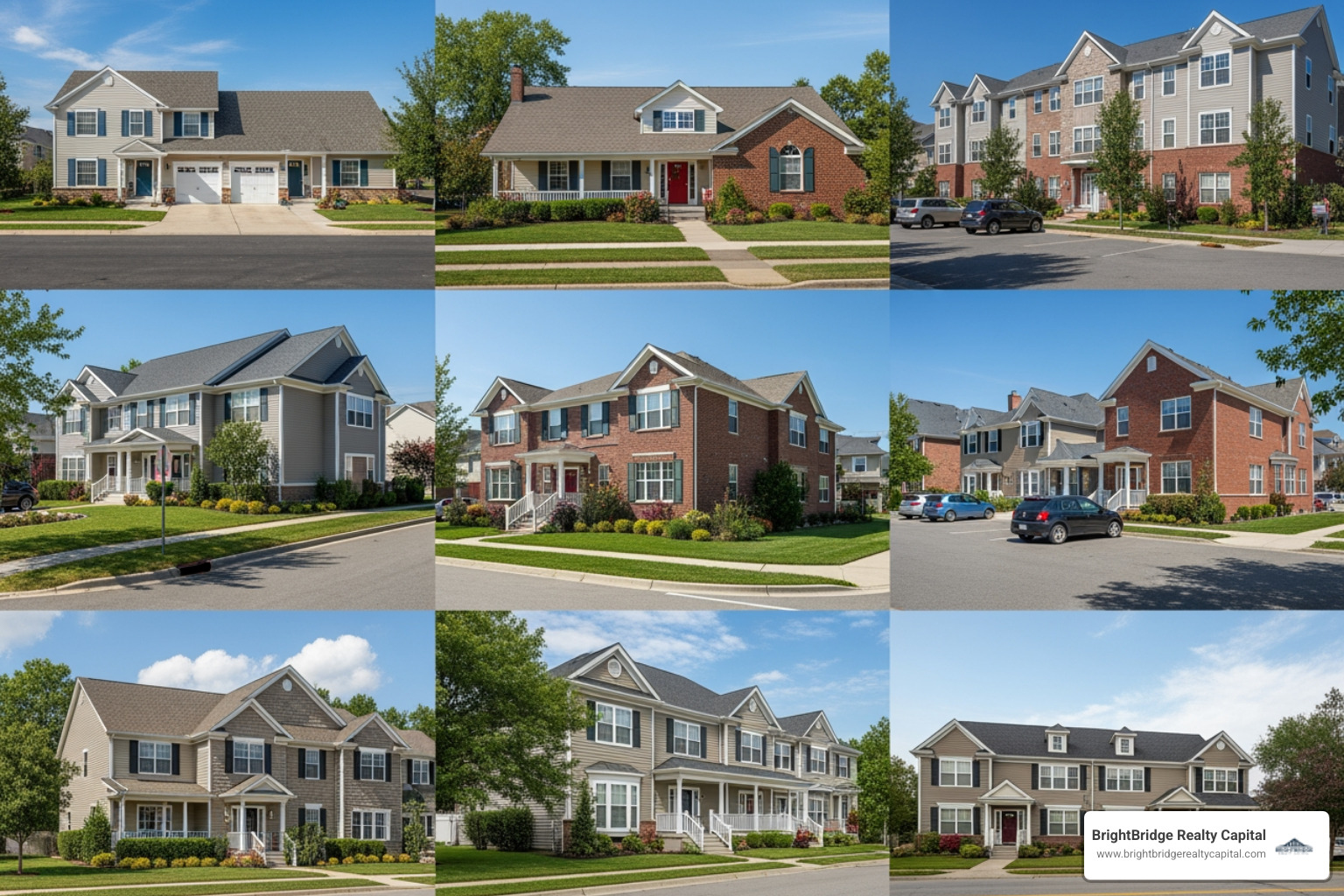
A blanket mortgage loan is a single mortgage that covers multiple properties at once, allowing real estate investors to finance an entire portfolio under one loan instead of managing separate mortgages for each property. This financial instrument is a cornerstone of professional real estate scaling, providing a level of agility that individual residential loans simply cannot match. By grouping assets together, investors can treat their real estate holdings as a unified business entity rather than a collection of disconnected liabilities.
Quick Definition:
- What it is: One mortgage secured by two or more properties, often across different locations.
- Who uses it: Real estate investors, developers, builders, house flippers, and multi-location businesses looking for efficiency.
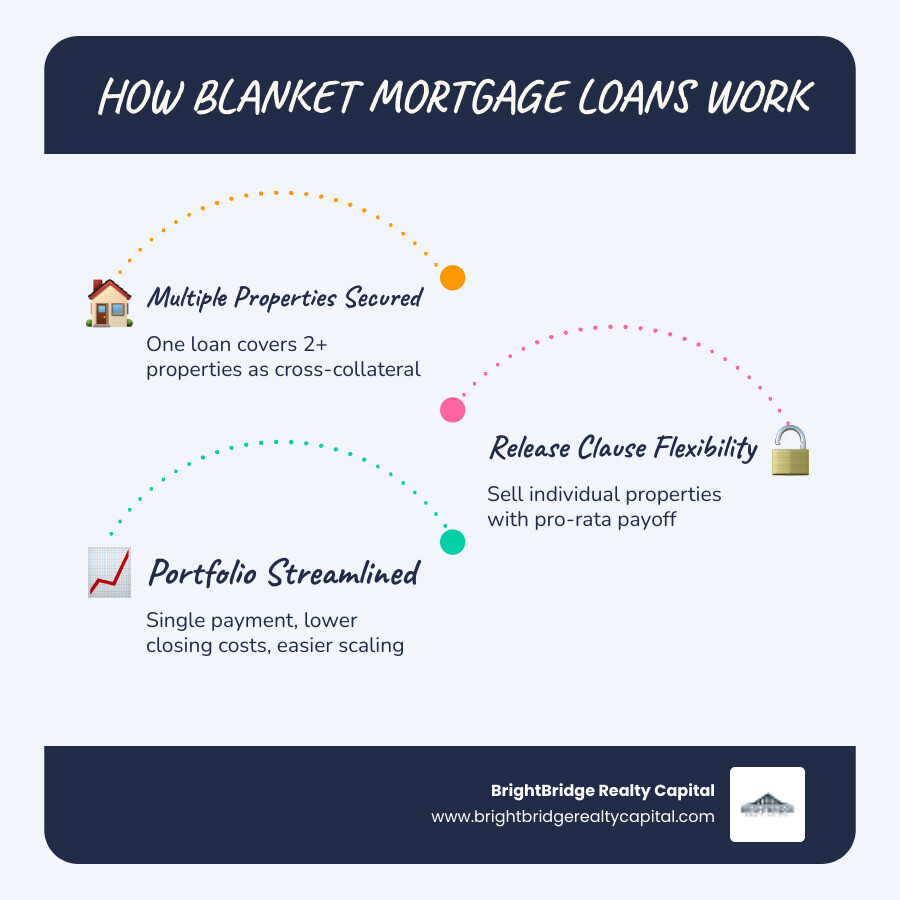
- Key feature: The release clause, which allows for the sale of individual properties without paying off the entire loan balance.
- Main benefit: Streamlined financing with potentially lower overall closing costs and simplified administrative management.
- Primary risk: Cross-collateralization, meaning all properties serve as security; a default on one can jeopardize the entire portfolio.
If you're buying a single property or just starting out, a blanket mortgage probably isn't for you. These loans are designed for experienced investors who are actively building or managing multiple properties—whether that's a rental portfolio, a subdivision development, or a series of fix-and-flip projects. The complexity of these loans requires a sophisticated understanding of cash flow, debt service, and long-term portfolio strategy. For the seasoned pro, however, the blanket loan is the "Swiss Army Knife" of the commercial lending world.
Traditional mortgages require separate applications, appraisals, and closings for each property. That means more paperwork, higher cumulative closing costs, and more time spent managing multiple lenders, each with their own portals, due dates, and escrow requirements. A blanket mortgage consolidates everything into one loan, which can save both time and money when you're scaling quickly. Instead of tracking ten different 30-year fixed loans, you track one commercial instrument. This consolidation also makes your balance sheet much cleaner, which can be a significant advantage when seeking further lines of credit or equity partners.
The most important feature of a blanket mortgage is the release clause. This allows you to sell one property from the group and use the proceeds to pay down a portion of the loan—without triggering a full payoff or refinancing the remaining properties. For investors who buy, renovate, and sell properties in cycles, this flexibility is critical. It allows for a "rolling" investment strategy where capital is constantly being recycled into new acquisitions without the friction of constant loan originations.
That said, blanket mortgages come with trade-offs that require careful consideration. Down payments are often 25% to 50% of the combined purchase price, reflecting the commercial nature of the product. Many include balloon payments, meaning the full balance comes due after a set period, typically five, seven, or ten years. And because all your properties are cross-collateralized, a problem with one property—such as a major environmental issue or a significant drop in occupancy—can put your entire portfolio at risk.
I'm Daniel Lopez, a loan officer at BrightBridge Realty Capital, and I've worked with investors using blanket mortgage loans to scale their portfolios efficiently while navigating complex financing structures. In this guide, I'll walk you through how these loans work, the technical nuances of the release clause, who they're best for, and the specific underwriting criteria you'll need to meet to qualify.
Common blanket mortgage loan vocab:
What is a Blanket Mortgage Loan?
At its core, a blanket mortgage loan is a specialized financing tool used to fund the purchase or refinance of more than one piece of real property. Instead of having a "one-to-one" relationship between a house and a loan, this structure creates a "many-to-one" relationship. This is not merely a convenience; it is a fundamental shift in how the debt is secured and serviced. In the eyes of the lender, the properties are no longer individual assets but a single "collateral pool."
The engine that drives this type of financing is cross-collateralization. This means that every property listed in the loan agreement serves as security for the entire debt. If you have five rental properties under one blanket loan, the lender holds a single lien that covers all five addresses. This is a departure from traditional lending, where each property would have its own deed of trust or mortgage document. If one property loses value, the equity in the other four properties helps to "blanket" the lender's risk, which is why these loans are often available for larger amounts than individual residential loans.
We often see these used as portfolio investment loans for seasoned landlords. While a portfolio loan is a broad term for any loan a lender keeps on its own books rather than selling to the secondary market (like Fannie Mae or Freddie Mac), a blanket loan is a specific type of portfolio financing that groups multiple assets together. This distinction is important because blanket loans are almost exclusively commercial products, meaning they are governed by different regulations and underwriting standards than consumer mortgages.
Comparing Collateral Structures
The difference between a blanket mortgage loan and a traditional mortgage is best understood by looking at how the debt is distributed and how the legal protections for the lender are structured. In a traditional scenario, if you sell a property, the due-on-sale clause kicks in, requiring you to pay the loan in full. With a blanket structure, the legal framework is designed for movement. You can sell off parts of the collateral without ending the loan for the remaining properties, provided you meet the "release price" requirements set by the lender.
Furthermore, blanket loans often involve a cross-default provision. This means that if you default on the payments for the blanket loan, even if the issue is only related to the cash flow of one specific property, the lender can declare a default on the entire loan and move to foreclose on all properties in the pool. This is the "double-edged sword" of the blanket structure: it offers massive flexibility but requires a higher level of operational excellence from the borrower.
| Feature | Traditional Individual Mortgage | Blanket Mortgage Loan |
|---|---|---|
| Number of Properties | One | Two or more (often 5 to 50+) |
| Closing Costs | Paid per property/loan | Consolidated (often lower total) |
| Management | Multiple monthly payments | One single monthly payment |
| Release Clause | Generally not available | Standard feature |
| Down Payment | Typically 3% - 25% | Typically 25% - 50% |
| Lender Type | Consumer banks/Agencies | Commercial/Specialized lenders |
| Underwriting Focus | Personal Income (DTI) | Property Income (DSCR) |
| Legal Structure | Individual Liens | Unified Lien with Release Provisions |
How a Blanket Mortgage Works
When we set up a blanket mortgage loan for our clients, the process involves evaluating the total value of the "blanket" of properties. The lender assesses the creditworthiness of the borrower and the income-generating potential of the combined assets. This is known as a "global" analysis. Instead of looking at one house in a vacuum, the lender looks at the net operating income (NOI) of the entire group. Once the loan is funded, the borrower makes one monthly payment that covers the principal, interest, taxes, and insurance for all properties in the group.
This is exceptionally useful for rental property portfolio loans. Imagine you own ten rental units across Brooklyn and Queens. Managing ten different due dates, ten different escrow accounts, and ten different interest rates is a logistical nightmare that consumes valuable time. By consolidating them, you reduce your administrative burden from roughly five or ten hours a month to just one or two. This allows you to focus on what actually grows your wealth: finding new deals and managing your tenants.

The Importance of the Release Clause in a Blanket Mortgage Loan
The "secret sauce" of this loan type is the release clause. Without it, a blanket loan would be a trap that locks your capital into a rigid structure.
In a standard mortgage, if you sell the home, you must pay back the entire loan immediately. However, a release clause stipulates that when one property in the portfolio is sold, a specific, pro-rata portion of the loan is paid back to the lender, and that property is "released" from the lien. The rest of the mortgage remains intact on the remaining properties.
Lenders typically calculate this using an Allocated Loan Amount (ALA). For example, if you have a $1 million blanket loan on four properties, each might have an ALA of $250,000. However, lenders often require a "release price" that is higher than the ALA—typically 115% to 125%. This means if you sell one property, you might have to pay down $300,000 of the loan to release it. This extra cushion protects the lender against the "cherry-picking" of the best properties, ensuring the remaining collateral is sufficient to cover the remaining debt.
For example, if you are a developer with a 10-home subdivision financed by a blanket mortgage loan, you don't want to refinance the whole project every time you sell one house. As each buyer closes, a portion of your blanket loan is retired, and you keep moving forward with the other nine homes. This provides incredible reinvestment flexibility and a clear exit strategy for house flippers who may be working on several projects simultaneously. It also allows for "substitution of collateral" in some advanced contracts, where an investor can swap a sold property for a new acquisition of equal or greater value without ever paying down the principal of the loan.
Pros and Cons of Blanket Financing
Like any high-level financial tool, the blanket mortgage loan has sharp edges. It can be a massive time-saver and a powerful engine for growth, but it requires a disciplined approach to risk management and a clear understanding of commercial debt structures.
The Pros:
- Administrative Efficiency: One payment, one lender, one point of contact. This simplifies your accounting and reduces the risk of missed payments or escrow shortages.
- Lower Total Closing Costs: While individual property appraisals are still required, you typically save on origination fees, recording fees, and legal costs by processing one large loan instead of several small ones. Instead of paying ten separate $1,500 processing fees, you pay one consolidated fee.
- Better Terms for Large Portfolios: Because the lender has multiple pieces of collateral, their risk is diversified. This can sometimes lead to more competitive portfolio loan interest rates compared to individual commercial loans, especially if the total loan amount exceeds $1 million.
- Equity Leveraging: You can use the combined equity of your portfolio to secure a larger loan for further acquisitions. If three properties have high equity and two have low equity, the "blanket" averages them out, allowing you to pull cash out of the entire group to fund your next deal.
- Substitution of Collateral: Some blanket loans allow you to "swap" properties. If you want to sell a property in a declining neighborhood and buy one in a growing area, you can sometimes substitute the new property into the blanket without a full refinance.
The Cons:
- Stricter Requirements: These aren't "mom-and-pop" loans. Lenders usually look for experienced investors with high credit scores, significant cash reserves, and a proven track record of property management.
- High Down Payments: You should expect to put down between 25% and 50% of the total purchase price. These loans are not designed for high-leverage, low-money-down strategies.
- Complexity: The paperwork involves multiple titles, appraisals, and legal descriptions. The "due diligence" phase for a blanket loan can take longer than a single-family loan because the lender must vet every single property in the pool.
- Prepayment Penalties: Many blanket loans come with "Yield Maintenance" or "Defeasance" clauses. These are complex prepayment penalties designed to ensure the lender gets their expected yield if you pay the loan off early. This can make exiting the entire loan expensive if interest rates have dropped.
Risks and Considerations
We always advise our clients to look at the "worst-case scenario." The biggest risk with a blanket mortgage loan is default contagion. Because of cross-collateralization, if one property in your portfolio fails to generate income—perhaps due to a localized disaster or a major tenant vacancy—and you can't make the single large payment, the lender has the legal right to foreclose on all the properties in the blanket. You cannot simply choose to stop paying on the "bad" property while keeping the "good" ones.
Additionally, many blanket loans are structured with balloon payments. This means you might have a 10-year term with payments calculated on a 30-year schedule, but at the end of that 10th year, the entire remaining balance is due in one lump sum. You must have a plan to refinance or sell before that date arrives. If the credit markets are tight when your balloon comes due, you could be forced into a difficult situation.
Qualifying for a Blanket Mortgage Loan
Qualifying for a blanket mortgage loan is more about the "business" than the "person." While your personal FICO score matters—usually requiring a 680 or higher—lenders focus heavily on the Debt Service Coverage Ratio (DSCR). This ratio is the primary metric used to determine if the portfolio is a healthy investment.
DSCR measures whether the income from the properties can comfortably cover the loan payments. Lenders typically look for a ratio of 1.2 or higher, meaning the properties generate 20% more net operating income than the mortgage costs. In high-cost markets like New York, some lenders might accept a 1.15 ratio, but 1.25 is the industry standard for "safe" lending. They will also look at your "Global Cash Flow," which includes your personal income and other business interests, to ensure you have the "staying power" to handle vacancies.
When financing multiple rental properties, your experience level is a major factor. Lenders want to see a "Schedule of Real Estate Owned" (SREO) that shows you have a track record of successfully managing real estate. If you are a first-time investor, you might find it difficult to secure a blanket loan and may be better off starting with rental portfolio financing options that allow for more flexibility as you grow. Most blanket lenders want to see at least two years of experience managing similar asset types.
Financial Requirements and Liquidity
Beyond the properties themselves, lenders will look at your post-closing liquidity. It is common for a blanket loan lender to require that you have 6 to 12 months of principal and interest payments sitting in a liquid account (cash or marketable securities) after the loan closes. They may also require a minimum net worth equal to the total loan amount. This ensures that if the "blanket" hits a rough patch, the borrower has the personal resources to keep the loan current.
Scaling with a Blanket Mortgage Loan
For those who have moved past their first few units, a blanket mortgage loan is the ultimate scaling tool. It allows for "asset valuation" on a grand scale. You can consolidate several single-family homes into one commercial real estate portfolio loan, freeing up your personal credit lines for other ventures. Because these are commercial loans, they often do not show up on your personal credit report in the same way a residential mortgage does, which can help keep your debt-to-income (DTI) ratio low for other personal financing needs.
By working with portfolio lenders who understand the nuances of the New York market, you can often negotiate terms that allow you to substitute properties in the blanket, giving you the agility to sell underperforming assets and replace them with higher-yield ones without restarting the loan process. This "evergreen" approach to financing is how the most successful real estate firms manage thousands of units across the country.
When to Avoid Blanket Financing
Despite the benefits, a blanket mortgage loan isn't always the right fit. It is a specialized tool, and like any tool, using it for the wrong job can lead to disaster. We typically suggest avoiding this structure in the following scenarios:
- First-Time Buyers: If you are buying your first or second rental property, the high down payment and strict requirements will likely be a barrier. Stick to conventional or FHA loans (if you plan to live in one unit) until you have a larger footprint. The cost of setting up a blanket loan (legal fees, commercial appraisals) often outweighs the benefits for small deals.
- High-Leverage Needs: If you only have 10% or 15% to put down, a blanket loan won't work. These are conservative instruments that prioritize equity and safety for the lender. If you need high leverage, you are better off looking at bridge loans or hard money, though those come with much higher interest rates.
- Disparate Property Types: If you are buying a beach house in Florida and a warehouse in New York, grouping them under one blanket loan can be legally and logistically complicated. Different states have different foreclosure laws and tax structures. It’s often better to group properties by region or asset class (e.g., a "New York Multi-Family Blanket" and a "Florida Short-Term Rental Blanket").
- Short-Term Holds Without Exit Plans: If you don't have a clear strategy for the balloon payment or a plan to sell the properties, the risk of cross-collateralization outweighs the convenience. If you plan to sell all properties within 18 months, the prepayment penalties on a blanket loan might eat all your profits.
- Properties with Environmental or Title Issues: If one property in your group has a "clouded" title or an environmental concern (like an old underground oil tank), it can stall the entire loan process for all properties. In these cases, it is better to finance the "problem" property separately so it doesn't hold up the rest of your portfolio.
For those just starting, our what is portfolio financing guide offers a great look at entry-level alternatives that provide some of the benefits of portfolio lending without the high barrier to entry of a full blanket mortgage.
Frequently Asked Questions about Blanket Loans
Can a blanket mortgage be refinanced?
Yes! In fact, refinancing rental property on a portfolio loan is a very common strategy. Investors often use a blanket mortgage loan to replace several high-interest individual loans with one lower-rate consolidated loan. This is often called a "rate and term" refinance. Just be prepared for the paperwork: you'll likely need fresh appraisals for every property in the group, and the lender will perform a new DSCR analysis on the entire portfolio.
What is the typical down payment for a blanket loan?
Expect to put down a minimum of 25%. In some cases, especially for developers or those with less experience, lenders may require up to 50% of the combined purchase price. The more "stabilized" the properties are (meaning they are fully leased and generating consistent income), the lower the down payment requirement will be.
Is a blanket mortgage recourse or non-recourse?
It depends on the lender and the loan size. Smaller blanket loans (under $2 million) are almost always recourse, meaning the borrower is personally liable if the properties don't cover the debt. Larger institutional blanket loans may be non-recourse, meaning the lender's only remedy in a default is to take the properties, though these usually include "bad boy carve-outs" for fraud or gross negligence.
What is the "seasoning" requirement for a blanket loan?
Most lenders want to see that you have owned the properties for at least 6 to 12 months before they will allow you to use the "appraised value" for a blanket loan. If you have owned them for less time, they may base the loan amount on the original purchase price rather than the current market value.
Who are the primary users of blanket mortgages?
The most common users are:
- Developers: Subdividing large tracts of land into individual lots for sale.
- House Flippers: Managing multiple "fix-and-flip" projects at once and needing to move capital quickly.
- Landlords: Consolidating a property portfolio mortgage to simplify management and improve cash flow.
- Business Owners: Financing multiple commercial locations (like a chain of restaurants, retail stores, or self-storage facilities).
Conclusion
Understanding the blanket mortgage loan is a key step in moving from a casual investor to a professional real estate mogul. It offers the "big picture" view of your finances, stripping away the clutter of multiple lenders and replacing it with a streamlined, efficient engine for growth. While the requirements are stricter and the risks of cross-collateralization are real, the benefits of administrative ease, lower long-term costs, and the flexibility of the release clause make it an indispensable tool for anyone serious about building a real estate empire.
As you scale, the ability to manage your debt as a single, cohesive strategy rather than a series of tactical fires will be the difference between staying small and reaching the next level of wealth. The blanket loan is not just a mortgage; it is a sophisticated financial structure that mirrors the complexity and ambition of your investment goals.
At BrightBridge Realty Capital, we specialize in these types of complex, high-velocity deals. Based in New York, NY, we understand that in this market, timing and precision are everything. Our direct lending model allows us to bypass the "red tape" of traditional banks, often closing loans in as little as a week for qualified portfolios. Whether you are looking for the best rental portfolio loans or need a custom blanket portfolio real estate loan tailored to your specific exit strategy, we have the expertise to help you scale.
Ready to take your portfolio to the next level and experience the efficiency of consolidated financing? Apply for Rental Portfolio Financing with us today and see how a blanket structure can change your investment game and accelerate your path to financial freedom.


