The Essential Guide to Bridge Loan Eligibility Requirements


Summary
Discover bridge loan eligibility requirements: credit scores, equity, docs & exit strategies for fast property financing approval.
Why Bridge Loan Eligibility Determines Whether You Close the Deal or Miss It

Bridge loan eligibility comes down to a handful of core factors that most lenders evaluate before approving short-term financing. In the high-stakes world of real estate, understanding these criteria is not just a matter of paperwork; it is the difference between securing a lucrative asset and watching it slip away to a more prepared buyer.
Here's a comprehensive snapshot of what you typically need to qualify:
| Eligibility Factor | Typical Requirement | Importance Level |
|---|---|---|
| Credit Score | 620-680 minimum (flexible with strong collateral) | Moderate |
| Property Equity | At least 20% equity in the collateral property | Critical |
| Loan-to-Value (LTV) | 65-80% (up to 75% standard for residential) | High |
| Exit Strategy | Clear, documented repayment plan required | Critical |
| Sale/Purchase Agreement | Firm agreements on current and new property | High |
| Debt-to-Income (DTI) | Generally below 50% (flexible for investors) | Moderate |
| Loan Term | 90 days up to 36 months depending on lender | Variable |
| Liquidity Reserves | 6-12 months of interest payments in cash | High |
Timing is everything in real estate. You find the right property. The deal is there. But your capital is tied up in an asset that hasn't closed yet. This is a common scenario in competitive markets like New York NY, where the inventory is low and the demand is relentless. If you cannot move within days, someone else will.
That gap — between what you need now and what you'll have later — is exactly where bridge loans come in. They are short-term, asset-backed loans designed to move fast. And whether you qualify depends on a specific set of criteria that differ meaningfully from traditional mortgage underwriting. Traditional banks are often bogged down by federal regulations and internal bureaucracy that prioritize income history over asset potential. Bridge lenders, however, operate with a different philosophy.
Unlike conventional loans that lean heavily on income verification and long approval timelines, bridge lenders focus on collateral value, your exit plan, and the equity you already hold. That makes them far more accessible for real estate investors working on fix-and-flip projects, portfolio expansions, or time-sensitive acquisitions — but only if you understand the eligibility landscape going in. This guide breaks down every major qualification factor, so you know exactly where you stand before you apply.
I'm Daniel Lopez, a loan officer at BrightBridge Realty Capital with hands-on experience structuring bridge financing across residential and commercial deals — including complex scenarios involving renovation timelines, competitive markets, and non-standard property types — where bridge loan eligibility is often the deciding factor between a closed deal and a missed opportunity. In the sections ahead, I'll walk you through everything you need to know to qualify with confidence, covering the nuances of credit, equity, and the strategic exit plans that lenders demand.
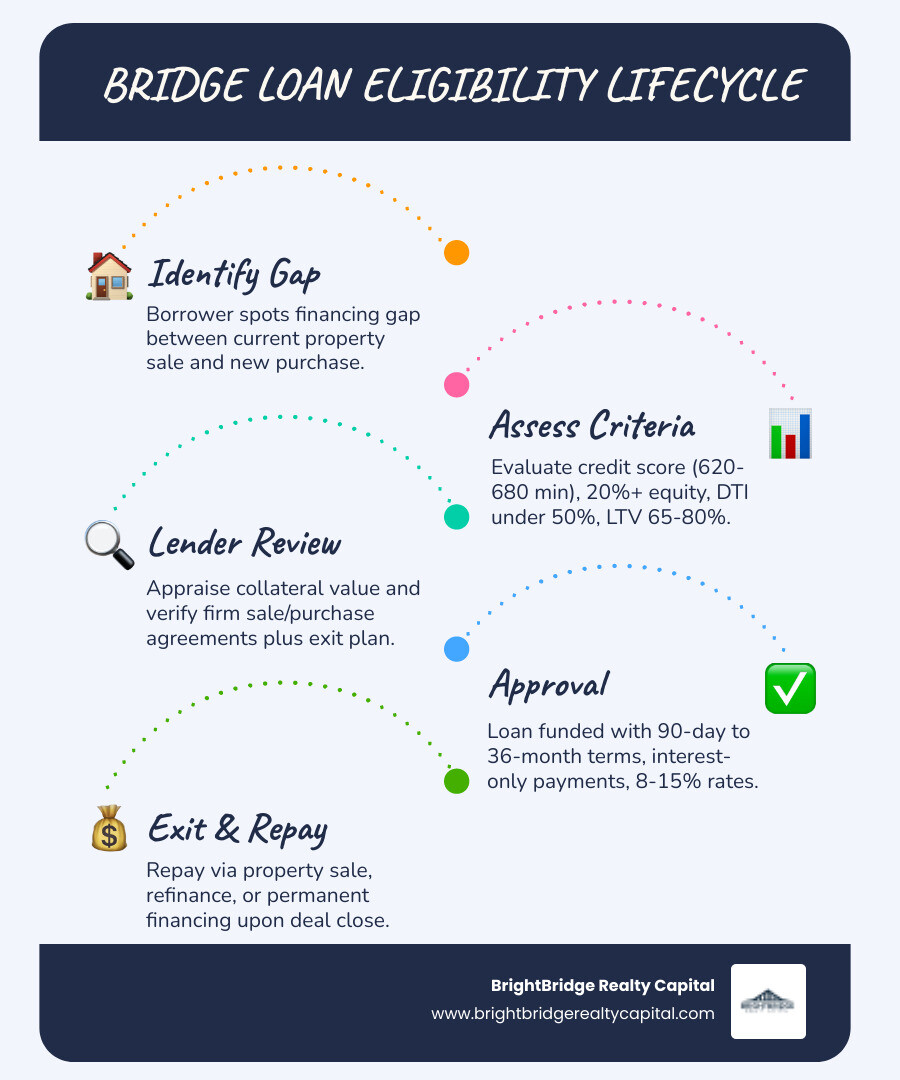
Bridge loan eligibility terms simplified:
Understanding Bridge Loan Eligibility and How Financing Works

At its heart, a bridge loan is a temporary financial tool. We often call it "interim financing" because it isn't meant to be a long-term burden. Instead, it acts as the glue holding two transactions together. If you are looking at a property in New York NY, you know that the market moves at the speed of light. Waiting 60 days for a traditional bank to approve a mortgage is often a recipe for losing the deal. In fact, many sellers in hot markets will not even entertain an offer that is contingent on traditional bank financing because of the high failure rate of those loans during the appraisal or underwriting phase.
What is a Bridge Loan?
A bridge loan is a short-term loan that allows you to use the equity in an existing property to secure immediate capital. This capital is typically used to purchase a new property, fund a renovation, or cover business expenses while waiting for a larger liquidity event (like the sale of an asset). It is essentially a "swing loan" that provides the liquidity necessary to seize an opportunity before your current assets are liquidated.
While terms vary, the typical bridge loan lasts up to 90 days for simple residential transitions, but can extend up to 36 months for complex commercial projects. The hallmark of this financing is speed; while a traditional mortgage takes months, we focus on fast closings—often within a single week. This speed is made possible by a streamlined underwriting process that prioritizes the value of the real estate over the exhaustive personal financial history of the borrower.
Core Components of Bridge Loan Eligibility
To qualify, lenders look at three main pillars: your profile as a borrower, the property acting as collateral, and your plan to pay the money back. Unlike a standard bank loan, we aren't just looking at your tax returns; we are looking at the "deal" as a whole.
- The Borrower Profile: While less critical than in traditional lending, your experience and financial stability still matter. For investors, a track record of successful projects can significantly improve your bridge loan eligibility and potentially lower your interest rates.
- The Collateral: The property itself does a lot of the heavy lifting for your application. Because these are asset-based loans, the value and condition of the real estate are paramount. Lenders will conduct a rigorous valuation to ensure the property can support the loan amount even in a market downturn.
- The Exit Strategy: This is the most scrutinized part of the application. A bridge loan is a means to an end, and the lender needs to see exactly how that end will be reached. Whether it is a sale, a refinance, or a cash infusion from another source, the exit must be realistic and documented.
You can find more info about bridge loan applications to see how these components fit together during the initial intake. Understanding these pillars allows you to present a stronger case to lenders, increasing your chances of a rapid approval.
Financial and Credit Requirements for Approval
Even though bridge loans are asset-based, your financial health still plays a role in bridge loan eligibility. Lenders need to know that you have the "staying power" to handle the loan until your exit strategy triggers. This is particularly important because bridge loans often carry interest-only payments, which can be higher than traditional amortized payments due to the increased interest rates.
Credit Score and Financial Profile
In bridge financing, your credit score is a secondary factor, but it isn't ignored. Most lenders look for a minimum score between 620 and 680. This range suggests a level of financial responsibility that gives lenders confidence. However, the beauty of private bridge lending is its flexibility. If you have a lower score but a massive amount of equity in a prime New York property, many private lenders offer flexible underwriting to make the deal work. They may look at the reasons behind a lower score—such as a past medical emergency or a business dispute—rather than just the number itself.
Financial stability is often measured by your liquidity reserves. Do you have enough cash on hand to cover the interest-only payments for the duration of the loan? Lenders typically like to see 6 to 12 months of interest payments held in a liquid account. Lenders also look at your Debt-to-Income (DTI) ratio, generally preferring it to stay below 50%, though this is often waived for experienced real estate investors who can demonstrate the profitability of the specific project.
The Role of Property Equity and LTV Ratios in Bridge Loan Eligibility
Equity is the "skin in the game" that makes lenders comfortable. To meet bridge loan eligibility requirements, you typically need at least 20% equity in the property you are using as collateral. This equity acts as a buffer for the lender; if the market dips or the project stalls, the lender is still protected by the underlying value of the asset.
The Loan-to-Value (LTV) ratio is the primary metric we use. Most bridge lenders offer an LTV between 65% and 80%. For example, if your property is worth $1,000,000, you might qualify for a loan of $650,000 to $800,000, depending on the risk profile.
It is also important to distinguish between LTV and LTC (Loan-to-Cost). While LTV looks at the current or future value, LTC looks at the total cost of the project, including purchase price and renovation costs. For investors, lenders might offer up to 90% LTC, provided the total loan does not exceed 70-75% of the After-Repair Value (ARV). If the property has a weak cash flow, lenders might look closer at your DSCR and equity ratios to ensure the asset can support the debt during the bridge period.
Essential Documentation and Property Criteria
Documentation for a bridge loan is often lighter than a traditional mortgage, but it must be precise. Because we move fast, having your "ducks in a row" is the best way to ensure a smooth approval. In the world of bridge lending, "time kills deals," and missing a single document can delay a closing by days, which might be all the time a competitor needs to outbid you.
Why a Firm Sale Agreement is Required
For residential homeowners, a "firm sale agreement" is often a non-negotiable part of bridge loan eligibility. This means you have a buyer for your current home, all contingencies (subjects) have been removed, and a closing date is set. This is the "gold standard" for an exit strategy because it virtually guarantees the repayment of the bridge loan.
This agreement proves to the lender that the money to repay the loan is already on its way. Without a firm sale, you may need to look at "open" bridge loans or harder-money options. Open bridge loans are for borrowers who have listed their home but haven't found a buyer yet. These come with higher interest rates and stricter LTV requirements (often capped at 50-60%) because the exit is less certain. For many, the "closed" bridge loan (with a firm sale) is the preferred route due to its lower cost and higher approval rate.
Documentation Needed for Bridge Loan Eligibility
When you apply, be prepared to provide a comprehensive package that allows the lender to make a quick decision:
- Property Information: Recent appraisals (often ordered by the lender), title insurance, and a clear Scope of Work (SOW) if you are doing renovations. The SOW should include detailed line items for labor and materials.
- Financial Details: Recent asset statements (bank accounts, brokerage accounts) and potentially two years of tax returns. While some "no-doc" options exist for high-equity deals, providing tax returns can often secure a better interest rate.
- Purchase Contract: The fully executed contract for the new property you are acquiring.
- Entity Documents: If you are borrowing through an LLC or Corporation, you will need your Articles of Organization, Operating Agreement, and an EIN.
- Legal Security: Documentation regarding how the loan will be secured. In common law areas, this involves the Personal Property Security Act (PPSA), while in other jurisdictions like Quebec, a hypothec is used. You can read more about legal security via PPSA and Hypothecs to understand how lenders protect their interests and what legal filings will appear on your property title.
Strategic Exit Plans and Investment Use Cases
A bridge loan is only as good as the plan to pay it back. In fact, the "exit strategy" is arguably the most important part of your application. Lenders are not in the business of owning your property; they are in the business of lending money and getting it back with interest. If the exit strategy is vague or unrealistic, the loan will be denied regardless of how much equity you have.
Common Exit Strategies for Repayment
How will you pay us back? This is the first question we ask. Common strategies include:
- Sale of the Property: The most common exit for fix-and-flip investors or homeowners moving to a new residence. The lender will look at comparable sales in the area to ensure your projected sale price is realistic.
- Refinancing: Moving the bridge loan into a long-term, lower-interest traditional mortgage once the property is stabilized or renovated. This is common for "BRRRR" (Buy, Rehab, Rent, Refinance, Repeat) investors. In this case, the lender will want to see a pre-approval or a clear path to qualifying for a conventional loan.
- Cash-Out Refinance: Using equity from another property in your portfolio to pay off the bridge. This is a sophisticated strategy used by portfolio investors to keep their capital moving.
- Business Cash Flow: For commercial bridge loans, the exit might be the increased cash flow from a newly renovated building, which then allows for a traditional commercial mortgage.
Bridge Loan Eligibility for Commercial and Investment Properties
For investors, bridge loan eligibility looks slightly different. We focus heavily on the "value-add" potential. If you are buying a distressed multi-family building in New York, we want to see your track record. Have you done this before? Do you have a realistic budget for renovations? Do you have a team of contractors ready to go?
Commercial bridge loans can fund everything from capital expenditures to business transitions. Unlike residential loans, these are almost exclusively for non-owner-occupied properties. Lenders will look at the Net Operating Income (NOI) and the projected Cap Rate of the property after the bridge period. For a deeper dive into the complexities of commercial underwriting, check out our commercial loan approval guide. Understanding the difference between residential and commercial eligibility is key to choosing the right lending partner.
Comparing Costs, Risks, and Provider Options
Bridge loans are often described as "convenience capital." You are paying for speed, flexibility, and the ability to bypass the rigid requirements of traditional banks. Because of this, the costs are higher than a 30-year fixed mortgage, and the risk profile is different for both the lender and the borrower.
Interest Rates and Fees Compared to Other Financing Options
Interest rates for bridge loans typically range from 8% to 15%, depending on the risk, the LTV, and the borrower's experience. Many lenders use floating rates based on benchmarks like the SOFR-based rate (Secured Overnight Financing Rate), often adding a margin (e.g., SOFR plus 4% to 8%). This means your payments could fluctuate if the Federal Reserve changes interest rates.
Beyond interest, expect to see a variety of fees that are standard in the industry:
- Origination Fees (Points): Usually 1% to 3% of the loan amount. This is paid upfront at closing.
- Administrative and Processing Fees: These cover the cost of underwriting, document preparation, and background checks.
- Appraisal and Inspection Fees: Bridge lenders often require specialized appraisals that look at both the "as-is" value and the "as-completed" value.
- Legal Fees: Since bridge loans involve complex security agreements, legal fees for the lender's counsel are typically passed on to the borrower.
- Exit Fees: Some lenders charge a small percentage (0.5% to 1%) when the loan is paid off, especially if it is paid off very early.
The Role of Lenders, Brokers, and Denial Avoidance
You can obtain bridge financing through large banks (though they are very selective), specialized mortgage brokers, or direct private lenders. Direct lenders like BrightBridge Realty Capital offer the advantage of "no middleman." When you speak to us, you are speaking to the decision-makers. This eliminates the "telephone game" that often happens with brokers and leads to faster approvals and more certain closings.
Common reasons for denial include a lack of a clear exit strategy, insufficient equity, or a property in such poor condition that it doesn't meet the LTV requirements. Furthermore, "environmental issues" on commercial properties can be a deal-breaker. Working with experienced bridge loan providers can help you navigate these hurdles before they become deal-breakers. A good lender will work with you to structure the deal in a way that meets eligibility requirements while still achieving your financial goals.
Frequently Asked Questions about Bridge Loan Eligibility
What happens if the sale of my current home falls through?
This is every borrower's nightmare, but experienced bridge lenders have contingencies for this. Usually, the lender will already have a lien against the new property and potentially the old one (cross-collateralization). If the sale falls through, you may be able to request a term extension, though this will come with additional fees and potentially a higher interest rate. It is vital to have a "Plan B," such as converting the bridge into a rental property loan or seeking a second mortgage to pay down the bridge principal.
Can bridge loans be used for renovations or only for buying homes?
Absolutely. Bridge loans are excellent for "value-add" projects. Investors often use them to buy a property, fund the upgrades (the Scope of Work), and then either sell the property or refinance it at its new, higher value. This is a staple of the fix-and-flip industry. In these cases, the lender often holds the renovation funds in "escrow" and releases them in "draws" as specific milestones of the renovation are completed and inspected.
How is the bridge loan amount calculated based on equity?
Lenders calculate the "Net Proceeds" of your sale. We take the estimated sale price, subtract your current mortgage balance, and then subtract anticipated closing costs (realtor fees, legal fees, transfer taxes). Most lenders will then loan you up to 80-90% of those net proceeds. This ensures that even if the sale price is slightly lower than expected, there is enough cash to pay off the bridge loan in full.
Is there a prepayment penalty on bridge loans?
This varies by lender. Some bridge loans have a "minimum interest" requirement (e.g., at least 3 months of interest must be paid), while others allow you to pay off the loan as soon as you want without penalty. Always clarify this in your term sheet, as it can significantly impact the total cost of the loan if you find a buyer for your property faster than expected.
Can I get a bridge loan with a 500 credit score?
While difficult, it is not impossible if the equity is high enough. If you have 50% equity in a property, a lender may overlook a very low credit score because the asset provides more than enough security. However, expect to pay much higher interest rates and fees for this level of risk.
Conclusion
Navigating bridge loan eligibility doesn't have to be a headache, but it does require a strategic approach and a clear understanding of what lenders value most. While the requirements for credit, equity, and documentation are firm, the flexibility offered by bridge financing is unmatched in the real estate world. It is a specialized tool for specialized situations—designed for those who value speed and opportunity over the slow, standardized pace of traditional banking.
Whether you are a homeowner trying to secure your dream house in a competitive New York NY neighborhood before your current one sells, or an investor looking to pounce on a commercial opportunity that requires immediate renovation, a bridge loan is often the most powerful tool in your belt. By focusing on your exit strategy and maintaining a healthy equity position, you can unlock capital that would otherwise be trapped for months.
At BrightBridge Realty Capital, we specialize in making this process seamless. We are direct lenders, which means we make the decisions and provide the funds. No intermediaries, no endless red tape—just fast, flexible solutions designed to help you close your next deal in as little as a week. We understand the nuances of the market and the urgency of your transactions.
Ready to see if you qualify and take the next step in your real estate journey? Apply for bridge financing today and let us help you bridge the gap to your next success. Our team is ready to review your scenario and provide a term sheet that gets you to the closing table.