Bridge the Gap to Profit: How to Use Loans for Property Flipping
Summary
Unlock property flipping success with a bridging loan to flip property. Fund renovations, leverage ARV & accelerate your profits now!
Why a Bridging Loan to Flip Property is a Game-Changer for Investors
A bridging loan to flip property is a specialized, short-term financing solution that empowers real estate investors to rapidly acquire, renovate, and resell properties for a profit. In the fast-paced world of real estate investment, where opportunities can vanish in an instant, this financial tool is not just an alternative—it's a necessity. Here's a more detailed look at what you need to know:
- Purpose: Specifically designed to cover the acquisition cost of a property and, crucially, the full budget for its renovation. This dual-funding capability is essential for projects where value is created through improvements.
- Speed: The primary advantage. While traditional mortgages can take 45-60 days to close, bridging loans can be approved and funded in as little as 5-15 days. This speed allows investors to compete effectively with all-cash buyers and secure properties at auctions with tight closing deadlines.
- Loan Amount: Lenders typically offer up to 70-90% of the property's purchase price plus, in many cases, 100% of the budgeted rehabilitation costs. The total loan is usually capped at a percentage of the property's After Repair Value (ARV).
- Term Length: These are not long-term commitments. Terms generally range from 6 to 24 months, aligning perfectly with the typical timeline of a fix-and-flip project.
- Repayment: The loan is structured to be repaid in a single balloon payment at the end of the term, typically from the proceeds of the property sale or through a subsequent refinance into a long-term mortgage.
- Interest: Rates are higher than conventional loans to compensate for the shorter term and increased risk. Interest is calculated monthly, and investors often have the option to let it "roll up" or accrue, paying it all back with the principal at the end of the loan to preserve cash flow during the renovation phase.
Property flipping continues to be a potent investment strategy. In the U.S. market, house flipping rates have seen significant activity, with profits often reaching tens of thousands of dollars per project. According to recent market analysis, the gross profit on a typical home flip can average over $60,000, though this varies widely by location. However, success in this competitive arena hinges on two critical factors: speed of execution and access to flexible capital.
This is where traditional financing falls short. A conventional mortgage is simply not built for the realities of flipping. Banks are hesitant to lend on properties that are uninhabitable or in a state of disrepair. Their underwriting process is slow and cumbersome, focusing heavily on personal income verification and debt-to-income ratios, which may not reflect an investor's true financial strength. If you're buying at an auction with a 28-day completion deadline, trying to secure a distressed property that a bank deems unmortgageable, or competing against multiple cash offers in a seller's market, a traditional loan is a non-starter.
Bridging finance was created to fill this exact gap. These loans are asset-based, meaning the lender's primary focus is the value and potential of the property itself, not just the borrower's personal finances. The UK bridging market's valuation at £8.4 billion underscores how indispensable this tool has become for savvy property investors globally.
I'm Daniel Lopez, a senior loan officer at BrightBridge Realty Capital. Over the years, I've structured hundreds of bridging loans to flip properties, guiding both novice and seasoned investors through complex residential and commercial deals. I've seen firsthand how the right financing can unlock opportunities that would otherwise be missed. Understanding the mechanics of these loans is the first step toward scaling your portfolio and securing your next profitable project.
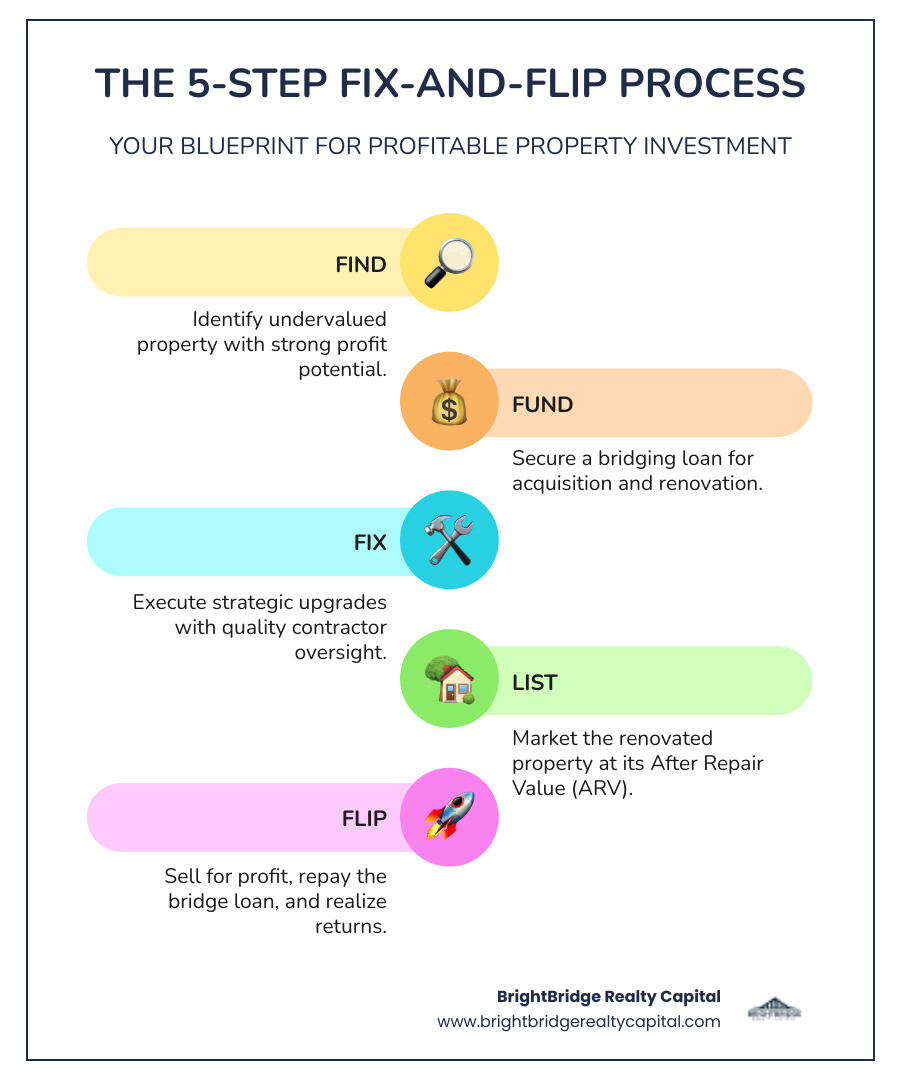
Bridging loan to flip property glossary:
What is a Fix and Flip Bridge Loan?
A fix and flip bridge loan is a specialized, short-term financing solution custom-built for the unique needs of real estate investors. It's aptly named because it "bridges" a critical financial gap: the period between acquiring a property and selling it for a profit. This financial instrument provides the immediate capital needed to purchase a property—often one that is distressed, outdated, or requires significant renovation—and to fund its complete transformation. For investors aiming to capitalize on opportunities that require speed and flexibility, these loans are a cornerstone of a successful property flipping business, enabling deals that traditional financing simply cannot accommodate.

Understanding the Core Concept
At its heart, a bridge loan is a temporary, asset-backed financing tool. It is engineered to provide rapid access to capital, making it the perfect vehicle for investors who need to move decisively on market opportunities. Imagine this scenario: you discover an undervalued property in a prime neighborhood, but it has significant structural damage and an outdated interior, making it ineligible for a conventional mortgage. Furthermore, the seller is accepting offers for only one week. A bridge loan allows you to make a competitive, near-cash offer, secure the property quickly, and access the funds needed for a full renovation. We see investors use this financing for a wide range of scenarios, from purchasing properties at auction with non-negotiable closing dates to acquiring commercial buildings for repositioning. A bridge loan is the catalyst that turns potential into profit.
How is it Different from a Traditional Mortgage?
The differences between a bridge loan and a traditional mortgage are fundamental, stemming from their distinct purposes, underwriting philosophies, and structures. Understanding these differences is key to knowing when to use each tool.
Lender Focus: Traditional mortgage lenders are primarily concerned with the borrower's ability to make monthly payments for decades. They conduct a deep dive into personal credit history, income stability, and debt-to-income ratios. Bridge lenders, in contrast, operate on an asset-based lending model. Their main focus is the quality of the real estate asset itself—its current value, its location, and, most importantly, its potential value after renovation (the ARV). The viability of your project plan and your strategy for repaying the loan (the "exit strategy") are far more important than your personal W-2 income.
After Repair Value (ARV): This is a critical distinction. A traditional mortgage appraisal is based on the property's current condition and value. If a property is distressed, its appraised value will be low, limiting the loan amount. A bridge loan, however, is underwritten based on the projected value after all renovations are complete. This forward-looking approach allows investors to borrow against the future value they intend to create, which is essential for funding both the purchase and the rehab.
Shorter Term: Bridge loans are sprints, not marathons. Their terms typically range from a few weeks to 24 months, reflecting their purpose as a temporary solution for a quick-turnaround project. Traditional mortgages are long-term commitments, with amortization schedules stretching over 15, 20, or 30 years.
Higher Interest Rates: The convenience, speed, and higher risk associated with fix-and-flip projects mean that bridge loans carry higher interest rates and fees than conventional loans. The risk is elevated due to factors like construction uncertainties, market fluctuations, and the short timeline for repayment. The higher rate is the price for the speed and flexibility that make the deal possible in the first place.
Faster Closing Times: This is the superpower of bridge loans for flippers. A well-prepared application can lead to funding in as little as 5-15 business days, with some direct lenders like us closing even faster. This speed is a massive competitive advantage, allowing investors to negotiate better terms and beat out buyers who are encumbered by the slow, bureaucratic process of traditional mortgage approval, which can take 45 days or more.
Less Paperwork and Streamlined Underwriting: While documentation is still required, the focus is different. Instead of mountains of personal financial statements, the lender is more interested in your business plan for the property. The underwriting process for bridge loans, especially with experienced direct lenders, is far more streamlined. We concentrate on the asset, the renovation budget, the ARV, and the exit strategy, allowing for a much faster and more logical approval process for real estate investors.
How Bridging Loans Work for Property Flipping
Understanding the mechanics of a bridging loan to flip property is crucial for any investor looking to leverage this powerful tool effectively. It’s not just about securing funds; it’s about structuring the financing in a way that aligns with your project's timeline, budget, and profit goals. From the pivotal role of the After Repair Value (ARV) to the nuances of repayment, mastering these concepts will allow you to strategically deploy capital to transform an asset and maximize your return on investment.

The Role of After Repair Value (ARV)
The After Repair Value (ARV) is the cornerstone of all fix-and-flip financing. It is the estimated market value of a property after all planned renovations and repairs have been successfully completed. This forward-looking valuation is the single most important figure for a bridge lender.
- ARV Defined: ARV is a professional appraiser's opinion of what a property will be worth once it is fully renovated and ready for sale. It is calculated by analyzing comparable, recently sold properties (comps) in the immediate area that are similar in size, style, and condition to your finished project.
- How Lenders Use ARV: We, as lenders, use the ARV to determine the maximum loan amount for your project. The loan is typically structured as a percentage of the ARV, often referred to as Loan-to-ARV (LTARV). For instance, a lender might offer up to 75% of the ARV. This ensures that once the project is complete and the loan is repaid, there is a healthy equity cushion to protect both the investor and the lender.
- The Appraisal Process: To determine the ARV, the lender will order a professional appraisal. The appraiser will review your detailed scope of work, renovation budget, and architectural plans. They will then visit the property to assess its current state and use their expertise and market data to project its future value based on your proposed improvements. A credible, well-supported ARV is essential for loan approval.
- How ARV Determines Loan Amount: Let's say you're buying a property for $200,000 with a renovation budget of $50,000. Your total project cost is $250,000. An appraiser determines the ARV will be $400,000. If the lender offers 75% of the ARV, your maximum loan amount would be $300,000 ($400,000 * 0.75). This is more than enough to cover your $250,000 in costs, allowing you to finance the entire project.
Typical Loan Terms and Repayment
Bridging loans to flip property are defined by their short-term nature and flexible structures designed for investors.
- Loan Terms: Terms typically range from 6 to 24 months. This timeframe is intentionally short to align with the goal of a quick renovation and sale. Lenders want to see a clear path to repayment within this window.
- Interest Rates and Fees: Rates are higher than traditional mortgages, often quoted monthly. For example, a rate might be 0.75% to 1.5% per month. In addition to interest, be prepared for fees such as:
- Origination Fee: A one-time fee for processing the loan, typically 1-2% of the total loan amount.
- Underwriting & Processing Fees: Flat fees to cover the administrative costs of vetting the deal.
- Appraisal & Valuation Fees: The cost of the professional appraisal to determine the ARV.
- Exit Fee: Some loans include a fee upon repayment, often 1% of the loan amount or one month's interest.
- Rolled-Up Interest vs. Serviced Interest: This choice significantly impacts your cash flow during the project.
- Rolled-Up (Accrued) Interest: This is the most popular option for flippers. Instead of making monthly payments, the interest accrues each month and is added to the principal balance. The entire sum (principal + accrued interest) is paid off in one lump sum when the property is sold. This maximizes cash on hand for the renovation.
- Serviced Interest: With this option, you make monthly payments covering only the interest. This reduces the final repayment amount and can result in slightly lower total interest paid. It's a good choice for investors who have other sources of steady cash flow.
| Feature | Rolled-Up Interest | Serviced Interest |
|---|---|---|
| Payment | Paid as a lump sum at the end of the loan term. | Paid monthly throughout the loan term. |
| Cash Flow | Preserves cash flow during renovation. | Requires monthly cash outlay. |
| Total Cost | Can result in a higher total interest paid due to compounding. | Generally results in lower total interest paid. |
| Flippers | Popular for maximizing funds for renovation. | Suitable for those with consistent income streams. |
- Repayment Methods (The Exit Strategy): The loan is designed to be repaid from one of two primary sources: the proceeds from the sale of the flipped property, or a refinance into a different loan product if you decide to keep the property as a rental.
The Application and Funding Process
At BrightBridge Realty Capital, our process is built for speed and clarity.
- Initial Inquiry & Pre-Approval: The process starts with a conversation about your project. We'll discuss the property, your budget, experience, and goals. Based on this, we can often issue a pre-approval letter within 24-48 hours.
- Document Submission (The Loan Package): You'll submit a package that includes your ID, entity documents (if borrowing as an LLC), a purchase agreement for the property, a detailed scope of work, a line-item renovation budget, and information on your experience (a portfolio of past projects is ideal).
- Property Valuation and Underwriting: We order the appraisal to confirm the ARV. Simultaneously, our underwriting team reviews your loan package, focusing on the project's viability, the soundness of your budget, and the strength of your exit strategy. Our "asset-first" approach means we prioritize the deal's potential.
- Loan Approval & Term Sheet: Once underwriting is complete, we issue a formal loan approval and a term sheet outlining all rates, fees, and conditions.
- Closing and Funds Disbursement: Upon your acceptance, we work with a title company to schedule the closing. Funds for the purchase are disbursed at closing. Renovation funds are typically held in an escrow account and released in draws as you complete stages of the project.
This streamlined process, often completed in 5-10 business days, is what allows our clients to compete with cash buyers and secure the best deals without delay.
Ready to get started? Get Financing
Weighing the Pros and Cons of a Bridging Loan to Flip Property
Like any powerful financial tool, a bridging loan to flip property presents a double-edged sword. It offers unparalleled advantages that can unlock significant profits, but it also carries inherent risks and costs that must be carefully managed. A sophisticated investor doesn't just focus on the upside; they conduct a thorough analysis of the risk-reward profile, underpinned by meticulous due diligence and a deep understanding of market conditions. Let's break down the key advantages and the potential pitfalls.
Key Advantages of Using a Bridging Loan to Flip Property
In the competitive arena of property flipping, bridge loans provide a decisive strategic edge.
- Unmatched Speed of Funding: This is the single greatest advantage. The ability to close a deal in 5-15 days, compared to the 45-60 days required for a conventional loan, is a game-changer. This speed allows you to seize time-sensitive opportunities, such as properties listed at auction or those with motivated sellers demanding a quick close.
- A Powerful Competitive Edge: When you can promise a seller a closing in two weeks, you are effectively competing on the same level as all-cash buyers. This negotiating power can often mean the difference between winning a deal and losing it to a competitor, and may even allow you to secure the property at a lower price.
- Integrated Financing for Renovations: Most traditional loans will only finance the purchase of a property, leaving you to fund costly renovations out-of-pocket. Bridge loans are designed to solve this. Lenders like us can finance up to 100% of the rehab costs, rolling them into the total loan amount. This preserves your personal capital for other needs and ensures the project is fully funded from day one.
- Access to Unmortgageable Properties: The most profitable flips are often properties in significant disrepair—fire damage, foundation issues, or missing kitchens make them "unmortgageable" by traditional bank standards. Because bridge lenders focus on the After Repair Value (ARV), they are willing to finance these diamonds in the rough, giving you access to a pool of high-potential properties that other buyers can't touch.
- Greater Flexibility: Bridge loans are far more flexible than their conventional counterparts. Terms can often be negotiated, repayment structures can be tailored (e.g., rolled-up interest), and they can be used for a wide variety of property types, including residential (single-family, multi-family) and commercial assets.
- Leveraging Your Capital: By using a bridge loan to finance the majority of the project costs (e.g., up to 90% of purchase and 100% of rehab), you can keep more of your own cash free. This powerful leverage allows you to spread your capital across multiple projects simultaneously, scaling your investment portfolio much faster than if you were using all your own funds for each deal.
Risks and Costs to Consider
While the benefits are compelling, a clear-eyed assessment of the risks is essential for a profitable outcome.
- Higher Interest Rates: The speed and flexibility of bridge loans come at a price. Interest rates are significantly higher than those for 30-year mortgages, reflecting the lender's increased risk and the short-term nature of the loan. These higher costs must be factored into your profit calculations from the very beginning.
- A Multitude of Fees: The interest rate is only part of the cost. You must budget for a variety of fees, which can add up quickly:
- Arrangement/Origination Fees: Typically 1.00% - 2.00% of the loan amount, paid upfront.
- Appraisal and Valuation Fees: Can range from $500 to several thousand dollars, depending on the property's complexity.
- Closing Costs: Includes title insurance, legal fees, and other third-party charges, often totaling 1.00% - 5.00% of the loan.
- Exit Fees: Some lenders charge a fee upon repayment, which can be a percentage of the loan or a fixed amount. It's crucial to read the term sheet carefully to identify this.
- The Draw Process: Renovation funds are not given as a lump sum. They are disbursed in "draws" after you complete specific milestones and an inspector verifies the work. If your project is delayed or fails an inspection, your next draw can be held up, stalling the project and creating a cash flow crisis.
- Significant Default Risk: The short repayment window is unforgiving. If you experience construction delays, cost overruns, or a slow market, and cannot sell or refinance the property before the loan matures, you face serious consequences. This can include exorbitant default interest rates (which can be double the original rate), and ultimately, foreclosure proceedings where the lender seizes the property.
- Market Volatility: You are making a bet on the property's future value. A sudden downturn in the local real estate market could erode your projected ARV, making it difficult to sell the property for a profit or even to break even. This is why thorough market research is non-negotiable.
- Renovation Cost Overruns: Unexpected problems are the rule, not the exception, in renovations. Unforeseen structural issues, plumbing disasters, or permit delays can inflate your budget. Without a substantial contingency fund (15-20% is recommended), these overruns can wipe out your entire profit margin.
- Personal Guarantees: Even if you borrow through a business entity like an LLC, most lenders will require the principals to sign a personal guarantee. This means that if the business defaults on the loan, the lender can pursue your personal assets—including your primary home, savings, and other investments—to recoup their losses.
Your Blueprint for Securing a Fix and Flip Bridge Loan
Securing a bridging loan to flip property is a strategic process that goes far beyond simply filling out an application. Success hinges on presenting a compelling, well-documented business case to the lender. It requires meticulous due diligence, transparent financial planning, and a proactive approach to risk management. This section serves as your comprehensive blueprint, detailing exactly what lenders look for and how you can position your project for a swift and successful funding approval.
Who is Eligible and What Do Lenders Look For?
Bridge lenders evaluate deals through a different lens than traditional banks. They are essentially short-term business partners, investing in your project's potential. Here’s a detailed breakdown of what they need to see to feel confident in your deal.
- Credit Score: While a strong credit score (generally 650 or higher) will always help you secure more favorable terms and lower rates, it is not the make-or-break factor it is with conventional loans. Many bridge lenders are flexible and will approve loans for investors with lower scores if the project itself is strong. They are more interested in the asset's value and your plan to realize it.
- Investor Experience (The Story of Your Track Record): Experience matters. Lenders want to see that you have a history of successful flips. A portfolio showcasing past projects—including before-and-after photos, budgets vs. actuals, and profit statements—is incredibly powerful. For beginners, this doesn't mean you're disqualified. You can compensate by partnering with an experienced mentor, hiring a proven general contractor, or presenting an exceptionally thorough and conservative project plan.
- A Detailed, Bulletproof Project Plan: This is your business plan for the property. It must be comprehensive and professional. Lenders need to see:
- Scope of Work (SOW): A detailed, room-by-room description of every planned renovation and repair.
- Line-Item Budget: A granular breakdown of all projected costs, from demolition and materials to labor and permits. This should be supported by contractor bids.
- Contingency Fund: A line item in your budget for unexpected costs, typically 15-20% of the total renovation cost. This shows the lender you are a prudent planner.
- Project Timeline: A realistic schedule with clear milestones for each phase of the renovation, from demolition to final finishes.
- A Clear and Credible Exit Strategy: This is arguably the most critical component of your application. The lender needs to know exactly how you plan to repay their short-term loan. There are two primary exits:
- The Flip (Sale): Your plan must be supported by a comparative market analysis (CMA) showing recently sold, comparable renovated properties in the area. This data validates your projected ARV and demonstrates a clear market demand for your finished product.
- The Hold (Refinance): If your plan is to keep the property as a rental, you must show that you can qualify for a long-term mortgage (like a DSCR loan) to pay off the bridge loan. This includes demonstrating that the property's projected rental income will be sufficient to cover the new mortgage payments.
- Skin in the Game (Equity or Deposit): While lenders like us can finance a very high percentage of the project costs, they will almost always require you to contribute some of your own capital. This down payment or deposit (typically 10-20% of the purchase price) demonstrates your commitment to the project and ensures you have a vested interest in its success.
Mitigating Risks and Ensuring Profitability
Smart investors make their money on the buy and protect it during the renovation. Proactive risk mitigation is key to ensuring your flip remains profitable.
- Conduct Exhaustive Due Diligence: Never, ever skip a professional property inspection. Hire a qualified inspector to uncover any hidden structural, electrical, plumbing, or environmental issues (like mold or asbestos). The cost of an inspection is a tiny price to pay to avoid a six-figure surprise during demolition.
- Budget with Extreme Conservatism: Your initial budget is a hypothesis. Assume it's wrong. Get multiple, detailed bids from vetted contractors. Add a 15-20% contingency fund on top of your highest bid. It is far better to have surplus cash at the end of a project than to run out of money halfway through.
- Master Your Market Research: Become an expert on your target neighborhood. Analyze key data points: average days on market (DOM), sale-to-list price ratios, inventory levels, and school district ratings. Understand who the end buyer is and what finishes and features they expect. For a market like New York, NY, this means drilling down to the block level.
- Location, Location, and Renovation Strategy: Choose a property in a desirable location with strong fundamentals (good schools, low crime, proximity to amenities). Your renovation strategy should align with the neighborhood's character and price point. Avoid over-improving a property for its area (e.g., installing ultra-luxury finishes in a mid-range neighborhood), as you won't recoup the cost.
- Assemble Your A-Team: Your success is dependent on your team. Build a network of reliable and trustworthy professionals: a real estate agent who understands investors, a meticulous general contractor with proper licensing and insurance, an attorney, and an accountant. Vet everyone thoroughly by checking references, licenses, and past work.
- Always Have a Plan B (and C): Your primary exit strategy might be to sell, but what if the market suddenly cools? Your backup plan could be to refinance into a long-term rental loan and hold the property until market conditions improve. Having a viable alternative exit provides a crucial safety net and gives your lender additional confidence.
Frequently Asked Questions about Fix and Flip Bridge Loans
As specialists in this financing niche, we encounter many of the same questions from investors exploring a bridging loan to flip property. Getting clear, straightforward answers is essential for building confidence and making informed decisions. Here are detailed responses to some of the most common inquiries.
What is a good ROI for a fix and flip project?
A "good" return on investment (ROI) is subjective and highly dependent on the project's risk, location, and the investor's goals. However, as a general benchmark, most experienced flippers aim for a net profit ROI of at least 15% to 20%. It's crucial to understand how to calculate this accurately. Your "total investment" includes not just the purchase price and renovation costs, but also all holding costs (insurance, taxes, utilities), financing costs (interest and fees), and selling costs (realtor commissions, closing costs). A strong target ROI is necessary to create a sufficient buffer against unforeseen expenses and market shifts, ensuring the project remains profitable even if things don't go exactly as planned.
Can I get a bridge loan with bad credit?
Yes, it is often possible to secure a bridge loan even with a challenging credit history. This is a key differentiator from traditional banks, which may automatically disqualify applicants with scores below a certain threshold. Bridge lenders, particularly private and hard money lenders like us, practice asset-based lending. This means our primary focus is on the quality of the real estate deal itself: the property's location, its purchase price relative to its value, and the profit potential as determined by the After Repair Value (ARV). A well-structured project with a strong ARV, a clear exit strategy, and sufficient equity can often overcome a lower credit score. While a better score will likely secure you a lower interest rate, a compelling deal is the most important factor.
What happens if I can't sell the property in time?
This is a critical risk that every flipper must plan for. If you are approaching the maturity date of your bridging loan to flip property and haven't sold it, you have a few potential paths, each with different implications:
- High Default Interest Rates: The first consequence of failing to repay on time is that your loan will go into default. The interest rate will typically increase dramatically, sometimes doubling, which rapidly erodes your equity.
- Request a Loan Extension: Many lenders are willing to offer an extension, provided the project is progressing and you have been a reliable borrower. However, this is not free. An extension usually comes with a fee (often 1-2% of the loan balance) and may involve a higher interest rate for the extension period.
- Execute Your Backup Exit Strategy (Refinance): This is where having a Plan B pays off. You can refinance the short-term bridge loan into a long-term financial product. If the property is renovated and habitable, you could get a traditional mortgage. Alternatively, you could secure a DSCR (Debt Service Coverage Ratio) loan, which qualifies you based on the property's rental income, and hold it as a rental property. This pays off the bridge lender and gives you more time to wait for a better selling market.
- Foreclosure: This is the worst-case scenario. If you cannot pay, extend, or refinance the loan, the lender will initiate foreclosure proceedings to take possession of the property and sell it to recover their capital. This typically results in the complete loss of your initial investment and any profit.
How are renovation funds disbursed?
Renovation funds are almost never given to the borrower as a lump sum at closing. Instead, they are held in an escrow account by the lender and disbursed through a draw schedule. Before the loan closes, you and the lender will agree on a series of project milestones. For example, Draw 1 might be released after demolition is complete and framing has passed inspection. To receive a draw, you typically submit a request with proof of the completed work (photos, receipts, lien waivers from contractors). The lender then sends an inspector to the property to verify that the work has been completed to standard. Once approved, the funds for that phase are released to you. This process protects the lender by ensuring their capital is being used as intended and the project is progressing, which in turn protects the investor from getting ahead of their budget.
What is the difference between a bridge loan and a hard money loan?
The terms "bridge loan" and "hard money loan" are often used interchangeably, and for good reason—they share many characteristics. Both are short-term, asset-based loans used by real estate investors. However, there can be subtle differences:
- Hard Money Loans: This term is often associated with loans from private individuals or small, less-regulated groups. They can sometimes be more expensive and may have less formal underwriting processes. They are excellent for very fast closings and complicated or unusual scenarios that institutional lenders might avoid.
- Bridge Loans: This term is often used by more institutional private lenders and financial companies (like BrightBridge Realty Capital). While still fast and flexible, the process might be slightly more structured, with standardized underwriting and documentation. Rates may be more competitive than traditional hard money sources. Essentially, you can think of many hard money loans as a type of bridge loan, but some bridge loans come from more established, institutional sources.
Conclusion: Take the Next Step in Your Flipping Journey
The world of property flipping is a high-stakes, high-reward environment that offers immense potential for wealth creation. However, navigating this landscape successfully requires more than just a good eye for property; it demands an equally agile and powerful financing strategy. A bridging loan to flip property is precisely that tool. It is not merely a loan but a strategic instrument that equips investors with the speed to outmaneuver competitors, the flexibility to tackle distressed assets, and the capital leverage to fund ambitious renovations.
Throughout this guide, we've explored how these loans empower investors to compete on the level of cash buyers, how they are underwritten based on the future potential (ARV) rather than the past, and how they provide the necessary funds for both acquisition and renovation. We've also delved into the critical importance of meticulous planning—from crafting a bulletproof project budget and timeline to defining a clear and credible exit strategy. Understanding and mitigating the inherent risks, such as market volatility, cost overruns, and the unforgiving short-term repayment window, is what separates successful, professional flippers from cautionary tales.
At BrightBridge Realty Capital, we don't just provide capital; we provide a partnership built on expertise and a deep understanding of the investor's journey. We are a nationwide direct lender with a strong presence in markets like New York, NY, and our unique selling proposition is rooted in certainty and speed. By eliminating intermediaries and streamlining our underwriting, we deliver fast closings—often within a week—at competitive rates, ensuring our clients never miss an opportunity.
Don't let outdated, slow, and inflexible financing be the bottleneck that holds back your investment ambitions. It's time to elevate your strategy, unlock your full potential, and take your property flipping business to the next level.