The Bridge Loan Breakdown: Everything You Need to Know

Summary
Unlock the power of bridging loans. Learn how they bridge financial gaps, their uses, costs, and risks for real estate success.
Why Real Estate Investors Turn to Short-Term Finance
In the fast-paced world of real estate, opportunity rarely waits. Whether it's a property auction with a non-negotiable deadline or a seller who will only entertain cash-equivalent offers, speed is the ultimate currency. This is where traditional financing, with its lengthy underwriting and approval processes, often falls short. Enter the strategic alternative: bridging loans. These are short-term secured loans that provide immediate access to capital, acting as a financial conduit while you arrange permanent financing or await the sale of an existing asset. They are specifically engineered to "bridge the gap" between an immediate cash requirement and future, anticipated funds.
Imagine you're a seasoned investor who has found a distressed multi-family property in Brooklyn that's perfect for a value-add project. The seller needs to close in ten days. A conventional bank loan would take at least 45-60 days. A bridging loan can be funded in a fraction of that time, allowing you to secure the deal, begin renovations, and stabilize the property before refinancing into a long-term commercial mortgage. This is the essential function of bridging finance: it provides the agility to execute time-sensitive strategies that would otherwise be impossible.
Quick Definition:
- What it is: A short-term loan, typically lasting from 90 days to 24 months, that is secured against a real estate asset.
- Typical amounts: Loan sizes are highly flexible, ranging from $5,000 for minor projects to well over $20 million for significant commercial acquisitions.
- Primary use: Facilitating real estate transactions that demand rapid funding, such as auction purchases, development projects, and breaking property chains.
- How it's repaid: The loan is cleared via a single lump-sum payment from a clearly defined "exit strategy," most commonly the sale of the property or refinancing onto a long-term loan.
- Key feature: The standout characteristic is the speed of approval and funding, which can often be completed in a matter of days to weeks, not months.
Once a niche product, these loans have surged in popularity among a diverse group of real estate players—from seasoned developers and portfolio landlords to first-time fix-and-flip investors and even business owners leveraging property equity. In a competitive market like New York, having access to bridging finance can be the deciding factor that wins a deal. It transforms you into a power buyer, able to compete with all-cash offers.
However, this speed and flexibility come at a premium. Interest rates, typically quoted monthly, can range from 0.48% to 2% per month, and a variety of fees (arrangement, legal, valuation) can accumulate. The structure of these loans is unforgiving to those without a solid plan. A failed exit strategy or a missed repayment deadline doesn't just incur penalties; it can lead to the lender repossessing the property used as collateral.
I'm Daniel Lopez, a senior loan officer at BrightBridge Realty Capital. Over the years, I've structured hundreds of bridging loans for investors across New York, helping them navigate competitive acquisitions and scale their portfolios. My mission is to demystify complex financing, ensuring every client understands not just the benefits, but the full scope of their commitments before they sign on the dotted line.
Bridging loans definitions:
- alternative real estate financing
- short-term property loans
- short term mortgage for property development
What Is a Bridging Loan and How Does It Work?
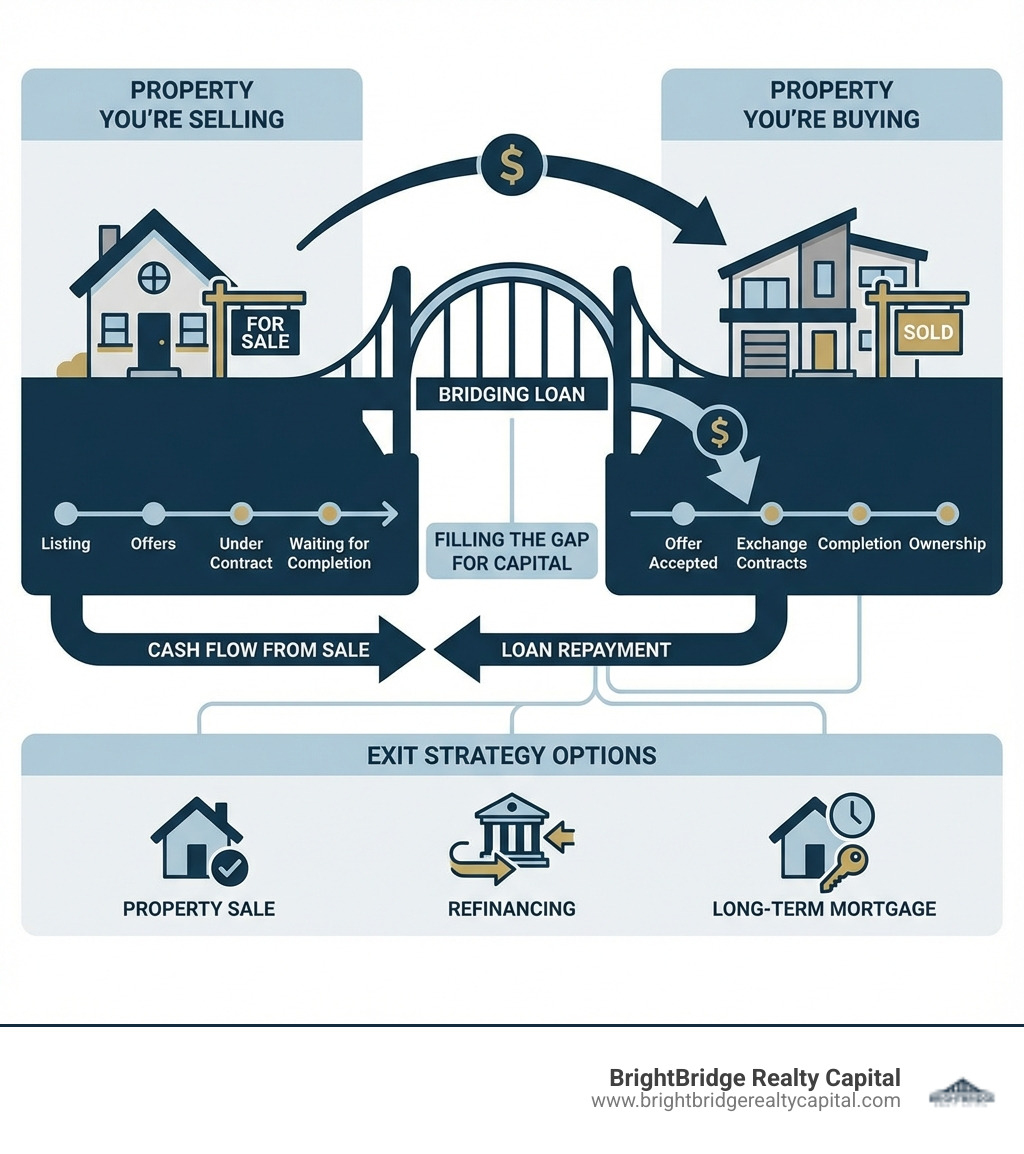
At its core, a bridging loan is a short-term financial solution designed to provide immediate cash flow until permanent financing is secured or an existing obligation is met. Think of it as a tactical financial "bridge" that connects two crucial points in time: the immediate need for capital to seize an opportunity and the eventual arrival of long-term funding. When your capital is tied up but a valuable, time-sensitive deal appears, a bridging loan steps in to fill that temporary liquidity gap, ensuring the opportunity is not lost.
These loans are a form of asset-based lending, meaning they are generally secured against a high-value asset—most commonly real estate. This fundamental difference is what sets them apart from traditional bank loans. The lender's primary focus shifts from a borrower's income and credit score to the intrinsic value of the collateral and the credibility of the repayment plan, known as the "exit strategy." This asset-centric approach streamlines the underwriting process, allowing for significantly faster approvals and funding than conventional loans, which are bogged down by stringent income verification and credit history analysis.
For real estate investors, particularly in a hyper-competitive market like New York, NY, this speed is a game-changer. Imagine finding a perfectly located but unmortgageable property at a Manhattan auction. The closing deadline is 21 days. A traditional mortgage is not an option due to both the property's condition and the timeframe. This is the exact scenario where a bridging loan shines, providing the agility and capital needed to acquire the asset confidently and quickly.

As Investopedia aptly defines it, a bridging loan is a "short-term financial solution used to provide immediate cash flow until permanent financing is secured or an existing obligation is met." This form of "interim financing" is characterized by its higher interest rates and reliance on collateral, which are direct reflections of the lender's increased risk and the short-term, urgent nature of the funding.
Common Uses for Bridging Finance
Bridging loans are remarkably versatile, serving as a key tool in a wide array of real estate scenarios where timing is paramount:
- Breaking a Property Chain: This is the classic use case. You've found your dream home but haven't sold your current one. A seller won't accept a contingent offer. A bridging loan can provide the funds to purchase the new property, effectively making you a chain-free buyer. You then repay the loan once your old property sells.
- Auction Purchases: Property auctions demand certainty and speed. A successful bid typically requires a 10% deposit on the day and the remaining 90% within 28 days. Bridging loans are ideal for this, as they can be pre-arranged and funded well within this tight deadline, allowing you to secure the property while you later organize long-term financing.
- Property Development & Renovations: For a developer, a bridging loan can fund the initial acquisition of land or a dilapidated building. A portion of the funds may also be released in stages (known as drawdowns) to cover construction costs. Once the development is complete and value has been added, the loan is repaid either through the sale of the finished units or by refinancing to a specialized development exit loan or commercial mortgage.
- Fix and Flip Projects: The 'fix and flip' model is built on speed and efficiency. A bridging loan provides the capital to both purchase an undervalued property and fund the necessary renovations. This allows an investor to acquire, renovate, and list the property for sale in a matter of months, maximizing their return on investment before the high interest costs accumulate.
- Buy-to-Let Investment: A prime buy-to-let property becomes available, but it requires a quick purchase to beat other investors, or it's currently unmortgageable (e.g., lacks a functioning kitchen). A bridging loan secures the property. After light refurbishment, you can refinance onto a standard buy-to-let mortgage, using the rental income to service the new debt, and repay the bridge loan.
- Business Cash Flow and Expansion: Businesses can leverage equity in their commercial properties to secure a bridging loan for a rapid capital injection. This can be used to manage temporary cash flow shortages, purchase inventory, or fund a strategic expansion while waiting for a larger, slower commercial loan to be approved.
- Meeting Urgent Tax Liabilities: An unexpected inheritance tax bill or a corporate tax deadline can create significant financial strain. A bridging loan secured against a property can provide the necessary funds to meet these obligations promptly, avoiding steep penalties from tax authorities, while you organize the sale of assets or other long-term financial arrangements.
The Critical Role of the Exit Strategy
While the speed of bridging loans is their main appeal, they are fundamentally temporary. This means that every application must be accompanied by a clear, credible, and well-documented "exit strategy." This is your detailed plan for repaying the loan in full at the end of its term. Lenders will scrutinize this plan as rigorously as they do the asset's valuation, as it represents their path to getting their capital back.
A strong exit strategy is not just a vague idea; it's a substantiated plan. Common strategies include:
- Sale of the Property: This is the most frequent exit for development and fix-and-flip projects. The plan should be supported by a realistic valuation from a local real estate agent, data on comparable sales in the area (comps), and a clear timeline for marketing and selling the property.
- Refinancing to a Long-Term Mortgage: For buy-to-let investors or homeowners, the exit is often to replace the bridging loan with a conventional mortgage. To make this credible, you should ideally have a Decision in Principle (DIP) from a mortgage lender, demonstrating that you are likely to be approved for the long-term loan once certain conditions are met (e.g., renovations are complete).
- Sale of Other Assets: Your exit might involve selling a different property, a portfolio of stocks, or another business interest. Lenders will require proof of ownership and a realistic valuation and sale plan for these other assets.
- Forthcoming Funds: This could include an expected inheritance, a pension lump sum, or the settlement of a legal case. This requires verifiable documentation, such as a solicitor's letter or official statements, confirming the amount and expected date of the funds.
Without a robust and verifiable exit strategy, securing a bridging loan is nearly impossible. Lenders are not in the business of owning property; they are in the business of lending money and getting it back with interest. At BrightBridge Realty Capital, we work hand-in-hand with our clients in New York, NY, to refine their exit strategies, ensuring they have a clear and viable path to repayment from day one.
The Core Mechanics of Bridging Loans
Understanding the fundamental mechanics of bridging loans is essential for any investor looking to leverage them effectively. These financial instruments are not one-size-fits-all; they come in several distinct forms, each designed for specific scenarios and carrying different implications for risk, cost, and structure.

Open vs. Closed Bridging Loans
The primary distinction between open and closed bridging loans lies in the certainty of the repayment date.
- Closed Bridging Loans: These loans are structured with a fixed and predetermined repayment date. This is possible because the borrower has a clear and contractually confirmed exit strategy. For example, if you are buying a new property and have already exchanged contracts on the sale of your existing one, the completion date for that sale becomes the fixed repayment date for the closed bridge. Because the lender has a high degree of certainty about when they will be repaid, these loans are considered lower risk and, as a result, often come with slightly lower interest rates and fees.
- Open Bridging Loans: In contrast, an open bridging loan does not have a fixed repayment date at the outset. While there isn't a specific calendar day locked in, the loan agreement will still stipulate a final deadline, typically within 12 or sometimes 24 months. This type of loan is suitable when the exit strategy is planned but not yet certain. For instance, you might be using the loan to renovate a property before putting it on the market. You intend to sell it to repay the loan, but you don't have a buyer or a sale date confirmed. The increased uncertainty for the lender makes open bridging loans inherently riskier, which is reflected in higher interest rates and potentially more stringent terms.
Here's a quick comparison:
| Feature | Closed Bridging Loans | Open Bridging Loans |
|---|---|---|
| Repayment Date | Fixed and predetermined (e.g., confirmed sale completion date) | No fixed date, but an end-of-term deadline (e.g., within 12 months) |
| Cost | Generally lower interest rates and fees | Generally higher interest rates and fees |
| Risk | Lower risk for the lender due to a certain exit | Higher risk for the lender due to an uncertain exit timeline |
| Ideal Use Case | Breaking a property chain with contracts exchanged | Renovating a property to sell on the open market |
First Charge vs. Second Charge Bridging Loans
This distinction is all about legal priority. It determines the order in which lenders are repaid if the borrower defaults and the property used as security is sold.
- First Charge Bridging Loans: A first charge gives the bridging loan lender the primary legal claim over the property. If the loan defaults, they are the first in line to be repaid from the proceeds of the sale. This is the same position a primary mortgage provider holds. Because they have the strongest security and the lowest risk of not recovering their funds, lenders can typically offer higher loan-to-value (LTV) ratios and more favorable interest rates on first charge loans. These are common when the property being used as security has no existing mortgage on it.
- Second Charge Bridging Loans: A second charge loan is taken out on a property that already has an existing loan (the 'first charge,' usually a conventional mortgage) secured against it. The bridging loan lender's claim is secondary. In a default scenario, the first charge lender must be repaid in full before the second charge lender receives any money. For example, if a property sells for $500,000, and there is a $300,000 first charge mortgage and a $150,000 second charge bridge loan, the first $300,000 goes to the mortgage provider. The second charge lender then gets their $150,000 from the remaining $200,000. Because of this subordinate position and higher risk, second charge loans almost always have higher interest rates, lower LTVs, and require the explicit consent of the first charge lender.
Regulated vs. Unregulated Loans
The regulatory framework governing a bridging loan is a critical distinction that determines the level of consumer protection afforded to the borrower.
- Regulated Loans: In the United States, a bridging loan is generally considered regulated if it is secured against a property that the borrower or a close family member intends to live in (i.e., a primary residence or a second home). These loans fall under strict consumer protection laws, such as the Truth in Lending Act (TILA) and the Real Estate Settlement Procedures Act (RESPA), which are enforced by the Consumer Financial Protection Bureau (CFPB). These regulations mandate specific disclosures about costs (like the APR), impose a 'cooling-off' period, and require lenders to perform rigorous affordability checks to ensure the borrower can repay the loan without undue hardship. The process is more structured and offers greater protection for individuals.
- Unregulated Loans: These loans are for business or investment purposes. If the loan is for acquiring a buy-to-let property, a commercial building, a fix-and-flip project, or land for development, it is typically classified as unregulated. The underlying assumption is that the borrower is a 'sophisticated' business person or investor who can assess the risks involved. This lack of regulation allows for greater speed and flexibility, as lenders can focus purely on the commercial viability of the project—the asset's value and the exit strategy—rather than the borrower's personal income. While this is a major advantage for investors, it also means fewer consumer protections are in place, placing a greater onus on the borrower to perform their own due diligence.
At BrightBridge Realty Capital, we specialize in providing financing solutions for real estate investors in New York, NY, focusing exclusively on unregulated commercial and investment bridging loans. We operate with full transparency to ensure our clients, while operating in an unregulated space, are fully aware of the terms, costs, and responsibilities associated with their financing.
Explaining Costs, Rates, and Loan Terms
While bridging loans offer unparalleled speed and flexibility, this premium service comes at a higher cost than traditional long-term financing. Understanding the complete cost structure is absolutely critical to accurately forecast the profitability of your project and ensure the loan remains a tool for success, not a financial burden. The costs are higher due to the short-term nature, the administrative intensity of a fast closing, and the increased risk lenders assume.
Typical Loan Amounts and Terms
Bridging loans are designed to cover significant, yet temporary, financial needs. We facilitate loans from as little as $5,000 for minor refurbishments to over $20 million for large-scale commercial developments. The amount you can borrow is primarily determined by the property's value and the lender's risk appetite, expressed as a Loan-to-Value (LTV) ratio.
- Loan-to-Value (LTV): Most lenders offer a maximum LTV of around 75% of the property's appraised value on a gross loan basis. This means the total loan amount, including some fees, cannot exceed this percentage. For example, on a property valued at $1,000,000, the maximum gross loan would be $750,000.
- Loan-to-Gross-Development-Value (LTGDV): For development and heavy renovation projects, lenders may also use LTGDV. This metric is based on the projected value of the property after the work is completed. A lender might offer up to 65-70% LTGDV, which can often allow for a larger loan that covers both purchase and construction costs.
The loan terms are inherently short, reflecting their bridging nature. The typical duration is between 90 days and 12 months. However, for more complex projects, terms can be extended up to 24 or even 36 months. The short duration underscores why a clear, achievable, and time-bound exit strategy is the most critical component of any bridging loan application.
How Interest Rates and Fees for bridging loans are Calculated
This is where borrowers must pay close attention, as costs can accumulate from multiple sources.
- Monthly Interest Rates: Unlike traditional mortgages that quote an Annual Percentage Rate (APR), bridging loans use a monthly interest rate. These can range from 0.48% for very low-risk, low-LTV loans to 2% or more per month for higher-risk scenarios. A 1% monthly rate is equivalent to a 12% annual rate before compounding, highlighting the expense if the loan is held for an extended period.
- Arrangement Fees (or Facility Fees): This is a standard one-off charge for setting up the loan. It is calculated as a percentage of the gross loan amount, typically between 1% and 2%. On a $500,000 loan, a 2% arrangement fee would be $10,000. This fee is often deducted from the loan proceeds before they are disbursed, meaning you receive the net loan amount.
- Exit Fees: Some, but not all, lenders charge an exit fee upon repayment of the loan. This is often 1% of the loan amount or one month's interest. It's crucial to clarify this upfront, as it can significantly impact your total cost of borrowing. Many competitive lenders, including BrightBridge Realty Capital, do not charge exit fees.
- Legal Fees: The borrower is responsible for paying the legal fees for both their own solicitor and the lender's solicitor. These costs vary depending on the complexity of the transaction but can range from a few thousand to several thousand dollars.
- Valuation Fees: The lender requires an independent valuation of the security property, and the borrower bears this cost. The fee depends on the property's value and type, from a simple residential valuation to a more complex commercial or development appraisal.
- Broker's Fees: If you use a mortgage broker to find your loan, they will charge a fee for their service. This can be a fixed fee or a percentage of the loan. As a direct lender, BrightBridge Realty Capital eliminates this layer of cost, offering a more streamlined and potentially more cost-effective process.
Interest Payment Methods: A Worked Example
Let's compare the two common ways interest is handled on a $500,000 bridging loan for 12 months at 1% per month, with a 2% arrangement fee ($10,000).
Rolled-Up Interest (or Retained Interest): This is the most popular method. The lender calculates the total interest for the term ($500,000 x 1% x 12 months = $60,000) and adds it to the loan from the start. The borrower makes no monthly payments. The total repayment at the end of 12 months would be the principal plus the interest: $500,000 + $60,000 = $560,000. This method is excellent for cash flow during a project but is more expensive overall as you pay interest on the full term, even if you repay early (unless the terms allow for a rebate).
Serviced Interest: This method functions more like a traditional loan, where the borrower makes monthly interest payments. In our example, the monthly payment would be $500,000 x 1% = $5,000. Over 12 months, you would pay a total of $60,000 in interest, and the final repayment would be just the principal of $500,000. This requires strong monthly cash flow but can be cheaper if the loan terms allow for it, and it prevents the debt from escalating.
The Key Advantages and Risks to Consider
Like any powerful financial tool, a bridging loan is a double-edged sword. When wielded with expertise and a clear strategy, it can unlock opportunities and generate substantial returns. However, if mishandled or used without a full understanding of its risks, it can lead to significant financial distress. A prudent investor must weigh both sides carefully.
Main Advantages of Using a Bridging Loan
When applied strategically, the benefits of bridging loans are compelling and distinct:
- Unmatched Speed: This is the primary advantage. A bridging loan can be arranged and funded in a fraction of the time of a conventional mortgage—often within 7-14 business days, and sometimes even faster. For an investor in New York, this speed is a superpower. It allows you to confidently bid at auctions, secure off-market deals from motivated sellers, and close transactions before competitors can even get their financing in order. At BrightBridge Realty Capital, our direct lending model and in-house decision-making enable us to provide term sheets in 24 hours and close within a week for straightforward cases.
- Exceptional Flexibility: Bridging lenders are far more adaptable than traditional banks. Their focus is on the quality of the asset and the viability of the exit strategy, not rigid income multiples or flawless credit reports. This flexibility extends to the types of properties financed—from uninhabitable buildings and land without planning permission to unique commercial or mixed-use assets that mainstream lenders would reject.
- Access to Significant Capital: Bridging loans provide access to substantial sums of money based on property equity. This enables investors to acquire high-value assets or undertake large-scale development projects that would be impossible to fund through other short-term means, allowing for significant portfolio growth in a short period.
- Enhanced Buying Power: With a bridging loan pre-approved, you can operate as a cash buyer. This status is highly attractive to sellers, giving you significant negotiating leverage. You can often secure a property at a discount compared to buyers who are dependent on slow, uncertain mortgage financing.
- Less Reliance on Credit Score (for Unregulated Loans): For investment-purpose (unregulated) loans, the asset is king. While a poor credit history isn't ignored, a strong property asset and a bulletproof exit plan can often overcome credit blemishes. This provides a crucial funding route for experienced investors who may have a complex financial history but a solid, profitable project in hand.
Potential Disadvantages and Risks of bridging loans
An investor must approach bridging loans with a healthy respect for their potential downsides:
- Higher Interest Rates and Costs: The convenience of speed and flexibility comes at a price. Monthly interest rates are significantly higher than long-term mortgages. If the exit strategy is delayed by even a few months, these costs can rapidly erode, and potentially eliminate, the projected profit margin of a project.
- Expensive Fees: The total cost is not just the interest. Arrangement fees (1-2%), legal fees for both sides, and valuation fees can add up to 3-5% of the loan amount upfront. These costs must be factored into your financial modeling from the very beginning.
- The Ultimate Risk of Repossession: This cannot be overstated. The loan is secured against your property. If you fail to repay the loan by the end of the term, you are in default. The lender has the legal right to repossess the property and sell it on the open market to recover their capital, interest, and any associated costs. You could lose the asset and any equity you had in it.
- Intense Pressure to Execute: The short-term nature of the loan creates a high-pressure environment. If your exit is a sale, a slowing market might force you to accept a lowball offer to avoid default. If your exit is a refinance, a tightening of credit markets could see your long-term loan application denied. A solid contingency plan is not a luxury; it's a necessity.
- The Consequences of Default: If you cannot repay the loan on time, you enter a default state. The immediate consequences typically include the application of a much higher 'default interest rate,' which can be double the original rate or more. The lender will begin legal proceedings, and if a solution cannot be negotiated (such as a short-term extension, often with heavy fees), the repossession process will commence. This will severely damage your credit profile and your reputation with lenders.
- Market Volatility Risk: If you borrow based on a property's current value, and the market experiences a sudden downturn, the value of your security asset could fall. This not only jeopardizes your ability to sell for a profit but could also put you in breach of your loan's LTV covenants, potentially triggering a default even before the term ends.
Securing Your Loan: Application Steps and Considerations
Applying for a bridging loan is a process built for speed, but it still demands meticulous preparation. Unlike the slow, bureaucratic nature of conventional mortgage applications, the bridging process is more dynamic and collaborative between the borrower and lender. Knowing what to expect and having your documentation in order is key to a smooth and rapid closing.
The Bridging Loan Application Process: A Step-by-Step Guide
While specifics vary between lenders, the journey from inquiry to funding generally follows these key stages:
- Initial Enquiry & Consultation: This is the first conversation with a lender or broker. Be prepared to discuss the 'what, why, and how': what the loan is for (e.g., auction purchase), why you need it (e.g., speed), and how you'll repay it (your exit strategy). You'll need to provide the property address, purchase price/value, required loan amount, and a summary of your plan.
- Indicative Terms (or Term Sheet): If the project aligns with the lender's criteria, they will issue indicative terms within 24-48 hours. This document outlines the proposed loan amount, interest rate, fees, and conditions. It is not a binding offer but a strong expression of interest.
- Decision in Principle (DIP) & Formal Application: Once you accept the terms, you'll complete a formal application form. The lender performs initial due diligence, including credit checks. A positive outcome results in a Decision in Principle (DIP), a more formal commitment to lend, subject to valuation and legal checks.
- Submission of Documentation & Due Diligence: This is where you provide the detailed evidence. Key documents include: proof of identity and address, an asset and liability statement, bank statements, and, most importantly, robust evidence for your exit strategy (e.g., an agreement in principle for a refinance, a comparative market analysis from an agent for a sale).
- Property Valuation: The lender instructs an independent, RICS-certified surveyor to conduct a valuation of the security property. The type of report will depend on the project—from a simple mortgage valuation to a full structural survey or a development appraisal. The final loan amount is contingent on this valuation.
- Legal Work: This is often the most time-consuming part. Solicitors for both you and the lender are instructed. They handle the legal due diligence, draw up the loan agreement and security documents (the 'charge'), and ensure all legal requirements are satisfied before funds can be released.
- Underwriting and Final Approval: The lender's underwriting team reviews the entire case file: the application, valuation report, legal report, and all supporting documents. They make the final decision. Once satisfied, a formal loan offer is issued.
- Completion and Loan Drawdown: You (and your solicitor) sign the loan offer and legal documents. The funds are then transferred to your solicitor, who completes the property purchase or releases the capital to you.
The entire process can take as little as 5-7 business days if all parties are motivated and prepared. Direct lenders like BrightBridge Realty Capital, who have in-house underwriters and established relationships with valuers and solicitors in New York, NY, can significantly expedite this timeline.
Critical Considerations Before You Apply
Before you even make that first enquiry, pause and conduct a thorough self-assessment:
- Stress-Test Your Exit Strategy: This is the most important step. Your 'Plan A' must be realistic and well-documented. But you must also have a 'Plan B' and even a 'Plan C'. What if the property takes six months longer to sell than expected? What if renovation costs are 20% over budget? What if the lender for your refinance pulls their offer? Model these scenarios to understand their financial impact. A good lender will want to see that you've considered these contingencies.
- Calculate the True Cost of Borrowing: Don't be swayed by a low headline interest rate. Create a spreadsheet and list every single potential cost: arrangement fee, valuation fee, your legal fees, the lender's legal fees, and any potential exit or administrative fees. Sum these up to understand the total cost and how it will impact your project's profitability.
- Choose the Right Lending Partner: Not all lenders are created equal. Consider the differences between a direct lender, a broker, and a private fund. A direct lender like us offers speed and a single point of contact. A good broker can offer access to a wide range of products. Research your potential lender's reputation, read case studies, and ask for references. You are entering a partnership, and you need to trust that your partner is experienced, transparent, and reliable.
- Prepare Your Paperwork in Advance: Having your documentation ready can shave days or even weeks off the application process. Compile a digital folder with your ID, proof of address, asset/liability statement, and any evidence related to your exit strategy before you even start.
Frequently Asked Questions About Bridging Loans
As specialists in this field, we encounter a wide range of questions from investors exploring bridging loans for the first time. Here are detailed answers to some of the most common queries we receive.
How quickly can I get a bridging loan?
The speed of a bridging loan is its hallmark feature. A realistic timeframe from a formal application to receiving funds is typically between 2 to 4 weeks. However, this can be significantly accelerated. With a motivated borrower, a responsive solicitor, and a straightforward property, direct lenders can often complete a loan in 5-10 business days. At BrightBridge Realty Capital, our streamlined processes and use of tools like Automated Valuation Models (AVMs) for certain properties allow us to close deals in the New York, NY market in as little as a few days when a client's file is complete and the need is urgent.
Can I get a bridging loan with bad credit?
Yes, it is often possible. For unregulated, investment-purpose bridging loans, the lender's primary focus is on the quality of the property asset and the strength of your exit strategy. A low credit score is a risk factor that will be considered, but it's not an automatic disqualifier like it might be with a high-street bank. If you have significant equity in the security property and a highly credible repayment plan (e.g., a confirmed sale of another asset), many lenders will look past historical credit issues. Be prepared, however, that a lower credit score may result in a higher interest rate or a lower Loan-to-Value (LTV) to mitigate the lender's perceived risk.
What's the difference between a bridging loan and a hard money loan?
This is a crucial question, as the terms are often used interchangeably, especially in the US. Historically, 'hard money' had a reputation for being from private individuals at very high rates with little regulation. 'Bridging loans' were often seen as a more structured product from specialist financial institutions. Today, the lines have blurred significantly. Generally, both are short-term, asset-based loans. However, 'hard money loan' is still often used to describe loans for riskier projects (like heavy-fix-and-flips or land deals) with a strong focus on the 'hard' asset's value. 'Bridging loan' can sometimes refer to slightly more conventional scenarios, like breaking a property chain. At BrightBridge Realty Capital, we offer products that cover the entire spectrum, but we prefer the term 'bridging loan' as it better reflects our structured, transparent, and professional approach to short-term real estate finance.
How is a bridging loan repaid?
Repayment is almost always made in a single lump-sum payment, known as a 'bullet repayment,' at the end of the agreed-upon loan term. This payment clears the original principal and all accrued interest (if it was 'rolled up'). The funds for this repayment come directly from your pre-agreed 'exit strategy.' For example, if you used a bridging loan to buy a property at auction, you would repay the loan with the proceeds from either the subsequent sale of that property or the funds received from a new, long-term mortgage you secure on it.
Can I repay a bridging loan early? Are there penalties?
Most bridging loans can be repaid early without penalty. In fact, since interest is calculated daily or monthly, repaying early is the best way to reduce your overall costs. If your interest is 'serviced' monthly, you simply stop paying. If your interest was 'rolled up,' you will typically only be charged for the interest up to the day you repay. However, it is vital to check the loan agreement for any 'Early Repayment Charges' (ERCs) or minimum interest periods (e.g., a minimum of 3 months' interest). Reputable lenders are usually flexible, but you must confirm this before signing.
What is the maximum LTV I can get?
For most standard residential properties, the maximum Loan-to-Value (LTV) is typically around 75% of the property's market value. For more specialized assets like commercial property or land, the LTV might be lower, perhaps 50-65%, reflecting the higher risk. Some lenders may offer a higher LTV if you can provide additional security (a 'charge' over another property). It's also important to note that the LTV is usually calculated on the lower of the purchase price or the independent valuation.
Your Next Move in Real Estate Financing
Bridging loans are an undeniably powerful and sophisticated tool in the modern real estate investor's arsenal. They provide the critical speed and flexibility required to seize time-sensitive opportunities, transforming complex transactions into achievable ventures. From securing a property at auction to funding a large-scale renovation or simply breaking a frustrating property chain, bridging finance closes the gap that traditional lending leaves wide open.
However, this power demands respect. The higher costs and significant risks associated with these loans mean they are not a casual financing option. Success hinges on a deep understanding of the costs, a disciplined approach to project management, and, above all, a meticulously planned and realistic exit strategy. It's not just about getting the money; it's about having a clear, documented, and stress-tested plan to pay it back on time.
Before you proceed, ask yourself these key questions—a final readiness checklist:
- Is my opportunity clearly defined? Do I have a specific property and a clear business plan?
- Is my exit strategy viable and verifiable? Do I have a realistic sale price supported by data, or an Agreement in Principle for a refinance?
- Have I created a contingency plan? What happens if my exit is delayed by three, six, or nine months?
- Have I calculated the total cost? Have I accounted for all interest, arrangement fees, legal costs, and valuation fees?
If you're a real estate investor in New York, NY, who has answered these questions and is looking for fast, reliable funding from a transparent direct lender, then BrightBridge Realty Capital is ready to be your strategic partner. We don't just provide capital; we provide expertise. We specialize in structuring competitive bridging loans tailored to the unique demands of your investment, whether it's a quick fix-and-flip, a multi-unit development, or a strategic commercial acquisition.
Ready to explore how a bespoke bridging loan can accelerate your next real estate venture and give you the competitive edge you need?