Build Big: Understanding Commercial Construction Loans


Summary
Secure your commercial construction loan. Discover types, application steps, and key terms to fund your next big real estate project.
Why Commercial Construction Loans Matter for Real Estate Investors
Commercial construction loans are specialized financing tools that fund the development of income-producing properties--from ground-up builds to major renovations. Unlike traditional mortgages that pay out in a lump sum, these loans disburse funds in stages as construction milestones are met, with interest-only payments during the build phase.
Quick Overview:
- Purpose: Finance new construction, renovations, or expansions of commercial properties
- Loan Amounts: Typically $5M to $75M+ (some lenders start at $5M minimum)
- Loan-to-Cost (LTC): Usually 70-85% of total project costs
- Terms: Short-term (12-36 months), often converting to permanent financing
- Payments: Interest-only during construction
- Disbursement: Funds released in stages based on construction progress (draw schedule)
According to a 2023 Construction Outlook Survey by the Associated General Contractors of America, rising construction costs are a top concern for over 70% of contractors--making smart financing choices more critical than ever.
Whether you're expanding a rental portfolio, developing a retail center, or converting an industrial property, commercial construction loans provide the capital to execute your vision. Understanding how they work, what lenders require, and how to structure deals is key to protecting your investment and maximizing returns.
I'm Daniel Lopez, a loan officer at BrightBridge Realty Capital, and I've helped clients steer commercial construction loan financing across diverse property types. My goal is to explain the process so you can proceed with confidence.
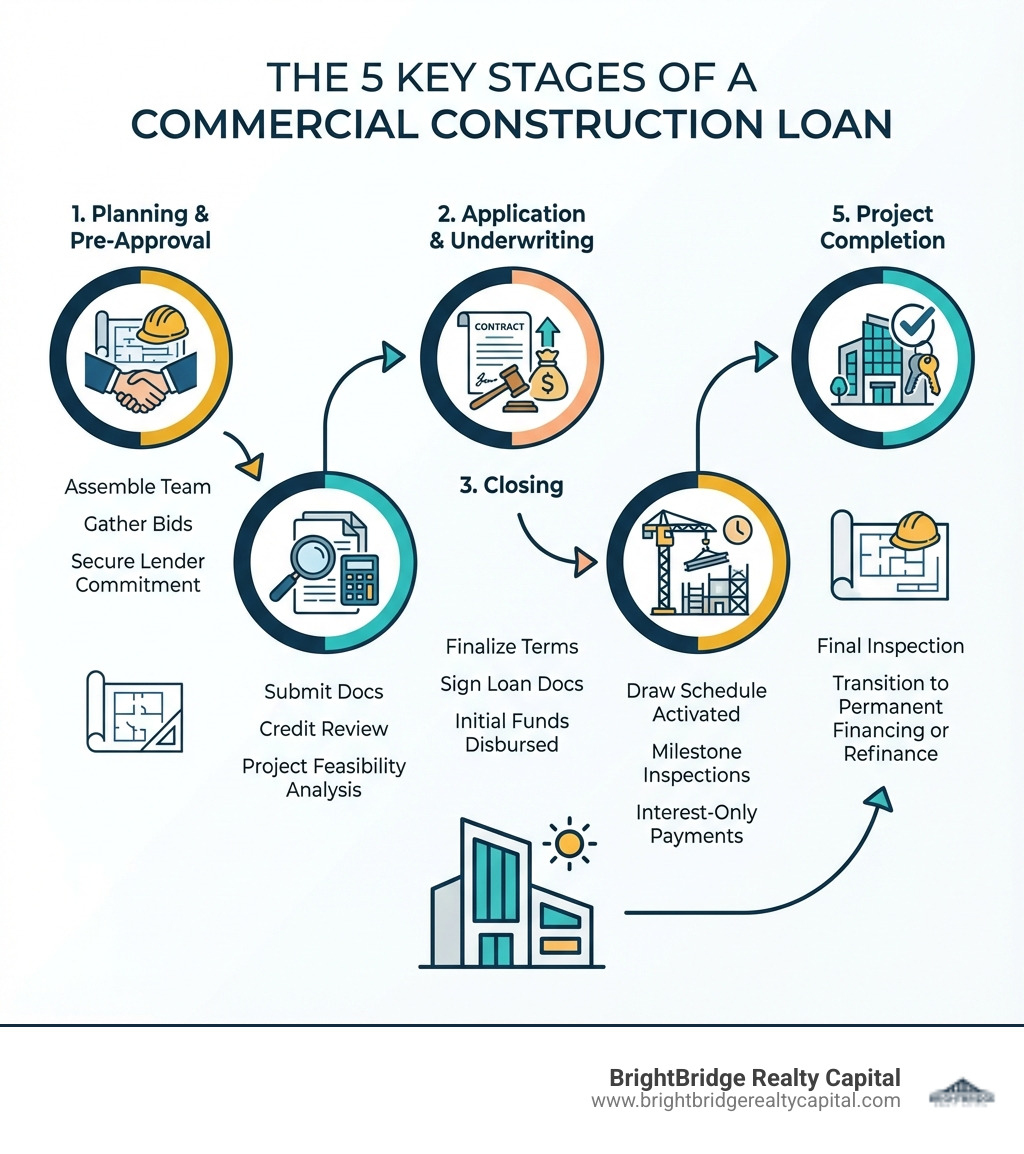
Commercial construction loan terms to remember:
What is a Commercial Construction Loan and How Does It Work?
At its core, a commercial construction loan is a specialized, short-term financial product designed to fund the creation or significant renovation of commercial properties. Think of it as the financial blueprint that allows your physical blueprint to come to life. Unlike a traditional commercial mortgage, which you'd use to purchase an existing, completed property, a commercial construction loan is specifically tailored for projects where the property is being built from the ground up, undergoing major structural changes, or being expanded. These loans are the lifeblood for developing a wide array of income-generating assets, including office buildings, retail shopping centers, industrial warehouses, multifamily apartment complexes, hotels, and special-use properties like medical facilities or self-storage units.
The fundamental difference lies in how the funds are disbursed. With a traditional mortgage, you receive the entire loan amount as a lump sum at closing. A commercial construction loan, however, operates on a staged funding model, often referred to as a "draw schedule." This means that instead of getting all the money upfront, the lender releases funds in installments as specific construction milestones are achieved and verified by an inspector. This methodical approach serves as a critical risk mitigation tool for both the borrower and the lender. For the lender, it ensures their capital is being deployed into a project that is tangibly progressing, protecting their investment. For the borrower, it provides a structured framework that helps keep the project on budget and on schedule, preventing contractors from being paid for work that hasn't been completed.
These loans are typically short-term, usually spanning 12 to 36 months, a period designed to cover the estimated duration of the construction phase. During this period, borrowers typically make interest-only payments, which is a significant advantage. Imagine trying to service a full principal and interest mortgage payment on a property that isn't yet completed, let alone occupied and generating income. The interest-only structure dramatically eases the financial burden during this pre-stabilization phase, freeing up the borrower's capital for other critical project needs. The interest is only calculated on the funds that have been drawn to date, not the total loan amount, which further helps manage carrying costs.
The primary purpose of a commercial construction loan is to finance new construction (ground-up development), major renovations (gut rehabs), or significant property expansions. This could involve building a new office complex in a growing suburban market, developing a retail center anchored by a grocery store, constructing a multi-family residential building to meet housing demand, or undertaking extensive renovations to convert an outdated industrial space into a modern logistics facility. For businesses looking to grow, these loans are often a critical catalyst, providing the capital needed to expand operations, increase capacity, or enter new markets through new or improved facilities. They are indispensable tools in the dynamic world of commercial real estate development, providing the structured financing necessary to transform vacant land or underutilized structures into vibrant, income-producing assets.
Types of Commercial Construction Loans
Just as there are many types of commercial properties, there are various types of commercial construction loans to match diverse project needs and borrower profiles. Understanding these options is key to finding the right fit for your development.
Conventional bank loans are a common path for many experienced developers with strong financial standing. These loans are offered by traditional financial institutions and often require substantial down payments, typically ranging from 15% to 30% of the project's total cost. They can be flexible but often come with stringent underwriting requirements.
For those seeking more custom or rapid solutions, private lender financing, like what we offer at BrightBridge Realty Capital, can be an excellent alternative. We specialize in providing customized real estate financing solutions nationwide, focusing on quick, flexible funding for investors. Our direct lending model means we can often provide faster closings and a more seamless process, which can be invaluable in time-sensitive development projects.

SBA Construction Loans
The Small Business Administration (SBA) offers programs designed to support small businesses, and these can extend to construction projects. SBA-backed construction loans are appealing for their flexible terms and lower down payment requirements compared to conventional loans. They are a great option for small businesses looking to build or expand without tying up significant capital.
The SBA 7(a) loan program, for example, can offer up to $5 million with repayment terms as long as 25 years. A significant benefit of SBA 7(a) loans is their flexibility; they can finance not only the real estate but also working capital, equipment, and even cover interest payments during construction. Some sources suggest down payments can be as low as 0% for SBA 7(a), though traditional commercial real estate loans typically require 15-20% or more.
Another popular option is the SBA 504 loan program. This program is specifically designed for the acquisition of fixed assets, including land, buildings, and machinery, which makes it ideal for construction. It offers a low, fixed interest-rate loan of up to $5.5 million with terms up to 25 years, usually requiring only a 10% down payment from the borrower. For new construction projects utilizing an SBA 504 loan, you must occupy at least 60% of the rentable property, with certain provisions for leasing out the remaining space temporarily or permanently. The SBA 504 loan involves a partnership between a bank and a Certified Development Company (CDC), which works with the SBA to provide a portion of the loan. This structure makes significant funding more accessible for small businesses.
Construction-to-Permanent Loans
A construction-to-permanent loan is a clever financing solution that bundles two loans into one. It starts as a commercial construction loan during the building phase, with funds disbursed on a draw schedule and interest-only payments. Once construction is complete and the property is stabilized (meaning it's ready for occupancy or generating income), the loan seamlessly converts into a traditional, long-term permanent mortgage.
The main benefit of a construction-to-permanent loan is its efficiency. By having a single closing for both phases, you save time and reduce the closing costs associated with securing two separate loans. This streamlined process eliminates the need to re-qualify or go through another lengthy application process once construction is finished. It’s particularly beneficial for developers or business owners who intend to hold the property for the long term, as it provides stability and predictability from the outset. This structure ensures a smooth transition from build to long-term ownership and is especially valuable for projects like multifamily affordable housing.
Bridge and Other Short-Term Financing
Sometimes, you need a financial "bridge" to get from one point to another in your project's lifecycle. That's where bridge loans and other short-term financing solutions come in.
Bridge loans are short-term loans that provide quick capital to "bridge the gap" between immediate funding needs and securing permanent financing. They are often used for acquisition, refinance, or recapitalization. For instance, a developer might use a bridge loan to quickly acquire a property, then refinance into a commercial construction loan once permits are secured, or cover costs while awaiting a permanent loan closing.
These loans are typically interest-only and can have terms up to five years, including extensions. Loan amounts can range from $5 million to $75 million, with larger amounts considered for portfolios. Interest rates are usually floating (SOFR-based). Bridge loans are known for their flexibility and speed, making them ideal for investors who need fast access to capital to seize opportunities or steer transitional periods. At BrightBridge Realty Capital, our expertise in providing quick, flexible funding makes us a strong partner for bridge financing needs, ensuring you don't miss out on crucial opportunities.
The Application and Approval Process for a Commercial Construction Loan
Securing a commercial construction loan is a multi-step journey that requires meticulous preparation and a clear understanding of what lenders expect. It's not just about asking for money; it's about presenting a compelling, data-driven vision backed by solid plans and a capable, experienced team. The lender is not just a source of capital but a partner in the project, and they need to be confident in every aspect of the deal.

Eligibility and Documentation: A Deep Dive
Lenders scrutinize every detail of a construction project to mitigate their risk. Being prepared with a comprehensive and professionally organized documentation package is crucial. While specific requirements can vary, here’s a more detailed look at what you’ll need:
- Detailed Construction Plan: This goes beyond basic blueprints. It includes fully engineered architectural drawings, a comprehensive scope of work with material specifications and finish schedules, and a precise, critical-path construction timeline.
- Hard and Soft Cost Budget: You'll need a line-item budget that separates "hard costs" (labor, materials, site work) from "soft costs" (architectural fees, engineering, permits, legal fees, interest reserves, contingency funds). This must be thorough and realistic.
- Contractor Bids and Agreement: Lenders require at least two, often three, competitive bids from qualified, licensed, and insured general contractors. You will also need to provide the final, signed contract with your chosen GC, which may be a fixed-price (lump sum) or a cost-plus contract.
- Permits and Approvals: You must provide evidence that all necessary zoning, land use, environmental, and building permits have been secured or are in the final stages of approval. A project without entitlements is not ready for financing.
- Solid Business Plan: This is your project's narrative. It must include an executive summary, detailed market analysis (including demographics, competitive properties, and absorption rates), pro forma financial projections (detailing projected rental income, vacancy rates, operating expenses, and Net Operating Income), a marketing and lease-up strategy, and biographies of the key principals (the development team).
- Financial Statements: Lenders need to see personal and business financial statements and tax returns, typically for the past 3-5 years. This includes a personal financial statement for all guarantors, detailing assets and liabilities.
- Strong Credit History: A strong personal and business credit score is essential. Lenders will pull credit reports to assess your history of managing debt.
- Borrower Experience (The Development Team's Resume): Lenders heavily favor teams with a proven track record. You must provide a portfolio of previously completed projects of similar size and scope, demonstrating your ability to deliver a project on time and on budget.
- Project Feasibility Study: Often required for larger projects, this is an independent, third-party analysis that validates the assumptions in your business plan. It confirms the project's market demand, financial viability, and potential for success, providing an unbiased assessment for the lender.
Lenders will use this information to calculate key metrics like the Loan-to-Cost (LTC) ratio and the projected Debt Service Coverage Ratio (DSCR) to ensure the project is financially sound from inception to stabilization.
Key Parties Involved
A commercial construction loan project is a complex collaboration. Understanding the role of each party is vital:
- Borrower/Developer: The project's visionary and leader. You conceive the project, assemble the team, secure the land and entitlements, provide the equity, and are ultimately responsible for the loan.
- Lender: The financial partner (that's us!). We perform due diligence, underwrite the risk, structure the loan, disburse funds according to the draw schedule, and monitor construction progress to protect our investment.
- General Contractor (GC): The on-the-ground manager of construction. The GC hires subcontractors, procures materials, manages the day-to-day schedule, and is responsible for building the project according to the approved plans.
- Appraiser: An independent professional who provides two crucial valuations: the "as-is" value of the land and the "as-complete" or "stabilized" value of the finished project. The loan amount is often constrained by these valuations.
- Architect & Engineers: The design team. The architect creates the building's design and blueprints, while structural, civil, and MEP (mechanical, electrical, plumbing) engineers ensure the design is safe, functional, and compliant with all codes.
- Title Company & Attorneys: Legal experts who ensure the property has a clean title, handle the loan closing, and manage the disbursement of funds, including protecting against liens.
Step-by-Step: From Pre-Approval to Closing
The path to securing a commercial construction loan typically follows these steps:
Step 1: Project Planning & Team AssemblyThis is the foundational phase. Assemble your project team, including architects, engineers, and a reputable general contractor. Finalize plans, secure entitlements, and obtain detailed bids based on thorough site visits. As per SBA guidance, relying on estimates without thorough site walk-throughs can lead to inaccurate bids, unexpected delays, and cost overruns.
Step 2: Lender Pre-ApprovalEngage with potential lenders early. Present your preliminary plans, budget, and financial overview. A pre-approval or term sheet will give you a clear idea of your borrowing capacity and the proposed loan structure, strengthening your position with your team.
Step 3: Full Application & UnderwritingSubmit your complete loan package with all required documentation. The lender's underwriting team will then conduct deep due diligence. This involves a critical review of your financials (the borrower), the project's feasibility and budget (the project), and the third-party appraisal and market study (the market). This phase is iterative and may involve requests for additional information.
Step 4: Loan Commitment & ClosingIf approved, the lender issues a formal loan commitment letter outlining the final terms. After you accept, attorneys for both sides will prepare the closing documents. At closing, all legal documents are signed, the title is transferred, and the loan is officially recorded. The initial funds for land acquisition or soft costs may be disbursed, marking the official start of your construction financing.
Understanding Key Terms for Your Commercial Construction Loan
Navigating commercial construction loans means getting familiar with a specialized vocabulary. Don't worry, we'll break down the jargon so you can speak confidently with your lender.
Loan Metrics: LTC, LTV, and Loan Amounts
- Loan-to-Cost (LTC): This is a critical metric for commercial construction loans. It represents the loan amount as a percentage of the total project cost, which includes land acquisition, construction, soft costs (like architect fees and permits), and interest reserves. Lenders typically offer up to 70-85% LTC for construction loans, meaning you'll need to contribute 15-30% of the total project cost as equity. For example, if a project costs $10 million, an 80% LTC loan would provide $8 million, requiring you to put in $2 million.
- Loan-to-Value (LTV): While LTC focuses on total project costs, LTV relates the loan amount to the completed property's appraised value. For construction, lenders often look at the "stabilized LTV," which is the loan amount divided by the property's value once it's built and generating income.
- Typical Loan Amounts: Commercial construction loan options often start at $5 million, with some lenders offering up to $75 million or even more for larger portfolios or complex projects. Non-recourse loans, which we’ll discuss next, typically start at $20 million.
Interest Rates and Repayment Structures
- Fixed vs. Variable Rates: Just like residential mortgages, commercial construction loans can come with either fixed or variable interest rates. Fixed rates offer predictability, locking in your interest cost for the loan term. Variable rates, on the other hand, fluctuate with market indices, often tied to the Secured Overnight Financing Rate (SOFR). While variable rates might start lower, they introduce uncertainty. Your choice depends on your risk tolerance and market outlook.
- Interest-Only Period: As mentioned, during the construction phase, most commercial construction loans are interest-only. This means your monthly payments cover just the interest accrued on the funds you've drawn, not the principal. This helps manage cash flow while the property isn't generating income.
- Recourse vs. Non-Recourse Loans: This is a significant distinction.
- Recourse Loans: With a recourse loan, the borrower is personally liable for the debt. If the project fails and the collateral (the property) isn't enough to cover the outstanding loan amount, the lender can pursue the borrower's personal assets to recover the debt. Most smaller to mid-sized commercial construction loans are recourse.
- Non-Recourse Loans: In a non-recourse loan, the borrower is generally not personally liable. The lender's recourse is limited to the collateral itself. If the project defaults, the lender can seize the property but typically cannot pursue the borrower's other assets. Non-recourse loans are usually reserved for larger projects and more experienced developers, often starting at loan amounts of $20 million or more. They come with "standard carve-outs," meaning there are specific situations (like fraud or environmental issues) where personal liability can still apply.
The Construction Draw Schedule
The draw schedule is the heartbeat of a commercial construction loan. It dictates when and how funds are released to the borrower.
- Definition: A draw schedule is a pre-agreed plan outlining the stages of construction and the corresponding amounts of loan funds that will be disbursed at each stage.
- Milestone-Based Disbursements: Funds are tied to specific project milestones, such as completion of the foundation, framing, roofing, or interior finishes. This ensures that money is released only as work progresses.
- Inspection Process: Before each draw is released, the lender (or their designated inspector/engineer) will typically conduct an on-site inspection. This verification confirms that the work for that milestone has been completed satisfactorily and that the funds requested are justified.
- Managing Draws: Borrowers submit a draw request, usually including invoices from contractors and suppliers, lien waivers, and a progress report. The lender reviews these documents and conducts the inspection before approving the release of funds.
- How a Draw Schedule Works: This systematic approach protects the lender by ensuring funds are used as intended and protects the borrower by ensuring payments align with actual progress, preventing overspending or misallocation of funds. It's a critical mechanism for risk management in construction financing.
Navigating Risks and Ensuring Project Success
Construction projects are inherently complex and fraught with potential pitfalls. Proactively identifying, planning for, and mitigating these risks is crucial to keep your commercial construction loan project on track, on budget, and on schedule.
Common risks include:
- Cost Overruns: Unexpected expenses can quickly derail a budget. Hard costs can escalate due to material price volatility (e.g., steel, lumber) or labor shortages. Soft costs can also increase from legal battles or extended design phases. As highlighted in the introduction, rising construction costs are a top concern for over 70% of contractors.
- Delays: Time is money in construction. Weather, supply chain disruptions, labor disputes, permitting hold-ups, or poor coordination can push back timelines, which increases interest carrying costs and delays the start of revenue generation.
- Contractor Issues: A project is only as good as its general contractor. Poor performance, financial instability, or even contractor bankruptcy can halt a project and lead to costly litigation and delays.
Beyond these, several other significant risks must be managed:
- Zoning and Entitlement Risk: This is the risk that you cannot obtain the necessary government approvals to build your project as designed. A denial of a zoning variance or a lengthy delay in permit issuance can kill a project before it even starts.
- Interest Rate Risk: For loans with a variable interest rate (e.g., tied to SOFR), a sharp rise in market rates can significantly increase your monthly interest payments, eating into your contingency and project profitability.
- Market Risk: This is the risk that by the time your project is completed 12-24 months later, market conditions have deteriorated. A recession could weaken tenant demand, lower achievable rental rates, and reduce the property's final appraised value, making it difficult to refinance.
Proactive Risk Mitigation Strategies
- Robust Contingency Funds: Your budget must include a healthy contingency fund, typically 10-15% of the total construction cost. This is a non-negotiable buffer to absorb unexpected costs without having to go back to the lender.
- Vet Your Team Thoroughly: Partner with experienced and reputable professionals. This means a general contractor with a strong track record on similar projects, an architect who understands local codes, and a land-use attorney who can navigate the entitlement process.
- Use Fixed-Price Contracts: Whenever possible, negotiate a Guaranteed Maximum Price (GMP) or fixed-price contract with your GC. This transfers a significant portion of the cost overrun risk from you to the contractor.
- Thorough Pre-Development Due Diligence: Before closing on the loan, invest in comprehensive due diligence. This includes geotechnical reports (soil tests), Phase I Environmental Site Assessments, and detailed zoning and code reviews.
- Manage Interest Rate Exposure: For variable-rate loans, consider purchasing an interest rate cap or entering into an interest rate swap to limit your exposure to rising rates.
- Secure Pre-Leasing/Pre-Sales: To mitigate market risk, securing leasing commitments from anchor tenants or pre-selling a percentage of condominium units before construction begins provides lenders with confidence in the project's future revenue stream.
- Master the Mechanic's Lien Process: A mechanic's lien is a legal claim against a property by a contractor or supplier who hasn't been paid. These liens can take priority over the lender's mortgage, creating a massive problem. To prevent this, you must meticulously manage payments. At each draw request, you must collect signed lien waivers from the general contractor and all major subcontractors and suppliers. This proves they have been paid for the prior period's work and waive their right to file a lien for that work. The title company will often assist in collecting these waivers and may provide special title insurance endorsements to protect the lender's lien priority.
Frequently Asked Questions about Commercial Construction Loans
We know you've got questions, and we're here to provide clear answers. Here are some of the most common inquiries we receive about commercial construction loans, expanded with the detail you need to move forward confidently.
How long does it take to secure a commercial construction loan?
The timeline for securing a commercial construction loan can vary significantly, typically ranging from 45 to 120 days. The final timing depends on the project's complexity, the lender's internal process, and, most importantly, the completeness of your loan package. A well-prepared borrower with a shovel-ready project—meaning plans are complete, a GC is selected, and major permits are in hand—will experience a much faster process. Delays are most often caused by incomplete documentation, unresolved entitlement issues, or an appraisal that comes in below expectations.
At BrightBridge Realty Capital, we pride ourselves on providing quick, flexible funding. Our direct lending model and streamlined process are designed to facilitate fast closings for qualified projects in New York, NY, and nationwide, which can be a huge advantage in a competitive market.
Can I use the loan to purchase the land for my project?
Yes, in most cases. A commercial construction loan can be structured to finance both the land acquisition and the subsequent vertical construction. This is often referred to as an "acquisition and construction loan." The cost of the land is included in the total project cost, and the loan amount is based on the overall Loan-to-Cost (LTC) ratio. However, lenders will want to see that you have some "skin in the game." If you already own the land free and clear, you can often use its value as part of your equity contribution to the project, which can significantly reduce your cash-to-close requirement.
What are the typical fees associated with a commercial construction loan?
Beyond the interest rate, you should budget for several fees. These are part of the project's soft costs. Common fees include:
- Origination Fee: A fee for processing the loan, typically 1% to 2% of the total loan amount, paid at closing.
- Appraisal and Review Fees: The cost for a full narrative appraisal report from a third-party appraiser, plus a fee for the lender to review it.
- Inspection Fees: A flat fee paid for each construction draw inspection. The inspector verifies progress before the lender releases the next round of funds.
- Legal Fees: Fees for the lender's counsel to draft and review loan documents. The borrower is typically responsible for paying these.
- Title Insurance and Endorsements: The cost of a lender's title policy, plus specific construction-related endorsements to protect the lender's lien priority.
- Other Costs: May include fees for surveys, environmental reports, and loan administration.
What happens if the project goes over budget?
This is a critical risk to plan for. The commercial construction loan is for a fixed amount. If costs exceed the budgeted amount, the borrower is responsible for covering the shortfall. You cannot simply draw more from the loan. This is precisely why lenders require a contingency fund in your budget from the start. If the contingency is exhausted and costs continue to rise, you must inject more of your own equity. Failure to do so can halt construction and trigger a loan default, putting the entire project at risk.
Can I act as my own general contractor?
While technically possible, it is highly discouraged by most lenders unless you are a professional, licensed contractor with extensive experience building similar projects. When a borrower acts as their own GC, lenders see it as a significant increase in risk. They lose the oversight and accountability that an independent third-party contractor provides. If a lender does agree to it, they will scrutinize your qualifications, require a detailed track record, and may demand a higher equity contribution or a lower LTC to compensate for the added risk.
What happens when the construction loan term ends?
This is a critical question highlighting the short-term nature of these loans. When the term ends (typically 12-36 months), the full outstanding balance becomes due. You must have a clear "exit strategy." The options are:
- Refinance into a Permanent Loan: This is the most common path. Once construction is complete and the property is stabilized (i.e., has received its Certificate of Occupancy and is leased up to a certain level), you secure a long-term commercial mortgage to pay off the construction loan. This permanent loan will have a longer term and will be amortized with principal and interest payments.
- Sell the Property: If your business model is to "build and flip," you would use the proceeds from the sale to pay off the commercial construction loan.
- Construction-to-Permanent Conversion: If you secured a single-close construction-to-permanent loan, the loan automatically converts to a permanent mortgage upon project completion, avoiding the time and cost of a second closing.
Conclusion
Navigating commercial construction loans can seem daunting, but with the right knowledge and a strong partner, it becomes a clear path to realizing your development goals. We've explored what these specialized loans are, how they differ from traditional mortgages, the various types available (from SBA options to bridge financing), and the detailed application process. We've also demystified key terms like LTC and recourse and discussed how to mitigate common risks.
A commercial construction loan is more than just money; it's a strategic tool that facilitates the development of commercial real estate and contributes directly to business growth. Whether you're building a new facility, undertaking a major renovation, or expanding your portfolio, careful preparation, a solid plan, and an experienced team are your greatest assets.
At BrightBridge Realty Capital, we understand the unique demands of real estate investors. We provide customized real estate financing solutions nationwide, specializing in quick, flexible funding and direct lending without intermediaries. Our goal is to offer competitive rates and a seamless process, ensuring you get the capital you need precisely when you need it.
Get the flexible, fast financing you need for your next project