From Ground Up to Grand Opening: Navigating Commercial Construction Financing

Summary
Unlock your next project! Explore commercial construction loans: types, how to qualify, benefits, & risks. Build your vision.
Why Commercial Construction Financing Matters for Your Development Project
Commercial construction loans are specialized, short-term financing tools meticulously designed to fund the development of income-producing properties from the ground up. Unlike traditional mortgages that finance existing, stabilized buildings, these loans provide the essential capital specifically for the construction or major renovation of commercial real estate. This can encompass a wide array of projects, including sprawling retail centers, modern office buildings, expansive warehouse and logistics facilities, multi-family apartment complexes, and boutique hotels. Essentially, if you can envision it, a commercial construction loan is the financial engine that can bring it to life.
These loans are the lifeblood of urban development and business expansion, enabling developers and business owners to create assets that are perfectly tailored to their market's needs and their own operational requirements. They bridge the critical financial gap between raw land or an outdated structure and a fully functional, revenue-generating property.
Key Facts About Commercial Construction Loans:
- Loan Structure: These are structured as short-term financing, typically lasting 12-36 months, which covers the construction period. Payments are almost always interest-only during this phase, which helps manage cash flow before the property begins generating income.
- Typical Loan Amounts: Loan amounts are highly variable, starting from around $1 million for smaller projects and extending to $100 million or more for large-scale developments, contingent on the lender's capacity and the project's scope.
- Leverage: Lenders typically finance up to 70-80% of the total project cost, a metric known as Loan-to-Cost (LTC). More complex structures involving layered financing, such as mezzanine debt, can sometimes push this to 85%.
- Down Payment: Borrowers are generally required to contribute a significant equity injection, usually between 10% and 30% of the total project cost. This "skin in the game" demonstrates commitment and mitigates lender risk.
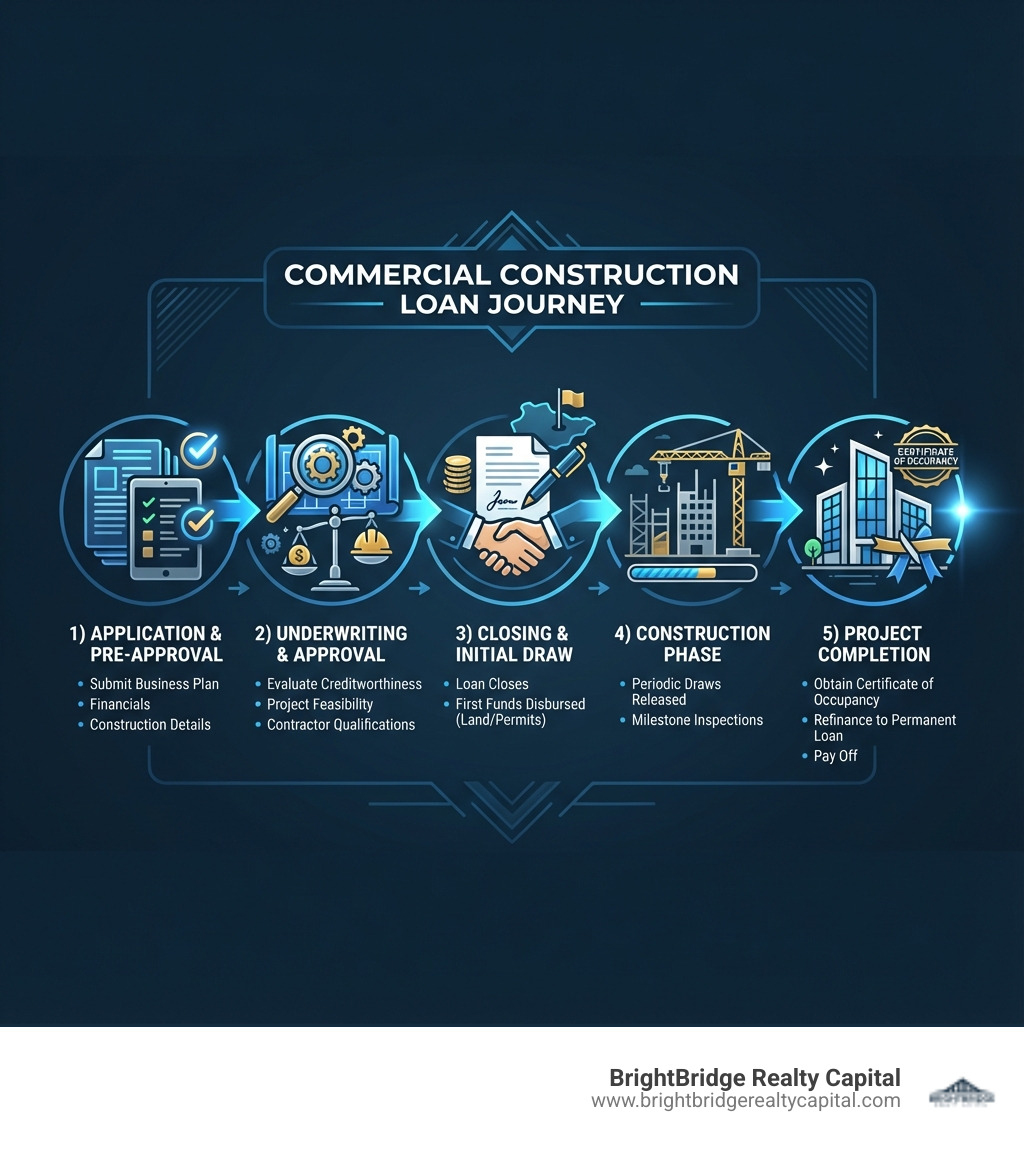
- Disbursement: Funds are not provided in a lump sum. Instead, they are released in stages, or "draws," that correspond to verified construction milestones (e.g., foundation complete, framing up). This ensures loan proceeds are used as intended.
- Common Types: A variety of loan types exist, including conventional bank loans, flexible SBA 7(a) loans (up to $5M), long-term fixed-rate SBA 504 loans, and alternative options like bridge and hard money loans.
- Interest Rates: Due to the inherent risks of construction (e.g., delays, cost overruns), interest rates are higher than those for permanent financing. They are typically variable rates tied to a benchmark like the Prime Rate or the Secured Overnight Financing Rate (SOFR), plus a spread.
- Requirements: A successful application hinges on a strong borrower profile, including excellent credit (700+ FICO is standard), a highly detailed construction budget and timeline, a vetted and experienced general contractor, and a compelling business plan with solid financial projections.
How They Differ from Traditional Mortgages:
Traditional commercial mortgages are designed for finished properties with predictable cash flows. They feature long repayment terms (15-30 years) with principal and interest payments (amortization) and lower, often fixed, interest rates. In stark contrast, commercial construction loans are all about the building phase. They cover a specific set of costs—land acquisition, permits, labor, materials, and other soft costs—and have a defined end date. Upon project completion, the construction loan must be paid off, which is typically achieved by refinancing into a long-term traditional mortgage, a process known as the "takeout."
Your business is ready to expand. You've found the perfect location. But traditional financing wasn't built for ground-up projects. That's where commercial construction loans come in—they bridge the gap between your vision and a fully operational property.
As Daniel Lopez, a loan officer at BrightBridge Realty Capital, I've helped clients steer commercial construction loans for everything from multi-unit developments to specialized commercial spaces, ensuring they secure the right financing structure for projects that require flexibility and speed. Understanding the mechanics of these loans—from draw schedules and contingency planning to conversion options and takeout financing—can mean the difference between a project that breaks ground on time and one that stalls in the approval phase. A well-structured loan is the foundation upon which a successful development is built.
Quick commercial construction loans definitions:
What is a Commercial Construction Loan and How Does It Work?

At its core, a commercial construction loan is a specialized financial product designed to fund the creation or significant renovation of income-generating real estate. Think of it as the financial blueprint for your physical blueprint. Unlike a traditional mortgage used to purchase an existing property, a construction loan provides capital to cover the full spectrum of project costs. This includes not only the obvious expenses like land acquisition, materials, and labor but also a wide range of "soft costs" such as architectural and engineering fees, permits, appraisals, legal fees, and even interest reserves to cover payments during the construction period. In some cases, it can also finance working capital or furniture, fixtures, and equipment (FF&E) for the new business.
The primary purpose of a commercial construction loan is to manage the flow of capital throughout the project lifecycle. Because the primary collateral—the building itself—doesn't exist in its final, income-producing form during construction, these loans carry a higher perceived risk for lenders. This risk profile includes completion risk (the project might not be finished), budget risk (costs could exceed projections), and market risk (the economy could sour before tenants are secured). This elevated risk translates to a different loan structure compared to permanent financing. Generally, construction loans feature higher, variable interest rates and shorter terms, typically 12 to 36 months. During the construction phase, payments are often interest-only on the funds that have been drawn to date, providing crucial breathing room for the project to reach completion and begin generating revenue.
The Disbursement Process: Understanding the Draw Schedule
One of the most distinctive features of a commercial construction loan is its disbursement process, known as a "draw schedule." Instead of receiving the full loan amount upfront, the borrower requests funds in stages, or "draws," as specific project milestones are achieved and verified. This methodical process ensures that funds are used as needed and directly align with construction progress, protecting both the borrower from overspending and the lender from financing a stalled project.
A typical draw schedule is meticulously detailed in the loan agreement. For example, the first draw might cover land acquisition and initial site work. Subsequent draws could be tied to milestones like: completion of the foundation, erection of the steel frame, completion of the exterior shell and roof, installation of HVAC and electrical systems, and finally, interior finishes. Each draw request requires a formal process: the general contractor submits an application for payment, which is then reviewed by the borrower and the lender. Crucially, a third-party inspector visits the site to verify that the work claimed has been completed in a satisfactory manner and aligns with the approved plans. Only after this inspection is confirmed will the lender release the funds, often through a title company to ensure all contractors and suppliers are paid lien-free. This oversight is paramount for maintaining project momentum and financial control. The draw schedule also often includes a "retainage"—a percentage of each payment (typically 5-10%) withheld until the project's final completion and punch-list items are resolved, ensuring contractors finish strong.
Construction-to-Permanent Loans
For many developers, the prospect of securing two separate loans—one for construction and another for long-term financing—is a daunting and inefficient process. A construction-to-permanent (C-to-P) loan, also known as a single-close loan, elegantly solves this problem by combining the short-term construction loan and the long-term permanent mortgage into a single product with one application and one closing.
During the construction phase, the loan functions exactly like a standard commercial construction loan, with funds disbursed via a draw schedule and interest-only payments. The key advantage emerges upon completion. Once construction is finished and the property receives its Certificate of Occupancy, the loan automatically converts into a permanent, amortizing mortgage without any additional paperwork or closing costs. This permanent phase usually features a longer term (e.g., 10-25 years) and often a fixed interest rate that may have been locked in at the initial closing, providing long-term stability and predictability. This seamless transition eliminates the significant risk (known as "takeout risk") of being unable to secure permanent financing due to changes in the market, interest rates, or the borrower's financial situation. This all-in-one solution is particularly popular for owner-occupied properties and developments where long-term cost certainty is a primary goal.
Understanding the Different Types of Commercial Construction Loans
Navigating the world of commercial construction loans means finding the right financial tool for your specific project. We offer a diverse portfolio of financing solutions, each with unique characteristics tailored to different project sizes, risk profiles, and borrower needs. These options vary significantly by loan amounts, interest rates, and leverage ratios, primarily measured by Loan-to-Cost (LTC) and Loan-to-Value (LTV).
To clarify, LTC is the loan amount divided by the total project cost (hard and soft costs), while LTV is the loan amount divided by the appraised value of the completed, stabilized property. Lenders will almost always use the lower of the two calculations to determine the final loan amount. For example, if a project costs $10 million and the loan request is $7.5 million (75% LTC), but the completed property appraises for only $9 million, a lender using a 75% LTV threshold would only lend $6.75 million. Additionally, understanding the difference between recourse and non-recourse loans is vital. Recourse loans hold the borrower and any guarantors personally liable for the debt if the project fails, allowing the lender to pursue personal assets. Non-recourse loans limit the lender's claim to the collateral (the property) itself. While attractive, non-recourse options are typically reserved for highly experienced sponsors, premier projects, and larger loan amounts, and they often include "bad boy carve-outs" that trigger personal liability in cases of fraud or other specified acts of misconduct.
Here's a quick comparison of some common types of commercial construction loans:
| Loan Type | LTV (Max) | Loan Amount (Typical) | Down Payment (Min) | Best Use Case |
|---|---|---|---|---|
| Conventional Loans | 70% LTC/LTV | $1MM - $100MM+ | 30% | Established businesses, lower risk projects |
| SBA 7(a) Loans | 80% | Up to $5MM | 0-10% | Smaller projects, owner-occupied, working capital |
| SBA 504 Loans | 80-90% | Up to $5.5MM (SBA) | 10% | Owner-occupied, long-term fixed assets, larger projects |
| Bridge Loans | Up to 75% LTC | $5MM - $75MM | Varies | Short-term gap financing, quick closings |
| Hard Money Loans | Lower (property-based) | Varies | Higher | Distressed properties, borrowers with credit challenges |
Conventional Construction Loans
Conventional commercial construction loans are the traditional workhorse of development financing, provided by private lenders such as community banks, national banks, and specialized debt funds like us. They are best suited for established developers and businesses with strong financial standing, a proven track record of successful projects, and significant liquidity. For conventional loans, we generally offer leverage up to 70% LTC or LTV, whichever is lower, meaning you'll need a substantial equity injection of at least 30%. Loan amounts can range from $1 million to over $100 million, catering to a wide variety of project sizes. Interest rates are often variable, tied to a benchmark like the Prime Rate or SOFR-based rates, plus a spread determined by the project's risk profile. Underwriting is rigorous, with a heavy emphasis on the borrower's experience and the feasibility of the project's pro forma.
SBA-Backed Construction Loans
For small to medium-sized businesses, government-guaranteed loans through the Small Business Administration (SBA) present a fantastic alternative, often with more favorable terms and lower down payments than conventional options.
SBA 7(a) Loans: As the SBA's most flexible loan program, the 7(a) can be used for a wide range of purposes, including new construction, renovation, and expansion. To qualify, the property must be at least 51% owner-occupied. Loans are capped at $5 million with terms up to 25 years for real estate. The key advantage is the lower required down payment and the ability to roll working capital and equipment costs into the same loan. Reviewing the official SBA 7(a) Loan Terms and Eligibility is essential for full details.
SBA 504 Loans: The SBA 504 Loan Program is specifically designed for financing major fixed assets, like owner-occupied real estate and heavy equipment. Its unique structure involves three parties: a private lender (like us) provides 50% of the financing, a Certified Development Company (CDC) provides up to 40% with an SBA guarantee, and the borrower contributes as little as 10%. This structure allows for up to 90% LTV and provides long-term, fixed-rate financing on the CDC portion, which is a significant advantage for businesses seeking financial stability.
Other Financing Options
Beyond conventional and SBA loans, a suite of alternative financing solutions exists for special situations or to achieve higher leverage.
Bridge Loans: These are short-term (1-5 years) solutions designed to "bridge the gap" between an immediate funding need and a long-term solution. Our commercial bridge loans, from $5 million to $75 million, are ideal for quick closings on time-sensitive acquisitions, repositioning a property, or providing capital during a stabilization period before permanent financing is viable.
Hard Money Loans: For projects with unique challenges, distressed assets, or for borrowers with credit issues, hard money loans are a viable option. These asset-based loans focus almost entirely on the property's value rather than the borrower's credit. They offer rapid funding but at a cost: significantly higher interest rates, upfront points, and shorter terms.
Layered Financing (Mezzanine Financing, Preferred Equity): To push leverage beyond the typical 70-80% LTV/LTC, sophisticated developers often use a "capital stack" approach. This involves layering junior debt (mezzanine financing) or preferred equity on top of the senior construction loan. Mezzanine debt is a hybrid of debt and equity, while preferred equity is an equity investment with debt-like features. By layering these options, we can help you achieve leverage as high as 85% LTC, enabling larger projects with less upfront capital. This requires careful structuring to balance the interests of all capital providers.
The Application and Approval Gauntlet: How to Qualify
Securing a commercial construction loan is an intensive process, but with meticulous preparation and a clear understanding of lender expectations, it's a conquerable challenge. Lenders, including us, employ a thorough underwriting process to assess the risk associated with your project and your capacity to repay the loan. This evaluation is often framed by the "Five C's" of credit, a time-tested framework for gauging creditworthiness:
- Character: Your track record and reputation. Do you have proven experience in development? Do you honor your obligations? We look at your credit history and professional background.
- Capacity: Your ability to repay the loan. This is assessed through historical and projected cash flow analysis (Debt Service Coverage Ratio).
- Capital: The amount of your own money invested in the project. This equity injection, or "skin in the game," demonstrates your commitment and cushions the lender's risk.
- Collateral: The asset securing the loan. For construction loans, this is the land and the to-be-built improvements.
- Conditions: The loan's purpose and the economic/market conditions. Is the project viable in the current market? Is the business plan sound?

Key Eligibility Factors for Commercial Construction Loans
To maximize your chances of approval and secure the most favorable terms for your commercial construction loan, focusing on these key eligibility factors is paramount:
- Credit Score: A strong personal and business credit history is non-negotiable. Lenders typically require a FICO score of 700 or higher for all principals with more than 20% ownership. A robust credit report signals financial discipline and reliability.
- Down Payment/Equity Injection: Most commercial construction loans require a substantial down payment, typically 10% to 30% of the total project cost. This capital demonstrates your commitment and reduces the lender's exposure. For example, conventional loans often require 30% down, while SBA 504 loans can be as low as 10%. Lenders also assess your liquidity to ensure you have cash reserves to cover potential cost overruns, often requiring a contingency fund of 10-15% of hard costs after your equity is injected.
- Comprehensive Business Plan: Your business plan is the narrative that sells your project. It must be data-driven and professional, including detailed financial projections (pro forma), a thorough market analysis justifying demand, a clear exit strategy (e.g., refinance or sale), and a detailed outline of how the completed property will be managed and generate income. This document must convince the lender that your vision is both achievable and profitable.
- Developer Experience: Lenders heavily favor borrowers with a proven track record of successfully completing similar projects on time and on budget. If you are new to development, the lender will expect you to mitigate this lack of experience by partnering with a highly experienced development consultant, project manager, or general contractor.
- Contractor and Team Qualifications: The quality of your team is critical. Lenders will rigorously vet your general contractor, architect, and engineers. They will scrutinize the contractor's financial stability, bonding capacity, licensing, insurance, and references. A strong, experienced team provides the lender with confidence that the project can be executed successfully.
Essential Documentation for Your Application
Preparing a meticulous and complete loan package is crucial. An organized submission demonstrates professionalism and significantly expedites the underwriting process. Be prepared to provide the following:
- Detailed Construction Plan: This includes full architectural drawings, engineering plans, and a line-item budget that breaks down all hard costs (materials, labor) and soft costs (fees, permits, insurance).
- Construction Contract: A signed agreement with your general contractor is essential. Lenders prefer a Guaranteed Maximum Price (GMP) contract, as it shifts some of the cost overrun risk to the contractor.
- Business Financial Statements: At least three years of historical profit and loss statements, balance sheets, and detailed cash flow projections for your business.
- Personal Financial Statements: Required for all principals with 20% or more ownership, detailing all personal assets and liabilities.
- Tax Returns: Both business and personal tax returns, typically for the past three years, to verify income and financial history.
- Legal Entity Documents: Articles of incorporation, operating agreements, and partnership agreements that outline the legal structure of your business entity.
- Appraisal and Environmental Reports: An independent, third-party appraisal forecasting the completed project's value (the "as-complete" value) is required. A Phase I Environmental Site Assessment is also standard to ensure the land is free of contamination.
- Building Permits and Zoning Approvals: You must provide documentation confirming the project is fully entitled and complies with all local zoning regulations.
- Resumes/Bios: Professional resumes for all key principals and the general contractor, highlighting relevant experience and past projects.
Benefits, Risks, and Key Considerations
Embarking on a commercial construction project is a significant venture, one that offers immense potential for growth and profitability but is also fraught with challenges. A clear-eyed understanding of the benefits, risks, and key strategic considerations is essential for navigating the complex journey from groundbreaking to stabilization.
The Upside: Fueling Business Growth and Creating Value
Commercial construction loans are powerful catalysts for growth and value creation. When deployed strategically, they offer substantial benefits:
- Leveraging Capital for Custom-Built Assets: A construction loan empowers you to build a property perfectly tailored to your business needs or market demands. This means optimized layouts for operational efficiency, modern amenities that attract high-quality tenants, and the integration of current technology and sustainable building practices, leading to higher long-term value and income potential.
- Expanding Operations and Market Share: For a growing business, a new or expanded facility is often a prerequisite for scaling. A construction loan facilitates this physical expansion, increasing production capacity, service area, or retail footprint, which in turn drives revenue growth.
- Generating Stable, Long-Term Cash Flow: For real estate investors, a development project's primary goal is to create a stable, income-producing asset. The completed property will generate rental income, providing predictable cash flow and a strong return on the initial investment.
- Potential for High Return on Investment (ROI): Developing a property from the ground up often yields a significantly higher ROI compared to purchasing an existing asset. This is due to the "development spread"—the difference between the total project cost and the market value of the stabilized property. By managing the project effectively, you create substantial equity.
Navigating the Inherent Risks of Commercial Construction
While the rewards are compelling, it's crucial to be acutely aware of the potential pitfalls associated with commercial construction loans and development projects:
- Construction Delays: Time is unequivocally money in construction. Delays caused by adverse weather, labor shortages, supply chain disruptions, or prolonged permitting processes can push back completion dates, increase interest carry costs, and delay revenue generation. The 2023 Construction Outlook Survey highlighted supply chain issues and labor shortages as persistent top concerns for contractors.
- Cost Overruns: Budgets can be broken by unforeseen expenses. Fluctuations in material prices, unexpected site conditions (like poor soil or rock), or design changes can lead to significant cost overruns. A well-funded contingency reserve (typically 10-15% of hard costs) is not just advisable; it's a requirement for most lenders.
- Market Fluctuations: The real estate market is cyclical and can shift during the 12-36 month construction period. A downturn could result in lower-than-projected rental rates or property values, making it difficult to attract tenants or meet the lender's debt service coverage ratios.
- Interest Rate Risk: Most construction loans have a variable interest rate tied to a benchmark like SOFR. If this benchmark rate rises during your project, your monthly interest payments will increase, eroding your project's profitability. Sophisticated borrowers may use financial instruments like interest rate caps to mitigate this risk.
- Refinancing and Takeout Risk: A standalone construction loan requires you to secure permanent financing upon completion. If market conditions have deteriorated, interest rates have risen, or the project's performance is weaker than projected, finding a favorable "takeout" loan can be challenging, potentially leaving you with a maturing high-interest loan.
Choosing the Right Lending Partner
Selecting the right lender is as critical to your project's success as choosing the right general contractor. A good lender is more than a source of capital; they are a strategic partner. Here's what to look for:
- Direct Lenders with Deep Experience: Seek out direct lenders like us who specialize in commercial construction financing. Our focused expertise means we understand the unique challenges and nuances of development projects, from draw administration to navigating change orders.
- Certainty and Speed of Execution: In commercial real estate, speed and certainty are invaluable. We pride ourselves on a streamlined process and fast closings, often within a week of a complete submission, to ensure your project stays on schedule and you don't lose a time-sensitive opportunity.
- Relationship-Based Approach: A dedicated relationship manager who understands your project intimately and is accessible throughout the process is vital. This ensures timely draw processing, proactive problem-solving, and a flexible approach when minor issues arise.
- Local Market Knowledge: Our deep understanding of specific markets, such as New York, NY, allows us to provide more relevant underwriting, accurate valuation insights, and competitive terms tailored to your project's specific location.
Frequently Asked Questions about Commercial Construction Loans
We know you have questions, and we're here to provide clear, straightforward answers. Here are some of the most common inquiries we receive about commercial construction loans, along with some deeper insights.
How long does it take to get a commercial construction loan?
The timeline for securing a commercial construction loan can vary widely, from 45 days to over four months, depending on the project's complexity, the lender's process, and the completeness of your application package. A simple pre-approval can be quick, but the full underwriting and due diligence process—which includes the appraisal, environmental reports, and legal review—takes time. However, experienced direct lenders like BrightBridge Realty Capital, who have in-house decision-making, can significantly accelerate this. We prioritize fast closings, often within a week once all third-party reports and documentation are in order, ensuring your project doesn't lose critical momentum.
What are typical interest rates and fees?
Interest rates for commercial construction loans are typically higher than for permanent mortgages due to the increased risk. They are usually structured as a variable rate, calculated as a benchmark index (like the Prime Rate or SOFR) plus a spread (e.g., SOFR + 3.5%). The spread depends on the borrower's strength and project risk. In addition to interest, you should budget for several fees, including: an origination fee (typically 1-2% of the loan amount), appraisal and environmental report fees, legal fees for loan documentation, and inspection fees for each construction draw.
Can I use the value of land I already own as equity?
Yes, absolutely. If you own the land for the project outright and it's free of liens, its appraised value can typically be counted toward your required equity injection. For example, if a project's total cost is $5 million and the lender requires a 20% equity injection ($1 million), and your land is appraised at $1 million, you have likely met your equity requirement without needing to contribute additional cash. This is a significant advantage for developers who have held land for some time.
What happens when the construction is complete?
Once your project is complete, has passed all final inspections, and you receive the Certificate of Occupancy, the construction loan matures. At this point, the loan must be paid off. You have a few options:
- Pay Off the Loan: If the project was a build-to-sell or had significant pre-sales, you can use the proceeds from the sale to pay off the construction loan in full.
- Refinance into a Permanent Mortgage: This is the most common path for long-term hold projects. You secure a new, long-term commercial mortgage to pay off the construction loan. This "takeout" loan will have a longer amortization schedule and typically a lower, more stable interest rate. We can assist in this transition.
- Construction-to-Permanent Conversion: If you opted for a C-to-P loan at the outset, the process is seamless. The loan automatically converts into its permanent phase, avoiding the time, cost, and risk of a second closing.
Can I get a commercial construction loan with bad credit?
Securing a commercial construction loan with a poor credit history is very challenging with traditional lenders, who often have a strict minimum FICO score of 700. However, it's not always impossible, as some alternative financing options prioritize other factors:
- Hard Money Lenders: These asset-based lenders focus primarily on the project's collateral value and potential, not your personal credit score. They provide flexibility and speed but at the cost of much higher interest rates (often in the double digits), higher upfront fees, and shorter terms.
- Larger Down Payment: Making a significantly larger equity injection (e.g., 40-50% instead of 20-30%) can help offset the perceived risk of a lower credit score and make your application more appealing to some lenders.
- Bring in a Strong Partner: Partnering with an individual or entity with a strong credit profile and financial standing can bolster the application and provide the lender with the confidence they need.
Conclusion: Building Your Future with the Right Financing
Navigating the intricate landscape of commercial construction loans can seem daunting, but it is a manageable and highly rewarding process when approached with diligence and the right partners. As we've explored, success hinges on a deep understanding of the available loan types, the rigorous application process, and a clear-eyed assessment of the associated benefits and risks. The key takeaways are clear: meticulous preparation is paramount. A comprehensive, data-driven business plan, a strong credit profile, a substantial equity contribution, and a detailed grasp of your project's costs and timeline are your most powerful assets in securing favorable financing.
Remember that a construction project's success is not solely dependent on the builder; it is equally reliant on the financial structure supporting it. From managing the draw process and planning for contingencies to mitigating interest rate exposure and ensuring a smooth transition to permanent financing, every step requires strategic foresight. The risks of construction delays, cost overruns, and market shifts are real, but they can be managed with a robust plan and an experienced team.
Choosing the right financing partner is arguably the most critical decision you will make. You need more than just a lender; you need a strategic ally. At BrightBridge Realty Capital, we pride ourselves on being direct lenders who possess an intimate understanding of the complexities of commercial development. We don't just provide capital; we provide expertise, speed, and certainty of execution. We offer customized solutions with fast closings and competitive rates, ensuring you have the flexible, reliable funding you need to transform your vision into a tangible, profitable reality. Our ultimate goal is to help you build financing operations that scale seamlessly with your growing portfolio.
Ready to lay the financial groundwork for your next commercial success?