Unlock Your Empire State Dreams with Commercial Real Estate Lending in New York

Summary
Discover commercial real estate loans NY: rates, types, eligibility & NYC financing. Unlock your Empire State investment today!
Why Commercial Real Estate Loans NY Are Key to Building Wealth in America's Largest Market

Commercial real estate loans NY provide the essential financial scaffolding for income-producing properties across the Empire State. From the iconic skyscrapers of Manhattan to the sprawling industrial parks of Western New York, these loans are the lifeblood of the state's economy. New York is not just a local market; it is a global gateway, attracting capital from every corner of the world. However, navigating this landscape requires more than just capital—it requires a deep understanding of the specific loan products, regulatory hurdles, and market cycles that define New York real estate.
Quick Facts and Market Benchmarks:
- Loan amounts: Typically range from $1M for small multifamily units to $100M+ for institutional-grade office towers and large-scale developments.
- Down payments: Generally 10% to 35%. SBA programs offer the lowest entry point at 10%, while conventional bank loans usually require 20% to 30%.
- Interest rates: Currently fluctuating between 2% and 11%. The lower end is reserved for government-backed programs and high-credit borrowers, while the higher end applies to bridge and hard money loans.
- Loan-to-Value (LTV): Most lenders cap LTV at 65% to 75% for conventional deals, though SBA 504 and certain mezzanine structures can push total leverage to 90%.
- Terms: Amortization schedules often run 20 to 25 years, but the actual loan term (the duration until the balloon payment) is typically 5, 7, or 10 years.
- Property types: A diverse mix including Class A/B/C Office, Retail (Strip Malls and Urban Retail), Industrial/Flex, Multifamily (5+ units), Mixed-Use, and Hospitality.
Top Loan Types in NY:
- SBA 7(a): The gold standard for small businesses, offering up to $5M with 10% down for owner-occupied properties.
- SBA 504: A powerful tool for long-term fixed-rate financing on major fixed assets, requiring only 10% equity from the borrower.
- Conventional Bank Loans: Offered by local, regional, and national banks, these are the most common for stabilized investment properties.
- Bridge loans: Short-term, high-interest solutions used for acquisitions, renovations, or "quick-close" scenarios where traditional financing is too slow.
- CMBS (Commercial Mortgage-Backed Securities): Often used for larger, stabilized assets where non-recourse debt is preferred.
New York's commercial real estate market is arguably the most competitive and complex in the world. With a population exceeding 8 million in NYC alone and a massive suburban and upstate footprint, the demand for space is constant but ever-shifting. Investors face a unique set of challenges: high property taxes, stringent rent regulations, and a fast-paced environment where a delay of even a few days can result in a lost deal. Whether you are looking to acquire a retail strip in Nassau County, refinance a rent-stabilized multifamily building in Brooklyn, or fund a ground-up industrial project in the Hudson Valley, your choice of financing will determine your ultimate return on investment.
The primary hurdle for many investors is the "friction" of the lending process. Traditional banks often have slow approval timelines that don't align with the speed of the NY market. Furthermore, many lenders lack the granular knowledge required to underwrite properties in specific New York neighborhoods, leading to conservative valuations or confusing eligibility requirements.
I'm Daniel Lopez, a senior loan officer at BrightBridge Realty Capital. My career has been dedicated to helping investors and business owners navigate the intricacies of commercial real estate loans NY. I have structured deals across the entire capital stack, from $1 million SBA loans for local bakeries to multi-million dollar bridge facilities for complex urban redevelopments. I've seen firsthand how the right loan structure can turn a marginal deal into a home run, and I've learned that in New York, your lender needs to be as aggressive and informed as you are.
Quick commercial real estate loans NY definitions and resources:
- Debt Service Coverage Loans: A deep dive into how lenders calculate your ability to repay based on property income.
- Rental Property Loan New York: Specific strategies for residential rental investors in the NY market.
- Investment Property Acquisition: A step-by-step guide to the buying process for commercial assets.
Understanding Commercial Real Estate Loans NY
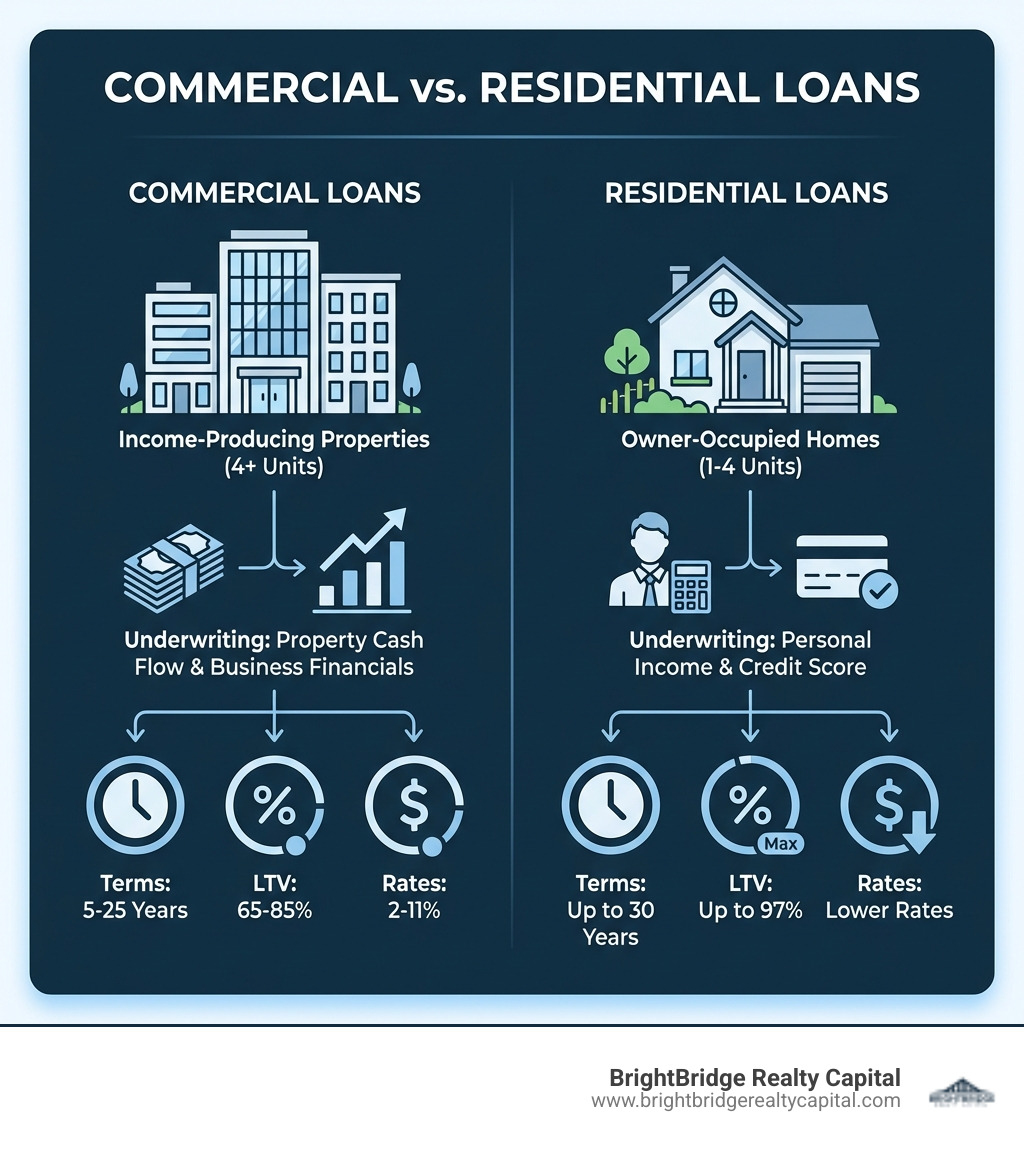
When we discuss commercial real estate loans NY, we are entering a financial realm that operates on entirely different principles than the residential mortgage market. While a residential loan is primarily a bet on an individual's personal earning power, a commercial loan is a bet on the property's economic viability. In New York, where real estate is the primary driver of wealth, understanding these nuances is critical for any serious investor.

The Core Philosophy: Property Income vs. Personal Income
In the residential world, lenders look at your W-2s, your debt-to-income ratio, and your FICO score. In the commercial world, while your credit matters, the "star of the show" is the property's Net Operating Income (NOI). Lenders want to know: After all operating expenses—taxes, insurance, maintenance, utilities, and management fees—is there enough money left over to pay the mortgage and still provide a cushion?
In the New York market, this calculation is complicated by high operating costs. For instance, New York City property taxes can consume a significant portion of gross income, and utility costs in older buildings can be unpredictable. A sophisticated lender will look at your "expense ratio" and compare it to market benchmarks for that specific borough or neighborhood. If you are looking to dive deeper into how these properties operate as investments, check out our NYC investment property ultimate guide.
Diverse Asset Classes in the New York Market
New York offers a staggering variety of commercial assets, each with its own risk profile and lending requirements:
- Office Space: This sector is currently undergoing a transformation. Lenders are favoring "Class A" buildings with modern amenities and high environmental ratings (often driven by Local Law 97 compliance). Smaller medical offices in suburban areas like Westchester or Long Island remain highly stable and attractive to local banks.
- Retail Centers: The "death of retail" has been greatly exaggerated in New York. While big-box stores face challenges, neighborhood strip malls anchored by grocery stores or pharmacies are thriving. Urban retail—the storefronts that line the streets of Manhattan and Brooklyn—remains a high-demand asset class, though underwriting now focuses heavily on the "e-commerce resilience" of the tenants.
- Industrial and Logistics: This is perhaps the hottest sector in NY. The need for "last-mile" delivery centers to serve the millions of residents in the tri-state area has sent industrial rents skyrocketing. Lenders are very aggressive in this space, often offering higher LTVs for well-located warehouses in Queens, the Bronx, or Staten Island.
- Multifamily Units: In New York, any residential building with 5 or more units is considered commercial. This is the bedrock of the NY investment market. However, investors must navigate the complex web of rent stabilization and rent control laws, which can limit income growth and impact the loan amount a lender is willing to provide.
Current Rates and the Economic Environment
The question we hear most often is: "What's the rate?" In New York, current commercial loan rates typically range from 2% to 11%. This wide variance is due to the different "buckets" of capital available.
- Government-Backed (SBA/FHA): These often offer the lowest rates, sometimes in the 6-7% range depending on the current Treasury yields.
- Bank/Life Insurance Co: These are competitive, middle-of-the-road rates for stabilized assets with strong borrowers.
- Private Credit/Bridge: These are higher-rate, short-term loans (8-11%) used for properties that are currently vacant or in need of major renovation.
Many NY lenders utilize the SOFR (Secured Overnight Financing Rate) as their benchmark for floating-rate loans. Understanding how SOFR moves is essential for investors using bridge financing to ensure their interest reserves are sufficient to cover potential rate hikes during the project's duration.
The Critical Ratios: LTV and DSCR
Lending in New York is a game of ratios. Two numbers will dictate your success: Loan-to-Value (LTV) and Debt Service Coverage Ratio (DSCR).
- LTV Ratios: This is the percentage of the property's value that the bank is willing to lend. In a conservative market like NY, most conventional banks cap this at 65% to 75%. This means you need to bring significant equity to the table. However, for owner-occupied properties via the SBA, you can achieve up to 90% leverage.
- DSCR: This is the most important metric for a commercial lender. It is calculated by dividing the NOI by the annual debt service. A 1.25x DSCR is the standard requirement. This means the property must generate $1.25 in profit for every $1.00 in mortgage payments. In high-priced markets like Manhattan, achieving a 1.25x DSCR can be challenging, often requiring the borrower to put more money down to reduce the loan amount until the ratio "works."
Major Types of Commercial Real Estate Financing in New York
Navigating the various loan products in the Empire State can feel like navigating the subway at rush hour—it’s fast, crowded, and requires a clear map. Choosing the wrong "line" can lead to delays, higher costs, or a deal that simply falls through. Here is a detailed breakdown of the primary financing vehicles used in New York today.
Conventional Commercial Mortgages
Conventional loans are the bread and butter of the industry. These are typically issued by commercial banks (like Chase or M&T), regional banks (like Valley National or Signature's successors), and credit unions.
- Pros: They offer the most competitive long-term rates and the lowest fees. They are generally "permanent" financing, meaning they are intended for properties that are already occupied and generating steady income.
- Cons: They have the strictest underwriting requirements. You will need a high credit score, significant liquidity (cash reserves), and a property that is already performing well.
- NY Nuance: Many NY conventional lenders include "prepayment penalties" that can be quite steep, such as yield maintenance or declining points (5-4-3-2-1). If you plan to sell or refinance in 3 years, a 5-year lockout can be a deal-breaker. For more on this, see commercial real estate financing NY.
SBA 7(a) and 504 Loan Programs
For the small business owner—the backbone of the New York economy—the Small Business Administration (SBA) provides a path to ownership that would otherwise be impossible.
- SBA 7(a): This is a versatile loan used for purchasing real estate, equipment, or even working capital. The maximum loan is $5 million. In NY, this is frequently used for mixed-use buildings where the business owner operates on the ground floor and rents out the apartments above.
- SBA 504: This is designed specifically for major fixed assets. It involves a unique structure: a private lender provides 50% of the project cost, a CDC (Certified Development Company) provides 40% (backed by the SBA), and the borrower provides only 10%. This allows a business to preserve its cash for operations while owning its building.
- The Occupancy Rule: To qualify for SBA financing, your business must occupy at least 51% of the square footage of an existing building. If you are building from scratch, you must occupy 60% initially and 80% eventually.
Bridge Loans and Hard Money
In the fast-moving New York market, sometimes you need to close in 10 days, not 60. Or perhaps you are buying a "distressed" asset—a vacant warehouse in Long Island City or a brownstone in Bed-Stuy that needs a total gut renovation. Conventional banks won't touch these properties because they don't have current cash flow.
Bridge loans provide the "bridge" from acquisition to stabilization.
- Terms: Usually 12 to 36 months.
- Structure: Often interest-only, meaning your monthly payments are lower, but you aren't paying down the principal.
- Exit Strategy: Lenders will only issue a bridge loan if you have a clear "exit strategy"—either a plan to refinance into a conventional loan once the property is leased up, or a plan to sell the property for a profit. Learn more about this in our guide on what is a bridge loan in commercial real estate.
Construction and Development Loans
New York is a state of constant growth. Ground-up development in the five boroughs is a high-stakes game. Construction loans are structured differently than mortgages; the money is not given all at once. Instead, it is released in "draws" as specific milestones are met (e.g., foundation poured, framing complete, roof on).
- Horizontal Construction: Funding for site prep, clearing, and infrastructure.
- Vertical Construction: Funding for the actual building structure.
- Mezzanine Debt: For very large projects ($20M+), developers often use mezzanine debt to fill the gap between their primary construction loan and their own equity. This is "junior" debt, meaning it sits behind the primary lender in priority, and thus carries a much higher interest rate.
CMBS (Conduit) Loans
Commercial Mortgage-Backed Securities (CMBS) loans are pooled together and sold to investors as bonds. These are popular in New York for large, stabilized assets like shopping centers or office buildings. The primary advantage is that they are almost always non-recourse, meaning the lender cannot come after your personal assets if the loan defaults; they can only take the property. The downside is that they are very difficult to modify if the market turns, as you are dealing with a "servicer" rather than a human banker.
Eligibility and Documentation for New York CRE Loans
If you want to secure a commercial real estate loan NY, you must be prepared for a level of scrutiny that far exceeds a residential application. Lenders in New York are dealing with high-value assets and complex legal environments, so they leave no stone unturned. Being organized is the difference between a smooth closing and a deal that dies in underwriting.
The "Three Pillars" of Underwriting
Lenders evaluate your application based on three primary pillars: the Property, the Borrower, and the Market.
- The Property (The Cash Flow): As discussed, the NOI is king. You will need to provide at least three years of Profit & Loss (P&L) statements and federal tax returns for the property. Lenders will also demand a current Rent Roll, which lists every tenant, their lease start and end dates, their monthly rent, and their security deposit. In NY, they will look for "lease expirations"—if all your tenants' leases end next year, that's a high risk for the bank.
- The Borrower (The Experience): Lenders want to see a "track record." If you are buying a 20-unit building in the Bronx, have you managed multifamily before? If not, do you have a professional property management company lined up? You will need to provide a Personal Financial Statement (PFS) showing your assets, liabilities, and liquidity. Lenders often require you to have "post-closing liquidity"—cash in the bank equal to 6-12 months of mortgage payments.
- The Market (The Context): Lenders will perform their own market analysis. They look at "comparable sales" (comps) and "market rents." If you claim you can rent an office for $50/sq ft but the market average is $35, the lender will underwrite the loan based on the $35 figure, which could significantly reduce your loan amount.
The Documentation Checklist
To get started, you should have a "deal room" or folder ready with the following:
- Purchase and Sale Agreement (PSA): The signed contract for the property.
- Entity Documents: Most commercial properties are held in an LLC. You'll need the Operating Agreement and Articles of Organization.
- Environmental Reports: In New York, a Phase I Environmental Site Assessment is mandatory. This checks the history of the land to ensure there were no gas stations, dry cleaners, or chemical plants that leaked toxins into the soil. If a Phase I shows "RECs" (Recognized Environmental Conditions), you may be forced to do a Phase II (soil testing), which can be expensive and time-consuming.
- Property Condition Assessment (PCA): An engineer's report on the state of the roof, HVAC, plumbing, and structure. If the building needs $500,000 in repairs, the lender may "hold back" that amount from the loan until the work is done.
- Appraisal: A third-party valuation. Note that commercial appraisals in NY can cost between $3,000 and $10,000 and take 3-5 weeks to complete.
New York Specific Regulatory Hurdles
New York has unique laws that impact loan eligibility. For example, Local Law 97 in NYC requires buildings over 25,000 square feet to meet strict energy efficiency targets or face massive fines. Lenders are now asking for "energy audits" to ensure the building won't be hit with these fines, which would eat into the NOI and threaten the loan repayment. For a broader overview of these legal and financial landscapes, our resource on real estate finance New York is an essential read.
Market Dynamics and Loan Availability in New York City
New York is not a monolithic market; it is a collection of micro-markets, each with its own lending climate. A lender who is bullish on industrial space in New Jersey might be very cautious about office space in Midtown. Understanding these dynamics is key to positioning your loan request. For more insights on the broader lending landscape, see our article on New York real estate loans.
The Five Boroughs: A Lending Perspective
- Manhattan: The "Center of the Universe" remains the most liquid market, but it is also the most expensive. Lenders here are focused on "Class A" assets. The retail market in areas like SoHo and the Upper East Side has seen a strong recovery, making those loans more accessible. However, the "Class B and C" office market is struggling, and financing for those assets often requires significant "equity infusions" from the borrower.
- Brooklyn: Once the "alternative" to Manhattan, Brooklyn is now a primary target for institutional capital. Areas like Williamsburg and DUMBO command Manhattan-level rents. Lenders love Brooklyn multifamily, but they are wary of the high prices and low "cap rates" (the return on investment), which can make the DSCR tight.
- Queens: Known for its diversity, Queens is a powerhouse for industrial and multifamily real estate. Long Island City has become a hub for life sciences and tech, attracting specialized lenders. The residential markets in Astoria and Flushing remain incredibly stable, making them favorites for local community banks.
- The Bronx: This borough offers some of the highest "yields" in the city. While property values are lower than in Manhattan, the rental demand is massive. Lenders here focus heavily on the borrower's ability to manage properties in a more challenging socio-economic environment.
- Staten Island: Often overlooked, Staten Island is a major hub for logistics and distribution due to its proximity to the ports. Industrial loans here are highly sought after.
The Impact of Interest Rates and Inflation
We are currently in a "higher for longer" interest rate environment. This has led to a "valuation gap"—sellers still want 2021 prices, but buyers can only afford 2024 prices because their borrowing costs have doubled.
This has created a surge in demand for creative financing. We are seeing more "Seller Carryback" notes, where the seller acts as a secondary lender to help the buyer close the gap. We are also seeing more "Assumable Mortgages," where a buyer takes over the seller's existing low-interest-rate loan. If you are navigating these complex waters, having a lender who understands these structures is vital.
The Rise of Private Credit
As traditional banks have pulled back due to increased regulation and economic uncertainty, private credit funds have stepped in to fill the void. These are non-bank lenders who are not subject to the same strict federal oversight. They can be more flexible on LTV and credit scores, but they charge higher rates. In New York, private credit is now a major player in the $5M to $50M loan space, providing the speed and flexibility that the "big banks" currently lack.
Frequently Asked Questions about Commercial Real Estate Loans NY
How do commercial loans differ from residential mortgages?
Residential loans (1-4 units) are primarily regulated by consumer protection laws and are based on personal credit and income. They typically offer 30-year fixed terms. Commercial loans (5+ units or business use) are business-to-business transactions. They are based on the property's income, have shorter terms (5-10 years), and often feature "balloon" payments where the remaining balance is due in full at the end of the term. They also carry higher interest rates and fees.
What is the typical down payment for a commercial property in NY?
For a standard investment property, expect to put down 20% to 30%. If you are a business owner occupying the building, you can use the SBA 504 program to get in with only 10% down. For high-risk assets or bridge loans, lenders may require 35% to 40% equity.
Can I get a commercial loan for a mixed-use building in NYC?
Yes, mixed-use buildings are the most common asset type in NYC. Lenders will categorize the loan based on the "predominant use." If 70% of the income comes from apartments and 30% from a ground-floor deli, it will likely be treated as a multifamily loan. If the commercial component is more than 50%, it will be treated as a pure commercial loan, which may have slightly higher rates.
What is a "Non-Recourse" loan?
A non-recourse loan means the borrower is not personally liable for the debt. If the property fails to pay and goes into foreclosure, the lender can take the property but cannot sue the borrower for the "deficiency" (the difference between the loan amount and the property's sale price). Most non-recourse loans have "bad boy carve-outs," meaning the loan becomes recourse if the borrower commits fraud or gross negligence.
How long does it take to close a commercial loan in New York?
A conventional bank loan typically takes 60 to 90 days. An SBA loan can take 90 to 120 days due to the government paperwork. However, a private bridge loan can often close in 7 to 14 days if the appraisal and environmental reports are already available.
What are "Closing Costs" like for NY commercial deals?
Closing costs in New York are notoriously high. You must account for the Mortgage Recording Tax, which in NYC is roughly 2.8% of the loan amount for loans over $500,000. When you add in legal fees, appraisal, environmental reports, and title insurance, you should budget 4% to 6% of the loan amount for closing costs.
Conclusion: Securing Your Future in the Empire State
Building a real estate portfolio in New York is one of the most proven paths to long-term wealth, but it is not a journey for the faint of heart. The complexity of the market, the intensity of the competition, and the nuances of the lending environment require a strategic approach. You cannot simply walk into a local bank branch and expect to get the best terms for a multi-million dollar acquisition.
Success in New York commercial real estate requires a "Capital Strategy." This means knowing when to use a low-cost conventional loan to lock in long-term stability, and when to use a high-speed commercial bridge loans to seize a distressed opportunity before your competitors even get their paperwork together. It means understanding the "Capital Stack" and how to layer different types of debt to maximize your cash-on-cash return.
At BrightBridge Realty Capital, we don't just provide loans; we provide the market intelligence and the speed that New York investors demand. We understand that in this city, time is not just money—time is the deal itself. Whether you are looking for a commercial property loan for a stabilized asset or need a creative solution for a complex redevelopment, we have the expertise to get you to the closing table.
Our process is designed for the modern investor. We leverage technology and deep industry relationships to provide fast closings—often within a week for bridge scenarios. As direct lenders, we have the final say on our approvals, cutting out the layers of bureaucracy that plague traditional institutions. We are committed to helping you navigate the challenges of the New York market and turning your investment goals into concrete reality.
Ready to take the next step in your investment journey? Don't let the perfect deal slip away while waiting for a slow bank. Secure your New York rental property loan today and partner with a team that moves as fast as New York does. Let us help you build your empire in the Empire State.


