Big Apple Business: The Best Commercial Real Estate in NY
Summary
Discover top commercial real estate NY listings, trends, and investment strategies for 2024 in NYC and beyond.
Your Guide to Commercial Real Estate NY

If you're looking to invest or expand in the Empire State, commercial real estate NY offers a dynamic landscape filled with diverse opportunities. From bustling urban centers to emerging regional markets, New York's commercial sector is constantly evolving, driven by global capital, a highly skilled workforce, and a relentless spirit of innovation. Whether you are a seasoned institutional investor or a local entrepreneur looking for your first storefront, the New York market provides a scale and variety that is virtually unmatched anywhere else in the world.
Here's a quick look at what the commercial real estate NY market offers in the current climate:
- Top Locations for Listings: Manhattan, Brooklyn, Queens, Long Island City, Buffalo, Syracuse, and Rochester.
- Key Property Types: Office, Retail, Industrial, Multifamily, Land, Mixed-Use, and specialized Life Sciences facilities.
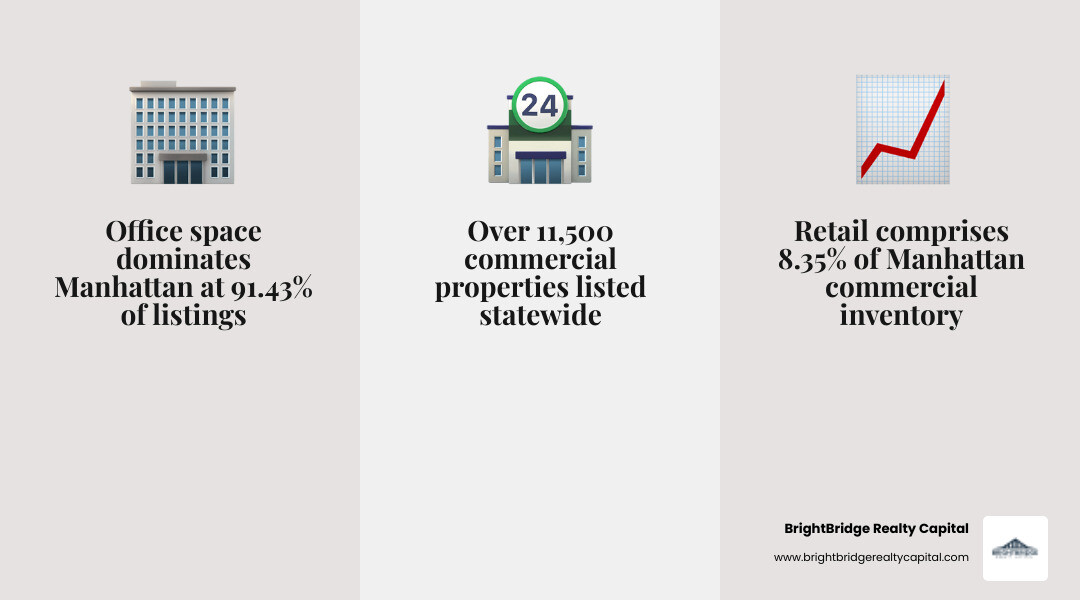
- Extensive Inventory: Over 11,500 commercial properties are currently listed across New York State, ranging from small boutique spaces to massive industrial complexes.
- Manhattan Focus: More than 2,800 commercial listings are available for lease, with office space making up the largest share, though retail and mixed-use properties are seeing a significant resurgence.
This guide will help you understand the vast potential and navigate the complexities of this vibrant market. We'll explore everything from popular property types and key locations to investment strategies and financing options. The New York market is not just about the five boroughs; it encompasses a massive geographic area with varying economic drivers, from the financial power of Wall Street to the burgeoning tech and manufacturing hubs in Upstate New York.
As a loan officer at BrightBridge Realty Capital, I've seen the potential within commercial real estate NY, helping investors navigate complex financing and secure their success. My experience focuses on bridging the gap between institutions and individuals, offering strategic insight and commitment to long-term growth in this competitive market. We understand that in New York, a deal can be won or lost in a matter of hours, which is why we prioritize speed, transparency, and deep local knowledge.
Commercial real estate NY vocabulary:
Navigating the Commercial Real Estate NY Market
Navigating the commercial real estate NY market can feel like trying to catch a subway train during rush hour—it’s fast, crowded, and requires knowing exactly where you're going. New York remains one of the most robust commercial hubs globally, attracting over 10 million unique searchers every month to major listing networks. This high level of interest is a testament to the state's enduring economic power and its ability to reinvent itself in the face of global shifts.
The sheer volume of activity is staggering. On platforms like LoopNet, approximately 800 new listings are added daily, ensuring that the inventory is always fresh and that there is always a new opportunity around the corner. Whether you are looking for a skyscraper in Midtown or a warehouse in Buffalo, the options are plentiful. However, finding the right deal requires more than just browsing; it requires understanding the nuances of local financing, zoning laws, and tax incentives. At BrightBridge Realty Capital, we specialize in commercial-real-estate-loans-new-york, providing the speed and flexibility needed to compete in this high-stakes environment where traditional banks often move too slowly.
Understanding Commercial Real Estate NY Inventory
When we look at the data, the scale of the New York market becomes clear. PropertyShark currently tracks roughly 11,500 commercial real estate listings across the state. This inventory is spread across several key hubs, each with its own unique personality and investment profile:
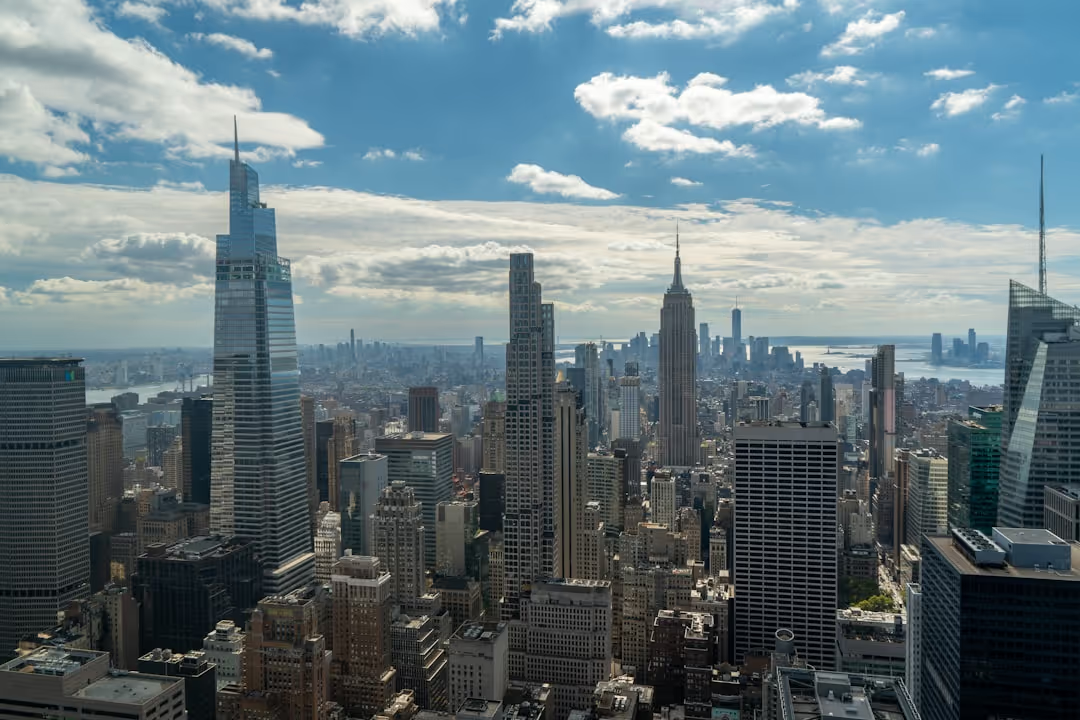
- Manhattan: The crown jewel of the market, Manhattan boasts 2,907 commercial listings. It is heavily weighted toward office and retail space, reflecting its status as a global financial and shopping destination. Despite the rise of remote work, Manhattan's core remains the most sought-after real estate in the world.
- Brooklyn: With 1,723 listings, Brooklyn has transitioned from an industrial powerhouse to a diverse mix of creative offices, trendy retail, and significant multifamily developments. Neighborhoods like Williamsburg and DUMBO have become global brands in their own right.
- Queens: Offering 956 listings, Queens is a vital hub for logistics and industrial space, particularly near JFK and LaGuardia airports. It is also seeing a surge in residential-mixed-use projects as the borough's population continues to grow and diversify.
- The Bronx and Staten Island: These boroughs offer unique value-add opportunities, particularly in the industrial and affordable housing sectors, as investors look for higher yields outside the more saturated Manhattan and Brooklyn markets.
In Manhattan alone, the lease market is dominated by office space, which accounts for 1,345 listings and a massive 67.5 million square feet of available space. Retail follows with 1,392 listings, covering over 6 million square feet. Interestingly, office properties make up over 91% of the rental use type in Manhattan, while retail sits at about 8.35%. This concentration of office space is why the "return to office" trends are so closely watched by investors in this region.
Leading Firms and Brokerage Activity
The New York market is served by some of the world's most sophisticated real estate firms. These organizations don't just list properties; they provide deep market intelligence, strategic consulting, and valuation services that are essential for making informed decisions. For instance, top-tier firms like CBRE and JLL employ thousands of professionals in NYC alone and consistently lead the "Top 50" transactions in Manhattan.
Brokerage activity in New York is highly competitive and often involves complex multi-party negotiations. The Real Estate Board of New York (REBNY) frequently recognizes the most "ingenious" deals of the year, highlighting the complexity of transactions in this region, which often involve air rights, ground leases, and intricate tax structures. These firms help manage everything from small-scale startups looking for their first 1,000 square feet to Fortune 100 corporate headquarters requiring millions of square feet. For investors, partnering with active brokers is essential for gaining access to "off-market" or "blue listings"—exclusive opportunities often reserved for industry professionals with deep-rooted connections.
Top Commercial Property Types for Sale and Lease
New York’s commercial landscape is incredibly varied, offering something for every type of investor. Depending on your investment goals, risk tolerance, and capital availability, you might find yourself looking at a high-rise office tower, a boutique retail storefront, or a sprawling industrial facility. Understanding the real-estate-investment-in-new-york landscape means recognizing which asset classes are performing best in the current climate and where the future growth lies.
For a comprehensive view of current availabilities, many investors turn to resources like New York Commercial Real Estate for Lease and Sale, which aggregates data across all five boroughs and beyond, providing a macro view of the market's health.
- Office Space: Despite the rise of remote work, Manhattan remains the office capital of the world. There is a growing trend toward "Flight to Quality," where tenants seek Class A buildings with top-tier amenities, advanced air filtration, and sustainable certifications. Older, Class B and C buildings are increasingly being looked at for adaptive reuse, including conversions to residential or life sciences use.
- Retail Units: From the luxury corridors of Fifth Avenue and Madison Avenue to neighborhood shopping centers in Queens and the Bronx, retail remains a staple. Neighborhood centers anchored by grocery stores or pharmacies have shown remarkable resilience recently as consumers prioritize convenience and essential services.
- Industrial Warehouses: This is currently one of the hottest sectors in the state. The demand for "last-mile" delivery centers, driven by the e-commerce boom, has pushed vacancy rates to historic lows. Areas with easy access to major interstates, such as the I-87 and I-95 corridors, are particularly valuable. Cold storage facilities are also seeing a surge in demand as online grocery shopping becomes more prevalent.
- Multifamily Buildings: With a perennial housing shortage in New York City and its surrounding suburbs, multifamily assets are highly sought after. Investors are drawn to the stable, long-term cash flow provided by rental apartments, especially in "renter-centric" neighborhoods with strong public transit links.
Standout Commercial Real Estate NY Listings
To give you a taste of the market's diversity, let’s look at some standout properties that have recently graced the listings, showcasing the range of opportunities available:
- Industrial in Syracuse (1810 Lemoyne Ave): A prime example of a stable investment in an emerging market. This property is 100% occupied with NNN leases and sits just minutes from Downtown Syracuse and I-90. With the massive Micron investment coming to the region, industrial properties like this are seeing increased interest.
- Multifamily in Brooklyn (245 Martense St): Located in a "renter-centric" area of Flatbush, this type of asset is a "walker's paradise," making it a low-vacancy risk for residential investors. Brooklyn's multifamily market remains one of the most resilient in the country.
- Office in Washington Heights (512 W 181st St): A versatile commercial building with excellent frontage in a high-traffic area. This property proves that there are great opportunities outside of the traditional Midtown core, catering to local professional services and medical offices.
- Mixed-Use Assets in Queens: These are becoming increasingly popular among mid-market investors. Imagine a building with ground-floor retail (like a cafe or laundromat) and several floors of apartments above. This diversification helps protect owners from market dips in any single sector, providing a balanced income stream.
The Impact of Online Auctions
The way we buy commercial real estate NY is changing rapidly, thanks to platforms like Ten-X and LoopNet Auctions. These platforms have introduced a level of transparency and speed previously unseen in the industry, allowing investors from around the world to bid on New York assets in real-time.
Online auctions often feature "distressed" or "value-add" assets where the starting bids can be significantly lower than market value—sometimes starting as low as $100,000 or $200,000 for smaller parcels or suburban retail strips. This creates immediate market liquidity and allows for a faster price discovery process. For an investor, auctions offer a clear timeline: you know exactly when the bidding starts and ends, and the closing process is typically expedited. However, they require significant upfront due diligence and ready capital, as these deals often close much faster than traditional sales and usually require non-refundable deposits.
High-Inventory Neighborhoods: From Manhattan to Buffalo
While Manhattan often steals the spotlight with its iconic skyline and record-breaking transactions, the commercial real estate NY market extends far beyond the island. Different regions offer vastly different price points, risk profiles, and potential returns (cap rates). Understanding these regional differences is key to building a diversified and profitable portfolio.

Central Midtown and the Financial District
In Manhattan, Central Midtown remains the heavyweight champion of the world's office market, boasting over 1,100 commercial spaces for lease. It’s the heart of the city's corporate world, home to major banks, law firms, and media giants. The Financial District (FiDi) follows closely, offering nearly 1,000 listings. FiDi has undergone a massive transformation over the last decade, evolving from a 9-to-5 business hub into a 24/7 neighborhood with luxury residential conversions and a thriving dining scene, which has in turn boosted the local retail and office markets.
Long Island City (LIC) and the Brooklyn Tech Triangle
Long Island City in Queens has become a premier destination for industrial and flex spaces. Its proximity to Manhattan, combined with excellent transit links and a more modern industrial stock, make it a favorite for tech, film production, and logistics companies. Meanwhile, the "Brooklyn Tech Triangle"—comprising Downtown Brooklyn, DUMBO, and the Brooklyn Navy Yard—is seeing massive innovation projects. These areas are turning old industrial sites into cutting-edge centers for manufacturing, workforce development, and creative offices, attracting a young, highly educated workforce.
Upstate Markets: The Rise of Buffalo and Syracuse
Don't overlook Upstate! Buffalo and Syracuse offer a much lower barrier to entry for new investors and significantly higher yields. Buffalo has seen a revitalization of its waterfront and historic districts, attracting new residents and businesses. Syracuse is currently preparing for a massive economic boom following the announcement of the Micron semiconductor plant, which is expected to create tens of thousands of jobs and drive demand for all types of commercial real estate. While a Manhattan office building might trade at a 4-5% cap rate, properties in Buffalo or Syracuse often offer cap rates in the 7-9% range, providing much higher immediate cash flow for investors who are willing to look outside the five boroughs.
| Market Region | Typical Property Type | Avg. Price Range (Small/Med) | Estimated Cap Rates |
|---|---|---|---|
| Manhattan | Office / Retail | $2M - $100M+ | 3.5% - 5.5% |
| Brooklyn | Multifamily / Industrial | $1.5M - $20M | 4.5% - 6.0% |
| Buffalo | Industrial / Retail | $300k - $5M | 7.0% - 9.0% |
| Syracuse | Office / Flex | $200k - $4M | 7.5% - 9.5% |
For those looking to break into these markets quickly, we offer various financing paths, including new-york-property-investment strategies that focus on asset-based lending. This approach allows investors to leverage the value of the property itself, rather than relying solely on personal credit scores, which is often essential for fast-moving deals in competitive neighborhoods.
NNN vs Value-Add Distribution
How you invest is just as important as where you invest. The New York market generally categorizes properties by their risk and management profile, allowing investors to choose a strategy that fits their lifestyle and financial goals:
- Triple Net (NNN) Leases: These are "hands-off" investments where the tenant pays for taxes, insurance, and maintenance. These are often "Core" investments with occupancy rates above 90%, popular with 1031 exchange investors looking for stable, passive income.
- Value-Add Assets: These properties usually have occupancy between 60% and 90% or require physical renovations. The goal here is to renovate, re-tenant, or improve management to increase the property's Net Operating Income (NOI) and, consequently, its overall value.
- Opportunistic Assets: These are high-risk, high-reward properties with occupancy below 60% or those requiring major structural changes. They often require significant capital for stabilization but offer the highest potential for appreciation in a rising market.
Investment Strategies and Market Trends for 2026
As we move toward 2026, several key trends are reshaping commercial real estate NY. The market is no longer just about location; it's about technology, sustainability, and adaptability. Investors who adapt to these changes are the ones finding the most success and future-proofing their portfolios.
- Smart Buildings and PropTech: The integration of cutting-edge technology is no longer optional. Tenants want buildings with advanced security, touchless entry, AI-driven energy management, and ultra-high-speed connectivity. PropTech (Property Technology) is also changing how buildings are managed, with sensors providing real-time data on occupancy and energy usage.
- Hybrid Work and Flex Spaces: The permanent shift toward flexible work has created a demand for "flex spaces" and coworking environments. Manhattan alone now offers 245 coworking spaces to cater to this mobile workforce. Landlords are increasingly incorporating flexible lease terms and shared amenities into traditional office buildings to attract modern tenants.
- Retail Evolution and Experience: Large, traditional malls are struggling, but "neighborhood shopping centers" and "experiential retail" are thriving. Consumers are looking for more than just products; they want experiences, services, and convenience. This has led to a rise in medical-retail (MedTail), fitness studios, and high-end dining in retail corridors.
Sustainability is also a major driver, particularly in New York City, which has set ambitious goals to slash greenhouse gas emissions by 80% by 2050. Local Law 97 is a significant piece of legislation that mandates strict carbon emission limits for large buildings, with heavy fines for non-compliance starting in 2024 and increasing in 2030. This means that green building standards are becoming a financial necessity rather than a luxury.
Sustainability and LEED Certification in NY
If you want your property to maintain its value and attract institutional tenants, looking for LEED (Leadership in Energy and Environmental Design) certification is a smart move. Manhattan is a global leader in this space, featuring 234 LEED-certified commercial buildings. Of these, 157 have achieved the prestigious LEED Gold status, and several have reached the ultimate LEED Platinum level.
These buildings aren't just good for the environment; they are good for the bottom line. They typically command higher rents (often a 10-15% premium), have lower operational costs due to energy and water efficiency, and attract high-quality corporate tenants who have their own carbon-neutral mandates to meet. Furthermore, green buildings often qualify for specialized "green financing" with more favorable interest rates.
New Construction and Adaptive Reuse
New York's skyline is always growing, but some of the most interesting work is happening within existing structures. Adaptive reuse—turning an old factory into a luxury office, a warehouse into a life sciences lab, or an underutilized office building into residential apartments—is a major trend in Brooklyn, Long Island City, and even the Financial District.
Other emerging sectors include:
- Cold Storage: With the explosion of online grocery delivery and meal kit services, specialized refrigerated warehouses are in high demand and short supply, particularly in the outer boroughs.
- Life Sciences: New York is positioning itself as a rival to Boston and San Francisco for biotech research. The city is investing heavily in specialized lab space construction in areas like the East Side of Manhattan and Long Island City.
- Modular Construction: To combat rising labor and material costs, more developers are turning to modular techniques, where sections of a building are constructed off-site and then assembled on-site, significantly speeding up the building process and reducing waste.
Frequently Asked Questions about NY Commercial Real Estate
What are the most popular types of commercial real estate in New York?
In Manhattan, office space remains the dominant force, making up over 90% of the lease market by square footage. However, statewide, industrial warehouses and multifamily apartment buildings are currently the most popular for investors due to high demand, low vacancy rates, and the growth of e-commerce and the rental economy. Mixed-use properties are also gaining traction as they offer diversified income streams.
Which New York cities have the highest number of commercial listings?
New York City (specifically Manhattan, Brooklyn, and Queens) has the highest concentration of listings by far. In Upstate New York, Buffalo, Rochester, and Syracuse are the primary hubs for commercial activity. Each of these cities has its own economic drivers, such as healthcare in Rochester and the burgeoning semiconductor industry in Syracuse.
What are the typical cap rates for commercial properties in NYC vs. Buffalo?
NYC properties typically see lower cap rates, often between 4% and 6%, because the property values are so high and the market is considered very stable with high liquidity. In Buffalo and other Upstate markets, cap rates are generally higher, ranging from 7% to 9%, offering better immediate yields and cash flow for investors, though with potentially slower long-term appreciation compared to Manhattan.
How does Local Law 97 affect commercial real estate in NYC?
Local Law 97 requires most buildings over 25,000 square feet to meet strict energy efficiency and greenhouse gas emission limits. Building owners who exceed these limits face significant annual fines. This has led to a surge in retrofitting projects, including HVAC upgrades, window replacements, and the installation of solar panels, as owners work to bring their properties into compliance and avoid penalties.
What financing options are available for quick commercial acquisitions in NY?
For investors who need to move quickly, bridge loans are a popular option. These are short-term loans that allow for fast closings (often in as little as 5-7 days) and can be used to secure a property while long-term financing is arranged. At BrightBridge Realty Capital, we specialize in these types of agile financing solutions, providing the capital needed to win bids in New York's competitive environment.
Is it a good time to invest in New York office space?
While the office sector faces challenges from remote work, it is also a time of opportunity for "value-add" investors. Class A buildings with modern amenities continue to perform well, while older buildings are being acquired at a discount for conversion to other uses. Success in the office sector now requires a focus on quality, location, and the ability to offer flexible, tech-enabled spaces.
Conclusion
The commercial real estate NY market remains a land of opportunity for those who are prepared, informed, and agile. Whether you are eyeing a trophy office tower in the Plaza District, a trendy retail space in Williamsburg, or a value-add industrial site in Buffalo, success requires a combination of deep market knowledge, strategic planning, and the right financial partner. The New York market is complex and fast-moving, but for those who understand its rhythms, the rewards can be substantial.
At BrightBridge Realty Capital, we understand that in the New York market, timing is everything. A delay of a few days can mean the difference between winning a bid and losing it to a competitor with ready cash. That’s why we focus on fast closings—often within a single week—and provide direct lending without the red tape and bureaucratic delays of traditional banks. We pride ourselves on being more than just a lender; we are a strategic partner dedicated to helping you grow your portfolio.
We offer customized solutions for every step of your journey, from bridge loans for quick acquisitions and renovations to long-term financing for your growing portfolio of rental properties. Our team has the expertise to handle complex deal structures and the local knowledge to understand the unique value of New York assets. Secure your next investment with a rental property loan and experience a seamless, professional process designed for the modern investor. The Big Apple and the vast opportunities of the Empire State are waiting—are you ready to make your mark and build a lasting legacy in one of the world's most iconic real estate markets?