Rental Property Down Payments: What Investors Need to Know

Summary
Understand the down payment required for rental property. Explore loan types, low-down strategies, and requirements to invest smarter.
Understanding the Down Payment Required for Rental Property
The down payment for a rental property is a critical first step in real estate investing, typically ranging from 15% to 25% for conventional loans. However, this substantial upfront cost isn't the only path. Creative strategies, particularly those involving owner-occupancy, can dramatically lower this barrier to as little as 0% to 3.5%. Understanding the full spectrum of options is essential for any aspiring or seasoned investor.
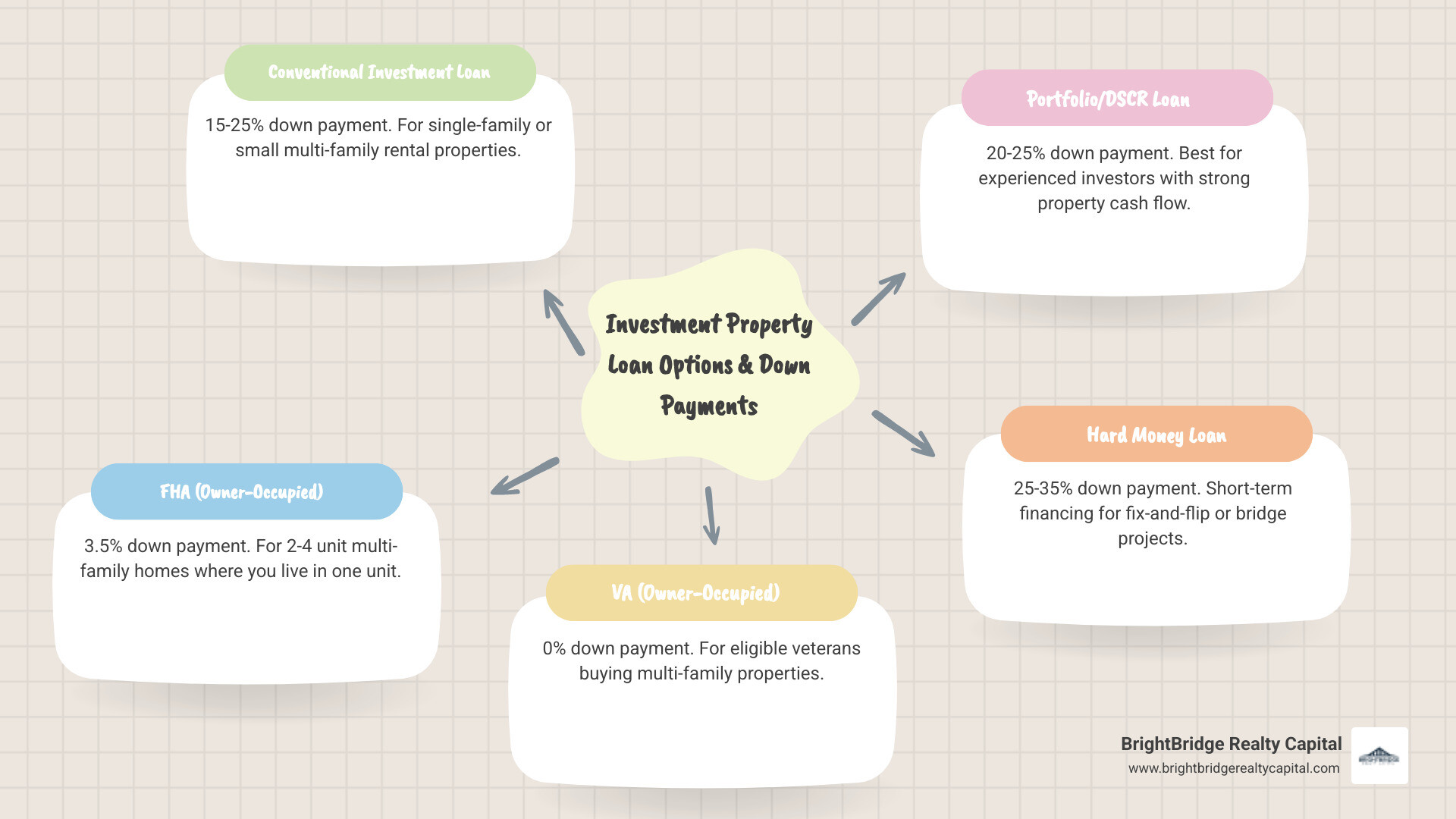
Here's a quick overview of the most common financing routes:
| Loan Type | Minimum Down Payment | Best For |
|---|---|---|
| Conventional Investment Loan | 15-25% | Single-family or small multi-family rental properties |
| FHA (Owner-Occupied) | 3.5% | Multi-family (2-4 units) where you live in one unit |
| VA (Owner-Occupied) | 0% | Eligible veterans buying multi-family properties |
| Portfolio/DSCR Loan | 20-25% | Experienced investors with strong property cash flow |
| Hard Money Loan | 25-35% | Short-term fix-and-flip or bridge financing |
The required amount is not arbitrary; it's a calculated risk assessment by the lender. Your specific loan type, occupancy plans, personal credit score, and the property's projected rental income all play a significant role. Lenders mandate a higher down payment for investment properties because they are inherently riskier than a primary residence. From a lender's perspective, if a borrower encounters financial hardship, they are statistically more likely to stop paying the mortgage on a rental property before they default on the home they live in. This elevated risk of default necessitates a larger equity stake from the investor to protect the lender's capital.
Beyond the down payment, it's crucial to budget for other significant upfront expenses. These include closing costs (typically 2-5% of the purchase price), appraisal fees, inspection fees, and initial repair or renovation costs. Furthermore, lenders will require you to have cash reserves—liquid funds set aside to cover several months of mortgage payments—to ensure you can weather unexpected vacancies or maintenance issues.
Fortunately, proven strategies can significantly reduce this initial financial burden. The most popular method is "house hacking"—living in one unit of a multi-family property—which qualifies you for low-down-payment, owner-occupied loans. Other powerful options include leveraging home equity from an existing property, negotiating seller financing directly with the owner, or pooling capital by partnering with other investors. Each strategy comes with its own set of rules and considerations, making it vital to understand the details.
I'm Daniel Lopez, a loan officer at BrightBridge Realty Capital. My expertise lies in helping investors navigate these complexities to structure loans that align perfectly with their financial goals. Understanding your down payment options is the foundational first step to a successful real estate investment, whether you're acquiring your first rental or expanding a growing portfolio.
What is the Typical Down Payment Required for a Rental Property?
When you seek financing for a rental property, lenders immediately classify the loan as higher risk compared to a mortgage for your own home. This is because, in times of financial distress, a borrower's priority is almost always their primary residence. To mitigate this risk, lenders require a larger down payment, which creates an immediate equity cushion. The down payment required for rental property typically falls between 15% and 25% of the purchase price. The exact percentage depends on the property type (single-family vs. multi-family), the specific loan product, and your financial profile.
This relationship is expressed through the loan-to-value (LTV) ratio. An LTV of 80% means the lender is financing 80% of the property's value, and you are contributing the remaining 20% as a down payment. A lower LTV (achieved with a higher down payment) reduces the lender's exposure to loss, which often translates into better interest rates and more favorable loan terms for you.
Let's walk through your main financing options in greater detail.
Conventional Loan: Down Payment Required for a Rental Property
Conventional loans, which are not insured by a government agency, are the most common type of financing for investment properties. For a single-family rental, Fannie Mae and Freddie Mac guidelines generally require a minimum down payment of 15%. However, for a non-owner-occupied multi-family property (2-4 units), the requirement increases to 20% to 25%. Putting down 25% for a multi-family property often results in the best available interest rates.
Beyond the down payment, lenders conduct a thorough review of your financial standing:
- Credit Score: A minimum score of 680 is often the floor, but most lenders prefer 700 or higher for investment properties. To secure the most competitive terms, especially with a 15% down payment, a score of 740+ is highly recommended.
- Debt-to-Income (DTI) Ratio: Your DTI, which compares your total monthly debt obligations to your gross monthly income, should ideally be below 45%. Some lenders may have stricter limits, capping it at 43%.
- Cash Reserves: Lenders need to see that you can cover the property's expenses during vacancies. You'll be required to show at least six months of PITI (Principal, Interest, Taxes, and Insurance) in a liquid account. For investors with multiple financed properties, the reserve requirements can increase significantly.
- Private Mortgage Insurance (PMI): If your down payment is less than 20%, you will be required to pay PMI. This insurance protects the lender, not you. Unlike government-backed loans, PMI on conventional loans can be requested for cancellation once your LTV ratio reaches 80%.
Government-Backed Loans for Owner-Occupants
Government-backed loans present a powerful strategy for investors willing to "house hack." This involves purchasing a multi-family property (2-4 units), living in one unit as your primary residence for at least one year, and renting out the remaining units. This owner-occupant status unlocks access to low-down-payment loans typically reserved for homebuyers.
- FHA loans: Insured by the Federal Housing Administration, these loans allow you to purchase a multi-family property with as little as 3.5% down, provided you have a credit score of 580 or higher. Borrowers with scores between 500 and 579 may still qualify but will need a 10% down payment. FHA loans require two types of Mortgage Insurance Premium (MIP): an upfront premium (UFMIP) and an annual premium paid monthly for the life of the loan in most cases. The FHA 203k loan program is an excellent variation that bundles the purchase price and renovation costs into a single mortgage, ideal for properties needing repairs.
- VA loans: Available to eligible veterans, active-duty service members, and surviving spouses, VA loans offer an unparalleled 0% down option for an owner-occupied multi-family property. While there's no down payment or monthly mortgage insurance, most borrowers pay a one-time VA funding fee, which can be rolled into the loan amount. After fulfilling the one-year occupancy requirement, you can potentially use your remaining entitlement to purchase another property with a VA loan.
- Fannie Mae's HomeReady and Freddie Mac's Home Possible programs: These conventional loan programs are designed for low- to moderate-income borrowers and allow for down payments as low as 3% on owner-occupied multi-family homes. They have specific income limits and may require a homeownership education course. You can explore the details on the Fannie Mae's HomeReady and Freddie Mac's Home Possible websites.
The HUD website provides extensive resources on FHA loans, including the FHA 203k mortgage insurance program.
Hard Money & Portfolio Loans
For investors who prioritize speed, operate outside traditional W-2 income structures, or are purchasing properties that won't qualify for conventional financing, alternative loans are essential.
- Hard money loans: These are short-term (typically 1-3 years), asset-based loans from private lenders. The focus is almost entirely on the property's after-repair value (ARV), not your personal income. They are perfect for fix-and-flip projects or securing a property quickly in a competitive market. Expect a higher down payment of 25% to 35%, higher interest rates (8-15%), and upfront points (1-3% of the loan amount).
- Portfolio loans and DSCR (Debt Service Coverage Ratio) loans: These loans are kept on the lender's books (in their portfolio) rather than being sold, which allows for more underwriting flexibility. DSCR loans are a popular type of portfolio loan that qualifies you based on the property's cash flow. The lender calculates if the property's rental income can cover the mortgage payment. A common benchmark is a DSCR of 1.25x, meaning the rental income must be at least 125% of the proposed PITI payment. These loans typically require a 20% to 25% down payment and are ideal for experienced investors looking to scale their portfolio without their personal DTI being a constraint.
At BrightBridge Realty Capital, we specialize in these flexible financing solutions, working directly with you to structure deals that fit your investment strategy.
How to Buy a Rental Property with a Lower Down Payment
A large down payment required for rental property can seem like an insurmountable hurdle, but numerous creative and strategic solutions exist to get you into an investment property with significantly less cash upfront. Success lies in understanding these alternative paths and choosing the one that best fits your circumstances.

House Hacking a Multi-Family Property
House hacking is arguably the most powerful strategy for minimizing your down payment. By purchasing a multi-family property with two to four units and occupying one as your primary residence, you transform an investment purchase into an owner-occupied one in the eyes of a lender. This unlocks the most favorable loan terms available.
The primary benefit is financial. Instead of a 20-25% down payment, you can qualify for an FHA loan with 3.5% down or, if eligible, a VA loan with 0% down. You are required to live in the unit for at least 12 months. After this period, you are free to move out and rent your unit, turning the entire property into a cash-flowing asset. Furthermore, lenders will allow you to use 75% of the projected rental income from the other units to help you qualify for the loan, significantly boosting your borrowing power.
For example, on a $500,000 fourplex, a traditional investment loan might require a $125,000 down payment (25%). With an FHA loan, the down payment drops to just $17,500 (3.5%). The rental income from the other three units could potentially cover most, if not all, of your monthly mortgage payment, allowing you to live for free or even generate positive cash flow while living on-site.
Seller Financing and Lease Options
In some situations, the property owner can become your lender, offering flexibility that traditional banks cannot. This is particularly common with sellers who own their property outright or have significant equity.
With seller financing (also known as an owner carryback), you and the seller negotiate the loan terms directly, including the down payment, interest rate, and repayment schedule. This can be an excellent way to secure a property with a lower-than-market down payment. The agreement might be structured as a short-term loan with a balloon payment due in 3-5 years, giving you time to improve the property and refinance with a traditional lender.
Lease options (or rent-to-own agreements) provide another path. You lease the property for a set term with the contractual option to purchase it at a predetermined price. A portion of your monthly rent is often credited toward the future down payment. This requires an upfront "option fee," typically 1-5% of the purchase price, which is much lower than a standard down payment. This strategy allows you to control a property and benefit from appreciation while you save for the purchase and improve your credit profile.
Using Existing Home Equity
If you are already a homeowner, the equity in your primary residence is a powerful financial tool that can be leveraged to fund your next investment. The two primary methods are a Home Equity Line of Credit (HELOC) or a cash-out refinance.
A HELOC functions like a credit card secured by your home, providing a revolving line of credit that you can draw from as needed to cover the down payment required for rental property and renovation costs. A cash-out refinance involves replacing your current mortgage with a new, larger one, and you receive the difference in cash. While effective, this strategy increases the debt on your personal residence, placing it at risk if the investment property fails to perform as expected. It is crucial to perform conservative cash flow analysis and maintain adequate reserves before leveraging your home.
Partnerships and Group Investing
Pooling your financial resources with like-minded partners can make a large down payment much more attainable. This can range from a simple joint venture with a friend or family member to forming a more formal Real Estate Investment Group (REIG) or syndicate.
A successful partnership is built on a comprehensive, legally sound written agreement. It is highly advisable to consult with a real estate attorney to draft an operating agreement for a Limited Liability Company (LLC), which can protect personal assets. At BrightBridge Realty Capital, we've observed that the most durable partnerships are those with absolute clarity from the outset. Your agreement must explicitly define:
- Capital contributions: Who is contributing what amount of cash, and when.
- Roles and responsibilities: Who will handle property management, tenant screening, bookkeeping, and communicating with lenders.
- Profit and loss distribution: How cash flow and profits from a future sale will be split.
- Exit strategy: A clear plan for what happens if a partner wants to leave, passes away, or if the property needs to be sold.
Key Requirements for an Investment Property Loan
Beyond the down payment required for rental property, lenders perform a deep dive into your overall financial health to assess your ability to repay the loan and manage the responsibilities of a landlord. Getting pre-approved for a loan should be your first step, even before you start seriously looking at properties. A pre-approval letter defines your budget, demonstrates to sellers that you are a serious and capable buyer, and gives you a significant competitive advantage in a hot market.
Here are the core components lenders will scrutinize:
Credit Score
Your credit score is a numerical representation of your creditworthiness and is one of the most critical factors in the lending decision. For conventional investment property loans, lenders typically require a minimum FICO score of 680 to 700. However, to qualify for the best interest rates and most favorable terms, a score of 740 or higher is ideal. A higher score indicates to lenders that you are a low-risk borrower with a proven history of managing debt responsibly. If your score is below this threshold, it is often wise to spend a few months improving it. You can do this by consistently paying all bills on time, paying down credit card balances to lower your credit utilization ratio (ideally below 30%), and disputing any errors on your credit report.
Debt-to-Income (DTI) Ratio
Your debt-to-income (DTI) ratio is a key metric lenders use to gauge your ability to handle a new mortgage payment. It is calculated by dividing your total monthly debt payments (including your current mortgage or rent, car loans, student loans, and credit card payments) by your gross monthly income. For investment property loans, most lenders prefer a DTI below 45%. Some government-backed programs may have slightly different limits (e.g., 43% for some FHA loans, 41% for VA loans).
For example, if your gross monthly income is $10,000 and your total monthly debt payments are $4,000, your DTI is 40% ($4,000 / $10,000). A lower DTI demonstrates that you have sufficient income to comfortably manage your existing obligations plus the new mortgage, reducing the lender's risk.
Cash Reserves
Lenders require you to have a financial safety net in the form of cash reserves. This ensures you can cover the property's expenses during periods of vacancy or when unexpected major repairs arise, such as a failed HVAC system or a leaking roof. You will typically need to show proof of at least six months of PITI (Principal, Interest, Taxes, and Insurance) payments in a liquid account. Qualifying accounts include savings accounts, checking accounts, and money market accounts; retirement funds like a 401(k) may sometimes be counted but often at a discounted value and with restrictions. For investors with multiple financed properties, lenders will often require reserves for each property, so this figure can grow substantially as you scale your portfolio.
Using Future Rental Income to Qualify
One of the most significant advantages of financing an investment property is the ability to use the property's own income to help you qualify for the loan. Lenders will typically allow you to add 75% of the projected gross rental income to your monthly income when calculating your DTI ratio. The 25% reduction, sometimes called a "vacancy factor," is a conservative measure to account for potential vacancies, maintenance costs, and property management fees.
To use this future income, you must provide proper documentation. If the property is already occupied, you'll need to provide a copy of the current, executed lease agreement. If the property is vacant, the lender will require the appraiser to complete a Fannie Mae Single-Family Comparable Rent Schedule (Form 1007). This form provides a professional estimate of the fair market rent based on comparable rental properties in the immediate area. This feature makes investment loans far more accessible, as the asset you are purchasing directly contributes to your ability to qualify for its financing.
Benefits of Making a Larger Down Payment
While creative strategies to minimize your upfront investment are attractive, making a larger down payment required for rental property offers substantial long-term financial advantages. Committing more capital upfront can lead to greater profitability, reduced risk, and a more resilient investment over the long haul. If you have the means, putting down 20%, 25%, or even more can significantly improve the financial performance of your rental.
Improved Loan Terms and Instant Equity
A larger down payment directly reduces the lender's risk, and they reward you for it with better loan conditions. Consider the impact on a $400,000 investment property:
- Scenario A (15% Down): Down payment of $60,000, loan of $340,000. With a higher interest rate (e.g., 7.5%) and PMI (~$150/month), your monthly P&I + PMI could be around $2,527.
- Scenario B (25% Down): Down payment of $100,000, loan of $300,000. With a lower interest rate (e.g., 7.0%) and no PMI, your monthly P&I would be around $1,996.
In this example, the larger down payment saves you over $530 per month, dramatically improving your cash flow.
Here’s a breakdown of the key benefits:
- Lower Monthly Payments: Borrowing less money results in a smaller principal and interest payment each month. This is the most direct way to increase your property's monthly cash flow.
- No Private Mortgage Insurance (PMI): On a conventional loan, a down payment of 20% or more eliminates the need for PMI, an extra monthly fee that offers you no benefit and can cost hundreds of dollars.
- Better Interest Rates: Lenders use risk-based pricing. A lower loan-to-value (LTV) ratio, achieved with a larger down payment, makes you a less risky borrower, often qualifying you for a lower interest rate that saves you tens of thousands of dollars over the life of the loan.
- Instant Equity: A larger down payment means you own more of your property from day one. This equity provides a crucial financial cushion and immediately boosts your personal net worth.
Stronger Cash Flow and Reduced Risk
Investing more of your own capital upfront fortifies your investment against market volatility and unforeseen expenses. This creates a more stable and profitable asset.
- Higher Monthly Profit: As seen in the example above, lower mortgage payments directly translate to higher net operating income and a healthier monthly profit margin. This extra cash can be used to build reserves faster, pay for capital expenditures, or fund your next investment.
- Buffer Against Market Downturns: Significant equity protects you if property values temporarily decline. You are far less likely to find yourself "underwater" (owing more than the property is worth), which can make it difficult to sell or refinance. This buffer provides peace of mind and strategic flexibility.
- Easier Future Financing: When you apply for your next investment loan, lenders will review the performance of your existing portfolio. A property with a strong equity position and positive cash flow makes you a more attractive and credible borrower, simplifying the process of scaling your real estate business. It demonstrates a conservative and successful investment strategy, which lenders love to see.
Frequently Asked Questions about Rental Property Down Payments
Navigating the world of investment financing can bring up many questions. Here are detailed answers to some of the most common queries investors have about the down payment required for rental property.
Can I use a gift for a down payment on an investment property?
Yes, it is possible to use gift funds for a down payment on an investment property, but the rules are much stricter than for a primary residence. Lenders need absolute certainty that the funds are a true gift, not a disguised loan that adds to your debt obligations.
To be accepted, the gift must come from an acceptable source, which is typically a close family member (parent, sibling, grandparent). The funds must be meticulously documented with a formal gift letter. This letter is a legal document that must clearly state the donor's name, address, and relationship to you; the exact dollar amount of the gift; and an explicit statement that no repayment is expected or required. Both you and the donor must sign it.
Furthermore, many lenders impose seasoning requirements. This means the gifted funds must be in your bank account for a specific period, usually 60 to 90 days, before you close on the property. This is verified by providing the last two or three months of your bank statements. The seasoning period helps prove to the underwriter that the money is genuinely yours to use and is not a last-minute, undocumented loan. Always discuss your intention to use gift funds with your loan officer early in the process to ensure all documentation meets underwriting guidelines.
Is the down payment different for a vacation rental vs. a long-term rental?
The down payment requirement hinges on how the lender classifies the property: as a true second home or as a pure investment property. The distinction is critical.
If you can classify the property as a second home, you may qualify for more favorable financing, potentially with a down payment as low as 10%. To qualify as a second home, the property must be for your personal use and enjoyment for at least part of the year. Lenders will look for evidence to support this, such as the property being located in a resort area and being a reasonable distance from your primary residence (e.g., at least 50 miles away). You cannot have it managed by a property management company year-round.
However, if the property is primarily an income-generating asset that you intend to rent out for most of the year (like an Airbnb or VRBO you market heavily), it will be classified as an investment property. In this case, lenders will require the standard 15-25% down payment required for rental property. Your intended use, and how you document it, is the key factor in the lender's decision.
Do I have to pay PMI on an investment property loan?
Whether you pay mortgage insurance depends entirely on your loan type and down payment size. It is a significant monthly expense that is best avoided if possible.
- Conventional Loans: You are required to pay Private Mortgage Insurance (PMI) if your down payment is less than 20%. This insurance protects the lender in case you default. The good news is that PMI on conventional loans is not permanent. You can request its removal once your loan balance drops to 80% of the original property value, or it will automatically terminate when it reaches 78%.
- FHA Loans: These government-insured loans require a Mortgage Insurance Premium (MIP). This includes an upfront premium (UFMIP) and a monthly premium. For most FHA loans originated today, the monthly MIP must be paid for the entire life of the loan, regardless of your equity position. This is a significant long-term cost to consider.
- VA Loans: A major benefit of VA loans is that they do not require any monthly mortgage insurance, even with a 0% down payment. This is a substantial advantage that lowers the monthly payment for eligible veterans.
The most straightforward way to avoid PMI on a conventional investment loan is to make a down payment of at least 20%. While it requires more cash upfront, it eliminates a monthly fee, reduces your overall borrowing costs, and often helps you secure a better interest rate.
Secure Your Next Investment with the Right Financing
You now have a comprehensive understanding that the standard 15% to 25% down payment required for rental property is not an immovable obstacle but a starting point. The path to real estate ownership is filled with flexible and creative strategies, from the low-down-payment power of house hacking to the negotiated terms of seller financing and the strategic use of your existing home equity.
Every investor's financial situation and goals are unique. The key to success is strategic planning and aligning your chosen financing method with your long-term objectives. Whether you are a veteran leveraging your hard-earned VA benefits for a 0% down payment, a first-time buyer house hacking a duplex to live for free, or a seasoned investor using a DSCR loan to expand your portfolio without impacting your personal debt ratios, there is a tailored solution available.
Building a successful real estate portfolio is rarely a solo endeavor. It's crucial to assemble a team of trusted professionals, including a knowledgeable real estate agent, a detail-oriented home inspector, a savvy accountant, and, most importantly, a creative and experienced lending partner. This team will provide the guidance and expertise needed to navigate the complexities of the market and the financing process.
At BrightBridge Realty Capital, we pride ourselves on being that dedicated financing partner. As direct lenders, we specialize in crafting bespoke financing solutions that fit your specific goals and timeline. We eliminate the bureaucratic delays of traditional banks, offering competitive rates and fast closings—often within a week—to ensure you never miss an opportunity. We have a proven track record of helping investors across the nation secure the properties they need to build lasting wealth and achieve financial freedom.
The down payment required for rental property is just one piece of a larger puzzle. With the right strategy, a strong professional team, and a dedicated financing partner, you can confidently take the next step toward achieving your investment goals. We are here to make the financing process transparent and seamless, whether you are purchasing your first rental or your fifteenth.
Ready to turn your investment plans into reality? Explore your rental loan options with BrightBridge Realty Capital today, and let's build your real estate portfolio together.