Beyond the Hammer: Navigating Financing for Your Flip

Summary
Navigate fix and flip financing. Compare hard money, equity options, and secure flip house loans to fund your next project.
Why Flip House Loans Are Your Gateway to Real Estate Profits
Flip house loans are short-term financing solutions meticulously crafted for real estate investors aiming to purchase, renovate, and resell properties for a profit. Unlike traditional mortgages, which heavily scrutinize your personal income, tax history, and debt-to-income ratio, these specialized loans prioritize the viability of the investment deal itself. Lenders in this space are primarily concerned with the property's current value, its potential value after renovations (the After-Repair Value or ARV), and the investor's plan to realize that value. This asset-centric approach is what makes them an indispensable tool for flippers.
Quick Answer: What Are Flip House Loans?
- Purpose: To finance both the acquisition of a property and the capital needed for its renovation. This all-in-one structure is a hallmark of fix-and-flip financing.
- Timeline: The loan term is typically short, ranging from 6 to 24 months, aligning perfectly with the project lifecycle of a flip, unlike the 15-30 year terms of conventional home loans.
- Funding Speed: In a competitive market, speed is paramount. These loans can often close in as little as 7-10 days, a stark contrast to the 30-60 day timeline for traditional financing, giving investors a competitive edge against cash buyers.
- Loan Amount: The amount you can borrow is primarily based on metrics like After-Repair Value (ARV) and Loan-to-Cost (LTC), not just the purchase price.
- Payment Structure: Payments are often structured as interest-only during the loan term. This keeps monthly holding costs low, freeing up capital for the renovation itself. The principal is then repaid in a lump sum (a balloon payment) when the property is sold or refinanced.
- Common Types: The most prevalent forms include hard money loans, private money loans, bridge loans, and specialized business lines of credit.
These loans are designed to bridge the critical financial gap between acquiring a distressed or undervalued property and selling it as a fully renovated, market-ready home. The underwriting process is fundamentally different; you're not borrowing based on your W-2s or years of tax returns. Instead, lenders are laser-focused on the quality of the deal, your renovation plan, and your exit strategy—how you plan to pay back the loan, which is typically through the sale of the property.
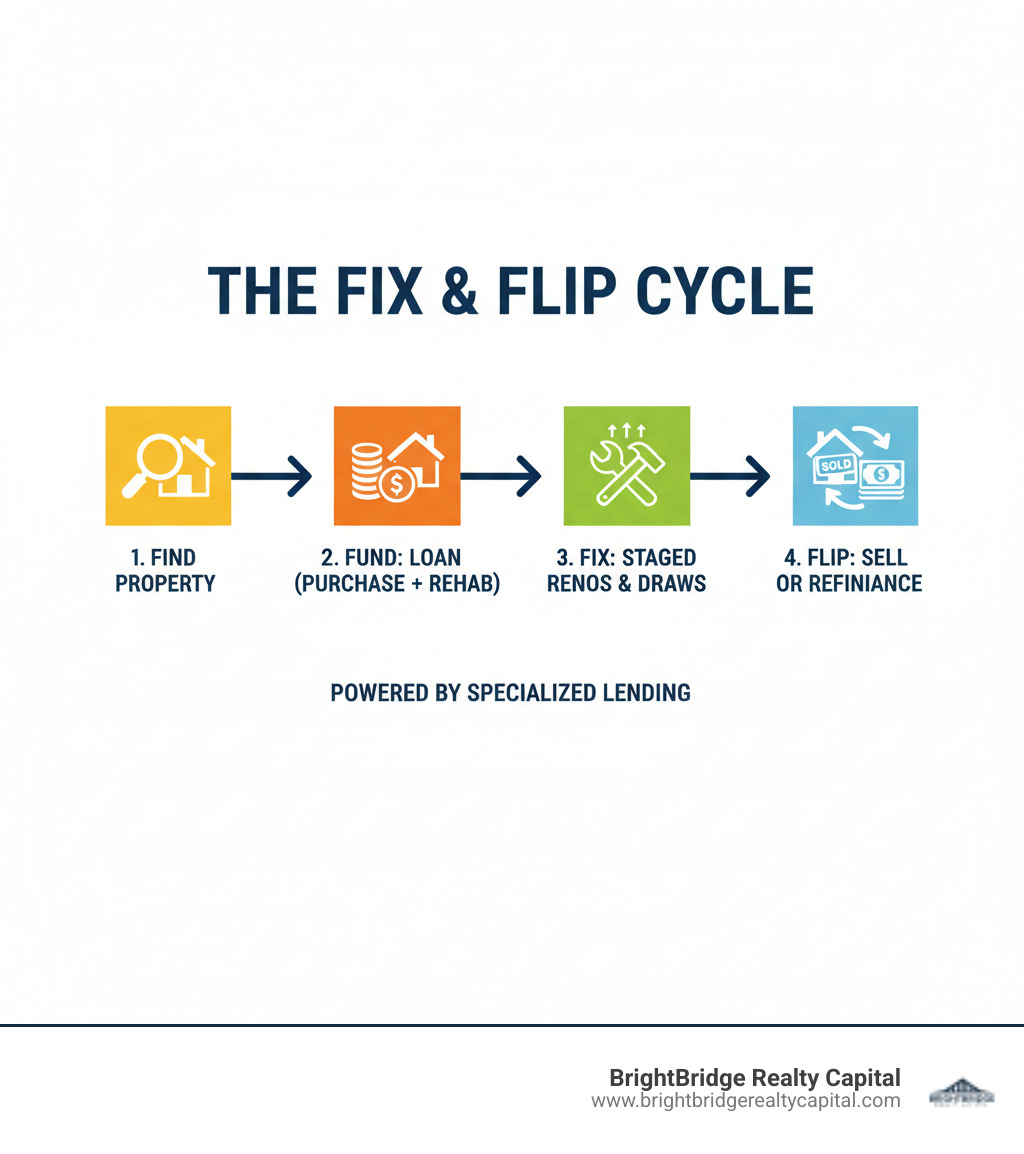
The key differentiators are speed and flexibility. A conventional lender might take 45 days or more to close, and they may not even approve a loan for a property that needs significant repairs. Specialized flip house loans are built for the fast-paced reality of real estate investing. They enable quick closings to secure deals, provide renovation funds in stages (known as draws) as work is completed, and are structured for a quick payoff upon sale.
According to recent industry data, the fix-and-flip market has seen consistent growth, with leading lenders funding hundreds of thousands of projects annually. This is no longer a niche financing product; it's a mainstream, proven path for investors at every level, from beginners to seasoned professionals.
I'm Daniel Lopez, a loan officer at BrightBridge Realty Capital, and I've helped countless investors, from first-timers in Queens to seasoned pros managing multiple projects in Brooklyn, structure flip house loans that align with their unique timeline, experience level, and project scope. I've seen firsthand how the right financing can be the deciding factor between a modest profit and a home run. Whether you're tackling your first cosmetic rehab or a full gut renovation, understanding your financing options is the cornerstone of building a profitable and scalable flipping business.
Simple guide to flip house loans terms:
Decoding Your Financing Options
Choosing the right financing for your flip can feel overwhelming—a sea of acronyms, varying terms, and different lender types can make your head spin. But here's the good news: once you understand the core function of each loan type, you can strategically match the right financial product to your specific project, experience level, and market conditions. At BrightBridge Realty Capital, we've structured financing for every kind of investor, from first-time flippers using their savings for a down payment to seasoned professionals juggling multiple projects across New York. Let's break down your primary options so you can move forward with clarity and confidence.
Hard Money and Specialized Flip House Loans
If traditional mortgages are marathons, hard money loans are sprints. The term "hard money" originates from the loan being secured by a "hard" asset—the property itself. These are asset-based loans, meaning the lender's primary focus is on the property's potential value, not your personal financial history. They evaluate the deal's numbers: the purchase price, the detailed renovation budget, and, most importantly, the After-Repair Value (ARV). This makes them ideal for investors who may not qualify for conventional loans or who need to act quickly.
Funding happens fast. While a conventional loan process involves weeks of paperwork and stringent underwriting, hard money loans often close in 7 to 10 days. This speed is a massive competitive advantage, allowing you to compete with all-cash offers. The trade-off for this speed and flexibility is higher interest rates (typically ranging from 7.75% to 15%) and origination fees (points). However, since you only hold the loan for a short period (6-24 months), the total interest paid is often a justifiable business expense for securing a profitable deal.
The real power of specialized flip house loans lies in their leverage. Many lenders, including direct lenders like us, offer up to 90% of the purchase price and 100% of your renovation costs, capped at a certain percentage of the ARV (e.g., 75%). This high Loan-to-Cost (LTC) structure allows you to keep more of your own cash liquid, enabling you to cover holding costs, contingencies, or even start looking for your next deal. At BrightBridge Realty Capital, we are direct lenders, which means no middlemen or broker fees—just a streamlined process to get you funded quickly.
Leveraging Your Existing Equity: Portfolio and HELOCs
For experienced investors with a portfolio of properties, leveraging existing equity is a powerful strategy. Instead of securing a loan solely against the new property, you can use the equity you've built in your other investment properties.
- Portfolio Loans: These loans are secured by multiple properties you own. Because the lender's risk is spread across several assets, they can often offer lower interest rates and more favorable terms than a single-asset hard money loan. The catch is time. The underwriting process is more complex, involving appraisals and analysis of your entire portfolio, so it can take several weeks to a month or more. This makes it less suitable for deals requiring a rapid close but excellent for investors planning their financing in advance.
- Home Equity Line of Credit (HELOC): While you generally cannot use a HELOC on the investment property itself, you can take one out on your primary residence or another investment property you own free and clear. This gives you a revolving line of credit you can draw from to purchase properties, often with cash, and then pay back. It offers great flexibility but puts your personal assets on the line.
Expect loans against equity to be capped at around 75-85% of the property's available equity. This strategy is best for seasoned investors looking to scale and reduce their cost of capital. If you're curious whether this makes sense for you, reach out to BrightBridge Realty Capital. We can analyze your holdings and help you determine the most efficient way to put your equity to work.
[TABLE] Comparing Top Financing Options
Here's how hard money loans and portfolio loans stack up against each other:
| Feature | Hard Money Loans | Portfolio Loans (Leveraging Investment Property Equity) |
|---|---|---|
| Speed | Very Fast (7-10 days closing) | Slower (weeks to months) |
| Interest Rate | Higher (e.g., 7.75%-15%) | Generally Lower |
| Loan Basis | Primarily on the new property's ARV & LTC | Primarily on existing investment property equity |
| Best For | New Investors, Quick Deals, Distressed Properties | Experienced Investors, Scaled Operations, Lower Costs |
| Primary Collateral | The property being flipped | Existing investment properties in your portfolio |
Other Flexible Funding Solutions
- Business Lines of Credit: This is like a credit card for your flipping business. You get approved for a certain amount and can draw funds as needed for smaller repairs, earnest money deposits, or to cover unexpected costs. You only pay interest on the amount you use. It's a perfect tool for managing cash flow between draws.
- Bridge Loans: As the name implies, these loans bridge a financial gap, typically between selling one property and buying another. They are very short-term (usually 6 to 12 months) with higher interest rates but are invaluable when you find a new opportunity before your current flip has sold.
Both of these options are part of the comprehensive suite of products available through BrightBridge Realty Capital. We customize these solutions to provide the agility you need to seize opportunities as they arise.
Understanding the Fine Print: Key Terms and Requirements
Stepping into the world of flip house loans means learning a new language. Understanding the key terms, metrics, and requirements is not just academic; it's essential for accurately analyzing deals, projecting profits, and speaking confidently with lenders. Think of these as the core components of the financial roadmap that will guide your project from acquisition to profitable exit.
The Alphabet Soup of Lending: LTV, LTC, and ARV

These three acronyms are the foundation of how lenders structure fix-and-flip loans. Mastering them is non-negotiable.
- Loan-to-Value (LTV): This metric compares the loan amount to the property's current appraised value at the time of purchase. For example, if you're buying a distressed property appraised at $100,000 and the lender offers 80% LTV, they will lend up to $80,000 for the purchase. LTV is more prominent in traditional lending but is still used by some hard money lenders as a baseline.
- Loan-to-Cost (LTC): This is arguably the most critical metric for flippers. It compares the loan amount to the total project cost, which includes both the purchase price and the renovation budget. If a property costs $150,000 to buy and requires $50,000 in repairs (total cost = $200,000), a lender offering 90% LTC would lend up to $180,000. Lenders like BrightBridge Realty Capital can offer up to 100% of renovation costs, significantly reducing your out-of-pocket cash requirements.
- After-Repair Value (ARV): This is the estimated market value of the property after all renovations are complete. Lenders hire an appraiser to determine the ARV by analyzing comparable recent sales (or "comps") of similar, renovated homes in the area. The ARV serves as the ultimate ceiling for the loan amount. For instance, a lender might cap the total loan at 75% of the ARV. If the ARV is $300,000, the maximum loan amount would be $225,000, regardless of the LTC. This ensures there is enough protective equity in the deal for both you and the lender.
Typical Eligibility Requirements for Flip House Loans
While flip house loans are more flexible than conventional mortgages, lenders still have common-sense requirements to ensure the project and the borrower are set up for success.
- Minimum Credit Score: Most lenders look for a minimum credit score in the 620-660 range. However, the emphasis is less on a perfect score and more on demonstrating financial responsibility. A lower score might be offset by significant experience or cash reserves. At BrightBridge Realty Capital, we have programs for a wide range of credit profiles.
- Real Estate Experience: A proven track record is your best asset. Lenders want to see that you've successfully completed flips in the past. For first-time flippers, lenders may require a higher down payment or offer slightly less favorable terms. However, many lenders, including us, have dedicated programs for new investors, especially if they have a strong team (like an experienced contractor) and a solid plan.
- Liquidity/Cash Reserves: Lenders need to see that you have "skin in the game." You'll need to show proof of funds (via bank statements) for the down payment, closing costs, and a contingency fund for unexpected expenses. This reserve often needs to cover several months of interest payments.
- Business Entity: It is a near-universal requirement to borrow through a business entity, such as a Limited Liability Company (LLC) or a Corporation. This protects your personal assets from any liabilities associated with the project and is considered a professional best practice.
- Detailed Scope of Work (SOW): A vague renovation plan won't cut it. You need a detailed, line-item budget that breaks down all anticipated labor and material costs, from demolition to the final coat of paint. This document is crucial for the lender to validate your budget and the ARV.
Costs That Impact Your Bottom Line
To calculate your true profit, you must account for all loan-related costs.
- Interest Rates: Rates are higher than traditional mortgages (e.g., 7.75%-15%) to compensate the lender for the higher risk and shorter term of the loan.
- Origination Points: This is an upfront fee for creating the loan, calculated as a percentage of the total loan amount. A loan with "2 points" means a fee of 2% of the loan. These are paid at closing.
- Loan Terms: The short term (usually 6-24 months) creates pressure. Ensure your project timeline is realistic to avoid costly extensions or penalties.
- Prepayment Penalties: Some loans charge a fee if you pay off the loan too early (e.g., within the first few months). This is a critical point to clarify. Ideal flip house loans, like those offered by BrightBridge Realty Capital, have no prepayment penalties, allowing you to sell as soon as the project is done.
- Draw Fees & Closing Costs: Lenders may charge a small administrative or inspection fee for each draw release. You'll also have standard closing costs, including appraisal fees, title insurance, attorney fees, and recording fees. We believe in full transparency, so you'll see a detailed breakdown of all costs before you commit.
The Road to Funding: From Application to Closing
Securing a flip house loan might seem daunting, but a systematic approach and a responsive lending partner can make it a surprisingly smooth and efficient journey. When you partner with a direct lender like BrightBridge Realty Capital, you're not just a number in a queue; you're a partner in a project. We've refined our process to be clear, straightforward, and fast, guiding you every step of the way from your initial property discovery to getting the keys and starting demolition.
Step 1: Preparing Your Application Package
A well-prepared, comprehensive application is the single best thing you can do to accelerate your funding timeline. It demonstrates your professionalism and allows the underwriter to make a quick, confident decision. Here’s a detailed checklist of what you'll need to assemble:
- Property Details: This includes the full property address, the executed purchase and sale agreement, and any available inspection reports. The more information you have about the property's current state, the better.
- Detailed Renovation Budget (Scope of Work): This is the heart of your application. Create a line-by-line spreadsheet detailing every anticipated cost, from permits and architectural plans to materials (lumber, drywall, tile) and labor for every trade (plumbing, electrical, carpentry). Always include a separate line item for contingency, typically 10-15% of the total rehab budget, to cover unexpected issues.
- Contractor Information and Estimates: Provide the name and contact information for your general contractor. Including their license, insurance information, and detailed bids or estimates that align with your renovation budget adds immense credibility to your application.
- Investor Profile & Financials: This is where you sell yourself as a borrower. Include:
- Entity Documents: Articles of Organization for your LLC or corporation.
- Experience List: A simple spreadsheet detailing your past flip projects, including purchase price, sale price, and net profit.
- Proof of Funds: Recent bank or brokerage statements showing you have the cash for the down payment, closing costs, and required reserves.
Step 2: Finding and Comparing Lenders
Choosing the right lending partner is as crucial as finding the right property. Not all lenders are created equal.
- Direct Lenders vs. Brokers: A direct lender like BrightBridge Realty Capital uses its own funds to make the loan. This results in a streamlined process, faster decisions, and often lower costs because there's no middleman. A broker, on the other hand, shops your loan application to various lenders, which can add time and fees.
- Local Expertise: Especially in a market as complex as New York, a lender with local expertise is invaluable. We understand neighborhood-specific values, renovation costs, and potential permitting hurdles, allowing us to offer more accurate insights and faster appraisals.
- Networking: A great way to find reliable partners is by networking at local investor meetups, such as those organized by your regional Real Estate Investors Association. Ask other investors who they trust and have had good experiences with.
- Compare Loan Offers Diligently: When you receive a term sheet, look beyond the interest rate. Compare origination points, all closing fees, the existence of prepayment penalties, the proposed draw schedule, and the lender's online reviews and reputation. A transparent partner who communicates clearly is worth their weight in gold.
Step 3: The Underwriting and Draw Process Explained
Once your application is submitted, the lender's back-office process kicks into high gear. Here’s what happens:
- Underwriting, Appraisal & Title Search: The underwriter reviews your entire package to ensure it meets the lender's guidelines. Simultaneously, they will order a property appraisal to validate the current value and, most importantly, the ARV. At BrightBridge, we often use a combination of third-party appraisers and internal data models to accelerate this step. A title search is also conducted to ensure the property has a clean title, free of any liens or encumbrances.
- Closing the Loan: Once underwriting is complete and the title is clear, you'll be issued a "clear to close." You'll sign the final loan documents with an attorney or title agent. Our primary goal is speed; many of our flip house loans for New York properties close in just 7-10 business days from a complete application.
- The Draw Schedule in Action: Your renovation funds are not given to you in a lump sum. They are disbursed in stages ("draws") as you complete phases of the project. The process typically looks like this: You complete a portion of the work (e.g., framing and rough-in plumbing). You then submit a draw request with documentation. The lender sends an inspector to the site to verify the work is complete and up to standard. Once verified, the funds for that phase are wired to your account. This system protects both you and the lender and is the mechanism that allows lenders to confidently fund up to 100% of rehab costs.
Weighing the Risks and Rewards
Flip house loans are undeniably powerful tools for wealth creation, but they are not without risk. Like any form of leverage, they amplify both gains and losses. A successful real estate investor is not someone who avoids risk, but someone who understands, respects, and intelligently mitigates it. Let's take a comprehensive look at the pros and cons.
The Pros: Why Use a Fix and Flip Loan?
- Massive Capital Leverage: This is the single greatest advantage. Leverage allows you to control a high-value asset with a relatively small amount of your own capital. For example, let's say you have $50,000. You could buy a small condo for cash and maybe make a $15,000 profit. Or, you could use that $50,000 as a down payment and reserve fund for a flip house loan on a $300,000 project. If that project yields a $60,000 profit, your cash-on-cash return is a staggering 120% ($60k profit / $50k cash invested). This is how investors scale.
- All-in-One Funding (Purchase and Rehab): Unlike traditional loans that may only cover the purchase, flip house loans are specifically designed to finance both the acquisition and the renovation. This integrated approach simplifies the financing process, providing a clear, single source of capital for the entire project lifecycle.
- Competitive Speed: In hot real estate markets like New York, the best deals are often snapped up in days. The ability to close in 7-10 days allows you to make offers that are nearly as strong as cash, giving you a decisive edge over investors relying on slower, conventional financing.
- Accelerated Business Scaling: With the right financing partner, you're not limited to doing one flip at a time. Once you have a successful project underway, you can use the same model to acquire a second and third property. This allows you to move from a hobbyist to a full-time real estate professional in a fraction of the time it would take using only your own cash.
- Preservation of Personal Cash: By using the lender's capital to fund the bulk of the project, you keep your personal cash reserves liquid. This cash can be used for your contingency fund, to seize another investment opportunity, or simply as a safety net. This financial flexibility is crucial for long-term success.
The Cons and How to Mitigate Them
While the rewards are enticing, it's critical to go in with your eyes wide open to the potential risks.
- Higher Costs: Flip house loans come with higher interest rates and origination fees compared to 30-year mortgages. This is the price of speed, flexibility, and higher risk for the lender.
- Mitigation: This is a numbers game. You must be ruthless in your deal analysis. Use a conservative ARV, get multiple contractor bids to create a realistic budget, and build a detailed spreadsheet that accounts for all costs (interest, points, closing costs, holding costs, selling costs) to ensure your potential profit margin is substantial enough to absorb these higher financing expenses. A thin margin is a recipe for disaster.
- Short Repayment Terms: With terms typically ranging from 6 to 24 months, the clock is always ticking. Every month of delay means another interest payment, eating directly into your profits.
- Mitigation: Create a hyper-realistic project timeline with built-in buffers for each phase. Vet your contractors thoroughly to ensure they are reliable. Before signing, ask the lender about their extension policy. What are the costs and terms if you need an extra 3-6 months to sell?
- Project Delays & Cost Overruns: Renovations are notorious for surprises. You might open a wall and find termite damage, outdated electrical wiring, or a leaky pipe. Permitting issues in cities like New York can also cause significant delays.
- Mitigation: The best defense is a good offense. Conduct the most thorough due diligence possible before closing, including hiring professional inspectors for structure, plumbing, and electrical. Your number one financial protection is a contingency fund of at least 10-15% of your total renovation budget. Do not even start a project without this buffer.
- Market Downturns: The real estate market can shift. A sudden increase in interest rates or a local economic downturn could cool buyer demand, lower your expected ARV, or extend the time it takes to sell the property.
- Mitigation: Know your market inside and out. Avoid the temptation to over-improve for the neighborhood; the finishes should match the local comps. Most importantly, always have a Plan B. If the market turns and you can't sell for a profit, could you refinance the property into a long-term rental loan (like a DSCR loan) and hold it as a cash-flowing asset? A solid exit strategy has more than one exit.
Frequently Asked Questions about Flip House Loans
When you're diving into the fast-paced world of house flipping, questions are inevitable. Getting clear, accurate answers is key to building confidence and avoiding costly mistakes. We've compiled some of the most common questions we hear about flip house loans to give you the clarity you need.
How quickly can I really get a fix and flip loan?
This is one of the most significant advantages of this type of financing. In real estate, speed wins deals, and flip house loans are built for speed. While timelines can vary depending on the complexity of the deal and the completeness of your application, many direct lenders like BrightBridge Realty Capital can fund a loan in as little as 7 to 10 business days.
How is this possible? It comes down to the underwriting focus. A traditional mortgage application involves a deep, time-consuming dive into your personal financial life: years of tax returns, pay stubs, employment verification, and a detailed analysis of your personal debt-to-income ratio. In contrast, a fix-and-flip lender is primarily underwriting the asset. They focus on the property's purchase price, your renovation budget, and the After-Repair Value (ARV). If the deal makes sense and the numbers are solid, the process can move very quickly. Our direct lending approach at BrightBridge Realty Capital cuts out the middlemen, allowing us to give you a competitive edge in the bustling New York market.
Can I get a flip loan with no money down?
This is the holy grail for many investors, and the answer is: it's possible, but with important caveats. Securing a loan that covers 100% of the purchase price and 100% of the renovation costs is an option, but it's typically reserved for experienced investors with a strong, proven track record of successful flips. Lenders need to see that you can manage a project from start to finish before they will extend this level of leverage.
Even in a "no money down" scenario, you will almost always need cash for other expenses. These include closing costs (appraisal, title, attorney fees), initial interest payments, and a cash reserve or contingency fund for unexpected repairs. A more common scenario for highly leveraged loans is for the lender to finance up to 90% of the purchase price and 100% of the rehab costs. This significantly reduces your cash-to-close but still requires you to have some "skin in the game." At BrightBridge Realty Capital, we can explore high-leverage options to see if one is the right fit for your experience level and your next project.
What is the 70% Rule in house flipping, and should I use it?
The 70% Rule is a popular rule of thumb used by flippers to quickly analyze a potential deal. It provides a simple formula to determine the maximum price you should offer for a property. The rule states that an investor should pay no more than 70% of the home's After-Repair Value (ARV), minus the estimated repair costs.
Here's the formula in action:
Maximum Offer Price = (ARV x 0.70) - Estimated Repair Costs
Let's say a property has an ARV of $400,000 and you estimate it needs $60,000 in renovations.
Using the 70% Rule: ($400,000 x 0.70) - $60,000 = $280,000 - $60,000 = $220,000
According to this rule, you shouldn't pay more than $220,000 for the property. The remaining 30% ($120,000 in this case) is meant to cover your financing costs, holding costs (taxes, insurance), selling costs (realtor commissions), and your desired profit. While it's a fantastic tool for initial screening, it's not a law. In highly competitive markets, you may need to adjust the percentage to 75% or even 80% to win a deal. Always follow up this quick calculation with a detailed spreadsheet that accounts for every single potential cost.
Can I live in the property while I'm flipping it?
Generally, the answer is no. Flip house loans are commercial loan products designed for non-owner-occupied investment properties. The underwriting, terms, and legal documents are all based on the property being used for business purposes. Attempting to live in the property (a practice known as "live-in flipping") could violate the terms of your loan agreement. If you intend to occupy the property, you would need to look at different loan programs, such as an FHA 203(k) loan, which have very different requirements, timelines, and limitations.
Conclusion: Build Your Flipping Empire with the Right Partner
You've made it through this comprehensive guide to flip house loans. You now have a deeper understanding of not just what these loans are, but how they function as strategic tools to build and scale a real estate investment business, particularly in a dynamic market like New York. The right financing is not merely a transaction; it's the engine of your enterprise.
We've walked through the critical differences between asset-based flip house loans and traditional mortgages, emphasizing the paramount importance of speed and flexibility. We've demystified the language of lending—LTV, LTC, and ARV—so you can analyze deals like a pro. We've provided a detailed roadmap for the application and funding process, from assembling your package to managing your draw schedule. And, crucially, we've been transparent about the inherent risks—from higher costs and tight timelines to market volatility—and armed you with practical strategies to mitigate them. Successful investors don't ignore risks; they plan for them.
The unvarnished truth is that every successful flip is built on a foundation of two things: a well-chosen property and a reliable financing partner. You need more than just a bank; you need a partner who understands the unique pressures and opportunities of flipping. A partner who can close quickly so you don't lose the deal, who understands that renovation surprises happen, and who has a seamless draw process to keep your project moving forward without cash flow gaps.
This is the role we proudly fill at BrightBridge Realty Capital. We are not intermediaries or brokers who pass your application from desk to desk. We are direct lenders, using our own capital and expertise to make swift, decisive lending decisions. We can often take your loan from application to closing in a week, giving you the power to compete with cash buyers and secure the best opportunities. Whether you're a first-time flipper in Staten Island or a seasoned pro juggling multiple projects in Manhattan and the outer boroughs, we customize our lending solutions to fit your specific experience level and project scope.
I've seen firsthand how the right financing can completely transform an investor's trajectory. I recently worked with a client who started with a single, small condo flip. By strategically using our flip house loans and reinvesting their profits, they scaled their business to managing five simultaneous projects and building a multi-million dollar portfolio in just three years. That kind of exponential growth doesn't happen by accident. It happens when a determined investor is backed by a financial partner who is genuinely invested in their long-term success.
Your time is your most valuable asset. It's better spent finding great properties, managing contractors, and designing beautiful homes—not chasing paperwork and waiting for answers. We provide competitive rates, transparent terms, and a seamless process so you can focus on what you do best.
For fast, direct lending solutions customized for your next project, explore our fix and flip loan options. Let's start a conversation about your goals and build your flipping empire together—one profitable project at a time.