Stop Renting and Get a Real Estate Loan Today

Summary
Get real estate loan today! Stop renting, master mortgages, qualify easily & unlock homeownership with expert tips.
Why Homeownership Starts with the Right Financing

Get real estate loan financing is the critical first step toward owning property—whether you're buying your first home or expanding an investment portfolio. For most Americans, buying a home is one of the largest and most complex financial transactions they will ever undertake. It is not merely a purchase; it is a long-term commitment that requires a deep understanding of financial markets, personal creditworthiness, and the legal intricacies of property law. A mortgage uses the property itself as collateral, which means if you don't repay the loan, the lender can take ownership through a process known as foreclosure. But with the right preparation and guidance, securing financing doesn't have to feel overwhelming.
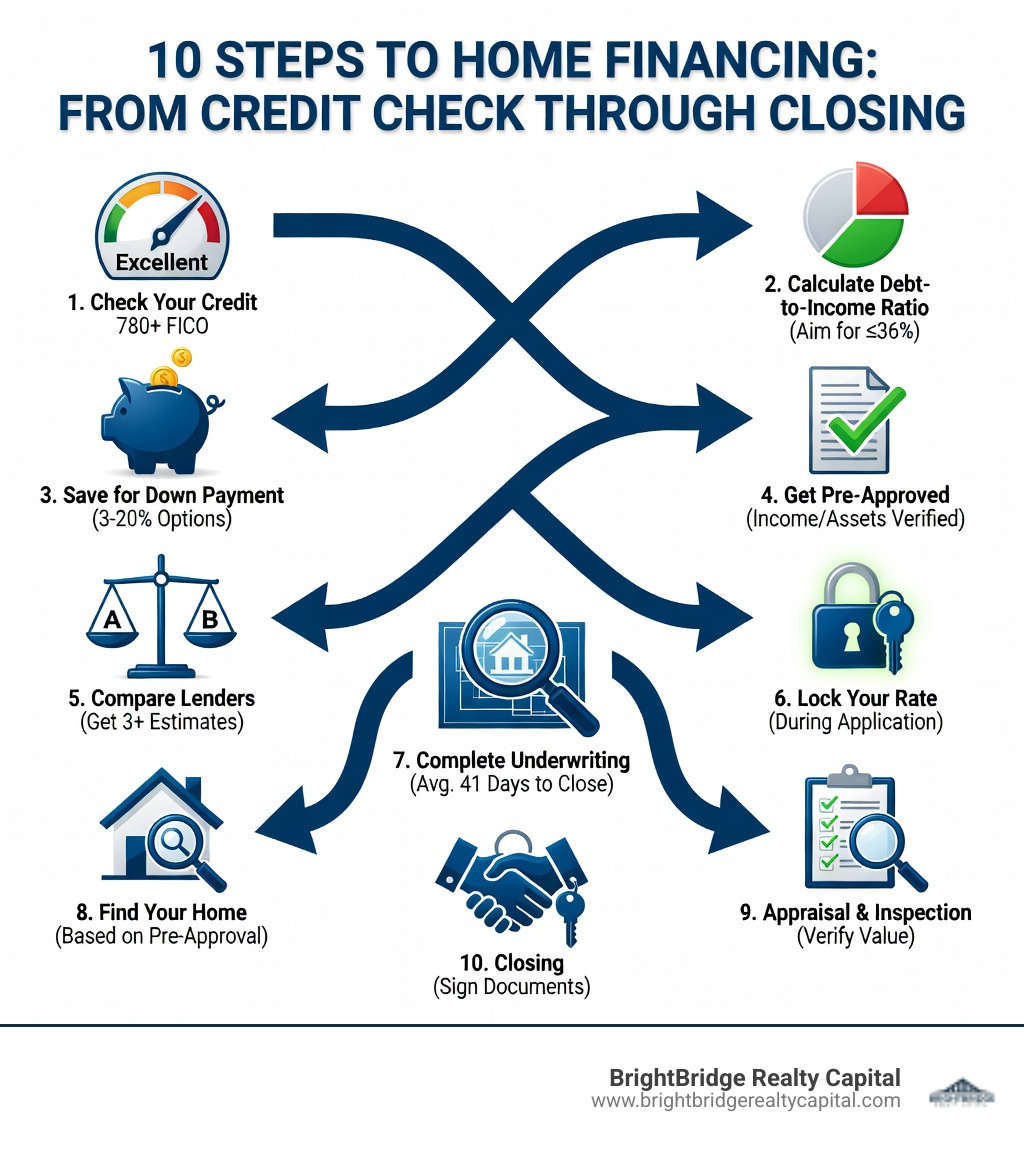
Quick Steps to Secure a Real Estate Loan:
- Check your credit - Most lenders require a minimum FICO score of 580-650. Your credit score is a reflection of your financial reliability. It tells lenders how likely you are to repay your debts on time. A higher score not only makes it easier to get approved but also secures lower interest rates, which can save you tens of thousands of dollars over the life of the loan.
- Calculate your debt-to-income ratio - Lenders prefer 36% or lower. This ratio compares your monthly debt payments to your gross monthly income. It helps lenders determine if you can afford the additional monthly expense of a mortgage without becoming "house poor."
- Save for down payment - Options range from 3% (conventional) to 0% (VA/USDA). While the 20% down payment was once the industry standard, modern lending programs have made homeownership more accessible to those with less liquid capital.
- Get pre-approved - Provide income, assets, and employment verification. A pre-approval letter is a powerful tool in a competitive market, signaling to sellers that you are a serious and qualified buyer.
- Compare lenders - Request Loan Estimates from at least three sources. Not all lenders are created equal; some specialize in first-time buyers, while others focus on high-net-worth individuals or real estate investors.
- Lock your rate - Secure favorable terms during the application process. Interest rates fluctuate daily based on economic indicators like inflation and employment data. Locking your rate protects you from sudden spikes while your loan is being processed.
- Complete underwriting - Expect an average of 41 days to closing. This is the phase where the lender's team verifies every detail of your financial life and the property's value.
The real challenge isn't just getting approved—it's finding a loan that fits your timeline and goals. Conventional loans require as little as 3% down for primary residences, while FHA loans accept credit scores as low as 580 with just 3.5% down. For real estate investors, the landscape looks different: expect 20-30% down payments and interest rates 0.50% to 0.75% higher than primary residence mortgages. This is because investment properties are statistically more likely to go into default during economic downturns.
Many borrowers don't realize that requesting multiple Loan Estimates within a 45-day window counts as a single credit inquiry. This is a crucial piece of consumer protection legislation. It means you can shop around and let multiple lenders pull your credit report without damaging your score—a critical advantage when comparing rates and terms.
Closing costs typically run 2-5% of the loan principal, covering everything from origination fees and title insurance to appraisals and recording fees. First-time buyers often overlook these expenses, which can add thousands to the upfront investment. It is vital to have these funds set aside in addition to your down payment to ensure a smooth transition into your new home.
I'm Daniel Lopez, a loan officer at BrightBridge Realty Capital who has helped countless investors and homebuyers navigate the complexities of real estate financing. Whether you're looking to get real estate loan approval for your first home or need flexible funding for a fix-and-flip project, I've structured deals that accommodate tight timelines, renovation budgets, and unique property types—ensuring clients secure the financing they need without unnecessary delays.
Get real estate loan terms to remember:
Understanding Your Options to Get Real Estate Loan
When you decide to Get real estate loan financing, you are essentially entering into a legal agreement where the property serves as collateral. This means the lender has a secured interest in the asset. Every monthly payment you make is typically divided into several parts: the principal (the actual balance of the loan), interest (the cost of borrowing), and often escrow (funds set aside for property taxes and homeowners insurance). Understanding how these components interact over the life of the loan is essential for long-term financial planning.

The path you take depends heavily on the type of property you are eyeing. A primary residence in New York NY might qualify for different terms than a multi-family rental property or a commercial warehouse. To make an informed decision, you must first understand the fundamental structure of the debt you are taking on. The mortgage market is vast, offering everything from standard 30-year terms to specialized bridge loans for quick renovations.
| Feature | Fixed-Rate Mortgage | Adjustable-Rate Mortgage (ARM) |
|---|---|---|
| Interest Rate | Remains constant for the life of the loan | Changes periodically after an initial fixed period |
| Monthly Payment | Predictable and stable | Can increase or decrease over time |
| Best For | Long-term homeowners seeking stability | Short-term owners or those expecting lower future rates |
| Total Interest | Easier to calculate long-term costs | Can be lower initially, but carries more risk |
For a deeper dive into the basics, you can explore A Beginner’s Guide to Home Loans. This resource provides a comprehensive overview of the terminology and the various entities involved in the secondary mortgage market, such as Fannie Mae and Freddie Mac.
Choosing Between Fixed and Variable Rates
The most common choice for many is the 30-year fixed mortgage. For example, a $500,000 loan at a 7.069% APR for 30 years results in a principal and interest payment of roughly $3,326.51 monthly. This predictability is the gold standard for many families because it protects them from inflation. Even if market interest rates double in ten years, your payment remains the same, effectively making your housing costs cheaper in real dollars as your income grows over time.
However, an Adjustable-Rate Mortgage (ARM), such as a 5/5 ARM, offers a different strategy. With a 5/5 ARM, your initial interest rate remains the same for the first 60 months (five years). After that, it adjusts every five years based on an index like the SOFR index (Secured Overnight Financing Rate) or the U.S. Treasury-Index (T-Bill). ARMs often start with a lower interest rate than fixed-rate mortgages, making them attractive for buyers who plan to sell or refinance before the first adjustment period.
To protect borrowers, these loans include interest rate caps that limit how much the rate can jump during an adjustment period or over the life of the loan. There are typically three types of caps: the initial adjustment cap, the subsequent adjustment cap, and the lifetime cap. While ARMs can offer lower initial payments—like a $300,000 loan at 6.625% resulting in a $1,920.93 monthly payment—they require a careful look at real estate loan rates to ensure you aren't caught off guard by a rate hike that could make the payment unaffordable.
Conventional and Specialized Loan Options
Conventional loans are the most popular "non-government" option. They are not insured by the federal government but instead follow the guidelines set by Fannie Mae and Freddie Mac. They typically require a minimum 3% down payment for first-time buyers. If you put down less than 20%, you'll likely need to pay for Private Mortgage Insurance (PMI). PMI is an insurance policy that protects the lender if you default on your loan. Once you reach 20% equity in your home, you can usually request to have the PMI removed, which lowers your monthly payment.
Beyond conventional paths, there are specialized programs designed to address specific needs. In New York, programs like SONYMA (State of New York Mortgage Agency) offer specific benefits for residents, including down payment assistance and competitive rates for low-to-moderate-income earners. At BrightBridge Realty Capital, we also provide Loan Program Options that cater to those who need more flexibility than a traditional big-box bank can offer. This includes non-QM (Non-Qualified Mortgage) loans for self-employed individuals who may have high income but significant tax deductions that make traditional qualifying difficult.
Eligibility and Credit Requirements for Borrowers
Before you can Get real estate loan approval, lenders need to know you are a reliable "bet." They look at a combination of your financial history, your current income stability, and your overall liquid assets. This process is known as risk assessment. Lenders want to ensure that you have both the ability and the willingness to repay the debt over a long period.
Qualifying to Get Real Estate Loan with Low Credit
Your FICO score is the first thing a lender checks. It is a three-digit number that summarizes your credit report into a single metric. While a score in the 700s will land you the best rates and the most favorable terms, you aren't necessarily out of the running if your score is lower. Different loan programs have different "floors" for credit scores:
- FHA Loans: These are government-backed and are very forgiving. They allow for a 3.5% down payment with a 580 score. If your score is between 500-579, you may still qualify, but you will likely be required to put 10% down.
- Conventional Loans: These usually require at least a 620-650. Borrowers with scores below 620 often find it difficult to secure a conventional loan without a significant down payment or a co-signer.
- VA Loans: While the VA doesn't set a minimum score, most lenders look for at least a 580-620.
If your score isn't where it needs to be, don't despair. Credit is dynamic. Start by paying down revolving credit card balances, as high credit utilization is one of the biggest drags on a score. You should also Review your credit reports for free to check for errors. It is surprisingly common to find incorrect addresses, accounts that don't belong to you, or old loans that should be marked as paid. Disputing these errors can sometimes result in a quick boost to your score.
The Role of Debt-to-Income Ratios
Lenders use the Debt-to-Income (DTI) ratio to see how much of your gross monthly income is already spoken for by recurring debt. Recurring debt includes things like car loans, student loans, minimum credit card payments, and child support. It does not include utilities, groceries, or insurance premiums.
There are two types of DTI:
- Front-End Ratio: The percentage of your income that goes toward your future housing payment (principal, interest, taxes, and insurance).
- Back-End Ratio: The percentage of your income that goes toward all monthly debt payments combined.
The industry standard "magic number" for the back-end ratio is 36%. While some lenders will go as high as 43% or even 50% for certain government-backed loans (like FHA), staying near 36% ensures you have enough breathing room for life's other expenses, such as home maintenance and emergencies. At BrightBridge, we perform a thorough real estate loan portfolio analysis for our investor clients to ensure their debt levels align with their long-term growth strategies and cash flow requirements.
Navigating the Application and Approval Process
The process to get a mortgage currently takes an average of 41 days as of late 2025. It is a marathon, not a sprint, but knowing the hurdles helps you clear them faster. The process involves multiple parties, including the loan officer, the processor, the underwriter, the appraiser, and the title company. Coordination between these entities is what determines how quickly you can move from application to keys-in-hand.
How to Get Real Estate Loan Pre-approval
Pre-approval is far more powerful than pre-qualification. Pre-qualification is a simple estimate based on information you provide verbally. Pre-approval, however, involves a hard credit check and a deep dive into your income documentation. You will need to provide:
- W-2s from the last two years.
- Pay stubs covering the last 30 days.
- Tax returns (especially if you are self-employed or own rental property).
- Bank statements for the last 60 days to verify you have the funds for a down payment.
- Asset verification for retirement accounts or stocks.
When you have a pre-approval letter in hand, sellers in the New York NY market take your offer much more seriously. In a "seller's market," a pre-approval is often a requirement just to tour a home. It shows that a lender has already done the legwork to verify you can afford the home. You can start this process today by looking into real estate loan pre-approval.
One of the best things you can do is Request and review multiple Loan Estimates. Lenders are required by law to provide these within three business days of receiving your application. The Loan Estimate is a standardized three-page form that makes it easy to compare interest rates, monthly payments, and closing costs across different lenders. Because of the 45-day credit inquiry rule mentioned earlier, shopping around is the smartest way to save money without hurting your credit.
From Underwriting to Closing Day
Once you find a property and your offer is accepted, the underwriting phase begins. This is where the lender's "detectives" verify everything about you and the property. They will order an appraisal to ensure the home is worth the sales price. If the appraisal comes in low, you may have to bridge the gap with extra cash or renegotiate the price with the seller.
They will also conduct a title search to ensure there are no legal claims, liens, or judgments against the property that could prevent a clean transfer of ownership. During this time, it is absolutely critical to maintain financial stability. Avoid making any large purchases (like a new car or expensive furniture) or opening new credit cards. These actions can change your DTI ratio and jeopardize your final approval, even if you were previously pre-approved. We pride ourselves on the real estate loan process at BrightBridge, where we aim for much faster timelines than the national average—often closing within a week for our investor-focused products by utilizing streamlined technology and direct access to capital.
Overcoming the Down Payment Hurdle
The down payment is often cited as the biggest barrier to homeownership. For decades, the "20% down" rule was treated as law, but that is largely a myth for primary residences in the modern era. While putting 20% down has benefits—such as avoiding PMI and having a lower monthly payment—it is not a requirement for most buyers. In fact, the average down payment for first-time buyers is often closer to 6-7%.
Down Payment Assistance and Grants
There are numerous ways to bridge the gap if you don't have tens of thousands of dollars sitting in a savings account. Many state and local governments offer programs to help residents achieve homeownership. For example, some programs offer "silent seconds"—subordinate loans that require no monthly payments and are only repaid when you sell the home, refinance the mortgage, or reach the end of the loan term.
- FHA Loans: Require only 3.5% down. This can often be gifted from a family member, provided there is a "gift letter" documenting that the money does not need to be repaid.
- VA and USDA Loans: These are incredible programs that often require 0% down. VA loans are for eligible veterans and active-duty service members, while USDA loans are for homes in designated rural areas.
- Grants: Some lenders and non-profits offer grants (which don't require repayment) for conventional fixed-rate loans. These often have strict income and location limits, but they can be a lifesaver for those who qualify.
We encourage you to explore our Down Payment Assistance Options or Contact BrightBridge for Down Payment Solutions to see how we can help you get into a property with less cash out of pocket. We stay up-to-date on the latest local and federal programs to ensure our clients take advantage of every available dollar.
Understanding Closing Costs and Fees
Don't forget that you'll need cash for closing costs, which typically total 2-5% of the loan principal. In a $400,000 transaction, that’s an extra $8,000 to $20,000 that you must have available at the closing table. These fees are not part of your down payment; they are the costs associated with the transaction itself. These fees include:
- Origination fees: What the lender charges to process, underwrite, and fund the loan.
- Title insurance: Protects both you and the lender against future ownership disputes or undiscovered liens.
- Appraisal fees: The cost of having a professional estimate the home's market value.
- Recording fees: Paid to the local county or city government to officially record the new deed and mortgage.
- Prepaid items: Such as the first year of homeowners insurance and initial deposits into your escrow account for property taxes.
Being prepared for these costs is a vital part of your real estate loan application. A common strategy is to ask for "seller concessions," where the seller agrees to pay a portion of your closing costs in exchange for a specific offer price. This can significantly reduce the amount of cash you need to bring to the closing.
Financing for Real Estate Investors
If you are looking to Get real estate loan funding for a rental property, a fix-and-flip, or a commercial development, the rules of the game change significantly. Lenders view investment properties as higher risk than primary residences. The logic is simple: if a borrower faces financial hardship, they are much more likely to stop paying the mortgage on a rental property than on the home where their family sleeps. Because of this increased risk, the requirements are more stringent.
Investment Property Loan Requirements
For investment properties, you should expect a different set of criteria than you would for a standard home loan:
- Higher Down Payments: Usually 20% to 30%. It is very rare to find investment financing with less than 20% down unless you are using a specialized "house hacking" strategy with an FHA loan on a multi-unit property where you live in one of the units.
- Higher Interest Rates: Typically 0.50% to 0.75% higher than primary residence rates. This reflects the risk premium lenders charge for non-owner-occupied properties.
- Cash Reserves: Lenders often want to see "reserves" in your bank account—liquid cash that could cover 6 to 12 months of mortgage payments, taxes, and insurance for all properties you own. This ensures you can handle vacancies or unexpected repairs.
A unique benefit for investors is the rental income calculation. Many loan programs allow you to use the projected rental income from the property you are buying to help you qualify for the loan. For example, if the property is expected to rent for $2,000 a month, the lender may count 75% of that ($1,500) toward your qualifying income. This is a core part of the real estate loan service we provide to help our clients scale their portfolios. Learn more about real estate loans for investors.
Refinancing Strategies for Growth
Once you own a property, you aren't stuck with that loan forever. Refinancing is a powerful tool that successful investors use to build wealth. There are two primary types:
- Rate-and-Term Refinance: This involves lowering your interest rate or changing your loan term (e.g., moving from a 30-year to a 15-year mortgage to build equity faster). This is usually done when market rates drop.
- Cash-Out Refinance: This is the engine of the "BRRRR" (Buy, Rehab, Rent, Refinance, Repeat) method. You take out a new, larger loan based on the increased value of the property after renovations. You use the new loan to pay off the old one and pocket the difference in cash. This cash is then used as a down payment for your next investment property.
Check out our real estate loan options to see if a refinance could save you money or provide the capital you need for your next project. We specialize in helping investors maximize their ROI through strategic debt management.
Frequently Asked Questions about Real Estate Loans
What is the difference between a mortgage and a real estate loan?
While the terms are often used interchangeably in casual conversation, they have distinct technical meanings. A "mortgage" specifically refers to the legal instrument that creates a lien on a property, using it as collateral for a debt. A "real estate loan" is a broader umbrella term. It includes mortgages, but it also encompasses bridge loans (short-term financing), hard money loans (asset-based lending), and commercial financing used to acquire or develop land and buildings. All mortgages are real estate loans, but not all real estate loans are mortgages.
How long does it take to get a real estate loan approved?
The national average for a traditional bank mortgage is about 41 to 45 days. This timeline includes the application, documentation gathering, appraisal, and underwriting. However, at BrightBridge Realty Capital, we understand that in the world of real estate investing, speed is often the difference between winning a deal and losing it. We specialize in fast closings, often securing funding in as little as one week for our investor clients because we are direct lenders and have streamlined our internal processes.
Can I get a real estate loan with a low down payment?
Yes, absolutely! For primary residences, there are several low-down-payment options. FHA loans require only 3.5% down, and conventional loans for first-time buyers can go as low as 3%. VA and USDA loans offer 0% down options for those who qualify based on military service or property location. For investors, down payments are generally higher (20%+), but there are creative financing options, such as private money or seller financing, that can sometimes lower the upfront cash requirement.
What is a DSCR loan?
A DSCR (Debt Service Coverage Ratio) loan is a type of investment property loan that focuses on the cash flow of the property rather than the personal income of the borrower. If the property's rental income covers the mortgage payment (usually by a ratio of 1.2 or higher), the loan can be approved without the borrower needing to provide tax returns or pay stubs. This is a favorite tool for seasoned investors who want to scale quickly without the limitations of traditional DTI requirements.
Conclusion
Securing the right financing is the bridge between where you are and where you want to be. It is the foundation upon which your real estate dreams are built. Whether you are tired of paying a landlord and are ready to build equity in your first home, or you're a seasoned investor ready to pull the trigger on a New York NY multi-family unit, the right partner makes all the difference. The world of real estate finance is complex, but it is also full of opportunity for those who are prepared and well-informed.
At BrightBridge Realty Capital, we provide customized real estate financing solutions nationwide. We understand that every borrower's situation is unique, and a one-size-fits-all approach rarely works in today's dynamic market. We specialize in quick, flexible funding with a unique selling proposition of fast closings and direct lending. By cutting out the intermediaries and the bureaucratic red tape of traditional big-box banks, we offer competitive rates and a seamless, transparent process that gets you to the closing table without the typical headaches.
Our team of experts is dedicated to helping you navigate the nuances of credit scores, DTI ratios, and loan programs to find the perfect fit for your financial goals. We don't just provide loans; we provide the capital that fuels your future. Ready to take the next step? Get real estate loan experts on your side and start building your future today. Your property journey begins with a single conversation—let's make it a successful one.


