From One to Many: Smart Ways to Grow Your Real Estate Portfolio

Summary
Learn smart strategies to grow your real estate portfolio from one property to many. Discover financing, diversification, and management tips.
Why Growing Your Real Estate Portfolio Matters
To grow your real estate portfolio means expanding your collection of investment properties to generate passive income, build long-term wealth, and achieve financial freedom.
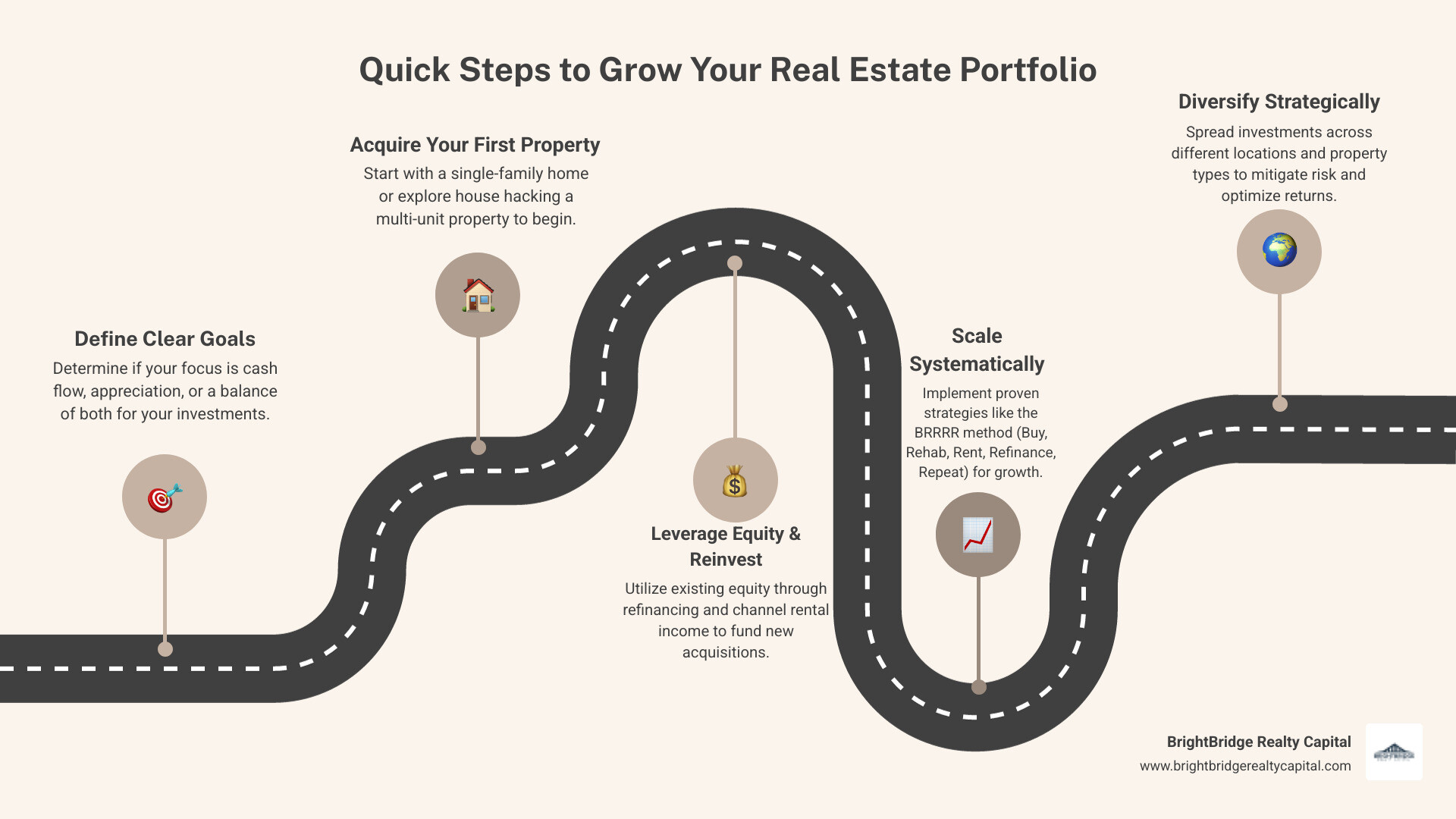
Quick Steps to Grow Your Real Estate Portfolio:
- Start with clear goals - Define your focus: cash flow, appreciation, or both.
- Secure your first property - Begin with a single-family home or house hack a multi-unit.
- Leverage existing equity - Use refinancing to fund additional purchases.
- Reinvest your profits - Channel rental income into new acquisitions.
- Diversify strategically - Spread investments across locations and property types.
- Scale systematically - Use methods like BRRRR (Buy, Rehab, Rent, Refinance, Repeat).
Building a real estate portfolio is about strategic planning, smart financing, and consistent execution. Data shows that diversified portfolios have 40% less volatility than single-property investments. The path from one property to many requires mastering financing options, leveraging equity, and building systems that scale.
The difference between adding one property every few years and leveraging each property to fund multiple new ones comes down to how well you execute these fundamentals.
I'm Daniel Lopez, a loan officer at BrightBridge Realty Capital, and I've helped dozens of investors grow their real estate portfolios by structuring financing that accommodates their unique timelines and property types. My focus is on making complex lending simple so clients can move quickly when opportunities arise.
Laying the Foundation: Your First Steps to Portfolio Growth
The journey to grow your real estate portfolio begins with a clear vision and a solid first property. Think of your portfolio as a group of assets working together to generate income and build wealth. The long-term upward trend in home prices demonstrates the wealth-building potential that draws investors to real estate.
Define Your Objectives and Risk Tolerance
Before you start browsing listings, you must create a detailed investment thesis. This written plan acts as your compass, guiding every decision from market selection to financing choices. It should clearly articulate your goals, timeline, and risk appetite.
What does success look like for you? The answer determines your strategy:
- Focus on Long-Term Appreciation: This strategy involves buying properties in areas with strong growth indicators, such as job growth, population increases, and planned infrastructure projects. The goal is for the property's value to increase significantly over 10, 20, or 30 years. Appreciation can be passive (market-driven) or forced. Forced appreciation is achieved through strategic renovations—upgrading a kitchen, adding a bathroom, or improving curb appeal—to increase the property's value beyond general market trends. This strategy is often capital-intensive upfront and may produce lower initial cash flow.
- Focus on Maximum Cash Flow: This strategy prioritizes generating consistent monthly income. Investors pursuing cash flow often look for properties in stable, high-demand rental markets where rents are high relative to property prices. Multi-family properties are often favored for this approach. For example, if a property generates $2,500 in monthly rent and total expenses (mortgage, taxes, insurance, maintenance) are $2,100, you have a positive cash flow of $400 per month. This income provides financial stability and can be saved to fund future investments.
- A Hybrid Approach: Most successful investors blend both strategies. They seek properties that provide at least some positive cash flow while being located in areas with solid long-term appreciation potential. This balances immediate income needs with long-term wealth creation.
Your investment timeline and risk tolerance are equally critical. A fix-and-flip project aims to generate capital in 6-12 months but carries high execution and market risk. A long-term buy-and-hold strategy is lower risk but locks up capital for years. Similarly, consider how hands-on you want to be. Will you self-manage to maximize cash flow, or will you hire a property manager to free up your time for finding new deals? The spectrum ranges from being a DIY landlord handling late-night maintenance calls to a completely passive investor in a REIT or syndication. A good guideline for larger portfolios is the 5% rule, which suggests allocating no more than 5% of your portfolio's value to a single property to mitigate risk.
| Pros of Real Estate Investing | Cons of Real Estate Investing |
|---|---|
| Passive Income: Consistent rental revenue. | High Costs: Significant upfront capital. |
| Tax Benefits: Deductions, depreciation. | Maintenance: Ongoing repairs and upkeep. |
| Equity Building: Property value growth. | Market Risk: Value can decline. |
| Illiquidity: Hard to sell quickly. | |
| Diversification: Hedge against inflation. | Management Pressure: Tenant issues, vacancies. |
| Control: Direct management of assets. |
Choose Your Starting Point and Location
Your first property doesn't need to be perfect, just a solid starting point. Many investors begin with a single-family home because they are straightforward and appeal to a broad tenant pool. Others start with house hacking—buying a multi-unit property (2-4 units), living in one unit, and renting out the others. This powerful strategy allows you to qualify for favorable primary residence financing (with a lower down payment) while the rental income helps cover your mortgage.
Even more important than property type is location. A property's proximity to amenities like schools, transportation, and employment hubs directly impacts rental demand and appreciation. A good property in a great location will almost always outperform a great property in a poor location.
Conduct thorough local market analysis. This goes beyond browsing listings. Dig into specific data points to gauge a market's health and future prospects:
- Economic Trends: Look at population growth, job market reports, and the diversity of local industries. A town reliant on a single employer is riskier than one with a diverse economy.
- Real Estate Metrics: Analyze historical price appreciation, average days on market, vacancy rates, and average rent prices. This data is available from local real estate associations and online platforms.
- Community Factors: Research school district ratings, crime statistics, and walkability scores. These factors heavily influence tenant quality and rental demand.
- Future Development: Check with local government planning departments for information on upcoming infrastructure projects, new commercial developments, or zoning changes. A new transit line or major employer can transform a neighborhood's value.
This deep-dive research is what separates successful, strategic investors from those who simply get lucky.
Smart Financing Strategies to Grow Your Real Estate Portfolio

Financing is the engine that powers your portfolio growth. Without capital, even the best strategy is stuck at the starting line. Mastering both traditional and creative financing methods is essential for scaling your investments. Fortunately, there are many ways to fund your investments.
At BrightBridge Realty Capital, we've seen investors succeed by understanding how to leverage capital smartly. We provide customized, quick, and flexible real estate financing solutions to help investors in New York and nationwide close deals fast—often within a week.
Traditional and Creative Funding Options
Your existing properties are potential sources of capital. This is called leveraging equity, and it's how many investors accelerate growth from one property to many.
- A cash-out refinance lets you take out a new, larger loan on a property you own. You pay off the old mortgage and receive the difference in cash, which can be used for your next down payment. Lenders typically allow you to borrow up to 75-80% of the property's appraised value on an investment property. Most lenders also require a "seasoning period" of 6-12 months before they will use the new appraised value.
- A home equity line of credit (HELOC) acts like a credit card backed by your property's equity. It has two phases: a "draw period" (often 10 years) where you can borrow and repay funds as needed, and a "repayment period" (10-20 years) where the line freezes and you pay back the principal and interest. Its flexibility is ideal for covering rehab costs or having cash ready for a new opportunity, but be mindful that most HELOCs have variable interest rates.
- Hard money loans are short-term, asset-based loans from private lenders that can close in days instead of weeks. Because the lender is focused on the property's value, credit requirements are less stringent. While rates are higher (typically 10-15% interest plus 2-5 points upfront), the speed is invaluable for securing competitive deals like auction properties or fix-and-flips that traditional banks won't finance quickly.
- With seller financing, the property owner acts as the lender. You make payments directly to the seller instead of a bank. This can be a great way to acquire properties with more flexible terms, a lower down payment, and reduced closing costs. Sellers may offer this to achieve a higher sale price or for the tax advantages of an installment sale.
- Real estate partnerships allow you to pool resources. You can team up with an equity partner who provides capital in exchange for a share of ownership and profits, or a debt partner who simply lends money for the project at a fixed interest rate. This allows you to acquire properties you couldn't afford on your own.
- Portfolio Loans: Once you have several properties, you can seek a portfolio loan. This is a single mortgage that covers multiple properties, simplifying your finances with one monthly payment. Lenders who offer these loans are often more flexible and may provide a line of credit based on the combined equity of your portfolio, giving you a powerful tool for future acquisitions.
Securing Capital for Rapid Expansion
To scale from a side project to a wealth-building machine, you need reliable and repeatable access to capital.
Establishing lines of credit with lenders gives you on-demand capital, allowing you to make strong, cash-like offers and move decisively when you find a good deal.
The BRRRR method (Buy, Rehab, Rent, Refinance, Repeat) is a powerful strategy for rapid expansion. You buy a distressed property, rehab the property to increase its value, rent it out to a tenant, and then do a cash-out refinance to pull your initial investment back out. This recycled capital is then used to buy the next property, allowing you to scale with a limited amount of initial funds.
You can also find private money lenders—individuals with capital looking for investment opportunities. They are often more flexible and faster than traditional banks. When approaching any lender, presenting a strong business plan with a clear strategy, realistic projections, and a demonstrated track record is essential.
At BrightBridge Realty Capital, we understand that time is money. Our direct lending model cuts through the red tape, providing the capital you need with the speed you want so you can focus on building wealth.
Advanced Growth Engines: Scaling from Linear to Exponential
To build real wealth, you need to shift from linear growth (adding one property every few years) to exponential growth. This means using each property as a springboard to the next, creating a system where each acquisition helps fund the next one. The secret is to master strategies that allow you to reinvest profits and leverage equity efficiently.

Proven Methods to Grow Your Real Estate Portfolio
Here are strategies that have helped countless investors scale their portfolios:
- The BRRRR Method: As mentioned, this stands for Buy, Rehab, Rent, Refinance, Repeat. It's a system for recycling your capital. For example: You Buy a distressed property for $150,000 using a short-term loan. You Rehab it with $30,000 of your own cash. Your total investment is $180,000. After the rehab, the property is appraised at a new value of $250,000. You Rent it out to a stable tenant. Then, you Refinance with a long-term loan at 75% of the new value, which is $187,500. This new loan pays off your original $150,000 loan and returns your $30,000 rehab budget, plus an extra $7,500. You've now pulled all your initial capital back out and can Repeat the process on a new property, all while owning a cash-flowing asset.
- The Snowball Method: This is a more patient but highly effective strategy. You use the net rental income (cash flow) from your first property to aggressively save for the next down payment. Once you acquire a second property, the combined cash flow from both properties accelerates your savings for the third. As you add more properties, the income snowballs, dramatically shortening the time it takes to acquire each subsequent asset.
- Fix-and-Flip Projects: While not a buy-and-hold strategy, flipping can generate large sums of capital quickly. These profits can then be used as down payments for several long-term rental properties, allowing you to scale your portfolio much faster than saving up from a primary job alone.
- The 1031 Exchange: This powerful provision in the U.S. tax code, the 1031 exchange, allows you to defer paying capital gains taxes when you sell an investment property, as long as you reinvest the proceeds into a "like-kind" property. This is a massive advantage. The rules are strict: you must formally identify potential replacement properties within 45 days of the sale and close on the new property within 180 days. The term "like-kind" is broad, meaning you can exchange a single-family rental for a commercial building, raw land, or a multi-family apartment, allowing you to trade up to larger, more profitable assets without losing a significant chunk of your equity to taxes.
The Critical Role of Diversification
Putting all your eggs in one basket is risky. Research shows that diversified real estate portfolios have 40% less volatility. Diversification is your portfolio's insurance policy against market fluctuations.
Geographic diversification is your first line of defense. Spreading investments across different neighborhoods, cities, or even states protects you from localized economic downturns. If one city's major employer leaves town, your investments in other markets will keep your portfolio stable. In a market like New York, this could mean owning properties in different boroughs with unique economic drivers.
Property type diversification adds another layer of protection. As you grow, consider branching out from residential into other asset classes. Different property types respond to different economic cycles, which can stabilize your income. Common types include:
- Residential: Single-family homes, small multi-family (2-4 units), large multi-family (5+ units), and short-term rentals.
- Commercial: Office buildings, retail spaces (strip malls), and industrial warehouses.
- Specialized: Self-storage facilities, mobile home parks, and student housing.
For investors wanting broad exposure with less hands-on work, Real Estate Investment Trusts (REITs) are a great option. These companies own and operate large-scale, income-producing real estate. You can buy shares on the stock market, receiving dividends as income. They are a smart way to add instant geographic and asset-class diversification beyond your direct property ownership.
At BrightBridge Realty Capital, we provide the fast, flexible financing needed to execute these strategies. Our direct lending model means we can close in as little as a week, helping you capitalize on time-sensitive opportunities.
Managing and Optimizing Your Growing Portfolio
Once you start to grow your real estate portfolio, the focus shifts from acquisition to management and optimization. A well-managed portfolio is what separates investors who build lasting wealth from those who struggle with constant headaches and underperforming assets. Effective management is a system, not a reaction.
Key Metrics for Tracking Performance
Numbers tell you the story of how your investments are performing. You cannot optimize what you do not measure. Track these key metrics diligently for every property:
- Cash Flow: The money left after all expenses, including the mortgage, are paid. Positive cash flow is the lifeblood of your portfolio.
- Cash-on-Cash Return (CoC): The annual pre-tax cash flow divided by the total cash you invested. Formula:
(Annual Cash Flow / Total Cash Invested) x 100. If you invested $50,000 (down payment, closing costs) and have an annual cash flow of $4,000, your CoC return is 8%. This metric is crucial for comparing the performance of different properties. - Capitalization Rate (Cap Rate): A property's Net Operating Income (NOI) divided by its market value. NOI is all rental income minus all operating expenses (excluding the mortgage). It measures the unleveraged return of a property and is a standard way to compare commercial properties.
- Return on Investment (ROI): The total gain from an investment (cash flow, appreciation, equity paydown) relative to its cost. This is a more holistic view of your total return over time.
- The 50% Rule: A rule of thumb that assumes about half your gross rental income will go toward operating expenses (excluding the mortgage). These expenses include property taxes, insurance, vacancy (budget 5-10%), repairs, maintenance, capital expenditures (CapEx), and property management fees. If a property rents for $2,000/month, expect about $1,000/month in operating expenses.
- Occupancy Rate: The percentage of time your properties are rented. A low occupancy rate is a major red flag, indicating issues with the property, location, rent price, or management.
How to Efficiently Manage and Grow Your Real Estate Portfolio
As your portfolio expands, you'll face a choice: self-management or hiring a property manager. Self-management saves on fees (typically 8-10% of gross rents) but costs you your most valuable asset: time. A professional manager handles tenant screening, rent collection, maintenance calls, and evictions. This frees you up to focus on high-value activities like finding new deals, which is why many of our clients at BrightBridge Realty Capital do it to scale faster.
Building a reliable team is non-negotiable for growth. Your "power team" should include:
- An investor-friendly Real Estate Agent who finds deals, not just lists them.
- A knowledgeable CPA for proactive tax strategy, entity structuring (LLCs), and maximizing deductions like depreciation.
- A real estate Attorney for legal protection, reviewing contracts, creating LLCs, and handling evictions correctly.
- A trusted Contractor for reliable and fair-priced repairs and renovations.
Leverage technology. Property management software (like Buildium or AppFolio) can streamline everything from rent collection to maintenance requests. Tools like Zillow Rental Manager help you manage listings and screen tenants from anywhere.
The market is always changing, so you must adapt. This might mean adjusting rents to market rates, refinancing to a lower interest rate to improve cash flow, or strategically selling an underperforming asset to reinvest the capital into a better opportunity.
Finally, avoid common pitfalls:
- Overleveraging: Taking on too much debt makes you vulnerable to market shifts or unexpected vacancies. Always keep healthy cash reserves (3-6 months of expenses per property).
- Insufficient Due Diligence: Rushing into a deal without proper inspections, verifying leases, and analyzing the numbers is a recipe for disaster. Trust, but verify everything.
- Poor Tenant Screening: Bad tenants can cause tens of thousands in property damage and lost income. A rigorous screening process—including credit checks, background checks, income verification (3x rent), and calling past landlords—is your best protection.
- Underestimating Capital Expenditures (CapEx): Many new investors budget for small repairs but forget about major replacements. A roof ($10,000+), HVAC system ($5,000+), or water heater ($1,500+) will eventually fail. Set aside 5-10% of monthly rent into a separate CapEx fund so you're prepared.
By managing your portfolio with intention, you set yourself up for long-term success. At BrightBridge Realty Capital, we've seen how investors who master management can scale much faster because they're building systems that work.
Frequently Asked Questions about Growing a Real Estate Portfolio
How much money do I need to start building a property portfolio?
You don't need to be wealthy to start. While a traditional investment property requires a down payment of 20-25% plus closing costs and reserves, there are more accessible entry points.
House hacking is a popular strategy. By buying a multi-unit property and living in one unit, you can qualify for owner-occupied financing with a much lower down payment (as little as 3.5%). Your tenants' rent helps pay your mortgage.
For as little as $5,000, you can also start by investing in REITs or crowdfunding platforms. These options provide exposure to real estate and passive income without the responsibilities of direct ownership, allowing you to get started while you save for a physical property.
At BrightBridge Realty Capital, we work with investors at every stage, helping structure financing that fits your capital and goals.
Should I invest in residential or commercial properties first?
For new investors, residential properties are almost always the smarter first move. They offer easier financing, simpler management, and lower entry costs compared to commercial properties. Getting a loan for a duplex is far simpler than for a strip mall.
Commercial properties can offer higher returns and longer leases, but they come with greater complexity. We recommend building experience with 3-5 residential properties first. Learn the ropes of financing, management, and maintenance before scaling up to commercial investments, where the stakes are higher.
How many properties are needed for a diversified portfolio?
The question of "how many" doesn't have a one-size-fits-all answer, but most real estate experts agree that 5-10 properties create meaningful diversification. However, quality over quantity is the golden rule. Five great properties will always outperform fifteen mediocre ones.
The goal of diversification is risk mitigation. Start with geographic diversification by investing in different neighborhoods or submarkets. If one area has a downturn, your other properties provide stability.
As you grow, add property type diversity. Mix single-family homes with multi-family units, and eventually consider a commercial property. This protects you as different property types perform differently through economic cycles. A resilient portfolio is what allows investors to weather market cycles successfully.
At BrightBridge Realty Capital, our fast financing helps investors act on opportunities to diversify their portfolios, whether it's your fifth property across town or your first in a new market.
Conclusion
The path to grow your real estate portfolio is about building a foundation for financial independence. We've covered the essential steps: setting clear goals, conducting market research, and understanding key metrics.
We explored financing strategies that fuel exponential growth, from leveraging equity to using the BRRRR method and 1031 exchanges. These tools, combined with strategic planning and diversification, are what turn a single property into a thriving portfolio.
Leverage and smart financing are your greatest allies. They allow you to make strategic moves at the right time, with the right partners who understand your goals.
At BrightBridge Realty Capital, we know that timing is everything. We provide the quick, flexible financing investors need to capitalize on opportunities. Our direct lending model means no intermediaries and fast closings—often within a week—so you can move confidently on deals in New York and across the country.
Your real estate journey is unique, but you don't have to go it alone. Ready to take the next step? Explore our rental loan programs to fund your next investment and see how we can help you move forward with confidence.