Broker-Free and Loving It: A Guide to Direct Real Estate

Summary
Discover no broker real estate: Save commissions, navigate FSBO transactions, and explore NoBroker's proptech revolution with direct C2C matching.
The Real Cost of Middlemen in Real Estate (And How to Skip Them)
No broker real estate is exactly what it sounds like — buying, selling, or renting property directly, without paying a traditional agent or broker. For decades, the real estate industry was a closed loop, where access to information was guarded by licensed professionals who charged a premium for their gatekeeping services. Today, that wall is crumbling. The rise of the direct-to-consumer model in property transactions is not just a convenience; it is a financial revolution that allows individuals to reclaim equity that was previously lost to commissions.
Here's a quick breakdown of what that means in practice:
| What You Skip | What You Save |
|---|---|
| Listing agent commission (3%) | Thousands of dollars per transaction |
| Buyer's agent commission (2-3%) | Negotiating leverage on price |
| Broker coordination delays | Faster deal timelines |
| Intermediary markups on services | Lower overall transaction costs |
The idea is simple: connect buyers, sellers, and renters directly — and let technology handle what brokers used to do. In the past, the "value add" of a broker was their Rolodex and their access to the Multiple Listing Service (MLS). However, in the digital age, the Rolodex has been replaced by global databases, and the MLS is no longer the only way to find a home. By removing the middleman, both parties in a transaction can often walk away with a better deal. The seller keeps more of their hard-earned equity, and the buyer can often negotiate a lower purchase price because the seller isn't factoring a 6% commission into the closing costs.
Traditional real estate has always been built around intermediaries. Brokers find listings, arrange viewings, handle paperwork, and charge 5–6% of the sale price for doing it. On a $400,000 home, that's up to $24,000 out of your pocket. For many families, that $24,000 represents years of savings or the entire budget for a much-needed renovation. When you look at the math, the traditional model starts to look increasingly antiquated, especially when much of the work — finding the home online, researching the neighborhood, and checking school districts — is now done by the consumers themselves before they even contact an agent.
But the market is changing fast. Proptech platforms now connect property owners and buyers directly. Flat-fee MLS services let sellers list without a full-service agent. Consumer-to-consumer marketplaces have scaled to tens of millions of users. The traditional broker model — once untouchable — is being disrupted from every angle. This disruption is driven by a generation of tech-savvy consumers who are used to managing their own investments, travel, and banking online. Why should real estate be any different?
For real estate investors especially, cutting out the middleman isn't just about saving on commissions. It's about speed, control, and deal flow. In competitive markets like New York or Miami, direct access to motivated sellers and off-market properties can be the difference between a great deal and a missed one. Investors who can bypass the traditional listing process often find "distressed" properties or owners looking for a quick, quiet sale, allowing for much higher margins on the back end.
I'm Daniel Lopez, a loan officer at BrightBridge Realty Capital, where I specialize in helping investors structure fast, flexible financing for deals — including those found through no broker real estate channels. I've worked with clients across fix-and-flip projects and rental portfolio expansions where skipping the broker was just the first step in a smarter, leaner deal strategy. Our goal is to match the efficiency of the no-broker model with financing that doesn't get bogged down in the bureaucracy of traditional big-box banks.
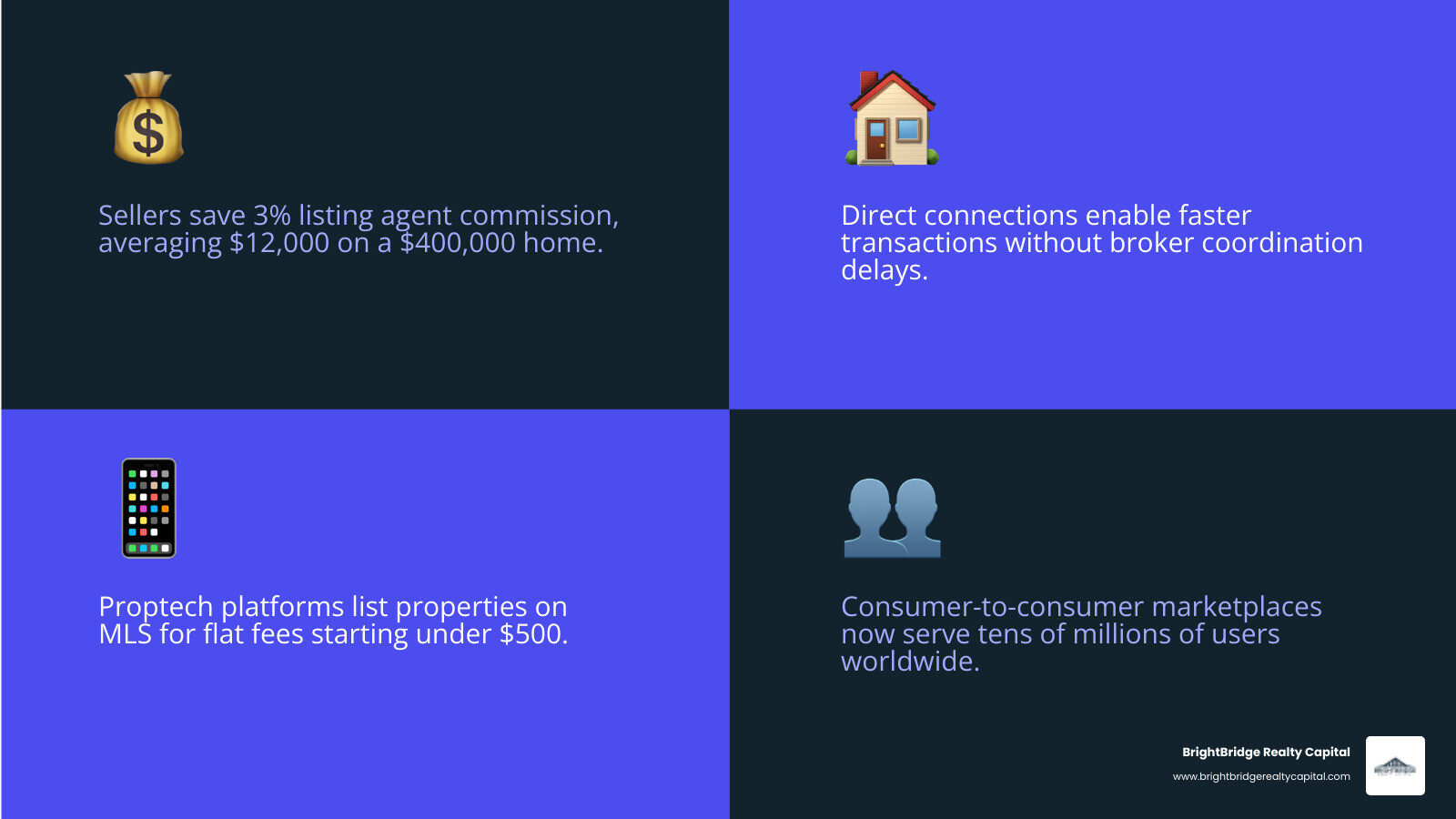
No broker real estate terms at a glance:
Understanding the No Broker Real Estate Model
At its heart, the no broker real estate model is a consumer-to-consumer (C2C) marketplace. It aims to solve a decades-old problem: the "information asymmetry" that once forced every property seeker to hire a professional just to see what was available. In the pre-internet era, if you wanted to know what houses were for sale, you had to walk into a real estate office and look at a physical book or wait for the Sunday newspaper. Brokers held all the cards because they held all the data. By leveraging technology, modern platforms have caused massive disruption in the industry by democratizing this data.
Instead of a gatekeeper holding the keys to the kingdom, we now have verified listings accessible to anyone with a smartphone. These platforms use listing automation and direct communication tools to allow owners and seekers to chat, negotiate, and close deals without a middleman hovering over the conversation. This direct line of communication eliminates the "game of telephone" that often happens when two different agents are trying to relay messages between a buyer and a seller. While the initial promise was entirely free access, many of these "disruptors" have evolved to include subscription fees for property owners to access premium tenant or buyer data, a shift explored in NoBroker: The Real Estate Disruptor.
For those of us in the investment world, this model mirrors what we do here at BrightBridge. Just as you might skip a broker to find a house, you can also skip the red tape of traditional banks by working with private mortgage lenders who provide direct access to capital. The philosophy is the same: remove the unnecessary layers, reduce the friction, and let the principals of the deal speak directly to one another.
Core Business Model and Differentiation
How does a tech platform actually replace a human broker? It isn't just about putting a photo on a website; it's about replicating the complex workflow of a real estate transaction through software. It comes down to three things: matching, verification, and relationship management.
- Technology-Driven Matching: Instead of a broker's "gut feeling" or limited local knowledge, these platforms use data science and machine learning to pair the right tenant or buyer with the right property based on thousands of data points. This includes everything from commute times and local amenities to historical price trends and user behavior patterns. The algorithm doesn't sleep, and it doesn't have a bias toward its own listings.
- User-Friendly Interface: By providing a seamless, intuitive app experience, the barrier to entry for a "For Sale By Owner" (FSBO) transaction is lowered significantly. In the past, selling your own home was a logistical nightmare involving yard signs and answering endless phone calls. Now, an app can manage your calendar, filter out non-serious inquiries, and even provide a digital lockbox for self-guided tours.
- Verification: To keep the platform "broker-free," advanced algorithms and manual checks are used to weed out agents trying to sneak into the ecosystem. This is a constant cat-and-mouse game. Brokers often try to post "ghost listings" to lure in clients, but modern proptech uses AI to detect duplicate images, suspicious phone numbers, and non-owner behavior to ensure the integrity of the C2C marketplace.
Achievements in the Direct Market
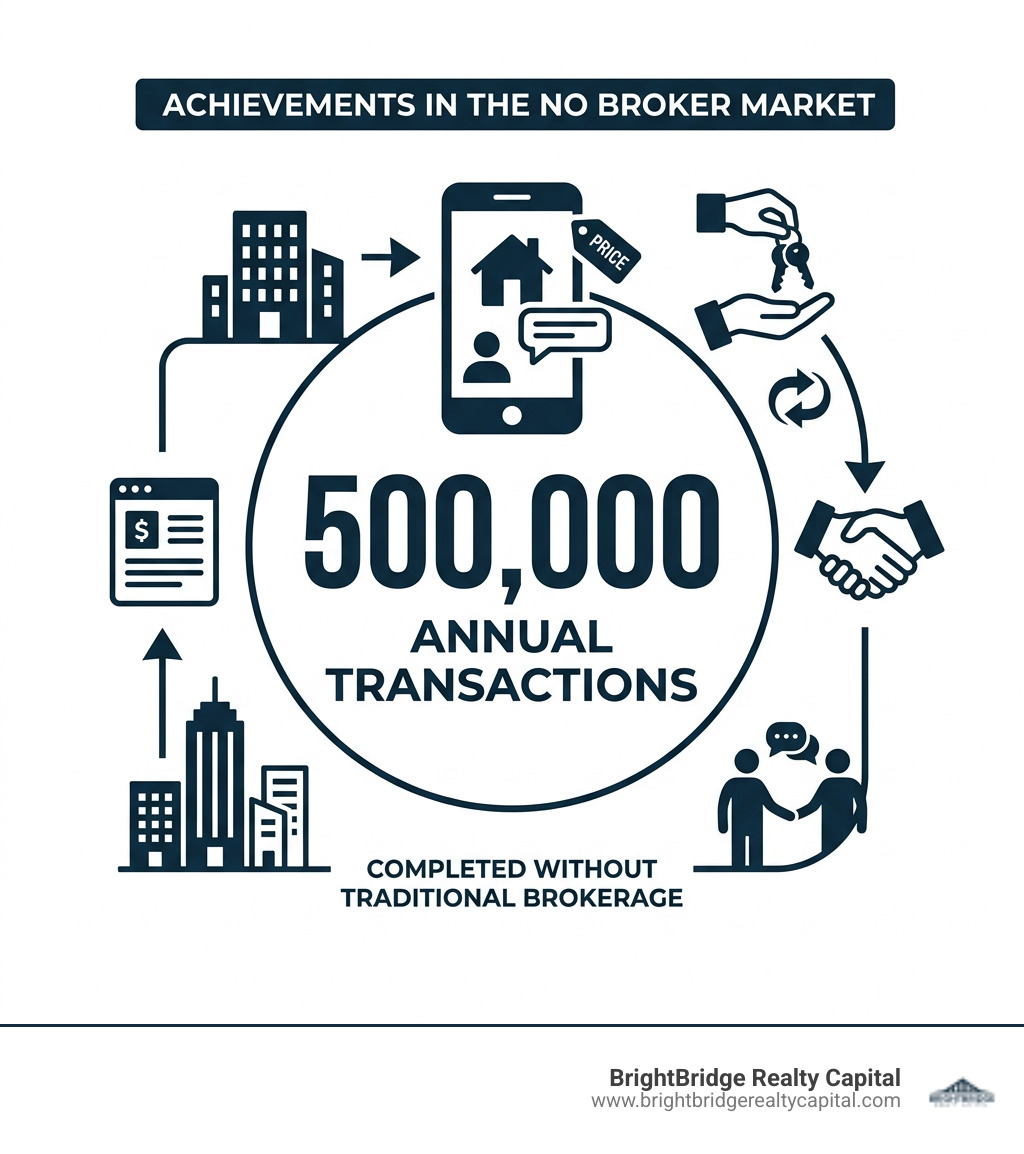
The scale of the no broker real estate movement is staggering. It is no longer a niche hobby for DIY enthusiasts; it is a mainstream financial strategy. To give you an idea of the volume being handled by these direct-to-consumer platforms, look at these 2022 statistics which highlight the sheer magnitude of the shift:
- 7.5 million properties registered on major portals, creating a massive inventory that rivals traditional MLS systems.
- 500,000 annual transactions completed without traditional brokerage, proving that the model works for high-value assets.
- ₹130 crore monthly savings in commissions for users (approximately $15 million USD per month in specific markets), which goes directly back into the pockets of consumers.
- 30 lakh monthly connections between owners and seekers, showing a high level of engagement and liquidity in the market.
- 2 lakh new listings added every single month, ensuring that the database remains fresh and competitive.
The Rise of Proptech Giants: A Case Study
The journey of the world's largest no-brokerage site provides a roadmap for how this industry evolved from a radical idea into a multi-billion dollar sector. Founded in 2013 by Akhil Gupta, Amit Kumar Agarwal, and Saurabh Garg, the concept was born out of the founders' own frustrations with the "broker mafia" and high fees in the Indian market. They realized that in a world where you could book a flight or buy a car online, paying two months' rent to a guy who simply showed you an apartment for ten minutes was an economic absurdity.
The growth was explosive, fueled by a massive demand for transparency. By November 2021, NoBroker becomes India's first proptech unicorn after securing $210 million in a funding round led by Tiger Global. With total funding reaching $361 million by 2023 and backing from tech giants like Google, the model proved that investors see a massive future in removing the middleman. This influx of capital allowed these platforms to expand beyond simple listings into a full-stack real estate ecosystem.
Traditional Brokers vs. No-Broker Platforms
To understand why this shift is happening, we have to look at the fundamental differences in the service delivery model. The traditional broker model is labor-intensive and high-cost, whereas the platform model is capital-intensive but low-cost for the end user.
| Feature | Traditional Broker | No-Broker Platform |
|---|---|---|
| Cost | 1-2 months' rent or 5-6% sale price | Zero commission (Subscription-based) |
| Control | Broker manages the schedule | You manage everything directly |
| Speed | Depends on broker's network | Instant access to the entire database |
| Verification | Personal vetting | AI and data-driven verification |
| Transparency | Information is filtered | Direct access to all property data |
| Availability | Business hours only | 24/7 access via mobile app |
Challenges in No Broker Real Estate
It hasn't been all smooth sailing. The disruption of a multi-billion dollar industry naturally leads to friction, and the traditional brokerage industry has not gone down without a fight. In the early days, some company offices were actually physically assaulted by groups of local property agents who felt their livelihoods were under threat. These "broker unions" recognized that if the public realized they could transact safely on their own, the traditional commission-based career path would vanish.
Beyond physical resistance, there have been significant legal and ethical disputes. Allegations of data theft between competing apps and accusations of anti-competitive practices have made headlines. Furthermore, many users have criticized the "policy shifts" where platforms that once promised to be entirely free began charging subscription fees to owners. This has led to the common refrain among skeptics that "NoBroker is no longer no broker." However, proponents argue that a small flat fee for a subscription is still vastly superior to a percentage-based commission that scales with the price of the home.
Geographic Reach and Service Cities
While we focus our lending operations in New York, NY, it's worth noting that the global no-broker movement thrives in high-density urban centers where the cost of living is high and the real estate market is fast-paced. In India, the services are concentrated in major hubs like Bangalore, Mumbai, Chennai, Pune, Hyderabad, and Delhi-NCR. These are cities where the rental market is incredibly competitive and the "broker fee" can be a significant financial burden, making the direct model incredibly attractive. We are seeing similar trends in the US, with platforms like Zillow, Redfin, and various FSBO sites gaining massive traction in cities like Austin, Seattle, and New York, where consumers are eager to save on high-value transactions.
How to Navigate a Broker-Free Transaction
If you're looking to dive into a no broker real estate deal here in New York or anywhere else, you need a plan. You are essentially taking on the job of the agent, which means you need to be organized, diligent, and prepared for the administrative workload. While the savings are immense, the responsibility is equally significant. You are the one who will be answering the 10:00 PM emails, scheduling the Sunday morning walkthroughs, and ensuring the smoke detectors are up to code.
The Step-by-Step Process for Success
- FSBO Steps: If you're selling, you'll need to price your home using comparable sales ("comps"). Don't just look at what people are asking for their homes; look at what they actually sold for in the last 90 days. You'll also need to take professional-grade photos — lighting is everything — and write a compelling description that highlights the lifestyle, not just the square footage.
- Flat-Fee MLS: To get maximum exposure, many sellers use a flat-fee service to get their home onto the Multiple Listing Service (MLS) without paying a listing agent commission. This ensures your home appears on sites like Zillow and Realtor.com, even if you aren't using a traditional agent. You pay a one-time fee (usually a few hundred dollars) instead of 3% of the sale price.
- Attorney-Led Closings: In many states, including New York, you'll want a real estate attorney to handle the contract and closing to ensure everything is legally sound. In fact, in NY, attorneys are a standard part of the process. They will handle the title search, the escrow of the down payment, and the final deed transfer. This provides a layer of legal protection that a broker simply cannot offer.
- Disclosures and Inspections: You are legally required to provide certain property disclosures (like lead paint or known structural issues). Conversely, as a buyer, never skip a professional home inspection just because there isn't a broker involved. The $500 you spend on an inspector could save you $50,000 in future repairs.
For investors, having a Direct Private Real Estate Lender Guide is essential for moving as fast as the direct market requires. When you find a deal on a no-broker platform, you need to be able to prove you have the funds immediately, or the seller will move on to the next person in their inbox.
Pros and Cons of No Broker Real Estate
The Pros:
- Commission Savings: This is the big one. You keep the 5–6% for yourself. On a million-dollar New York condo, that's $60,000. That's a lot of money to leave on the table for a middleman.
- Direct Control: You talk to the owner/buyer directly. No "he said, she said" through a middleman. You can explain the nuances of the property yourself and get immediate answers to your questions.
- Faster Decisions: Without waiting for a broker to return a call or check their schedule, you can negotiate in real-time. This speed is a massive advantage in a "seller's market."
The Cons:
- Time Commitment: You have to handle the calls, the showings, and the follow-ups. It can feel like a second full-time job during the weeks your property is on the market.
- Negotiation Risks: If you aren't a confident negotiator, you might leave money on the table. Brokers often argue that their negotiation skills pay for their commission, though data on this is mixed.
- Paperwork Management: You'll need to be diligent with contracts, disclosures, and legal requirements. One missing signature can delay a closing by weeks.
User Experience and App Performance
With over 10 million downloads and a 3.6-star rating from nearly 450,000 reviews, the feedback on no-broker apps is a mixed bag. This reflects the growing pains of a disruptive industry. Many users love the convenience and the massive savings, while others complain about the aggressive "relationship managers" or the difficulty in getting a refund on subscription plans.
When reading reviews, look for Real people Verification on Trustpilot to ensure you're getting honest feedback. Common complaints often center around service reliability and the persistence of the sales teams, but for many, the trade-off is worth the thousands of dollars saved. It's important to remember that these platforms are tech companies first, and their customer service models are often automated, which can be frustrating for users used to the high-touch (but high-cost) service of a traditional agent.
Beyond Listings: Integrated Real Estate Services
Modern no broker real estate platforms aren't just about listings anymore. They have evolved into "super-apps" for the home. The goal of these companies is to own the entire lifecycle of the property, from the moment you think about moving to the day-to-day management of your new home. Once you find a place, they want to help you move in, maintain it, and even manage the community. This "ecosystem" approach is what makes these platforms so valuable to investors and homeowners alike.
The Full-Stack Property Ecosystem
- Home Services: You can book painters, cleaners, AC repair techs, and plumbers directly through the app. Because these platforms have a massive user base, they can negotiate bulk rates with service providers, passing the savings on to you. This also provides a layer of accountability; if a painter does a poor job, you can complain directly to the platform that holds their contract.
- Society Management: Apps like NoBrokerHood help gated communities and apartment complexes manage visitors, pay maintenance bills, and even coordinate with neighbors. This digitizes the entire experience of living in a managed community, replacing old-fashioned paper logs with secure, app-based QR codes for visitors and delivery personnel.
- Financial Tools: From loan eligibility checks to paying your rent via credit card (to earn those sweet reward points), the financial integration is deep. Some platforms even offer "rent now, pay later" schemes or security deposit insurance, which helps tenants move into better properties with less upfront cash.
- Legal Assistance: Many platforms now offer automated rental agreement generators and assistance with the paperwork required for a property sale. These documents are often vetted by legal professionals to ensure they comply with local laws, providing peace of mind for both parties without the cost of a private consultation.
- Conversational AI: Tools like CallZen.AI are being used to improve customer service and help businesses manage their own lead flows more effectively. By using AI to handle initial inquiries, these platforms can scale their operations without hiring thousands of customer service agents, keeping their overhead low and their services affordable.
This integration is particularly useful for the "accidental landlord" — someone who has moved but decided to keep their old home as a rental. Managing a property from a distance is difficult, but with a super-app, you can handle everything from finding a tenant to fixing a leaky faucet without ever having to visit the property in person. It turns real estate into a truly passive investment.
Frequently Asked Questions about Broker-Free Property
What is the core business model of a no-broker platform?
The core model is a direct-to-consumer marketplace that eliminates the need for a middleman. These platforms earn revenue through a variety of channels to make up for the lack of commissions. This includes premium subscription plans (for both owners and seekers), lead generation for home services (like moving or painting), and partnerships with financial institutions for loans and insurance. They also monetize data by providing market insights to developers and institutional investors.
Is it legal to sell a house without a realtor?
Absolutely. Selling "For Sale By Owner" (FSBO) is perfectly legal across the United States. There is no federal or state law that requires you to hire a broker to sell your own property. However, you must still comply with state-specific disclosure laws, fair housing regulations, and contract law. In New York, it is standard practice (and highly recommended) to have a real estate attorney supervise the contract and closing process to ensure that all legal t's are crossed and i's are dotted.
How do no-broker platforms make money if they don't charge commission?
They diversify their income. While they don't take a percentage of the sale price, they charge for "Value Added Services." This includes premium listing packages that give your property more visibility, rental agreement drafting, home maintenance leads, and society management fees. They also act as a bridge for financial services, earning fees on loan referrals and insurance products. By spreading their revenue across the entire lifecycle of the home, they can afford to keep the initial listing free or very low-cost.
Are no-broker deals safe?
Safety is a common concern, but no-broker platforms often have more rigorous verification processes than individual agents. They use AI to flag fraudulent listings and verify the identity of both owners and seekers. However, as with any major transaction, you should exercise due diligence. Always meet in public places for initial discussions, never send money before seeing a property and signing a contract, and always use a professional inspector and a legal professional to finalize the deal.
Can I still use a buyer's agent on a no-broker listing?
Yes, but it can be complicated. If a seller is listing their home as "no broker," they are usually doing so specifically to avoid paying commissions. If you bring a buyer's agent, the seller may refuse to pay that agent's 2.5-3% fee. In this case, you (the buyer) would be responsible for paying your agent out of pocket. This is why many people who use no-broker platforms choose to represent themselves entirely.
Conclusion
The shift toward no broker real estate is more than just a trend; it's a fundamental change in how we interact with property. It represents the democratization of data and the empowerment of the individual. For the average renter or homeowner, it's a way to save a month's salary or a year's savings. For the real estate investor, it's a powerful way to streamline operations, increase margins, and gain a competitive edge in a crowded market.
As technology continues to evolve, we can expect even more friction to be removed from the process. We are already seeing the beginnings of blockchain-based title transfers and AI-driven virtual staging that makes a vacant apartment look like a designer home. The role of the traditional broker is not necessarily disappearing, but it is being forced to evolve. To survive, brokers will have to provide actual advisory value that goes far beyond simply "finding a listing."
At BrightBridge Realty Capital, we believe in the power of direct transactions. Our business is built on the same principles of speed, transparency, and the elimination of unnecessary intermediaries. We provide customized, direct lending solutions that allow you to close on your next investment property in as little as a week, without the red tape of a traditional bank. We understand that in the world of no-broker real estate, timing is everything.
If you're looking to capitalize on a broker-free deal and need financing that moves as fast as you do, we're here to help. Check out our No Broker Real Estate Complete Guide to learn more about how to navigate this exciting market and maximize your returns.
Let's get your next deal closed — no middlemen required. The future of real estate is direct, and the future is already here.