Hard Money, Easy Gains: Your Comprehensive Guide to Real Estate Private Lending


Summary
Unlock real estate success! Discover how real estate private lending offers speed, flexibility & capital for your investment projects.
Why Real Estate Investors Turn to Private Lending
In the fast-paced world of real estate investment, opportunity rarely waits. For investors, fix-and-flip professionals, developers, and rental property owners, the ability to act decisively is paramount. This is where real estate private lending emerges as a critical financing solution. At its core, it involves securing loans from non-bank entities—private individuals, dedicated funds, or family offices—with the property itself serving as the primary collateral. This asset-centric model offers a stark contrast to traditional bank financing, prioritizing the potential of the deal over the borrower's personal financial history.
For decades, investors reflexively turned to conventional banks for capital. However, the post-2008 financial landscape brought stricter regulations, making bank loans a challenging path for many real estate professionals. Traditional lenders impose rigid underwriting criteria, including high credit score requirements, low debt-to-income (DTI) ratios, extensive income verification, and seasoning requirements for down payment funds. These hurdles often create insurmountable roadblocks for time-sensitive opportunities, such as property auctions, or for projects involving properties that need significant repairs—assets that banks typically deem too risky. Real estate private lending provides a powerful and necessary alternative. Private lenders look at the deal through an investor's lens, focusing on the property's intrinsic value, its after-repair value (ARV), the borrower's experience, and the viability of the proposed exit strategy. This approach opens doors for countless investors who don't fit the narrow mold of a traditional borrower but possess a profitable project.
The current market dynamics amplify this shift. The commercial real estate (CRE) sector is facing a "wall of maturities," with over $3 trillion in loans coming due in the near future. Simultaneously, many regional and national banks are retreating from CRE lending due to increased regulatory scrutiny and balance sheet pressures. This has created a significant funding gap, and private lenders are stepping in to fill this critical void, providing the liquidity necessary for investors to acquire, renovate, and stabilize properties.
The most celebrated advantage is speed. While a conventional bank loan can take 30, 45, or even 60 days to close, a private lender can often fund a deal in one to two weeks, and sometimes in a matter of days. In a competitive market, this speed is not just a convenience; it's a decisive weapon that can mean the difference between securing a highly profitable deal and losing it to a faster, all-cash competitor.
I'm Daniel Lopez, a senior loan officer at BrightBridge Realty Capital, and I've spent my career structuring private lending solutions that have empowered hundreds of real estate investors to scale their portfolios. I've seen firsthand how the right financing can unlock potential that traditional lenders overlook. In this comprehensive guide, I will demystify the world of private lending, walking you through every critical aspect—from its fundamental mechanics and loan types to the intricate details of securing funding and understanding the associated risks and rewards.
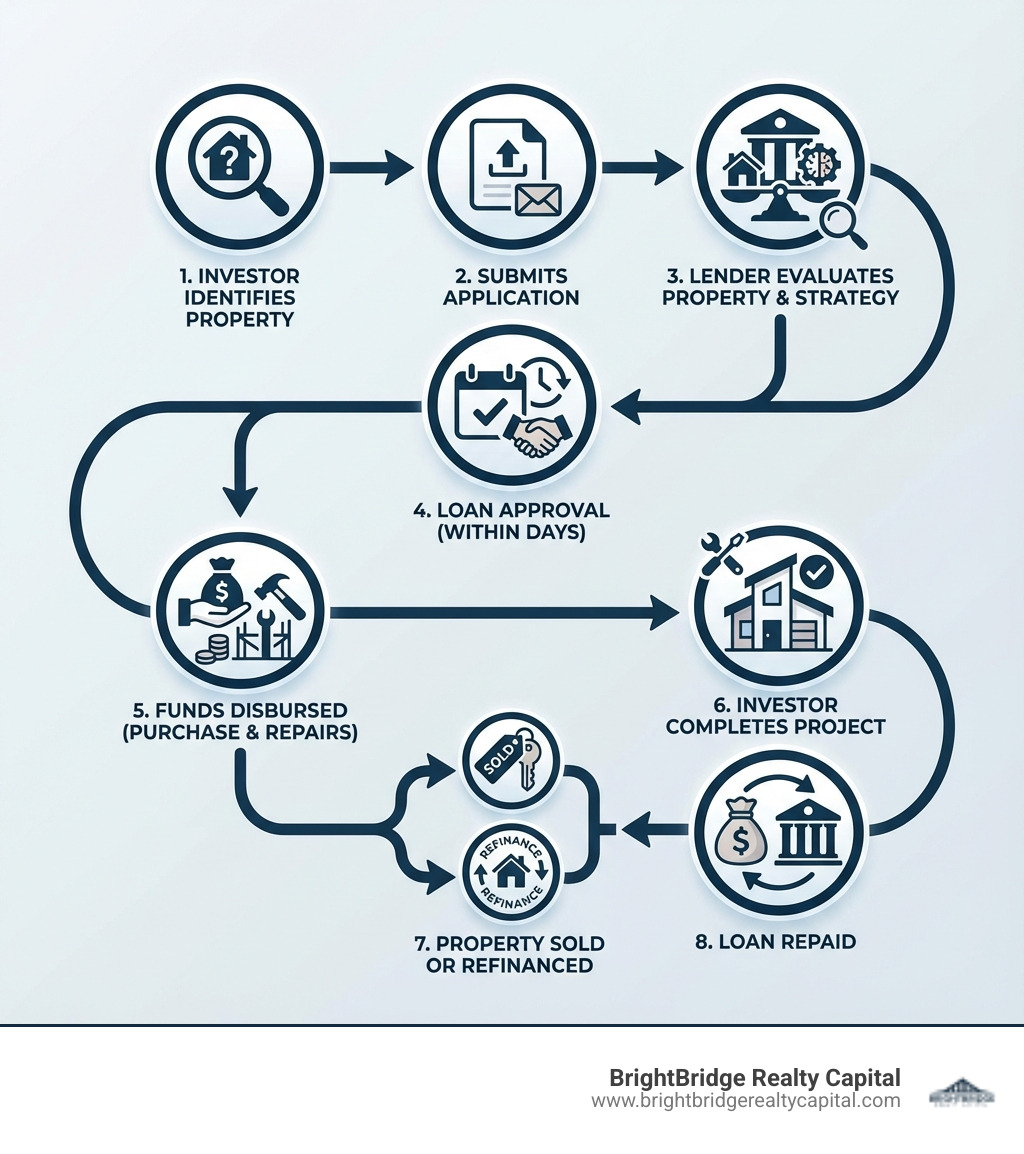
The Great Divide: Private Lending vs. Traditional Bank Loans
Choosing the right financing is one of the most critical decisions a real estate investor will make. The landscape is dominated by two primary paths: traditional bank loans and real estate private lending. While both ultimately provide capital, their philosophies, processes, and requirements are fundamentally different. A deep understanding of these distinctions is essential for aligning your funding strategy with your investment goals.
Traditional banks and credit unions are depository institutions governed by a web of federal and state regulations. Their primary responsibility is to protect their depositors' money, which translates into a highly risk-averse lending posture. They prioritize a borrower's personal financial stability, meticulously scrutinizing credit scores (FICO), employment history, personal income streams, and debt-to-income (DTI) ratios. Their underwriting process is standardized, often automated, and notoriously slow and inflexible. This makes them a poor fit for investors with non-traditional income (like self-employed flippers), complex projects, or the need to close quickly.
Private lenders, by contrast, operate in a more entrepreneurial framework. Their capital comes from private sources, allowing them to focus squarely on the real estate asset itself—its current value, its potential after renovation (ARV), and the soundness of the investor's plan to realize that potential. This asset-centric model enables a far more agile, adaptable, and common-sense underwriting process, bypassing the rigid, check-the-box criteria of institutional financing.
| Feature | Real Estate Private Lending | Traditional Bank Loans |
|---|---|---|
| Approval Timeline | Extremely fast (2-10 business days) | Slow and protracted (30-60+ days) |
| Underwriting Focus | The asset: property value, ARV, exit strategy | The borrower: credit score, DTI, income history |
| Property Condition | Welcomes distressed, rehab, and unique properties | Requires stabilized, move-in ready, or turnkey properties |
| Flexibility | High (custom terms, interest-only, draw schedules) | Low (standardized products, rigid terms) |
| Interest Rates | Higher (typically 9-15%) | Lower (typically 4-7%, market dependent) |
| Loan-to-Value (LTV/LTC) | Higher on project cost (up to 90% LTC), based on ARV | Lower on current value (often 75-80% LTV) |
| Borrower Credit | Flexible; secondary to the deal's strength | Strict; high FICO score is paramount |
| Documentation | Streamlined; focused on the property and project plan | Extensive; requires tax returns, pay stubs, bank statements |
| Loan Purpose | Business/investment purposes only | Can be for primary residence or investment |
| Prepayment Penalties | Common, but can sometimes be negotiated | Less common on conventional loans, more on others |
| Closing Costs | Higher (origination points, processing fees) | Lower (fewer points, standardized fees) |
This detailed comparison illuminates why real estate private lending is not just an alternative but often the superior strategic choice for active investors.
The Primary Benefits of Private Money
The allure of private money extends beyond just getting a 'yes' when a bank says 'no.' It's about gaining a powerful strategic edge. Our clients at BrightBridge Realty Capital consistently leverage these key benefits:
- Unmatched Speed to Close: In competitive real estate markets, the fastest offer often wins. Imagine finding a deeply discounted property at an auction that requires closing in 10 days. A bank is a non-starter. A private lender, however, can underwrite and fund the loan within that timeframe, allowing you to secure an opportunity your competitors can't touch. This speed is a potent weapon for acquiring wholesale deals, short sales, and other time-sensitive assets.
- Financing for the Unfinanceable: Banks have a strong aversion to properties with problems. A house with a failing roof, foundation issues, or outdated systems will be immediately rejected for conventional financing. Private lenders, especially those specializing in fix-and-flip loans, see potential where banks see liability. They will finance distressed assets, vacant commercial buildings, and ground-up construction projects precisely because they understand the value-add process.
- Highly Flexible and Customizable Terms: Real estate projects are not one-size-fits-all, and neither should be the financing. Private loans can be tailored to the specific needs of your project. This can include interest-only payments to keep holding costs low during a renovation, flexible draw schedules for construction funds that align with your project milestones, and extension options in case of unforeseen delays. This level of customization is simply unavailable from traditional lenders.
- Asset-Focused, Common-Sense Underwriting: Private lenders are investors themselves. They understand that a borrower's past credit issues or non-traditional income stream (common for entrepreneurs) doesn't negate the profitability of a great real estate deal. By prioritizing the property's value and the clarity of your exit strategy (e.g., selling the flipped property or refinancing into a long-term rental loan), they open the door to a much wider pool of capable investors.
The Downsides and Trade-Offs to Consider
While real estate private lending offers game-changing advantages, it's crucial to approach it with a clear understanding of the associated costs and trade-offs:
- Higher Interest Rates and Points: The speed, flexibility, and increased risk tolerance of private loans come at a price. Expect interest rates ranging from 9% to 15%, significantly higher than conventional loans. Additionally, you'll pay upfront origination fees, known as "points," typically totaling 2% to 4% of the loan amount. These costs must be meticulously factored into your project's budget to ensure profitability.
- Short Repayment Terms: These are not 30-year mortgages. Private loans are short-term instruments, with typical terms ranging from 6 to 24 months. This structure necessitates a well-defined and realistic exit strategy. You must be confident in your ability to either sell the property or refinance into a long-term loan before the loan matures.
- Significant Upfront and Ancillary Fees: Beyond origination points, a private loan involves other costs. These can include an underwriting fee, a processing fee, appraisal or Broker Price Opinion (BPO) costs, and legal fees for document preparation. If it's a construction loan, you may also encounter draw fees each time you request funds. A reputable lender will provide a clear term sheet outlining all potential costs.
- Fewer Consumer Protections: Private loans are almost always classified as "business-purpose loans," which means they are exempt from many of the consumer protection regulations (like RESPA and TILA) that govern owner-occupied mortgages. This places a greater onus on the borrower to perform thorough due diligence, carefully read all loan documents, and ideally, have a real estate attorney review the agreement.
- The Inevitable Balloon Payment: Most private loans are structured with interest-only payments. This keeps monthly payments manageable during the project, but it means the entire principal balance is due in one large lump sum—a "balloon payment"—at the end of the loan term. This structure underscores the absolute necessity of having a solid exit plan in place from day one.
The Anatomy of a Private Real Estate Loan
Understanding the mechanics of a real estate private lending transaction is key to navigating the process successfully. At its heart, a private loan is a straightforward debt instrument secured by real property. The property itself acts as collateral, which means if the borrower fails to repay the loan, the lender has the right to foreclose and take ownership of the asset to recoup their investment. This collateral-based security is what gives lenders the confidence to act quickly and flexibly.

A critical component of this security is the first lien position. Nearly all private lenders will require their loan to be recorded as the first lien on the property's title. This legal standing ensures that in the event of a default and subsequent sale, the private lender is the very first party to be paid back from the proceeds. Any other loans or claims (junior liens) are subordinate and only get paid if funds remain after the first lien holder is made whole. This priority position significantly mitigates the lender's risk.
Private lenders use a distinct set of metrics to evaluate the viability and risk of a deal, focusing on the asset rather than the borrower's personal finances:
- After-Repair Value (ARV): This is the most important metric for fix-and-flip projects. ARV is the estimated market value of a property after all proposed renovations and improvements are completed. Lenders hire appraisers to determine this value based on comparable sales (comps) of similar, recently renovated properties in the area. A typical private loan might cover up to 70-75% of the ARV. For example, if you buy a property for $200,000, plan $50,000 in renovations, and the ARV is determined to be $350,000, a lender might offer a loan up to 75% of $350,000, which is $262,500. This could potentially cover your entire purchase price and renovation budget.
- Loan-to-Cost (LTC): This metric compares the loan amount to the total cost of the project. The total cost includes both the purchase price and the budgeted renovation costs. Lenders often offer up to 85-90% LTC for experienced investors. Using the same example: the total cost is $200,000 (purchase) + $50,000 (rehab) = $250,000. A 90% LTC loan would be $225,000. This metric shows the lender how much of your own capital (skin in the game) you are contributing to the project.
- Loan-to-Value (LTV): This is the most traditional metric, comparing the loan amount to the property's current appraised value (or purchase price, whichever is lower). It's more commonly used for bridge loans or simple acquisitions without a renovation component. For example, if you are buying a stabilized property for $500,000, a lender offering an 80% LTV would provide a $400,000 loan.
Common Types of Private Real Estate Loans
Real estate private lending is not a monolithic product; it encompasses a range of specialized loans designed for different investment strategies:
- Hard Money Loans: Often used as a catch-all term for private lending, hard money loans are short-term, asset-backed loans where speed and collateral are the primary considerations. They are the quintessential tool for fix-and-flip investors who need to acquire and renovate a property quickly.
- Bridge Loans: This type of financing serves as a short-term "bridge" to solve a timing issue. For example, an investor may need to close on a new investment property before the sale of their existing property is finalized. A bridge loan provides the capital for the purchase, and is then paid off once the old property sells. It's also used to acquire a commercial property quickly and stabilize it before securing long-term bank financing.
- Fix-and-Flip Loans: A specialized loan product designed specifically for the business model of buying, renovating, and reselling a property within a short timeframe (typically 12 months). These loans are often structured to fund a percentage of the purchase price and 100% of the renovation budget, with the rehab funds held in escrow and released in draws as work is completed.
- Construction Loans: For major rehabilitation projects or ground-up construction, these loans finance the entire building process. Unlike a standard loan where funds are disbursed at closing, construction loans are paid out in stages, or "draws." As the project hits pre-agreed milestones (e.g., foundation poured, framing complete), the borrower can request a draw. The lender will inspect the progress and then release the next tranche of funds.
- Refinance Loans: Investors use private refinance loans for several purposes. A "cash-out refinance" allows an investor to pull equity out of a property they already own to fund a new acquisition or for business purposes. It can also be used to pay off a maturing loan (like another private loan) to gain more time to complete a project or wait for better market conditions to sell.
- Commercial Real Estate Loans: Private lenders are very active in the commercial space, providing financing for non-owner-occupied properties such as office buildings, retail centers, industrial warehouses, and multi-family apartment complexes. These loans are critical for investors looking to acquire or reposition commercial assets, especially when traditional banks are hesitant.
Typical Loan Terms, Rates, and Fees
Budgeting accurately is paramount. While every deal is unique, here's a breakdown of the financial components you can expect:
- Interest Rates: Typically range from 9% to 15%, calculated annually and paid monthly. Most are interest-only.
- Loan Terms: Short-term by nature, usually lasting from 6 to 24 months, with 12 months being the most common.
- Origination Fees (Points): An upfront fee for creating the loan, calculated as a percentage of the total loan amount. Expect to pay 2 to 4 points (1 point = 1%). On a $300,000 loan, 3 points would be $9,000.
- Other Fees: Be prepared for a variety of ancillary costs, which may include an underwriting/processing fee ($500-$1,500), appraisal fee ($500+), legal document preparation fees ($500-$2,000), and draw fees ($150-$500 per draw) for construction loans. Some loans may also have prepayment penalties or extension fees if you need more time.
The Nuts and Bolts of Real Estate Private Lending
The real estate finance landscape is in a constant state of flux, and real estate private lending is currently playing a more significant and structural role than ever before. A primary catalyst for this is the enormous volume of maturing commercial real estate (CRE) loans—a figure exceeding $3 trillion over the next few years. This "wall of maturity" was created during a period of lower interest rates. As these loans come due, property owners need to refinance in a much higher-rate environment, and traditional banks, facing their own balance sheet pressures and heightened regulatory scrutiny, are significantly pulling back from this type of lending. This has created a massive funding gap that private lenders, with their flexible capital and risk appetite, are uniquely positioned to fill.
This market dynamic has propelled private credit into the spotlight as a high-performing asset class. Direct lending in the private markets has historically delivered strong, risk-adjusted returns, often outperforming more liquid credit segments like leveraged loans and high-yield bonds. The entire private credit market is on a steep growth trajectory, forecasted to reach nearly $2.8 trillion by 2028, a clear indicator of its increasing importance in the global financial ecosystem.
Within the real estate sector, certain property types are attracting the most private capital. Multifamily and industrial properties are considered "high-conviction" sectors. The persistent nationwide housing shortage fuels strong demand and rent growth for multifamily assets, while the continued expansion of e-commerce and the need for resilient supply chains drive insatiable demand for modern logistics and warehouse facilities.

For investors on the lending side, this environment presents an opportunity to potentially earn attractive, income-driven yields, often exceeding 10%, secured by a first lien position on a valuable, tangible asset. This combination of strong returns and downside protection is a compelling proposition.
Navigating Regulations and Compliance
While the flexibility of real estate private lending is a major draw, it's crucial to understand the regulatory framework it operates within. The key distinction is that these are "business purpose" loans, not consumer loans. This means they are generally exempt from the most stringent consumer protection laws, such as the Truth in Lending Act (TILA) and the Real Estate Settlement Procedures Act (RESPA), which are designed to protect individuals buying their primary residences. This lack of regulatory oversight means there are fewer built-in safety nets for borrowers.
However, the industry is not a complete Wild West. State-level regulations are highly relevant. Usury laws, for instance, exist in many states, including New York, and set a maximum interest rate that can be legally charged. A loan that exceeds the usury limit can be deemed unenforceable, a severe penalty for the lender. Furthermore, many states have licensing requirements for commercial mortgage lenders or brokers. At BrightBridge, we are diligent in maintaining full compliance with all state and federal regulations in the jurisdictions where we operate, ensuring our loans are both ethical and legally sound.
For borrowers, the main takeaway is the critical importance of performing your own due diligence. Since the government provides fewer protections, you must protect yourself. This involves thoroughly vetting your potential lender's reputation, carefully reviewing every word of the loan documents (promissory note, mortgage, personal guarantee), and, most importantly, engaging an experienced real estate attorney to review the agreement before you sign.
Understanding the Risks and Tax Implications
Every investment involves risk, and private lending is no exception. Both borrowers and lenders must have a clear-eyed view of the potential pitfalls.
For Borrowers:
- Cost Risk: The primary risk is the high cost. The interest rates and fees can quickly erode the profitability of a project if not budgeted for correctly. A deal that is profitable with 5% financing may be a loser with 12% financing.
- Execution Risk: Delays are costly. Construction projects can be plagued by contractor issues, permit hold-ups, or unexpected discoveries during demolition. These delays can push you past your loan's maturity date, triggering expensive extension fees or, in a worst-case scenario, default.
- Market Risk: You are betting on the property's value increasing or holding steady. A sudden downturn in the local real estate market could lower your final sales price or appraised value for a refinance, jeopardizing your exit strategy and your ability to repay the balloon payment.
For Lenders:
- Default Risk: The most significant risk is that the borrower fails to repay the loan. While the loan is secured by the property, the foreclosure process can be lengthy, expensive, and complex, varying significantly by state. During this time, the lender's capital is tied up and not earning interest.
- Illiquidity: As the Federal Reserve notes, private credit is an illiquid asset class. Once a loan is made, the lender's capital is committed until the loan is repaid. It cannot be easily sold or converted to cash, unlike a stock or bond. private credit characteristics and risks
- Valuation Risk: The entire premise of the loan rests on an accurate valuation of the property, particularly the ARV. If the initial appraisal was overly optimistic, the lender's protected equity position is smaller than anticipated, increasing their risk of loss in a default scenario.
Tax Implications: For lenders, the interest earned from a private loan is generally taxed as ordinary income. For borrowers, the interest paid on an investment property loan is typically a deductible business expense, which can help offset the higher cost. Similarly, origination points and other loan costs can often be amortized over the life of the loan. Given the complexity, it is imperative for both parties to consult with a qualified tax professional to understand the specific tax consequences and ensure proper documentation and reporting, such as providing provide tax returns when necessary.
A Tale of Two Roles: The Borrower and The Lender
In the world of real estate private lending, the relationship between the borrower and the lender is a symbiotic partnership. Success is not merely transactional; it hinges on mutual trust, transparent communication, and meticulous due diligence from both sides of the table. Whether you are an investor seeking capital to bring a project to life or a capital provider looking for attractive, asset-backed returns, understanding the other party's perspective is paramount.
This collaborative dynamic fosters a powerful ecosystem. Unlike faceless banking institutions, private lenders often build long-term relationships with their borrowers. Many lenders report that repeat business from proven investors can constitute as much as 70% of their loan volume. A borrower who executes their plan flawlessly and communicates proactively builds a track record of reliability, which can lead to better terms, faster approvals, and access to more capital on future deals. For investors starting out, networking at local Real Estate Investor Associations (REIAs), attending industry meetups, and seeking referrals from other professionals like attorneys and accountants are excellent ways to connect with reputable private lenders.
How to Secure a Real Estate Private Lending Deal: A Step-by-Step Guide
As a real estate investor, particularly in a competitive market like New York, securing a private money loan is a strategic process that requires preparation and professionalism. Presenting a well-packaged deal is the best way to get a quick 'yes'.
- Define Your Project with Precision: Before you even approach a lender, you need a crystal-clear plan. This involves developing a detailed scope of work for the renovation, creating a line-item budget for all anticipated costs (both hard and soft costs), and establishing a realistic project timeline from acquisition to exit.
- Prepare a Professional Loan Package: This is your business plan for the deal. A comprehensive package makes it easy for the lender to underwrite and inspires confidence in your abilities. It should include: an executive summary of the deal, the fully executed purchase and sale agreement, a detailed rehab budget, contractor bids, your real estate investing track record (a schedule of real estate owned or a portfolio of past projects), a personal financial statement, recent bank statements to show liquidity, and formation documents for your business entity (e.g., LLC operating agreement).
- Find and Vet Reputable Lenders: Not all lenders are created equal. Seek recommendations from your professional network. Research potential lenders online, looking for reviews and case studies. Understand the difference between a direct lender (who uses their own funds) and a broker (who connects you to lenders for a fee). At BrightBridge Realty Capital, we are a direct lender, which streamlines the process and eliminates intermediary fees.
- Pitch Your Deal Compellingly: When you present your project, tell a clear and concise story. Focus on what lenders care about: the strength of the collateral, your experience and 'skin in the game,' and the clarity of your exit strategy. A strong pitch demonstrates that you have thought through all aspects of the project and have a plan for every contingency.
- Negotiate the Term Sheet: Once a lender is interested, they will issue a term sheet outlining the proposed loan amount, interest rate, points, duration, and other key terms. Review this carefully. While some terms are non-negotiable, you may have room to discuss aspects like the interest rate, origination points, or the inclusion of a prepayment penalty. Don't be afraid to ask questions to ensure you understand every fee and condition.
- Formalize the Agreement with Legal Review: Once terms are agreed upon, the lender will generate formal loan documents (typically a Promissory Note, a Mortgage or Deed of Trust, and a Personal Guarantee). It is absolutely critical to have a qualified real estate attorney review these documents on your behalf before you sign. They will ensure the terms match the term sheet and that your interests are protected.
- Close the Deal and Execute Your Plan: The closing will typically be handled by a title company or attorney, who will ensure the title is clear and that the lender's lien is properly recorded. Once the loan is closed and you have the funds, the real work begins. Execute your project plan diligently and maintain open lines of communication with your lender, providing them with updates on your progress, especially if it's a construction loan with draws.
How to Become a Private Money Lender
For individuals with capital seeking to diversify their investments, becoming a real estate private lending partner can be a highly rewarding path, offering strong returns secured by tangible assets.
- Meet Investor Qualifications: To participate in many private lending funds or syndications, you will likely need to be an Accredited Investor. As defined by the SEC, this generally means having an individual income of over $200,000 (or $300,000 joint income) for the last two years with the expectation of the same in the current year, or having a net worth of over $1 million, excluding the value of your primary residence.
- Source and Structure Your Capital: Lenders can use their own capital for direct lending, or they can pool funds from other accredited investors to create a mortgage fund or a deal-specific syndication. This allows for diversification across multiple loans and the ability to fund larger projects.
- Master the Art of Underwriting: Success as a lender is all about risk assessment. You must develop expertise in evaluating property value (both current and ARV), scrutinizing a borrower's experience and financial stability, stress-testing the project budget and timeline, and confirming the viability of the exit strategy. This is especially true in complex markets like New York.
- Implement Rigorous Risk Mitigation: Prudent lenders protect their capital in several ways. They secure a first lien position on the title, require the borrower to have significant 'skin in the game' (cash equity), obtain a personal guarantee from the borrower, and require title insurance and hazard insurance. Thorough due diligence on the borrower and the property is non-negotiable.
- Diversify Your Loan Portfolio: Just as with any investment, diversification is key. Spreading your capital across multiple loans—in different geographic areas, with different borrowers, and on different property types—can help mitigate the impact of any single loan defaulting.
When we at BrightBridge evaluate a loan application, we conduct a holistic review, focusing on these key factors:
- Property Value, Location, and Potential: Is the property located in a stable or appreciating market? What is its current value, and is the projected after-repair value realistic and supported by strong comparable sales?
- Borrower Experience and Track Record: Does the investor have a documented history of successfully completing similar projects? First-time investors may be considered but will face higher scrutiny and may require more cash equity in the deal.
- The Exit Strategy: Is the plan to repay the loan clear, logical, and achievable within the loan term? Whether it's a sale to a retail buyer or a refinance into a long-term rental loan, the exit must be well-defined.
- Loan-to-Value (LTV) and Loan-to-Cost (LTC): Are the loan metrics within our acceptable risk parameters? A lower LTV/LTC provides a larger equity cushion for the lender in case of default.
- Project Feasibility and Budget: Is the renovation plan realistic? Is the budget detailed and well-researched, with appropriate contingency funds built in?
- Borrower's Financial Stability: While we are asset-based lenders, we still assess the borrower's liquidity and financial capacity to handle unexpected costs and make interest payments during the loan term.
Frequently Asked Questions about Private Lending
As specialists in real estate private lending, we field questions every day from both new and seasoned investors. Navigating this space can seem complex, so we've compiled detailed answers to some of the most common inquiries to provide clarity and confidence.
What types of properties can be financed with a private money loan?
One of the greatest strengths of real estate private lending is its versatility. Unlike conventional loans that are restricted to pristine, owner-occupied homes, private capital can be deployed across a wide spectrum of non-owner-occupied investment properties. This includes:
- Single-Family Residences (SFRs): The bread and butter for many fix-and-flip and BRRRR (Buy, Rehab, Rent, Refinance, Repeat) investors.
- Multi-Family Properties: From small duplexes and fourplexes to larger apartment complexes, private loans are ideal for acquiring and repositioning rental properties.
- Commercial Real Estate: We regularly finance projects involving office buildings, retail storefronts, industrial warehouses, and mixed-use properties.
- Distressed and REO Properties: Properties that are in disrepair, have been foreclosed upon (Real Estate Owned by a bank), or have title issues are prime candidates for private money, as banks will not touch them.
- Land and Construction: While more specialized, some private lenders will finance land acquisition (entitlement loans) or ground-up construction projects for experienced developers.
Essentially, if you have a non-owner-occupied property with a clear investment thesis and strong profit potential, it's likely a candidate for private financing.
How quickly can you get a private money loan?
Speed is the defining advantage of private lending. The contrast with traditional banking is stark. A conventional mortgage process is a marathon of paperwork and bureaucratic hurdles that typically takes 30 to 60 days. In that time, a great investment opportunity can easily disappear.
Private lenders operate on a timeline built for investors. At BrightBridge Realty Capital, our process is designed for maximum efficiency. Once we receive a complete loan package, we can often issue a term sheet within 24 hours. From there, appraisal and underwriting can be completed in as little as 3-5 business days. The entire process, from application to closing and funding, can be completed in 7 to 10 business days. For repeat borrowers with a proven track record, we have closed deals in as little as 48 hours. This velocity is what allows our clients to compete with all-cash buyers and win deals in competitive markets like New York.
Is private money the same as hard money?
The terms "private money" and "hard money" are often used interchangeably, and for good reason—they refer to the same fundamental concept of asset-based lending from non-bank sources. However, there can be subtle differences in connotation:
- Hard Money traditionally emphasizes the "hard asset" (the property) as the sole basis for the loan. The term sometimes carries a reputation for being a loan of last resort, with very high rates and fees, often from larger, more institutionalized lending companies.
- Private Money can imply a more relationship-based approach. It might refer to a loan from a single wealthy individual, a small group of investors, or a family office. The terms might be slightly more flexible and relationship-driven.
In modern practice, the lines have blurred significantly. Most firms, including ours, embody the best of both worlds. We offer the asset-focused security and professional process of a hard money lender combined with the common-sense underwriting and flexible, solutions-oriented approach of a true private capital partner.
What is the minimum credit score for a private money loan?
This is a crucial distinction from bank lending. For a conventional loan, a credit score is a primary gatekeeper; a score below 680 can be an automatic denial. In private lending, there is no universal minimum credit score. Because the loan is secured by the asset, a borrower's credit history is a secondary consideration. We have successfully funded loans for investors with scores in the low 600s or even lower. However, the credit report is still reviewed to assess the borrower's overall financial responsibility. A history of recent foreclosures, bankruptcies, or unresolved judgments will require a detailed explanation. A lower credit score might result in a slightly higher interest rate or a requirement for the borrower to contribute more equity to the deal, but it is rarely an automatic disqualifier for an otherwise strong project.
What is a personal guarantee and is it always required?
A personal guarantee (PG) is a legal agreement in which the individual borrower (or the principals of the borrowing LLC) agrees to be personally liable for the loan's repayment if the business entity defaults. It is a standard requirement for almost all private real estate loans. Lenders require a PG to ensure the borrower is fully committed to the project's success and has "skin in the game" beyond their initial cash investment. It aligns the interests of the borrower and the lender, as it gives the borrower a powerful incentive to see the project through to a profitable conclusion rather than simply walking away if challenges arise. While some very large, institutional borrowers may be able to secure non-recourse loans (without a PG), it is a universal expectation for the vast majority of private lending deals.
Conclusion
Real estate private lending has evolved far beyond a simple alternative to bank financing. It is now a fundamental and strategic tool that empowers savvy real estate investors to navigate the complexities of today's market with unparalleled agility and confidence. Throughout this guide, we have explored its distinct advantages over traditional loans, highlighting the game-changing benefits of speed, flexibility, and access to capital for value-add projects that institutional lenders systematically overlook.
We've dissected the anatomy of a private loan, from the core metrics of ARV and LTC to the diverse array of loan types tailored for every strategy, be it a quick fix-and-flip, a complex construction project, or a strategic bridge financing play. While the higher costs and shorter terms demand meticulous planning and a bulletproof exit strategy, the strategic benefit of seizing time-sensitive opportunities and unlocking the hidden value in distressed properties frequently provides a return on investment that far outweighs these costs. As the broader financial market continues its tectonic shift, with traditional banks receding from commercial real estate and the private credit sector expanding to fill the void, the role of expert private lenders has become more vital than ever.
At BrightBridge Realty Capital, we pride ourselves on being more than just a source of capital. We are your strategic partners in growth. Our expertise is rooted in providing customized real estate private lending solutions across the nation, with a deep and nuanced understanding of dynamic markets like New York. Our unique selling proposition is clear: we are direct lenders who deliver with certainty and speed, often closing deals within a week. By eliminating intermediaries, we ensure a transparent, efficient process and highly competitive rates. Our success is built on fostering long-term relationships and taking the time to understand the unique vision behind every project.
For any investor venturing into this space, the pillars of success remain constant: rigorous due diligence on every deal and every partner, crystal-clear communication, and a well-defined exit strategy from day one. If you are ready to accelerate your investment journey with financing that moves at the speed of your ambition, we are here to help you build your future.
Take the next step in your real estate journey by exploring our flexible financing solutions. Find your rental loan solution and let us help you achieve your investment ambitions.