Fix, Flip, and Hold with Private Real Estate Funding


Summary
Discover real estate private money for fix-and-flip, BRRRR, and bridge loans. Get fast funding, flexible terms, and scale your investments now!
What Is Real Estate Private Money — and Is It Right for You?

Real estate private money refers to loans funded by individuals or non-institutional investors — not banks — secured directly by the property being purchased or renovated. In the modern financial landscape, this is often referred to as "shadow banking" or "private debt," but for the boots-on-the-ground investor, it is simply the fuel that allows for rapid growth and the acquisition of distressed assets that traditional institutions won't touch.
Here's a quick breakdown of what you need to know:
| Real Estate Private Money | |
|---|---|
| Who lends | Individuals, private investors, non-bank companies |
| Approval basis | Property value and deal strength, not credit score |
| Typical rates | 10% - 12% interest |
| Loan terms | 6 - 36 months |
| LTV ratio | Up to 65% - 75% of property value |
| Closing time | As fast as 8 - 10 days |
| Best for | Fix-and-flip, BRRRR, bridge loans, off-market deals |
If you're a real estate investor tired of waiting 30 to 50 days for a bank to say maybe, private money offers a faster, more flexible path to closing deals. The evolution of the real estate market over the last decade has made speed a primary currency. When a wholesaler has a deeply discounted property, they aren't looking for the highest offer; they are looking for the offer that is most likely to close without a financing contingency. This is where private capital becomes a competitive weapon.
Traditional lenders evaluate you — your credit, your income, your debt-to-income ratios, and your tax returns for the last two years. Private money lenders evaluate the deal. They look at the equity in the property, the cost of the renovation, and the ultimate value once the work is completed. That single difference unlocks financing for investors who are moving fast, buying distressed properties, or scaling a portfolio that doesn't fit neatly inside a bank's rigid credit box.
Furthermore, the regulatory environment for banks has become increasingly restrictive since 2008. Banks are often prohibited from lending on properties that lack a certificate of occupancy or have significant structural issues. Private money fills this void, providing the liquidity necessary to improve the nation's housing stock. The tradeoff is real: rates are higher, terms are shorter, and the stakes for execution are greater. But for investors who know their numbers and have a clear exit strategy, private money can be the competitive edge that wins the deal.
I'm Daniel Lopez, a loan officer at BrightBridge Realty Capital with hands-on experience structuring real estate private money solutions for investors across fix-and-flip projects, rental expansions, and time-sensitive acquisitions. In this guide, I'll walk you through everything — from how private money works to how to pitch a deal, navigate terms, and choose the right lender.
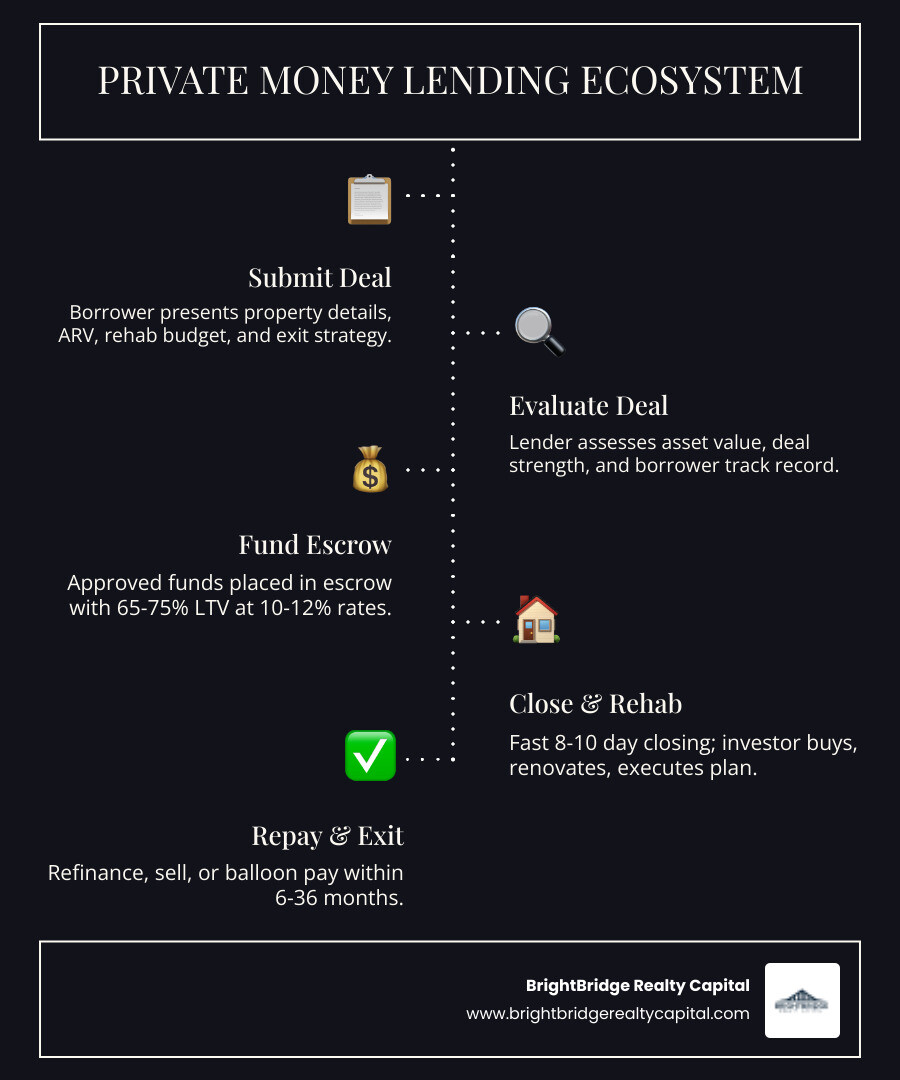
Real estate private money basics:
Defining Real Estate Private Money and How It Works

At its core, real estate private money is capital provided by private individuals or non-bank entities. Think of it as "relationship capital." While a bank has a thick book of federal regulations and rigid credit boxes, a private lender is often just someone with liquid capital looking for a better return than a savings account or the volatile stock market can offer. This capital is typically deployed through a Mortgage or a Deed of Trust, ensuring the lender has a first-lien position on the property.
We see this as the ultimate "win-win." The investor gets the speed they need to win a bidding war, and the lender gets a secured investment backed by a physical asset. This is known as Private Money Lending, where the property itself serves as the collateral. If the borrower defaults, the lender has the legal right to take the property to recoup their investment. This "asset-based" approach is what allows for such rapid underwriting. Because the lender is protected by the equity in the home, they don't need to spend weeks verifying your high school transcripts or your spouse's employment history.
This relationship-driven model allows for incredible capital flexibility. Because we are a Private Direct Lender, we don't have to wait for a committee in another state to approve a loan. We look at the property, the renovation plan, and the exit strategy. If the numbers work, the funding moves. This direct funding model is why many investors in New York and across the country are moving away from traditional institutions for their short-term needs. In a direct lending scenario, you are speaking to the decision-maker, not a middleman who is just checking boxes on a computer screen.
Private Money vs. Hard Money: Key Distinctions
In the industry, the terms "private money" and "hard money" are often used interchangeably, but there are nuanced differences that matter to your bottom line. Hard money lenders are typically professional companies with structured loan programs. They have standardized terms, set application fees, and a more "corporate" feel, even though they are still non-bank lenders. They often have institutional backing or "warehouse lines" of credit that they use to fund their loans.
Real estate private money, in the strictest sense, often refers to individuals—friends, family, or local business owners—who lend on a more informal, negotiable basis. These are often "one-off" lenders who might only do one or two deals a year. While they can be more flexible on rates, they can also be less reliable if they decide they'd rather spend their cash on a new boat than your next flip.
Here is how they stack up against traditional options:
| Feature | Traditional Bank Loan | Hard Money Loan | Private Money Loan |
|---|---|---|---|
| Primary Focus | Borrower Credit/Income | Property Value (Collateral) | Relationship & Deal Potential |
| Closing Speed | 30–60 Days | 10–15 Days | 7–10 Days |
| Interest Rates | 6%–8% | 10%–13% | 8%–12% (Negotiable) |
| LTV Ratio | 80% | 65%–75% | Highly Flexible |
| Regulations | High (Federal/State) | Moderate | Low (Personal/SEC Exempt) |
Why Investors Choose Real Estate Private Money
The most common question we hear is: "Why would I pay 10% interest when a bank offers 7%?" The answer is simple: Speed and Opportunity. In the world of real estate, the cost of capital is just another line item on the spreadsheet. If paying 10% interest allows you to secure a deal with $100,000 in equity, but waiting for a 7% bank loan causes you to lose the deal entirely, the "cheaper" money actually cost you $100,000.
In a competitive market like New York NY, properties under market value don't sit around. If you find a distressed home that needs a total gut renovation, a bank won't touch it because the kitchen is missing or the roof is leaking. Private Real Estate Funding fills that gap.
Investors choose this route because it offers:
- Credit-Blind Approvals: We care more about the property's equity than a credit score from ten years ago. While we do look at credit, it is rarely a deal-breaker if the asset is strong.
- No Red Tape: No "4506-T" tax transcripts or three months of pay stubs required. We don't need to know your debt-to-income ratio because the property's income (or potential value) is the primary driver.
- Competitive Advantage: Being able to close in 8 days allows you to make "cash-like" offers. Sellers often prefer a lower cash offer over a higher offer with a financing contingency that might fall through after 45 days.
- Closing Efficiency: We handle everything in-house, ensuring a Private Real Estate Financing experience that is seamless from application to wire transfer. This includes in-house legal review and streamlined title coordination.
Strategic Applications: Fix-and-Flip, BRRRR, and Bridge Loans
Real estate private money isn't just a "last resort"; it is a strategic tool used by some of the most successful investors to scale their portfolios. If you are using your own cash, you are limited by the amount of money in your bank account. If you use private funding, you are only limited by the number of good deals you can find. This is the concept of "leverage," and when used correctly, it can exponentially increase your Return on Equity (ROE).
Fix-and-Flip
This is the most common use for Private Lenders for Flipping Houses. An investor buys a "fixer-upper" using private money, uses a portion of the loan to fund the rehab, and then sells the property for a profit. The lender is repaid the principal plus interest, and the investor keeps the "spread."
In these deals, we often structure "rehab draws." This means the lender holds the renovation funds in escrow and releases them in stages as the work is completed. This protects the lender by ensuring the money is actually going into the property, and it helps the borrower stay on track with their contractor. We look closely at the After-Repair Value (ARV) to ensure there is enough "protective equity" to keep both the lender and the borrower safe. A typical flip might involve a 70% ARV loan, meaning the total loan amount (purchase + rehab) does not exceed 70% of what the house will be worth when finished.
The BRRRR Method
(Buy, Rehab, Rent, Refinance, Repeat). Private money is the engine that starts the BRRRR cycle. You use a short-term Private Real Estate Lender to acquire and renovate the property. Because you are buying a distressed asset, you are creating forced equity.
Once the property is rented and its value has increased, you "take out" the private lender by refinancing into a long-term, lower-interest bank loan (often a DSCR loan). This allows you to pull your original capital back out—and sometimes even more—and move on to the next deal. Without the initial speed and flexibility of private money, most BRRRR investors would never be able to acquire the properties in the first place.
Bridge Loans
Sometimes you just need to "bridge" a gap. Maybe you are selling one property and buying another, but the closing dates don't align. Or perhaps you need to buy a property quickly at auction before securing permanent financing. Private Real Estate Loans provide that short-term liquidity. Bridge loans are also common in commercial real estate, where an investor might buy a vacant building, use a bridge loan to fund the build-out for a new tenant, and then refinance once the tenant starts paying rent.
How to Pitch Your Real Estate Private Money Deal
When you approach a Private Investor for Real Estate Loans, you aren't just asking for money; you are presenting a business opportunity. To be successful, you need a professional pitch that demonstrates you have done your homework. Lenders are looking for reasons to say "yes," but they are also looking for red flags that suggest you are inexperienced or disorganized.
We recommend including these five elements in your deal package:
- Executive Summary: A one-page overview of the property, the purchase price, the rehab cost, and the projected profit. Include the address, property type, and a brief description of the neighborhood.
- The Numbers: Be specific. What is the current value? What is the ARV? What is your budget? We want to see a detailed line-item budget for the renovation. (Don't forget to include a 10% contingency for surprises like mold, outdated wiring, or plumbing issues!).
- Track Record: If you've done flips before, show them. Photos of "before and after" are worth a thousand words. Include a spreadsheet of your past projects with purchase prices, rehab costs, and sale prices.
- Exit Strategy: How will the lender get their money back? Are you selling or refinancing? If you are refinancing, do you already have a relationship with a long-term lender? Having a "Plan B" (like renting if the market cools) is also a great way to build trust.
- Borrower Credibility: Even if your credit isn't perfect, show that you are organized, transparent, and have a team (contractors, attorneys, etc.) ready to move. A professional-looking PDF package goes a long way in proving you are a serious investor.
Navigating Terms, Rates, and the Approval Process
Understanding the "anatomy" of a real estate private money loan is vital. Unlike a 30-year mortgage where you just look at the monthly payment, these loans have several moving parts that can significantly impact your total project cost.
- Interest Rates: Typically range from 10% to 12%, though they can go higher for riskier deals or lower for long-term partners. These are usually interest-only payments, meaning you aren't paying down the principal each month. This keeps your monthly carrying costs lower during the renovation phase.
- Points: These are upfront fees paid at closing. One point equals 1% of the loan amount. Most lenders charge 1 to 3 points. For example, on a $200,000 loan, 2 points would be $4,000. These are often rolled into the loan or paid out of the closing proceeds.
- Loan-to-Value (LTV): Most private lenders will fund 65% to 75% of the property’s current value. This ensures the lender has a "cushion" if they have to foreclose and sell the property quickly.
- Loan-to-Cost (LTC): This measures the loan amount against the total cost of the project (purchase + rehab). We often see 80% to 90% LTC for experienced flippers, meaning the investor only needs to bring 10% to 20% of the total project cost to the table.
- Promissory Note: This is the legal "I.O.U." that outlines the interest rate, the term length (usually 6–24 months), and the penalties for late payments. It is the document that binds you to the debt.
- Protective Equity: This is the difference between the loan amount and the liquidated value of the property. It’s the "cushion" that protects the lender. If a lender gives you $70,000 for a house worth $100,000, they have $30,000 of protective equity.
The underwriting speed is where we truly shine. While a bank might spend three weeks just "processing" your file and another two weeks waiting for an appraisal, a Private Direct Money Lender can perform due diligence in 48 hours. We focus on the property's potential and your ability to execute the plan. We often use BPOs (Broker Price Opinions) or internal valuations rather than full appraisals, which saves both time and money.
Risks and Disadvantages of Real Estate Private Money
We believe in full transparency. While private money is a powerful tool, it isn't without risks. It is a high-octane fuel; if you drive the car well, you'll win the race, but if you crash, the impact is greater.
- Higher Costs: You are paying for speed and flexibility. The interest rates are significantly higher than traditional bank loans. If your project takes twice as long as expected, those interest payments can quickly eat into your profit margins.
- Short-Term Pressure: These loans usually have "balloon payments" due in 12 to 24 months. This means the entire principal is due at once. If you can't sell or refinance by then, you could face extension fees (often 1% of the loan balance) or even foreclosure.
- Foreclosure Risk: Because these are asset-based loans, the lender's primary recourse is taking the property. Private lenders are often much faster to initiate foreclosure than big banks if payments are missed.
- Lender Reliability: Not all lenders are created equal. Some individuals may run out of capital mid-project or be difficult to reach when you need a rehab draw approved. This is why working with an established firm like BrightBridge is often safer than a "Jo Schmo" lender who is lending out of their personal retirement account.
- Default Interest: Many private money contracts include a "default rate" of interest. If you miss a payment or the loan matures without being paid off, the interest rate could jump to 18% or 24% until the issue is resolved.
When doing a Private Lending vs Bank Financing analysis, you must ensure your profit margins are wide enough to absorb the higher cost of capital. If the deal is "thin," the high interest could eat all your profit. We generally recommend that investors look for deals with at least a 15-20% profit margin after all costs, including the cost of private money.
Frequently Asked Questions about Private Money
Is private money lending legal and what regulations apply?
Yes, it is perfectly legal. However, it is governed by a mix of state and federal laws. In most cases, individuals can lend their own money under a private placement exemption, which is a carve-out from SEC regulations. This allows for private loans without the need to register as a securities dealer, provided the lender isn't soliciting the general public in a way that violates "General Solicitation" rules.
In New York, we also keep a close eye on usury laws, which cap the amount of interest that can be charged on certain types of loans. Most commercial or investment-purpose loans have higher thresholds or are exempt from personal usury caps, making real estate private money a standard and safe practice for the industry. It is important to note that these loans are for business purposes only; using private money for a primary residence is a different legal landscape (Dodd-Frank) and is generally avoided by private lenders.
How does the private money application process differ from banks?
The difference is night and day. A bank application is a marathon of paperwork. A private money application is a sprint.
- Submission: You send us the deal scenario (Purchase price, rehab, ARV). We don't need a 50-page application on day one.
- Valuation: We perform a quick internal valuation or order a "broker price opinion" (BPO). We are looking at comparable sales in the last 6 months.
- Terms: We issue a Term Sheet within 24–48 hours. This outlines the rate, points, and LTV.
- Closing: Once title work and insurance are in place, we fund. This can happen in as little as 8 days.
We are a Private Direct Money Lender, which means we use our own capital. There are no middlemen, no "loan committees" that meet once a month, and no outside investors to slow down the streamlined underwriting process.
Can I use private money for 100% of the purchase price?
While rare, it is possible through "cross-collateralization." If you have significant equity in another property (like a rental you own free and clear), a lender might use that as additional security to fund 100% of your new purchase. This is often called a "blanket mortgage."
Generally, however, most Private Investor Loans for Real Estate require the borrower to have "skin in the game"—typically a 10% to 20% down payment. This ensures the investor is committed to the project's success. If you have no cash, you might consider bringing in a partner who provides the down payment while you provide the sweat equity.
What documents will I typically need to provide?
While the list is shorter than a bank's, you will still need to be prepared. Most lenders will ask for:
- An executed purchase contract.
- A detailed renovation budget (Scope of Work).
- A preliminary title report.
- Proof of insurance (Builder's Risk).
- Entity documents (LLC Operating Agreement, Articles of Organization).
- A simple personal financial statement (PFS) to show you have the liquidity to cover interest payments and your portion of the down payment.
Can I use my Self-Directed IRA to borrow or lend private money?
Absolutely. Many savvy investors use a Self-Directed IRA (SDIRA) to either lend money to other investors (earning tax-free interest) or to fund their own deals. However, there are strict "prohibited transaction" rules. You cannot lend money to yourself or a "disqualified person" (like a spouse or child) from your own IRA. But you can certainly use your IRA to buy an investment property or lend to an unrelated third party.
Conclusion
Navigating the world of real estate private money can feel overwhelming at first, but once you understand the mechanics, it becomes your most valuable asset. It is the bridge between seeing a great opportunity and actually owning it. Whether you are looking to flip your first house in New York NY, execute a complex BRRRR strategy, or scale a massive rental portfolio, having a reliable funding partner is the key to longevity and success in this business.
In a market where inventory is tight and competition is fierce, the ability to move quickly is often more important than the ability to find the lowest interest rate. Private money provides that agility. It allows you to act like a cash buyer, solve problems for distressed sellers, and revitalize neighborhoods—all while building your own personal wealth.
At BrightBridge Realty Capital, we pride ourselves on being more than just a source of cash. We are a direct lender providing customized real estate financing solutions nationwide. We specialize in fast closings—often within a single week—and offer competitive rates without the headache of intermediaries. We understand the challenges of the modern investor because we live them every day. Our goal is to make the lending process as seamless as possible so you can focus on what you do best: finding, fixing, and managing great properties.
Don't let a lack of traditional financing hold you back from your next great deal. The capital is out there; you just need the right partner to help you unlock it. By focusing on the deal's fundamentals and maintaining a professional approach, you can leverage private money to reach your real estate goals faster than you ever thought possible.
Ready to take your investing to the next level?Get Your Customized Funding Solution Now