Unlock Your Dream Home A Guide to Short-Term Housing Loan Options


Summary
Unlock your dream home! Explore short term housing loan options for investors & homebuyers. Understand pros, cons & qualify.
Why Short-Term Housing Loans Are Changing Real Estate Investment

A short term housing loan is a specialized financing solution meticulously designed to provide rapid capital for property purchases, renovations, or complex transitions between properties. These loans are defined by their condensed repayment periods, which typically range from a few months to a few years, standing in stark contrast to the multi-decade lifespan of traditional mortgages. Unlike conventional home loans that prioritize long-term affordability and are underwritten with a focus on a borrower's stable income, short-term loans prioritize speed, agility, and flexibility, making them an indispensable tool in the modern real estate investor's arsenal.
Quick Answer: What You Need to Know About Short-Term Housing Loans
- Definition: A category of loans with repayment terms significantly under the traditional 30 years. For real estate investors, this often means 90 days to 3 years, while for some homeowners, it could be a mortgage with a term under 15 years.
- Common Types: The most prevalent forms include bridge loans (to cover gaps between a sale and purchase), fix-and-flip loans (for purchasing and renovating investment properties), construction loans (for new builds), and interest-only mortgages (to maximize cash flow during the initial loan period).
- Typical Interest Rates: Expect rates in the 7-12% range, and sometimes higher. This premium is charged in exchange for speed, flexible underwriting, and the lender assuming higher risk compared to traditional mortgages (which are often in the 3-6% range, market-dependent).
- Processing Time: The key advantage. These loans can often be approved and funded in 2-5 business days, whereas conventional mortgages require a lengthy 30-45 day (or longer) underwriting and closing process.
- Best For: Their strategic use is ideal for real estate investors, house flippers, builders, buyers in highly competitive markets needing a cash-like advantage, and homeowners who need to bridge the financial gap between selling their old home and buying a new one.
- Key Advantage: Unparalleled speed in accessing capital, which allows borrowers to seize time-sensitive opportunities that would be lost while waiting for traditional financing.
- Main Drawback: The cost. Higher interest rates, origination points, and fees result in significantly higher monthly payments and overall borrowing costs if not managed with a clear and swift exit strategy.
Finding and choosing a home is a lengthy process filled with research, reflection, and emotional investment. Finding and choosing financing shouldn't be the bottleneck that causes a time-sensitive opportunity to evaporate.
Whether you're a seasoned real estate investor eyeing a lucrative fix-and-flip project in a hot neighborhood, a landlord looking to expand your rental portfolio with a quick acquisition, or a homebuyer navigating the stressful misalignment of closing dates, short-term housing loans offer a level of speed and flexibility that traditional mortgages simply cannot match. While they command higher interest rates—typically 7-12% compared to 3-6% for conventional loans—they process in a matter of days, not weeks or months. This velocity gives you a powerful competitive edge, transforming your offer from one of many to one that demands a seller's attention.
The challenge, however, lies in navigating this high-stakes financial landscape. It requires a deep understanding of which type of short-term financing aligns with your specific goal, a clear-eyed assessment of the true costs involved (beyond the headline interest rate), and a solid plan to qualify without falling into expensive traps or experiencing debilitating payment shock down the road. Miscalculating your timeline or budget on a short-term loan can quickly erode profits and turn a promising venture into a financial burden.
I'm Daniel Lopez, a senior loan officer at BrightBridge Realty Capital. For over a decade, I've specialized in helping countless real estate investors and homebuyers strategically leverage short term housing loan options to close deals faster, outmaneuver the competition, and capitalize on fleeting opportunities. Through transparent, no-nonsense guidance, I've witnessed firsthand how the right short-term financing, when deployed correctly, can be the catalyst that transforms missed opportunities into highly profitable investments and stressful housing transitions into seamless experiences.
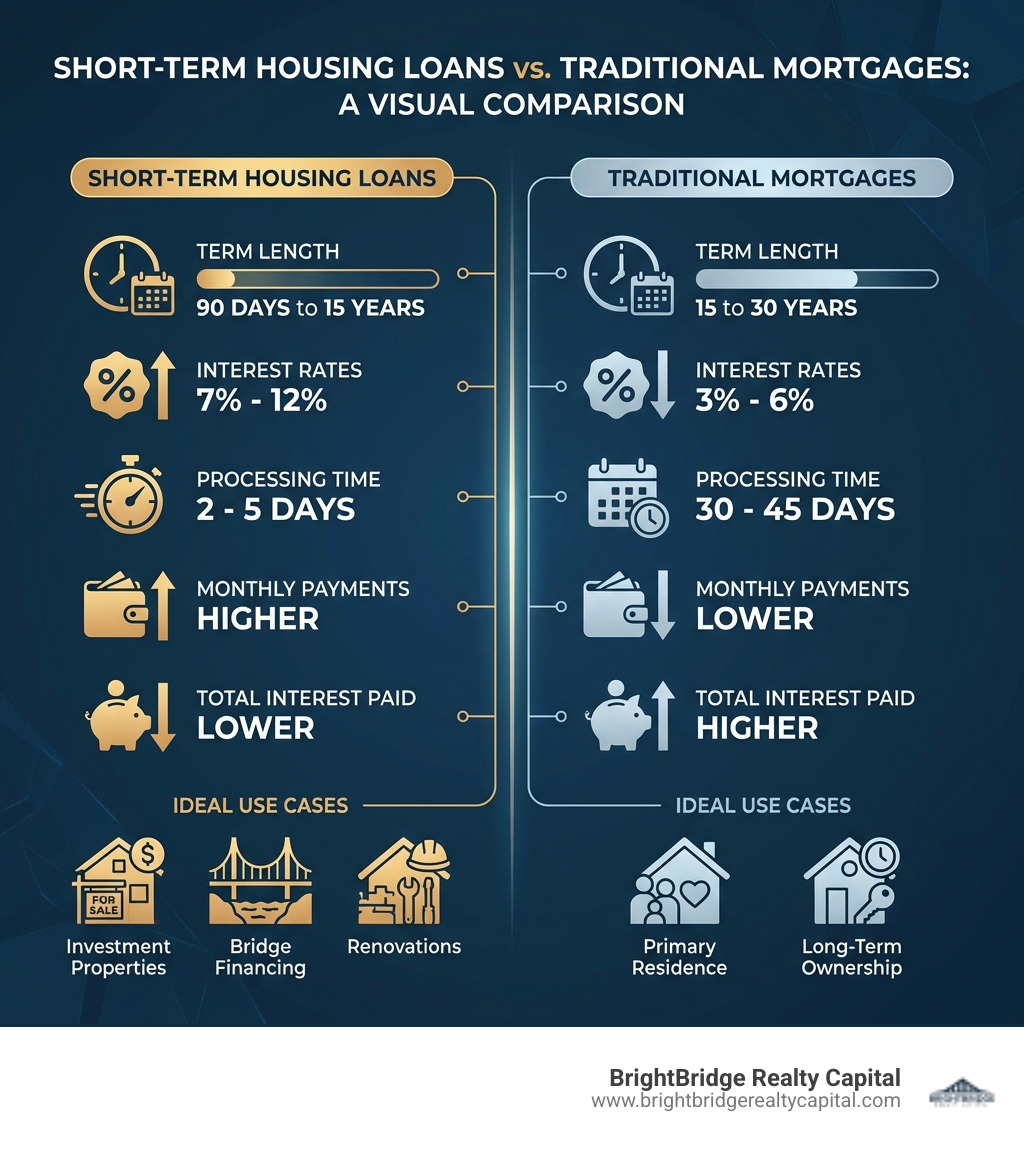
Short term housing loan terminology:
What is a Short-Term Housing Loan?
A short term housing loan is a form of debt financing used for real estate that is designed to be repaid over a much shorter period than a conventional mortgage. While the standard home loan in the United States has a term of 15 or, more commonly, 30 years, a short term housing loan typically has a term ranging from a few months up to a few years. For investor-focused products like bridge or fix-and-flip loans, terms rarely exceed five years. These loans are a form of temporary or transitional financing, providing a rapid infusion of capital for time-sensitive real estate transactions where speed is paramount.
Unlike traditional mortgages, which can take a painstaking 30-45 days (or more) to process through layers of underwriting and compliance checks, short term housing loans are engineered for velocity. They are often approved and funded in a matter of days—sometimes as quickly as 2-5 business days. This speed is a complete game-changer in dynamic and competitive real estate markets like New York, allowing investors and homebuyers to act with the decisiveness of a cash buyer and seize opportunities that would otherwise slip away.
The loan-to-value (LTV) ratio for these loans can vary widely based on the loan type and lender, but they are almost always secured against the property itself. This means the lender's primary underwriting consideration is the property's value and equity, both in its current state and its potential future state (known as the After Repair Value or ARV).
Here's a more detailed look at how short term housing loans stack up against their longer-term cousins:
| Feature | Short-Term Housing Loans | Traditional 30-Year Mortgages |
|---|---|---|
| Term Length | 90 days - 5 years (some shorter mortgages up to 15 years) | 15 - 30 years |
| Interest Rates | Higher (typically 7-12%+) to compensate for risk and speed | Lower (typically 3-6%, market dependent) |
| Monthly Payments | Higher (due to shorter term or interest-only structure) | Lower (spread over a very long period) |
| Processing Time | Extremely Fast (2-10 business days is common) | Slow (30-45+ days) |
| Underwriting Focus | The asset (property value, ARV, project viability) | The borrower (credit score, income, DTI ratio) |
| Equity Building | Rapid (through principal paydown or forced appreciation) | Gradual and slow, especially in early years |
| Total Interest Paid | Lower (if repaid quickly as planned) | Significantly Higher (over the full 30-year life of the loan) |
| Exit Strategy | Critical; loan is predicated on a sale or refinance | Not required; loan is designed to be held long-term |
| Ideal Use Cases | Investment properties, bridge financing, renovations, new construction | Primary residences, long-term ownership, stable buy-and-hold rentals |
How a Short-Term Housing Loan Differs from a Traditional Mortgage
The differences between a short term housing loan and a traditional mortgage are fundamental, extending far beyond just the term length. They reflect entirely different financial philosophies and purposes:
- Amortization Period: The most obvious difference is the repayment schedule. A short term housing loan has a much shorter amortization period, meaning the principal is paid back much faster. Many investor loans are structured as interest-only, meaning there is no amortization during the loan term; the entire principal is due as a lump-sum balloon payment at the end. This contrasts sharply with the fully amortizing 15 or 30-year terms of traditional mortgages, where each payment includes a small portion of principal.
- Interest Rates: You will always find that short term housing loans come with higher interest rates. Lenders charge this premium for several reasons: the increased risk associated with the nature of the investment (e.g., a distressed property needing renovation), the speed of closing, and the less stringent borrower income verification on asset-based loans. For instance, hard money loan rates can range from 9.99% to 15.00% or more, plus points, which is substantially higher than the prime rates for conventional mortgages.
- Monthly Payments: Due to the shorter term and/or higher interest rates, monthly payments on a short term housing loan are considerably higher than for a traditional mortgage of the same amount. For an interest-only loan, the payment might seem lower than a fully amortizing loan, but it doesn't reduce the principal balance. For a shorter-term amortizing loan (e.g., 10 years), the payments will be much higher because the principal is being paid down aggressively.
- Equity Building: One of the most powerful advantages of a short term housing loan for investors is rapid equity building through 'forced appreciation.' By financing renovations, an investor can dramatically increase a property's value in a short time. For homeowners using a shorter amortization mortgage, equity builds much faster simply due to the accelerated principal paydown schedule.
- Lender Risk and Focus: From a lender's perspective, the risk profile is entirely different. For a traditional mortgage on a primary home, the risk is tied to the borrower's long-term ability to repay. For a short term housing loan on a flip, the risk is tied to the project's success: the accuracy of the renovation budget, the timeline, and the final sale price. This is why short-term lenders focus more on the property and the deal's economics than on the borrower's personal DTI ratio.
- The Exit Strategy: The entire premise of a short term housing loan is the existence of a clear and viable exit strategy. The lender is providing temporary capital with the explicit understanding that it will be paid back quickly, either through the sale of the property or by securing permanent long-term financing (a refinance). Without a solid exit plan, these loans are exceptionally risky.
Common Types of Short-Term Financing Offered by BrightBridge Realty Capital
At BrightBridge Realty Capital, we specialize in providing a diverse suite of custom short term housing loan solutions that empower real estate investors and homebuyers across New York, NY, and nationwide. Our offerings are engineered for speed, flexibility, and transparency, ensuring you get the capital you need without the bureaucratic delays of traditional banks.
Here are some of the common types of short term housing loan options we provide:
- Bridge Loans: These are the quintessential short term housing loan. A bridge loan literally "bridges the gap" between the purchase of a new property and the sale of an existing one. They are secured by the equity in your current home and are perfect for when closing dates don't align, allowing you to buy your next home without a home sale contingency. Terms typically range from 90 days to 12 months, with some flexibility.
- Fix-and-Flip Loans (Hard Money/Private Money Loans): Designed specifically for real estate investors, these loans cover both the purchase price and the renovation costs of a property intended for a quick resale. They are often structured with interest-only payments during the renovation phase to maximize cash flow. Crucially, these loans are often based on the property's After Repair Value (ARV), allowing investors to borrow more than a traditional lender would offer on a distressed property.
- Construction Loans: While some larger commercial projects involve long-term financing, most ground-up construction or major gut-rehabilitation projects are financed with short term housing loans. Funds are disbursed in stages or "draws" as construction milestones are met and verified by an inspector. The loan is expected to be repaid once the project is completed and sold, or refinanced into a permanent mortgage for the end-user or a rental loan for an investor.
- Interest-Only Loans: These loans allow the borrower to pay only the interest for a set period, typically 1 to 7 years. This structure dramatically lowers the monthly payment during the initial phase, freeing up capital for other investments, renovations, or expenses. This is a powerful tool for real estate investors who need to maximize cash flow during a project's stabilization period or who anticipate a future lump sum (from a sale or bonus) to pay down the principal.
- Shorter Amortization Mortgages (8-15 years): For financially disciplined borrowers who can afford higher monthly payments, a mortgage with a term of 8, 10, 12, or 15 years is a fantastic short term housing loan option. While the monthly payments are higher than a 30-year loan, the benefits are immense: you save a fortune in total interest over the life of the loan and you own your home free and clear decades sooner, accelerating your journey to financial freedom.
Key Uses for Short-Term Housing Loans
Short term housing loans are not a one-size-fits-all financial product; they are highly specialized, strategic tools deployed for specific purposes where speed, leverage, and flexibility are more valuable than the lowest possible interest rate. Real estate investors, property flippers, developers, and savvy homebuyers in competitive markets find these loans to be an indispensable part of their financial toolkit, enabling them to execute strategies that would be impossible with slow, conventional financing.
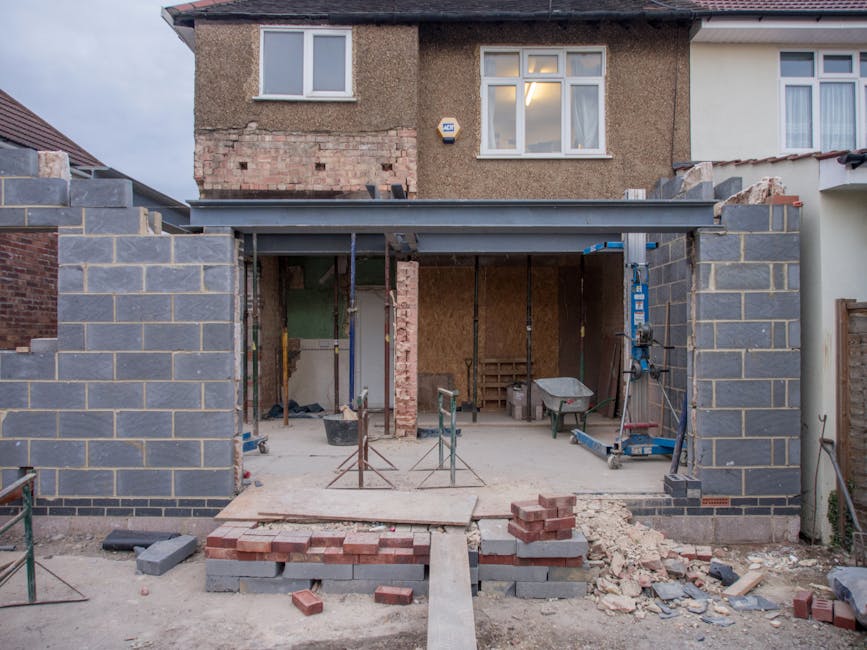
Bridge Financing to Buy Before You Sell
Imagine this common but stressful scenario: you've found your dream home in a competitive New York neighborhood. It's perfectly located, has the right layout, and is priced fairly. However, your current home isn't even on the market yet, or it's listed but hasn't sold. The seller of your dream home won't accept an offer contingent on your home selling. This is precisely where bridge financing shines as a crucial short term housing loan.
- Closing the Timing Gap: Bridge loans are specifically engineered to "bridge" this financial and logistical gap. They provide the immediate funds required to close on your new home, allowing you to secure it without waiting for the proceeds from your old home's sale.
- Unlocking Your Down Payment: The most significant barrier to buying a new home is often the down payment, which is typically tied up as equity in the current home. A bridge loan allows you to tap into that equity before you sell, effectively letting you use your old home's value to buy your new one.
- Strengthening Your Offer: In a seller's market, offers with financing or home sale contingencies are often pushed to the bottom of the pile. A bridge loan allows you to make a non-contingent offer, which is nearly as strong as an all-cash offer in the eyes of a seller, dramatically increasing your chances of acceptance.
- Avoiding Logistical Nightmares: The alternative to a bridge loan can be a logistical and financial mess: selling your home, moving into temporary housing or a rental, putting your belongings in storage, and then moving all over again once you buy. A bridge loan allows for a single, seamless move from your old home directly into your new one.
- How Bridge Loans Work in Practice: Typically, these loans have a term of 90 days to 12 months. The loan is secured by your existing property. When your old home sells, the proceeds are used to pay off the bridge loan first, with the remaining funds going to you. While you may have to cover two mortgage payments for a short period, the strategic advantage and peace of mind often far outweigh this temporary cost.
Fix-and-Flip Loans for Investment Properties
For the ambitious property flipper in a market like New York, a short term housing loan is the lifeblood of their business model. The entire fix-and-flip strategy—buy a distressed property, renovate it, and sell it for a profit—hinges on speed and leverage. These specialized loans are perfectly suited for this high-velocity investment cycle.
- Financing the Entire Project: Fix-and-flip loans, often provided by hard money or private lenders, are structured to cover not just the acquisition of the property but also 100% of the renovation costs. This integrated financing means investors don't have to waste time and resources seeking separate loans for each phase of the project.
- Lending on After Repair Value (ARV): This is the key that unlocks the deal. Traditional banks lend based on a property's current (often poor) value. Fix-and-flip lenders underwrite the loan based on the property's estimated value after all renovations are complete (the ARV). This allows investors to borrow significantly more, often up to 70-75% of the ARV, which can cover a large portion of the purchase and all of the rehab budget.
- Speed as a Competitive Weapon: The best deals on distressed properties (foreclosures, estate sales, off-market listings) are often snapped up in days, if not hours. Our ability to close a fix-and-flip loan in under a week means our clients can confidently make offers and acquire properties that buyers relying on slow, conventional financing will always miss.
- Maximizing Return on Investment (ROI): Time is money in flipping. Every month spent holding a property incurs costs: interest payments, taxes, insurance, and utilities. By providing rapid access to funds for both purchase and renovation, these loans enable investors to complete projects efficiently, minimize these holding costs, and maximize their potential profit upon resale.
Securing a New Home in a Competitive Market
The residential real estate market, especially in desirable urban centers and suburbs, can be incredibly fierce. When a well-priced home hits the market, it can trigger a bidding war with multiple buyers vying for the same property. In these high-pressure situations, the speed and certainty of your financing can be a more powerful negotiating tool than price alone. This is another prime scenario where a short term housing loan becomes an invaluable asset.
- Presenting a Cash-Like Offer: With a pre-approved short term housing loan from a direct lender like BrightBridge Realty Capital that can close in days, you can confidently waive the financing contingency on your offer. This signals to sellers that your funding is secure and the deal is highly likely to close without delays, making your offer nearly as attractive as an all-cash bid.
- Winning Bidding Wars: Imagine a scenario with two offers: one is for $510,000 with a 45-day close and a financing contingency, and yours is for $505,000 with a 10-day close and no financing contingency. Many sellers will choose the certainty and speed of your offer over the slightly higher price that comes with more risk and a longer waiting period.
- Unlocking Your Dream Home: These loans can be the key that unlocks the door to that "dream home" or ideal investment property that you might otherwise lose. In a fast-moving market, waiting for a traditional mortgage approval is a liability. A short-term loan transforms your purchasing power and allows you to compete on a level playing field with cash buyers.
The Pros and Cons of a Short-Term Housing Loan
Like any powerful financial tool, short term housing loans come with a distinct set of advantages and disadvantages. They can be the catalyst for immense wealth creation and strategic success, but they also carry significant risks if not used appropriately. A thorough understanding of both sides of the coin is absolutely crucial for effective financial planning, accurate risk assessment, and making a sound cost-benefit analysis before committing.

Advantages: Speed, Flexibility, and Faster Equity
The primary benefits of a short term housing loan are directly linked to the speed, agility, and financial leverage they provide, which are often unavailable through traditional channels.
- Unmatched Funding Speed: We're talking about processing and funding times of 2-10 business days, a stark contrast to the 30-45 days (or more) required for traditional mortgages. This is possible because lenders like BrightBridge Realty Capital are direct, private lenders with streamlined, in-house underwriting processes that focus on the asset's value rather than extensive personal income verification.
- Decisive Competitive Advantage: In a market where multiple offers are the norm, presenting a deal that can close in a week versus a month and a half makes your offer exponentially more attractive. Sellers prioritize certainty and speed. This advantage allows you to negotiate more effectively and win deals even when you're not the highest bidder.
- Building Equity at an Accelerated Rate: With shorter amortization mortgages (e.g., a 15-year term), homeowners build equity far more rapidly. A larger portion of each monthly payment goes toward the principal balance from day one. For investors, equity is built through "forced appreciation"—using loan funds to renovate a property and increase its market value far beyond the cost of the improvements.
- Achieving Full Ownership Sooner: This is a straightforward but profound benefit. The shorter the loan term, the sooner you own your property outright. Being free from a mortgage payment decades earlier than your peers is a massive step toward financial independence, freeing up hundreds or thousands of dollars in monthly cash flow for other investments, savings, or lifestyle goals.
- Significant Savings on Total Interest Paid: While the monthly payments are higher, the total amount of interest paid over the life of a short term housing loan is dramatically less than that of a long-term loan. For example, on a $500,000 loan, the difference is staggering:
- 30-Year Term at 6%: Total interest paid is approximately $579,191. Total cost: $1,079,191.
- 15-Year Term at 5.5%: Total interest paid is approximately $233,433. Total cost: $733,433.
- The 15-year loan results in owning the home 15 years sooner and saving over $345,000 in interest payments.
Disadvantages: Higher Costs and Substantial Financial Risks
While the benefits are compelling, the potential drawbacks are equally significant and must be taken seriously. These loans are not for the unprepared or the faint of heart.
- Higher Interest Rates and Points: This is the most significant drawback. Short term loans come with a higher annual percentage rate (APR) to compensate the lender for taking on more risk and providing rapid funding. Rates of 7-12% are common. Furthermore, many of these loans come with "points," which are upfront fees calculated as a percentage of the loan amount (e.g., 2 points on a $400,000 loan is an $8,000 fee), paid at closing. This further increases the total cost of borrowing.
- Higher Monthly Payments and Payment Shock: Because the loan is being paid off in a much shorter timeframe (or is an interest-only payment on a large principal at a high rate), the monthly payments are substantially higher. A borrower must have robust and reliable cash flow to handle these larger installments without financial strain. For bridge loan borrowers, the risk of carrying two mortgage payments for longer than anticipated can create significant financial distress.
- Significant Upfront and Closing Costs: Beyond points, many short term housing loans come with a variety of other fees. These can include origination fees, setup fees ($500-$1,500 is common), underwriting fees, processing fees, and legal fees for document preparation. These costs are typically paid at closing and reduce the net funds available to the borrower.
- The Risk of Balloon Payments: Many investor-focused loans are not fully amortized. They require interest-only payments for the term, followed by a massive "balloon payment" of the entire principal balance at the end. The borrower must have a concrete exit strategy to handle this. If the property doesn't sell in time or they fail to secure a long-term refinance, they risk defaulting on the loan and facing foreclosure.
- The Property-Sale Risk: For bridge loans and fix-and-flip projects, the primary risk is that the property does not sell within the anticipated timeframe or for the expected price. A sluggish market can leave a flipper holding a property with mounting carrying costs (interest, taxes, insurance) that eat away at profits daily. It can leave a homeowner with a bridge loan juggling two mortgages for an uncomfortably long time.
- Vulnerability to Market Conditions: These loans are highly sensitive to shifts in market conditions. A sudden economic downturn, a spike in interest rates, or a change in local buyer demand can dramatically impact property values and the ability to sell or refinance. An investor who bought a property at the peak of the market with a short-term loan could find themselves unable to exit the loan without a significant financial loss if the market turns.
Qualifying for and Comparing Loan Options
Navigating the world of short term housing loans requires a different approach than applying for a conventional mortgage. The process is faster but often requires a more sophisticated presentation of your project and financial standing. Understanding what lenders look for and how to meticulously compare different offers is not just about finding a loan; it's about finding the right strategic partner and financial product for your specific project.
How to Qualify for a Short-Term Housing Loan
While the qualification process for a short term housing loan can be quicker and more flexible than for a traditional mortgage, lenders still perform rigorous due diligence. At BrightBridge Realty Capital, we look at a holistic picture of the borrower and the project to ensure a successful partnership.
- Credit Score and History: While private money and hard money lenders can be more lenient than traditional banks, a strong credit score is still beneficial. A score above 720 will typically unlock the best rates and terms. However, many private lenders can work with scores down to the mid-600s, especially if the deal itself is strong, albeit at a higher interest rate and with more points.
- Debt-to-Income (DTI) Ratio: The importance of DTI varies by loan type. For a shorter-amortization mortgage (e.g., 10-15 years) on a primary residence, your personal DTI is critical, as lenders need to ensure you can comfortably afford the high monthly payments. For asset-based investment loans (like fix-and-flip), the lender is more concerned with the property's ability to generate profit. They may focus on a Debt Service Coverage Ratio (DSCR) for the property itself rather than your personal DTI.
- Property Equity and After Repair Value (ARV): For a bridge loan, having significant equity in your existing property is the primary requirement. For fix-and-flip or construction loans, the ARV is the most critical number. You will need a detailed scope of work and budget that justifies the projected value, which will be verified by an appraiser who specializes in this type of valuation.
- Experience and Track Record (For Investors): For investment loans, your experience matters. Lenders are more likely to offer favorable terms to an investor who has successfully completed multiple fix-and-flip projects than to a first-timer. A portfolio of past projects, including purchase price, renovation costs, and final sale price, is a powerful tool in your application.
- Cash Reserves and Liquidity: Lenders need to see that you have sufficient cash on hand. This is for several reasons: to cover the down payment, closing costs, and to have reserves to handle unexpected project costs or carrying costs if the sale is delayed. A common rule of thumb is to have at least 6 months of payment reserves.
- Comprehensive Documentation: Be prepared to provide a professional and thorough loan package. This often includes:
- Company Profile and Articles of Incorporation (for LLC borrowers)
- Detailed Scope of Work and Renovation Budget
- Purchase Agreement for the subject property
- Track Record/Portfolio of completed projects (for investors)
- Bank statements to verify liquidity and cash reserves
- Appraisal report (often ordered by the lender)
- Proof of property insurance
Understanding the Costs: Interest Rates, Fees, and Terms
When evaluating a short term housing loan, it is a critical error to focus only on the interest rate. The total cost of the loan is a combination of the rate, various fees, and the specific repayment terms. A savvy borrower analyzes the Annual Percentage Rate (APR), which provides a more complete picture.
- Typical Interest Rates: As discussed, these are higher than traditional mortgages, often ranging from 7-12% for more competitive products and 12-15%+ for higher-risk hard money loans. Rates can be fixed or variable (e.g., tied to the Prime Rate).
- Origination Points and Fees: This is a major cost center. Lenders charge upfront points (1 point = 1% of the loan amount). It's common to see 1-3 points on these loans. Additionally, look for setup fees, underwriting fees, processing fees, and document preparation fees, which can add thousands to your closing costs.
- Legal and Appraisal Fees: Expect to pay for the lender's legal counsel to draft and review loan documents ($500-$1,500) and for a specialized appraisal to determine the property's current value and ARV ($500-$1,000+).
- Prepayment Penalties: Be sure to ask about prepayment penalties. Some lenders, to guarantee their return, will charge a fee if you pay off the loan too early (e.g., within the first 6 months). This can be a nasty surprise for a flipper who completes a project ahead of schedule.
- Repayment Structures: Understand exactly how the loan is to be repaid. Is it interest-only with a balloon payment? Or is it fully amortizing? This dramatically affects your monthly cash flow and your final repayment obligation.
- The Power of APR: The Annual Percentage Rate (APR) is your best tool for comparison. It factors in the interest rate plus the points and other finance charges, expressed as an annual rate. A loan with a lower interest rate but high points could have a higher APR than a loan with a higher interest rate but no points. Always compare the APR and the total closing costs side-by-side.
Short-Term Real Estate Financing Solutions from BrightBridge Realty Capital
At BrightBridge Realty Capital, we recognize the unique challenges and opportunities within the New York real estate market and nationwide. We provide customized real estate financing solutions designed for the sophisticated investor and the strategic homebuyer who require agility and certainty.
Our unique selling proposition is built on three pillars:
- Unrivaled Speed: We pride ourselves on our ability to close loans in as little as 5-7 business days. Our streamlined process ensures you never miss a time-sensitive opportunity.
- Direct Lending Advantage: We are a direct lender, not a broker. This means you work with the decision-makers from start to finish. There are no intermediaries, which results in a faster, more transparent process, competitive rates, and clear, consistent communication.
- Truly Customized Solutions: We reject the one-size-fits-all mentality. We take the time to understand your specific project, your financial goals, and your exit strategy. Whether you need a bridge loan to navigate a complex closing, a fix-and-flip loan to transform a distressed property, or a ground-up construction loan, we will structure a short term housing loan product that is precisely tailored to your needs. Our goal is to be more than a lender; we aim to be your strategic financing partner.
Conclusion: Is a Short-Term Housing Loan Right for You?
After exploring the intricate landscape of short term housing loans—from their strategic uses and rapid execution to their higher costs and inherent risks—the fundamental question remains: Is this the right financial tool for your specific situation?
These loans are undeniably powerful instruments. They offer a level of speed, leverage, and flexibility that traditional mortgages cannot hope to match. They empower real estate investors to execute profitable strategies, enable homeowners to navigate complex transitions seamlessly, and provide a pathway to faster equity building and significant savings on total interest for those with the financial discipline to manage them. For the savvy operator in a fast-paced market, a short term housing loan is often the strategic differentiator between securing a prime investment and watching from the sidelines.
The ideal candidate for a short term housing loan is not a casual borrower. They are typically an individual or entity with a clear, well-defined plan, the financial capacity to handle elevated monthly payments and potential contingencies, and an urgent need for quick access to capital. This profile includes:
- Real estate investors laser-focused on fix-and-flip projects, who need to finance both acquisition and renovation under one loan based on ARV.
- Landlords and developers looking to quickly acquire a property for new construction or to add to a rental portfolio before stabilizing it with long-term financing.
- Homeowners caught in the classic "buy before you sell" dilemma, who need to bridge the financial gap to secure their next home without a sale contingency.
- Financially disciplined individuals with high incomes who prioritize achieving debt-freedom quickly and can comfortably afford the higher payments of a 10 or 15-year mortgage.
Before you pursue this path, conduct a rigorous self-assessment. Ask yourself these critical questions:
- What is my exit strategy? Is it concrete, realistic, and time-bound? (e.g., a signed sales contract, a pre-qualification for a refinance, a detailed project timeline and budget).
- Have I accounted for all costs? Have I created a detailed budget that includes not just the interest rate, but all points, fees, closing costs, and monthly carrying costs (taxes, insurance, utilities)?
- Do I have sufficient cash reserves? What happens if my renovation goes over budget or my property takes three months longer to sell than expected? Do I have the liquidity to cover these contingencies without jeopardizing the project or my personal finances?
- Is the cost worth the benefit? Is the speed and flexibility offered by this loan creating enough value (e.g., securing a below-market deal, winning a bidding war) to justify the premium interest rate and fees?
- Have I done my due diligence? For investors, is my After Repair Value (ARV) estimate conservative and supported by strong comparable sales? For homebuyers, am I prepared for the higher monthly payment?
While the higher interest rates and potential for significant fees might seem daunting, when used strategically and with careful planning, a short term housing loan can be a highly effective and profitable financial tool. It empowers you to act with decisiveness and confidence in a dynamic market, turning potential roadblocks into stepping stones toward your real estate goals.
At BrightBridge Realty Capital, we are committed to providing transparent, efficient, and custom short term housing loan solutions. Our direct lending model and fast closing times ensure you have a trusted partner ready to help you analyze your deal and secure the capital you need to succeed. If you are ready to turn your real estate vision into reality, let's start the conversation.
Find out more about our rental loan programs to see how we can help you achieve your real estate aspirations in New York, NY.