Portfolio Financing 101: Why Your Lender Might Keep Your Loan

Summary
Discover what is portfolio loan: flexible financing for self-employed, investors & unique properties. Compare to traditional mortgages & apply now!
What Is a Portfolio Loan? (The Quick Answer)

What is a portfolio loan is one of the most searched questions among real estate investors who've hit a wall with traditional financing — and the answer is simpler than you might think.
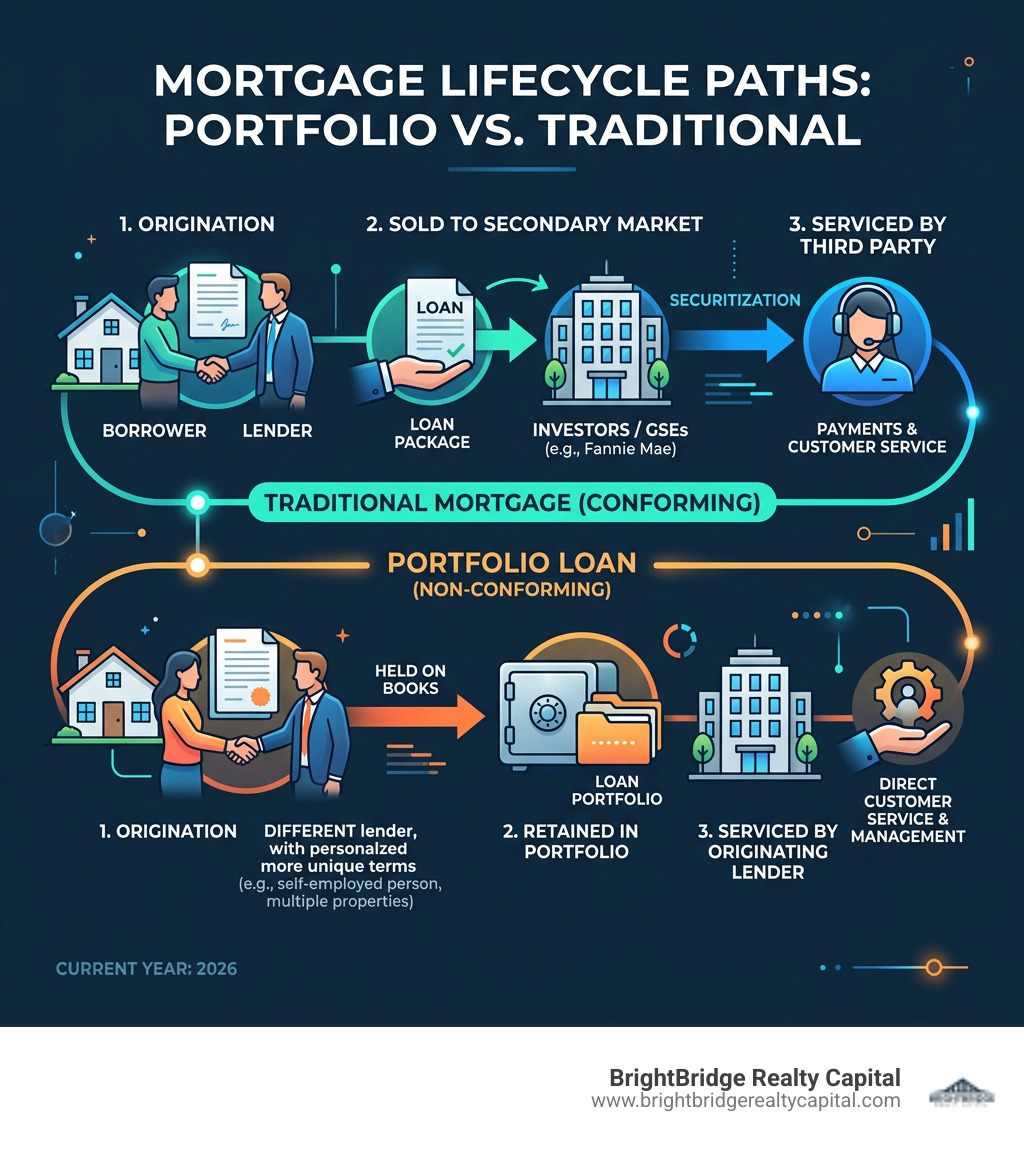
A portfolio loan is a mortgage that a lender originates and keeps on its own books, rather than selling it to the secondary market through Fannie Mae or Freddie Mac. Because the lender holds the loan, they set their own rules — which means more flexibility for borrowers who don't fit the standard mold.
Here's the core idea at a glance:
| Feature | Portfolio Loan |
|---|---|
| Held by | The originating lender |
| Sold to secondary market? | No |
| Underwriting standards | Set by the lender, not the government |
| Who it helps | Self-employed, investors, credit-challenged borrowers |
| Typical loan type | Non-conforming |
Most mortgages in the U.S. are packaged and sold to government-sponsored enterprises (GSEs) like Fannie Mae or Freddie Mac. To be sold, those loans must meet strict federal guidelines — minimum credit scores, debt-to-income limits, loan size caps, and more. If your situation doesn't check every box, you're out.
Portfolio loans exist for exactly that gap.
I'm Daniel Lopez, a loan officer at BrightBridge Realty Capital with hands-on experience guiding investors through complex financing structures — including the flexible, non-conforming products at the heart of what is a portfolio loan. I've helped clients structure deals that traditional lenders turned away, and in this guide, I'll break down everything you need to know to decide if portfolio financing is right for you.
What is portfolio loan terminology:
What is a Portfolio Loan?
To get technical for a moment, let’s look at how the pros define it. According to Investopedia, a portfolio loan is a mortgage that a lender keeps in its investment holdings rather than selling it on the secondary market. Think of it like a "farm-to-table" mortgage; the bank that grows the loan is the one that serves it and stays with it until it’s paid off.
When we talk about a "balance sheet," we are referring to the lender’s internal accounting. In a traditional mortgage scenario, your loan is essentially a product manufactured to be shipped out. With a portfolio loan, your mortgage stays on our balance sheet as an asset. Because we are the ones holding the risk, we have the ultimate say in the custom guidelines used to approve you.
This leads to a much more personalized experience. Instead of your file being sent to a massive, faceless processing center in another state, the underwriting and servicing happen in-house. This means if you have a question about your escrow or a payment, you are dealing with the same institution that gave you the keys to your house. You can find more info about portfolio lenders and how they operate differently than big-box banks.
Understanding How a What is a Portfolio Loan Works
The underwriting process for these loans is where the "magic" happens. Traditional lenders use automated underwriting systems (AUS) that spit out a "yes" or "no" based on rigid algorithms. If your debt-to-income ratio (DTI) is 0.1% too high, the computer says no.
Portfolio lending uses what we like to call "common-sense lending." We look at your holistic financial picture. Are you a self-employed business owner with high gross income but lots of tax write-offs? A traditional bank sees low net income and panics. We see a successful entrepreneur with high cash flow and significant assets.
This asset-based evaluation allows us to consider compensating factors—like large cash reserves or a high-value property—to offset a lower credit score or a non-traditional income stream. As the Consumer Financial Protection Bureau’s explanation of portfolio loans notes, these loans are essentially customized agreements between the lender and the borrower, free from the red tape of government-sponsored enterprises.
Portfolio Loans vs. Traditional Mortgages
If you are trying to decide between these two paths, it helps to see the data side-by-side. Traditional mortgages (conforming loans) are designed for the "average" borrower, while portfolio loans are designed for the "exceptional" or "unique" borrower.
| Feature | Conforming/Traditional | Portfolio Loan |
|---|---|---|
| Primary Regulator | Fannie Mae / Freddie Mac | The Lender's Internal Board |
| Credit Score | Usually 620+ | Can be as low as 580 |
| Down Payment | 3% - 20% | Often 20% (but flexible) |
| Loan Limits | Set annually by FHFA | Set by lender (Jumbo friendly) |
| Income Verification | W-2s and Tax Returns | Bank Statements, P&L, Assets |
| Mortgage Insurance | Required if < 20% down | Often not required |
One of the biggest differences is the loan limit. Conforming loans have a "ceiling"—if you want to buy a luxury property in New York, NY, that exceeds these limits, you are automatically in non-conforming territory. Portfolio loans don't have these arbitrary caps. Furthermore, because the lender isn't selling the loan, they often skip the requirement for Private Mortgage Insurance (PMI), even if you put less than 20% down, though they may charge a slightly higher interest rate to compensate for that risk. For those moving into the investment space, there is more info about portfolio loan real estate available to help you navigate these nuances.
Who Should Consider Portfolio Financing?
Who is the "ideal" candidate for what is a portfolio loan? Generally, it's anyone who has the money to pay for a house but can't prove it using a standard 1040 tax form.
- The Self-Employed & 1099 Contractors: If you own a business, you likely have a talented accountant who helps you minimize your tax burden. Ironically, the better your accountant is at their job, the harder it is for you to get a traditional mortgage. We can use bank statement programs to look at your actual deposits rather than just your taxable income.
- Foreign Nationals: If you don't have a U.S. credit history or social security number, traditional banks won't even talk to you. Portfolio lenders can use alternative credit data.
- High Net Worth Individuals: You might have $5 million in the bank but no "job" in the traditional sense. We can use asset depletion models to qualify you.
- Those in Credit Recovery: Life happens. Whether it was a medical emergency or a business failure, sometimes your credit score takes a hit. We look for "seasoning"—how much time has passed since a bankruptcy or foreclosure. While traditional loans might make you wait 7 years, portfolio lenders might only require 2 or 4 years of seasoning.
If you are an investor looking to scale, there is more info about rental property portfolio loans that explains how to leverage these tools for multiple doors.
Qualifying for What is a Portfolio Loan
While we are more flexible, we aren't "handing out money." We still need to ensure the loan is a good investment for us. Typical requirements include:
- Credit Score: While some niche lenders accept a 580 FICO, most prefer to see something in the 600s. The lower the score, the higher the down payment we usually require.
- Down Payment: A 20% down payment is the industry standard for portfolio loans. However, many lenders allow "gift funds" to cover that entire amount, meaning a family member or business partner can provide the down payment with no contribution required from your personal pocket.
- Debt-to-Income (DTI): We can often go up to a 50% DTI, which is significantly higher than the 36-43% limits seen at traditional banks.
- Cash Reserves: We like to see that you have a "rainy day fund"—usually 6 to 12 months of mortgage payments sitting in a liquid account.
The Pros and Cons of Portfolio Lending

Like any financial tool, portfolio loans have their trade-offs. It is important to weigh the speed and flexibility against the cost.
The Pros
- Flexible Terms: We can customize the length of the loan or the repayment structure (like interest-only periods).
- Faster Approval: Because the decision-makers are in the same building as the loan officers, the "red tape" is much thinner. Closings can often happen in half the time of a traditional bank.
- No PMI: As mentioned, many portfolio products skip mortgage insurance entirely.
- Property Type Flexibility: Want to buy a non-warrantable condo or a mixed-use building? A traditional bank will say no; a portfolio lender will look at the property’s potential.
The Cons
- Higher Interest Rates: Because we are holding the risk and not selling the loan for a quick profit, we usually charge a premium. You can find more info about portfolio loan interest rates to see the current spreads.
- Prepayment Penalties: Some (though not all) portfolio loans include a fee if you pay the loan off too early (usually within the first 3-5 years). This helps the lender recoup their costs since they aren't selling the loan.
- Limited Availability: Not every bank offers these. You usually have to find specialty lenders or community banks.
Portfolio Loans for Real Estate Investors
For the real estate investor, what is a portfolio loan is often the "secret sauce" for rapid scaling. Once you own four or five properties, most traditional banks will cut you off. They have "exposure limits" and won't lend to someone with too many active mortgages.
Portfolio lenders love investors. We offer:
- Property Consolidation: We can take five separate loans on five different properties and roll them into one "Blanket Mortgage." This means one monthly payment, one interest rate, and much less paperwork.
- 1-4 Unit & Multi-Family: Whether it's a duplex or a small apartment building, portfolio loans are the standard for these assets.
- Non-Warrantable Condos: These are condos that don't meet Fannie Mae's strict criteria (often because one person owns too many units in the building or there is pending litigation). We can finance these when others can't.
- DSCR Options: Debt Service Coverage Ratio loans are a type of portfolio loan where we don't even look at your personal income. We only look at whether the rent from the property covers the mortgage payment.
If you are looking to move from a single rental to a small empire, portfolio financing is likely the bridge that will get you there.
Frequently Asked Questions about Portfolio Loans
Are portfolio loans more expensive than traditional loans?
Generally, yes. You should expect to pay an interest rate that is 0.5% to 2% higher than a conforming loan. You may also see slightly higher origination fees (the cost to "start" the loan). However, when you factor in the lack of PMI and the ability to actually get the deal done when a traditional bank says no, the "expensive" loan often becomes the most profitable one for an investor.
Can I get a portfolio loan with a low credit score?
Yes. Some lenders in our network accept scores as low as 580. The key is "compensating factors." If you have a 580 score but are putting 30% down and have $50,000 in savings, you are a much lower risk than someone with a 720 score and zero savings. We look at the "why" behind the score.
What types of properties qualify for portfolio financing?
Almost anything with a roof! This includes:
- Investment properties (single-family or multi-unit)
- Unique or "unusual" homes (log cabins, earth-bermed homes, etc.)
- Fixer-uppers that don't meet FHA "habitability" standards
- High-value jumbo estates in markets like New York NY
- Mixed-use buildings (retail on bottom, apartments on top)
Conclusion
Understanding what is a portfolio loan opens up a world of possibilities that most retail banks simply can't offer. At BrightBridge Realty Capital, we pride ourselves on being a direct lender. We don't hide behind intermediaries or wait for a government computer to tell us if a deal is good. We use our own capital and our own expertise to provide customized financing solutions nationwide.
Whether you are a self-employed first-time buyer or a seasoned investor looking for fast closings (often within a week!), we have the flexibility to make it happen. We specialize in the "hard" deals—the ones that require a human touch and a deep understanding of the real estate industry.
If you’re ready to stop jumping through hoops and start growing your wealth, we’re here to help. Start your application for rental loans today and see the difference that direct, portfolio lending can make for your future.