Your Quick Guide to Bridge Loans: What They Are and How They Work


Summary
Need quick finance? Understand a bridging loan, its uses, costs, and how it can help you seize property opportunities. Learn more!
Why Real Estate Investors Choose Bridge Loans

A bridging loan is a short-term financing solution that helps property investors and buyers access funds quickly—typically within days or weeks—while they wait for permanent financing or the sale of another asset to complete. These loans "bridge the gap" between immediate funding needs and future cash flow, making them essential tools for time-sensitive real estate opportunities. In the modern financial landscape, where traditional banking institutions have become increasingly risk-averse and slow to process applications, the agility provided by bridge financing has transformed it from a niche product into a cornerstone of professional property investment.
Quick Overview:
- Purpose: Temporary financing to cover the gap between buying a new property and selling an existing one, or until long-term financing is secured
- Loan Amount: Typically £25,000 to £30 million (or $50,000 to $10+ million in the US)
- Term Length: Usually 90 days to 12 months, though some extend up to 24 months
- Interest Rates: Generally 0.5% to 2% per month (6-24% APR equivalent)
- Speed: Can close in as few as 10 days, with some approvals in 24-48 hours
- Security: Secured against property as collateral
- Common Uses: Auction purchases, breaking property chains, renovation projects, portfolio expansion
Real estate projects have many moving parts, and financing is often the factor that can make or break a deal. For investors who need to move fast—whether at auction, on a fix-and-flip, or to prevent a chain break—bridge loans offer the speed and flexibility that traditional mortgages can't match. The bridging loan market is thriving, with values expected to reach £9.46 billion in 2025 and forecasts predicting over £12 billion by year's end. Investment purchases account for 24% of all bridging loans, reflecting their critical role in real estate investment strategies. This growth is driven by a combination of rising property prices, the need for rapid refurbishment of aging housing stock, and the increasing number of professional landlords seeking to capitalize on market volatility.
I'm Daniel Lopez, a loan officer at BrightBridge Realty Capital, where I've helped countless investors structure a bridging loan to accommodate renovation timelines, competitive markets, and unique property types. Whether you're a first-time flipper or a seasoned portfolio builder, understanding how bridge loans work can open up opportunities that would otherwise slip away. In my experience, the difference between a successful acquisition and a missed opportunity often comes down to having a lender who understands the nuances of the local market and can provide a bespoke solution rather than a one-size-fits-all product.
Relevant articles related to a bridging loan:
What is a Bridging Loan and How Does It Work?
At its core, a bridging loan is a form of interim financing. Think of it as a financial "swing" that carries you from one transaction to the next. In real estate, timing is rarely perfect. You might find a "diamond in the rough" at an auction that requires payment within 28 days, but your current investment property isn't scheduled to close for another three months. This is where bridge loans shine. They provide the liquidity necessary to seize an asset without having to wait for the slow-moving machinery of traditional retail banking.
According to the Investopedia Definition: Bridge Loan, these are short-term loans used until a person or company secures permanent financing or removes an existing obligation. They are asset-backed, meaning the loan is secured against real estate collateral. Because the lender has a physical asset to fall back on, we can often provide a quick drawdown of funds, giving you capital access when speed is of the essence. This asset-centric approach is what differentiates bridging from other forms of credit; while your income and credit score are considered, the primary focus is the value of the property and the viability of your exit strategy.
Understanding the Mechanics of a Bridging Loan
The mechanics of a bridging loan differ significantly from a standard 30-year mortgage. First, the loan-to-value (LTV) ratio is a primary metric. Lenders typically offer up to 75% or 80% of the property's value. If you have significant equity in an existing property, you can often use that as collateral to fund the purchase of a new one. This is known as cross-collateralization, and it can be a powerful way to leverage your existing portfolio to acquire new assets without a large cash deposit.
Interest on bridge loans is typically calculated monthly rather than annually. You'll also encounter the choice between "Open" and "Closed" structures:
| Feature | Closed Bridging Loan | Open Bridging Loan |
|---|---|---|
| Repayment Date | Fixed date agreed at the start | No fixed date (usually within 12 months) |
| Requirements | Evidence of a firm exit (e.g., exchanged contracts) | A clear, viable exit strategy is still required |
| Cost | Often slightly lower interest rates | Higher rates due to increased lender risk |
| Flexibility | Less flexible; strictly tied to a date | More flexible for uncertain timelines |
In many cases, the interest isn't paid monthly but is instead "rolled up" or "deferred," meaning the interest accrual is added to the principal amount and paid back in one lump sum at the end of the term. This is particularly beneficial for investors who may have tight cash flow during a renovation project and prefer to settle all costs once the property is sold or refinanced.
The Role of First and Second Charges
When you take out a bridging loan, the lender will take a "charge" on the property. This is a legal ranking that determines who gets paid first if things go south. This legal framework ensures that all parties understand their priority in the event of a default or sale.
- First Charge: If you own the property outright or are using the bridge loan to pay off your existing mortgage entirely, the bridge lender takes a first charge. They are first in line for repayment. This is the most common scenario for investment purchases and auction buys.
- Second Charge: If you already have a mortgage and are taking a bridging loan as additional funding, the bridge lender takes a second charge. The Financial Conduct Authority Handbook provides detailed regulations on how these charges are handled, especially for residential properties.
Second charges carry higher risk for the lender because the first mortgage holder gets paid first in a default scenario. Consequently, second charge bridge loans usually come with higher interest rates and more stringent underwriting requirements. It is also important to note that you will usually need permission from your first-charge lender to place a second charge on the property.
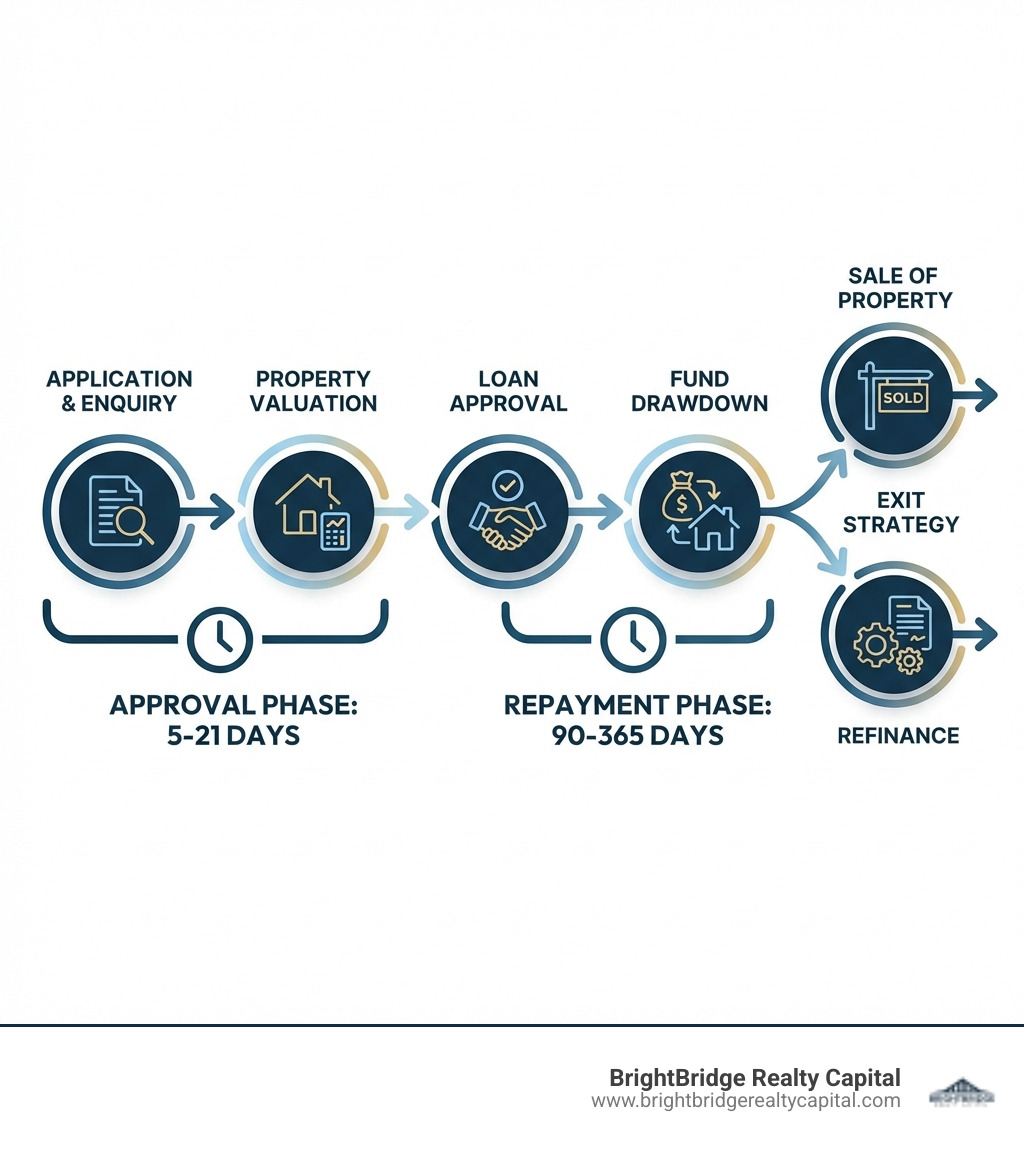
The Application Process: Step-by-Step
Navigating the application for a bridging loan is generally faster than a mortgage, but it still requires diligence.
- Initial Inquiry: You provide the lender with details about the property, the amount needed, and your exit strategy.
- Indicative Terms: The lender provides an 'Agreement in Principle' (AIP) or a 'Decision in Principle' (DIP) outlining the expected rates and fees.
- Valuation: A surveyor is dispatched to assess the property's current value and, in some cases, its post-renovation value (GDV - Gross Development Value).
- Underwriting: The lender reviews the valuation, your credit history, and the feasibility of the exit plan.
- Legal Work: Solicitors for both the lender and the borrower handle the charge registration and contract details.
- Drawdown: Funds are released to your solicitor, and the deal is completed.
Common Uses and Eligibility Criteria
Why would someone pay higher interest for a bridging loan? Usually, because the cost of the loan is far outweighed by the profit of the deal or the cost of a missed opportunity. In the world of high-stakes real estate, the ability to move with the speed of a cash buyer is a competitive advantage that often justifies the premium cost of the capital.
- Auction Purchases: Most auctions require completion within 20 to 28 days. Traditional banks simply cannot move that fast, often taking 60 to 90 days to process a standard commercial or residential mortgage. A bridge loan allows you to meet the auctioneer's deadline and secure the property.
- Chain Breaks: If a buyer in your property chain drops out, a bridging loan can provide the funds to complete your purchase while you find a new buyer for your old home. This prevents the entire chain from collapsing and saves you from losing your dream home or a lucrative investment.
- Property Flipping: Investors use bridge loans to buy properties, renovate them, and sell them (the "exit") within 6 to 12 months. Since the loan is short-term, the high monthly interest is only paid for a few months, making it a manageable business expense.
- Unmortgageable Properties: If a property lacks a kitchen or bathroom, or has structural issues, traditional lenders won't touch it. A bridge loan allows you to buy it, fix it, and then refinance it onto a standard mortgage once it meets habitable standards.
- Downsizing: Seniors often use bridge loans to buy a smaller home before their larger family home has sold, allowing for a stress-free move without the pressure of a synchronized closing.
- Commercial to Residential Conversions: With changing urban landscapes, many investors use bridge loans to acquire office spaces or retail units and convert them into apartments under permitted development rights.
Qualifying for a Bridging Loan
Unlike traditional mortgages that focus heavily on your monthly salary and debt-to-income ratios, bridge lenders focus on the asset and the exit strategy. This makes bridge financing accessible to a wider range of borrowers, including those who are self-employed or have complex income structures.
According to eligibility for bridge financing, a firm sale agreement on your existing home is often a requirement for residential bridge loans. However, for investment purposes, we look for:
- Property Valuation: A professional appraisal to confirm the LTV. We often look at both the 'as-is' value and the 'after-repair' value.
- Exit Strategy: How exactly will you pay us back? This is the most critical part of the application. Common exits include selling the property, refinancing with a long-term lender, or using funds from the sale of another asset.
- Credit History: While we are more flexible than banks, a massive history of recent defaults or bankruptcies can still be a hurdle. However, minor credit blips are often overlooked if the security is strong.
- Equity: You generally need at least 20-25% equity in the property. The more 'skin in the game' you have, the more favorable the terms will be.
- Experience: For complex renovation or development projects, lenders will want to see a track record of similar successful projects.
Market Trends and Statistics
The bridging sector is no longer a "niche" product for desperate borrowers. It is a sophisticated £9.46 billion market that serves as a vital artery for the real estate industry.
- 24% of usage is for pure investment purchases, highlighting how investors use these loans to build portfolios.
- 23% of usage is specifically to prevent chain breaks in the residential market, showing its utility for everyday homeowners.
- LTV Limits: Most lenders cap out at 75% LTV to maintain a safety buffer against market fluctuations. In a volatile market, some lenders may pull back to 65% or 70% LTV.
- Speed: Bridging loans can be obtained within days, whereas a standard mortgage often takes 3 to 4 months. This speed is the primary driver of the market's 15% year-on-year growth.
- Average Term: Most borrowers exit their bridge loan within 7 to 9 months, even if the original term was for 12 months.
The Costs and Risks of Short-Term Financing
We believe in transparency: a bridging loan is more expensive than a standard mortgage. You are paying for speed, flexibility, and the lender's willingness to take on risks that traditional banks avoid. Understanding the full cost of capital is essential for calculating your potential Return on Investment (ROI).
Common Costs Include:
- Monthly Interest: Typically 0.5% to 2%. Over a year, this can reach an APR of 20% or more. It is important to distinguish between 'retained interest' (where the interest is held back from the initial loan) and 'rolled-up interest' (where it is added to the balance).
- Arrangement/Facility Fees: Usually 2% of the total loan amount, paid at the start. This covers the lender's administrative and underwriting costs.
- Exit Fees: Some lenders charge around 1% when you pay the loan off. Not all lenders charge this, so it is a key point of comparison when shopping for a loan.
- Legal & Valuation Fees: You will usually be responsible for both your legal costs and the lender's, plus the cost of the property survey. These are often required upfront and are non-refundable.
- Broker Fees: If you use a broker to find the deal, they may charge a fee (typically 1%) for their services.
- Drawdown Fees: A small administrative fee charged when the funds are actually transferred.
Potential Risks:As noted in the potential disadvantages of bridge loans, the primary risk is the "failed exit." If you plan to sell the house to pay the loan but the market cools and the house doesn't sell, you are stuck with a high-interest debt. If you cannot repay, the lender may foreclose on the property. This is why having a "Plan B" (like refinancing) is crucial.
Another risk is the 'interest erosion' of your profit. If a renovation project takes twice as long as expected, the monthly interest payments can quickly eat into your projected margins. Always include a contingency fund in your budget to cover extra months of interest. Furthermore, if property values drop significantly during the term of the loan, you may find it difficult to refinance the full amount needed to pay off the bridge, requiring an unexpected cash injection.
How BrightBridge Realty Capital Can Help
At BrightBridge Realty Capital, we understand that in real estate, speed equals profit. We specialize in providing customized real estate financing solutions nationwide, focusing on the specific needs of investors who require more than what a traditional bank can offer. Our team is comprised of real estate experts who look at deals through the lens of an investor, not just a credit committee.
- Direct Lending: We aren't brokers; we are direct lenders. This means no intermediaries, fewer fees, and a seamless process. When you speak with us, you are speaking with the decision-makers. This direct relationship allows for faster pivots and more creative structuring of deals.
- Fast Closings: We pride ourselves on our ability to close deals quickly—often within a single week. We have streamlined our internal processes to ensure that paperwork never stands in the way of a good deal.
- Flexible Terms: Whether you are flipping a brownstone in New York or stabilizing a multi-family unit in the Midwest, we offer terms custom to your project. We understand that every property and every investor is unique.
- Nationwide Reach: While we love our home base in New York, NY, we provide financing for non-owner-occupied rental properties across the country. Our national footprint gives us a broad perspective on market trends and opportunities.
- Transparency: We provide clear, upfront term sheets with no hidden surprises. We want our clients to return for their next ten deals, which is why we prioritize honesty and long-term partnerships over short-term gains.
Learn more about our bridge loan process to see how we can fuel your next project. Our goal is to be the wind in your sails, providing the capital you need to scale your real estate business efficiently.
Frequently Asked Questions about Bridge Loans
How much can you borrow with a bridge loan?
In the current market, it is possible to borrow anywhere from £25,000 to £30 million. The actual amount is dictated by the equity in your property and the LTV limits of the lender. Most lenders will allow a maximum LTV of 75% to 80% of the combined value of your properties minus any existing mortgage balance. For high-net-worth individuals with significant assets, some bespoke lenders may even go higher if additional security is provided.
How is a bridge loan repaid?
The loan is typically repaid in a single lump sum, known as a 'balloon payment.' This usually happens when the sale is finalized and the proceeds are transferred by your solicitor or notary. Alternatively, many investors "repay" the bridge by refinancing into a traditional, lower-interest long-term mortgage once renovations are complete or the property is tenanted. This is often referred to as the 'Buy, Refurbish, Refinance' (BRR) strategy.
Can I get a bridge loan with bad credit?
Yes. Because a bridging loan is secured by property, many specialist lenders are willing to work with borrowers who have less-than-perfect credit. The property's value and the exit strategy are far more important than your credit score. However, expect to pay a higher interest rate to compensate for the perceived risk. It’s always a good idea to take steps to improve your credit score before applying to secure the best possible rates in the future, but for a bridge loan, the asset is king.
What is the difference between a regulated and unregulated bridge loan?
A regulated bridge loan is one secured against a property that is currently occupied, or will be occupied, by the borrower or an immediate family member. These are overseen by the Financial Conduct Authority (FCA) to protect consumers. An unregulated bridge loan is used for investment properties, commercial buildings, or buy-to-let projects where the borrower does not intend to live. Unregulated loans offer more flexibility in terms of structuring but lack the consumer protections of regulated products.
How long does it take to get the money?
While some lenders claim to offer 24-hour funding, a realistic timeframe for most bridge loans is 10 to 21 days. The speed is largely dependent on how quickly the valuation can be completed and how fast the solicitors can process the legal paperwork. Having your documentation (ID, proof of address, property details, and exit plan) ready in advance can significantly speed up the process.
Can I pay off a bridging loan early?
Most bridge loans allow for early repayment, but you should check for 'minimum interest' periods. Some lenders require at least 1 to 3 months of interest to be paid even if you settle the loan within a few weeks. However, unlike traditional mortgages, most bridge loans do not have heavy early repayment charges (ERCs) beyond that initial minimum period, making them very flexible for short-term needs.
Conclusion
A bridging loan is a powerful financial tool that provides the interim liquidity needed to steer the complex and fast-moving world of real estate. While it comes with higher costs than traditional financing, the ability to close a deal in days rather than months can be the difference between a successful investment and a missed opportunity. In an era where market timing is everything, having access to rapid, asset-backed capital is an invaluable asset for any serious property professional.
At BrightBridge Realty Capital, we are committed to helping you bridge that gap with direct lending and fast closings. We understand the pressures of the modern real estate market and the need for a partner who can move as fast as you do. Whether you're looking to renovate a fixer-upper, flip a commercial property, or simply secure a new home before your current one sells, we have the expertise, the capital, and the dedication to help you succeed.
As the bridging market continues to evolve and grow, it remains one of the most versatile tools in the investor's toolkit. By understanding the costs, managing the risks, and having a rock-solid exit strategy, you can use bridge financing to unlock new levels of growth for your portfolio. Stabilize your investment with a bridge loan today and see the difference that a dedicated, direct lender can make for your financial future. Don't let the slow pace of traditional banking hold back your ambitions; bridge the gap to your next success with BrightBridge.